---
title: "AI Agent Edge Cases: How to Build Voice Systems That Never Break"
description: "Frustrated by AI agents that fail? Learn to manage AI agent edge cases, prevent prompt injection, and build a voice system that qualifies every call."
publishedAt: "2026-05-04T10:00:00.000000Z"
modifiedAt: "2026-05-09T06:01:13.000000Z"
autoseoId: "1143047"
languageCode: "en"
heroImage: "/blog-images/autoseo/1143047/hero.jpg"
infographicImage: "/blog-images/autoseo/1143047/infographic.jpg"
tags: ai agent edge cases
metaKeywords: "ai agent edge cases, voice AI systems, LLM prompt injection, conversational AI development, AI agent resilience, EU AI Act, AI lead qualification"
faqSchema: "[{\"answer\":\"Prompt injection in voice systems often stems from persistent callers rather than malicious hackers. When a lead repeatedly demands an answer outside the agent's scope, the model may prioritize the user's immediate input over its system-level instructions. This accidental override is one of the most common ai agent edge cases in production environments. Without strict guardrails, the agent might promise a discount or a service it isn't authorized to offer, damaging your professional reputation. Context drift occurs when a conversation lasts longer than the agent's active memory window. As the transcript grows, the agent loses track of earlier details, such as the caller's name or the specific problem they mentioned. Professional call flow design and optimization is the only defense against context drift because it structures how the agent prioritizes recent data over irrelevant history. This prevents the agent from asking the same questions twice or getting stuck in a loop. The \\\"Latency Trap\\\" is a specific risk for platforms like Vapi or Retell when handling complex ai agent edge cases. Reasoning through a difficult or unexpected question requires more compute time, which can push response latency past 1200ms. These awkward silences often trigger \\\"barge-ins\\\" where the caller speaks over the AI, or simply hangs up. If you have specific concerns about how your current setup handles these delays, you can find answers to common technical questions here.\",\"question\":\"The three tiers of voice AI failure\"},{\"answer\":\"Guardrail models provide a secondary layer of security by filtering user intent before it reaches the primary logic. These models act as a \\\"logic firewall\\\" to prevent accidental jailbreaking. By setting strict system-level constraints, you ensure the agent never deviates from its core mission of lead qualification and appointment booking. This approach ensures your AI receptionist remains helpful without becoming vulnerable to manipulation.\",\"question\":\"Securing the 'Agentic Edge'\"},{\"answer\":\"Agents often invent facts when they feel \\\"cornered\\\" by a question they aren't programmed to answer. To prevent this, we implement an \\\"I don't know\\\" protocol. Instead of guessing, the agent admits its limitation and offers a human callback. This maintains brand authority and ensures no false information reaches your high-value leads. It's better to admit a limit than to provide a wrong answer that costs you a customer. Resilient call flows require a shift from linear scripts to non-linear logic that accounts for ai agent edge cases. Instead of a rigid \\\"if-this-then-that\\\" structure, production systems use the Resumption Rule to handle noise bursts or mid-sentence interruptions. This ensures that if a caller pauses to quiet a barking dog or deal with a distraction, the agent doesn't restart the entire intake process. It simply acknowledges the break and picks up exactly where it left off, maintaining a natural rhythm that mimics human professional behavior. Fallback loops act as \\\"safe harbors\\\" within the conversation. If the agent detects that context is degrading or the caller is becoming confused, it triggers a summary prompt: \\\"I want to ensure I have this right; you're calling about the apartment on Main Street for a July move-in?\\\" This reset prevents the agent from spiraling into the repetitive loops that frustrate 72% of consumers who use automated systems. For more complex interactions, mastering how to keep a conversation going is essential for maintaining authority in high-stakes business environments. Dynamic prompting allows the system to adjust its \\\"strictness\\\" based on real-time sentiment analysis. If the caller sounds hurried or frustrated, the agent can shorten its responses and move directly to the scheduling phase. This level of adaptability ensures that the ai agent edge cases involving emotional callers don't lead to a negative brand experience. If you're ready to deploy a system that handles these transitions flawlessly, you can start with a done-for-you AI receptionist today.\",\"question\":\"Managing the 'Hallucination' risk\"},{\"answer\":\"Configuring barge-in sensitivity is a balancing act between being responsive and being rude. If the sensitivity is too high, background noise will cut off the agent's speech; if it's too low, the caller feels ignored. The \\\"Wait and Listen\\\" strategy uses precise silence detection to ensure the caller has fully finished their thought before the AI begins its turn. This reduces the cognitive load on the caller and prevents the robotic \\\"talking over\\\" that ruins the user experience.\",\"question\":\"Handling interruptions and 'Barge-in'\"},{\"answer\":\"A resilient system knows its own limits. You must program specific \\\"red flag\\\" phrases, such as \\\"I want to speak to a manager\\\" or \\\"This is an emergency,\\\" to trigger an immediate transfer to a live representative. The real value lies in the data handoff. Our system passes the full transcript and structured lead data directly to the human agent's screen in real-time. This ensures the customer doesn't have to repeat themselves, preserving the brand's reputation for efficiency and care. DIY builders often fail at the \\\"last mile\\\" because they treat voice AI as a standalone tool rather than a production-grade infrastructure. Handling ai agent edge cases requires deep CRM integration to verify caller data on the fly. Without this real-time connection, an agent can't distinguish between a new high-value lead and an existing customer with a routine billing question. Voicetta's model uses real-world call data to patch logic gaps before they cause a second failure, ensuring your system converts even in messy, unscripted scenarios. While 97% of enterprises have adopted some form of voice AI by early 2026, many struggle with systems that break during high-traffic periods or complex interactions. A managed system provides the technical depth needed to maintain the industry-standard sub-800ms latency, even when the AI is processing difficult requests. This reliability is why platforms like PolyAI have demonstrated a 391% return on investment for their users. We ensure your 24/7 call answering doesn't just answer the phone; it qualifies and books leads with absolute precision.\",\"question\":\"The 'Human-in-the-loop' escalation trigger\"},{\"answer\":\"We don't just provide a script; we manage your AI receptionist production system end-to-end. Our team specifically monitors for \\\"logic drift,\\\" where the agent's responses may slowly deviate from your brand's voice over hundreds of unique calls. Through continuous A/B testing, we refine the agent's decision-making logic based on actual performance data. This proactive management eliminates the \\\"80% hype\\\" problem found in unmanaged tools that fail when faced with real-world human unpredictability.\",\"question\":\"The Voicetta Advantage: Managed Reliability\"},{\"answer\":\"Monitoring for ai agent edge cases is a full-time engineering task that involves constant reliability and performance tuning. Our enterprise-grade setup includes monitoring for API timeouts, latency spikes, and prompt injection attempts in real-time. This level of oversight ensures your system remains a \\\"specialist\\\" in your field rather than a generic chatbot. If you're concerned about how a system would handle your specific industry quirks, ask our experts your hardest 'what-if' questions to see how we build resilient logic for every scenario. We take full ownership of the technical stack so you can focus on growing your business with total confidence. Building a voice system that survives the real world means moving beyond the happy path. You've seen how ai agent edge cases like background noise and accidental prompt injection can derail a standard setup. By implementing fallback loops and the Resumption Rule, you turn potential failures into seamless customer experiences. Resilience isn't just a technical feature; it's the foundation of your brand's professional reputation during every inbound call. A production-grade system ensures that your business stays accessible, even when the conversation gets messy. Voicetta provides a full enterprise setup using Vapi, Retell, and ElevenAgents to guarantee sub-800ms response times. Our team handles continuous logic optimization based on your real call data, ensuring your agent evolves alongside your customers. With instant CRM logging and automated lead qualification, you gain a reliable partner that never sleeps. Never miss a customer call again; see how Voicetta handles your hardest edge cases. The future of your business communication is ready to handle anything your callers throw at it.\",\"question\":\"Enterprise-grade uptime and monitoring\"},{\"answer\":\"The agent stops speaking immediately through a feature called barge-in detection. It listens to the new input and updates its response logic in real-time. This prevents the frustration of \\\"talking over\\\" the user and is essential for handling ai agent edge cases where callers need to provide quick corrections or ask a side question without waiting for a script to finish.\",\"question\":\"What happens if a caller interrupts the AI agent?\"},{\"answer\":\"Yes, our system processes over 50 languages and accurately interprets regional accents using advanced neural speech models. These models are trained to isolate the caller's voice from background noise like wind or traffic. This ensures that lead qualification remains accurate even when the audio quality is poor or the caller uses non-standard dialect patterns that would confuse basic automated systems.\",\"question\":\"Can an AI agent handle multiple languages or heavy accents?\"},{\"answer\":\"No, because the agent operates within a \\\"logic firewall\\\" that prevents it from deviating from your pre-set business rules. Even if a caller uses persistent or confusing language to request a discount, the agent is hard-coded to admit its limitations. It will stick to the authorized script and offer a human callback rather than making unauthorized promises that could damage your brand's bottom line.\",\"question\":\"Is it possible for a caller to 'trick' the AI into giving away free services?\"},{\"answer\":\"The agent triggers a transfer based on specific sentiment thresholds and \\\"red flag\\\" phrases like \\\"I need a manager.\\\" It recognizes when a conversation has reached a logic limit it cannot resolve. This proactive escalation ensures that difficult ai agent edge cases are handled by your live team, who receive a full transcript and structured data of the call before they even pick up the phone.\",\"question\":\"How does the AI agent know when to transfer to a human?\"},{\"answer\":\"Dead air is the awkward silence caused when an agent's processing time exceeds 800ms. We eliminate this by optimizing the technical stack for extreme low latency and using \\\"conversational fillers\\\" for longer tasks. If a database lookup takes more than a second, the agent acknowledges the delay with a natural phrase like \\\"One moment while I pull up those details,\\\" keeping the caller engaged and preventing hang-ups.\",\"question\":\"What is the 'dead air' problem in voice AI and how do you fix it?\"}]"
canonical: "https://voicetta.com/blog-md/ai-agent-edge-cases-how-to-build-voice-systems-that-never-break"
---
# AI Agent Edge Cases: How to Build Voice Systems That Never Break
Published: 2026-05-04
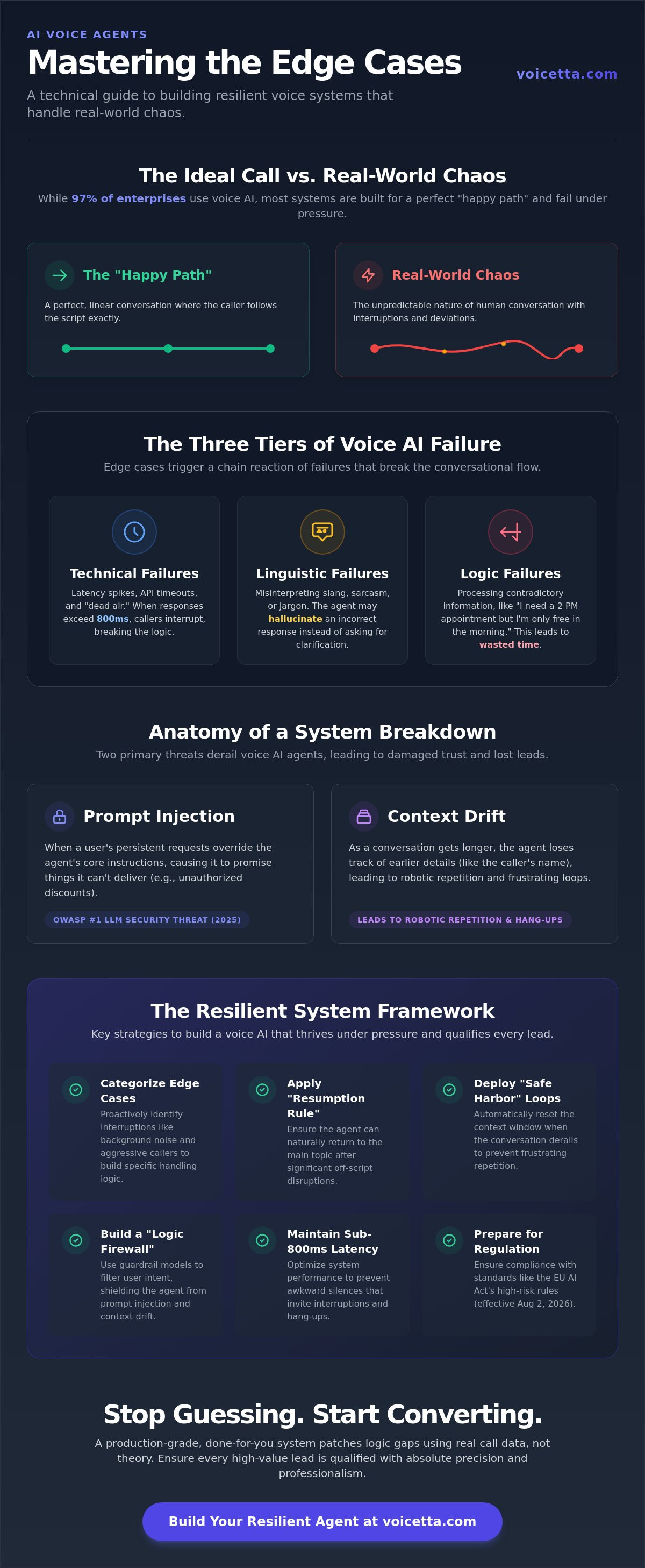
Your AI agent is only as good as the messiest call it can handle without crashing. While 97% of enterprises have adopted voice AI by early 2026, most systems still struggle when a caller interrupts or goes off-script. These **ai agent edge cases** are the difference between a seamless lead qualification and a frustrated hang-up. You know the risk of an agent hallucinating details or falling into robotic loops; it doesn't just lose a lead, it damages the professional trust you have built with your customers.
This guide provides the technical framework to build a production-grade system that stays resilient under pressure. You'll learn how to prevent prompt injection, which the 2025 OWASP update ranks as the highest-severity security threat for LLM applications, and how to prepare for the EU AI Act's high-risk requirements coming into force on August 2, 2026. We'll walk through the logic required to handle human unpredictability while maintaining the industry-standard sub-800ms latency for natural conversation. By the end, you'll have a clear strategy for creating a voice system that qualifies every call and manages complex speech with absolute precision.
## Key Takeaways
- Identify and categorize common **ai agent edge cases** like background noise or aggressive interruptions to keep your system functional during real-world chaos.
- Shield your agent from prompt injection and context drift by building logic that prevents users from accidentally overriding your business rules.
- Apply the "Resumption Rule" to ensure your voice system maintains a natural flow even after significant audio disruptions or off-script questions.
- Deploy "safe harbor" fallback loops to reset the context window automatically, preventing the robotic repetition that frustrates high-value leads.
- Use a production-grade, done-for-you system to patch logic gaps based on real call data rather than guessing at potential failure points.
## Table of Contents
- [What are AI agent edge cases and why do they break voice systems?](#what-are-ai-agent-edge-cases-and-why-do-they-break-voice-systems)
- [How do prompt injection and context drift impact voice AI performance?](#how-do-prompt-injection-and-context-drift-impact-voice-ai-performance)
- [What are the best practices for designing resilient call flows?](#what-are-the-best-practices-for-designing-resilient-call-flows)
- [Why is a 'Done-For-You' system better at managing complex edge cases?](#why-is-a-done-for-you-system-better-at-managing-complex-edge-cases)
## What are AI agent edge cases and why do they break voice systems?
AI agent edge cases are any user interactions that fall outside the primary "happy path" of your programmed call flow. These include real-world variables like background sirens, heavy regional accents, or a caller suddenly asking, "Are you a robot?" While a human receptionist filters these noises out instinctively, an unoptimized system treats them as data points it can't process without specific, pre-defined logic.
When these cases go unmanaged, they trigger a conversation vacuum, which is the moment an AI agent loses its contextual anchor and defaults to generic, repetitive filler. This loss of context often leads to the agent hanging up on a high-value lead or providing incorrect information that damages your brand reputation. For a deeper look at how users can derail a system's logic, this [Prompt injection overview](https://en.wikipedia.org/wiki/Prompt_injection) explains the risks of overriding core instructions during a call.
To better understand how these systems function in a production environment, watch this helpful video:
Failing to account for **ai agent edge cases** leads to three specific tiers of failure that can break your automated voice system. Each tier requires a different technical solution to ensure the agent remains helpful and professional.
### The three tiers of voice AI failure
- **Technical failures:** These involve latency spikes, API timeouts, or "dead air" during processing. If an agent exceeds the 800ms response threshold, the caller will likely interrupt, causing a logic collision that breaks the conversation flow.
- **Linguistic failures:** Misinterpreting slang, sarcasm, or industry-specific jargon can lead to the agent giving the wrong answer. If a caller uses a term the model doesn't recognize, the system may hallucinate a response rather than asking for clarification.
- **Logic failures:** These occur when a caller provides conflicting information, such as requesting a 2 PM appointment while stating they're only available in the morning. Without robust logic to catch these contradictions, the agent will proceed with incorrect data, leading to wasted time and scheduling errors.
## How do prompt injection and context drift impact voice AI performance?
Prompt injection in voice systems often stems from persistent callers rather than malicious hackers. When a lead repeatedly demands an answer outside the agent's scope, the model may prioritize the user's immediate input over its system-level instructions. This accidental override is one of the most common **ai agent edge cases** in production environments. Without strict guardrails, the agent might promise a discount or a service it isn't authorized to offer, damaging your professional reputation.
Context drift occurs when a conversation lasts longer than the agent's active memory window. As the transcript grows, the agent loses track of earlier details, such as the caller's name or the specific problem they mentioned. Professional call flow design and optimization is the only defense against context drift because it structures how the agent prioritizes recent data over irrelevant history. This prevents the agent from asking the same questions twice or getting stuck in a loop.
The "Latency Trap" is a specific risk for platforms like Vapi or Retell when handling complex **ai agent edge cases**. Reasoning through a difficult or unexpected question requires more compute time, which can push response latency past 1200ms. These awkward silences often trigger "barge-ins" where the caller speaks over the AI, or simply hangs up. If you have specific concerns about how your current setup handles these delays, you can find answers to common technical questions here.
### Securing the 'Agentic Edge'
Guardrail models provide a secondary layer of security by filtering user intent before it reaches the primary logic. These models act as a "logic firewall" to prevent accidental jailbreaking. By setting strict system-level constraints, you ensure the agent never deviates from its core mission of lead qualification and appointment booking. This approach ensures your AI receptionist remains helpful without becoming vulnerable to manipulation.
### Managing the 'Hallucination' risk
Agents often invent facts when they feel "cornered" by a question they aren't programmed to answer. To prevent this, we implement an "I don't know" protocol. Instead of guessing, the agent admits its limitation and offers a human callback. This maintains brand authority and ensures no false information reaches your high-value leads. It's better to admit a limit than to provide a wrong answer that costs you a customer.
## What are the best practices for designing resilient call flows?
Resilient call flows require a shift from linear scripts to non-linear logic that accounts for **ai agent edge cases**. Instead of a rigid "if-this-then-that" structure, production systems use the Resumption Rule to handle noise bursts or mid-sentence interruptions. This ensures that if a caller pauses to quiet a barking dog or deal with a distraction, the agent doesn't restart the entire intake process. It simply acknowledges the break and picks up exactly where it left off, maintaining a natural rhythm that mimics human professional behavior.
Fallback loops act as "safe harbors" within the conversation. If the agent detects that context is degrading or the caller is becoming confused, it triggers a summary prompt: "I want to ensure I have this right; you're calling about the apartment on Main Street for a July move-in?" This reset prevents the agent from spiraling into the repetitive loops that frustrate 72% of consumers who use automated systems. For more complex interactions, mastering how to keep a conversation going is essential for maintaining authority in high-stakes business environments.
Dynamic prompting allows the system to adjust its "strictness" based on real-time sentiment analysis. If the caller sounds hurried or frustrated, the agent can shorten its responses and move directly to the scheduling phase. This level of adaptability ensures that the **ai agent edge cases** involving emotional callers don't lead to a negative brand experience. If you're ready to deploy a system that handles these transitions flawlessly, you can start with a done-for-you AI receptionist today.
### Handling interruptions and 'Barge-in'
Configuring barge-in sensitivity is a balancing act between being responsive and being rude. If the sensitivity is too high, background noise will cut off the agent's speech; if it's too low, the caller feels ignored. The "Wait and Listen" strategy uses precise silence detection to ensure the caller has fully finished their thought before the AI begins its turn. This reduces the cognitive load on the caller and prevents the robotic "talking over" that ruins the user experience.
### The 'Human-in-the-loop' escalation trigger
A resilient system knows its own limits. You must program specific "red flag" phrases, such as "I want to speak to a manager" or "This is an emergency," to trigger an immediate transfer to a live representative. The real value lies in the data handoff. Our system passes the full transcript and structured lead data directly to the human agent's screen in real-time. This ensures the customer doesn't have to repeat themselves, preserving the brand's reputation for efficiency and care.
## Why is a 'Done-For-You' system better at managing complex edge cases?
DIY builders often fail at the "last mile" because they treat voice AI as a standalone tool rather than a production-grade infrastructure. Handling **ai agent edge cases** requires deep CRM integration to verify caller data on the fly. Without this real-time connection, an agent can't distinguish between a new high-value lead and an existing customer with a routine billing question. Voicetta's model uses real-world call data to patch logic gaps before they cause a second failure, ensuring your system converts even in messy, unscripted scenarios.
While 97% of enterprises have adopted some form of voice AI by early 2026, many struggle with systems that break during high-traffic periods or complex interactions. A managed system provides the technical depth needed to maintain the industry-standard sub-800ms latency, even when the AI is processing difficult requests. This reliability is why platforms like PolyAI have demonstrated a 391% return on investment for their users. We ensure your 24/7 call answering doesn't just answer the phone; it qualifies and books leads with absolute precision.
### The Voicetta Advantage: Managed Reliability
We don't just provide a script; we manage your AI receptionist production system end-to-end. Our team specifically monitors for "logic drift," where the agent's responses may slowly deviate from your brand's voice over hundreds of unique calls. Through continuous A/B testing, we refine the agent's decision-making logic based on actual performance data. This proactive management eliminates the "80% hype" problem found in unmanaged tools that fail when faced with real-world human unpredictability.
### Enterprise-grade uptime and monitoring
Monitoring for **ai agent edge cases** is a full-time engineering task that involves constant reliability and performance tuning. Our enterprise-grade setup includes monitoring for API timeouts, latency spikes, and prompt injection attempts in real-time. This level of oversight ensures your system remains a "specialist" in your field rather than a generic chatbot. If you're concerned about how a system would handle your specific industry quirks, ask our experts your hardest 'what-if' questions to see how we build resilient logic for every scenario. We take full ownership of the technical stack so you can focus on growing your business with total confidence.
## Secure Your Voice Infrastructure for the Human Element
Building a voice system that survives the real world means moving beyond the happy path. You've seen how **ai agent edge cases** like background noise and accidental prompt injection can derail a standard setup. By implementing fallback loops and the Resumption Rule, you turn potential failures into seamless customer experiences. Resilience isn't just a technical feature; it's the foundation of your brand's professional reputation during every inbound call. A production-grade system ensures that your business stays accessible, even when the conversation gets messy.
Voicetta provides a full enterprise setup using Vapi, Retell, and ElevenAgents to guarantee sub-800ms response times. Our team handles continuous logic optimization based on your real call data, ensuring your agent evolves alongside your customers. With instant CRM logging and automated lead qualification, you gain a reliable partner that never sleeps. Never miss a customer call again; see how Voicetta handles your hardest edge cases. The future of your business communication is ready to handle anything your callers throw at it.
## Frequently Asked Questions
### What happens if a caller interrupts the AI agent?
The agent stops speaking immediately through a feature called barge-in detection. It listens to the new input and updates its response logic in real-time. This prevents the frustration of "talking over" the user and is essential for handling **ai agent edge cases** where callers need to provide quick corrections or ask a side question without waiting for a script to finish.
### Can an AI agent handle multiple languages or heavy accents?
Yes, our system processes over 50 languages and accurately interprets regional accents using advanced neural speech models. These models are trained to isolate the caller's voice from background noise like wind or traffic. This ensures that lead qualification remains accurate even when the audio quality is poor or the caller uses non-standard dialect patterns that would confuse basic automated systems.
### Is it possible for a caller to 'trick' the AI into giving away free services?
No, because the agent operates within a "logic firewall" that prevents it from deviating from your pre-set business rules. Even if a caller uses persistent or confusing language to request a discount, the agent is hard-coded to admit its limitations. It will stick to the authorized script and offer a human callback rather than making unauthorized promises that could damage your brand's bottom line.
### How does the AI agent know when to transfer to a human?
The agent triggers a transfer based on specific sentiment thresholds and "red flag" phrases like "I need a manager." It recognizes when a conversation has reached a logic limit it cannot resolve. This proactive escalation ensures that difficult **ai agent edge cases** are handled by your live team, who receive a full transcript and structured data of the call before they even pick up the phone.
### What is the 'dead air' problem in voice AI and how do you fix it?
Dead air is the awkward silence caused when an agent's processing time exceeds 800ms. We eliminate this by optimizing the technical stack for extreme low latency and using "conversational fillers" for longer tasks. If a database lookup takes more than a second, the agent acknowledges the delay with a natural phrase like "One moment while I pull up those details," keeping the caller engaged and preventing hang-ups.
## Infographic