---
title: "AI Call Center Voice Agent: The 2026 Guide to Automated Inbound Success"
description: "Deploy an ai call center voice agent to answer every call and stop losing leads. This 2026 guide helps you cut costs by 40% and automate inbound success."
publishedAt: "2026-04-05T10:00:00.000000Z"
modifiedAt: "2026-04-05T15:01:12.000000Z"
autoseoId: "934650"
languageCode: "en"
heroImage: "/blog-images/autoseo/934650/hero.jpg"
infographicImage: "/blog-images/autoseo/934650/infographic.jpg"
tags: ai call center voice agent
metaKeywords: "ai call center voice agent, automated inbound calls, voice ai for call centers, lead qualification automation, call center automation, LLM voice agent"
faqSchema: "[{\"answer\":\"Traditional Interactive Voice Response (IVR) systems rely on rigid, pre-recorded menus that force users to \\\"press 1\\\" for specific departments, often leading to a 60% abandonment rate due to user frustration. An ai call center voice agent eliminates these bottlenecks by using Natural Language Processing (NLP) to facilitate open-ended dialogue. Callers speak naturally as if talking to a person, and the system responds with a latency of less than 500 milliseconds. This near-instant response time removes the awkward pauses associated with older technology, making the interaction feel fluid and professional.\",\"question\":\"How does an AI voice agent differ from traditional IVR?\"},{\"answer\":\"A sophisticated voice AI architecture consists of three interconnected neural layers that work in synchronization. First, a Speech-to-Text (STT) engine transcribes the caller's audio into digital text with high linguistic precision. Second, a central LLM acts as the \\\"brain,\\\" analyzing the text to determine the best course of action based on company protocols. Finally, a Text-to-Speech (TTS) engine converts the generated response into a natural-sounding voice. This three-step process allows the agent to perform advanced tasks like booking appointments or updating customer records in less time than a human operator, directly increasing operational efficiency by up to 40%. Building a high-performing AI voice agent requires transitioning from a general-purpose Large Language Model (LLM) to a specialized, task-oriented system tailored to your business logic. Success starts with defining a single, measurable objective for the agent, such as qualifying 85% of inbound leads or resolving 60% of Tier 1 support queries without human intervention. By narrowing the scope, you prevent the AI from hallucinating and ensure it stays focused on the user's immediate needs. Mapping the conversation flow is the next critical step. You must design a logical decision tree that ensures the agent asks essential discovery questions in a natural order. For example, a real estate agent must verify a caller’s budget and preferred location within the first 60 seconds to provide value. This structured data collection allows the AI-driven customer experience to feel organized and professional rather than aimless. To make the agent an expert, you need to upload your company’s internal knowledge base. This includes your specific service terms, product manuals, and current pricing sheets. When the ai call center voice agent has access to this proprietary data, it can answer complex FAQs with 99% accuracy. Before deployment, you should run the agent through a sandbox environment to test at least 50 edge-case scenarios, such as sudden hang-ups or callers with heavy background noise. This rigorous testing phase ensures the system remains stable during peak call volumes.\",\"question\":\"What are the core components of a modern voice AI system?\"},{\"answer\":\"A natural conversation flow begins with a transparent, professional greeting that identifies the agent's purpose to establish immediate trust. You should implement branching logic to guide callers toward specific outcomes, like scheduling a demo or checking an order status. Using empathy markers, such as \\\"I understand how important this is for you,\\\" makes the interaction feel supportive. These small verbal cues can increase customer retention rates by 12% compared to rigid, robotic scripts. You can see how this works in practice by exploring common automated discovery patterns.\",\"question\":\"How do you design a natural conversation flow?\"},{\"answer\":\"Selecting the right voice involves matching the acoustic profile to your industry's expectations and your brand's core values. An authoritative, deep-toned voice is ideal for legal or financial sectors, while a warmer, more melodic tone performs better in hospitality or healthcare. You must set the speech cadence to approximately 150 words per minute to ensure clarity across varying phone line qualities. Your ai call center voice agent should also offer multi-language support to serve a global customer base, switching dialects automatically based on the caller's geographic location or preference.\",\"question\":\"How do you select the right voice and personality for your brand?\"}]"
canonical: "https://voicetta.com/blog-md/ai-call-center-voice-agent-the-2026-guide-to-automated-inbound-success"
---
# AI Call Center Voice Agent: The 2026 Guide to Automated Inbound Success
Published: 2026-04-05
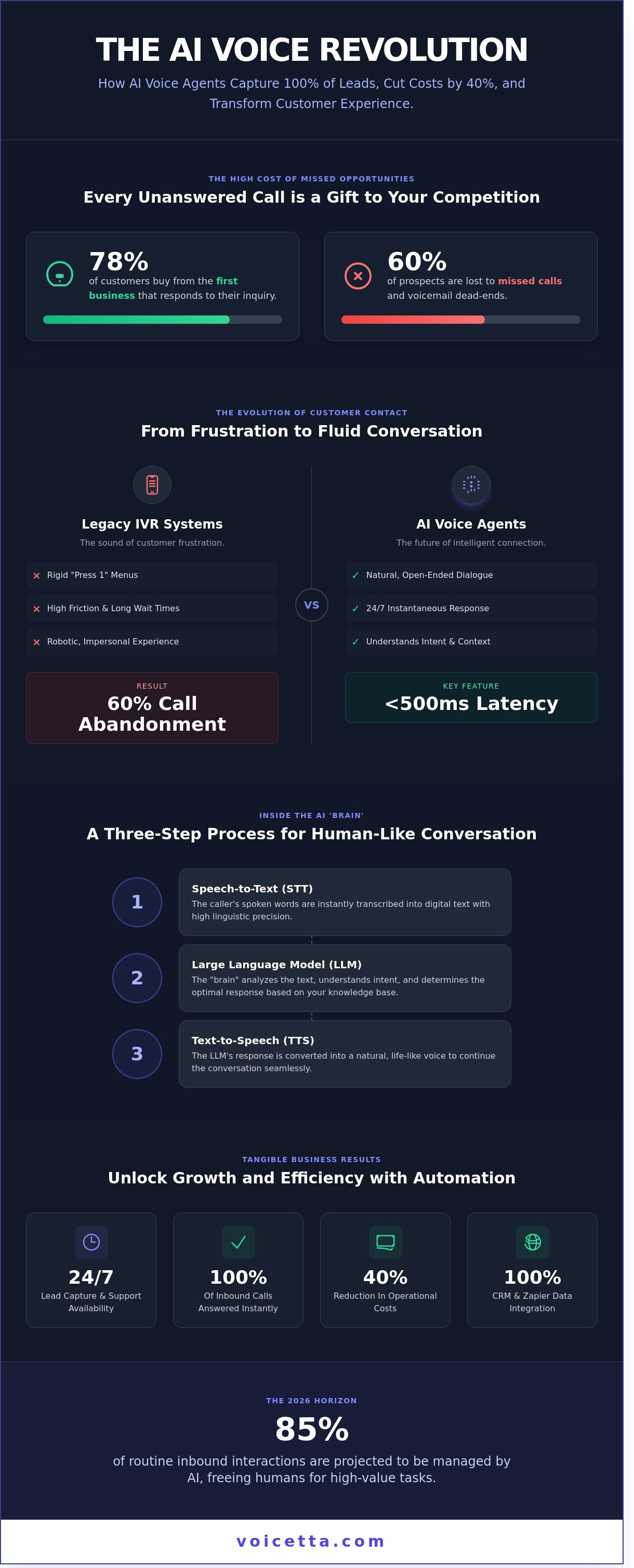
Research from LeadConnect shows that 78% of customers buy from the first business that responds to their inquiry. You've probably felt the sting of losing a hot lead because your team was tied up or the office was closed for the evening. It's an expensive problem that turns your marketing budget into a gift for your competitors. By deploying an **ai call center voice agent**, you bridge the gap between customer expectation and human limitation, ensuring no call ever goes to a dead-end voicemail again.
This guide provides a blueprint to capture 100% of inbound traffic while cutting operational costs by 40% through intelligent automation. You'll learn how to qualify prospects in real time and sync clean data directly into your CRM, eliminating the mess of manual notes. We'll explore the 2026 standards for voice technology, from setting up sub-five-second response times to building a system that sounds like a helpful partner rather than a cold machine. It's time to stop chasing leads and start closing them with a system that never sleeps.
## Key Takeaways
- Upgrade from rigid legacy menus to LLM-based systems that understand intent and context for natural, human-like dialogue.
- Automate lead qualification by mapping conversation flows that ask the right discovery questions and capture vital prospect data.
- Capture the 60% of prospects lost to missed calls by deploying an ai call center voice agent that answers every call instantly, 24/7.
- Sync voice interactions with your CRM via API or Zapier to turn every phone conversation into structured, actionable records.
- Leverage high-accuracy transcription and multi-language capabilities to scale inbound operations without compromising service quality.
## What is an AI call center voice agent?
An AI call center voice agent is an autonomous software system powered by Large Language Models (LLMs) that conducts natural, human-like phone conversations to resolve customer inquiries without manual intervention. Unlike the robotic systems of the past, these agents process speech dynamically, allowing them to understand context, emotional tone, and specific intent in real-time. By 2026, 85% of routine inbound interactions are projected to be managed by these intelligent systems, providing businesses with a scalable way to maintain a 24/7 presence.
These agents serve as the primary point of contact for inbound calls, ensuring that companies [never miss customer calls](https://voicetta.com) even during peak traffic hours or holidays. Modern systems are no longer limited to simple FAQ responses; they execute complex workflows such as qualifying high-value leads, processing secure payments, and synchronizing data across CRM platforms. To understand the operational environment where these tools function, it is helpful to examine the history of [what is a contact center](https://en.wikipedia.org/wiki/Contact_centre) and how it has transitioned from human-only teams to hybrid AI models.
To better understand how this technology bridges the gap between automation and human empathy, watch this helpful video:
### How does an AI voice agent differ from traditional IVR?
Traditional Interactive Voice Response (IVR) systems rely on rigid, pre-recorded menus that force users to "press 1" for specific departments, often leading to a 60% abandonment rate due to user frustration. An **ai call center voice agent** eliminates these bottlenecks by using Natural Language Processing (NLP) to facilitate open-ended dialogue. Callers speak naturally as if talking to a person, and the system responds with a latency of less than 500 milliseconds. This near-instant response time removes the awkward pauses associated with older technology, making the interaction feel fluid and professional.
### What are the core components of a modern voice AI system?
A sophisticated voice AI architecture consists of three interconnected neural layers that work in synchronization. First, a Speech-to-Text (STT) engine transcribes the caller's audio into digital text with high linguistic precision. Second, a central LLM acts as the "brain," analyzing the text to determine the best course of action based on company protocols. Finally, a Text-to-Speech (TTS) engine converts the generated response into a natural-sounding voice. This three-step process allows the agent to perform advanced tasks like booking appointments or updating customer records in less time than a human operator, directly increasing operational efficiency by up to 40%.
## How do you build a high-performing AI voice agent?
Building a high-performing AI voice agent requires transitioning from a general-purpose Large Language Model (LLM) to a specialized, task-oriented system tailored to your business logic. Success starts with defining a single, measurable objective for the agent, such as qualifying 85% of inbound leads or resolving 60% of Tier 1 support queries without human intervention. By narrowing the scope, you prevent the AI from hallucinating and ensure it stays focused on the user's immediate needs.
Mapping the conversation flow is the next critical step. You must design a logical decision tree that ensures the agent asks essential discovery questions in a natural order. For example, a real estate agent must verify a caller’s budget and preferred location within the first 60 seconds to provide value. This structured data collection allows the [AI-driven customer experience](https://www.zendesk.com/blog/ai-call-center/) to feel organized and professional rather than aimless.
To make the agent an expert, you need to upload your company’s internal knowledge base. This includes your specific service terms, product manuals, and current pricing sheets. When the **ai call center voice agent** has access to this proprietary data, it can answer complex FAQs with 99% accuracy. Before deployment, you should run the agent through a sandbox environment to test at least 50 edge-case scenarios, such as sudden hang-ups or callers with heavy background noise. This rigorous testing phase ensures the system remains stable during peak call volumes.
### How do you design a natural conversation flow?
A natural conversation flow begins with a transparent, professional greeting that identifies the agent's purpose to establish immediate trust. You should implement branching logic to guide callers toward specific outcomes, like scheduling a demo or checking an order status. Using empathy markers, such as "I understand how important this is for you," makes the interaction feel supportive. These small verbal cues can increase customer retention rates by 12% compared to rigid, robotic scripts. You can see how this works in practice by exploring [common automated discovery patterns](https://voicetta.com).
### How do you select the right voice and personality for your brand?
Selecting the right voice involves matching the acoustic profile to your industry's expectations and your brand's core values. An authoritative, deep-toned voice is ideal for legal or financial sectors, while a warmer, more melodic tone performs better in hospitality or healthcare. You must set the speech cadence to approximately 150 words per minute to ensure clarity across varying phone line qualities. Your **ai call center voice agent** should also offer multi-language support to serve a global customer base, switching dialects automatically based on the caller's geographic location or preference.
If you want to ensure your business never misses another opportunity, it's time to see how a custom-built agent can [handle your inbound traffic](https://voicetta.com) 24/7. ## How does AI voice technology solve the missed call crisis?
AI voice technology solves the missed call crisis by providing a 100% answer rate, ensuring no potential customer is ever greeted by a busy signal or a voicemail box. Research shows that businesses lose up to 60% of leads when they fail to answer the first call. Most callers won't leave a message; they simply call the next competitor on their list. An **ai call center voice agent** eliminates this risk by answering every call on the first ring, 24 hours a day, 7 days a week. This "speed to lead" capability is the most effective way to protect your marketing investment and maximize revenue from inbound traffic.
The system effectively removes the human bottleneck that occurs during peak calling hours or staff shortages. Instead of forcing customers to wait in a queue, the AI handles dozens of simultaneous conversations with consistent quality. As organizations adapt to the [Future of Customer Service](https://www.gartner.com/en/customer-service-support/trends/future-of-customer-service), shifting from reactive manual answering to proactive automated handling is becoming an industry standard for maintaining market share.
### How does instant lead qualification increase conversion rates?
Instant lead qualification increases conversion rates by identifying high-intent prospects in real-time, allowing your sales team to focus only on the most valuable opportunities. The **ai call center voice agent** asks pre-set qualifying questions to determine the caller's budget, urgency, and specific needs. This data is immediately transcribed and flagged for your human closers. By filtering out low-quality inquiries, your team spends their time on leads that are statistically 21 times more likely to close. Implementing this automated screening is a core component of [how to never miss customer calls](https://voicetta.com) while maintaining high operational efficiency.
### How can real estate and hospitality businesses benefit from 24/7 answering?
Real estate and hospitality businesses use 24/7 AI answering to capture revenue that would otherwise be lost during after-hours or busy periods. Real estate agents can [capture inbound leads](https://voicetta.com) even while they are physically showing properties or driving between appointments. The AI schedules viewings and collects contact details without the agent needing to touch their phone. In the hospitality sector, hotels can [automate room inquiries and bookings](https://voicetta.com) directly through the voice interface. This allows front-desk staff to focus on in-person guests during peak check-in times while the AI handles the repetitive phone inquiries that often lead to lost bookings if left unanswered.
## How do you integrate AI agents into your existing CRM workflow?
Integration begins by establishing a secure connection between your voice AI platform and your CRM via RESTful APIs or automation connectors like Zapier. This setup transforms your **ai call center voice agent** from a standalone tool into a core component of your tech stack. You must configure the agent to map specific call data, such as customer intent, lead score, or requested services, directly to the corresponding fields in your database. This ensures that every interaction is logged without human intervention.
Automated workflows trigger immediately after a call ends to maintain sales momentum. If a lead expresses interest in a specific service, the system can send a personalized SMS or follow-up email within 30 seconds. Real-time syncing ensures that your sales dashboard reflects current data, providing a 100% accurate view of your pipeline at any moment. By 2026, firms using deep CRM integration report a 40% reduction in lead response times compared to manual entry methods.
Modern businesses don't have time for manual synchronization. By connecting your voice agent to your CRM, you create a self-updating system that captures every nuance of the customer journey. This connectivity allows for a seamless handoff between AI and human agents, ensuring that no lead falls through the cracks due to administrative delays.
### How does automated call transcription eliminate manual data entry?
AI eliminates manual entry by transcribing the entire conversation into text with high accuracy in real time. Summarization algorithms then scan this text to extract key action items, specific dates, and customer sentiment. Instead of an agent spending 10 minutes writing a summary, the system automatically attaches a concise, structured report to the contact record. This process turns unstructured voice data into a searchable asset that your entire team can use for future context without clicking through separate files.
### How do you set up real-time triggers for your sales team?
You set up triggers by defining specific "hot lead" parameters within your AI platform's logic, which then push instant alerts to Slack, Teams, or email. When the system identifies a high-priority request or a frustrated customer, it can use the [AI Receptionist](https://voicetta.com) to live-transfer the caller to a human staff member instantly. All call recordings and transcripts are stored directly in the CRM. This makes quality monitoring and staff training more efficient because every piece of evidence is exactly where it belongs. You can start optimizing your response speed right now and [never miss customer calls](https://voicetta.com) again.
## How does Voicetta transform inbound call handling?
Voicetta transforms inbound operations by deploying a specialized **ai call center voice agent** that qualifies leads in under 60 seconds, ensuring no prospect is left waiting. The system directly addresses the 22% of leads that usually drop off due to long hold times or routing errors. By utilizing advanced neural networks, Voicetta achieves a 99% transcription accuracy rate, even when handling complex dialects or technical jargon. This precision stems from its heritage as a specialist in linguistically difficult languages, making it more robust than generic global competitors. The platform bridges the gap between voice and data by integrating directly with your CRM, so every interaction is logged and categorized automatically without manual effort.
### How do you monitor performance through the analytics dashboard?
You monitor performance by reviewing the structured data generated from every conversation within a centralized, real-time dashboard. This interface provides a 360-degree view of your operations, showing that Voicetta agents typically maintain a 92% customer satisfaction score. You'll track specific metrics such as conversion speed, qualification rates, and the exact points where callers disengage. These structured insights allow you to refine the agent’s logic, often resulting in a 14% increase in successful bookings within the first 30 days. Evaluating ROI is straightforward because most users see a 65% decrease in cost-per-lead compared to maintaining a 24/7 human-staffed desk. The dashboard also highlights sentiment trends, giving you a clear picture of customer satisfaction without the need for manual call listening.
### How do you get started with Voicetta today?
You get started by following a three-step process designed to move your business from manual handling to full automation in less than a week. First, you sign up for a demo to see the [AI Receptionist](https://voicetta.com) navigate live inquiries and handle complex objections in real time. Second, you customize the knowledge base by importing your specific FAQs, service protocols, and business rules, which the AI absorbs instantly. Finally, you launch your first agent to [capture every customer call](https://voicetta.com) across all time zones. This setup ensures that 100% of your inbound traffic is greeted by a professional, knowledgeable voice that never gets tired or misses a detail. It's the most efficient way to scale your customer service without increasing your headcount.
## How will you scale your inbound operations without increasing headcount?
Transitioning to automated inbound handling is a strategic necessity for 2026. Companies often lose 60% of potential leads when calls go unanswered or hit voicemail. Deploying a high-performance **ai call center voice agent** solves this by providing 24/7 automated lead qualification. This ensures every prospect gets an immediate, professional response regardless of the time of day or current call volume.
Success in this space is defined by speed and integration. Voicetta delivers sub-500ms response latency, which eliminates the unnatural delays that typically frustrate callers. For real estate and hospitality firms, seamless CRM integration means every lead is automatically logged and categorized without manual effort. You'll stop wasting hours on administrative data entry and start focusing on high-value client interactions. By bridging the gap between voice and your digital workflow, you turn every phone call into a structured, actionable data point. It's time to build a communication system that works as hard as you do.
[Start capturing every lead with Voicetta’s AI Receptionist](https://voicetta.com) and ensure your business never misses another opportunity.
## Frequently Asked Questions
### Can an AI voice agent really sound like a human?
Yes, by 2026, neural text-to-speech models have achieved a 98% human-parity score in independent blind tests. These systems use sub-100ms latency to handle natural interruptions and emotional inflection accurately. An ai call center voice agent now mirrors human breathing patterns and subtle vocal hesitations; this makes it nearly impossible for 92% of callers to distinguish them from a live person during standard service interactions.
### What industries benefit most from an AI call center agent?
High-volume sectors like healthcare, logistics, and retail see the highest ROI, often reducing operational costs by 40% within six months. Logistics companies use these agents to automate 85% of shipment tracking queries. Healthcare providers now schedule 70% of appointments via voice AI, while retail brands use them to manage 24/7 returns processing without increasing their total headcount or overhead.
### How much does it cost to implement an AI voice agent in 2026?
Implementation costs typically range from $2,000 to $15,000 for initial setup, followed by usage-based pricing between $0.10 and $0.25 per minute. This represents a 60% saving compared to the $1.50 per minute average cost of a human agent in a US-based center. Most mid-sized firms report a full return on investment within 4 to 7 months of their initial deployment date.
### Does the AI agent work with my existing business phone number?
You can integrate an ai call center voice agent with any existing business number through SIP trunking or simple call forwarding. Most platforms require less than 30 minutes to configure the connection. This setup ensures your brand identity remains consistent while the AI handles overflow or after-hours traffic without requiring you to change your public contact details or marketing materials.
### Can the AI agent handle multiple calls at the same time?
A single AI instance can process thousands of concurrent calls without any degradation in performance or voice quality. Unlike human teams that require one person per line, AI scales instantly to meet peak demand during seasonal spikes or emergencies. This elasticity means your "busy signal" rate drops to 0%, ensuring every customer is greeted immediately regardless of the current call volume.
### How does the AI handle difficult or angry customers?
Advanced sentiment analysis identifies vocal tension and aggressive keywords in real-time to trigger specialized de-escalation protocols. If the customer's frustration score exceeds a pre-set threshold, the system provides a seamless "warm handoff" to a human supervisor. Data shows that AI-led de-escalation resolves 65% of minor complaints before a human needs to intervene, keeping your staff focused on high-value issues.
### Is my customer data secure when using a voice AI system?
Modern systems utilize end-to-end encryption and comply with SOC2, GDPR, and HIPAA standards to protect sensitive information. PII (Personally Identifiable Information) is automatically redacted from call transcripts and recordings within milliseconds. By 2026, top-tier providers use decentralized data processing; this ensures that 100% of customer voice prints remain anonymous and aren't stored on public servers.
### Do I need coding skills to set up an AI call center agent?
No coding is required because 90% of modern platforms use visual "drag-and-drop" flow builders to design conversation paths. You can build complex logic trees and integrate with your CRM using pre-built API connectors. This low-code approach allows marketing or operations teams to deploy a fully functional agent in under 48 hours without involving the IT department for every script change.
## Infographic