
Understanding AI Chatbots That Actually Work
The term "AI chatbot" seems to be everywhere. But what does it really mean for your business? It signifies more than just a passing tech trend. It represents a significant change in how businesses connect with their customers and manage their internal workings. At the heart of this change is artificial intelligence, enabling chatbots to understand and respond to human language in a natural, conversational way. This moves us beyond simple, pre-written responses and into dynamic, context-aware conversations. The result? Increased efficiency and more meaningful customer engagement.
What Sets Effective AI Chatbots Apart?
The real difference lies in the technology behind these AI chatbots. Basic chatbots rely on pre-programmed rules, offering a limited range of responses triggered by specific keywords. A true AI chatbot, on the other hand, uses natural language processing (NLP) and machine learning (ML). NLP allows the chatbot to grasp the subtleties of human language, while ML enables it to learn from past conversations and continually refine its responses. For instance, an AI chatbot can interpret the meaning behind a customer's question, even if it's not perfectly phrased. It can also tailor its answers to the specific conversation, creating more personalized and helpful interactions. Want to dive deeper into conversational AI? Check out this helpful resource: How to master conversational AI.
The Power of Context and Learning
This context-driven understanding, often powered by neural networks, is key to crafting positive customer experiences. Imagine a chatbot that remembers your previous interactions and uses that knowledge to offer more tailored solutions. This personalized touch builds trust and strengthens customer loyalty, making people feel valued and understood, not just like another ticket number. This is the core strength of AI chatbots: transforming customer service from a reactive cost center to a proactive engine of engagement.
This rapid advancement is reflected in market forecasts. The AI chatbot market, estimated at $8.6 billion in 2024, is expected to grow to $11.14 billion in 2025 and reach an impressive $31.11 billion by 2029. More detailed statistics can be found here. This significant projected growth highlights the increasing recognition of AI chatbots as vital tools for businesses across diverse sectors. From managing complex customer questions to optimizing internal processes, AI chatbots are proving their value in boosting efficiency and enriching customer interactions.
Choosing The Right AI Chatbot For Your Business
Finding the perfect AI chatbot for your business is a critical step. Selecting the wrong one can lead to wasted resources and missed opportunities. Much like choosing the right tool for a specific task, different businesses require varying levels of chatbot complexity. This section will guide you through the diverse world of AI chatbot options, from basic rule-based systems to sophisticated conversational AI, helping you determine the best fit for your business needs.
Understanding Chatbot Types
AI chatbots come in a range of complexities, each designed with specific functionalities in mind. For instance, a rule-based chatbot shines at handling frequently asked questions (FAQs) by adhering to pre-defined rules and delivering pre-written responses. This makes them a practical choice for tasks such as offering basic product details or guiding users through a straightforward process. Conversely, conversational AI chatbots employ natural language processing (NLP) and machine learning (ML) to participate in more nuanced interactions, deciphering subtleties and context. This allows them to address complex inquiries, provide tailored recommendations, and even engage in sales discussions.
Let's delve deeper into the different types:
-
Rule-Based Chatbots: Perfect for straightforward, repetitive tasks and FAQs. While limited in flexibility, they are cost-effective and easy to implement.
-
Conversational AI Chatbots: Equipped to handle complex dialogues and comprehend user intent. They possess greater sophistication but demand more training data and resources.
-
Hybrid Approach: This method merges rule-based and conversational AI components. It capitalizes on the strengths of each approach to deliver a more versatile solution.
To help you visualize the key differences, let's look at a comparison table:
AI Chatbot Types Comparison: A comprehensive comparison of different AI chatbot types, their capabilities, use cases, and implementation complexity.
| Chatbot Type | Capabilities | Best Use Cases | Implementation Complexity | Cost Range |
|---|---|---|---|---|
| Rule-Based | Answers FAQs, follows pre-set rules, provides pre-written responses | Basic customer support, lead generation, simple transactions | Low | Low to Medium |
| Conversational AI | Understands natural language, learns from interactions, personalizes responses | Complex customer service, sales conversations, personalized recommendations | Medium to High | Medium to High |
| Hybrid | Combines rule-based and AI capabilities, adapts to user needs | Multifaceted customer interactions, integrates with various systems | Medium | Medium |
This table highlights the varying capabilities and use cases of each chatbot type, along with the associated implementation complexity and cost implications. Rule-based chatbots are simpler and cheaper to implement, while conversational AI and hybrid models offer more advanced functionalities but come with higher costs.
Matching Chatbots to Your Needs
Choosing the ideal chatbot hinges on several crucial factors:
-
Customer Expectations: If your customers primarily seek quick answers to basic questions, a rule-based chatbot may suffice. However, if your customer interactions are more intricate, conversational AI becomes essential.
-
Technical Requirements: Evaluate your current systems and ensure the chatbot seamlessly integrates. Explore resources like automating your customer support for more guidance.
-
Budget Constraints: Rule-based chatbots typically involve lower implementation and maintenance expenses compared to conversational AI solutions.
Measuring the Impact of AI Chatbots
AI chatbots bring several key benefits that can profoundly impact your business. The following infographic visually represents these advantages, highlighting response time, cost savings, and uptime availability.
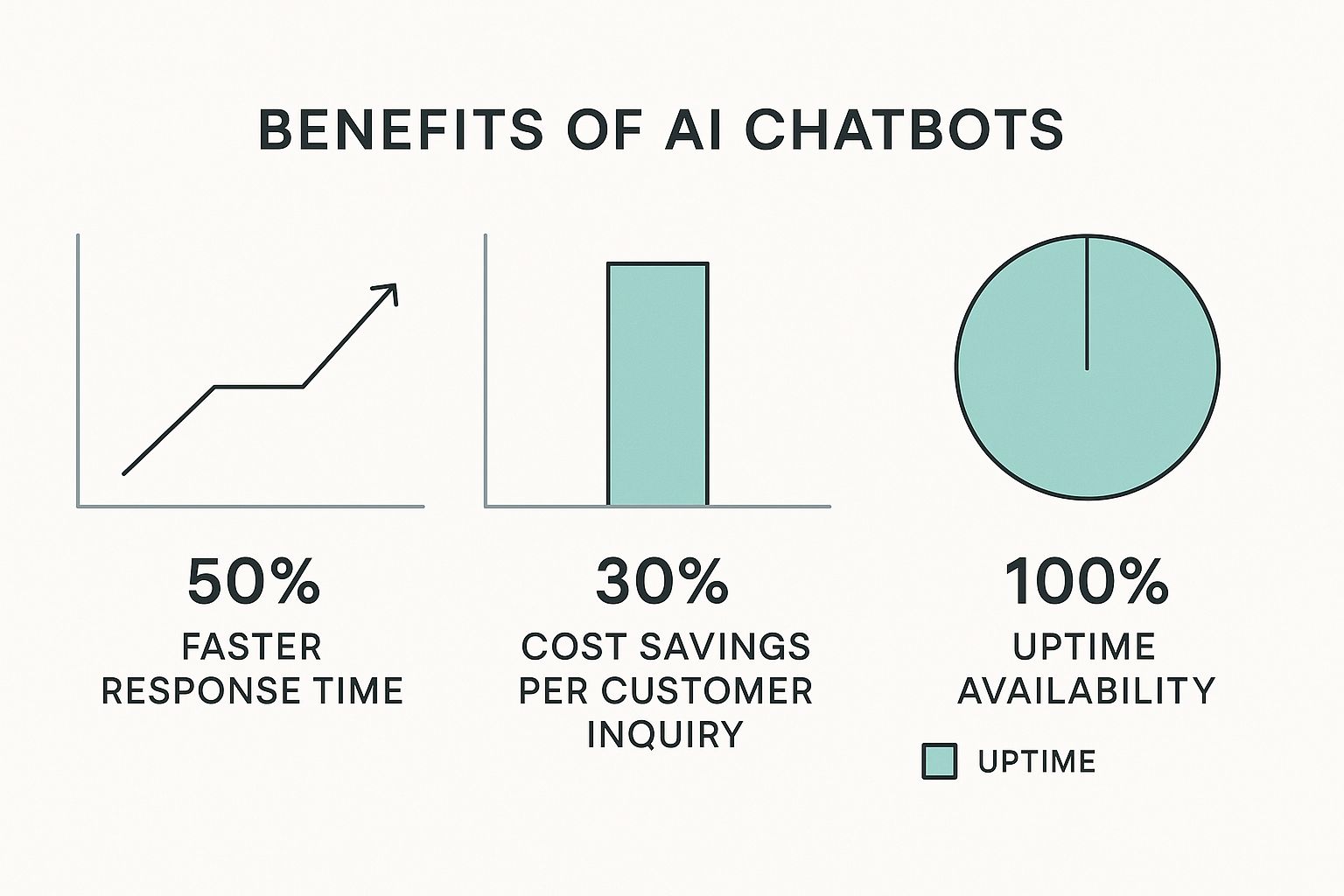
The data reveals that AI chatbots can achieve 50% faster response times, directly boosting customer satisfaction. Moreover, they can contribute to 30% cost savings per inquiry by automating tasks and reducing the workload on human agents. Lastly, their 100% uptime availability guarantees consistent support, preventing potential revenue loss. These combined advantages make AI chatbots a valuable asset for enhancing both operational efficiency and customer engagement. Selecting the right AI chatbot is a strategic investment in your business's future. By thoroughly evaluating your needs and understanding the available choices, you can identify a solution that elevates the customer experience, streamlines operations, and ultimately fuels business growth.
AI Chatbot Platforms That Drive Real Results
The AI chatbot market offers a diverse range of platforms, each with its own set of advantages and disadvantages. Choosing the right platform is crucial for achieving your specific business objectives. This means looking beyond the hype and focusing on platforms that deliver measurable improvements. Factors such as integration capabilities, industry-specific functionalities, and scalability become paramount.
Key Players in the AI Chatbot Arena
Several prominent platforms are currently shaping the AI chatbot landscape. ChatGPT, known for its advanced natural language processing capabilities, offers robust integration options for businesses. Microsoft has integrated this technology into its products, including Bing Copilot, thereby expanding its reach. Google's conversational AI presents another strong option, focusing on integration with its existing suite of services.
Furthermore, specialized platforms are emerging, catering to specific industry needs with custom-built solutions. These specialized platforms often provide a more targeted approach for particular business uses. This targeted approach can be especially beneficial for businesses looking for solutions designed for their specific requirements.
Market share data reveals the dominance of certain players in the field. ChatGPT, along with its Bing Copilot integration, commands a significant portion of the generative AI chatbot market, particularly in the US. Between January 2024 and April 2025, ChatGPT maintained a market share in the mid-70% range, starting at 76.4% and eventually stabilizing around 74.2%. More detailed statistics can be found here. However, platform selection should not be based solely on market share. A thorough assessment of how a platform aligns with your unique business goals and technical needs is essential.
Evaluating Platform Features and Capabilities
When selecting a platform, several key aspects warrant consideration:
-
Pricing Models: Different platforms offer diverse pricing structures, ranging from usage-based models to subscription plans. Selecting a model that fits your budget and expected usage is important.
-
Customer Support: Reliable customer support is critical, particularly when dealing with technical challenges. Prioritize platforms with responsive and helpful support channels.
-
Scalability: As your business grows, so too will your chatbot requirements. Ensuring the chosen platform can scale to handle increased traffic and complexity is key. This proactive approach can save you significant time and resources in the future.
-
Integration Options: Seamless integration with existing CRM, ERP, and other business systems is crucial for optimal efficiency.
Platform Selection for Specific Business Needs
The ideal platform choice often hinges on the particular industry and use case. Platforms like Voicetta excel in sectors such as hospitality, real estate, and healthcare by providing features specifically designed for their distinct communication needs. For example, Voicetta effortlessly manages appointment scheduling, lead qualification, and other vital tasks. Its ability to integrate with current enterprise systems provides a major advantage. This integration capability allows businesses to streamline their workflows and maximize efficiency. By focusing on a platform's strengths relative to your industry's specific hurdles, you can choose a solution that delivers optimal results.
Turning AI Chatbots Into Revenue Generators

Smart businesses are recognizing the potential of AI chatbots to drive revenue growth. These aren't just tools for answering FAQs; they're opportunities to actively engage customers and create sales. Think of them as conversation architects, strategically guiding users toward valuable actions like making a purchase or booking an appointment. Let's explore how to turn these AI-powered interactions into profit-generating machines.
Lead Qualification and Sales Support with AI
AI chatbots can significantly boost revenue through lead qualification. Available 24/7, they engage website visitors, gather crucial information, and identify promising leads. Imagine a chatbot on a real estate website. It asks about property preferences and budget, pre-qualifying potential buyers before they even connect with an agent. This saves the agent valuable time and ensures they're focusing on truly interested clients.
Beyond lead qualification, AI chatbots excel at sales support. They can provide instant answers to product-related questions, guide customers through the purchase process, and even suggest relevant upsells or cross-sells. This proactive approach improves the customer experience and directly impacts sales conversions. For chatbot solutions, you might want to check out Voicetta's Chatbot solutions.
Industry-Specific Revenue Generation Strategies
Maximizing revenue with AI chatbots requires a tailored approach for each industry. In healthcare, chatbots can enhance patient engagement by scheduling appointments, sending medication reminders, and providing post-discharge support, which leads to better patient outcomes. For e-commerce businesses, AI chatbots can tackle cart abandonment, proactively addressing customer concerns and offering personalized incentives to complete the purchase. This recovers lost sales and directly contributes to revenue growth.
In the financial services sector, chatbots can improve customer lifetime value. They offer personalized financial advice, promote relevant products, and handle routine transactions, strengthening customer relationships and fostering continued engagement.
Measuring ROI and Designing Effective Conversation Flows
To gauge the true impact of your AI chatbot, focus on key performance indicators (KPIs) like conversion rate improvements and customer satisfaction gains. These metrics offer clear insights into how your chatbot contributes to business growth.
Beyond the numbers, the design of your conversation flows is paramount. A natural, helpful, and non-intrusive experience builds trust and loyalty. Avoid aggressive sales tactics and prioritize genuine assistance. The conversational AI market is experiencing impressive growth, with total revenue projected to hit $14.6 billion by 2025 and $30.8 billion by 2029. Learn more about this growing market here.
By crafting conversations that guide users toward valuable actions while providing authentic support, you can transform your AI chatbot from a cost-saving measure into a powerful revenue generator.
Implementation Strategies That Avoid Common Pitfalls
Implementing an AI chatbot successfully isn't a quick fix; it's a journey. Understanding potential roadblocks can mean the difference between a helpful virtual assistant and a frustrating digital dead end. This section offers strategies to navigate this process, based on the successes of other companies.
Mapping The Customer Journey For Optimal Engagement
Before the technical details, understand your customer journey. Where do they interact with your business? What are their common questions and frustrations? Your AI chatbot should integrate seamlessly into these touchpoints, offering value at every stage. For instance, an e-commerce chatbot might greet customers, offer personalized product recommendations, and answer questions about shipping. This improves customer satisfaction and streamlines buying. Curious to learn more? Check out this resource: How to master AI chatbot implementation.
Selecting The Right Technology Stack
Choosing the right technology stack is crucial for long-term success. Your stack should align with your business needs, technical skills, and budget. Consider integration with current systems, scalability, and security. Voicetta is a platform that integrates well with enterprise systems, making your chatbot a part of existing workflows. This ensures smooth data flow, improving efficiency and accuracy. Also, evaluate the platform's ability to handle future growth and changing customer needs.
Addressing Data Security and Privacy Concerns
Data security and user privacy are essential. Your AI chatbot must comply with regulations and protect sensitive data. Strong security measures, like data encryption and access controls, are key. This protects your customers and builds trust in your brand. Transparency about data use is also crucial, as customers expect responsible handling of their information.
Designing Natural and Helpful Conversation Flows
Effective chatbots have well-designed conversation flows. The interaction should feel natural and intuitive, guiding users efficiently. Avoid complex menus or technical terms. Focus on clear language and anticipate user questions. This user-centric approach ensures a positive experience and encourages engagement. For example, a chatbot might offer multiple ways to access the same information, accommodating different communication styles.
Training, Testing, and Launching Your AI Chatbot
Training your AI chatbot is an ongoing process. The more data it receives, the better it understands user intent and provides relevant answers. Regular testing is vital to catch problems before they affect customers. Start with a pilot program to gather feedback and adjust as needed. A phased rollout allows you to refine your approach and ensure a smooth transition. This careful approach minimizes disruptions and sets you up for success.
To help visualize the implementation process, take a look at the following table:
AI Chatbot Implementation Timeline
A detailed breakdown of implementation phases, key milestones, and estimated timeframes for AI chatbot deployment
| Phase | Key Activities | Duration | Success Metrics | Common Challenges |
|---|---|---|---|---|
| Planning & Design | Define objectives, map customer journeys, design conversation flows | 2-4 weeks | Clearly defined scope, documented user flows | Unclear objectives, inadequate user research |
| Development & Integration | Build the chatbot, integrate with existing systems, test functionality | 4-8 weeks | Functional chatbot, successful system integration | Technical difficulties, integration complexities |
| Training & Testing | Train the chatbot with relevant data, conduct user testing, refine conversation flows | 2-4 weeks | Improved chatbot accuracy, positive user feedback | Data quality issues, insufficient testing |
| Deployment & Monitoring | Launch the chatbot, monitor performance, gather user feedback, make ongoing improvements | Ongoing | Increased user engagement, improved customer satisfaction | Unexpected user behavior, technical glitches |
This table highlights the key stages of implementation, from initial planning and design to ongoing monitoring and improvement. Each phase has its own set of activities, estimated durations, and metrics for measuring success. Being aware of potential challenges in each phase allows for proactive mitigation.
By following these implementation strategies and understanding potential problems, you can build an AI chatbot that effectively serves customers and contributes to business growth.
Optimizing Performance And Measuring Success
Launching your AI chatbot is just the first step. The real journey begins with ensuring its lasting value and continual improvement. This means looking beyond surface-level metrics and focusing on indicators that truly matter to your business. Let's explore how to establish effective analytics, implement key optimization techniques, and address the ongoing maintenance needed for a truly successful AI chatbot.
Key Performance Indicators for AI Chatbots
Simply measuring the volume of chats doesn't tell the whole story. Real success lies in understanding how your AI chatbot contributes to tangible business outcomes. Customer satisfaction, resolution effectiveness, and operational impact are the key performance indicators (KPIs) that should be your focus. These KPIs reveal the chatbot’s ability to efficiently resolve issues, leading to happier customers and improved operational efficiency.
For example, tracking first contact resolution rates shows how often your chatbot resolves issues on the first try, saving valuable time for both customers and your support team. Tracking customer satisfaction scores after chatbot interactions provides insights into how well the chatbot meets expectations, highlighting areas for potential improvement. Finally, analyzing the chatbot's contribution to reducing support ticket volume offers clear evidence of its positive operational impact.
Establishing Actionable Analytics Systems
Understanding user behavior is essential for optimization. Setting up analytics that track user behavior patterns and conversation quality is critical. These systems offer valuable insights into how users interact with the chatbot, pinpoint friction points, and highlight areas for improvement in conversation flow.
This involves a detailed examination of user interactions. Which conversational paths are most common? Where do users drop off or express confusion? Analyzing this data helps you identify common pain points and make targeted changes. These might include refining chatbot responses, streamlining the conversation flow, or adding new functionalities to meet user needs.
Optimization Techniques for Enhanced Performance
The most successful AI chatbot implementations share a common thread: a commitment to continuous improvement. This means optimizing response accuracy, reducing escalation rates, and constantly enhancing the user experience. Much like a finely tuned instrument, an AI chatbot requires regular adjustments to perform at its best.
Employing techniques like A/B testing different conversation flows allows you to experiment and discover what works best for your users. Regularly updating the chatbot's knowledge base ensures it provides accurate and up-to-date information. Critically, integrating user feedback into the optimization process is essential for understanding and addressing user needs effectively.
Scaling, Maintenance, and Staying Current
As your chatbot handles increasing volumes of interactions, scaling becomes crucial. This might involve upgrading your infrastructure or optimizing the chatbot's architecture to handle greater demand. Regular maintenance is also essential for ensuring consistent performance. This includes monitoring for errors, implementing necessary updates, and proactively addressing potential issues.
Finally, staying at the forefront of this rapidly evolving field requires continuous learning and adaptation. Keeping up with evolving technology capabilities and changing customer expectations ensures your AI chatbot remains a valuable asset. This includes exploring new AI features, incorporating user feedback, and staying informed about industry best practices.
Voicetta, our advanced AI communication platform, addresses all these needs and more. From 24/7 availability to seamless integration with existing systems, Voicetta ensures no customer interaction is missed. Want to learn how Voicetta can transform your customer communications? Visit us at Voicetta to learn more.