
Blog
Boost Business with Analytics Call Center Solutions
Analytics call centers have undergone a dramatic shift. They’ve moved from basic call tracking and metrics like average handle time to sophisticated systems offering ...
The Evolution of Analytics in Modern Call Centers
Analytics call centers have undergone a dramatic shift. They’ve moved from basic call tracking and metrics like average handle time to sophisticated systems offering a complete picture of customer interactions. This change is fueled by the need to understand customers on a deeper level and improve every step of their journey. It's about moving from simply reacting to problems to proactively shaping strategies.
From Basic Metrics to Strategic Insights
Early analytics call centers mainly focused on operational efficiency. Metrics like call volume, wait times, and abandonment rates were the primary indicators of success. These are still important, but the scope has broadened considerably. Now, customer experience (CX) is the priority. Modern analytics call centers use data to understand not just what occurred during a call, but why. This means going beyond traditional metrics and adopting advanced analytics frameworks.
For instance, rather than simply measuring call duration, businesses now analyze conversation content. This helps identify customer sentiment, recurring issues, and even predict future customer behavior. As a result, analytics call centers are becoming essential for understanding the nuances of customer interactions and guiding business choices. You might be interested in: Voicetta Blog - exploring resources about customer experience.
The Rise of AI and Advanced Analytics
This move toward deeper insights has been propelled by rapid technological advancements, especially in Artificial Intelligence (AI). AI-powered tools like speech analytics and predictive analytics are changing how call centers function. Speech analytics can transcribe calls automatically, analyze sentiment, and identify key themes and topics. Predictive analytics takes it a step further, using historical data to forecast future call volumes, predict customer churn, and spot personalized upsell opportunities. Call centers have changed drastically, making it crucial to understand Analytics Call Center Efficiency.
This increase in AI adoption isn't a temporary fad. The integration of AI and analytics in call centers is significantly impacting performance and efficiency. By 2025, it's projected that almost 98% of contact centers will use AI, including tools like chatbots and AI-driven analytics. This widespread adoption highlights how these technologies improve efficiency and customer experiences, ultimately leading to quicker resolutions and greater customer satisfaction. More detailed statistics can be found here. Modern platforms are also designed to integrate with other business systems, like CRM and ERP software, expanding the reach of these insights throughout the organization.
Essential Metrics That Drive Analytics Call Center Success
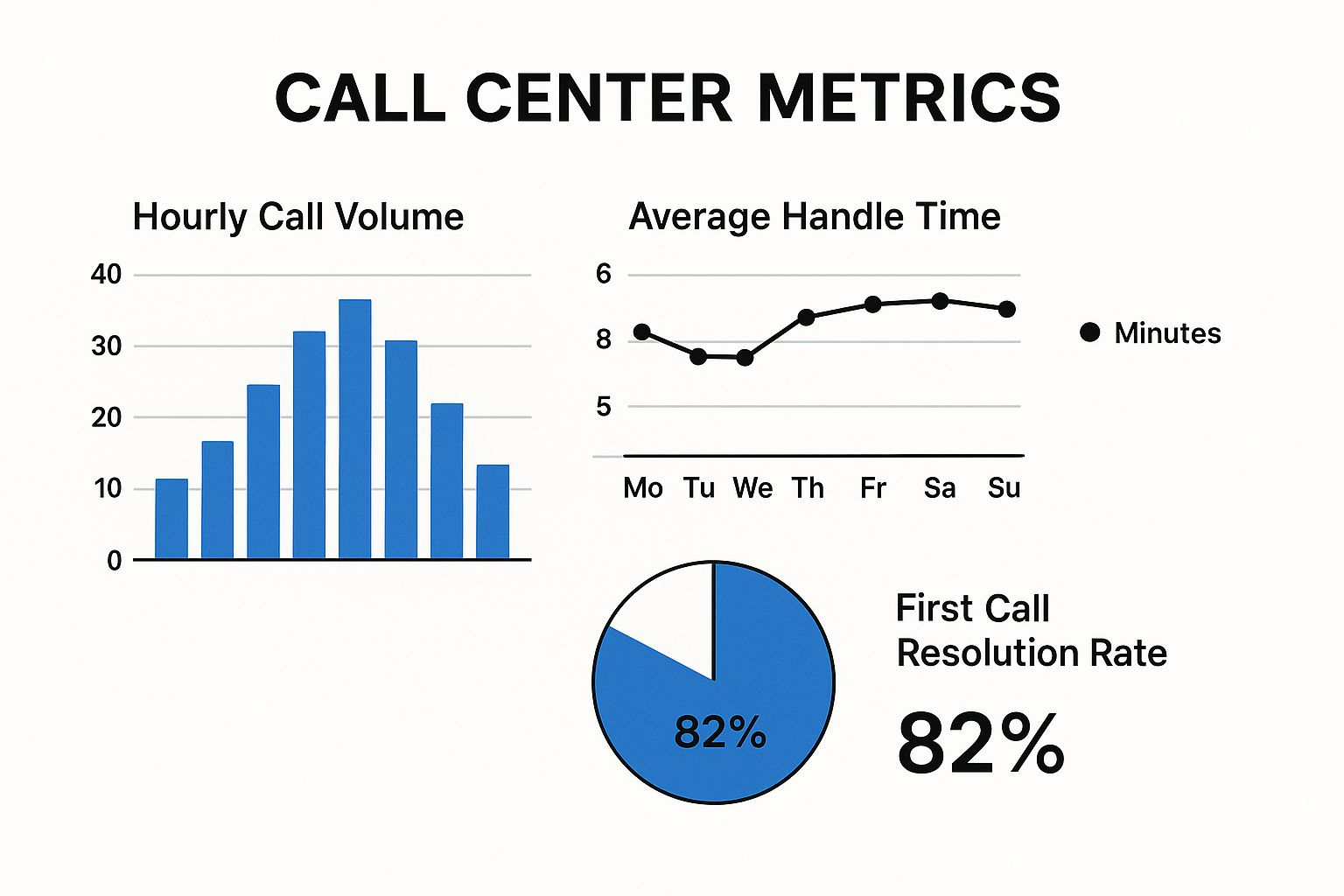
What defines a truly successful analytics call center? It's more than just keeping an eye on traditional metrics like average handle time (AHT) and abandonment rates. While these numbers offer a glimpse into operational efficiency, high-performing call centers dig deeper. They focus on metrics directly linked to customer loyalty and revenue growth, aiming to understand the why behind customer interactions, not just the what.
Beyond The Basics: Key Metrics For The Modern Call Center
Moving beyond traditional metrics provides a more detailed understanding of customer needs and agent effectiveness. This means embracing advanced analytics for a more complete picture of the customer experience. To boost your team's operational efficiency, consider important Customer Support KPIs. For instance, Customer Effort Score (CES) measures how easily customers can interact with your business. A high CES usually points to a smoother, more satisfying experience, potentially boosting customer retention.
Tracking emotional sentiment trends during calls can also uncover hidden customer frustrations or highlight areas where agents shine in building rapport. This in-depth analysis goes beyond basic satisfaction surveys and provides valuable context for agent coaching and process improvements.
Imagine pinpointing recurring negative sentiment spikes related to a specific product or service. This allows for immediate attention and proactive issue resolution, drastically improving customer satisfaction and preventing churn. You can learn more at Voicetta.
Furthermore, predictive satisfaction indicators, powered by machine learning, can anticipate future customer satisfaction based on current interaction data. This forward-looking view enables proactive issue resolution and personalized customer journeys. By analyzing past interactions, you can identify patterns and predict future customer behavior, leading to personalized service and proactive problem-solving, ultimately improving your business outcomes.
To illustrate the benefits of advanced analytics, let's take a look at some data. The following table, "Essential Call Center Analytics Metrics Comparison," compares traditional and advanced analytics metrics, showcasing their business impact and implementation complexity.
| Metric Category | Traditional Metrics | Advanced Analytics Metrics | Business Impact | Implementation Complexity |
|---|---|---|---|---|
| Operational Efficiency | Average Handle Time (AHT), Abandonment Rate | Average Speed of Answer, Agent Occupancy | Reduced operational costs, improved call handling efficiency | Low to Moderate |
| Customer Satisfaction | Customer Satisfaction (CSAT) | Customer Effort Score (CES), Sentiment Analysis | Increased customer loyalty, reduced churn rate | Moderate to High |
| Agent Performance | Calls per Agent, Average Talk Time | Agent Sentiment, First Call Resolution (FCR) | Improved agent engagement, increased productivity | Moderate |
| Business Outcomes | Revenue per Call, Cost per Call | Customer Lifetime Value (CLTV), Predictive Satisfaction | Improved revenue generation, proactive issue resolution | High |
This comparison highlights the shift from basic operational metrics to those focused on understanding and predicting customer behavior. While advanced analytics might be more complex to implement, the potential for positive business impact is significant.
Visualizing Success: The Power Of Data Charts
The following bar chart visually represents how incorporating advanced analytics impacts key call center metrics.
| Metric | Traditional Approach (%) | Advanced Analytics Approach (%) |
|---|---|---|
| Customer Satisfaction (CSAT) | 75 | 88 |
| First Call Resolution (FCR) | 60 | 72 |
| Customer Churn Rate | 15 | 8 |
| Agent Satisfaction | 65 | 78 |
This chart clearly demonstrates the positive effects of using a more advanced analytics approach. We see a 13% increase in both CSAT and agent satisfaction, a 12% improvement in FCR, and a significant 7% reduction in customer churn. These gains highlight how data-driven insights empower agents and improve performance, leading to better results for both customers and the business.
Unlocking Customer Intelligence Through Speech Analytics

Voice conversations are packed with valuable information, but many organizations struggle to unlock its potential. This exploration reveals how speech analytics transforms ordinary call recordings, within an analytics call center, into powerful business intelligence. We'll see how this technology uses Natural Language Processing (NLP) to understand the true meaning behind what customers say.
Deciphering the Voice of the Customer With NLP
Speech analytics, powered by NLP, goes beyond simple transcription. It delves into the nuances of language, analyzing tone and word choice to gauge customer sentiment. This means understanding not only what is said, but also how it's said.
For example, a customer might say they're "fine," yet a frustrated tone could reveal underlying dissatisfaction. This deeper level of understanding is crucial for identifying potential issues before they escalate.
Imagine multiple customers expressing subtle frustration about a specific product feature. Speech analytics can quickly flag this trend, enabling timely intervention and product improvements. It's about proactive problem-solving and enhancing the customer experience.
Additionally, NLP can identify recurring themes and topics within conversations, providing valuable insights into product feedback, service requests, and even competitor mentions. This knowledge allows businesses to adapt their strategies, refine products, and gain a competitive edge, especially in industries where customer preferences change rapidly.
Driving ROI With Actionable Insights
The true strength of speech analytics lies in its ability to transform data into positive change. It's not just about collecting information; it's about turning that information into actionable insights. Speech analytics helps identify process improvements that directly impact the bottom line.
Consider a scenario with numerous customers calling about the same simple question. Speech analytics could quickly highlight this, suggesting a need for better website FAQs or improved self-service options. This reduces call volume, freeing up agents to handle more complex issues, and ultimately lowering operational costs.
Moreover, speech analytics enables a more personalized customer experience. By understanding individual needs and preferences expressed during calls, businesses can tailor interactions and offer targeted solutions. This strengthens customer relationships, fostering loyalty and shifting the focus from reactive problem-solving to proactive relationship building.
Speech analytics software, a key component of call center analytics, is experiencing significant growth. This software automates the analysis of call recordings, providing valuable insights into customer behavior and interaction quality. The market for speech analytics is projected to grow at a CAGR of 15.61% from 2024 to 2029, potentially reaching a market value of over $6 billion by 2029. More detailed statistics can be found here.
Empowering Agents, Not Policing Them
It's vital to remember that speech analytics should be a tool for empowerment, not a means of policing agents. When implemented effectively, it becomes a valuable coaching resource.
By analyzing agent performance, speech analytics identifies areas for improvement and provides personalized training opportunities. This fosters agent growth and enhances overall team performance.
For instance, the technology can identify agents who excel at handling difficult conversations, providing valuable lessons for training colleagues. This creates a culture of continuous improvement, benefiting both the agents and the organization, and fosters a more positive and supportive work environment.
From Reactive to Proactive: Predictive Analytics in Action
The difference between a good and an exceptional analytics call center? It's the ability to anticipate customer needs. This exploration reveals how predictive analytics transforms contact centers from cost drains to strategic powerhouses. We'll dive into real-world scenarios, showing how organizations use this technology to fine-tune operations and elevate customer satisfaction. Interested in learning more? Check out Voicetta Pricing to see how predictive analytics can benefit your business.
Forecasting the Future: Predicting Call Volumes and Beyond
Predictive analytics uses historical data and machine learning models to anticipate future trends. A key application is call volume forecasting. By analyzing past call patterns, these models can predict future call volumes with impressive accuracy.
This empowers call centers to optimize staffing levels, ensuring sufficient agents during peak times while avoiding overstaffing during lulls. The result? Improved operational efficiency and reduced costs.
But predictive analytics goes further. It can also identify customers at risk of churning. By examining interaction history and other data, these models pinpoint customers showing signs of dissatisfaction. This allows for proactive intervention, offering tailored solutions or incentives to keep valued customers engaged.
This proactive approach strengthens customer relationships and lowers churn rates, contributing to long-term success.
Uncovering Hidden Opportunities: Upselling and Service Improvements
Predictive analytics is also instrumental in identifying personalized upsell opportunities. By analyzing customer profiles and purchase history, these models can recommend relevant products or services tailored to individual needs. This focused strategy boosts the chances of successful upselling and drives revenue growth.
Moreover, predictive analytics can foresee service issues before they negatively affect customers. By analyzing data from various sources, including social media sentiment and product usage, these models can spot emerging problems.
This allows for proactive service adjustments, preventing potential disruptions and ensuring customer satisfaction, ultimately leading to faster issue resolution and increased customer loyalty.
Building a Predictive Analytics Call Center: Data, Talent, and Operations
Implementing predictive analytics requires careful planning, considering data, talent, and operational changes. First, you need clean, reliable data from multiple sources. This includes call logs, customer interaction history, and other relevant business information. Data quality directly affects the accuracy of your predictive models.
Second, invest in skilled data scientists and analysts to build and maintain these models. These specialists play a critical role in interpreting data and uncovering actionable insights. Their expertise is essential for guiding strategy and optimizing performance.
Finally, adapt your existing operational processes. This may involve integrating new tools and platforms, as well as training staff to effectively interpret and utilize the data. These adaptations are vital for fully realizing the benefits of predictive analytics and transforming your call center into a proactive customer engagement hub.
Building the Omnichannel Analytics Ecosystem

Customer journeys are no longer simple, linear paths. They're intricate webs of interactions spanning multiple touchpoints and channels. This complexity renders traditional, siloed analytics within a call center insufficient. They simply can't grasp the full customer experience.
This reality demands a shift towards an omnichannel analytics ecosystem. This provides a comprehensive view of customer interactions across every channel, from traditional phone calls and emails to modern platforms like chat, social media, and self-service portals.
Breaking Down Data Barriers: A Unified Customer View
Creating a true omnichannel analytics ecosystem requires breaking down data silos. Historically, each channel functioned independently, with its own separate metrics and data sets. This fragmented approach obscured the complete customer journey, making it difficult to pinpoint areas needing improvement. The result? Incomplete customer profiles and a disjointed experience.
Forward-thinking organizations are adopting solutions to integrate data from all channels into a single platform. This creates unified customer profiles, giving a 360-degree view of each customer’s interactions, preferences, and history.
Consider a customer who initiates contact via chat, then sends a follow-up email, and ultimately calls to resolve an issue. A unified system links these interactions, providing agents with complete context. This comprehensive view fuels better decision-making and elevates customer service.
Mapping the Journey: Understanding the Customer Experience
With a unified customer view, organizations can construct customer journey maps. These maps visually depict the customer’s experience across all touchpoints, illuminating pain points, successes, and areas for improvement. It's like a roadmap guiding the customer through every interaction with your business.
This understanding allows for customer journey optimization by eliminating friction, personalizing interactions, and ensuring a seamless experience, regardless of the channel. It also improves resource allocation. Teams can focus on areas requiring immediate attention and create more effective training programs.
Enabling Technologies and Implementation Strategies
Several technologies empower cross-channel tracking and analysis. These include Customer Data Platforms (CDPs), journey orchestration engines, and advanced analytics tools powered by machine learning. These provide the basis for data consolidation, personalized interactions, and predictive insights.
For example, CDPs build unified customer profiles by integrating data from numerous sources, such as CRM systems, marketing automation platforms, and website analytics. Journey orchestration engines tailor customer interactions based on real-time data, ensuring the right message reaches the customer at the right time through the right channel.
Implementing omnichannel analytics extends beyond simply acquiring technology. It demands organizational readiness, budget allocation, and careful consideration of specific business needs. This involves aligning your implementation strategy with your organization's structure and objectives, ensuring your team possesses the necessary training and resources to effectively utilize the data. The contact center analytics market is booming. The global market size is projected to be $2.44 billion in 2025 and reach $7.03 billion by 2032, exhibiting a CAGR of 16.3%. This growth is driven by the increasing demand for omnichannel solutions and the need for improved operational efficiency in managing complex customer interactions. You can find more detailed information here. This market growth underscores the importance of embracing omnichannel strategies for long-term success in today’s competitive landscape.
The following table provides more detail about the growth of the contact center analytics market:
Global Contact Center Analytics Market Growth
| Year | Market Size (Billions USD) | Growth Drivers | Key Technology Trends | Regional Adoption Leaders |
|---|---|---|---|---|
| 2025 | 2.44 | Increasing demand for omnichannel solutions, need for improved operational efficiency | CDPs, Journey Orchestration Engines, Advanced Analytics with Machine Learning | North America, Europe |
| 2032 | 7.03 | Continued demand for omnichannel solutions, focus on personalized customer experiences | AI-powered analytics, real-time data analysis, predictive analytics | North America, Europe, Asia Pacific |
This table highlights the significant growth projected for the contact center analytics market, driven by the ongoing adoption of omnichannel strategies and the evolution of key technologies. The increasing importance of personalized customer experiences is expected to further fuel market expansion in the coming years.
Creating a Data-Driven Culture That Actually Works
Even with the most sophisticated contact center technology, true success hinges on a data-driven culture. This section explores practical strategies for cultivating this culture within your own contact center. We'll delve into overcoming common hurdles, building data literacy, and designing systems that turn insights into meaningful action.
Overcoming Resistance to Change
Transitioning to a data-driven approach can sometimes meet with resistance. Team members may feel apprehensive about new technologies or data-driven evaluations. Addressing these concerns head-on is essential. This requires transparent communication about the advantages of data-driven decisions and thorough training on new tools and processes.
Showing how data analysis can simplify tasks, improve customer interactions, and boost performance can alleviate anxieties. Involving team members in the implementation process also fosters ownership and encourages buy-in. Platforms like Voicetta - an AI communication platform can be helpful in this transition.
Developing Analytics Fluency at Every Level
While not everyone needs to be a data scientist, everyone should feel comfortable using data in their respective roles. This means tailoring training programs to different responsibilities.
- Frontline agents: Training should focus on using real-time dashboards to personalize customer interactions and enhance service.
- Supervisors: Equip supervisors with the tools to analyze team performance, pinpoint coaching opportunities, and monitor progress.
- Management: Develop management's ability to utilize data for strategic planning, resource allocation, and long-term vision.
This tiered approach cultivates analytics fluency throughout the organization, creating a shared understanding of data's value and encouraging its daily use.
Building Systems That Convert Insights into Action
Data without action is meaningless. Establishing clear processes for turning insights into tangible changes is paramount. This involves defining responsibilities for data analysis, creating feedback loops, and establishing systems that track progress and acknowledge successes.
For example, imagine sentiment analysis reveals customer frustration with a particular billing process. A well-defined process ensures this insight promptly reaches the responsible team, leading to process improvements and greater customer satisfaction.
Structuring Analytics Teams for Success
The structure of your analytics team influences its effectiveness. Centralized teams offer specialized expertise, while decentralized teams can be more responsive to individual business unit needs. The right balance depends on your organization's unique structure, size, and objectives.
Many organizations opt for a hybrid approach, blending centralized expertise with embedded analysts within specific business units. This provides both specialized support and rapid response to unique needs.
Integrating Data Insights into Coaching and Development
Data should play a central role in agent coaching and development. Using performance dashboards, supervisors can identify areas where agents excel and where they need support. This targeted approach boosts individual and team performance. Empowering agents with data-driven feedback fosters a culture of continuous improvement.
Establishing Data Governance Frameworks
Democratizing data access shouldn't compromise security and compliance. Clear data governance frameworks are necessary. This involves:
- Defining access levels based on roles.
- Implementing data security protocols to safeguard sensitive information.
- Ensuring compliance with industry regulations and best practices.
This fosters a secure environment while empowering teams to use data effectively.
Ready to unlock the potential of your call center data and transform customer interactions? Learn more about how Voicetta can help you build a data-driven, customer-centric call center.
Was this useful?
If this article helped, add Voicetta as a preferred source in Google Search. Your results can then highlight our writing.
Add as preferred source