
You've probably heard the saying "feedback is a gift," but that phrase doesn't quite capture the full picture. In today's market, actively listening to your customers isn't just good manners; it's a critical survival skill. It's the most direct line you have into what your customers really want and need from you.
Why Your Business Can’t Afford to Ignore Customer Feedback

Let’s be honest, in an uncertain economy, customer sentiment is one of the best predictors of how your business will perform. When people feel financially secure, they spend. When they're worried, they scrutinise every single purchase. Your customer feedback is a live, unfiltered report on this sentiment, giving you clues that balance sheets and financial charts simply can't.
If you’re not tuned in, you're essentially flying blind. You end up making decisions based on what you think is happening, not what actually is.
I once worked with a SaaS company that was about to pour a ton of resources into a major feature update they were convinced was a game-changer. But after we dug into their support tickets and call transcripts, a completely different picture emerged. Their customers weren't crying out for flashy new features. They were quietly struggling with a confusing billing process that was causing frustration and, ultimately, churn.
By switching gears to fix that billing issue—a direct response to what people were saying—they didn’t just stop customers from leaving. They built a massive amount of trust by proving they were paying attention to what really mattered.
Connecting Feedback to Financial Realities
This link between how customers feel and how they spend isn't just a theory; you can see it playing out in large-scale economic trends. In Poland, for instance, paying close attention to consumer mood is vital because it directly affects retail performance.
We saw retail sales shrink by 0.3% year-on-year in March 2025, right after a bigger drop in February. This downturn happened at the same time consumer confidence fell to -16.5 in April 2025, mostly because people were worried about their real wages and rising inflation. You can find more details on this in the Poland consumer outlook from Fitch Solutions.
The data tells a clear story: when people feel insecure about their finances, they pull back on spending. And your feedback channels are where you'll hear about these worries first.
Customer feedback is your early warning system for market shifts. When you see comments about pricing, value for money, or tight budgets, don't just dismiss them as complaints. They are direct signals about your customers' economic reality.
When you make analysing this feedback a core part of your process, you can:
- Spot Market Shifts Early: Catch those rising concerns about inflation or value before they hit your sales numbers.
- Confirm Your Roadmap: Make sure you’re building things that solve genuine, pressing problems—the kind people are happy to pay for.
- Build Stronger Relationships: Show customers you get their challenges and are adapting to help them, not just sell to them.
In the end, it all comes down to managing risk and spotting opportunities. Listening to your customers allows you to make smart pivots, put your resources where they’ll have the most impact, and keep your business resilient. It's how you turn a gut feeling into a solid, data-backed strategy for growth.
Building Your Feedback Collection System

Before you can even think about analysing customer feedback, you need a solid system for collecting it. Let's be honest, the days of relying on a single, once-a-year survey are long gone. If you want to genuinely get inside your customers' heads, you need a way to capture their true voice across all the different places they interact with you. It’s about creating a constant flow of insight.
The aim here isn’t to pester people with endless requests. It’s about smartly meeting them where they already are. Think about all the natural touchpoints a customer has with your brand. These moments are where the real, unfiltered feedback lives—the kind of stuff you'll never get from a formal questionnaire.
I once worked with a retail company that was completely dependent on its post-purchase email surveys. Their satisfaction scores were fine, but they were tearing their hair out over a sky-high cart abandonment rate. The surveys offered no clues. The answer was actually hiding in plain sight, buried deep in their live chat transcripts. Time and again, customers were asking about shipping costs right before ditching their carts. This was a critical insight that the formal surveys had missed entirely.
Tapping Into Unstructured Data Sources
Some of your most powerful feedback is hidden in what we call unstructured sources. This is the raw, unprompted stuff—the everyday conversations that give you the context that a multiple-choice question just can't provide.
Here’s where you should be looking:
- Support Calls and Chats: The transcripts from these interactions are pure gold. They reveal the exact words customers use to describe their pain points, what frustrates them, and what they actually want from you.
- Social Media DMs and Mentions: This is the front line of customer emotion. Monitoring social channels gives you a live, real-time feel for how your brand is perceived and helps you spot problems the second they pop up.
- Community Forums and Review Sites: On these platforms, customers talk to each other, not just to you. This peer-to-peer dialogue is incredibly candid, offering honest takes on what they love, what they can’t stand, and the features they wish you’d build.
By pulling all of this data into one place, you stop collecting random opinions and start building a rich, detailed story of your customer experience. This complete picture is the only way to do meaningful analysis.
Encouraging Honest and Detailed Responses
How you ask for feedback is just as important as where you ask. Ditch the generic, "How was your experience?" Instead, ask specific, open-ended questions that actually make people think and give you a detailed response.
For instance, after a customer has chatted with your support team, try asking something like, "What is one thing we could have done to make resolving your issue easier today?" This tiny change in wording does two things: it encourages a constructive, detailed answer instead of a simple rating, and it frames the whole interaction as a team effort to make things better.
Ultimately, a great collection system is all about creating a continuous loop. You gather feedback, dig into it for insights, and then you act on what you’ve learned. The final, crucial step is measuring customer satisfaction properly so you can see if your changes are actually making a difference. When you get this right, you’re not just collecting data—you’re actively improving the customer experience and building real loyalty.
Turning Raw Data Into Actionable Insights With AI
So, you've set up your channels and the feedback is rolling in. Fantastic. The only problem? You're now staring at a mountain of raw, unfiltered data. Manually sifting through every call transcript, social media comment, and survey response isn't just a monumental task; it's a surefire way to miss the forest for the trees. This is exactly where AI completely changes the game.
Forget dedicating entire teams to the soul-crushing work of manual review. Modern AI platforms, like Voicetta, can chew through thousands of data points in the time it takes to make a coffee. They automatically spot key themes, detect subtle shifts in customer sentiment, and flag recurring issues that would otherwise stay buried.
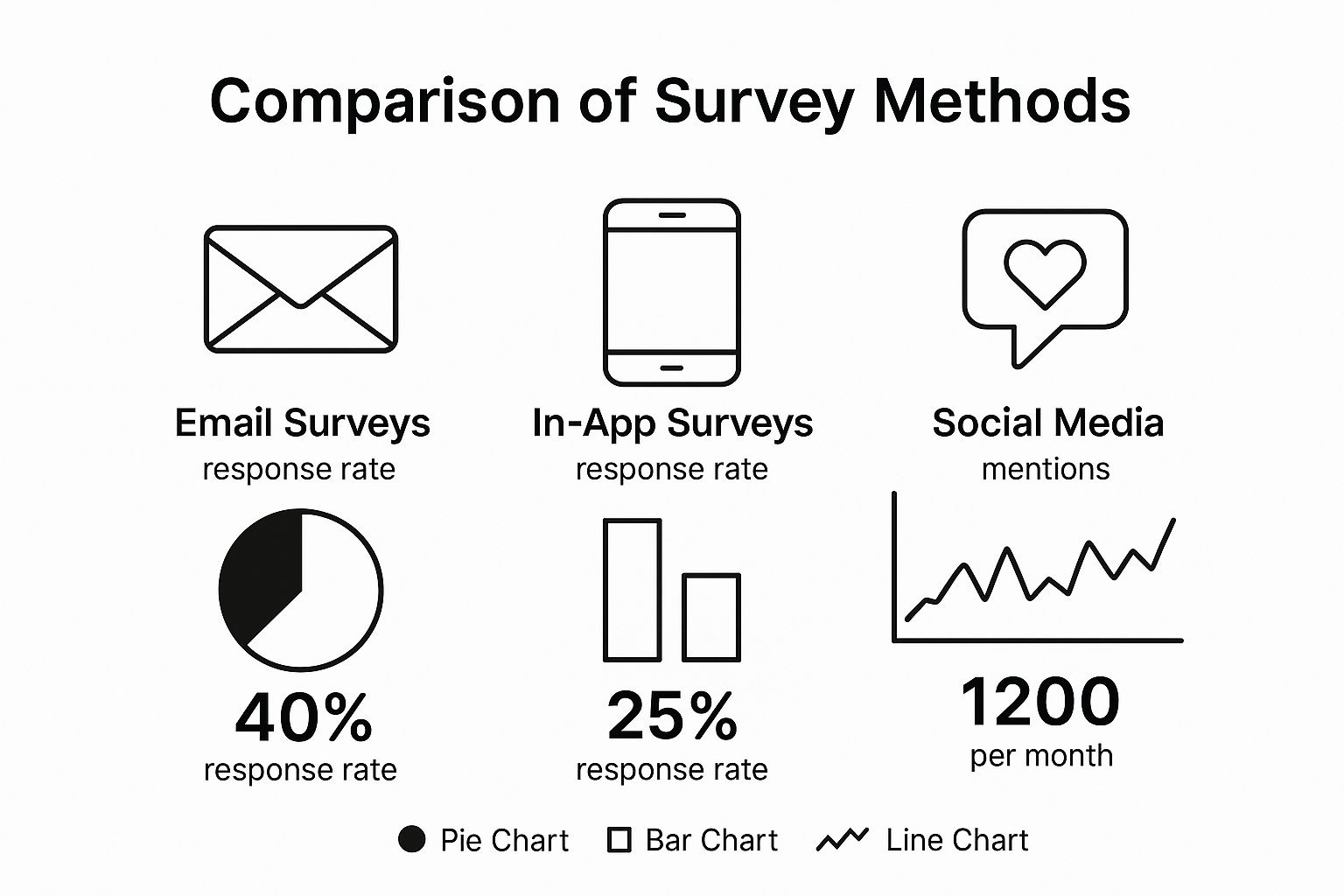
As you can see, structured feedback from surveys is just one piece of the puzzle. The real gold is often hidden in the massive, messy volume of unstructured chatter on social media or in support calls—places where manual analysis simply can't keep up.
Automating Your Insight Discovery Workflow
The secret to turning this chaos into clarity is building an automated workflow. It all starts by connecting your different feedback sources—call recordings, chat logs, review sites—into a central analysis hub. Once connected, you let the AI do the heavy lifting.
I saw this firsthand with an e-commerce client who was baffled by a sudden drop in their customer satisfaction scores. Their surveys offered no clues. But after feeding their support call transcripts into an AI tool, a critical pattern jumped out within hours. Dozens of customers were mentioning a "confusing checkout error," a specific phrase that never appeared in their structured surveys. This single insight, hidden in spoken conversations, led them directly to a bug that had been quietly costing them sales for months.
AI doesn't just speed up analysis; it uncovers the "unknown unknowns"—the problems your customers are actually talking about, not just the ones you're asking about.
This kind of automation helps you spot trends almost as they happen, shifting your team from a reactive "firefighting" mode to a proactive, strategic one. A great first step is to explore how an AI chatbot for your business can categorise and respond to incoming queries automatically, laying the groundwork for deeper analysis.
From Sentiment Scores to Strategic Priorities
True understanding goes far beyond a simple "positive" or "negative" label. Modern AI tools can dig into the nuances of language to identify specific emotions like frustration, confusion, or delight. This emotional context is what truly helps you prioritise.
A quick look at the old way versus the new way makes the difference crystal clear.
Manual vs AI-Powered Feedback Analysis
| Feature | Manual Analysis | AI-Powered Analysis (e.g., Voicetta) |
|---|---|---|
| Speed | Extremely slow; can take weeks or months. | Near real-time; processes thousands of points in minutes. |
| Scalability | Poor; requires more people as data volume grows. | Highly scalable; handles massive data volumes with ease. |
| Accuracy | Prone to human error, bias, and inconsistency. | Highly consistent and objective; flags trends without bias. |
| Depth of Insight | Surface-level; often identifies only obvious themes. | Deep; uncovers hidden patterns, sentiment nuances, and emerging issues. |
| Cost | High labour costs; diverts teams from strategic work. | Cost-effective; frees up human talent for high-value tasks. |
The move to an AI-powered approach isn't just about efficiency; it's about gaining a competitive edge by truly understanding what your customers feel.
This kind of sentiment tracking can even reflect broader economic trends. For instance, recent data from Poland showed that 61% of people felt satisfied with their household's material conditions. This general sense of stability often correlates with more positive purchasing behaviours and, in turn, more positive customer feedback.
By layering AI analysis over your feedback, you can start connecting the dots between sentiment and core business metrics. You can finally answer crucial questions like:
- Is that dip in sentiment around "pricing" directly linked to our lower conversion rate this month?
- Are the glowing mentions of our new feature actually driving higher user engagement?
This transforms customer feedback from a simple collection of opinions into a powerful strategic asset. It equips your product, support, and marketing teams with a clear, data-backed action plan, ensuring every decision is genuinely rooted in the voice of your customer.
From Insight to Impact: Making Your Feedback Matter

It’s a fantastic feeling to uncover that "aha!" moment in your customer feedback. But let's be honest, an insight gathering dust on a report is worthless. The real work—and the real reward—begins when you transform that knowledge into tangible changes that your customers can feel. This is the step that separates the companies that coast from the ones that lead their market.
The trick is to build a solid bridge from the raw data to the teams who can actually do something with it. You have to become a translator, a storyteller. What gets a product manager excited is worlds away from what a developer or your CEO needs to hear. Your job is to frame the same insight in a way that clicks for each of them.
I saw this firsthand with a client, an up-and-coming e-commerce brand. They used their feedback analysis to argue for a complete redesign of their checkout flow. Instead of presenting a vague collection of complaints, they walked into the boardroom with a powerful, data-backed story: 23% of all support tickets in the last quarter were about payment failures. That single statistic got them immediate approval for the project, which went on to boost their conversion rate by a very real 11%.
How To Prioritise What To Fix First
You can't fix everything at once. One of the biggest mistakes I see is teams trying to tackle every single piece of feedback, which just leads to burnout and a lot of half-finished projects. The smart way to approach this is with a simple prioritisation framework. Just ask two questions for every potential initiative:
- What’s the real business impact? (Will it reduce churn, grow revenue, or improve retention?)
- How hard is it to actually implement? (Think developer hours, resources, and budget.)
Your first targets should always be the high-impact, low-effort wins. These quick victories are gold. They build momentum, prove the value of listening to feedback, and get everyone energised. For example, fixing a confusing error message that cuts support tickets by 15% is a huge win. It's not glamorous, but it frees up your support team to handle more complex issues. Capturing these kinds of insights around the clock is easier when you're providing excellent 24/7 customer support.
The most successful companies don't just collect feedback; they build a system for evaluating, prioritising, and acting on it. This turns the voice of the customer into a core driver of their business strategy.
Getting The Right Message to The Right People
Once you know your priorities, it's all about communication. Please, don't just email a spreadsheet full of raw data and expect action. You have to tailor the message.
- For your Developers: Give them clear, concise bug reports backed by numbers. Show them how many people are affected. "This API error impacted 7% of our enterprise users last month" is much more effective than "some users are complaining about an error."
- For your Product Managers: Frame the feedback in their language—as feature requests and market opportunities. Connect customer suggestions to user personas and talk about the potential revenue gains.
- For your Leadership Team: Stick to the big picture. Show them how customer sentiment is directly impacting churn, loyalty, and the bottom line.
This kind of targeted communication makes the ROI of listening undeniable. Here in Poland, the evidence is overwhelming: customer-centric companies are 60% more profitable than their peers. And get this—just a 5% increase in customer retention can lift revenue by as much as 95%. These aren't just vanity metrics; they're proof that digging into customer feedback and acting on it is a direct line to sustainable growth.
By turning insights into action, you create a powerful flywheel. You solve real customer problems, which improves your business, which in turn proves that listening is the most valuable growth strategy you have.
Closing the Loop to Build Unbreakable Customer Loyalty
You’ve done the heavy lifting. You've gathered the feedback, used some smart tools to make sense of it all, and turned those raw insights into actual business improvements. It’s tempting to dust off your hands and call it a day right there. Most companies do.
But they're missing the final, and arguably most powerful, piece of the puzzle: letting your customers know you actually listened.
This simple act, what we call closing the feedback loop, is a loyalty supercharger. It's the moment a purely transactional relationship starts to feel like a real partnership. When people see their own suggestions come to life, it sends a clear message that their voice matters. That's how you turn passive users into passionate fans.
Just think about it from your own experience. How many times have you filled out a survey or reported a bug, only to be met with complete silence? It feels like you’re just shouting into a black hole.
Now, picture the exact opposite. You point out a frustrating glitch in an app. A few weeks later, an email lands in your inbox: "Hey, remember that issue you flagged? We fixed it. Thanks for helping us get it right." That single, personal touch can forge more loyalty than a hundred generic marketing blasts ever could.
From Critics to Community Champions
Closing the loop doesn’t need to be some massive, complicated undertaking. It's really about being thoughtful and personal. You can start with small, meaningful actions that prove you're paying attention.
Here are a few ways I’ve seen this work brilliantly:
- The "We Fixed It" Email: When you solve a specific problem a customer reported, send them a direct message. A simple, "Thanks to your feedback, we've updated X," is incredibly powerful.
- Public Shout-Outs in Release Notes: Rolling out a new feature that came from user ideas? Give them credit in your update notes. Something like, "Feature Y was inspired by great suggestions from users like Jane D. and Mike P.!"
- Blog Posts on the "Why": Write a quick post explaining the reasoning behind a recent change. You can frame it as a direct response to the themes you found in your feedback analysis.
It's not just a nice-to-have. A stunning 83% of customers say they feel more loyal to brands that respond to and resolve their complaints. Closing the loop is a direct investment in keeping the customers you have.
Making It a Habit, Not a One-Off Task
For this to truly work, it can't be an afterthought. You have to weave it into your team's daily rhythm. For instance, when your product team ships a fix that originated from a customer ticket, that action should automatically trigger a task for your support or marketing team. Their job? Reach out to the customers who brought it up in the first place.
This creates a self-sustaining cycle of improvement and communication.
I'm a big fan of how one software company I follow handles this. They have a dedicated section in their monthly newsletter called "You Asked, We Built." Every month, they highlight 2-3 new features or fixes that came straight from customer requests. It’s a genius move—it informs everyone about what's new while constantly reinforcing the idea that the company is building the product with its community, not just for them.
This is the step that makes the entire feedback process stick. It shows you’re transparent and that you respect your customers' time and input, turning even your biggest critics into your most vocal supporters. To see how these kinds of actions translate into real numbers, it's worth learning how to calculate your customer experience ROI. By consistently proving you’re listening, you build a foundation of trust that competitors will find nearly impossible to replicate.
Got Questions About Customer Feedback? We've Got Answers.
Even with a solid plan, a few questions always seem to pop up when you start getting serious about customer feedback. Let's tackle some of the most common ones we hear from founders and managers diving in for the first time.
How Should I Handle Negative Feedback?
It stings. Your first instinct might be to get defensive, but take a deep breath. Negative feedback is gold—it’s a free, brutally honest roadmap showing you exactly where to improve. The very first thing to do is thank the customer for their honesty and validate their frustration. A simple, "You're right, that sounds incredibly frustrating, and I appreciate you telling us," goes a long way. It shows you're actually listening.
Then, you need to dig in. Was this a one-off fluke, or is it a symptom of a larger, systemic problem? Once you’ve figured it out and have a plan, close the loop. Get back to that specific customer and tell them what you’ve done about their issue. You won't believe how often this single act turns an unhappy customer into one of your biggest fans. You proved their voice made a difference.
Remember, negative feedback isn't a personal attack; it's a diagnostic tool. Each complaint is a free consultation on how to make your business better.
What Is the Best Way to Start Collecting Customer Feedback?
Don't try to do everything at once. The key is to start small and win early. Pick one or two channels you already control and where your customers are most active. For most businesses, this usually means one of these two spots:
- Post-support surveys: Right after you've helped someone via chat or a call is the perfect moment to ask about their experience.
- Embedded forms: Place a simple feedback form somewhere logical in your app or on your site, like the order confirmation page.
Concentrate on these high-value touchpoints first. It gives you a manageable stream of data to work with, allowing you to get your analysis process right before you're overwhelmed. Once you've got a smooth system in place, you can start pulling in feedback from other places, like social media comments or call recordings.
How Can AI Tools Improve Our Feedback Analysis?
This is where things get really interesting. The sheer volume of feedback from open-ended survey questions, support calls, and social media is just too much for any human team to read through manually. It’s simply not possible.
AI, however, thrives on this kind of unstructured data. It excels at a few critical jobs:
- Automated Categorisation: AI can instantly read a comment and tag it with themes like "pricing," "bug," or "feature request" without anyone lifting a finger.
- Sentiment Detection: It moves beyond a simple positive or negative score to pick up on specific emotions like frustration or delight, which adds a whole new layer of understanding.
- Trend Identification: AI can spot new problems bubbling up in near real-time, acting as an early warning system before a small issue becomes a crisis.
When you automate this grunt work, you’re not just saving hundreds of team hours. You're uncovering insights that were buried in the noise, freeing up your team to focus on high-level strategy instead of drowning in spreadsheets.
Ready to turn your customer conversations into your biggest competitive advantage? See how Voicetta uses AI to automatically analyse feedback from every single call and chat, ensuring you never miss an opportunity to improve. Discover Voicetta today.