
Blog
Artificial Intelligence Automotive Explained
When we talk about artificial intelligence in the automotive world, we’re really talking about giving cars the ability to think, learn, and act. It’s the technology th...
When we talk about artificial intelligence in the automotive world, we’re really talking about giving cars the ability to think, learn, and act. It’s the technology that’s turning science fiction into reality, powering everything from self-driving systems to the helpful voice assistant that adjusts your music. This isn't just about adding new gadgets; it's about fundamentally changing our relationship with the vehicles we drive.
How AI Is Reshaping the Automotive World
Think of a car’s AI as its central nervous system. It’s not some optional extra—it’s the very core of what will drive the next generation of transport. This system is like a superhuman driver, one that can process a staggering amount of information from cameras, radar, and LiDAR sensors to make life-saving decisions in a fraction of a second.
It’s the ultimate co-pilot, one that never gets tired or distracted. While a human driver can only really focus on a few things at once, an AI can track hundreds of different objects simultaneously—other cars, pedestrians stepping off the curb, cyclists, and unexpected road hazards. It constantly calculates where everything is heading and adjusts its own path to steer clear of trouble. This relentless awareness is what makes modern safety features like automated emergency braking and advanced driver-assistance systems (ADAS) so effective.
The Brains Behind the Machine
So, what makes all this possible? At its heart, automotive AI stands on a few key technological pillars. These pieces work in concert to help the vehicle understand its environment and navigate it safely.
- Machine Learning: This is how a vehicle learns from experience. Just like a person becomes a better driver over time, AI models are fed data from billions of miles of real-world and simulated driving. This training helps them get better at handling all the strange and unpredictable things that happen on the road.
- Computer Vision: By using cameras, this technology gives the car the ability to "see." It can identify and interpret everything from traffic signs and lane markings to people and animals. It's basically a digital version of human sight, but one that works just as well in the pouring rain or dead of night.
- Sensor Fusion: This is the process of blending information from different sensors—like cameras, radar, and LiDAR—to build a single, crystal-clear 360-degree picture of the car’s surroundings. Each sensor has its strengths and weaknesses, but when their data is combined, they create a view of the world that’s far more reliable than any single sensor could provide on its own.
But these systems don't just react to what's happening; they actively try to predict what's coming next. For a deeper dive into how this technology is changing business operations, you can find excellent resources on AI fleet management that show its real-world benefits.
By spotting patterns in traffic flow and the behaviour of other drivers, an AI can anticipate a potential problem long before it happens, giving the car a critical head start in responding.
Ultimately, the goal is to create a true partnership between the driver and the machine. In many ways, the AI in a car is becoming a highly specialised digital worker, built to handle specific driving tasks with a level of speed and precision that humans simply can't match. To see how this idea extends beyond cars, it's worth understanding what is a digital worker and its broader role in automation. This shift—from a car being a simple tool to an intelligent partner—is what this automotive evolution is all about.
The Journey to Fully Autonomous Driving
Getting to a car that truly drives itself isn't an overnight jump. It's more like a journey up a flight of stairs, with each step representing a new level of intelligence and capability. This progression is laid out in what the industry calls the SAE Levels of Driving Automation. Forget the idea of flipping a switch from "human" to "AI" mode; think of it as a student driver gradually earning more trust and responsibility behind the wheel.
It all starts at a level we know well: Level 0. This is classic driving. The car has no automation whatsoever, and you—the driver—are responsible for everything. Steering, braking, accelerating, keeping an eye on traffic... it's all on you. The car simply does what you tell it to.
Taking the First Steps with AI Assistance
The first hint of AI support appears at Level 1. Here, the car can help with just one specific function at a time—either steering or speed. A great example is the adaptive cruise control that maintains your speed and distance from the car ahead, or a lane-keeping feature that gently nudges you back if you start to drift. You're still in full command, but the car is there to lend a hand.
Level 2 is a big step up, often called "hands-off" driving. Now, the system can manage both steering and speed at the same time, but only under specific conditions, like on a motorway. This is the territory of well-known systems like Tesla's Autopilot or GM's Super Cruise. The car can centre itself in the lane and handle the stop-and-go of traffic. But make no mistake, your job is to stay alert, eyes on the road, ready to take back control in a split second.
The critical difference at Level 2 is that even though the car is doing some of the work, you are the ultimate supervisor. You are legally and practically responsible for monitoring the environment and intervening immediately when needed.
This is a simplified look at how the vehicle's AI brain processes information from its sensors to make driving decisions.
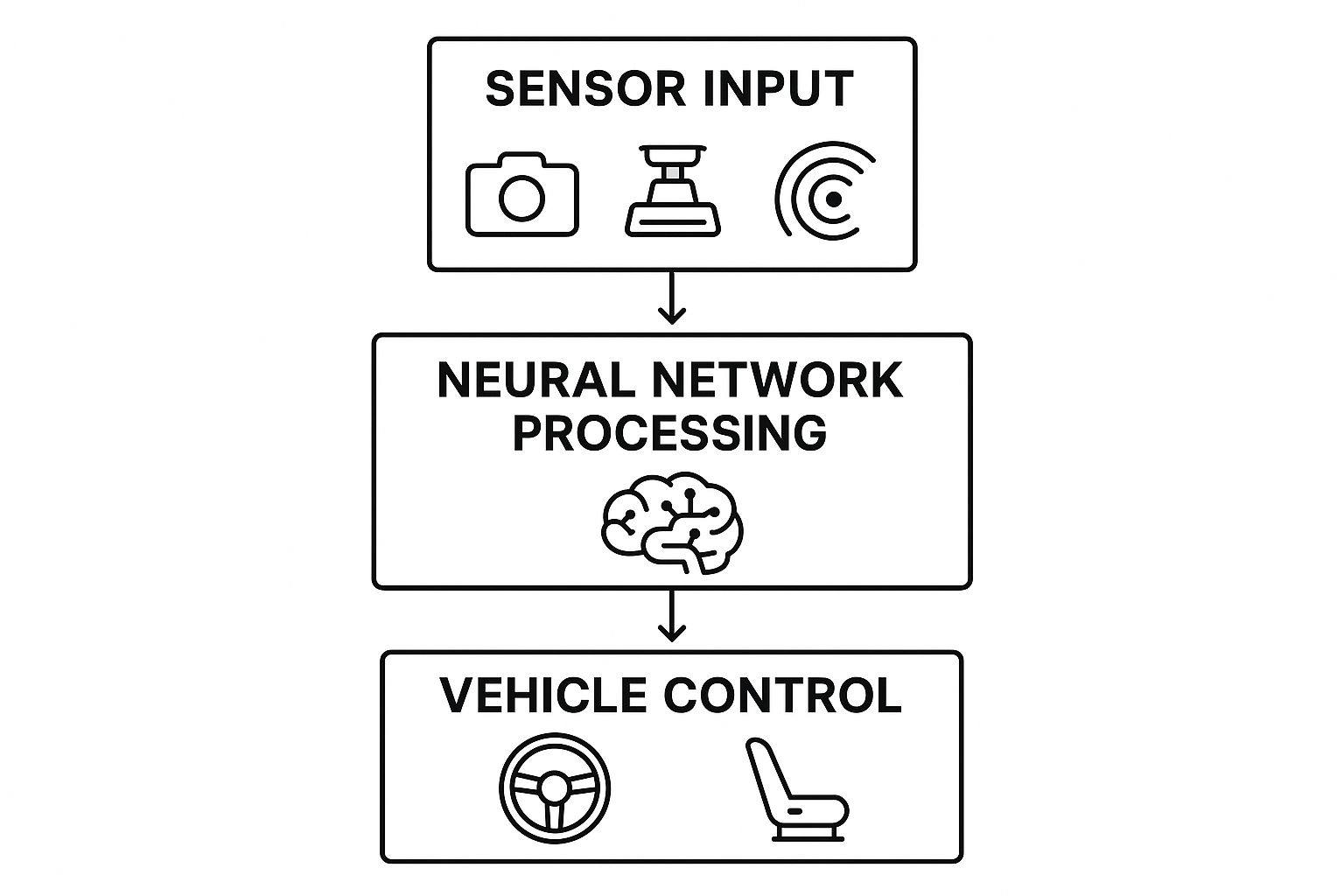
This constant loop of seeing, thinking, and acting is what allows a car to navigate its surroundings, forming the basis for every level of driving automation.
SAE Levels of Driving Automation Explained
To really grasp how this all fits together, it helps to see the levels laid out side-by-side. Each stage clearly defines who—or what—is in charge.
| SAE Level | Driver's Role | Vehicle's Role | Real-World Example |
|---|---|---|---|
| Level 0 | Does everything. | Provides warnings (e.g., blind spot alert). | A standard car from the early 2000s. |
| Level 1 | Always driving. | Assists with one function (steering or speed). | Adaptive Cruise Control. |
| Level 2 | Must supervise constantly. | Assists with steering and speed together. | Tesla Autopilot, GM Super Cruise. |
| Level 3 | Can be distracted in limited situations. | Drives completely, but may ask the human to take over. | Mercedes-Benz DRIVE PILOT. |
| Level 4 | A passenger (within a specific area). | Drives completely within a geofenced area. | Waymo or Cruise robotaxis. |
| Level 5 | Just a passenger. | Drives completely, anywhere, any time. | A hypothetical car with no steering wheel. |
This table shows the clear, step-by-step handover of responsibility from the human driver to the vehicle's AI system.
Handing Over the Reins
The real game-changer is Level 3, or "eyes-off" automation. This is where the car can truly take over all driving tasks, but only in specific, controlled environments like a traffic jam on a motorway. For the first time, the driver can legally take their eyes off the road and do something else. The system is smart enough to give plenty of warning when it's time for the human to take control again.
At Level 4, the car becomes highly autonomous. It can handle an entire trip from start to finish without any human intervention, as long as it stays within a predefined operational area—think a specific city district or a university campus. If the car runs into a problem it can't solve, it's designed to safely pull over and stop on its own. This is the tech behind the robotaxi services you see being tested in places like San Francisco. In the same way AI is reshaping guest experiences in other fields, like the application of artificial intelligence in the hospitality industry, Level 4 tech is completely rethinking what urban transport can be.
The Ultimate Destination: Full Autonomy
Finally, we reach the summit: Level 5. This is the ultimate goal. A Level 5 car is a true "robot" that can drive on any road, in any weather, under any condition a human could. There's no need for a steering wheel or pedals because the AI handles 100% of the driving, 100% of the time.
As AI keeps getting smarter, it’s pushing us to imagine things that once seemed like science fiction, including the concept of flying cars, which could fundamentally change our ideas about personal transport. While a true, drive-anywhere Level 5 car is still some years away, the steady climb up these levels shows we're on a clear and determined path toward a fully autonomous future.
From Factory Floor to Open Road: How AI is Building and Maintaining Our Cars
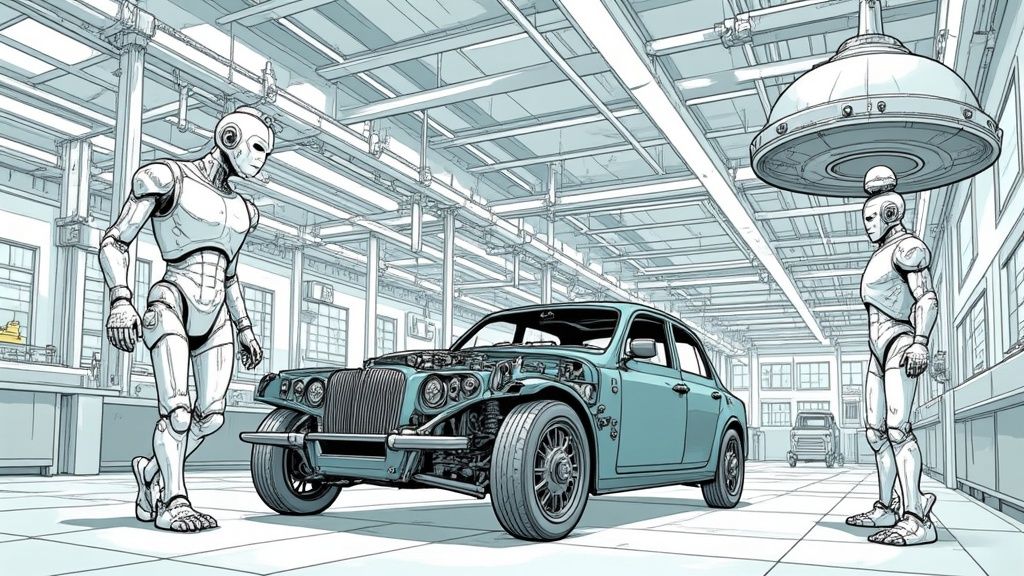
Long before a new car ever hits the tarmac, artificial intelligence has already been hard at work. Its influence starts right on the assembly line, a place once defined by repetitive mechanical tasks that AI is now transforming into a smart, self-correcting ecosystem. In this new world, AI isn't just another tool in the box; it's the conductor of the entire manufacturing orchestra.
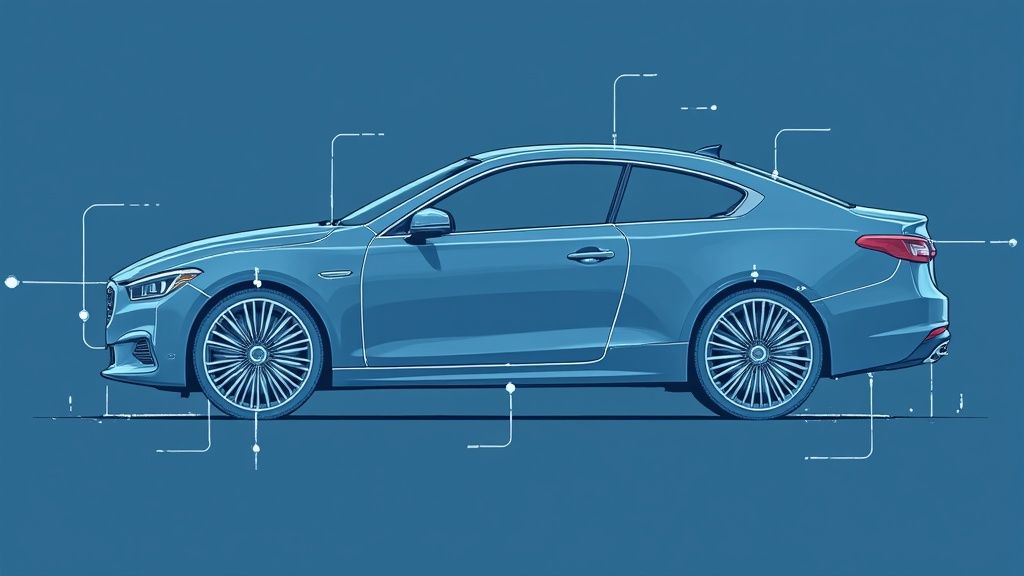
AI-driven robots and learning algorithms are completely reshaping how we build vehicles. They watch over production lines, making tiny adjustments on the fly to boost efficiency and stamp out errors. Picture an AI system that can scan thousands of weld points every second, spotting imperfections far too small for the human eye to catch. This isn't science fiction—it's how modern manufacturing ensures every component is fitted with incredible accuracy, resulting in cars that are stronger, safer, and more dependable.
A New Standard for Quality Control
One of the biggest game-changers AI brings to the factory is in quality assurance. In the old days, quality control often meant random spot-checks, a method that could easily miss subtle but crucial defects. AI flips that script entirely, making it possible to have 100% inspection of every single part on every vehicle that rolls off the line.
Here’s how it works in practice:
- Computer Vision Systems: Think of these as super-powered cameras that tirelessly scan components for cosmetic flaws, like scratches or tiny paint drips, with a consistency no human could ever match.
- Predictive Quality Analytics: By sifting through mountains of production data, AI can actually predict when a specific machine is about to produce a faulty part. This allows engineers to step in and make adjustments before a mistake even happens.
- Automated Anomaly Detection: AI algorithms can even "listen" to the factory. They pick up on tiny changes in the sounds or vibrations of machinery that signal a problem is brewing, long before it causes a shutdown.
This shift from reacting to problems to actively preventing them is a massive leap forward. If you're curious about the nuts and bolts of this technology, our guide on automated quality assurance breaks it down in more detail.
The AI Mechanic: Predictive Maintenance
Once a car is built and out on the road, AI's job is far from over. It takes on a new role as a vigilant guardian of the vehicle's health through something we call predictive maintenance. It’s a bit like having a doctor who can diagnose an illness before you even feel the first symptom. Instead of just waiting for a warning light to flash, the car itself starts to anticipate its own needs.
In a way, your car becomes its own health analyst. It’s constantly listening to itself, pulling data from thousands of sensors that track everything from engine temperature and oil quality to battery life and tyre pressure.
All of this data flows into sophisticated AI algorithms. These systems have learned from the real-world performance of millions of other vehicles, so they can recognise the faint digital whispers that hint at a future breakdown. This isn’t just about flagging current issues; it’s about forecasting what might go wrong weeks, or even months, from now.
Imagine your car's AI notices a tiny, unusual fluctuation in the transmission. It's nothing you'd feel while driving, but the algorithm recognises this specific pattern as an early sign of gear slippage that could pop up in the next 5,000 kilometres. The system then prompts you to book a service, turning a potential roadside nightmare into a simple, scheduled visit to the garage.
The benefits here are huge:
- Enhanced Safety: It helps prevent sudden failures in critical parts like brakes or steering.
- Reduced Costs: You get to fix small problems before they grow into massive, wallet-draining repairs.
- Increased Reliability: It dramatically cuts down on unexpected breakdowns, making sure your car is ready to go when you are.
By moving maintenance from a rigid, reactive schedule to a smart, predictive model, AI is making our cars not just more intelligent, but fundamentally more trustworthy for the long haul.
Creating the Smart Cockpit Experience
Hop into a new car today, and you might get the feeling it already knows you. The cabin is no longer just a static collection of seats and buttons; it's being reborn as a smart, responsive space. This is the new reality of the smart cockpit, where artificial intelligence acts as a quiet co-pilot, constantly working behind the scenes to make every trip safer, more comfortable, and feel like it was designed just for you.
This isn't just about flashy touchscreens. We're talking about an entire ecosystem where AI learns your habits, gets ahead of your needs, and adjusts the driving experience on the fly. Picture this: you get in the car on a frosty Monday morning. The AI, remembering your routine, has already warmed the seat and steering wheel to the exact temperature you like. It then pulls up your favourite news podcast, because it knows the work week has begun.
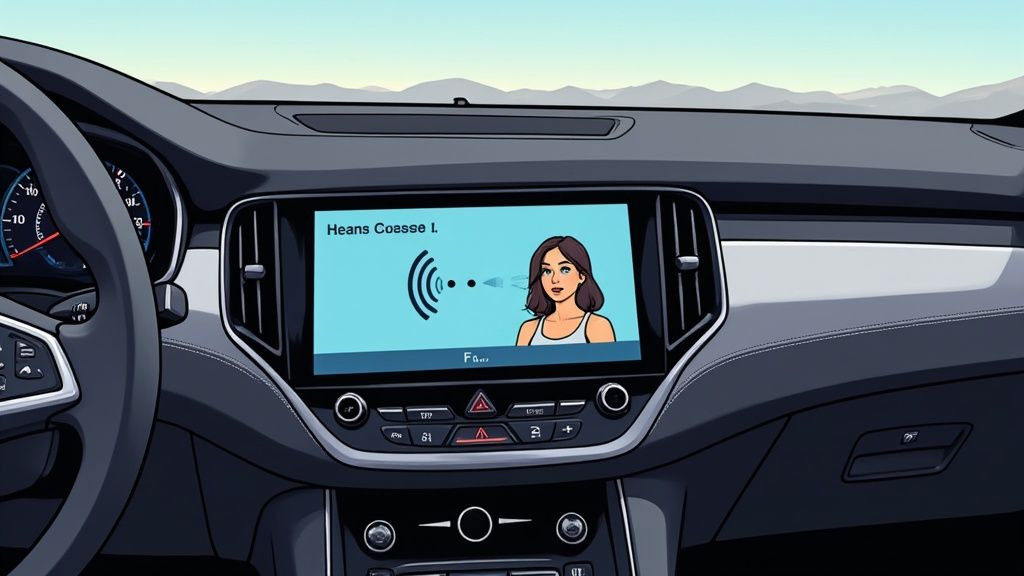
This kind of intuitive personalisation is all down to machine learning algorithms that quietly observe your behaviour. Over time, the system picks up on patterns in everything from your climate control preferences to the places you drive to most often. It’s this ability to predict what you'll want next that turns the car from a machine you operate into a partner that helps you out.
The Rise of the Intelligent Assistant
At the heart of the smart cockpit is the in-car voice assistant, which has come a very long way. Early versions were clunky and frustrating, often mishearing commands and forcing you to speak in rigid, unnatural phrases. Today’s AI-powered assistants are a different beast entirely, capable of understanding normal, everyday language.
Now, you can simply say, "I'm feeling a bit chilly," and the car will bump up the heat. Or you might ask, "Find me a good coffee shop on my way home," and the system will check your route against real-time reviews to give you a few solid options. These enhanced voice commands are powered by huge strides in conversational AI, making the whole interaction feel much more natural.
This fluid dialogue is a massive win for safety. It lets drivers manage navigation, change the music, or make a call while keeping their hands on the wheel and their eyes fixed on the road. It’s all about cutting down on distractions without sacrificing convenience.
A Guardian Watching Over the Driver
Beyond just making life easier, AI in the cockpit is also stepping into the role of a safety guardian. Advanced Driver Monitoring Systems (DMS) use small, discreet cameras pointed at the driver to keep an eye on their condition. These systems aren't just recording; they're actively interpreting what they see.
An AI-powered DMS can pick up on the subtle signs of drowsiness, like a drooping head or if your eyes have been closed for a little too long. When it spots fatigue, it can sound an alert, suggest pulling over for a break, or even prime other safety systems for a potential lapse in concentration.
This tech creates an invaluable safety net, particularly on long, monotonous drives. The AI is also trained to spot signs of distraction—like a driver glancing down at their phone for too long—and can provide a gentle nudge to refocus on the road.
When you bring all these pieces together—the personalisation, the smart assistant, and the vigilant monitoring—you get the modern smart cockpit. The car's interior is no longer a passive space but an active participant in your journey.
Here are just a few of the key functions being handled by cockpit AI:
- Personalised Profiles: The car can recognise you through your phone or face, instantly adjusting the seats, mirrors, and infotainment to your specific settings.
- Proactive Navigation: By analysing traffic and your calendar, the AI can suggest the quickest routes, sometimes before you even type in a destination.
- Biometric Integration: Some systems use sensors in the steering wheel to monitor things like heart rate, adjusting the ambient lighting or music to help create a calmer environment if it detects stress.
Ultimately, the goal of AI in the automotive cockpit is to build a seamless and safe partnership between the person and the machine. It’s about turning the daily commute into something less stressful and more enjoyable, one intelligent suggestion at a time.
When AI Cars Start Talking to the World
An AI-powered car is brilliant on its own, but its real genius shines through when it starts communicating with the world around it. This is where Artificial Intelligence collides with the Internet of Things (IoT)—that massive, ever-growing network of connected devices. Put them together, and you get something like a city-wide nervous system where vehicles don’t just drive; they collaborate.
Think about a flock of starlings flying in one of those incredible, mesmerising formations. There’s no leader shouting orders. Instead, each bird reacts instantly to the subtle movements of its neighbours. That collective intelligence allows them to navigate as a single, fluid entity. That’s the big idea behind Vehicle-to-Everything (V2X) communication.
With V2X technology, vehicles can talk to each other, to traffic lights, to sensors embedded in the road, and even to a pedestrian's smartphone. In this constant digital chatter, AI acts as the master translator and decision-maker. It sifts through torrents of data to give the vehicle an almost god-like awareness of everything happening around it.
The Symphony of a Smart City
In a world where V2X is the norm, traffic starts to look less like a chaotic scramble and more like a beautifully coordinated symphony. AI uses this connected network to see around corners and react to events happening kilometres down the road, far beyond what its own sensors could ever pick up.
This ecosystem is built on a few key layers of communication:
- Vehicle-to-Vehicle (V2V): Cars are constantly broadcasting their speed, position, and where they're heading. If a driver slams on the brakes three cars ahead, your car gets an instant warning, potentially preventing a pile-up before you even see the brake lights.
- Vehicle-to-Infrastructure (V2I): This is where the car talks to the city itself. Traffic lights can adjust their timing to ease congestion based on real-time flow. Your car might get a heads-up about a patch of black ice on an upcoming bridge or roadworks just around a blind bend.
- Vehicle-to-Pedestrian (V2P): The system can pick up a signal from a cyclist’s phone or a pedestrian’s smart device, alerting the car to their presence long before they become visible to the human eye.
This intricate web of shared data completely rewrites the rules of road safety and traffic management. If you're curious about how systems learn to understand and act on such complex streams of information, you can find some great real-world conversational AI examples that break it down.
Building a Safer, More Efficient Future
The practical benefits here are enormous. Imagine an ambulance needing to get through rush-hour traffic. It could communicate with the city's infrastructure, turning every traffic light green as it approaches. That simple act clears a path through the gridlock, shaving critical minutes off response times when lives are on the line.
The goal is to shift from reactive safety systems—things that help you survive a crash—to proactive ones that prevent the crash from ever happening. AI and IoT make this possible by giving vehicles the power of foresight.
This convergence of technologies is also a powerful economic engine. Here in Poland, the Artificial Intelligence market, especially within the automotive sector, is growing at a serious pace. The broader AI market is projected to hit around US$1.59 billion shortly, while the Automotive IoT market is also expected to pull in revenues of about US$1.68 billion. You can dig deeper into these figures by exploring the latest market insights on Statista.com.
Ultimately, connecting vehicles through AI and IoT isn’t just about making individual cars smarter. It's about creating a collective intelligence that makes our entire transport network safer, cleaner, and far more efficient for everyone.
It's Not All Smooth Driving: The Roadblocks for Automotive AI
While the vision of an AI-powered automotive world is incredibly exciting, the road from here to there isn't exactly a freshly paved motorway. It's winding and full of some serious obstacles—technical, ethical, and security-related—that the industry needs to navigate with extreme care. These aren't just minor speed bumps; they're complex issues that demand real solutions before we see widespread adoption.
The biggest challenge, without a doubt, is guaranteeing the safety and reliability of artificial intelligence automotive systems. You can train an AI on billions of kilometres of simulated and real-world driving data, but the real world has an infinite capacity for surprise. It’s full of unexpected "edge cases"—a rogue kangaroo hopping across a Polish country road, a child chasing a ball between parked cars, or bizarre debris from a lorry up ahead.
Teaching an AI to react to every possibility with the nuanced judgment of a seasoned human driver is a monumental undertaking. It requires an almost unimaginable amount of testing and validation to be sure the system will make the right call, every single time, especially when lives are on the line.
The Ethical Minefield of AI on the Road
Even if we solve the technical side, we're left with a maze of ethical questions. The most famous one is a modern take on the classic "trolley problem." Imagine an autonomous car is heading for an unavoidable collision. What does it do?
Should the car’s programming prioritise the lives of its passengers above all else? Or should it make a cold calculation to minimise the total number of casualties, even if that means sacrificing its own occupant?
There are no easy answers here. These are deeply moral choices that society needs to weigh in on, not just engineers. We need a global conversation between developers, ethicists, and regulators to build a clear ethical framework for artificial intelligence automotive decision-making.
Locking Down the Connected Car
As our cars get smarter and more connected, they also become more exposed. A vehicle that talks to traffic lights, other cars, and the cloud is a fantastic piece of technology, but it also opens up a new front for cyberattacks. The idea of a hacker remotely taking control of a car is no longer just a plot for a spy thriller; it's a genuine security risk we have to confront.
Engineers are building in multiple layers of defence to fortify these systems. Key measures include:
- Encrypted Communications: Scrambling all data flowing to and from the vehicle to make it unreadable to anyone who might be listening in.
- Secure Software Updates: Creating rock-solid verification processes to ensure that no malicious code can be pushed to the car's systems.
- Intrusion Detection Systems: Essentially building firewalls inside the car's own network to spot and block any suspicious activity.
Without ironclad cybersecurity, the public will never fully trust this technology. How the industry tackles these technical, ethical, and security challenges will be the true test of its ability to steer us into a smarter, more autonomous future.
Got Questions About AI in Cars? We’ve Got Answers
With all the buzz around AI in the automotive world, it's easy to get lost. The technology is moving at breakneck speed, touching everything from our daily drive to the very design of our cities. So, let's clear up some of the most common questions and get to the bottom of what's really going on under the bonnet.
Are Cars Actually Getting Safer with AI?
In a word, yes. The single biggest mission for most AI systems in cars is to make them safer. We're already seeing this with features like automated emergency braking, blind-spot monitoring, and lane-keeping assist. These aren't just fancy gadgets; they're AI-powered systems that can react in a split second—often faster than we can blink—to prevent a collision.
Think about it this way: an AI can process information from a dozen sensors at once, building a complete 360-degree view of the road. It doesn't get tired on a long drive, and it never gets distracted by a text message. This kind of constant, unwavering attention is a massive leap forward in tackling human error, which is still the cause of most accidents on the road.
What’s the Real Difference Between ADAS and a Self-Driving Car?
This is a great question, and the distinction is crucial. Advanced Driver-Assistance Systems (ADAS) are there to help you, not replace you. They're like a smart co-pilot, giving you a warning if you drift out of your lane or automatically hitting the brakes if the car in front stops suddenly. You are always in command.
Autonomous driving, on the other hand, is about handing over control completely. A truly self-driving car (what the experts call SAE Level 5) would be able to navigate any road, in any weather, without you ever needing to touch the steering wheel. Most modern cars have some level of ADAS, but that fully autonomous future is still a little way down the road.
At its core, it’s all about responsibility. With ADAS, you are the driver. With full autonomy, the car is the driver.
How Do AI and Electric Vehicles Fit Together?
AI and electric vehicles (EVs) are a perfect match; they genuinely make each other better. AI is the brain behind managing an EV's complex battery, figuring out the best way to charge it to extend its life and squeeze out every last kilometre of range. It can even plan your trip around charging stations, checking if they're available in real-time.
Here in Poland, for example, the EV market is really taking off. This boom is creating even more demand for smart, AI-powered features in the next generation of cars. As our roads fill with more electric vehicles, weaving AI into everything from self-driving systems to vehicle connectivity becomes that much more important. You can dig into the specifics by checking out the full report on the Polish EV market.
Never miss a customer again. Voicetta provides intelligent, 24/7 AI communication to handle your calls and chats, ensuring every lead is captured and every appointment is scheduled, day or night. https://voicetta.com
Was this useful?
If this article helped, add Voicetta as a preferred source in Google Search. Your results can then highlight our writing.
Add as preferred source