
Blog
Automated Quality Assurance A Polish Success Story
Imagine this: you're about to launch your brandnew software. But instead of that familiar knot of anxiety in your stomach, you feel a sense of calm confidence. Why? Be...
Imagine this: you're about to launch your brand-new software. But instead of that familiar knot of anxiety in your stomach, you feel a sense of calm confidence. Why? Because you know an intelligent system has already meticulously checked every single feature. This is the reality that automated quality assurance (QA) brings to the table. It’s all about using smart tools and scripts to run tests, confirm everything works as it should, and catch bugs automatically. It takes what used to be a slow, manual chore and turns it into a fast, strategic part of your process.
Your Introduction To Automated Quality Assurance
Let's think about building something complex, say, a high-performance car. A traditional, manual approach to quality assurance is like having a single mechanic painstakingly inspect each part one by one. They'll check the engine, then the brakes, then the lights. It's thorough for individual components, but this method struggles to see how all those systems work together under real-world pressure. It’s also open to human error and simply can't keep pace with a modern production line.
Now, contrast that with automated quality assurance. This is like putting the fully assembled car onto a sophisticated diagnostic rig. This rig can simulate an entire race, pushing the acceleration, braking, and steering all at once. It runs hundreds of checks in minutes, making sure every single part works in perfect harmony. That’s the fundamental difference—automation gives you a complete, dynamic picture of quality at a scale that's just not possible for human testers alone.
From Simple Scripts To Strategic Advantage
The journey of automated QA has mirrored the evolution of technology itself. It started out as a way to run simple, repetitive scripts. It was useful, but also quite rigid. Today, it’s blossomed into a strategic powerhouse for modern businesses, especially within Poland’s vibrant and fast-growing tech scene. This shift has become crucial for staying competitive, as customers now demand both speed and flawless reliability.
A well-implemented automated QA strategy brings several game-changing benefits to the table. It completely redefines the development cycle.
- Massively Increased Test Coverage: Automated tools can test far more of your application than a person ever could, often analysing 100% of interactions instead of a small sample.
- A Huge Boost in Speed: Tests that might take a manual team days to complete can be finished in hours, sometimes even minutes. This gives your developers feedback almost instantly.
- Unwavering Accuracy: Automation removes the risk of human error or inconsistency. Every test is run in precisely the same way, every single time, which means you can trust the results.
- Catching Bugs Early: When integrated directly into the development pipeline, automated tests can spot bugs almost as soon as they’re written. This makes them significantly cheaper and easier to fix.
This shift isn't just about finding bugs faster. It's about building confidence directly into your development process. It gives your teams the freedom to innovate and deploy new features with a much higher degree of certainty.
To get a clearer picture, let's look at a side-by-side comparison of the two approaches.
Manual QA vs Automated QA: A Quick Comparison
This table offers a high-level view of how traditional manual testing stacks up against a modern automated quality assurance process.
| Aspect | Manual QA | Automated QA |
|---|---|---|
| Speed | Slow and time-consuming; limited by human capacity. | Extremely fast; can run thousands of tests in hours. |
| Scope | Limited test coverage; often focused on critical paths. | Broad and deep coverage; can test complex scenarios. |
| Consistency | Prone to human error and variability. | Highly consistent and repeatable; tests are identical every time. |
| Cost | High long-term cost due to ongoing manual effort. | Higher initial setup cost, but lower long-term operational cost. |
| Feedback Loop | Delayed feedback; testing happens after development. | Immediate feedback; integrated into the development cycle. |
| Best For | Exploratory testing, usability, and ad-hoc checks. | Repetitive tasks, regression testing, and performance testing. |
As you can see, while manual testing still has its place for things like user experience, automation is unbeatable for scale, speed, and reliability.
Ultimately, automated quality assurance helps businesses move away from a reactive "break-fix" mindset and towards a proactive culture of continuous quality. It’s no longer just a final check before release; it becomes a core part of the creation process itself, ensuring excellence is built-in from the very first line of code. For Polish tech companies aiming to make a global impact, adopting this methodology isn't just a good idea—it's essential for success.
The Blueprint For Successful QA Automation
So, what separates a QA automation effort that constantly breaks from one that scales beautifully and just works? The secret isn't a single magical tool. It's all in the blueprint you follow. We've talked about what automated QA is; now let's get into the nitty-gritty of how to build it so it lasts.
Think of it like building a skyscraper. You wouldn't just show up with a pile of bricks and hope for the best, right? You need a solid architectural plan, quality materials, and a skilled crew. Your QA strategy is no different. It needs a smart test strategy (the plan), well-designed, modular scripts (the materials), and a sharp team of engineers who know how to put it all together. This approach is what stops your automation from crumbling the first time an update comes along.
This infographic shows just how all the moving parts of automated QA connect to deliver better quality and efficiency.
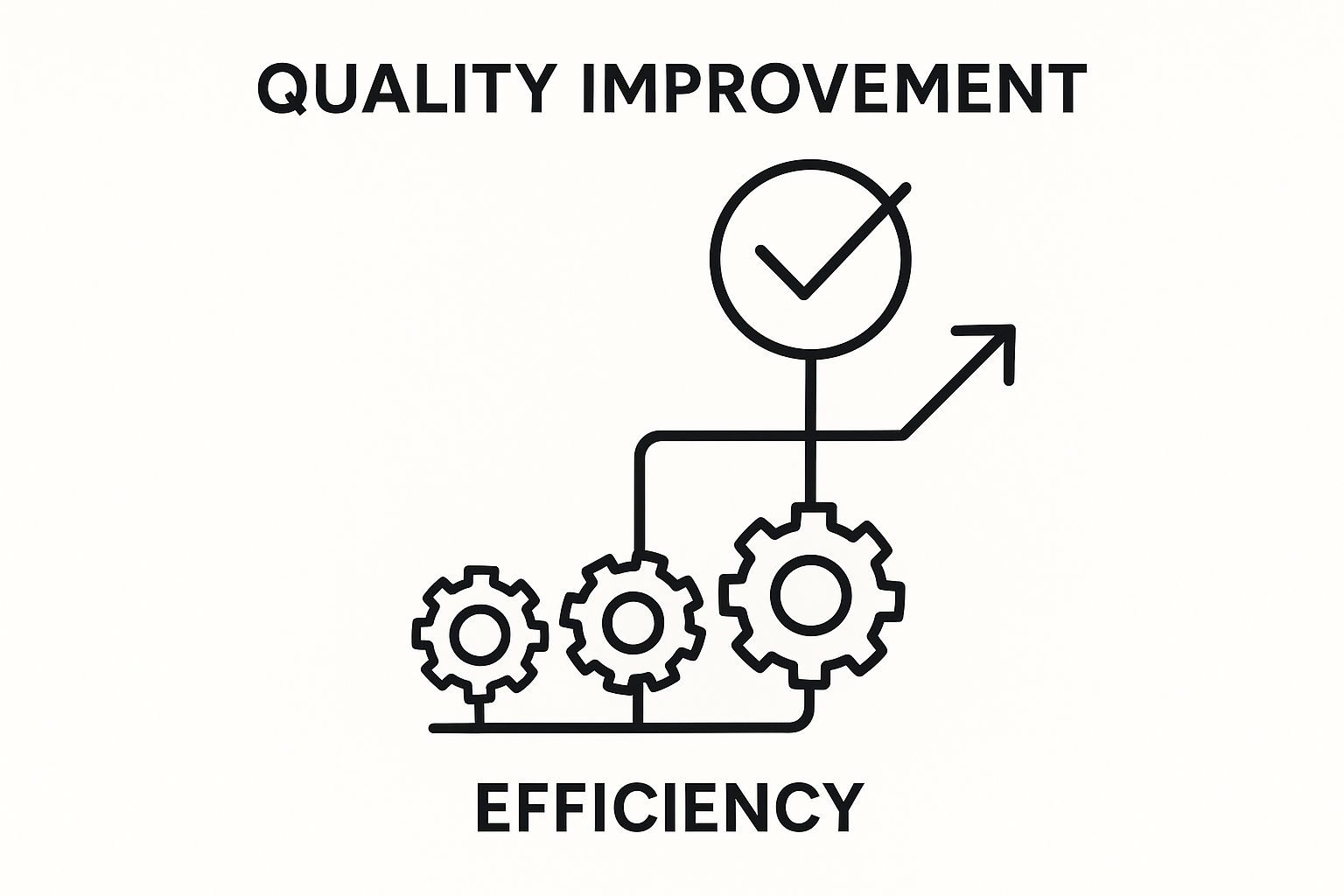
As you can see, when all the automated gears turn in sync, the result is consistent quality and a real push forward for the business.
Laying The Foundation With The Testing Pyramid
One of the most fundamental ideas in building a stable automation setup is the Testing Pyramid. It’s a simple but powerful model for figuring out where to focus your testing efforts to get the most bang for your buck. The whole point is to avoid creating a wobbly, top-heavy structure that’s just waiting to fall over.
At the very bottom, forming the wide, solid base, are Unit Tests. You should have loads of these. They’re the cheapest to write and the fastest to run because they check tiny, individual pieces of code in isolation. A strong foundation of unit tests means you're catching bugs right at the source, long before they snowball into messy, complicated problems.
Moving up, you have the middle layer: Integration Tests. These check that different parts of your application play nicely together. You'll have fewer of these than unit tests. They're a bit slower and more complex, but absolutely vital for making sure all the connections in your system are solid.
Right at the peak are your End-to-End (E2E) or UI Tests. These are the most expensive, the slowest, and the most fragile tests you'll run. They mimic a complete user journey through the interface, from login to logout. Because they can break so easily whenever the UI changes, you want to have the fewest of these. A pyramid overloaded at the top with UI tests becomes a slow, costly maintenance headache.
A well-balanced testing pyramid is the difference between getting fast, reliable feedback and dealing with a system that's always crying wolf with flaky, untrustworthy results. It’s all about putting your effort where it counts the most.
Assembling The Right Team And Tools
Of course, even the world's best blueprint is just a piece of paper without a skilled crew to bring it to life. Your QA automation initiative needs a dedicated team of professionals who really get both software development and testing principles. This isn't just about hammering out scripts; it’s about having an architect's mindset. This team usually includes automation engineers to build the framework and QA analysts to design the test cases.
The tools you choose are your construction materials. Picking the right ones comes down to what you're trying to build.
- API Testing: For checking the "under the hood" communication, tools like Postman are fantastic.
- Web UI Testing: Industry standards like Selenium or Playwright are go-to frameworks for automating web browsers.
- Mobile App Testing: When it comes to mobile, tools like Appium are built to handle testing on both Android and iOS.
The real goal is to pick tools that slot neatly into your development pipeline and that your team can use with confidence. Sometimes, this strategy even involves specialised systems that act like an extension of your human team. If you're curious about how automation extends beyond testing, take a look at our guide explaining what is a digital worker and how they tackle different business processes.
Adopting this strategic approach helps you build a scalable and maintainable automation framework—one that delivers more and more value over time, turning quality assurance from a cost centre into a genuine business asset.
Why Poland is All-In on Automated Quality Assurance
It’s no secret that Poland has become a real force in Europe’s technology scene. If you look under the bonnet, you’ll find that a huge part of this success comes down to a wholehearted embrace of automated quality assurance. This isn't just a happy accident. It’s the result of a unique mix of raw talent, fierce ambition, and a collective drive for digital excellence.
For Polish companies, automation isn't just another buzzword—it’s a core strategy for competing on a global scale.
This whole story really starts with Poland's incredible IT sector. For years, the country has been known for producing top-tier software engineers. This deep well of technical know-how created the perfect conditions for advanced practices like automated QA to flourish. As businesses set their sights higher, they quickly realised that old-school manual testing was a major bottleneck, slowing them down and holding them back from delivering truly world-class products.
That realisation opened the floodgates. Suddenly, there was a massive need for specialists who could design, build, and run these complex testing frameworks. Automated QA became the essential link between just making software and making great software, consistently and at scale.
The Buzzing Polish QA Job Market
You can see this commitment to quality written all over the job market. The demand for skilled QA professionals isn’t just stable—it's incredibly dynamic and growing fast. The fact that the country has such a strong talent pool for these roles shows just how mature and sophisticated the industry has become.
The numbers tell a compelling story. A 2023 report revealed that Poland's talent pool for QA and automated testing roles is made up of about 13,900 professionals. In the previous year alone, a staggering 3,139 of these experts switched jobs. This wasn't a sign of instability, but of a red-hot market where companies are competing aggressively to snap up the very best talent. This constant movement shows how serious Polish firms are about building flawless digital products. You can dive deeper into the numbers with the full QA and automated testing report for Poland.
Of course, an ecosystem this vibrant doesn't just spring up out of nowhere. It's been nurtured by several key factors that have made Poland a magnet for tech innovation:
- A Solid Educational Backbone: Polish universities have fantastic STEM programmes, consistently churning out sharp graduates who are ready to dive into complex engineering problems.
- A Push for Digitalisation: The government has made smart moves, investing in digital infrastructure and creating a business-friendly climate where tech companies can thrive.
- Thinking Globally: Polish companies aren't just building for the local market. They have global ambitions, and that means their products have to meet the highest international quality standards.
For Polish tech leaders, automated quality assurance is the engine of global competitiveness. It’s what lets them innovate faster, build stronger products, and deliver the seamless user experience that customers worldwide have come to expect.
A Leadership Mindset
When you boil it all down, the boom in automated QA in Poland is a story of smart, strategic thinking. Business leaders figured out early on that to win, they couldn't just build features quickly; they had to build them better. Automation gives them the confidence to push boundaries without risking the stability of their products.
By investing so heavily in automated quality assurance, Polish companies are doing more than just finding bugs. They're weaving a culture of quality into the very fabric of their development process. It's this deep-seated commitment that's turning local tech heroes into global leaders and making Poland's star shine so brightly in the European sky.
Weaving AI into Your QA Strategy

The next big step for automated QA isn't just about speed—it's about intelligence. The real game-changer is bringing Artificial Intelligence into the mix. Think of your standard automation script like a very diligent apprentice. You give it a checklist, and it follows every step perfectly.
But what if you could promote that apprentice to a seasoned master craftsman? Someone who not only follows the plan but also spots potential problems before they even surface. That’s the kind of upgrade AI gives your quality assurance.
This isn’t just a minor tweak; it’s turning the whole idea of testing on its head. We're shifting away from rigid, pre-written scripts and moving towards a smarter, more adaptive process that actually learns and gets better over time. AI is giving automated QA the ability to see, think, and react in ways we could only dream of before, opening up a whole new level of efficiency.
A New Era of Intelligent Testing
At its heart, AI-powered QA adds a thinking layer to the whole process. Instead of blindly running commands, these new systems can actually analyse how an application is behaving, pick up on patterns, and make their own decisions. This solves some of the most frustrating and time-consuming problems we've always faced with traditional automation.
This shift is especially significant in tech-focused nations like Poland. The country is quickly becoming a leader in the European Union for AI adoption, thanks to major initiatives like the European Commission's AI Continent Action Plan. With Poland now home to one of the very first AI factories, AIF Piast in Poznań, the groundwork is being laid for companies to build and use these kinds of advanced QA models. It's a clear signal of where the industry is heading.
How AI Helps Create and Maintain Tests
One of the first things you'll notice when bringing AI into your QA is how it takes over test creation and upkeep. It completely changes how your team puts together a test suite.
- Smart Test Generation: AI can scan your application's interface and typical user journeys to automatically create relevant test cases. It figures out what's clickable, where the forms are, and what paths users take, building a solid set of tests in a fraction of the time it would take a human.
- Self-Healing Scripts: We’ve all been there—a developer changes a button's ID, and suddenly half your tests break. It's a massive headache. AI-driven tools can spot these UI changes and automatically fix the broken test scripts on their own, which cuts down maintenance time dramatically.
- Visual Validation: This is where AI really shines. It can compare screenshots of your app to a baseline design, using machine learning to catch tiny visual bugs—a logo that's off by a few pixels, the wrong font, a colour that's slightly off—that older tools would simply miss.
By handling the tedious, repetitive parts of test management, AI frees up your engineers. Instead of constantly fixing brittle scripts, they can focus their brainpower on creative, exploratory testing where a human's intuition is irreplaceable.
When you combine these abilities, you get a much smarter, more complete testing approach. For instance, platforms like Voicetta use AI to analyse and manage customer conversations. A similar kind of intelligence can be applied to software testing, becoming a key part of a modern automated quality management system where smart checks are built-in from the start.
Ultimately, adding AI to your QA isn't just about getting new tools. It's about changing your mindset. It’s about seeing quality assurance not just as a safety net, but as an intelligent, proactive partner that helps you build better software from day one.
Real-World Applications In Polish Industries
Theories and concepts are one thing, but the true power of automated quality assurance really hits home when you see it working in the real world. Across Poland’s thriving industries, this isn't some far-off idea; it's a hands-on tool solving genuine business problems every single day.
Whether it’s fortifying digital banking or making sure your online shopping cart works without a hitch, automation is quietly powering a new standard of quality and reliability. Let's look at a few stories of how Polish industries are putting these smart systems to work. You'll notice a common thread: a tough business problem meets an intelligent automation solution, leading to some truly impressive results.
Securing The Financial Sector
Poland's financial industry has charged ahead, embracing new technology at a remarkable pace. For banks and fintechs, security and accuracy aren't just important—they're everything. But how do you test a mobile banking app for millions of users or spot clever fraud in real time? Doing it by hand is simply too slow and too risky.
This is exactly where automated QA makes its mark. Banks now use automated scripts that hammer their mobile apps relentlessly, running through thousands of user scenarios to find security holes before criminals do. These tests run on a loop, 24/7, making sure every single update is locked down tight.
When it comes to complex AI systems, for example, automated QA is indispensable. We’re seeing the Polish financial sector lean heavily on automation for critical tasks like:
- Automating Credit Decisions: Making sure the algorithms deciding on loans are fair, precise, and don’t carry hidden biases.
- Anti-Money Laundering (AML) Detection: Constantly scanning transaction patterns to flag unusual activity that a human might easily overlook.
- Fraud Prevention: Checking and re-checking the security protocols that stand between a customer's account and an unauthorised user.
It’s clear how automation is building a stronger foundation of digital trust in finance. You can get a sense of the wider impact by exploring the adoption of AI and automated QA in Poland to see the full picture.
Revolutionising Manufacturing And Logistics
In Poland’s powerhouse manufacturing and logistics sectors, the game has shifted to predictive quality. Companies can't afford the waste of finding a defect only after a product rolls off the line. The goal now is to see problems coming and stop them before they even start. That’s where machine learning and automated QA come together.
Picture a factory floor where sensors are constantly listening to the machinery. AI models sift through this stream of data to predict when a part is likely to fail, triggering maintenance before a costly breakdown ever happens. Automated QA is the referee in this process, constantly checking that the predictive models are accurate and their alerts can be trusted. It’s a shift from putting out fires to preventing them entirely.
By mixing automated QA with predictive analytics, Polish manufacturers aren't just making better products. They're building smarter, more resilient production lines from the ground up.
Perfecting The E-commerce Experience
For an e-commerce leader like Allegro, the user's journey is the entire business. A tiny glitch at checkout, a search filter that doesn’t work, or a page that takes forever to load can translate directly into lost sales and a frustrated customer. With millions of users and a platform that changes daily, ensuring everything runs smoothly is a massive undertaking.
Automated quality assurance is the only way to manage that kind of complexity. Their teams use automation to:
- Validate Core Functionality: Relentlessly testing the search bar, shopping cart, and payment gateways to make sure they work perfectly on every device, every time.
- Monitor Performance: Running constant checks on page load speeds and responsiveness, so the site stays lightning-fast even on the busiest shopping days.
- Ensure Visual Consistency: Using smart, AI-driven tools to scan pages and confirm they look exactly right, keeping the brand experience seamless and professional.
This constant, automated watchfulness means they can roll out new features without holding their breath. It’s a rigorous discipline that sits at the heart of a much bigger strategy, which you can read about in our guide on total quality management. These examples from the ground prove that automated QA isn't just a technical detail—it’s a cornerstone of modern business success in Poland.
Your Blueprint for Launching Automated QA
Getting started with automated quality assurance isn't just about picking some new software. It’s more like building a house. You need a solid blueprint before you even think about pouring the foundation. Without one, you’ll end up with a project that’s over budget, behind schedule, and doesn't really serve its purpose. This is your blueprint.
Think of what follows not as a rigid set of rules, but as a collection of hard-won lessons from the field. It’s a framework you can adapt to build an automation program that grows with you and starts delivering value from the get-go.
Kick Things Off With a Pilot Project
The biggest mistake I see teams make is trying to boil the ocean. They want to automate everything, all at once, and it’s a recipe for disaster. The smarter move? Start small.
Find a single, high-impact area to focus on for a pilot project. Maybe it's your user login flow or the main checkout process—something critical to the business but stable enough that you aren't chasing a moving target.
A great pilot project does a few things for you:
- Builds momentum: A quick, visible win gets everyone excited and shows what's possible.
- Creates a safe space to learn: Your team gets to grips with new tools and processes without the pressure of a massive, company-wide rollout.
- Unlocks support: Nothing gets buy-in from leadership faster than showing them real, tangible results.
Choose the Right Tools for Your Team
The market is flooded with automation tools, each claiming to be the best. The secret? The "best" tool is the one that fits your team, your tech, and your budget.
For example, if your team lives and breathes JavaScript, jumping into a framework like Playwright or Cypress makes a lot of sense. If you’re all about APIs, a dedicated tool like Postman is probably your best bet. The goal is to find something that slots into your existing workflow and empowers your team, not something that forces them to start from scratch.
It’s easy to get swayed by whatever tool is popular this month. A far better approach is to evaluate them against your specific needs. How well does it integrate? Can my team actually use it? What’s the long-term maintenance going to look like?
Put Together Your A-Team
Automation doesn't just happen; people make it happen. You need a dedicated team with the right skills to drive this forward. This isn't just a side-hustle for your manual testers—it’s a specialised role that combines a developer's mindset with a tester's eye for detail.
This team will be the architects of your automation framework, writing the clean, reusable test scripts that form its backbone and making sense of the results. Investing in their training is non-negotiable. Ultimately, the quality of your automation is a direct reflection of the expertise of the people behind it. For customer-facing teams, this is just as true for call centre quality assurance, where skilled people and smart tech are both essential.
Know What Success Looks Like From the Start
How will you know if any of this is actually working? You have to decide what you're measuring before you write a single line of test code. And I'm not just talking about the number of bugs you find.
Think bigger. Track metrics that tell a story, like:
- Manual testing hours saved: How much time are you giving back to your team?
- Bugs caught before production: Are you seeing fewer critical issues slip through to your customers?
- Feedback loop speed: How much faster are your developers getting feedback on their code?
- Return on Investment (ROI): Is the money and time you're investing paying for itself in savings and value?
When you establish these benchmarks early, you can clearly show the impact automated quality assurance is having and use real data to guide your strategy.
Common Questions We Hear About QA Automation
When teams start thinking about automated quality assurance, a few questions always seem to surface. It's completely normal. These aren't just technical questions; they're about justifying the cost, figuring out what's realistic, and understanding where automation really makes a difference.
Let's walk through some of the most common ones. Getting clear on these points builds confidence and helps you create a strategy based on solid ground, not just industry buzz.
How Do We Actually Measure The ROI Of Automation?
This is usually the first thing leaders want to know, and rightly so. But the answer isn't as simple as "time saved." To get the real picture, you have to look at metrics that show genuine business impact.
Think about it this way:
- Faster Deployment Speed: Are you shipping new features and fixes to your customers quicker than before? Speed to market is a huge competitive advantage.
- Lower Defect Escape Rate: Are you catching more critical bugs before they ever reach a real user? This has a direct line to customer trust and satisfaction.
- Reduced Manual Effort: How many hours of tedious, repetitive testing have you freed up? Your team can now use that brainpower for complex, exploratory testing that a script could never do.
When you can deliver better software faster, the return on investment becomes incredibly clear.
Should We Be Aiming For 100 Percent Test Automation?
Absolutely not. Chasing 100% automation coverage is a trap many teams fall into, and it almost always leads to a bloated, brittle, and expensive test suite. It’s a perfect example of diminishing returns, where the effort to automate that last little bit far outweighs any real benefit.
The goal isn't to automate everything; it's to automate the right things. You need to be strategic. Focus your energy on the high-impact, repetitive, and stable parts of your product. This means core user journeys, regression tests, and scenarios that rely on a lot of data—places where automation provides the most bang for your buck.
What Role Should Our Developers Play In QA Automation?
Quality isn't just a department; it's a team responsibility. The most effective automated quality assurance programmes happen when there’s a shared sense of ownership between developers and QA engineers. The old walls between writing code and testing it are really coming down.
Developers can make a massive impact by writing strong unit and integration tests for the code they've just built. This catches bugs at the earliest, cheapest stage. When developers and QA specialists work together to build the automation framework, the entire system becomes more resilient, testable, and easier to look after. It’s about building quality in from the start, not just inspecting it at the end.
Ready to see how intelligent automation can reshape your customer interactions? Voicetta works 24/7, making sure you never miss a lead or an opportunity by handling calls and chats with smart, natural conversation. Find out how we can back up your team by visiting https://voicetta.com.
Was this useful?
If this article helped, add Voicetta as a preferred source in Google Search. Your results can then highlight our writing.
Add as preferred source