
Blog
A Guide to Business Process Outsourcing
At its core, business process outsourcing is a simple idea: you hire another company to handle specific business operations for you. It’s a strategic move that lets yo...
At its core, business process outsourcing is a simple idea: you hire another company to handle specific business operations for you. It’s a strategic move that lets you delegate tasks that are absolutely necessary but fall outside your main business focus. This frees up your team to do what they do best.
What Is Business Process Outsourcing, Really?

Let’s cut through the corporate-speak for a moment. Picture yourself as a top-tier chef running a phenomenal restaurant. Your real magic is in the kitchen—creating amazing dishes and designing menus that people talk about for weeks. It's not in processing payroll, washing the linens, or taking reservations.
What would you do? You’d find experts for those jobs. You'd bring in an accounting firm for the books, a laundry service for the linens, and a sharp front-of-house manager for the bookings. In the business world, we call this exact strategy Business Process Outsourcing, or BPO.
Companies hand over entire functions to a specialised BPO provider. Doing this allows them to pour all their time, energy, and resources back into their true mission, whether that’s innovating new products, expanding into new markets, or building a powerful brand.
The Core Idea of BPO
The principle behind it all is beautifully simple: focus on what you're great at and outsource the rest. A BPO partner isn't just a temporary staffing agency. Think of them as a true extension of your team, one that brings specialised skills, proven workflows, and often, better technology to the table.
This approach gives businesses of all sizes the chance to run with the kind of efficiency you'd normally only see in much larger corporations.
What Kinds of Jobs Get Outsourced?
Below is a quick look at typical tasks businesses delegate through Business Process Outsourcing to achieve specific goals.
| BPO Service Area | Typical Functions Outsourced | Primary Business Goal |
|---|---|---|
| Customer Support | Inbound calls, emails, live chat, social media monitoring | Improve customer satisfaction & response times |
| IT Services | Help desk support, network management, software maintenance | Ensure stable operations & access to tech talent |
| Accounting & Finance | Payroll, bookkeeping, accounts payable/receivable, financial reporting | Increase accuracy, ensure compliance, reduce overhead |
| Human Resources (HR) | Recruitment, employee onboarding, benefits administration, payroll | Streamline hiring & administration, focus on culture |
| Data Entry & Processing | Data input, cleansing, document digitisation | Free up internal teams, improve data quality |
By delegating these non-core yet vital processes, companies become much more agile. They can scale services up or down based on market demand without the headaches and costs of hiring and training more full-time staff.
As business leaders look for ways to work smarter, they often face the core decision between automation vs. outsourcing. While automation is about getting technology to perform tasks, BPO is about trusting a human-led external team with those same responsibilities.
Ultimately, BPO is a powerful strategic tool. It's not just about saving money, though that’s often a welcome side effect. It’s about gaining access to a global talent pool, improving the quality of your services, and—most importantly—giving your core team the breathing room to drive your business forward. It's the smart way to get more done without losing sight of what truly matters.
Picking the Right BPO Model for Your Business
So, you've decided to outsource some of your business operations. Smart move. But the next big question is a crucial one: where will this new extension of your team actually be located? This isn't a minor detail; choosing the right engagement model is fundamental to getting a partnership that clicks with your budget, your company culture, and how you get things done.
Think of it like building a custom-tuned engine. Do you get your parts from a local specialist for quick turnaround and easy communication (onshore)? Or from a workshop in a neighbouring country that offers a great mix of price and expertise (nearshore)? What about sourcing them from a global powerhouse known for specific skills and major cost benefits (offshore)? Each path has its own set of pros and cons.
This image really highlights the core reasons businesses turn to BPO in the first place.
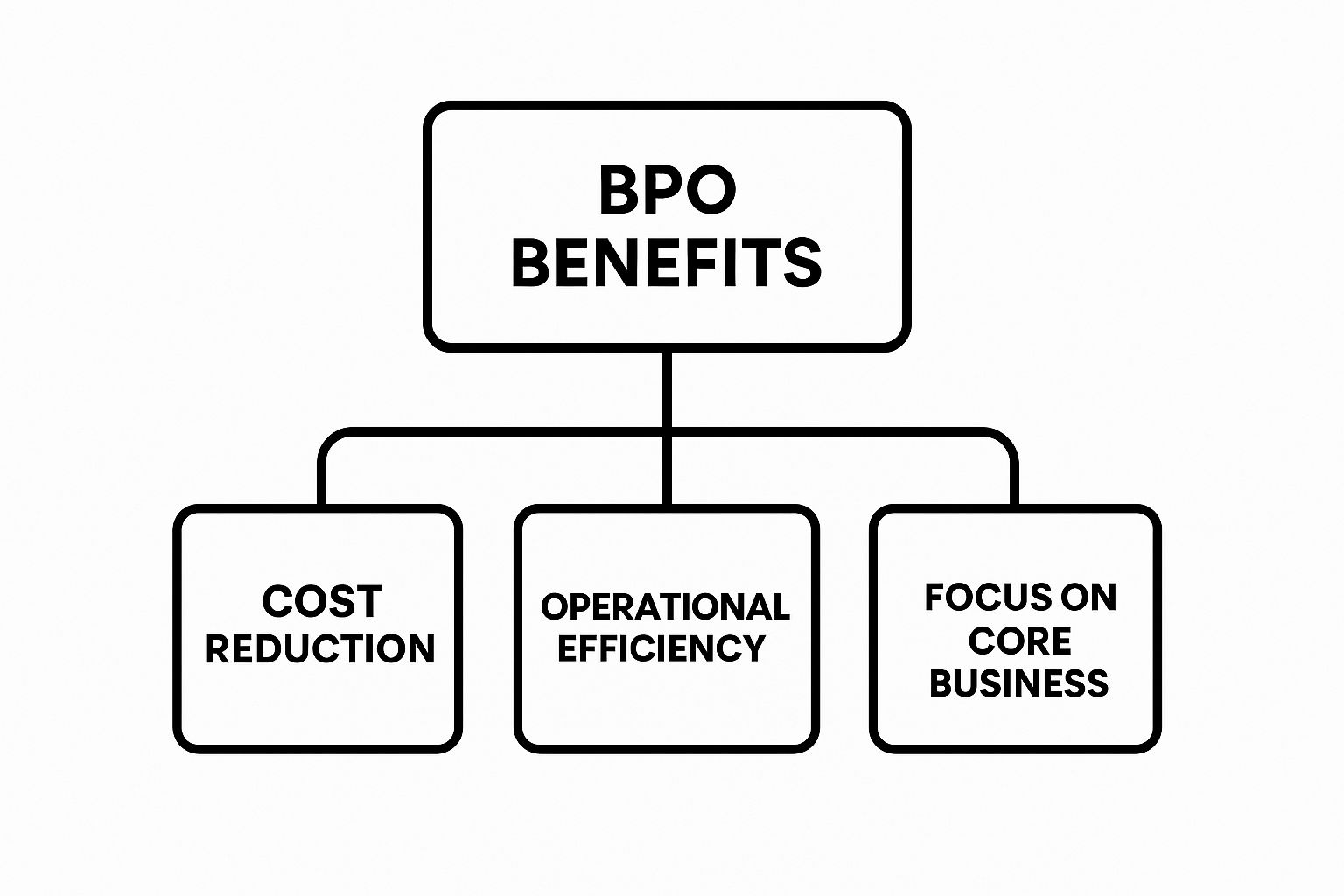
As you can see, the decision goes way beyond just handing off a to-do list. It’s about gaining a real strategic edge.
The Onshore Model: Keeping It Local
Onshore outsourcing—sometimes called domestic outsourcing—is exactly what it sounds like. You partner with a BPO provider located right here in your own country. From a logistics and culture point of view, this is by far the simplest route to take.
There are no language barriers to worry about and no tricky time zone maths to do. Your BPO team works when you work, and they operate under the exact same laws and regulations as your business. This is a massive plus for any industry dealing with tight compliance rules.
The trade-off? This convenience doesn't come cheap. Since you're not tapping into lower labour markets, the main driver isn't cutting costs. It’s more about gaining access to specialised skills and getting operational flexibility without the overheads of hiring permanent employees.
The Offshore Model: Going Global for Big Wins
On the complete opposite end of the scale, you have offshore outsourcing. This is when you send work to a company in a faraway country, usually one where labour costs are significantly lower. This model is famous for one thing above all: delivering major financial savings.
But it's not just about the money. Offshoring opens the door to a gigantic global talent pool. It also makes round-the-clock operations possible. Imagine your company in Europe having its overnight customer support issues handled by a team in Asia. Your customers wake up to solutions, not silence.
Of course, there are hurdles. You'll need to manage big time zone differences, get a handle on cultural nuances, and sometimes navigate language barriers. A rock-solid communication plan and clear management are non-negotiable to make an offshore partnership work.
Key Takeaway: Choosing between onshore, nearshore, and offshore is a strategic balancing act. You have to weigh the potential cost savings against things like cultural fit, time zone convenience, and how complex the work is.
The Nearshore Model: The Best of Both Worlds?
Nearshore outsourcing strikes a fantastic balance. It means working with a provider in a neighbouring country or one that’s in a very similar time zone. For a business in Western Europe, that often points towards countries in Central and Eastern Europe.
This approach gives you a healthy mix of the benefits from the other two models. You get significant cost savings compared to staying domestic, but without the huge time zone headaches or cultural disconnects that can come with going fully offshore. Collaboration is still straightforward, and hopping on a plane for a face-to-face meeting is perfectly manageable.
Poland, for instance, has emerged as a top outsourcing destination in Europe. It’s got the perfect combination of a strategic location, competitive costs, and a highly educated, multilingual workforce. Outsourcing costs in Poland can be 40–60% lower than in Western Europe, while the quality and compliance often surpass what you’d find in cheaper offshore locations. With over 75,000 STEM graduates every year, the talent well is deep. You can learn more about the advantages of outsourcing to Poland to see why it's becoming such a popular choice.
Unlocking the Strategic Advantages of BPO
It’s easy to think of business process outsourcing as just a way to cut costs. And while saving money is certainly a nice perk, looking at BPO only through a financial lens is like buying a high-performance sports car and never taking it out of first gear. The real power of outsourcing is as a strategic tool for driving genuine growth and building a serious competitive edge.
The biggest win? It frees up your most valuable asset: your team’s focus. When you hand off operational burdens to an expert partner, your own people can finally concentrate on the core activities that actually define your brand and move your company forward.
Think about a fast-growing startup. They might have a brilliant, game-changing product, but their small team is completely swamped with IT helpdesk tickets and customer service emails. By outsourcing these tasks, they aren't just offloading work—they're buying back precious time and mental energy to pour back into innovation and development.
Gaining Instant Expertise and Global Talent
One of the most immediate advantages of BPO is tapping into a global pool of specialised talent. Let's be honest, building an in-house team with deep expertise in every single field—from cybersecurity and digital marketing to accounting—is incredibly expensive and takes a huge amount of time.
A BPO partner gives you that expert team, ready-made. Suddenly, a small retail brand can go toe-to-toe with industry giants by outsourcing its complex logistics and supply chain management. They instantly have the operational backbone to handle huge seasonal spikes in demand without ever missing a beat.
By taking advantage of different time zones, you can offer seamless 24/7 customer support. While your local team is sleeping, your BPO partner on the other side of the world is actively resolving customer issues. This ensures you never miss an opportunity and keep satisfaction sky-high.
Enhancing Scalability and Flexibility
The business world changes fast. Business process outsourcing gives you the agility to react almost instantly. Need to ramp up customer support for a big product launch? A BPO provider can add trained agents at a moment's notice. Hitting a slow season? You can scale those services back down without the pain and complexity of layoffs.
This on-demand scalability means you’re not locked into fixed overhead costs, which allows for much smarter, more dynamic resource allocation. It’s this very flexibility that makes a business more resilient and better able to seize opportunities as they arise.
This adaptable approach is amplified when you bring technology into the mix. Many of the strategic perks of BPO get a serious boost from automation, and understanding the wider business process automation benefits can offer a much deeper perspective. When you pair expert human teams with smart tech, you unlock a whole new level of efficiency. You can find out more about this powerful synergy in our guide on business process automation.
Accessing High-Growth Outsourcing Hubs
Strategic outsourcing isn't just about what you delegate, but also where. Certain regions have blossomed into world-class hubs for specific services, offering a perfect blend of skill, efficiency, and cost-effectiveness. The Polish IT and BPO market, for example, is seeing explosive growth, fuelled by a highly skilled talent pool and incredible operational efficiency.
The IT services market in Poland is on track to hit $10.44 billion in revenue by 2025. A huge driver behind this is its remarkably productive workforce, with professionals averaging 1,929 work hours annually—significantly higher than the European average. This strong work ethic, combined with top-tier software developers, makes it an extremely attractive destination.
Ultimately, BPO isn’t about just delegating tasks; it's about elevating your entire business. It’s a calculated move to reinforce your operational foundation, allowing you to build your company higher, faster, and with far more stability than you ever could alone.
The Future of BPO With AI and Automation
The world of business process outsourcing is in the middle of a massive change, and it’s all being driven by Artificial Intelligence (AI) and automation. For years, BPO was all about tapping into human expertise. Now, it’s about giving that expertise a serious upgrade with smart technology, creating a powerful partnership between people and machines.
Think of it this way: if traditional BPO was like hiring a skilled crew to run your ship, AI-powered BPO is like equipping that same crew with a state-of-the-art navigation system, automated sails, and an AI that predicts the weather. The expert sailors are still in command, but their abilities are magnified, letting them sail faster, safer, and with pinpoint precision. It’s not about replacing the crew; it’s about making them better at what they do.
Redefining Efficiency with Intelligent Automation
This new chapter in BPO is built on what we call intelligent automation. Tools like Robotic Process Automation (RPA) and AI are designed to chew through high-volume, repetitive, and rule-based tasks with a speed and accuracy that people just can't sustain. We're talking about things like processing thousands of invoices, migrating data between different systems, or handling the first wave of customer questions.
By handing these foundational tasks over to automation, BPO providers can completely rethink how they deliver their services. Human agents are freed from the daily grind of monotonous work. This allows them to focus their skills on what people excel at: solving complex problems, building strong client relationships, and navigating sensitive customer interactions that require a human touch. It makes for a more rewarding job for them and delivers much greater value to you.
This evolution changes the entire value proposition of BPO. It’s no longer just about finding cheaper labour. It’s about creating hyper-efficient, tech-forward operational hubs that directly contribute to business growth.
This isn’t some far-off future; it’s happening right now in major outsourcing centres. Poland's BPO sector, for example, is jumping on these new technologies. A 2024 analysis of its modern business services found that 70.2% of these organisations plan to implement process automation by 2025. What's more, 64.4% are looking to roll out or expand their AI capabilities, showing a clear commitment to this high-tech direction.
Practical Applications in Modern BPO
So, what does this AI-infused approach actually look like on the ground? The applications are surprisingly diverse and are expanding all the time, going well beyond simple automation.
- Smarter Customer Support: AI-powered chatbots can now handle a huge chunk of initial customer enquiries. They offer instant, 24/7 answers to common questions, which frees up human agents to tackle the more complex or urgent issues. If you want to see how this works, you can learn how to automate customer support in a practical way.
- Predictive Analytics: AI algorithms can sift through massive amounts of data to spot trends and forecast what’s coming next. A BPO partner could use this to predict call volumes for the next holiday season, anticipate what customers might need, or even flag potential supply chain hiccups before they become real problems.
- Automated Data Entry and Validation: Instead of someone manually typing in details, AI tools can now "read" documents like invoices or contracts, pull out the important information, and pop it straight into a CRM or ERP system. This cuts down on errors and dramatically speeds up workflows.
- Sentiment Analysis: AI can monitor customer conversations across calls, emails, and chats to get a read on their mood. This gives businesses a real-time pulse on customer happiness, allowing them to step in and fix issues before they escalate.
To truly appreciate how much these changes are shaking things up, it’s worth exploring the core ideas behind AI Business Process Automation. It gives you a much clearer picture of how all these technologies fit together to build smarter, more agile operations.
The future of BPO is truly collaborative. It’s a model where technology handles the sheer scale and repetition, while human experts bring the strategy, empathy, and creative thinking. It’s this powerful combination that allows businesses to reach a level of efficiency and service quality that was once out of reach, turning what used to be a simple outsourcing decision into a genuine strategic advantage.
How to Select the Right BPO Partner
Choosing a company to handle your business processes isn't like picking a supplier from a catalogue. Think of it more like entering a long-term business partnership. This one decision will ripple through your daily operations, influence your company culture, and ultimately shape your path to growth.
Getting this choice right is what separates a relationship that drives you forward from one that becomes a constant source of headaches and operational drag. It’s a decision that demands careful thought, one that goes far beyond a simple price comparison.
After all, a cheap provider that can’t deliver on quality or security will cost you far more in the long run. We're talking lost customers, potential data breaches, and serious damage to your brand's reputation. The real goal is to find a partner who delivers genuine value, not just the lowest quote.
Laying the Groundwork Before You Search
Honestly, the most crucial step happens before you even start talking to potential BPO providers. You have to get crystal clear on what success actually looks like for your business. This means setting up specific and measurable Key Performance Indicators (KPIs).
Without clear KPIs, you have no real way to gauge performance or hold your partner accountable. What, precisely, do you need them to do?
- For customer service: Is the aim to slash average wait times by 30%? Or maybe to boost customer satisfaction scores to 90%?
- For accounting: Is the goal to close the books five days faster each month? Or to get invoicing errors down to less than 1%?
These aren't just minor details; they are the bedrock of your future agreement. A potential partner who immediately understands and is willing to commit to these metrics is already a cut above the rest.
Looking Beyond the Price Tag
Once you’ve sorted out your internal goals, it's time to evaluate potential BPO providers. But your assessment has to go much deeper than their pricing sheet. A true partnership is built on getting things aligned across several critical areas, not just saving money.
Cultural fit is a huge one. Your BPO provider will effectively become an extension of your own team, interacting with your staff and, in many cases, your customers. A mismatch in work ethic, communication styles, or core values can create constant friction and undermine the entire relationship.
You also need to take a hard look at their technological setup. Are they using modern, secure systems? Are their platforms even compatible with yours? A provider limping along on outdated software will cause integration nightmares and could even open you up to serious security risks.
A truly effective BPO relationship feels like a seamless collaboration, not a transaction. This requires a partner whose operational rhythm, technological capabilities, and cultural values are in sync with your own.
Critical Questions for Potential Partners
To properly vet a provider, you need to ask tough, specific questions that get to the heart of their capabilities and commitment. It helps to have a checklist ready so you can make sure all your bases are covered.
Security and Compliance:
- What specific data security certifications do you hold (e.g., GDPR, ISO 27001)?
- Can you walk me through your disaster recovery and business continuity plans?
- How do you screen and train your employees on data protection and privacy?
Technology and Communication:
- What tools do you use for project management and day-to-day communication?
- Can your systems integrate with our existing CRM or ERP software?
- How do you train agents, and what technology do you give them? For instance, asking if they use tools like real-time agent assist can show how committed they are to quality and efficiency.
Getting solid answers to these questions will paint a much clearer picture, helping you find a business process outsourcing partner who is genuinely equipped to help you succeed.
Navigating Common BPO Challenges
While bringing a BPO partner on board can be a fantastic way to spur growth, it's not always a walk in the park. Let’s be realistic: like any major business relationship, there will be bumps in the road. The trick isn't to hope these issues never come up, but to see them coming and have a solid plan in place to handle them from the very beginning.
Jumping into a BPO partnership without a clear strategy is a recipe for trouble. You can easily find yourself dealing with mismatched expectations, communication that slowly breaks down, and that nagging sense that you've lost the reins of your own business. By tackling these potential problems head-on, you can forge a partnership that's not just effective, but genuinely collaborative.
Managing Expectations and Communication
So, where do things most often go wrong? It usually starts with a gap between what you expect and what your BPO partner actually delivers. This is almost always rooted in fuzzy goals and patchy communication. The antidote is a rock-solid Service Level Agreement (SLA), and you need it locked in before a single task is outsourced.
Think of the SLA as the constitution for your partnership. It needs to be incredibly specific.
- Key Performance Indicators (KPIs): What exact metrics define success?
- Response Times: How quickly must customer queries be handled?
- Quality Standards: What does "good" look like, and how will you measure it?
- Reporting: How often will you get updates, and what will they include?
A well-crafted SLA gets everyone on the same page and eliminates guesswork. It creates a shared, objective definition of what a win looks like.
But the SLA is just the starting point. You also need a steady communication rhythm. Set up regular weekly or bi-weekly calls to go over performance, talk through any hurdles, and plan for what's next. This kind of open dialogue keeps small misunderstandings from snowballing into big conflicts and builds a feeling of genuine teamwork, not a cold, distant client-vendor relationship.
Overcoming Security Risks and Control Concerns
It’s completely normal to feel a bit anxious about data security and losing control when you hand over parts of your operation. These are serious concerns, and they need to be handled carefully. When it comes to security, don’t just take a provider’s word for it. You have to do your homework and really scrutinise their security setup.
A trustworthy BPO provider will be an open book about their security. They should have no problem showing you their certifications, like GDPR or ISO 27001, walking you through their disaster recovery plans, and explaining how they train their staff on handling sensitive data.
The fear of losing control? That’s often a matter of perspective. You aren't giving up control; you're delegating tasks so you can focus on the bigger picture. By setting the KPIs in your SLA and keeping an eye on performance through clear reporting, you're still the one steering the ship.
This shift to strategic oversight actually gives you more control over the results that truly matter. It’s the difference between trying to pull every single rope on the ship yourself versus confidently directing the crew from the helm. Understanding how to reduce operational costs through this kind of smart delegation is a huge part of making BPO work for you. When you anticipate these challenges, you turn them from potential roadblocks into opportunities for building a stronger, more successful partnership.
Common Questions (and Honest Answers) About BPO
As you start looking into business process outsourcing, you’re bound to have questions. It's a big step, and getting straight answers is the only way to feel confident that you’re making the right move for your business. Let’s tackle some of the most common things people ask.
What’s the Very First Thing I Should Do to Start Outsourcing?
It’s tempting to jump straight into researching BPO providers, but that’s not the first step. The real starting point is looking inward. You need to conduct a thorough internal audit of your own operations.
Before you can hand a process off to someone else, you have to know it inside and out. Pinpoint exactly which tasks you want to outsource and document how they work. This clarity is the bedrock of a successful partnership.
Ask yourself the big "why." Are you doing this to cut costs? To tap into skills you don't have in-house? Or is it about making your entire operation run smoother? Nail down these goals and decide on the Key Performance Indicators (KPIs) you'll use to track success. Without this foundational work, you can't properly vet a partner or know if they're delivering what you need down the line.
A great BPO partnership doesn't start with a sales call; it starts with introspection. Knowing your own goals acts as a compass, guiding you to the right partner and ensuring you see real value from day one.
How Does BPO Affect My Company’s Data Security?
This is a huge one, and rightly so. When you outsource a function, you’re often giving a partner access to sensitive company and customer data. It's completely natural to worry about keeping that information safe and private.
Any BPO provider worth their salt gets this. They invest a tremendous amount of money and effort into world-class security. Look for providers who hold internationally recognised certifications like GDPR compliance, ISO 27001, or SOC 2—these aren't just fancy acronyms; they're proof of a serious commitment to security.
When you're evaluating potential partners, dig deep. Ask them about their security protocols, how they encrypt data, what their employee screening involves, and what happens in a worst-case disaster scenario. Your contract should have ironclad clauses on who owns the data and exactly what happens if there’s a breach. This is non-negotiable.
Will I Lose Control Over My Business?
This is probably the single biggest fear people have about outsourcing, but it's built on an old-fashioned view of how BPO works. Modern outsourcing isn't about giving up control; it’s a strategic partnership. You’re handing off the daily grind, but you remain firmly in the driver’s seat.
You maintain control by setting the strategy. The Service Level Agreement (SLA) is where you lay out your goals, KPIs, and quality standards. The BPO provider’s job is to hit those targets, period.
You’ll oversee everything through regular review meetings, transparent performance reports, and open lines of communication. Think of it this way: you’re not losing control. You’re delegating the "how" so you can focus on the "what's next" for your business.
Are you ready to enhance your customer communications without missing a single opportunity? Voicetta provides a 24/7 AI-powered solution that works alongside your team to qualify leads, schedule appointments, and deliver exceptional service. Discover how our intelligent platform can transform your operations by visiting our site today.
Was this useful?
If this article helped, add Voicetta as a preferred source in Google Search. Your results can then highlight our writing.
Add as preferred source