
Blog
Mastering Business Systems Integration
Let’s be honest, the term "business systems integration" can sound a bit corporate and dry. But what it really boils down to is getting all your different software too...
Let’s be honest, the term "business systems integration" can sound a bit corporate and dry. But what it really boils down to is getting all your different software tools to talk to each other, so your business can run like a well-oiled machine instead of a collection of separate, clunky parts.
What Is Business Systems Integration Really About?
Think of your business as a top-tier kitchen. You have a station for prep, another for the main course, and a separate one for dessert. Each chef is an expert in their domain, but if they aren't communicating—if the dessert chef doesn't know when the main course is being served—the whole dining experience falls apart. That's what happens when your business systems are disconnected.
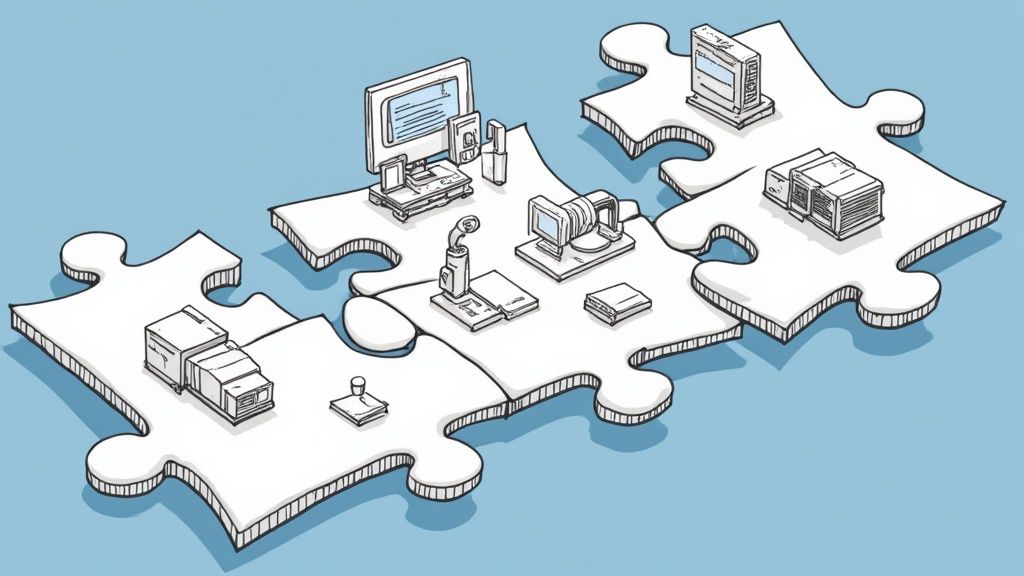
Business systems integration is the process of building bridges between these "stations." It connects your sales software (CRM), your operational hub (ERP), your customer support platform, and everything in between, allowing them to share information automatically and work together in concert.
The Problem of Disconnected Systems
When your tools operate in their own little bubbles, they create data silos. This is a huge, often invisible, roadblock. It means crucial information gets trapped. Your sales team might learn something vital about a client's needs, but if that insight stays locked in the CRM, your product team—working in a completely different system—will never know.
This breakdown forces your team into soul-crushing manual work. Picture an employee copying and pasting customer details from an email into a spreadsheet, then re-typing that same information into the invoicing software. It’s slow, boring, and a breeding ground for costly mistakes. One wrong keystroke could send a shipment to the wrong address or an invoice for the wrong amount.
To see the stark contrast, let's compare how businesses operate with and without integration.
Disconnected Systems vs Integrated Systems A Quick Comparison
| Operational Area | Challenge with Disconnected Systems | Solution with Integrated Systems |
|---|---|---|
| Data Management | Information is fragmented and often contradictory across different platforms. | A single, reliable source of truth is established for all departments. |
| Employee Productivity | Teams waste countless hours on manual data entry and cross-referencing. | Automated workflows handle data transfer, freeing up staff for high-value tasks. |
| Customer Experience | Service is slow and inconsistent because no one has a complete view of the customer journey. | Every team member has a 360-degree view, leading to faster, personalised service. |
| Decision Making | Leaders make choices based on incomplete or outdated information from one silo. | Real-time, comprehensive data allows for smarter, more strategic decisions. |
The difference is night and day. One path leads to frustration and inefficiency, while the other opens the door to smarter, faster operations.
Unlocking True Operational Potential
This is where the magic happens. When systems are truly integrated, you create intelligent, automated workflows that mirror your ideal business processes. For example, the moment a customer clicks "buy" on your website, a chain reaction can kick off automatically:
- Inventory is instantly updated in your ERP.
- The warehouse gets an alert to pick and pack the order.
- Your accounting software generates and sends the invoice.
- The customer's profile in your CRM is updated with their latest purchase.
No human intervention needed. This seamless flow crushes the risk of human error and dramatically speeds up everything from order fulfilment to getting paid. This drive for connectivity is a significant economic force. In Poland, for example, the IT market that powers these integration projects is forecast to hit around $10.35 billion by the end of 2025. This surge is partly thanks to nationwide digitalisation efforts and better network infrastructure, which makes it easier for businesses to adopt these connected technologies. You can learn more about Poland's growing influence in the global software landscape and how it’s shaping integration trends.
At its core, business systems integration is a strategic move to transform your assorted software subscriptions into a single, powerful asset. It’s about building a digital backbone for your company that is efficient, smart, and ready to scale with your ambitions.
What Does Integrated Systems Actually Look Like in a Business?
It’s easy to throw around terms like ‘improved efficiency’, but what does that really mean for a business on a day-to-day basis? The true power of integrating your business systems isn't just about shaving a few minutes off a task. It's about completely reshaping how your company functions, how you interact with customers, and ultimately, how you create value.
Let's move away from the abstract and walk through a real-world scenario to see this in action.

Picture a growing e-commerce business. From the outside, everything seems to be going great—sales are climbing steadily. But behind the curtain, the team is drowning. Every single time a customer places an order, it kicks off a frantic, manual scramble.
First, an employee has to spot the order confirmation in a crowded inbox. Then, they open a separate inventory spreadsheet to manually lower the stock count. After that, they draft an email to the warehouse team with all the order details. And finally, they have to open the accounting software to create and send the invoice. This clunky, step-by-step process wasn't just slow; it was a minefield of potential mistakes.
From Manual Mayhem to Automated Flow
The whole system reached a breaking point after a simple typo sent a high-value order to the wrong address, and another error led to them selling a product that was already out of stock. Customer complaints started rolling in, and team morale was hitting rock bottom. This is the painful, all-too-common reality of disconnected systems. The business wasn't failing because its products were bad, but because its internal operations simply couldn't keep up.
This is when they started their business systems integration journey. The plan was to connect their three most critical platforms: the e-commerce site, the inventory management system, and their accounting software.
The goal was simple but powerful: create a single, automated workflow where data moves instantly and freely between systems, all kicked off by one customer action—making a purchase.
The change was immediate and profound. Now, when a customer clicks "buy", a perfectly coordinated sequence happens automatically in the background. The sales platform instantly tells the inventory system to update stock levels. The inventory system then pings the warehouse's fulfilment software with all the shipping information. At the same time, the accounting software automatically generates and emails a flawless invoice.
The Real-World Results of a Connected Business
This wasn't just a small tweak; it was a complete operational game-changer. The results were clear and measurable, showing the very real benefits that come from building a truly unified digital backbone.
- Massive Reduction in Processing Time: A task that once took 15 minutes of manual work per order now happens in a matter of seconds. This freed up the team to focus on things that actually grow the business, like customer service and marketing.
- Shipping Errors Reduced to Almost Zero: By getting rid of manual data entry, those expensive shipping mistakes became a thing of the past. This didn't just save money; it helped rebuild trust with their customers.
- A Single, Clear View of the Customer: With sales and support data finally talking to each other, the team gained a 360-degree view of every customer. They could see purchase history, past support tickets, and preferences all in one place, which led to smarter marketing and much more personal support.
This story makes it clear that business systems integration is far more than just a tech project. It's a strategic move that directly boosts your bottom line, improves employee morale, and builds customer loyalty. Of course, connecting different systems, especially complex ones, can present difficulties. For anyone looking to understand this better, you can learn more about overcoming common ERP integration challenges and planning for success. By unifying your technology, you're not just fixing today's problems—you're building a stronger, smarter foundation for whatever comes next.
Choosing Your Integration Strategy
So, you’re sold on the idea of getting your systems to talk to each other. The big question now is how? Picking the right business systems integration approach is a bit like planning a transport network for a city. Do you need a few direct footpaths, a central train station, or a flexible grid of interconnected roads? The best answer depends entirely on your business's size, budget, and where you see it heading.
There's no one-size-fits-all solution here. The right strategy for you hinges on your specific goals. Are you looking to simply link two cloud apps together, or are you trying to untangle a complex web of enterprise software? Let's walk through the main options, keeping the tech-speak to a minimum.
The Oldest Method: Point-to-Point Connections
The most basic way to connect two systems is with a point-to-point (P2P) connection. Think of it as running a direct cable from your CRM to your accounting software. It’s a custom-built, one-to-one link designed for a single purpose. Simple, direct, and effective.
This works beautifully when you only have a couple of systems to connect. But what happens when you add a marketing platform? An inventory tool? A customer support desk? You’d need to build a new custom connection for each one, and soon you're left with what people in the industry call "spaghetti architecture." It's a tangled, brittle mess that’s a nightmare to manage and breaks every time you try to change something.
A More Organised Approach: The Hub-and-Spoke Model
To bring some order to the P2P chaos, the hub-and-spoke model came along. Picture a central post office. Instead of every person delivering mail directly to every other person, all mail goes to the central hub first, where it's sorted and sent out to its final destination (the "spokes"). The hub acts as a central translator and traffic controller.
This is a huge step up. Adding a new system is much easier—you just connect it to the hub instead of to every other individual system. The problem? That central hub is a single point of failure. If it goes down, everything stops. It can also become a serious bottleneck as your business grows and more data tries to squeeze through that central point, slowing everything down.
The Modern Gold Standard: API-Led Integration
Today, the most popular and future-proof strategy is API-led integration. Let's go with a restaurant analogy. Imagine you have a waiter who speaks every language. You (one application) can place an order in English. The waiter (the API) understands you perfectly, translates your order for the Spanish-speaking kitchen (another application), and brings your food back exactly as you wanted. You never had to learn Spanish, and the kitchen never had to learn English.
An Application Programming Interface (API) is basically a set of rules and instructions that lets different software talk to each other in a standardised way. The beauty of this approach is that it’s modular. You can create small, reusable APIs for specific tasks—like "check customer credit" or "update product stock"—and use them again and again. It avoids the rigidity of older methods, giving you a flexible foundation.
For any business serious about modernising, getting to grips with these strategies is a critical part of building a digital transformation roadmap.
The image below highlights some of the key frustrations that lead businesses down this path in the first place.
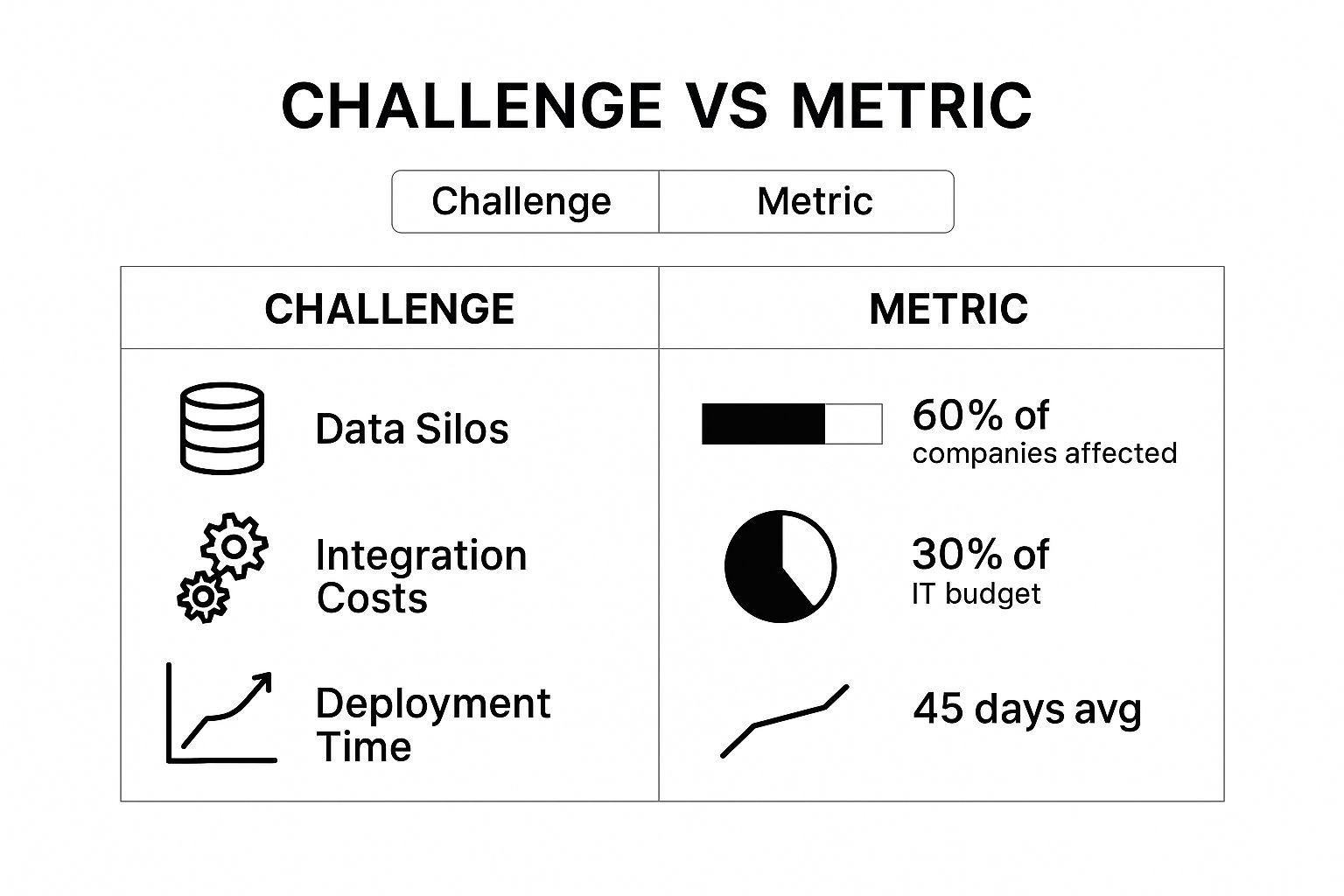
As you can see, isolated data and spiralling integration costs aren't just minor headaches; they are major roadblocks holding businesses back.
An API-led strategy helps you build a more nimble and resilient digital backbone. It’s not just about connecting App A to App B. It’s about creating a flexible ecosystem where you can plug in new tools, swap out old ones, or upgrade parts of your system without bringing the whole thing crashing down. That kind of agility is what keeps you competitive.
Comparing Integration Methods: Pros and Cons
Choosing the right path forward can feel daunting. To make it easier, let's break down the pros and cons of each method. This table should help you weigh which approach aligns best with your company's scale, budget, and technical know-how.
| Integration Method | Best For | Key Advantages | Key Disadvantages |
|---|---|---|---|
| Point-to-Point (P2P) | Very small businesses with only 2-3 systems to connect. | Quick to implement for a single connection; low initial cost for one-off projects. | Becomes exponentially complex and expensive to manage; creates brittle "spaghetti architecture." |
| Hub-and-Spoke | Mid-sized companies looking for a centralised way to manage a moderate number of systems. | Centralised management makes it easier to monitor data flow; simpler to add new "spokes." | The central hub is a single point of failure; can become a performance bottleneck as the business scales. |
| API-Led | Businesses of any size planning for growth, flexibility, and long-term agility. | Highly scalable, reusable, and flexible; promotes innovation by making data accessible. | Higher initial setup cost and requires more specialised skills; can be overly complex for very simple needs. |
Ultimately, the best choice is the one that not only solves today's problems but also gives you the freedom to adapt and grow tomorrow. For most modern businesses, that points squarely towards an API-led future.
Navigating Common Integration Hurdles
Deciding to integrate your business systems is a game-changer, but let's be honest—it’s not always a walk in the park. The path to a seamless, connected operation often has a few bumps along the way. The trick is to see these hurdles not as dead ends, but as problems waiting for a smart solution. With a bit of foresight and the right plan, you can sidestep the common pitfalls and keep your project on track.
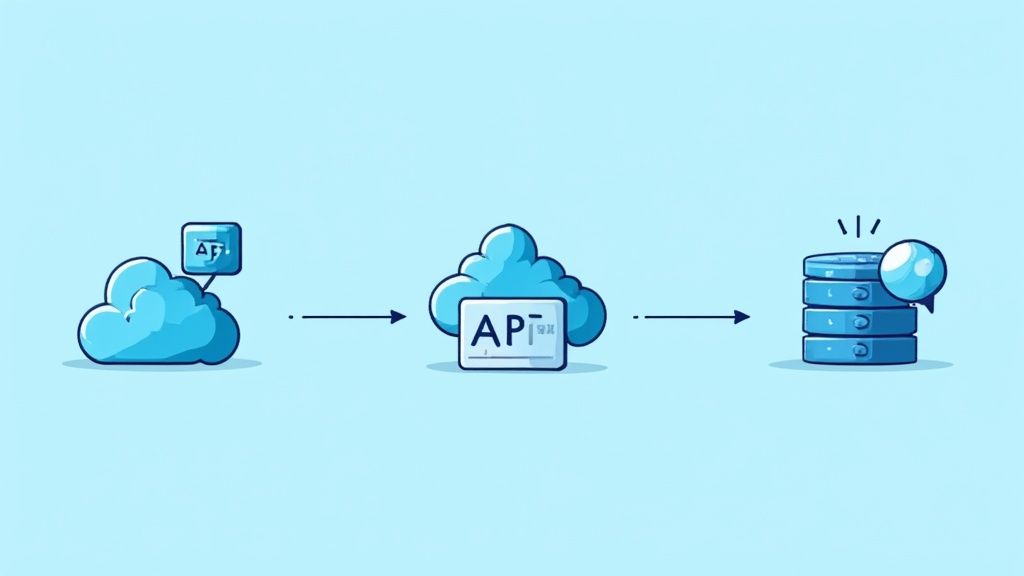
Most businesses stumble over the same things: the upfront cost, wrestling with ancient software, keeping data safe, and not having the right technical skills in-house. Each of these can bog down a project if you don't tackle them head-on.
Tackling Legacy Systems And High Costs
One of the biggest headaches? Legacy systems. We’re talking about those old, often custom-built programs that were never meant to play nicely with today's cloud-based tools. They’re usually rigid, lack modern APIs, and can be a real nightmare to connect to anything new.
This technical problem goes hand-in-hand with a financial one. The initial outlay for integration tools, development work, and expert help can look pretty steep. The answer isn't to do everything at once. A phased approach is much smarter.
- Start Small: Pinpoint the single biggest bottleneck in your current workflow. Focus on integrating just the systems involved there.
- Show The Value: A small, successful project gives you a clear return on investment (ROI). This makes it much easier to get the green light for the next stage.
- Modernise Over Time: Use that initial win to build a case for slowly phasing out or modernising those clunky legacy systems.
This step-by-step method spreads the cost out and builds positive momentum across the company. You can find more practical advice on structuring these kinds of projects in guides on business process automation.
Overcoming The Skills Gap And Security Risks
Another major hurdle is the internal skills gap. Your team might be fantastic at their day jobs, but they aren't necessarily experts in managing complex integration platforms. This is a real issue, especially in places like Poland, which ranks 24th out of 27 EU countries for digitisation. With only 44.3% of the population having basic digital skills, it highlights the challenge companies face in finding the right talent for these projects.
When you hit a skills gap, you have a choice: train your current team or bring in outside experts. Training builds up your own long-term capability, while partnering gets you immediate expertise and moves the project along faster.
At the same time, the moment you get data flowing between systems, you create new potential weak spots. Making sure that information is secure as it travels from your CRM to your ERP is absolutely critical. A security-first approach isn't optional; it's essential.
Key Security Strategies:
- End-to-End Encryption: Lock down your data. It needs to be encrypted both when it's sitting in a database (at rest) and when it's moving between apps (in transit).
- Strict Access Control: Use role-based permissions to ensure people can only see and touch the data they absolutely need for their job. No more, no less.
- Regular Security Audits: Keep a close eye on your data flows. Constant monitoring helps you spot and fix any unusual activity or potential threats quickly.
By thinking about these common issues—cost, old tech, skills, and security—before they become problems, you can build a solid plan. It turns a daunting technical task into a strategic move that delivers real, lasting value to your business.
A Blueprint for Successful Systems Integration
Kicking off a business systems integration project without a clear plan is like trying to build a house without blueprints. You might end up with something that has walls and a roof, but it’s unlikely to be the home you envisioned, and it probably won't be structurally sound. A successful integration isn’t about getting lucky; it's about following a thoughtful, strategic roadmap that turns a massive technical undertaking into a series of achievable steps.
This whole process starts long before a single line of code is written. It begins with a simple, powerful question tied directly to your business goals: What problem are we actually trying to solve here? Are you trying to dramatically speed up order processing? Do you want to give your sales team a complete, 360-degree view of every customer? Or are you bleeding money from inventory errors that need to be stamped out? This "why" becomes your North Star, guiding every single decision you make from that point forward.
The Tale of Two Rollouts
To see what a difference a methodical approach makes, let's look at two companies. The first, a mid-sized distributor, rushed headlong into their integration. They were eager to modernise and decided to connect their new ERP, CRM, and warehouse management system all at the same time. This “big bang” launch was meant to be impressive. Instead, it was a catastrophe. Data conflicts they never saw coming brought operations to a grinding halt. Frustrated employees gave up and went back to their old, familiar spreadsheets, and the project's budget spiralled out of control as the team scrambled to put out fires.
Now, consider their competitor, who took a completely different path. They started by identifying their single biggest pain point: the painfully slow, manual handoff between a sale being made and the order being fulfilled. Their first project was small and laser-focused on connecting their CRM to their inventory system. They carefully mapped out every piece of data, ran test after test, and rolled it out to a small pilot group first. It was a quiet, resounding success that delivered immediate value and built huge confidence. That small win paved the way for the next integration, and the next, creating a steady rhythm of low-risk, high-impact progress.
First Steps Define Final Success
The lesson here is crystal clear: careful planning and a phased rollout aren’t just nice ideas; they're essential for successful systems integration. Before you even think about connecting anything, you have to meticulously map your data. Think of it like creating a detailed wiring diagram for your entire business.
- Identify the Source of Truth: For every single piece of data, like a customer's address, which system is the master record holder? There can only be one.
- Trace the Flow: Where does that data need to go? What specific event—like a "new order" status—should trigger its movement?
- Define Transformations: Does the data need to be changed or reformatted along the way to be understood by the system receiving it?
Answering these questions is what prevents the data chaos that sank the first company. This clarity is also what helps you choose the right tools for the job. Your data map will tell you if you just need a simple connector for two cloud apps or a much more powerful platform. For a deeper look at this, our guide on selecting the right CRM integration software can help you match the right technology to your specific business needs.
A successful integration is less about a single, heroic launch and more about a series of well-planned, deliberate victories. Each step should solve a real problem and build a stronger foundation for the next.
Choosing the Right Partner and Place
The final piece of this puzzle is finding the right expertise. For many businesses, the necessary skills aren't sitting in the next cubicle. This is where strategic nearshoring has become a go-to solution. For instance, Poland has grown into a major European hub for IT services and systems integration. The country’s IT services market is on track to hit $13.1 billion by 2029, a boom driven by a deep pool of highly skilled engineers and a welcoming business environment.
Major tech firms have established significant operations in Polish tech centres specifically to tap into this talent. This makes it a compelling option for companies that need high-quality, cost-effective integration partners. You can find more information about Poland's role in the nearshoring market on devsdata.com. By combining a clear internal strategy with the right external expertise, you can build a blueprint that ensures your integration project not only works, but delivers real, lasting value to your business.
Of course. Here is the rewritten section, designed to sound like it was written by an experienced human expert.
Your Systems Integration Questions, Answered
It's completely normal to have questions when you're thinking about a systems integration project. Concerns about the cost, the time it will take, and whether it's even right for your business are all part of the process. Let's tackle some of the most common questions I hear from business owners and managers.
How Much Does Business Systems Integration Typically Cost?
There's no single price tag for integration, and anyone who gives you one without knowing the details is guessing. The final cost really depends on what you're trying to connect. A simple link between two modern cloud apps using a ready-made connector might only set you back a few thousand dollars.
But if you're looking at a huge project, like getting a brand-new ERP to talk to a dozen older, custom-built systems, you could be looking at a six-figure investment. The key is to see this as exactly that—an investment. You have to weigh the upfront cost against the massive long-term wins you'll get from better efficiency, fewer human errors, and the kind of sharp, data-driven decisions you couldn't make before.
How Long Does an Integration Project Take?
Just like the cost, the timeline is tied directly to the complexity. A straightforward API integration between two well-documented systems? You could be up and running in a few weeks. A full-blown ERP rollout across your entire company, on the other hand, is a much bigger beast. That could take anywhere from six months to well over a year.
The speed of your project really hinges on a few things: the quality of the data you're starting with, how good the technical documentation is for your existing software, and the team you can put on the job.
Honestly, the smartest way to handle a big project is often a phased approach. Tackle the integrations in smaller, manageable chunks. This way, you start seeing a return much faster, build momentum, and seriously cut down the overall project risk.
Can Small Businesses Benefit From Systems Integration?
Absolutely. This isn't just a game for the big corporations anymore. Think about it—most small businesses I know are juggling a whole suite of cloud tools for everything from accounting (like Xero) to sales (like HubSpot) and project management. Getting those tools to talk to each other is a massive time-saver.
Imagine automatically firing off an invoice in your accounting software the second a deal is marked 'won' in your CRM. That's one less manual task, one less chance for a typo or a forgotten bill. With so many modern platforms offering built-in connectors, business systems integration has never been more accessible or affordable for smaller companies.
What’s the Difference Between Data and Application Integration?
People often use these terms interchangeably, but they solve different problems. Think of it like this:
Data integration is all about getting your information in one place. Its goal is to pull data from various sources—your sales platform, your marketing tools, your support tickets—and combine it into a single, unified view. This is what you do when you build a central data warehouse for business reporting.
Application integration, however, is about making your software work together to automate tasks. It’s about the process. For example, when a customer updates their address in your CRM, application integration is what automatically pushes that new address to your billing and shipping systems. To get the full benefit, you really need both working in harmony.
Are you ready to stop losing leads and ensure every customer feels heard, 24/7? Discover how Voicetta can integrate with your existing systems to automate communication, qualify leads, and schedule appointments without missing a beat. Visit Voicetta.com to see how our AI communication platform can transform your business.
Was this useful?
If this article helped, add Voicetta as a preferred source in Google Search. Your results can then highlight our writing.
Add as preferred source