
Blog
Call Center Quality Assurance: Boost Customer Satisfaction
Inconsistent customer service can severely impact customer loyalty and, consequently, a company's profits. This makes call center quality assurance (QA) more critical...
The Strategic Value of Call Center Quality Assurance

Inconsistent customer service can severely impact customer loyalty and, consequently, a company's profits. This makes call center quality assurance (QA) more critical than ever. It’s not simply about listening to calls anymore; it's about gaining a competitive edge. Leading companies are transforming their call center QA programs into essential tools for customer retention and revenue growth.
This transformation involves recognizing the psychology behind customer interactions. Customers value consistent and predictable service experiences. Implementing a system of quality measurement helps provide this consistency, meeting the expectations of today's demanding customers.
Many traditional QA methods fall short. They frequently emphasize superficial compliance checklists rather than the overall quality of the interaction. However, successful brands are restructuring their QA programs. Their focus is on measurable business impact.
Why First Call Resolution Matters
A vital aspect of call center quality assurance is First Call Resolution (FCR). This metric tracks the percentage of customer issues resolved on the first contact, preventing the need for follow-up calls or escalations. A high FCR rate directly correlates with improved customer satisfaction.
The global FCR rate currently averages between 70% and 75%. Interestingly, two-thirds of unsuccessful FCR attempts result from inaccessible data and resources. Improving FCR means providing agents with the right tools. This includes improved training, readily available knowledge bases, and effective technology like Interactive Voice Response and skill-based routing. For more statistics, check out this resource: Call Center Statistics. Also, you might find this article helpful: How to Master Call Center QA.
Building a Customer-Centric QA Strategy
Effective call center quality assurance begins with a customer-centric philosophy. This involves understanding customer needs and creating QA procedures that reflect those expectations.
-
Focus on Empathy: Evaluate agent performance not only for efficiency but also for empathy and genuine customer connection.
-
Personalize the Experience: Leverage QA data to identify opportunities for personalized customer interactions.
-
Embrace Continuous Improvement: Regularly review and adjust QA strategies based on customer feedback and changing demands.
By evolving from basic call monitoring to a more strategic, customer-focused approach, organizations can transform call center QA programs into powerful growth drivers. This guarantees that every interaction reinforces a positive brand image and strengthens customer relationships. The result is improved customer loyalty and increased revenue.
Metrics That Actually Drive Call Center Excellence
Often, call centers get caught up in tracking vanity metrics. These numbers might look impressive on a report, but they don't tell the real story of the customer experience. Instead of focusing on call volume or average talk time, we need to dig deeper. We need to understand the quality indicators that truly affect customer satisfaction and, as a result, business success. This means finding the right balance between measuring efficiency and evaluating the quality of each customer interaction. This gives us a much more complete understanding of how well a call center is serving its customers.
Beyond Traditional Metrics
Traditional call center metrics, like Average Handle Time (AHT), certainly have their place. They’re useful for understanding efficiency, but they miss some of the subtleties of modern customer interactions. Think about it: a short handle time could mean an agent efficiently resolved an issue. But it could also mean they rushed the customer off the phone without addressing their needs completely. That's why smart organizations are creating custom Key Performance Indicators (KPIs). These KPIs are designed around specific moments in the customer journey, providing a more accurate view of the overall experience.
Focusing on Customer Satisfaction
This brings us to a crucial point: customer satisfaction is tied directly to specific call center quality assurance metrics. Two important examples are Average Speed of Answer (ASA) and Customer Satisfaction Score (CSAT). The global average ASA sits around 34.4 seconds, a seemingly short time that can significantly impact a customer's first impression. CSAT scores, often collected through post-call surveys, directly measure how happy customers are with the service. Globally, average CSAT scores typically fall between 75% and 80%. In the U.S., the average CSAT for call centers was approximately 73% in 2022. This highlights how crucial customer satisfaction is for encouraging repeat business. In fact, 93% of consumers are more likely to buy again from companies that offer excellent customer service. You can find more detailed information on Call Center Quality Assurance Metrics.
Key Metrics and Their Impact
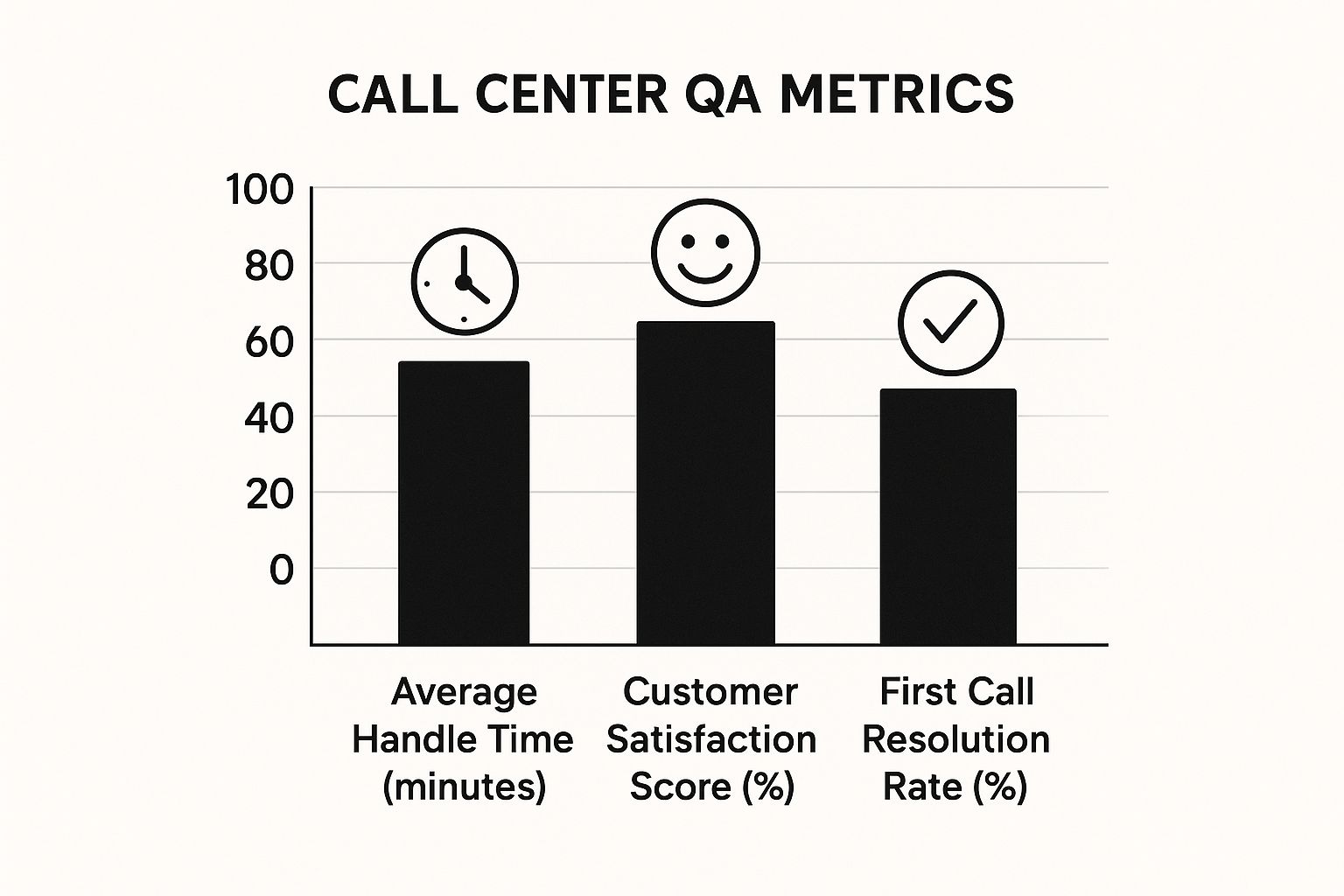
To better understand the link between these crucial metrics and overall customer satisfaction, take a look at the following data, visualized in the data chart below. This chart shows the target benchmarks for key call center metrics and how they influence CSAT:
- First Call Resolution (FCR): A good target for FCR is 70-80%. A high FCR is strongly linked to higher CSAT.
- Average Handle Time (AHT): Efficiency matters, but it's important to find the right balance between speed and thoroughly addressing customer needs.
- CSAT: Aim for a CSAT of 85% or higher. This is a direct reflection of how satisfied customers are with their experience.
- Agent Empathy Score: Measured through call monitoring and scoring, agent empathy significantly affects CSAT. A good goal is to achieve scores above 90%.
The data chart clearly illustrates the correlation between improvements in metrics like FCR and agent empathy, and a corresponding increase in CSAT. A low FCR rate, for instance, might highlight a need for better agent training or improved access to helpful resources. Similarly, a high AHT coupled with low CSAT could suggest agents are taking too long to resolve issues effectively. This underscores the need for a balanced approach to call center quality assurance. It's about looking beyond simple efficiency metrics and focusing on the factors that really build customer loyalty and drive business growth.
To help visualize the impact of these key metrics, the table below offers a more detailed breakdown:
Essential Call Center Quality Assurance Metrics
| Metric | Definition | Industry Benchmark | Impact on Customer Experience |
|---|---|---|---|
| First Call Resolution (FCR) | The percentage of calls resolved on the first contact | 70-80% | Higher FCR directly correlates with improved customer satisfaction and reduced call volume. |
| Average Handle Time (AHT) | The average duration of a call, including hold time and after-call work | Varies depending on industry and call complexity | While a lower AHT is desirable, it should not come at the expense of thoroughness and customer satisfaction. |
| Customer Satisfaction Score (CSAT) | A metric that measures how satisfied customers are with a specific interaction | 85% or higher | Directly reflects customer happiness and loyalty. |
| Agent Empathy Score | Measures an agent's ability to understand and respond to a customer's emotional state | 90% or higher | High empathy scores contribute significantly to positive customer interactions and improved CSAT. |
This table emphasizes the interconnectedness of these metrics and their collective impact on the overall customer experience. By focusing on these key indicators, call centers can move beyond vanity metrics and build a culture of true customer-centricity.
Crafting a QA Framework That Actually Works

Many call center quality assurance (QA) programs struggle to deliver meaningful results. The problem often lies within the framework itself. Instead of fostering improvement, these programs can become cumbersome processes that miss the nuances of modern customer interactions. This section explores building a QA framework that truly works, drawing insights from successful operations leaders. We'll examine how to create evaluation criteria that move beyond simple checklists and capture the heart of excellent service.
Balancing Objective Standards with Brand Philosophy
Effective call center quality assurance requires a delicate balance between objective standards and brand philosophy. Objective standards are crucial for consistent performance measurement. However, these standards shouldn't eclipse the unique service philosophy of your brand. Your QA framework should reflect the values and personality you aim to convey to customers. For instance, if your brand prioritizes personalized service, your QA framework should assess how well agents tailor their interactions to each customer's individual needs.
Designing Effective Scorecards
Traditional scorecards often focus on superficial compliance, missing the true essence of quality interactions. A truly effective scorecard delves deeper, assessing aspects like agent empathy, effective problem-solving, and rapport-building. This goes beyond checking boxes to consider the overall impact on the customer experience. This shift allows for a more holistic view of agent performance.
-
Focus on Behaviors: Evaluate the actions agents take to create positive customer experiences.
-
Prioritize Customer Impact: Measure how interactions influence customer satisfaction and loyalty.
-
Use Clear and Concise Language: Ensure the scorecard is easy to understand and apply.
Ensuring Evaluator Consistency and Agent Motivation
Even the best scorecard is ineffective if applied inconsistently. Calibration sessions are essential for ensuring all evaluators understand and apply the criteria uniformly. These sessions help minimize bias and maintain objectivity. Furthermore, feedback should be constructive and motivating, focusing on specific areas for improvement with clear guidance on skill enhancement. You might be interested in learning more about a tailored approach to QA: Learning more about our tailored approach to QA.
Building a Robust QA Framework
To illustrate the differences between traditional and modern approaches, let’s look at the table below:
The following table compares different approaches to key components of quality assurance frameworks.
| Component | Traditional Approach | Modern Approach | Implementation Considerations |
|---|---|---|---|
| Evaluation Criteria | Primarily focused on compliance and efficiency metrics | Balances objective standards with brand values and customer experience | Define specific behaviors that reflect your brand's service philosophy |
| Scorecards | Checklist-based, often superficial | Focuses on behaviors and customer impact; incorporates qualitative metrics | Use clear, concise language that is easy for evaluators and agents to understand |
| Evaluator Calibration | Often infrequent or nonexistent | Regular calibration sessions to ensure consistency | Develop clear guidelines and examples to illustrate the scoring criteria |
| Feedback System | Primarily focused on identifying weaknesses | Constructive feedback aimed at motivating and developing agents | Provide specific, actionable steps for improvement |
| Governance | Rigid, top-down approach | Flexible, adaptable to evolving customer needs | Establish clear roles and responsibilities for QA program oversight |
This table summarizes key components of a successful QA framework and their contribution to a more comprehensive and effective approach to quality assurance. By embracing these modern strategies, call centers can develop QA programs that drive genuine improvements in agent performance and enhance customer satisfaction.
Technology That Transforms Call Center Quality Assurance
Beyond simply recording calls, technology offers a deeper understanding of customer interactions, empowering call centers to significantly improve their quality assurance (QA) processes. Let's explore how tools like AI-powered analytics, real-time coaching, and automated scoring are reshaping call center QA.
AI-Powered Analytics: Uncovering Hidden Insights
AI algorithms can analyze massive amounts of call data, revealing trends and patterns that would be impossible to identify manually. This provides valuable insights into customer behavior, agent performance, and developing tendencies, all of which can inform and improve QA strategies. For instance, AI can identify specific phrases or keywords linked to customer satisfaction or dissatisfaction, helping call centers pinpoint areas where agents excel or need further training.
Real-Time Coaching Tools: Empowering Agents in the Moment
Real-time coaching tools offer immediate feedback during live calls. These tools can alert agents to deviations from the script, compliance issues, or shifts in customer sentiment. This allows agents to self-correct and enhance their performance on the spot. Furthermore, these tools offer just-in-time support, providing agents with instant access to helpful information and resources, minimizing errors, and resolving customer issues more effectively.
Analytics and Automation in Call Center QA
Another vital component of call center quality assurance is the integration of analytics and automation. While the importance of QA is widely acknowledged, many contact centers find it challenging to implement these processes smoothly. A significant 85% of contact centers are looking to upgrade or replace their quality assurance automation systems, highlighting a need for greater efficiency and better oversight. The use of analytics in quality assurance and customer experience management is projected to rise, with anticipated usage reaching 61% in both areas. However, hurdles remain: 85% of contact centers struggle to dedicate enough time to quality assurance, and 61% cite inadequate technology as a major obstacle. More detailed statistics can be found here.
Automated Scoring Systems: Ensuring Objectivity and Consistency
Automated scoring systems eliminate the subjectivity often present in manual call evaluations. Using pre-defined criteria to assess agent performance on every call ensures fairness and objectivity across the board. This consistent approach allows QA specialists to focus on more strategic activities like coaching and training, optimizing resource allocation. You might also be interested in How to Master Call Center Pricing.
The Human Element: Balancing Automation with Critical Thinking
While automation plays a vital role in modern call center QA, maintaining a balance with human insight is essential. Technology should augment, not replace, the critical thinking skills necessary for thorough quality assessment. QA specialists are crucial for interpreting data, providing personalized coaching, and ensuring that technology aligns with the overall goals of the call center. This combination of automation and human expertise ensures that call center QA remains adaptable and effective in meeting the ever-changing needs of customers.
Transforming Feedback Into Agent Performance Breakthroughs

Gathering valuable insights is only part of the call center quality assurance equation. These insights become truly powerful when combined with effective coaching. This section explores how top call centers transform evaluation data into targeted agent development opportunities that encourage real performance growth. Integrating live chat can also greatly enhance call center QA through real-time feedback and monitoring, as demonstrated by Social Intents' Live Chat.
Coaching for Performance Improvement
Effective coaching goes beyond simple critique. It's about inspiring genuine improvement by understanding individual learning styles and adapting coaching methods accordingly. Some agents may respond well to direct feedback, while others prefer a more collaborative approach.
-
Focus on Strengths: Begin by acknowledging what the agent excels at. This builds confidence and creates a receptive environment for constructive feedback.
-
Provide Specific Examples: Vague feedback is rarely helpful. Use concrete examples from call recordings or evaluations to pinpoint areas for improvement.
-
Create Actionable Steps: Help agents create a plan to address their weaknesses and hone their skills. This could involve further training, shadowing seasoned agents, or practicing specific techniques.
Personalized Development Plans
Just as learning styles vary, so do developmental needs. A generic, one-size-fits-all approach to agent development is unlikely to yield significant results. Instead, personalized development plans focusing on individual weaknesses and building on existing strengths create a sense of ownership and motivate agents to invest in their improvement. For more on call center QA, check out this article: How to master Call Center QA with Voicetta.
Engaging Agents with Quality Initiatives
Sustaining agent engagement with quality initiatives is key for long-term success. This often means moving beyond traditional training and embracing innovative approaches.
-
Peer Mentoring: Pairing experienced agents with newer team members fosters a supportive learning environment and encourages knowledge sharing.
-
Microlearning Modules: Offering short, focused training modules on specific skills or concepts makes learning more digestible and improves retention.
-
Gamification: Introducing game-like elements, such as points, badges, and leaderboards, into the QA process can boost agent motivation and make quality assurance more engaging.
Recognizing and Reinforcing Quality
Recognizing and rewarding agents who consistently meet or exceed quality standards is crucial. This reinforces positive behavior and cultivates a culture of excellence within the call center. Recognition can range from verbal praise to formal awards or incentives. Regularly highlighting success stories can also inspire other agents and further solidify quality as a core value.
Measuring Coaching Effectiveness and Demonstrating ROI
Finally, measuring the impact of your coaching and development programs is essential. Tracking key metrics, such as improved CSAT scores or reduced call handle times, demonstrates the return on investment (ROI) of these initiatives. This data is vital for securing continued support and resources for agent growth and ensuring the ongoing success of your call center quality assurance program.
Future-Proofing Your Call Center Quality Assurance Program
Customer expectations are constantly changing. Is your call center quality assurance (QA) program keeping pace? Forward-thinking organizations are adapting their QA initiatives to anticipate these shifts. This involves looking beyond individual interactions and embracing a more comprehensive understanding of the customer journey.
Evaluating the Holistic Customer Journey
Traditional call center quality assurance often focuses on single interactions. However, customers interact with your business across multiple channels. This means evaluating the entire customer journey is essential. A customer might begin with an online chat through a platform like Intercom, then follow up with an email, and finally, resort to a phone call. Each touchpoint contributes to their overall impression of your service. Therefore, your QA program must account for this interconnectedness.
Integrating Emotional Intelligence and Behavioral Analysis
Modern QA programs incorporate emotional intelligence and behavioral analysis. This goes beyond checking if agents adhered to a script. It delves into how they managed the emotional dynamics of the exchange. Did the agent display empathy? Did they actively listen and respond thoughtfully to the customer's emotional cues? These elements significantly influence customer satisfaction. Incorporating them into your QA criteria is key.
Maintaining Relevance and Preventing Evaluator Fatigue
Regularly updating your QA program is crucial for preventing evaluator fatigue and ensuring relevance. Imagine reviewing hundreds of calls weekly using the same criteria. Evaluators can become desensitized, leading to inconsistencies. To combat this, refresh your scorecards and evaluation criteria. This keeps the QA process engaging and aligned with evolving customer expectations and industry best practices.
Aligning QA with Broader Customer Experience Initiatives
Leading brands are connecting quality assurance with broader customer experience (CX) initiatives. This creates a unified approach to service excellence. Think of QA not as a separate entity, but as an integral part of the overall CX strategy. This means aligning your QA metrics with your CX goals. For example, if improving customer loyalty is a CX goal, then your QA program should emphasize factors that promote loyalty.
Measuring QA Program Maturity and Planning for Continued Evolution
For continued success, measuring your QA program's maturity is vital. This helps identify areas for improvement and create a strategic roadmap. This could involve establishing custom Key Performance Indicators (KPIs), implementing new technology, or refining coaching techniques.
- Assess Current Capabilities: Evaluate existing QA processes, technology, and team skillsets.
- Identify Gaps: Pinpoint areas where your QA program falls short of best practices.
- Develop a Roadmap: Create a plan to address the gaps and enhance the program's overall maturity.
By actively planning for evolution, you ensure your call center quality assurance program remains a valuable asset in delivering exceptional customer experiences.
Ready to transform your call center into a customer loyalty powerhouse? Voicetta, an AI communication platform, ensures comprehensive customer interaction coverage, offering 24/7 support. Learn more about how Voicetta can enhance your customer support.
Was this useful?
If this article helped, add Voicetta as a preferred source in Google Search. Your results can then highlight our writing.
Add as preferred source