
Blog
Call Center Transformation: Boost Efficiency & Customer Satisfaction
Jumping into a call centre transformation without first taking a brutally honest look at your operations is like trying to drive across the country without a map. You ...
Understanding Where Your Call Centre Really Stands
Jumping into a call centre transformation without first taking a brutally honest look at your operations is like trying to drive across the country without a map. You might get somewhere, but it’s going to be a long, frustrating trip, and you probably won’t end up at your intended destination. Many leaders I’ve spoken with believe they have a good handle on things, often pointing to respectable Customer Satisfaction (CSAT) scores. The problem is, these high-level metrics can hide deeper issues that are slowly eroding both agent morale and customer loyalty.
What’s happening on the floor often tells a different story. Picture your agents: they’re probably bogged down with repetitive data entry, switching between five different screens to answer a single question, and dealing with customers who are already annoyed after fighting with a confusing IVR menu. This is the perfect recipe for agent burnout, a huge operational drain that directly sinks service quality and sends turnover costs through the roof. At the same time, your customers' expectations have changed. They don't just want problems fixed; they want you to anticipate their needs and offer effortless, personalised help. A decent CSAT score completely misses the customer who gave up and hung up after a long wait, or the one who switched to a competitor after a clunky self-service experience.
To really see the shift, it helps to compare the old way of doing things with a modern, transformed approach.
Traditional vs. Modern Call Centre Comparison
This table breaks down the key differences between a standard call centre and one that has successfully modernised its operations. It shows not just what changes, but why it matters for your overall performance.
| Aspect | Traditional Call Centre | Modern Transformed Centre | Impact on Performance |
|---|---|---|---|
| Primary Focus | Cost reduction, call volume management | Customer experience, value creation | Shifts from a cost centre to a profit and loyalty driver. |
| Agent Role | Scripted, reactive problem-solver | Empowered, proactive consultant | Agents are more engaged, leading to lower turnover and higher quality interactions. |
| Technology | Disconnected, legacy systems | Integrated, AI-driven platforms | A single pane of glass reduces AHT and improves accuracy. |
| Key Metrics | Average Handle Time (AHT), calls per hour | First Contact Resolution (FCR), Net Promoter Score (NPS), Customer Effort Score (CES) | Focus moves from speed to effectiveness and loyalty, which are better indicators of long-term success. |
| Customer Interaction | Transactional, one-size-fits-all | Personalised, context-aware conversations | Customers feel understood, not just processed, which builds stronger relationships. |
| Self-Service | Basic, often frustrating IVR menus | Intelligent, conversational AI virtual agents | Reduces inbound calls for simple queries, freeing up human agents for complex issues. |
Seeing the contrast laid out like this makes it clear that a true transformation is about much more than just new software—it's a fundamental change in philosophy and operational strategy.
Moving Beyond Surface-Level Metrics
To get a true picture of where you stand, you have to look past the headline numbers. It’s about finding the real sources of friction, not just treating the symptoms. A high Average Handle Time (AHT), for example, isn't just a metric; it's a story. It could be telling you that agents lack the right information, that internal processes are clunky, or that the tech is getting in their way. Leaders who pull off successful transformations always start by asking the tough questions:
- Where are our agents really losing the most time during their day?
- What are the top three reasons customers have to call us back?
- Are our current tools actually helping our team, or are they just creating more clicks and confusion?
- From our customer’s point of view, what does a "frustrating experience" truly feel and sound like?
This kind of honest assessment gives you a solid baseline—a starting point you can actually measure your progress against. It’s not about finding fault; it’s about uncovering the biggest opportunities for meaningful improvement. This is a trend playing out across the industry. For instance, the Poland contact centre market is seeing significant growth as businesses adopt advanced tech to keep up with customer demands. With revenue and call volumes set to rise through 2031, the pressure to modernise is mounting. You can dig into the specifics of this growth and its ties to technology by exploring the full research about the Poland contact centre market.
This initial deep dive is the most vital part of any call centre transformation. It gives you the unvarnished truth you need to build a strategy that fixes real problems. It ensures that your investment in a new platform, like Voicetta, will produce genuine, measurable results instead of just a superficial facelift. Without it, you’re just automating old, inefficient habits and making existing problems bigger.
Creating a Transformation Strategy That Actually Succeeds
A real call centre transformation isn't about buying the shiniest new toy on the market. It’s built on a solid strategy. I’ve seen some of the most expensive failures happen when businesses rush to adopt new tech before they’ve done the hard work of planning. A smart transformation starts with some honest self-reflection and a clear idea of where you want to end up.
Before you even think about calling a vendor, you need to map out the entire journey. This means getting genuine support from two very different groups: the executives who hold the purse strings and the frontline agents who will live with these changes every single day. For executives, you need a business case that links the project directly to the bottom line. It’s not about vague promises like "improving CX." It’s about tangible goals, like "reducing customer churn by 15%" or "boosting upsell conversions by 10%."
The conversation with your agents is completely different. They're likely worried about their jobs changing or even disappearing. Great leaders tackle this concern head-on. They present the transformation as a chance for growth and upskilling. You need to paint a picture of a future where agents are no longer just reading from a script. Instead, they're expert problem-solvers, equipped with tools that handle the boring, repetitive tasks, freeing them up to deliver real, human value.
Choosing Your Transformation Path
Every company's journey is unique. The right approach for you will hinge on your business culture, your appetite for risk, and the resources you have. Generally, there are two main roads you can take:
-
The Gradual Evolution: This path involves rolling out changes in smaller, more digestible phases. You could start by using an AI chatbot to automate simple, frequent queries. This gets you a quick win, builds momentum, and gives your team time to adjust. It’s a solid choice if your organisation is cautious or working with a tighter initial budget.
-
The Comprehensive Overhaul: This is the "big bang" approach, where you replace several old systems all at once. It’s definitely riskier and needs more resources, but the payoff can be much faster and more significant. This route is best if your current systems are seriously holding you back and you need a complete reset to stay in the game.
Aligning Stakeholders and Setting Realistic Expectations
Once you've decided on a path, your next job is to get all the key players on the same page. This group is bigger than just the call centre manager and the IT department. Who from finance needs to be in the loop? What about the marketing team, whose campaigns drive your call volume? It helps to create a stakeholder map and set up a regular communication schedule to keep everyone informed and involved.
This is also the time for a reality check on your timelines and budget. A common mistake is promising the world in a short amount of time. A proper transformation takes effort. For example, a global e-commerce client I worked with initially planned a six-month timeline for their overhaul. They didn't properly account for the headache of migrating 10 years of customer data, and the project ended up taking an extra four months. Be realistic. Pad your timeline and budget for surprises—because they will happen. This kind of strategic thinking is a great way to improve operational efficiency before you've even started.
Looking at global trends can also offer valuable lessons. For instance, Poland has emerged as a major centre for Business Process Outsourcing (BPO), showing how skilled talent and a supportive business environment can fuel growth. The Polish BPO market revenue is expected to reach about US$3.44 billion in 2025. You can discover more insights about the Polish BPO market on Statista.com to see what's possible. Building a strategy with this level of clarity—both for your internal team and with an eye on the wider market—is what separates a successful project from one that never gets off the ground.
Choosing Technology That Transforms Operations
Picking the right technology for your call centre transformation can feel like trying to find your way through a maze. The market is packed with vendors, each one promising incredible results, but a polished demo often doesn't reflect real-world performance. If you choose poorly, you could halt your progress, waste your budget, and saddle your team with tools that cause more headaches than they solve. The real secret is to look beyond flashy feature lists and concentrate on what truly counts: smooth integration and genuine operational improvement.
I’ve had conversations with countless IT leaders who learned this lesson the tough way. A frequent mistake is focusing on a single, impressive feature while ignoring how the platform will connect with the systems you already use. A cutting-edge AI chatbot is pointless if it can’t access customer history from your CRM. This is where modern, all-in-one platforms like Voicetta are changing the game. They are designed with integration as a fundamental principle, making sure that intelligent routing, CRM connections, and automated workflows communicate with each other seamlessly.
For instance, this is what a modern, integrated platform's user interface often looks like, designed for clarity and ease of use.

The screenshot demonstrates how different communication channels and agent tools can be brought together in a single view. This is essential for reducing agent confusion and making response times faster.
Beyond the Demo: Evaluating Vendors for Real-World Success
When you're assessing potential technology partners, your main goal should be to find out if they can fix your specific operational issues. A fantastic way to cut through the marketing fluff is to insist on talking to their current clients—especially those in a similar industry or with a similar operational size to your own.
Here are a few vital questions to ask:
- How smoothly did the data migration process go?
- What unexpected technical problems did you encounter during implementation?
- How responsive and helpful was the vendor’s support team after you signed the contract?
- Did the platform actually deliver the ROI they pitched in the beginning?
Data migration is a common area where transformations can go off the rails. It's a tricky process that vendors sometimes understate. I know a company in the retail industry that spent an extra three months and went 20% over budget because their new platform had trouble importing a decade's worth of customer interaction data from their old system. This really shows why a detailed data migration plan is a must-have in any vendor agreement.
Prioritising Your Technology Stack
You don't have to roll everything out at once. Taking a phased approach usually works best. It gives your team time to get used to the new tools and helps you see a return on investment at every stage. To help you plan, let's look at the key technology pieces, their functions, and how you might prioritise them.
Call Centre Technology Stack Components
This table outlines the essential technology for a modern call centre, along with implementation priorities and cost considerations, to guide your transformation roadmap.
| Technology Component | Primary Function | Implementation Priority | Typical ROI Timeline |
|---|---|---|---|
| Unified Communications Platform | Integrates all channels (voice, chat, email, social) into one system. | High | 6-12 Months |
| AI-Powered Virtual Agents | Automates responses to common queries, freeing up human agents. | High | 3-6 Months |
| Advanced IVR Systems | Uses natural language to route callers more effectively. | Medium | 6-9 Months |
| Agent Assist Tools | Provides real-time guidance and information to agents during calls. | Medium | 9-18 Months |
| Workforce Management (WFM) | Optimises scheduling, forecasting, and agent performance tracking. | Low to Medium | 12-24 Months |
Platforms that offer intelligent IVR in call centre setups can greatly improve the customer journey from the very first moment. You can learn more about optimising your IVR to see how modern systems have moved past the frustrating "press one for sales" menus.
Finally, always remember that even the best technology is only as good as the team using it. Training shouldn't just be a one-time event. It needs to be a continuous process that helps agents feel confident and skilled with the new tools. During the transition, it's also smart to have a risk mitigation plan. What's your backup if the new system goes down? How will you keep service quality high? Thinking through these "what-if" scenarios is the sign of a properly planned transformation. This kind of strategic planning is particularly important as Poland’s IT outsourcing sector, which is deeply connected to this type of technology integration, is expected to reach $10.44 billion by 2025. You can explore more about Poland's booming IT outsourcing market on alcor-bpo.com. Choosing the right technology and planning for its real-world rollout is what turns a simple software purchase into a true operational leap forward.
Building a Team That Embraces Change
Let's be real for a moment. The technology is often the simplest part of a **call centre transformation**. The true test, and where you'll find real success, is in guiding your people through the change. You could have the most powerful AI platform in the world, but it won't mean a thing if your team isn't on board. The most successful organisations get this, pouring just as much energy into the human element as they do the technical setup.A common fear that spreads like wildfire across the call centre floor during these shifts is job security. As soon as agents hear "AI," their minds often jump straight to "replacement." You have to get out in front of this. Don't just send a memo; hold town halls and team meetings to tackle these worries head-on. Reframe the conversation from automation to augmentation. This isn't about replacing people; it's about giving them a powerful co-pilot to handle the boring stuff, like call summaries and data entry, so they can focus on the complex, satisfying work that needs a human touch.
Shifting from Scripts to Solutions
This kind of change completely redefines what it means to be a contact centre agent. The old model of someone just following a script and worrying about Average Handle Time is quickly becoming a relic. The modern agent is a problem-solver, a brand ambassador, and someone who builds genuine connections. Armed with real-time data and AI-powered insights, they can offer personalised solutions instead of just reading from a script.
For a great real-world example, look at Bell Canada, a major telecommunications company. They didn't just roll out AI; they completely redesigned their agent roles. By bringing in an AI-powered platform, they managed over 1.1 million virtual assistant interactions. This freed up their human agents to handle more specialised customer problems. Not only did this improve the customer experience, but it also created more engaging jobs and led to $20 million in operational savings.
Upskilling and Creating New Career Paths
To support this new kind of agent, you need a solid retraining and upskilling programme. Think of it not as replacing staff, but as reinvesting in their potential. The best programmes focus on building skills that AI simply can't copy:
- Empathy and Emotional Intelligence: Training agents to better read and react to customer emotions.
- Complex Problem-Solving: Giving them the tools to tackle unusual issues that demand creative thinking.
- Data Interpretation: Teaching them how to pull meaningful insights from the new platforms to make every interaction count.
This focus on people pays off in another big way: employee retention. When agents see a clear future for themselves—perhaps moving from a standard agent role to a data analyst, a quality assurance specialist, or a team lead for a new specialised unit—they're much more likely to stick around. This is a crucial piece of effective call centre workforce management in this new environment.
Ultimately, getting your team to welcome change boils down to communication, empowerment, and opportunity. You need to show them that this shift isn't something happening to them, but something happening for them. By focusing on upskilling and redefining their roles, you're not just installing new software; you're nurturing a more skilled, motivated, and resilient team ready to create amazing customer experiences.
Measuring What Matters in Your Transformation
When you set out to modernise your call centre, one of the biggest traps you can fall into is measuring success with yesterday's yardstick. For years, the industry has been fixated on metrics like call volume and Average Handle Time (AHT). While these numbers give you a story, they don't tell you the most important part: are you actually making customers happier and your business stronger? It’s time to look past these surface-level stats and focus on what genuinely moves the needle.

The real aim isn’t just to collect data; it’s to gather the right data that leads to clear actions. The best call centres use performance information to constantly get better. They don’t just glance at a dashboard once a month; they dig into analytics to find coaching moments for agents, adjust staffing schedules, and pinpoint exactly where processes are letting customers down. This switch from simple reporting to active analysis is what separates a genuine transformation from a simple tech upgrade.
Redefining Your Core Metrics
To get started, you need to shift from numbers that only show operational efficiency to metrics that reflect the quality of the customer experience and its effect on the business. The old way prioritises speed and cost, while the new approach focuses on effectiveness and loyalty.
Here’s a practical way to rethink your key performance indicators (KPIs):
- From Average Handle Time (AHT) to First Contact Resolution (FCR): Instead of obsessing over how quickly an agent gets off the phone, concentrate on whether the customer’s issue was solved on the first attempt. A low FCR is a major source of customer frustration and a huge drain on your resources.
- From Call Volume to Customer Effort Score (CES): Don't just count the calls. Ask your customers how easy it was to get their problem sorted. A high-effort experience, even if it ends in a resolution, can do serious damage to customer loyalty.
- From CSAT to Net Promoter Score (NPS): While Customer Satisfaction (CSAT) is useful for capturing a single moment, NPS helps you measure long-term loyalty by asking how likely customers are to recommend your business.
Adopting these metrics gives you a much clearer view of how you're truly performing. For example, by using this kind of deeper analysis, the telecom giant Bell Canada managed to find $20 million in operational savings while improving the customer experience. By focusing on outcomes, they turned their contact centre into a part of the business that creates value.
Communicating Success and Maintaining Momentum
Once you begin tracking these new metrics, you need a solid plan for sharing the results. This isn't just about emailing a report; it's about telling a compelling story. Your regular performance reviews should be built around these new KPIs. When you see a positive trend, like a 10% increase in FCR after rolling out new agent-assist tools, that's a powerful success story to share.
Make sure you communicate these wins to your stakeholders, especially senior leadership. Frame the results in business terms they understand. For instance, explain how that improved FCR doesn't just mean happier customers; it also means lower operational costs because you're handling fewer repeat calls. Using positive results to build a case for more investment is crucial for keeping your transformation project on track.
To get a better handle on which metrics matter most, take a look at our guide on the top key performance indicators for communication. It will help you build a measurement framework that fuels continuous improvement and proves the undeniable value of your efforts.
Overcoming the Obstacles That Derail Transformations
Let’s be honest: any major call centre transformation is going to hit a few bumps in the road. The real difference between a project that soars and one that stalls is how well you see these challenges coming and plan for them. It’s easy to get swept up in the excitement of new tech, but ignoring the practical hurdles is a quick way to stop your project in its tracks.
One of the first, and most common, roadblocks is the budget. Getting that initial sign-off is a great start, but what happens when unexpected costs pop up? You need more than just a request for more funds; you need a solid, ongoing business case. Instead of simply asking for more money, you have to constantly link your progress to real business results. For instance, you could show that your new AI chatbot isn't just a fancy feature, but a tool that has already cut after-hours call handling costs by 30%, directly affecting the bottom line.
Navigating Technical and Human Roadblocks
Beyond the budget, the technical side of things can give anyone a headache. Getting a new platform, like Voicetta, to talk nicely with your existing CRM and other older systems is rarely a simple plug-and-play affair. To avoid major disruptions, I always recommend starting with a smaller, controlled pilot project. This lets you work out the integration kinks in a low-risk setting before you go all-in. A frequent misstep is underestimating how tricky data migration can be, which can cause serious delays and a lot of frustration.
But often, the biggest obstacle isn't technical at all—it's human. Resistance to change is a natural response, especially when people are worried about their jobs. The key is to manage this change with open communication and empowerment. Don't just announce what's happening. Hold workshops to show agents how the new tools will make their jobs easier, not redundant. Frame the change as a chance for them to grow into expert problem-solvers who handle the really important customer interactions, while the tech handles the simple, repetitive stuff. A company that gets this right will see a boost in morale, not a dip.
Maintaining Service and Stakeholder Confidence
Throughout the transition, you absolutely cannot let your service levels drop. A great way to prevent this is to run your new and old systems side-by-side for a little while. This creates a safety net, giving your team the space to get comfortable with the new tools without the immense pressure of a sudden switch.
Finally, you have to accept that things will go wrong. When they do, being transparent with your stakeholders is crucial. Don’t try to hide problems. Instead, present them along with your plan to fix them. This builds trust and shows that you're in control of the project, even when facing difficulties. Thinking ahead about these roadblocks—from budget issues and technical glitches to staff anxiety—is the most critical part of ensuring your call centre transformation doesn't just succeed, but truly thrives.
Your Transformation Roadmap for Real Results
It's one thing to talk about modernising your contact centre, but turning that vision into reality? That takes a solid, practical plan. A successful call centre transformation isn’t a one-and-done project. Think of it as a continuous cycle: you assess, you act, and you adjust. This roadmap will break the journey down into manageable pieces, helping you decide what to tackle first and how to keep the ball rolling.
Prioritising Initiatives for Maximum Impact
Before you jump in, you need to figure out where to point your efforts for the biggest and quickest wins. You can't do everything at once. A simple but effective tool I always recommend is an impact vs. feasibility matrix. On one side, you rate potential changes by how much they'll move the needle on your key metrics (like First Contact Resolution or agent satisfaction). On the other, you rate how easy they are to pull off, considering costs, time, and technical headaches.
The ideas that fall into the "high-impact, high-feasibility" box are your golden tickets. For many call centres, this often means setting up AI-powered chatbots to handle the simple, repetitive questions. This single action can provide immediate relief, free up your agents for more complex issues, and show sceptical stakeholders the value of this new direction. For instance, a retail client I worked with saw a 25% drop in "where is my order?" calls just a month after we launched their chatbot. That quick win built a ton of support for the more ambitious projects that followed.
Building a Flexible and Phased Plan
With your priorities straight, it's time to build a plan with realistic timelines. Don't carve this roadmap in stone; it needs to be an adaptable guide that can handle unexpected bumps and opportunities along the way.
Here’s a straightforward look at how a phased approach can lead to real gains over time. You start by looking at your performance, bring in AI to help, and then keep a close eye on the results.
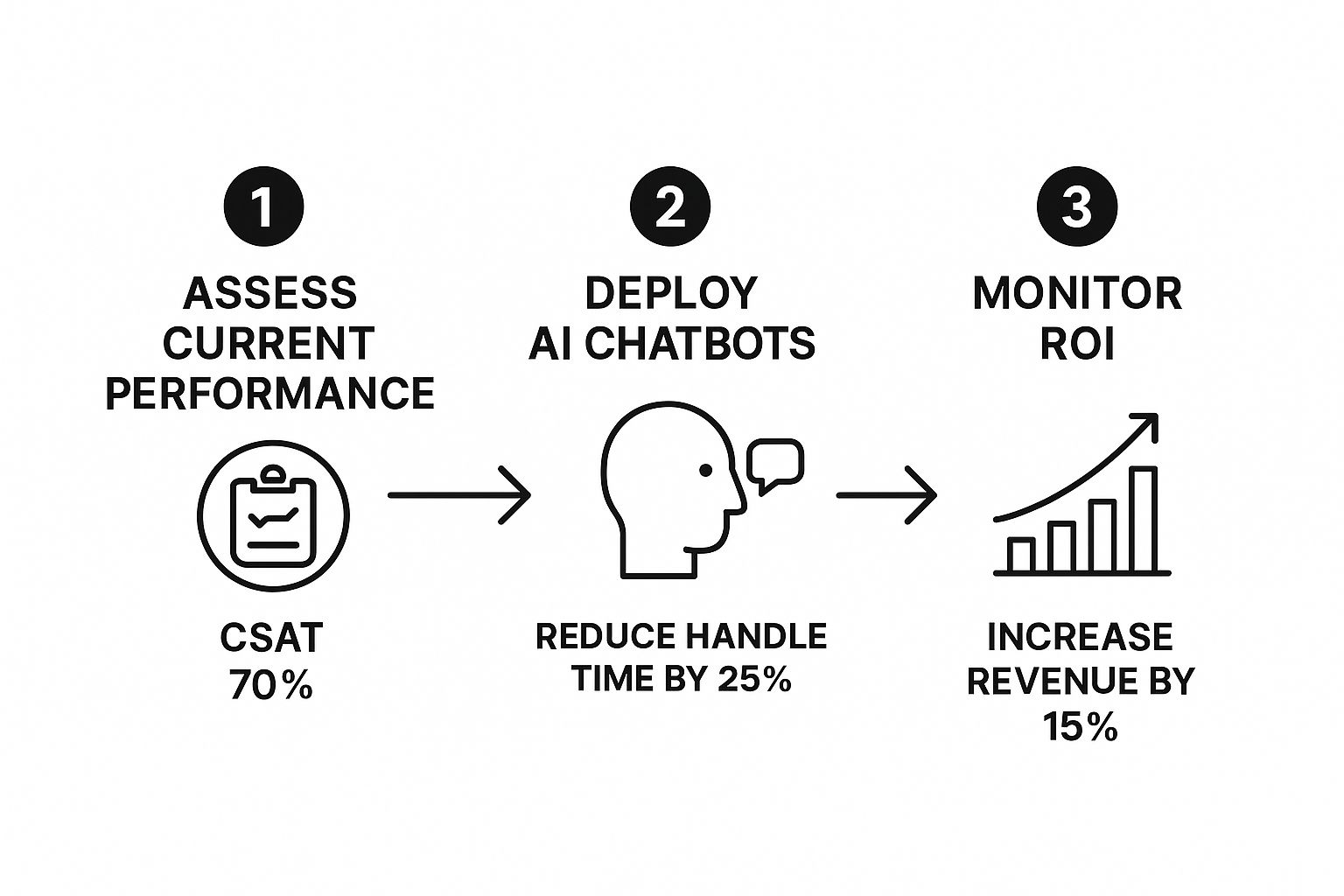
This flow shows that by improving operations step-by-step—like using AI to trim down agent handle time—you can achieve significant business outcomes, such as a 15% boost in revenue.
Maintaining Momentum for Long-Term Success
The initial buzz of a new project can wear off. To keep things moving forward, you need a strong project management structure. This means setting clear goals, making sure everyone knows who is responsible for what, and establishing a regular rhythm of communication to keep everyone in the loop. Don't forget to celebrate the small wins. When a new feature goes live or a team smashes a performance target, shout about it. This reinforces the project's value and keeps your team motivated for the long journey ahead. Your roadmap is a living document—it’s there to guide you, not to box you in. Revisit and tweak it often as you learn and grow.
Ready to build a roadmap that delivers real results? Voicetta has the AI-powered tools you need to make your transformation a success, automating the routine work so your team can focus on what they do best.
Was this useful?
If this article helped, add Voicetta as a preferred source in Google Search. Your results can then highlight our writing.
Add as preferred source