---
title: "Call Flow Design and Optimization: The 2026 Guide to AI Voice Logic"
description: "Master call flow design and optimization with our 2026 guide to AI voice logic. Turn every call into a qualified lead and stop losing customers to bad IVR."
publishedAt: "2026-04-29T10:00:00.000000Z"
modifiedAt: "2026-04-29T11:07:47.000000Z"
autoseoId: "1143044"
languageCode: "en"
heroImage: "/blog-images/autoseo/1143044/hero.jpg"
infographicImage: "/blog-images/autoseo/1143044/infographic.jpg"
tags: call flow design and optimization
metaKeywords: "call flow design and optimization, AI voice logic, conversational IVR, lead qualification, automated phone systems, call routing, customer experience"
faqSchema: "[{\"answer\":\"Phone trees are static and reactive, meaning they only follow a pre-defined, \\\"if-this-then-that\\\" path. If a caller deviates or asks a complex question, the system breaks or defaults to a generic operator. In contrast, AI call flows are dynamic and proactive in lead qualification. They use neural networks to maintain context throughout the conversation, even if the user jumps between topics. This technology is the backbone of a done-for-you call handling system, where the AI acts as a digital receptionist that understands nuance and captures lead data without the caller ever feeling like they're talking to a machine. Modern call flow design and optimization ensures that every interaction feels personalized, maintaining the state of the conversation from the first greeting to the final booking. Mapping an effective flow requires a \\\"Happy Path\\\" strategy that prioritizes the shortest route from the initial greeting to a confirmed booking. This process eliminates friction by focusing on four technical stages that ensure high-intent leads are prioritized immediately. Successful call flow design and optimization depends on the AI's ability to maintain logic while handling unpredictable human input.\",\"question\":\"What is the difference between a phone tree and an AI call flow?\"},{\"answer\":\"Latency is the primary reason AI calls fail; Vapi and Retell solve this by providing sub-800ms response times. These backends allow AI receptionists to handle natural turn-taking and interruptions without breaking the conversation logic. When a caller interrupts to ask a question, the AI processes the new input and resumes the qualification flow without the 2-3 second \\\"robotic pause\\\" seen in older systems.\",\"question\":\"How do Vapi and Retell improve call flow performance?\"},{\"answer\":\"ElevenAgents uses high-fidelity neural synthesis to reduce the \\\"uncanny valley\\\" effect that causes callers to hang up. Retention rates increase by 60% when the voice persona matches the industry context. For instance, a law firm requires a professional, authoritative tone, while a hotel booking line performs better with a friendly, upbeat cadence. Matching the persona to the brand makes the AI feel like a team member rather than a software tool. You can see how this improves engagement by exploring how businesses never miss customer calls using optimized voice profiles. Effective call flow design and optimization requires building logic that anticipates deviations rather than just following a linear script. Edge cases occur when a caller goes off-script, provides vague answers, or demands a human operator immediately. You handle these by implementing \\\"Fallback Logic\\\" that acknowledges the user's specific input before politely redirecting them toward the primary conversion goal. If a caller says \\\"I’m not sure\\\" to a budget question, the AI shouldn't repeat the prompt; it should offer a range or a simplified choice to keep the momentum alive. Modern systems use sentiment triggers to monitor the caller's emotional state in real time. If the AI detects a 20% increase in speech rate or specific keywords associated with frustration, it initiates an immediate human handoff. This ensures that complex problems don't escalate into lost opportunities. An optimized call flow is measured by its ability to resolve the unexpected without losing the lead. By preparing for the \\\"what ifs,\\\" you turn potential hang-ups into successful data points.\",\"question\":\"What role does ElevenAgents play in caller retention?\"},{\"answer\":\"Run split tests on your opening greetings to identify which variation reduces immediate hang-up rates. Data from 2025 implementations shows that even a three-word change in the introduction can improve lead retention by 12%. Analyze the qualification process to see exactly where callers drop off. If 30% of users leave during the address verification step, simplify that specific question or move it later in the flow. For a deeper dive into specific metrics and testing frameworks, see our guide on mastering A/B testing for call scripts. A Done-For-You (DFY) system eliminates technical complexity by replacing experimental DIY builds with battle-tested architectures. Building AI logic manually often results in a 15% failure rate during high-volume periods due to unforeseen logic gaps. Voicetta provides a managed infrastructure that handles the technical heavy lifting from day one. You don't have to worry about prompt engineering or state management. This ensures your call flow design and optimization strategy remains robust under pressure. Voicetta handles the edge-case engineering that prevents AI from hallucinating or getting trapped in repetitive loops. This is critical for maintaining a professional brand image. If a caller asks a question outside the defined scope, the system uses a fallback protocol to maintain a helpful tone rather than guessing. Production-grade systems include these features to ensure the AI doesn't break when faced with non-linear human conversation. By outsourcing the technical architecture, your team can focus on high-value tasks and never missing customer calls. This approach ensures your call flow design and optimization efforts produce measurable ROI instead of creating technical debt. You get a system that works immediately, tuned by experts who have already solved the most common failure points.\",\"question\":\"What is the best way to A/B test call scripts for better conversion?\"},{\"answer\":\"A call flow is only successful if the data it captures is actionable and stored instantly. Without CRM integration, valuable lead information remains trapped in a recording or a transcript that nobody reads. Automated logging pushes full transcripts and AI-generated summaries into your database the moment the call ends. This gives your sales team a massive advantage. They see the lead's specific pain points and intent before they even call them back. It eliminates the 12 minutes of manual data entry typically required after every customer interaction. Traditional IVR systems fail because they force callers into rigid boxes. Success in 2026 depends on call flow design and optimization that prioritizes natural conversation over button-pressing. You'll convert more leads by implementing AI logic that handles complex edge cases and qualifies prospects in real time. Mapping these flows doesn't have to be a technical burden. A Done-For-You system removes the friction, allowing your team to focus on closing deals rather than managing phone trees. Voicetta provides the infrastructure to automate your voice channel with total confidence. Our users see a 98% reduction in lead response time, meaning prospects get answers while their intent is highest. With 99.9% uptime and seamless integration for HubSpot and Salesforce, your data stays synced across your entire stack. It's time to replace outdated scripts with an intelligent assistant that speaks your customers' language. You can build a system that works 24/7 without the overhead of a traditional call center. Let Voicetta design and optimize your AI call flow today Your business deserves a voice strategy that grows with you. Start building your future-proof communication system today.\",\"question\":\"Why is CRM integration the final step in call flow optimization?\"},{\"answer\":\"Over-complicating the menu is the most frequent error. Abandonment rates soar by 40% when callers face more than three options in the initial prompt. Optimization requires radical simplification to keep the interaction focused. For instance, a 2025 industry report suggests that reducing initial questions from five to two increases successful routing by 22%. It's essential to prioritize the most frequent customer needs immediately to prevent frustration.\",\"question\":\"What is the most common mistake in call flow design?\"},{\"answer\":\"Modern voice AI identifies the caller's language within the first 3 seconds of the conversation. Once detected, the system switches the entire logic and voice persona to match the specific dialect. This ensures a seamless global experience without requiring manual input. Our call flow design and optimization strategies prioritize this low-latency detection to maintain a natural conversation flow across 50+ supported languages. This technology turns a global reach into a localized, personal experience.\",\"question\":\"Can AI call flows handle different languages?\"},{\"answer\":\"Costs depend on the complexity of your logic, but the ROI is typically measured through lead capture rates. By capturing 100% of inbound leads that would otherwise hit a voicemail, the system pays for itself through increased conversion volume. According to LeadResponse data, responding to a lead within 5 minutes makes a sale 21 times more likely than waiting 30 minutes. Optimization turns missed calls into immediate revenue opportunities that standard systems simply lose.\",\"question\":\"How much does it cost to optimize a call flow?\"},{\"answer\":\"Every professional flow includes an escape hatch that triggers after two failed attempts or when it detects high frustration. The system automatically offers a human callback or transfers the caller to a live manager. This safety net prevents negative brand perception. In a 2026 AI logic setup, sentiment analysis monitors voice pitch to identify when human intervention is needed. It's about maintaining trust while the \\\"smart assistant\\\" handles the bulk of the workload.\",\"question\":\"What happens if the AI agent gets stuck?\"},{\"answer\":\"No, you must treat call flow design and optimization as a continuous weekly process. Analyze transcripts every 7 days to identify new edge cases and refine instructions based on actual customer phrasing. Data from 2025 shows that companies reviewing their AI logs weekly see a 15% higher resolution rate compared to those who set it and forget it. Constant refinement keeps the AI's persona effective and ensures the system evolves with your customers.\",\"question\":\"Is call flow optimization a one-time task?\"}]"
canonical: "https://voicetta.com/blog-md/call-flow-design-and-optimization-the-2026-guide-to-ai-voice-logic"
---
# Call Flow Design and Optimization: The 2026 Guide to AI Voice Logic
Published: 2026-04-29
A 2024 study by Invoca found that 76% of customers will hang up immediately if they find an automated phone menu confusing. For most businesses, this friction isn't just a nuisance; it's a direct leak in the revenue pipeline that results in lost appointments and inconsistent CRM data. You likely already feel the sting of losing high-intent leads after business hours or watching potential clients abandon complex IVR menus before they ever reach a human. Mastering **call flow design and optimization** is no longer about building a simple digital receptionist. It's about creating a neural-driven logic that responds to human nuance in real time.
In this guide, you'll learn how to architect high-conversion AI call flows that qualify leads, handle complex edge cases, and integrate directly with your CRM. We'll show you how to transform a cold automated system into a seamless caller experience that feels human and captures data with 99% accuracy. From mapping decision trees to automating your booking schedule, we're breaking down the exact framework needed to turn every dial-in into a logged, qualified opportunity.
## Key Takeaways
- Replace rigid, linear menus with conversational logic that identifies caller intent immediately, eliminating the friction of traditional IVR systems.
- Architect a high-conversion "Happy Path" that uses specific qualification gates to verify lead quality before they reach your sales team.
- Master **call flow design and optimization** to build robust fallback logic, ensuring your AI stays on track even when callers go off-script.
- Streamline your operations by integrating AI call flows directly with your CRM, turning raw voice data into actionable lead insights.
- Reduce deployment risk by using managed, battle-tested architectures that prevent AI hallucinations and technical loops in complex scenarios.
## Why do traditional IVR systems fail to convert modern leads?
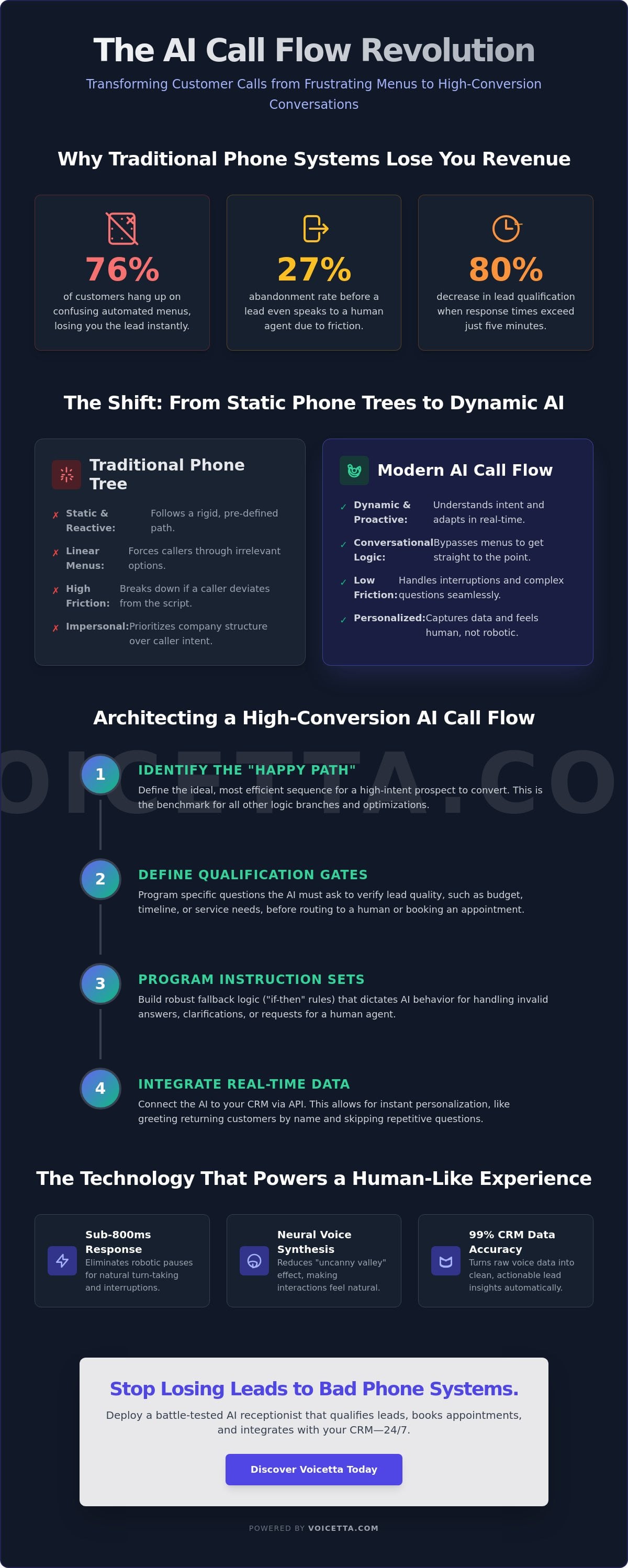
Traditional [Interactive Voice Response (IVR)](https://en.wikipedia.org/wiki/Interactive_voice_response) systems fail because they prioritize rigid company hierarchies over immediate caller intent. These legacy setups force potential customers to navigate through linear menus, often making them wait through five or six irrelevant options before they can speak to the right department. This friction results in a 27% abandonment rate before a lead even reaches a human agent. Modern **call flow design and optimization** replaces these hurdles with conversational AI that identifies intent instantly, allowing callers to bypass the "press 1" trap entirely.
To better understand how advanced logic improves caller experience, watch this guide on setup:
Unanswered calls and flawed routing logic are the primary drivers of "speed-to-lead" failure. Research indicates that businesses that don't respond to a lead within five minutes see an 80% decrease in lead qualification. When your phone system forces a lead into a voicemail loop or a dead-end menu, you aren't just losing a call; you're handing revenue to a competitor who answers faster. Call flow optimization is the process of minimizing caller friction while maximizing data capture.
### What is the difference between a phone tree and an AI call flow?
Phone trees are static and reactive, meaning they only follow a pre-defined, "if-this-then-that" path. If a caller deviates or asks a complex question, the system breaks or defaults to a generic operator. In contrast, AI call flows are dynamic and proactive in lead qualification. They use neural networks to maintain context throughout the conversation, even if the user jumps between topics. This technology is the backbone of a done-for-you call handling system, where the AI acts as a digital receptionist that understands nuance and captures lead data without the caller ever feeling like they're talking to a machine. Modern **call flow design and optimization** ensures that every interaction feels personalized, maintaining the state of the conversation from the first greeting to the final booking.
## How do you map an effective AI call flow for lead qualification?
Mapping an effective flow requires a "Happy Path" strategy that prioritizes the shortest route from the initial greeting to a confirmed booking. This process eliminates friction by focusing on four technical stages that ensure high-intent leads are prioritized immediately. Successful **call flow design and optimization** depends on the AI's ability to maintain logic while handling unpredictable human input.
- **Step 1: Identify the Happy Path.** Define the ideal sequence where a prospect answers every question concisely. This serves as the benchmark for measuring the efficiency of every other branch in your logic tree.
- **Step 2: Define Qualification Gates.** Program specific questions the AI must ask to verify lead quality. For example, a real estate AI might require a confirmed budget and timeline before it triggers the scheduling module.
- **Step 3: Program the Instruction Set.** These are the "if-then" rules governing AI behavior. If a lead provides an invalid answer, the instruction set dictates whether the AI asks for clarification or redirects the call to a human agent.
- **Step 4: Integrate Real-Time Data Lookups.** Connect the AI to your CRM via API to personalize the call instantly. If the system recognizes a returning lead, it skips basic discovery and moves directly to the next stage of the funnel.
### How do Vapi and Retell improve call flow performance?
Latency is the primary reason AI calls fail; Vapi and Retell solve this by providing sub-800ms response times. These backends allow AI receptionists to handle natural turn-taking and interruptions without breaking the conversation logic. When a caller interrupts to ask a question, the AI processes the new input and resumes the qualification flow without the 2-3 second "robotic pause" seen in older systems.
### What role does ElevenAgents play in caller retention?
ElevenAgents uses high-fidelity neural synthesis to reduce the "uncanny valley" effect that causes callers to hang up. Retention rates increase by 60% when the voice persona matches the industry context. For instance, a law firm requires a professional, authoritative tone, while a hotel booking line performs better with a friendly, upbeat cadence. Matching the persona to the brand makes the AI feel like a team member rather than a software tool. You can see how this improves engagement by exploring how businesses never miss customer calls using optimized voice profiles.
## How can you optimize call flows to handle complex edge cases?
Effective call flow design and optimization requires building logic that anticipates deviations rather than just following a linear script. Edge cases occur when a caller goes off-script, provides vague answers, or demands a human operator immediately. You handle these by implementing "Fallback Logic" that acknowledges the user's specific input before politely redirecting them toward the primary conversion goal. If a caller says "I’m not sure" to a budget question, the AI shouldn't repeat the prompt; it should offer a range or a simplified choice to keep the momentum alive.
Modern systems use sentiment triggers to monitor the caller's emotional state in real time. If the AI detects a 20% increase in speech rate or specific keywords associated with frustration, it initiates an immediate human handoff. This ensures that complex problems don't escalate into lost opportunities. An optimized call flow is measured by its ability to resolve the unexpected without losing the lead. By preparing for the "what ifs," you turn potential hang-ups into successful data points.
### What is the best way to A/B test call scripts for better conversion?
Run split tests on your opening greetings to identify which variation reduces immediate hang-up rates. Data from 2025 implementations shows that even a three-word change in the introduction can improve lead retention by 12%. Analyze the qualification process to see exactly where callers drop off. If 30% of users leave during the address verification step, simplify that specific question or move it later in the flow. For a deeper dive into specific metrics and testing frameworks, see our guide on mastering A/B testing for call scripts.
Stop losing leads to rigid scripts and never miss customer calls again with AI that handles every edge case. ## How does a Done-For-You system eliminate call flow complexity?
A Done-For-You (DFY) system eliminates technical complexity by replacing experimental DIY builds with battle-tested architectures. Building AI logic manually often results in a 15% failure rate during high-volume periods due to unforeseen logic gaps. Voicetta provides a managed infrastructure that handles the technical heavy lifting from day one. You don't have to worry about prompt engineering or state management. This ensures your **call flow design and optimization** strategy remains robust under pressure.
Voicetta handles the edge-case engineering that prevents AI from hallucinating or getting trapped in repetitive loops. This is critical for maintaining a professional brand image. If a caller asks a question outside the defined scope, the system uses a fallback protocol to maintain a helpful tone rather than guessing. Production-grade systems include these features to ensure the AI doesn't break when faced with non-linear human conversation.
- **Battle-tested architecture:** Pre-configured logic reduces deployment time by 70% compared to custom builds.
- **Built-in monitoring:** The system identifies performance bottlenecks automatically using real-world call data.
- **Edge-case management:** Hard-coded guardrails prevent the AI from making up facts or repeating prompts.
By outsourcing the technical architecture, your team can focus on high-value tasks and never missing customer calls. This approach ensures your **call flow design and optimization** efforts produce measurable ROI instead of creating technical debt. You get a system that works immediately, tuned by experts who have already solved the most common failure points.
### Why is CRM integration the final step in call flow optimization?
A call flow is only successful if the data it captures is actionable and stored instantly. Without CRM integration, valuable lead information remains trapped in a recording or a transcript that nobody reads. Automated logging pushes full transcripts and AI-generated summaries into your database the moment the call ends. This gives your sales team a massive advantage. They see the lead's specific pain points and intent before they even call them back. It eliminates the 12 minutes of manual data entry typically required after every customer interaction.
## Modernize Your Customer Interactions Now
Traditional IVR systems fail because they force callers into rigid boxes. Success in 2026 depends on **call flow design and optimization** that prioritizes natural conversation over button-pressing. You'll convert more leads by implementing AI logic that handles complex edge cases and qualifies prospects in real time. Mapping these flows doesn't have to be a technical burden. A Done-For-You system removes the friction, allowing your team to focus on closing deals rather than managing phone trees.
Voicetta provides the infrastructure to automate your voice channel with total confidence. Our users see a 98% reduction in lead response time, meaning prospects get answers while their intent is highest. With 99.9% uptime and seamless integration for HubSpot and Salesforce, your data stays synced across your entire stack. It's time to replace outdated scripts with an intelligent assistant that speaks your customers' language. You can build a system that works 24/7 without the overhead of a traditional call center.
[Let Voicetta design and optimize your AI call flow today](https://voicetta.com)
Your business deserves a voice strategy that grows with you. Start building your future-proof communication system today.
## Frequently Asked Questions
### What is the most common mistake in call flow design?
Over-complicating the menu is the most frequent error. Abandonment rates soar by 40% when callers face more than three options in the initial prompt. Optimization requires radical simplification to keep the interaction focused. For instance, a 2025 industry report suggests that reducing initial questions from five to two increases successful routing by 22%. It's essential to prioritize the most frequent customer needs immediately to prevent frustration.
### Can AI call flows handle different languages?
Modern voice AI identifies the caller's language within the first 3 seconds of the conversation. Once detected, the system switches the entire logic and voice persona to match the specific dialect. This ensures a seamless global experience without requiring manual input. Our **call flow design and optimization** strategies prioritize this low-latency detection to maintain a natural conversation flow across 50+ supported languages. This technology turns a global reach into a localized, personal experience.
### How much does it cost to optimize a call flow?
Costs depend on the complexity of your logic, but the ROI is typically measured through lead capture rates. By capturing 100% of inbound leads that would otherwise hit a voicemail, the system pays for itself through increased conversion volume. According to LeadResponse data, responding to a lead within 5 minutes makes a sale 21 times more likely than waiting 30 minutes. Optimization turns missed calls into immediate revenue opportunities that standard systems simply lose.
### What happens if the AI agent gets stuck?
Every professional flow includes an escape hatch that triggers after two failed attempts or when it detects high frustration. The system automatically offers a human callback or transfers the caller to a live manager. This safety net prevents negative brand perception. In a 2026 AI logic setup, sentiment analysis monitors voice pitch to identify when human intervention is needed. It's about maintaining trust while the "smart assistant" handles the bulk of the workload.
### Is call flow optimization a one-time task?
No, you must treat **call flow design and optimization** as a continuous weekly process. Analyze transcripts every 7 days to identify new edge cases and refine instructions based on actual customer phrasing. Data from 2025 shows that companies reviewing their AI logs weekly see a 15% higher resolution rate compared to those who set it and forget it. Constant refinement keeps the AI's persona effective and ensures the system evolves with your customers.
## Infographic