
Blog
Contact Centre Quality Mastery: The Complete Success Guide
Imagine walking into a contact centre filled with a tangible buzz. Agents aren't just going through the motions; they're genuinely engaged and empowered to help custom...
The Real Story Behind Contact Centre Quality Excellence

Imagine walking into a contact centre filled with a tangible buzz. Agents aren't just going through the motions; they're genuinely engaged and empowered to help customers. This isn't some far-off ideal; it's the reality for businesses that truly understand contact centre quality.
This goes much deeper than simply hitting metrics. It's about building a culture where quality is woven into every interaction, transforming the contact centre from a cost centre into a driver of loyalty and growth.
This shift changes how we define contact centre quality. Instead of prioritizing just efficiency, leading organizations focus on the overall customer experience. They know a happy customer is more likely to return, recommend the brand, and become a source of recurring revenue.
This means investing in agent training and empowering them to make real-time decisions. It means fostering a supportive environment where agents can thrive.
The global contact centre market is a testament to the growing importance of customer service. It reached $340 billion in 2020 and is expected to hit $496 billion by 2027.
A common benchmark is answering 80% of calls within 20 seconds, with many striving for 90% within 15 seconds. This highlights the importance of speed, but true quality demands a more thoughtful approach.
Discover more insights about call centre statistics.
Think about your own experiences with customer support. Was a quick answer enough? Or did you value a real connection and a helpful resolution? That's the difference.
This human element is what separates good contact centres from truly great ones. Building a culture of quality means empowering agents to go the extra mile, treating each customer as an individual, and building genuine relationships.
This creates a ripple effect of positive experiences, strengthening the brand and driving business success. This is the true essence of contact centre quality excellence: it’s about people, not just processes.
Beyond The Numbers: Quality Metrics That Drive Success
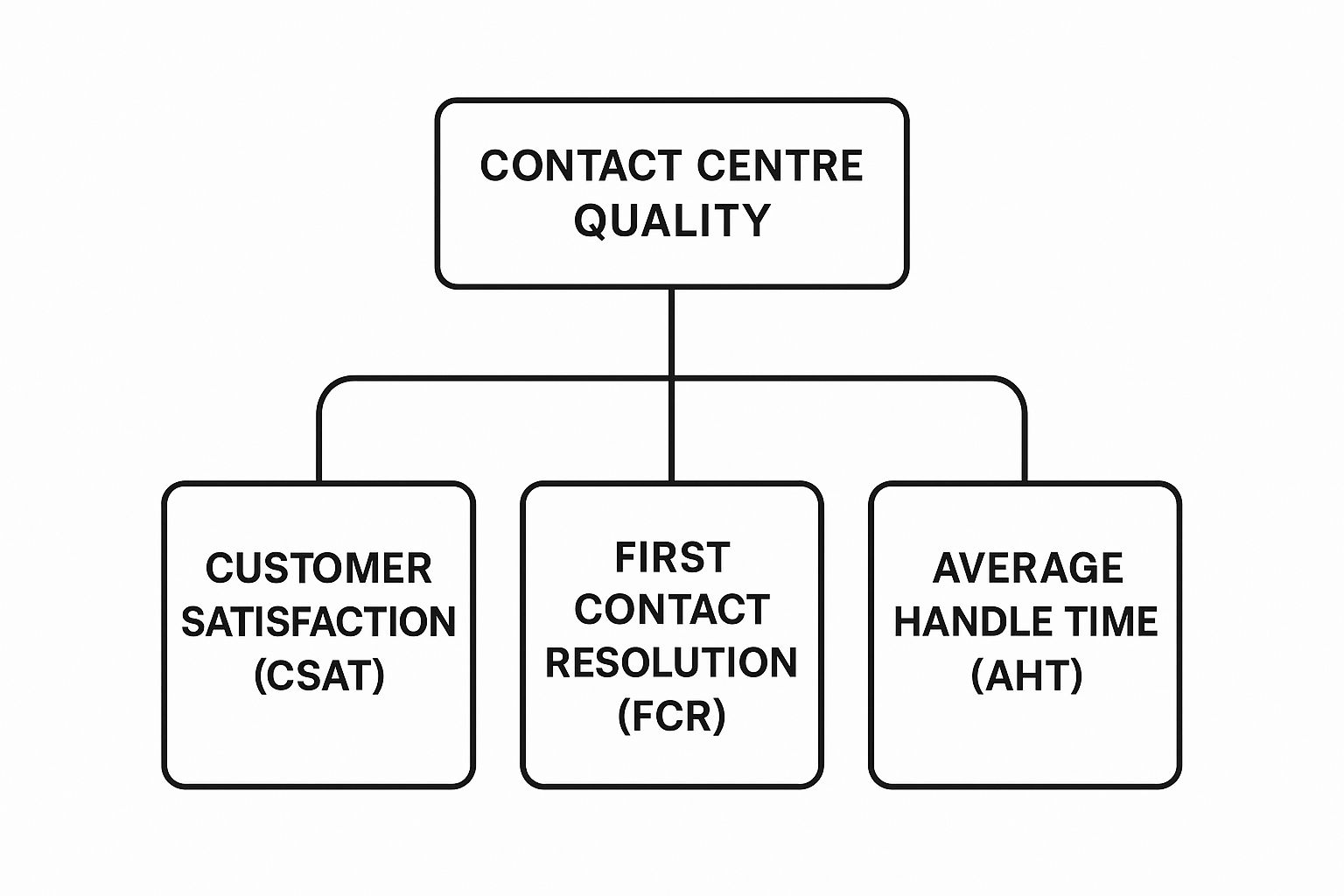
The infographic above shows how overall contact centre quality relates to three key performance indicators: Customer Satisfaction (CSAT), First Contact Resolution (FCR), and Average Handle Time (AHT). Think of it like a three-legged stool: each leg (CSAT, FCR, and AHT) is essential for stability (overall quality). Improving each metric individually strengthens the overall quality of your contact centre.
This interconnectedness emphasizes the importance of a balanced approach. You can't just focus on one metric and expect amazing results.
Moving Beyond Traditional Metrics
Traditional metrics like average handle time (AHT) are often prioritized. While efficiency matters, focusing only on speed can hurt quality. Imagine a fast-food restaurant: you get your burger quickly, but is it satisfying? Probably not. Similarly, rushing customers off the phone to improve AHT might seem efficient in the moment, but it can lead to unresolved issues and unhappy customers. This can result in more repeat calls, negative reviews, and a damaged reputation.
For example, consider first-call resolution (FCR). It’s a good starting point, but it doesn’t tell the whole story. A customer's issue might be technically resolved on the first call, but if the experience was frustrating or complicated, they won't be satisfied. That's where metrics like Customer Effort Score (CES) come into play. CES measures how much work a customer has to do to get their problem solved. A high CES often reveals a clunky, inefficient process, even if your FCR is high.
Furthermore, understanding customer emotions is vital for real contact centre quality. Did the customer feel heard and understood? Were they frustrated or relieved at the end of the call? Analyzing emotional sentiment through tools like speech analytics gives you valuable insights that traditional metrics miss. Contact centre quality is heavily influenced by efficiency and satisfaction metrics. As of 2022, customer satisfaction was rated 69 out of 100 for the private sector and 70 for government contact centres. Interestingly, while 74% of organizations track customer critical error accuracy, only 31% measure customer emotions. Discover more insights about call centre statistics. For further information on measuring customer satisfaction, check out this resource: Measuring Customer Satisfaction.
To illustrate the differences between traditional and modern quality metrics, let's take a look at the following table:
Essential Contact Centre Quality Metrics Comparison
A comprehensive comparison of traditional vs. modern quality metrics, showing measurement frequency, business impact, and implementation difficulty
| Metric Type | Measurement Frequency | Business Impact | Customer Impact | Implementation Difficulty |
|---|---|---|---|---|
| AHT (Traditional) | Real-time/Daily | Operational efficiency, Cost reduction | Can negatively impact satisfaction if prioritized over resolution | Low |
| FCR (Traditional) | Daily/Weekly | Repeat call reduction, Cost savings | Can be misleading if resolution isn't truly satisfactory | Low |
| CSAT (Traditional) | Post-interaction | Customer loyalty, Brand reputation | Direct measure of customer happiness | Medium |
| CES (Modern) | Post-interaction | Process improvement, Customer retention | Identifies pain points and areas for improvement | Medium |
| Sentiment (Modern) | Real-time/Post-interaction | Agent coaching, Customer experience enhancement | Deeper understanding of customer needs and feelings | High |
This table highlights the importance of including both traditional and modern metrics for a well-rounded view of contact centre quality. While traditional metrics provide valuable operational data, modern metrics delve deeper into the customer experience.
Building a Balanced Scorecard
Creating a balanced scorecard is crucial for real success. This scorecard should combine traditional metrics like AHT and FCR with more nuanced indicators like CES and emotional sentiment. By looking at the complete picture, you can pinpoint areas for improvement that truly affect the customer experience. This allows you to go beyond simply measuring activity and start driving meaningful change that boosts customer loyalty and business growth.
How Contact Centre Quality Transforms Your Business

Think of your contact centre like the front porch of your business. It's the first impression for many customers, and we all know how important first impressions are. It's not just a department; it's the face of your brand, shaping how customers perceive your entire operation.
Poor contact centre quality isn't just a minor hiccup; it's a major stumbling block. It can send customers running to your competitors and generate negative word-of-mouth, like a bad review spreading wildfire online. Then you face higher acquisition costs trying to replace those lost customers—like constantly refilling a leaky bucket.
Imagine a potential customer's first experience with your business is a frustrating call with a confusing automated system. That single negative experience can scare them away and tarnish your brand's image, making attracting new business an uphill battle.
This means investing in contact centre quality isn't an expense; it's a crucial investment in your business's future. It's like maintaining the foundation of a house—essential for long-term stability.
Hidden Costs and the Bottom Line
Beyond the obvious frustrations, there are hidden costs associated with poor quality. These costs are like termites, quietly eating away at your resources. Think about repeat calls from unresolved issues, escalations to supervisors, and offering discounts or refunds to appease frustrated customers. These all add up quickly.
These hidden costs can have a serious impact on your profits. In 2022, the average customer satisfaction score in the United States hovered around 73%. And with over half of retail customers preferring phone support for urgent issues, the importance of quick, effective resolutions is clear. Discover more insights on call centre statistics.
The ROI of Quality: A Positive Feedback Loop
But here’s the good news: exceptional contact centre quality creates a powerful positive cycle. Happy customers become loyal fans, spreading the good word about your business through positive reviews and referrals. This organic growth is like a snowball effect, building momentum over time.
This positive word-of-mouth is gold. It builds trust and credibility in a way paid advertising often can't. It’s like a personal recommendation from a trusted friend. This organic growth lessens your dependence on expensive marketing campaigns, creating a solid base for lasting success. Therefore, investing in contact centre quality offers a significant return on investment (ROI) that goes far beyond the contact centre itself.
Building the Business Case for Quality
Making a compelling argument for investing in quality initiatives is crucial. You might be interested in: Call Center Quality Assurance To secure the resources needed for lasting improvements, you need to clearly show how contact centre quality directly impacts your bottom line.
Quantifying the costs of poor quality – like lost customers and revenue – paints a vivid picture of the benefits of prioritizing quality improvements. It’s like showing a before-and-after photo to demonstrate the impact of a renovation.
Furthermore, highlighting the potential ROI of quality initiatives – like increased customer lifetime value and reduced churn – resonates with decision-makers. It helps secure the necessary support for making these essential changes. By presenting a strong case, you can shift the perception of contact centre quality from an expense to a strategic engine for business growth.
Creating a Quality Culture Agents Actually Want
Many contact centers operate with a top-down, metrics-obsessed approach to quality. Agents are often left feeling like numbers on a spreadsheet, rather than valued team members contributing to something bigger. This kind of environment can stifle creativity and discourage genuine engagement. It’s like trying to make a plant grow taller by constantly measuring it, instead of focusing on the health of its roots and providing the right nutrients.
Leading contact centers, however, are recognizing that true contact center quality grows best from the inside out. This means building a culture where agents feel empowered, appreciated, and truly invested in providing great customer experiences.
From Compliance to Collaboration
One of the biggest shifts is moving away from a compliance-focused mindset and toward a collaborative one. Instead of seeing quality monitoring as a “gotcha” exercise, think of it as a chance to learn and grow together.
Imagine a contact center where agents regularly participate in peer feedback sessions. They share their wins, discuss tricky situations, and learn from each other’s experiences. This kind of environment fosters a sense of shared ownership over quality.
Balancing Accountability and Autonomy
It’s a delicate balance, but finding the sweet spot between accountability and autonomy is crucial. While clear performance expectations are important, micromanaging every single interaction can be incredibly demotivating. It also prevents agents from providing the personalized service that customers truly appreciate.
Think of it like giving a musician sheet music but also allowing them the freedom to improvise and express their unique style. This empowers agents to take ownership of their customer interactions, leading to more engaging and effective service.
Feedback Loops That Fuel Growth
Effective feedback loops are the engine of continuous improvement. This goes beyond simply delivering a performance score. It’s about providing specific, actionable feedback that helps agents understand their strengths and weaknesses.
For example, using speech analytics can help identify patterns in agent language and customer sentiment. These insights can then be used to tailor coaching sessions to individual agent needs. Sonos, for example, has appointed a Quality Ombudsperson. This dedicated role is focused on channeling employee feedback about quality directly to executive leadership, demonstrating a strong commitment to improvement and a culture where quality is everyone’s responsibility.
Recognition and Career Development: Beyond Monetary Incentives
While money can be a motivator, it’s often less effective than genuine recognition and opportunities for professional growth, especially in customer-focused roles. Acknowledging exceptional performance, celebrating individual achievements, and offering clear career development paths shows agents their contributions are truly valued.
This creates a sense of pride and purpose that shines through in every customer interaction. Building a quality culture is a holistic process. It’s about empowering agents, fostering collaboration, and prioritizing continuous learning. By focusing on these elements, contact centers can transform quality from a burden into a source of professional fulfillment and a key driver of business success.
Smart Technology for Human-Centered Quality

The most successful contact centers understand a key principle: technology isn't about replacing their skilled agents. It's about giving them the best tools to shine. Imagine a master carpenter – their skill is paramount, but the right tools allow them to create wonders. Similarly, AI and automation handle the routine tasks in a contact center, freeing up agents to tackle complex issues and truly connect with customers. This focus on empowering agents is essential for both agent satisfaction and top-notch contact center quality.
AI-Powered Coaching and Analytics: Amplifying Agent Performance
Forward-thinking organizations are turning to AI-powered coaching tools to give their agents personalized feedback and development plans. Think of it like having a dedicated coach for each agent, analyzing their performance data and pinpointing areas for growth. These tools even suggest specific training resources, helping agents understand their strengths and weaknesses so they can refine their skills and create better customer experiences.
Speech analytics platforms add another layer of insight. They analyze customer conversations to identify trends in sentiment and highlight common pain points. This information is gold for improving training programs and refining customer service strategies, ultimately boosting contact center quality.
Automated Quality Monitoring: Scaling Quality Efforts
Traditional quality monitoring often relied on manual reviews, catching only a small percentage of interactions. Automated quality monitoring changes the game. It analyzes 100% of customer interactions, meaning potential problems are identified and addressed much faster, reducing errors significantly.
This comprehensive view reveals patterns and trends that manual sampling might miss. For a deeper dive into automating customer support, check out our guide: Automating Customer Support. By automating these routine monitoring tasks, supervisors have more time for strategic activities like coaching and team development.
Choosing the Right Technology: Focus on Impact and ROI
When choosing new technology, two factors are paramount: agent experience and customer outcomes. Tools that complicate workflows or confuse agents can actually hurt morale and performance. Instead, prioritize solutions that streamline processes and deliver actionable insights. For example, AI-powered tools can automatically flag training needs or suggest the best responses to customer inquiries, empowering agents and elevating contact center quality.
Don't forget about return on investment (ROI). While cost is a consideration, the real value comes from long-term benefits like higher customer satisfaction, reduced customer churn, and improved agent retention. Choose tools that directly support your specific business goals and offer a clear ROI.
To help you make the best choice, we've put together a comparison table of common contact center quality technologies:
Contact Centre Quality Technology Comparison
Comparison of different quality technology solutions showing features, implementation complexity, and ROI potential
| Technology Type | Key Features | Implementation Time | Cost Range | ROI Timeline | Best Use Cases |
|---|---|---|---|---|---|
| Speech Analytics | Sentiment analysis, keyword spotting, topic identification | 2-4 months | $5,000 - $50,000/year | 6-12 months | Identifying customer trends, improving training, reducing compliance risk |
| AI-Powered Coaching | Personalized feedback, targeted training recommendations, performance tracking | 1-3 months | $2,000 - $20,000/year | 3-6 months | Agent development, improving customer interactions, boosting agent morale |
| Automated Quality Monitoring | 100% interaction analysis, automated scoring, real-time alerts | 3-6 months | $10,000 - $100,000/year | 12-18 months | Reducing errors, improving compliance, freeing up supervisor time |
| Workforce Management (WFM) Software | Forecasting, scheduling, performance tracking | 6-12 months | $1,000 - $10,000/year | 12-24 months | Optimizing staffing levels, reducing costs, improving agent productivity |
Key takeaways from this comparison:
- Implementation time and cost vary widely based on the technology and the complexity of your contact center.
- ROI timelines also differ, but the potential benefits are significant across all technologies.
- Choosing the right solution depends on your specific needs and priorities.
By carefully considering these factors, you can select the technology that will have the greatest impact on your contact center quality and deliver the strongest ROI.
Sustainable Strategies for Quality Improvement
Contact center quality isn't a finish line you cross; it's an ongoing journey. Organizations that truly shine in this area understand that sustainable improvement isn't about band-aids, but a long-term, well-thought-out approach. It's about cultivating a culture of constant refinement, much like tending a garden – it needs consistent care, attention, and tweaks to flourish.
Identifying High-Impact Opportunities
The first step is figuring out where improvements will give you the most bang for your buck. This requires a thorough examination of your current processes, metrics, and customer feedback. Think about it like this: where are the biggest headaches for your customers? Which processes are causing agent frustration? Are there recurring issues that seem to pop up again and again? Answering these questions will help you pinpoint the areas that are ripe for improvement. For example, if your data shows long wait times are a frequent complaint, focusing on optimizing your call routing system (Five9, Talkdesk, Avaya etc.) could be a high-impact change.
Prioritizing improvements that align with your overall business goals is also vital. If your company is focused on keeping customers happy and coming back for more, improving first-call resolution and customer satisfaction scores should be at the top of your list. This strategic approach ensures your quality improvement efforts directly contribute to the company's success.
Engaging Stakeholders and Building Momentum
Improvement initiatives are like a team sport – they only work if everyone is on board. This means getting everyone involved, from the agents on the front lines to the executives in the corner office. Transparency is essential. Clearly communicate the goals of the improvement efforts, the benefits you anticipate, and how each team member plays a role in the overall success. This fosters buy-in and creates a shared sense of ownership, much like a rowing team needs everyone pulling in the same direction.
To build momentum, start with quick wins. These early successes create enthusiasm and demonstrate the value of the improvement process. For example, implementing a new knowledge base system could quickly empower agents to answer customer questions more efficiently, leading to better first-call resolution and increased customer satisfaction. These early victories boost confidence and fuel further improvements.
Balancing Quick Wins and Long-Term Transformation
While quick wins are important for initial momentum, don't neglect the deeper, more structural changes that create lasting impact. These initiatives might take longer to implement but often yield more significant, long-term benefits. Think of it like renovating a house. You might start with a fresh coat of paint (a quick win), but addressing the plumbing and electrical systems (long-term transformation) is essential for lasting improvement. Similarly, in a contact center, you might begin by streamlining a specific process, but eventually addressing underlying issues like agent training and employee engagement is crucial for sustainable quality. You might be interested in: Total Quality Management.
Overcoming Resistance to Change
Change can be tough, and resistance is expected. Address concerns head-on and get team members involved in finding solutions. This collaborative approach builds support for the changes and minimizes anxiety. Just as a gardener patiently nurtures a plant, successful quality improvement requires patience, persistence, and a commitment to ongoing refinement. By celebrating wins, addressing challenges openly, and focusing on continuous learning, you can build a culture of sustainable quality improvement that drives long-term success for your contact center and your business.
Your Quality Excellence Implementation Plan
Building a strong contact center quality program isn't a one-and-done deal. It's more like a continuous journey of improvement. Think of it as a long road trip – you need a roadmap, regular check-ins, and the flexibility to adjust your route along the way. This plan is designed to be your guide, helping you navigate each stage effectively.
Phase 1: Assess and Align
Before setting off on your journey, you need to know where you're starting from. Take stock of your current contact center quality. What are you doing well? Where are the gaps? Which metrics are you currently tracking? How are you using those metrics to drive improvements? This initial assessment is like checking the oil and tires before a long drive – essential for a smooth journey. For example, if you’re laser-focused on Average Handle Time (AHT) but overlooking customer sentiment, your assessment will highlight this imbalance.
Next, make sure your quality goals are aligned with your overall business objectives. Are you aiming for increased customer retention? Higher conversion rates? Reduced churn? Your contact center quality program should directly support these broader aims. It’s like setting the GPS for your final destination – ensuring every quality initiative contributes to the company's success.
Phase 2: Build and Implement
With a clear understanding of your starting point and destination, it's time to build your quality excellence program. This is where you start packing for your trip. Begin by defining your Key Performance Indicators (KPIs). Think of KPIs as your travel essentials – the things you absolutely need to track your progress. Remember, a balanced scorecard is crucial. This means including traditional metrics like AHT and First Call Resolution (FCR), alongside more nuanced indicators like Customer Effort Score (CES) and customer sentiment. This provides a holistic view of contact center quality, just like packing different outfits for different occasions.
Develop a detailed implementation plan. This is your itinerary, outlining specific action steps, timelines, and resource requirements. Each step should have a clear owner and measurable outcomes. For example, implementing speech analytics software might involve steps like vendor selection, software integration, agent training, and ongoing performance monitoring – each with its own timeline and responsible party.
Phase 3: Refine and Sustain
Once your program is in motion, the journey doesn't end. Regularly review your KPIs and assess their impact on your business goals. Are your improvements producing the desired results? Are there any unexpected consequences? This is like checking your map along the way, making sure you're still on track and adjusting course if needed. For example, a reduction in AHT might lead to lower FCR if agents rush calls. This kind of feedback is essential for continuous improvement.
Just as companies like Sonos commit to regular software updates and gather feedback through Customer Advisory Boards, your quality program should incorporate ongoing feedback loops and refinement mechanisms. This keeps you agile and allows you to adapt to the changing needs of your customers.
Remember, quality improvement is a marathon, not a sprint. Building a culture of quality requires sustained commitment, continuous learning, and a willingness to adapt and evolve. By following this phased approach, you can create a quality excellence program that not only elevates your contact center performance but also transforms it into a driver of customer loyalty and business growth – reaching your final destination and enjoying the rewards of a successful journey.
Ready to transform your customer communication into a seamless, 24/7 experience? Visit Voicetta today to learn more about how our AI-powered platform can revolutionize your customer support.
Was this useful?
If this article helped, add Voicetta as a preferred source in Google Search. Your results can then highlight our writing.
Add as preferred source