
Blog
Conversational AI Tutorial: Build Your Chatbot Quickly
At its heart, Conversational AI strives to make interactions between humans and computers feel as natural as a chat with a friend. This involves a complex dance of di...
Demystifying Conversational AI: Core Concepts That Matter

At its heart, Conversational AI strives to make interactions between humans and computers feel as natural as a chat with a friend. This involves a complex dance of different technologies, all working in perfect harmony. To build truly effective conversational AI, understanding these core concepts is essential.
Natural Language Processing (NLP)
Natural Language Processing (NLP) is the bedrock of conversational AI. This field is all about teaching computers to understand, interpret, and even generate human language. It's the bridge connecting our way of communicating with how a computer comprehends information. NLP allows AI to pick up on the subtleties of language, like slang, idioms, and different writing styles. This goes far beyond simply recognizing individual words; it's about understanding their meaning and the context in which they're used.
Intent Recognition
Building on the foundation of NLP, intent recognition seeks to identify what a user is actually trying to achieve in a conversation. For example, if someone types, "I want to book a flight to London," the AI needs to recognize that the underlying intent is "book a flight." Accurately identifying this intent is paramount for steering the conversation towards a helpful and successful conclusion.
Dialog Management
Once the AI understands the user's intent, dialog management takes the reins. This component orchestrates the flow of the conversation, much like a conductor guides an orchestra. It manages the context of the exchange, remembers previous interactions, and figures out the next best step. This ensures a cohesive and natural conversational experience. This means the AI can handle even complex, multi-turn conversations, gathering necessary information and offering relevant responses along the way. You might be interested in: How to master customer support automation.
Response Generation
Finally, response generation is the art of crafting the AI's reply. This stage uses natural language generation techniques to create responses that are not only relevant but also sound human. The goal isn't just to answer the question but to do so in a way that feels engaging and natural, avoiding robotic or stilted replies.
The conversational AI market is experiencing explosive growth. In 2024, the market was valued at $13.2 billion, and it's projected to reach a staggering $49.9 billion by 2030, growing at a CAGR of 24.9%. This remarkable growth is fueled by the integration of generative AI, computer vision, and voice recognition, opening the door for even more personalized and intuitive interactions between humans and machines. Find more detailed statistics here. These advancements are reshaping industries, from retail to healthcare, by making customer service more efficient through automated tasks and engaging, natural language interactions.
These core components work together seamlessly, allowing conversational AI systems to understand user requests, manage the dialogue effectively, and provide helpful, relevant responses. By implementing these technologies strategically, businesses can transform their customer experiences and drive significant business growth.
Setting Up Your Workspace: Tools That Actually Work
Skip the trial and error. This conversational AI tutorial will guide you through the development tools that successful conversational AI builders actually use. Through conversations with industry experts, we’ve identified the most effective frameworks, platforms, and libraries that provide a good balance of power and ease of use. Whether you're new to coding or an AI expert, learn how to set up your environment for maximum productivity.
Essential Tools and Frameworks
Choosing the right tools can significantly impact your conversational AI development journey. A wise choice streamlines the process, letting you focus on building intelligent and engaging conversations. Here’s a breakdown of the key components:
-
Programming Languages: Python remains a dominant force in the AI world due to its rich ecosystem of libraries like TensorFlow and PyTorch. Other languages like Java and JavaScript offer viable alternatives, but Python's simplicity and large community support make it a great choice for both beginners and experienced developers.
-
Conversational AI Platforms: Cloud-based platforms such as Google Dialogflow, Amazon Lex, and Microsoft Azure Bot Service offer pre-built models and tools to accelerate development. These platforms handle complex tasks like NLP, intent recognition, and dialogue management, freeing you to concentrate on designing engaging user experiences.
-
Open-Source Frameworks: Rasa is a powerful open-source framework offering flexibility and control. This framework enables you to build highly customized chatbots, especially when data privacy and on-premise deployment are critical.
Cloud vs. Local: Choosing the Right Environment
A key decision in your conversational AI journey is choosing between a cloud-based and local development environment. Both approaches offer unique advantages and disadvantages.
-
Cloud-Based Environments: Cloud platforms offer scalability, easy deployment, and ready access to pre-trained models. This is often the fastest route for prototyping and creating minimum viable products (MVPs). However, cloud solutions can lead to vendor lock-in and rising costs as your usage grows.
-
Local Environments: Local setups offer greater control, enhanced data privacy, and eliminate recurring subscription fees. However, they require more technical expertise to manage the underlying infrastructure and dependencies. This approach is typically better for complex projects with specific security or customization needs.
The infographic below visualizes the three core components of a conversational AI system: Intent Recognition, Dialogue Management, and Response Generation.
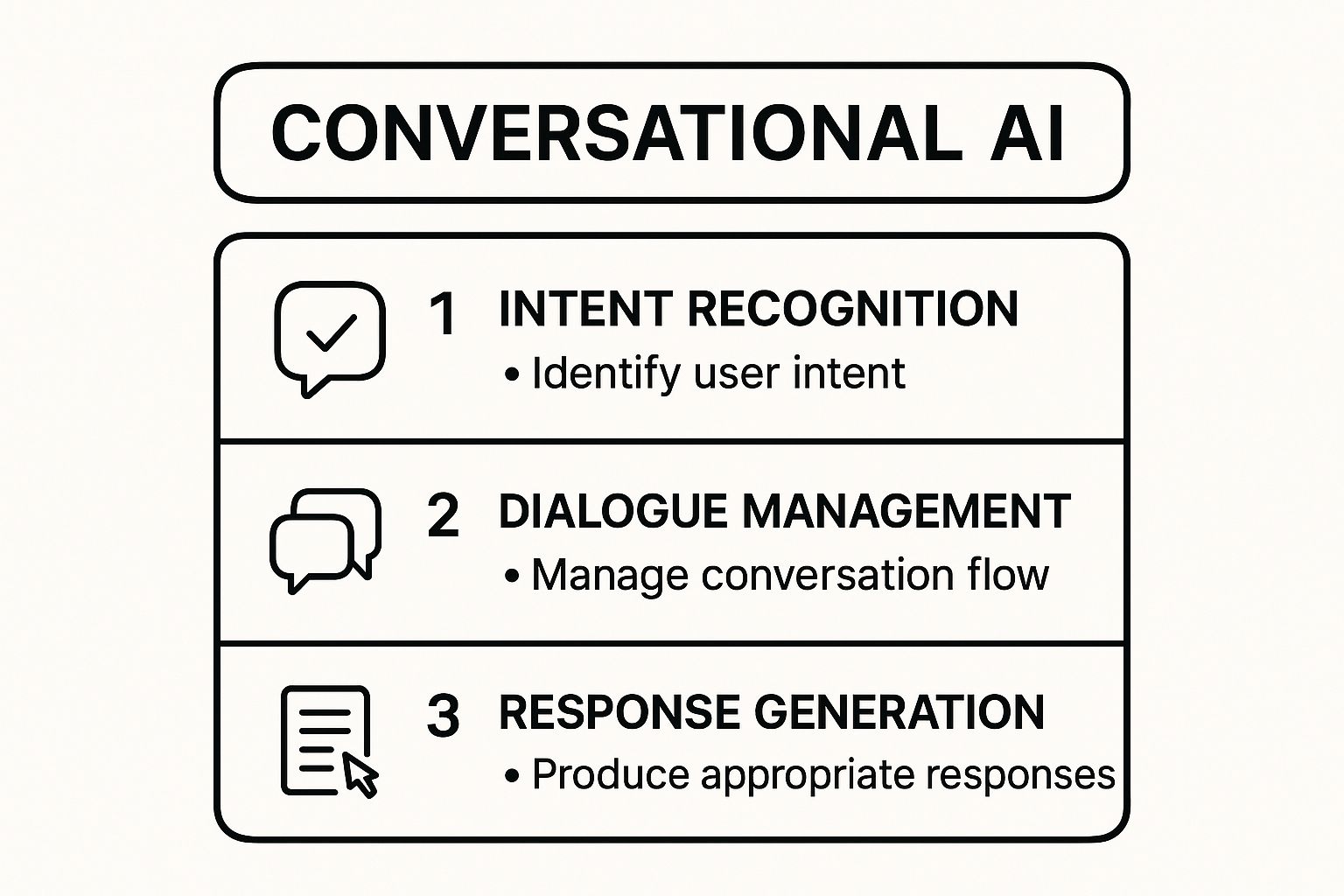
As the infographic shows, these components work together seamlessly. The system first identifies the user's intent, then manages the flow of the conversation, and finally generates an appropriate response. Understanding this interaction is fundamental to building effective and engaging conversational AI experiences.
Setting Up Your Chosen Workspace
After choosing your tools and environment, you're ready to set up your workspace. Make sure your chosen programming language is installed, along with any required libraries and frameworks. For cloud-based solutions, create an account on the chosen platform and explore its interface. With local setups, ensure your server infrastructure and dependencies are properly configured. Taking the time to do this right will save you significant time and effort later. This solid foundation will make your development experience much smoother as you delve deeper into your conversational AI tutorial.
To help you choose the right platform, here's a comparison of some popular options:
To help you choose the right platform, we’ve compiled a comparison of some popular options:
Conversational AI Development Platforms Comparison A detailed comparison of popular platforms for developing conversational AI applications, highlighting their features, pricing, ease of use, and ideal use cases.
| Platform | Pricing Model | Technical Expertise Required | NLP Capabilities | Integration Options | Best For |
|---|---|---|---|---|---|
| Google Dialogflow | Pay-as-you-go | Low to Medium | Strong, powered by Google's NLP engine | Wide range of integrations with Google Cloud and other services | Prototyping, rapid development, integrating with Google services |
| Amazon Lex | Pay-as-you-go | Low to Medium | Robust, backed by Amazon's AI technologies | Seamless integration with other AWS services | Building chatbots for customer service, e-commerce, and other business applications |
| Microsoft Azure Bot Service | Pay-as-you-go | Medium to High | Powerful, leveraging Microsoft's cognitive services | Integrates well with other Azure services and tools | Enterprise-grade chatbots, complex conversational flows, integrating with Microsoft ecosystem |
| Rasa | Open-source, paid enterprise option | Medium to High | Highly customizable, can use various NLP engines | Flexible integration options through APIs | Projects requiring high customization, on-premise deployment, or specific data privacy requirements |
This table provides a quick overview of some key considerations when choosing a conversational AI development platform. Each platform has its own strengths, so select the one that aligns best with your project's specific needs and your team’s technical expertise. Remember, the right tools empower you to create truly engaging and effective conversational AI experiences.
Crafting Conversations That Flow Naturally

The success of your conversational AI depends heavily on how well the conversations are designed. This is the crucial difference between a helpful chatbot and one that frustrates users. With careful planning and implementation, you can create dialogues that feel natural, engaging, and truly helpful.
Mapping Out Conversation Paths
Imagine all the different directions a conversation could go in. Think of it like creating a roadmap for your chatbot. This roadmap anticipates how users might ask questions and what information they’ll need. For example, if someone wants to book a hotel room, they might ask about room types, availability, prices, and amenities. Each question should receive a relevant answer, and the chatbot might ask follow-up questions to gather all the necessary details.
Developing a Consistent Personality
Just like a good conversationalist, your chatbot should have its own distinct personality. This helps build a connection with users and makes interactions more engaging. This doesn't mean your chatbot needs to be eccentric or tell jokes. It’s more about having a consistent tone of voice and communication style that reflects your brand and resonates with your target audience. A consistent personality goes a long way in creating a positive user experience.
Handling Unexpected Input Gracefully
Real conversations rarely follow a script. Users might phrase things in unusual ways, ask surprising questions, or even go off-topic. Your conversational AI needs to handle these moments smoothly. Implement strategies like asking clarifying questions or offering useful suggestions. This adaptability makes the interaction feel more human and less robotic. Robust error handling is essential for a seamless user experience.
This focus on natural conversation flow is mirrored in market trends. The conversational AI market is projected to grow substantially, with revenue expected to increase from $14.6 billion in 2025 to $30.8 billion by 2029, a 110% jump. This growth underscores how businesses are increasingly relying on conversational AI to improve customer engagement and operational efficiency. Learn more here.
Managing Context Across Multiple Turns
Many user requests involve more than just a single exchange. Booking a flight, for example, has several steps: choosing a destination, selecting dates, picking seats, and providing payment information. Your conversational AI must remember these previous interactions and use that information to shape its responses. This is what we mean by maintaining context. Effective context management makes the conversation feel connected and avoids asking repetitive questions.
Crafting Authentic Responses
One of the biggest hurdles in conversational AI is making responses sound human. Avoid stiff or overly technical language. Instead, opt for natural, conversational phrasing. Vary your responses to avoid sounding like a broken record. This keeps the interaction engaging and less like a pre-written script.
Guiding Users Toward Successful Outcomes
A well-designed conversation guides the user towards their goal without feeling forced. Think about how you can subtly steer the conversation by offering helpful suggestions and anticipating user needs. For example, if a user searches for a specific product, your chatbot could provide filtering options to narrow their search. This proactive approach helps users achieve their goals quickly and efficiently. It's a win-win: the user gets what they need, and your business benefits from a satisfied customer. These strategies ensure your conversational AI provides genuine value and contributes to positive business outcomes.
Building Your AI Model: From Concept to Conversation
This section explores the technical side of building your own Conversational AI. We'll delve into creating an AI model that can hold dynamic, context-aware conversations that go beyond simple responses. This conversational AI tutorial provides a step-by-step guide, offering insights for both quick projects and more complex, customized solutions.
Understanding User Intent: Intent Recognition
The foundation of a robust conversational AI lies in its ability to understand user intent. Intent recognition focuses on deciphering the goal behind a user's message. For example, the question "What's the weather like today?" expresses the intent "get_weather." Accurate intent recognition is essential for creating a successful conversational experience.
Extracting Key Information: Entity Extraction
Beyond understanding intent, your AI needs to pick out important details within the conversation. This is achieved through entity extraction. In the weather example, "today" is a key entity specifying the timeframe. Locations, dates, product names, or any information needed to fulfill the user's request are all examples of entities. Extracting these details allows your AI to provide personalized and accurate responses.
Maintaining Conversation Flow: Context Management
Conversations rarely consist of single questions and answers. Users build upon previous interactions, and your AI must be able to keep up. This is where context management plays a vital role. It allows the AI to remember past exchanges, much like giving it a memory. Context management ensures coherent responses, avoids repetitive questions, and creates a natural conversational flow.
Building with Popular Frameworks: Rasa, Dialogflow, and Python Libraries
You have several powerful tools at your disposal for building your conversational AI model. Rasa is an open-source framework offering flexibility and control over your chatbot’s behavior. Rasa is a good option when customization is a priority. Dialogflow, on the other hand, offers pre-built models and simplified development tools for a quicker start. Dialogflow is a great choice for faster prototyping and development. For coders, Python libraries like TensorFlow and PyTorch unlock deeper customization and integration with existing systems. Check out this guide on how to implement a chatbot. Also, you might find this article on how to build a chatbot helpful.
Practical Examples and Code Snippets
This tutorial also provides practical examples illustrating these concepts in action. We'll share code snippets demonstrating intent recognition, entity extraction, and context management within various frameworks. This hands-on approach helps you see how these pieces fit together and adapt them to your needs.
The use of conversational AI is transforming customer support services, resulting in substantial market growth. In 2025, the conversational AI market was valued at $13.08 billion, and it's projected to reach $55.11 billion by 2032, representing a CAGR of 22.8%. This growth is fueled by the increasing need for efficient, personalized, and always-available customer support. Learn more here.
Comparing Technical Approaches: Tradeoffs and Best Practices
Choosing the right approach for your project is essential. We'll compare different technical approaches, highlighting the tradeoffs between using pre-built services and creating custom solutions. Understanding these tradeoffs helps you balance development speed with the desired level of control and customization.
Building a Conversational AI for Real-World Interactions
By following the principles in this tutorial, you can build an AI that responds intelligently to real-world scenarios. Whether you're using Rasa, Dialogflow, or Python libraries, you'll acquire the practical skills to create a conversational AI that goes beyond simple question-and-answer interactions, delivering more engaging and fulfilling user experiences.
Testing That Actually Improves Your Chatbot

Many conversational AI projects fail to reach their full potential because of inadequate testing. This section will give you effective strategies to evaluate your chatbot’s performance and identify areas for improvement. We'll go beyond basic accuracy and focus on what truly matters: real user satisfaction.
Beyond Accuracy: Measuring Real-World Performance
Accuracy is important, of course. But it’s not the whole picture. A chatbot might correctly interpret a user’s request but still provide a useless response. That’s why testing should focus on real-world scenarios, like booking a flight or answering a multi-part question. We need to look at not just what the chatbot says, but how it guides the user toward a successful outcome.
Implementing Effective Testing Strategies
A combination of testing methods is crucial. Conversation simulations let you test various dialogue paths and identify potential bottlenecks. Structured user testing with real people provides insights into how users interact with the chatbot, often revealing unexpected behaviors and frustrations. Understanding the core principles of chatbot technology is also important as you build your AI model. A helpful resource for that can be found here. And finally, performance analytics track metrics like task completion rate and user satisfaction, providing quantifiable data to guide your improvement efforts.
Interpreting User Interaction Data
Data from user interactions is invaluable. Analyzing conversation logs helps you pinpoint confusion points, where users struggle to understand the chatbot or get stuck in repetitive loops. This data also reveals areas where the chatbot’s responses are inadequate or misleading. Careful examination of these interactions allows you to pinpoint areas for improvement and prioritize the most impactful changes.
To understand how to best measure your chatbot's performance and identify areas for improvement, take a look at the table below:
Key Performance Metrics for Conversational AI Essential metrics to track when evaluating and improving your conversational AI application, including definition, calculation method, and target benchmarks.
| Metric | Definition | How to Calculate | Industry Benchmark | Improvement Strategy |
|---|---|---|---|---|
| Task Completion Rate | Percentage of user goals successfully completed through the chatbot | (Successful interactions) / (Total interactions) | 70-90% | Improve dialogue flow, address confusion points, expand training data |
| User Satisfaction | Measure of user happiness with the chatbot interaction | Surveys, feedback forms, sentiment analysis | 4.0+ out of 5.0 | Personalize responses, reduce response time, provide helpful resources |
| Fallback Rate | Percentage of conversations requiring human intervention | (Human handoffs) / (Total conversations) | <20% | Improve NLU model, expand training data, refine dialogue flows |
| Average Handling Time | Average time taken to complete a user interaction | (Total interaction time) / (Number of interactions) | Varies based on task complexity | Optimize dialogue flow, provide quick replies, improve response time |
| Conversation Length | Average number of turns in a chatbot conversation | (Total turns) / (Number of conversations) | Varies based on task complexity | Streamline dialogue flow, anticipate user needs, offer proactive assistance |
This table summarizes some of the most important metrics to track when evaluating chatbot performance. By monitoring these metrics, you can gain a better understanding of where your chatbot excels and where it needs improvement.
Refining Your Training Data Strategically
Testing often reveals gaps in your training data. The chatbot might misunderstand certain phrases or struggle with specific requests. Analyzing user interactions helps you identify these weaknesses and strategically expand your training data. Adding more examples of problematic phrases or scenarios helps the chatbot learn and improve over time. This iterative process of testing and refinement is key to creating a truly effective conversational AI experience.
Prioritizing Enhancements for Maximum Impact
Not all improvements are equally valuable. Some changes will have a bigger impact on user satisfaction than others. By analyzing testing data and user feedback, you can prioritize enhancements that address the most critical issues. Focusing on high-impact changes ensures your development efforts are directed towards the areas that will deliver the most significant improvements to the user experience. For further insights on optimizing agent assistance, check out this resource on real-time agent assistance.
Continuous Improvement: The Key to Chatbot Success
Building a successful chatbot is a journey, not a destination. The most effective teams implement continuous improvement cycles, using testing data and user feedback to drive ongoing refinement. This iterative approach allows the chatbot to adapt to changing user needs and become increasingly effective over time. This dedication to constant refinement makes the difference between a good chatbot and a great one.
Launching Your AI Assistant: Deployment That Delivers
Your conversational AI is ready. Now it's time to introduce it to the world, where it can truly shine and bring value to your users. This part of our conversational AI tutorial will guide you through choosing the best deployment methods, tailored to your specific needs and technical resources. We’ll explore practical strategies for smooth integration across various platforms, from messaging apps and websites to mobile apps and even voice assistants.
Choosing the Right Deployment Platform
Picking the right platform is a crucial first step in deployment. Your decision depends on several factors, including your target audience, technical capabilities, and budget. Here are some key things to consider:
-
Messaging Platforms: Deploying on popular platforms like Facebook Messenger, WhatsApp, or Slack gives you a wide reach and easy access for users. These platforms often offer built-in tools and APIs to simplify integration.
-
Website Integration: Embedding your AI assistant directly into your website can boost customer service and lead generation. This lets users interact seamlessly within the familiar environment of your website.
-
Mobile Apps: Integrating your AI into your mobile app creates a personalized, readily-available experience for your users. This is especially beneficial for apps focused on customer engagement and support.
-
Voice Assistants: Deploying on platforms like Amazon Alexa or Google Assistant opens your AI to the world of voice-activated devices. This approach responds to the increasing popularity of voice-first interactions.
Implementing Your Deployment Strategy
After selecting your platforms, it's time to put your deployment strategy into action. This means integrating your AI's backend with the chosen platform's APIs and SDKs. Careful planning and thorough testing are essential for a smooth and problem-free launch.
Handling Security and Scaling
Security is paramount when deploying AI assistants. Implement strong security measures to safeguard user data and protect your system. Also, think about how your AI will handle a growing number of users. Cloud-based solutions can offer flexibility and scalability, whereas on-premise setups might require more careful resource management.
Monitoring and Maintenance: Ensuring Long-Term Success
After launch, ongoing monitoring is key. Track important metrics like conversation completion rates, fallback rates (when a human needs to step in), and user satisfaction. Regular maintenance and updates are vital for fixing issues, incorporating user feedback, and keeping your AI running efficiently.
Integrating with Existing Business Systems
Connecting the AI assistant to existing business systems is critical for many organizations. Integrating with CRM platforms, order management systems, and other internal tools can streamline workflows and enhance your AI’s capabilities. This smooth information flow between systems unlocks valuable data insights and allows for more personalized and effective interactions.
Measuring Business Impact: Demonstrating ROI
Ultimately, success is measured by how your AI assistant contributes to your business goals. Track relevant metrics like conversion rates, customer satisfaction scores, and cost savings. Demonstrating a positive return on investment (ROI) validates your investment in conversational AI and secures support for future improvements.
Creating Seamless Handoffs Between AI and Human Agents
While AI can handle many routine tasks, sometimes human interaction is essential. Plan a smooth transition process for handing conversations from your AI to human agents. This ensures complex or sensitive matters receive the required attention and maintains a positive customer experience. Learn more in our article about conversational AI solutions.
Real-World Examples: Industry-Specific Implementations
This section will showcase real-world success stories of conversational AI across various industries. These examples highlight how organizations use AI to improve customer service, automate processes, and boost business growth. You'll see how different industries tailor these technologies to their unique needs, offering valuable insights for your own project.
By following this conversational AI tutorial, you can confidently deploy an AI assistant that not only engages users but also delivers measurable results for your organization.
Ready to transform your customer communication and unlock the power of AI? Visit Voicetta today to learn how our AI-powered communication platform can elevate your business.
Was this useful?
If this article helped, add Voicetta as a preferred source in Google Search. Your results can then highlight our writing.
Add as preferred source