
Blog
Best Conversational Analytics Software for Customer Insights
Imagine a detective meticulously studying every customer interaction. That's the essence of conversational analytics software. It's more than just recording and trans...
Understanding Conversational Analytics Software: Beyond The Buzzwords

Imagine a detective meticulously studying every customer interaction. That's the essence of conversational analytics software. It's more than just recording and transcribing calls. It digs into the subtleties of human communication, revealing insights hidden within spoken words. Think of it as a tireless analyst, listening to every customer interaction across your business, spotting patterns and trends a human might miss.
Uncovering Hidden Insights
Traditional analytics often show you what happened, after the fact. Conversational analytics gives you a real-time view into why things happened. It's not about simply collecting data; it's about understanding the context, emotions, and unspoken cues in every conversation.
For example, a customer might say "everything's fine" in a flat tone. A human agent might accept this at face value. But conversational analytics software can detect underlying frustration based on vocal cues and word choice.
This ability to analyze conversations transforms basic data into strategic intelligence. It helps businesses identify potential problems before they escalate, personalize interactions, and improve the overall customer experience.
Furthermore, by analyzing successful interactions, conversational analytics software can identify training opportunities for agents and highlight best practices. This allows organizations to constantly improve customer service and sales processes based on real-world interactions.
From Call Recording to Actionable Intelligence
The market for conversational AI, including conversational analytics software, is experiencing remarkable growth. It's projected to reach $55.11 billion by 2032. This highlights the increasing need for tools that can unlock the valuable data hidden within everyday customer conversations. For more information on this growing market, check out: Learn more about Conversational AI Market Growth.
Conversational analytics software uses advanced technologies like Natural Language Processing (NLP) and Machine Learning (ML) to analyze conversations. It goes beyond simply converting speech to text; it strives to understand the meaning and sentiment behind those words. These systems identify key themes, track customer sentiment, and even predict future behavior based on past interactions. For businesses looking to improve customer support, consider automating customer support tasks in conjunction with conversational analytics.
This empowers businesses to move beyond simply reacting to customer issues. It enables them to proactively address customer needs and improve overall customer satisfaction. By understanding the nuances of customer communication, organizations can make informed decisions, improve efficiency, and drive business growth. These tools provide a powerful way to gain a competitive edge. This in-depth analysis translates into tangible business outcomes by allowing companies to anticipate needs and improve overall satisfaction.
How Conversational Analytics Actually Works Behind The Scenes

Imagine conversational analytics software as a truly perceptive listener, not just hearing words, but understanding the subtle cues and unspoken messages within a conversation. That's the real power of these platforms. They combine natural language processing (NLP), machine learning (ML), and artificial intelligence (AI) to unlock the complexities of human communication.
Deconstructing the Conversation
Think of the software like a detective meticulously piecing together evidence. It analyzes speech patterns, identifies recurring themes, and even picks up on those slight emotional shifts a human might miss. This all begins with gathering conversations from different channels – phone calls, video conferences, and online chats. This raw, often disorganized data is then processed by powerful AI algorithms.
These algorithms are the heart of the system, constantly learning and improving with every conversation they analyze. They become adept at differentiating speakers, pinpointing crucial keywords and phrases, and even gauging the emotional temperature of the exchange. The software doesn't just transcribe; it interprets.
From Data Chaos to Actionable Insights
What's truly remarkable is how these platforms handle the nuances of real-world conversations. Regional accents, industry jargon, even casual slang – the software can navigate it all. This ability to understand diverse language is essential for businesses operating globally or serving varied customer bases. The value of the conversational systems market, which includes analytics, reached USD 19.5 billion in 2024, showing the growing importance of this technology. For a deeper dive, check out this resource: Discover more insights into the Conversational Systems Market.
This process of refining messy conversational data into clear, usable insights is what makes conversational analytics so impactful. The software effectively cuts through the clutter, revealing important trends and patterns that can guide critical business decisions.
The Evolution of Conversational Analysis
The technology itself has come a long way. Early systems simply identified pre-defined words or phrases – a bit like a basic word search. Now, advanced platforms perform sophisticated sentiment analysis, assessing the overall tone and feeling of a conversation. Imagine predicting customer satisfaction before a call even ends – that's the power of modern conversational analytics. This allows for proactive intervention and better customer experiences. This continuous evolution means we can expect even richer and more valuable insights for businesses in the future.
Essential Features That Separate Great Platforms From Good Ones
Not all conversational analytics software is created equal. Knowing which features truly boost your business versus which ones are just marketing fluff can save you a lot of headaches (and money). Think of these features as the specialized tools in a craftsman's workshop – the better the tools, the better the final product.
Real-Time Insights for Proactive Responses
Imagine having a crystal ball that tells you when a customer conversation is about to go south. That's real-time sentiment analysis. It alerts managers to negative shifts in customer sentiment, allowing them to step in and smooth things over before a small issue becomes a big problem.
Then there's keyword spotting, which is more nuanced than just looking for specific words. It's about understanding the context of those words. For example, a customer saying "fine" can mean very different things depending on their tone of voice. Conversational analytics software can pick up on these subtle cues and flag the conversation for a manager's attention.
Let's say a customer uses the word "fine" repeatedly during a support call, but their tone suggests frustration. The software would detect this discrepancy and alert an agent, who could then address the underlying issue and turn a potentially negative experience into a positive one.
Unlocking Performance and Trends
Ever wondered what your top-performing sales reps do differently? Conversation scoring algorithms can help you figure it out. They analyze successful interactions, highlighting best practices that can be shared across the team to improve overall performance and create more consistent customer experiences. This means your business can learn from its best and replicate their success.
Trend analysis is like having a finger on the pulse of customer sentiment. It can identify shifting preferences and emerging issues before they snowball into major problems. Imagine noticing a growing number of complaints about a particular product feature. With trend analysis, you can address the issue proactively, preventing customer churn and protecting your brand reputation.
Integration and Automation for Efficiency
The infographic below illustrates the ripple effect of conversational analytics, showing how it leads to happier customers, faster response times, and ultimately, more sales.
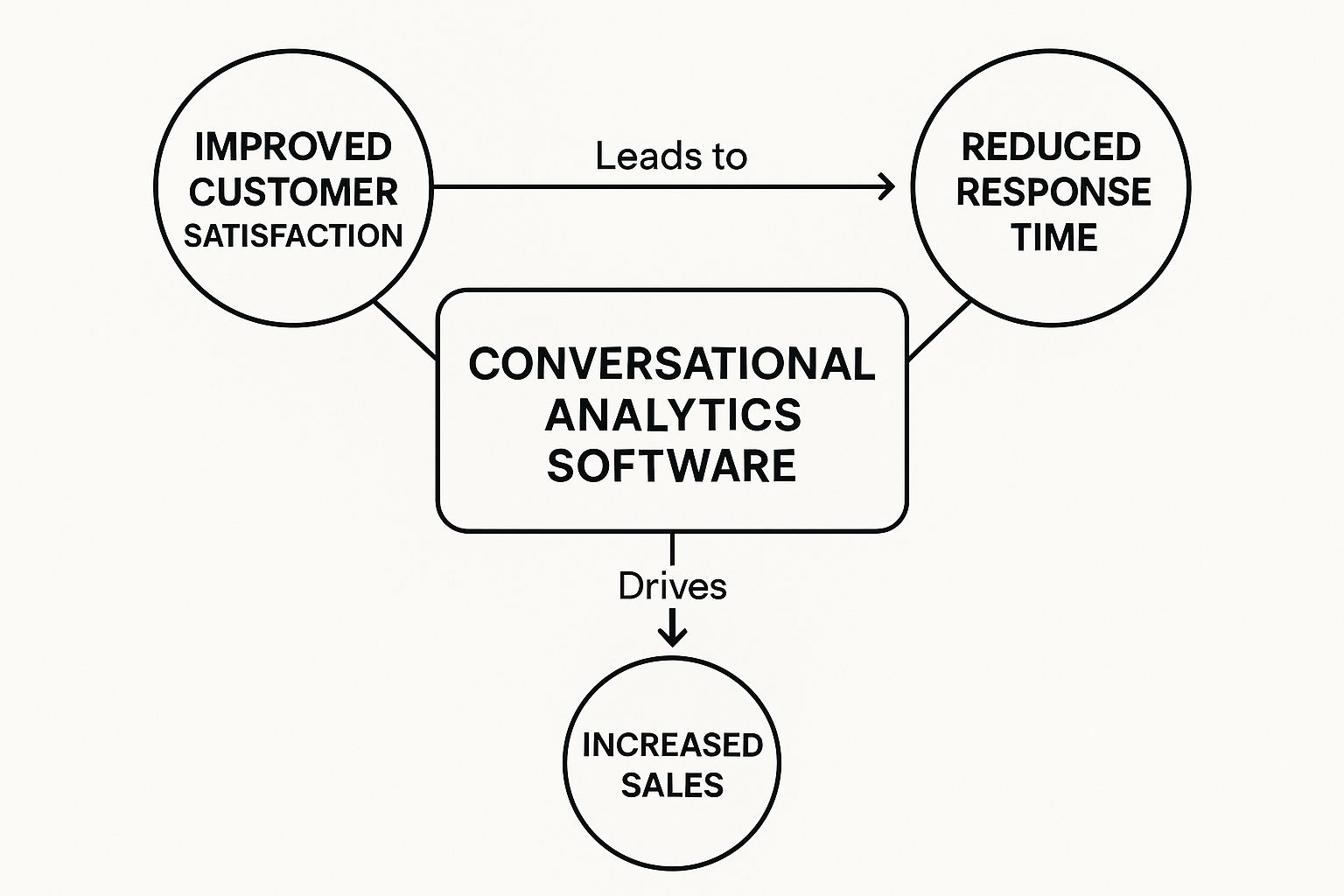
As you can see, improved customer interactions have a direct impact on the bottom line. Integration capabilities allow you to connect your conversational analytics insights with your existing CRM and business intelligence systems, giving you a holistic view of the customer journey.
Think about the time saved by not having to listen to hours of customer call recordings. Automatic call summarization does the heavy lifting for you, providing concise summaries that allow managers to quickly identify key issues and track agent performance. This frees up valuable time for strategic activities.
Finally, competitor mention tracking provides valuable market intelligence. By identifying when and how competitors are mentioned in customer conversations, you can gain a better understanding of the competitive landscape and adapt your strategies accordingly. This gives you a unique edge, helping you stay ahead of the curve and anticipate market trends.
To help illustrate the key differences between basic and advanced conversational analytics platforms, take a look at the comparison table below. It focuses on the practical business impact of each feature.
Feature Comparison: What Actually Matters In Conversational Analytics A practical comparison of essential capabilities across different platform tiers, focusing on business impact rather than technical specifications.
| Feature | Basic Platforms | Advanced Platforms | Business Impact |
|---|---|---|---|
| Real-time sentiment analysis | Basic sentiment detection | Granular sentiment analysis with context and tone detection | Improved agent response times, proactive issue resolution |
| Keyword spotting | Basic keyword matching | Contextual keyword analysis, identification of related terms | Deeper understanding of customer needs and intent |
| Conversation scoring algorithms | Basic scoring based on keywords | Advanced scoring based on multiple factors including sentiment, tone, and customer satisfaction | Identification of best practices, improved agent training |
| Trend analysis | Basic trend identification | Predictive trend analysis, identification of emerging issues | Proactive problem-solving, improved product development |
| Integration capabilities | Limited integrations | Seamless integration with CRM and other business systems | Holistic view of customer journey, improved data analysis |
| Automatic call summarization | Basic summaries | Detailed summaries with key insights and action items | Increased efficiency, improved manager oversight |
| Competitor mention tracking | Basic mention tracking | Detailed analysis of competitor mentions, including context and sentiment | Improved competitive intelligence, strategic advantage |
This table highlights how investing in a more advanced conversational analytics platform can lead to significant improvements across key business areas. From improved customer satisfaction to more efficient workflows, the right platform can be a game-changer.
Real Companies, Real Results: Where This Technology Shines
Conversational analytics software isn't just about impressive tech; it's about solving real business problems. Imagine giving every sales rep a personal coach, analyzing their every conversation to uncover what makes the top performers tick. That’s the potential of this technology.
Transforming Sales, Service, and Marketing
For sales, this software reveals the magic formulas in winning conversations. It's like having a secret decoder ring for sales success, allowing teams to replicate those winning strategies.
Customer service teams also benefit. Think of it as a real-time frustration detector. Agents can address issues before they explode, smoothly guiding customers to specialized agents when needed.
Marketing can tap into a goldmine of customer language and pain points. This informs everything from writing ad copy that truly connects to developing products based on real customer feedback.
It’s not just about what customers say, but why. A software company, for instance, can pinpoint the language patterns linked to successful upsells. Training sales teams to use these phrases can dramatically boost revenue.
Case Studies: From Theory to Tangible Impact
The impact is real and measurable. Retailers are using this technology to reduce customer churn. Imagine spotting early warning signs in conversations—like frequent mentions of competitors—and stepping in to save the relationship.
In financial services, conversational analytics is crucial for compliance. By monitoring every interaction, firms can ensure they’re meeting regulations and reducing risks. Even healthcare is seeing benefits, with analysis of communication leading to better patient care and satisfaction.
The use of conversational analytics is booming across industries—retail, banking, healthcare, travel, and more. Companies are using it for everything from understanding customer sentiment to mapping the entire customer journey. Discover more insights on this industry trend. These applications show just how adaptable this technology is.
Quantifiable Results: The Bottom-Line Impact
These aren’t just stories. A telecom company cut its average call resolution time by a whopping 30% after implementing conversational analytics. They spotted recurring questions and automated the answers, freeing up agents for more complex issues.
A software company uncovered millions in untapped upsell potential just by analyzing the language of its best salespeople. Imagine finding that kind of hidden revenue!
And a logistics company completely overhauled its customer experience. By analyzing conversations, they found the root causes of complaints and fixed them. This not only reduced negative reviews but also boosted customer loyalty. These real-world examples prove that conversational analytics has a direct impact on the bottom line. It’s about giving businesses the insights they need to make smarter decisions, work more efficiently, and achieve real growth.
Measuring What Matters: The Business Impact You Can Actually Track

Let's talk about real results. Instead of focusing on marketing hype, let's explore how conversational analytics software delivers measurable benefits for businesses that truly want to understand their customers. Unlike older tools that only give you a look back, this technology provides real-time insights, empowering you to address challenges and seize opportunities as they happen. Think of it like having a finger on the pulse of your customer interactions.
Quantifiable Improvements: From Satisfaction to Revenue
Imagine being able to boost customer satisfaction by finding and fixing service issues before they escalate into complaints. That's the power of real-time analysis. Conversational analytics software helps you proactively address customer concerns, resulting in happier customers and stronger brand loyalty. For a deeper dive into measuring customer satisfaction, check out this helpful resource: Measuring customer satisfaction.
Sales teams also benefit greatly. By understanding what works in successful sales conversations, they can refine their approach and improve conversion rates. This focused strategy helps maximize sales efforts and fuels revenue growth. Uncovering these winning patterns can be a true game-changer.
Furthermore, conversational analytics software streamlines training for new hires. By identifying best practices from top performers, companies can significantly reduce training time – sometimes by as much as 40%. This faster onboarding process translates to quicker productivity and greater efficiency.
Reducing Churn and Increasing Revenue
Another key advantage is the ability to identify and address customer churn. The software can pinpoint at-risk behavior patterns in conversations, allowing organizations to intervene weeks before a customer might typically leave. This proactive approach strengthens customer relationships and reduces expensive churn. Keeping your customers happy and engaged is key for long-term success.
But it doesn't stop there. This technology also unlocks opportunities for revenue growth. It can spot upselling opportunities that human agents might miss, leading to increased revenue per customer. Imagine being able to identify extra sales potential within existing customer interactions – that's the power of conversational analytics.
The market for conversation intelligence software, a close cousin of conversational analytics software, is projected to hit USD 1.27 billion in 2024. This shows the growing recognition of its value. You can discover more insights on the market if you're interested. This growth clearly points to a rising trend of adopting solutions that analyze and improve customer conversations.
Return on Investment: A Realistic Perspective
The initial investment in conversational analytics software often pays for itself within six months. This rapid return on investment (ROI) is driven by improved customer retention, increased sales effectiveness, and lower operational costs. Cost savings combined with revenue growth make a strong argument for this technology.
However, it's important to have realistic expectations. Implementation takes time, and success should be measured using leading indicators, not just lagging metrics. Focusing on things like improved agent performance and fewer customer complaints provides a more accurate picture of long-term success. These leading indicators give you valuable insights into how the software is impacting your business, allowing you to make adjustments and maximize its effectiveness. By embracing this technology and using it strategically, organizations can unlock significant value and gain a competitive edge. This focus on continuous improvement ensures you're always getting the most from your investment.
Your Implementation Roadmap: Starting Smart, Not Starting Over
Successfully implementing conversational analytics software doesn't have to mean tearing down your existing customer communication systems and rebuilding from scratch. Think of it more like a targeted home renovation: you can achieve significant improvements by focusing on key areas first, then expanding strategically. This section will guide you through a practical, phased approach that delivers early wins and builds towards a comprehensive understanding of your customers.
Starting Small with Pilot Programs
Imagine dipping your toes in the water before diving into the deep end. That's the idea behind starting with pilot programs. These smaller-scale projects allow you to demonstrate the value of conversational analytics software to stakeholders and build internal momentum. Concentrate on specific use cases that directly address critical business challenges, like improving customer satisfaction or reducing call handling time. A successful pilot provides concrete evidence of the software's capabilities and paves the way for wider adoption.
For instance, if reducing customer churn is a top priority, a pilot program could focus on analyzing customer service calls to identify early indicators of dissatisfaction. This targeted approach lets you quickly showcase the software's value and secure buy-in for further investment.
Key Steps for Successful Implementation
Here’s a breakdown of key steps to ensure a smooth and successful implementation:
- Select the Right Use Cases: Choose initial projects that align with your business priorities and offer a high potential for demonstrable ROI. This strategic approach ensures your early efforts yield tangible results and generate enthusiasm for the technology.
- Technical Integration: Seamless integration with existing systems, like your CRM (Salesforce), is crucial. This allows for a smooth flow of data and maximizes the value of your current technology investments.
- Data Privacy and Security: Address data privacy concerns right from the outset. Complying with regulations and protecting sensitive customer information is paramount. This builds trust and ensures the ethical use of the technology.
- Team Training: Give your team the skills they need to effectively use the software. Proper training empowers your staff to extract valuable insights and make data-driven decisions.
- Establish Governance Processes: Implement clear guidelines for data access and usage. Good governance sets the stage for long-term success and responsible data management.
You might be interested in: Check out our guide on how to implement a chatbot for more insights into integrating conversational tools into your business.
Avoiding Common Pitfalls
Just like any project, there are potential pitfalls to avoid. Trying to analyze everything at once can lead to overwhelm and diluted results. Instead, start small and focus on specific areas where the software can make the biggest impact.
Also, avoid getting caught up in vanity metrics. Focus on tracking metrics that directly impact business outcomes, like customer satisfaction, conversion rates, and revenue.
Setting Realistic Expectations and Measuring Success
Implementation takes time. Set realistic expectations for each phase of the project, establish clear milestones, and celebrate successes along the way. This keeps the team motivated and maintains momentum.
A robust measurement framework that tracks progress and demonstrates value at each stage is essential. This provides concrete evidence of the software’s impact and justifies ongoing investment. To help you visualize this process, let's look at a sample timeline:
To give you a clearer idea of a practical implementation timeline, take a look at the table below:
Implementation Timeline: Your 90-Day Conversational Analytics Launch A realistic breakdown of implementation phases with specific milestones and success metrics for each stage of deployment
| Phase | Duration | Key Activities | Success Metrics |
|---|---|---|---|
| Pilot Program Setup | 30 Days | Define use case, select pilot group, integrate with CRM, initial training | Pilot group engagement, initial data collection, system stability |
| Pilot Program Execution | 30 Days | Data analysis, feedback gathering, system adjustments, reporting | Improved customer satisfaction in pilot group, identified trends, refined reporting dashboards |
| Expansion and Refinement | 30 Days | Rollout to wider teams, ongoing training, further system integration, advanced analysis | Increased adoption rate across teams, improved overall customer satisfaction, measurable impact on key business metrics |
This table outlines a typical 90-day implementation, highlighting the key activities and success metrics for each phase. Remember, this is a sample timeline and can be adjusted to fit your specific needs and resources.
Building Internal Champions
Identify and cultivate internal champions who will advocate for the software and drive adoption across the organization. Their enthusiasm and firsthand experience with the software’s benefits can be highly influential in overcoming resistance to change.
By following this roadmap, you can transform what might seem like a complex technology project into a manageable, iterative process that strengthens customer relationships and delivers measurable business results from day one. This structured approach minimizes disruption, maximizes impact, and sets the stage for long-term success with conversational analytics software.
Choosing Your Platform: A Practical Buyer's Decision Framework
Picking the right conversational analytics software can feel overwhelming. The market is full of options, each with its own set of enticing promises. But a smart approach, one that looks past the marketing buzz and focuses on your needs, is key. Think of it like buying a car: a sports car is great for open roads, but not so much for hauling cargo or navigating rough terrain. The best choice depends on your specific journey.
Key Criteria For Evaluation
So, how do you navigate this decision? Here’s a practical framework for evaluating vendors:
-
Seamless Integration: Does the platform play nicely with your existing systems, like your CRM or marketing automation tools? Smooth data flow is crucial for getting the most out of your insights. Imagine trying to fit a square peg in a round hole – that’s what forced integration feels like, and it won't get you very far.
-
Scalability: Can the platform handle your current conversation volume and future growth without breaking the bank? You need a solution that grows with you, not one that holds you back. Think of it as choosing clothes: you want something that fits you now, but also has some room to grow.
-
Industry-Specific Accuracy: Does the platform understand the nuances of your industry? Every sector has its own language and unique customer communication patterns. A platform designed for healthcare might not be the best fit for a retail business, for example. It’s like using the right tool for the job – a hammer is great for nails, but not so much for screws.
-
Total Cost of Ownership: Look beyond the sticker price. Factor in things like ongoing support, potential hidden fees, and the resources you’ll need for implementation and maintenance. It’s like buying a house – the purchase price is just the beginning. You also have to consider property taxes, maintenance, and potential renovations.
This framework helps you assess each vendor objectively, focusing on what truly matters to your business.
Effective Evaluation and Negotiation
Now, let’s put this framework into action:
-
Proof-of-Concept: Test drive the platform before you buy! A proof-of-concept lets you see the platform’s strengths and weaknesses in action. It’s like taking a car for a test drive – you can read all the reviews you want, but nothing beats getting behind the wheel yourself.
-
Targeted Questions: During vendor demos, ask specific questions about integration, scalability, and industry-specific performance. This helps you uncover any potential issues early on. Don’t be afraid to ask tough questions! It’s your money and your business, so you need to be sure the platform is the right fit.
-
Contract Negotiation: Negotiate a contract that protects your interests. Clarify things like service level agreements, data ownership, and exit clauses upfront to avoid headaches down the road. It’s like signing a lease – you want to make sure you understand all the terms and conditions before you commit.
The image below summarizes key considerations for evaluating conversational analytics software, emphasizing factors that contribute to real business value.
Just as this screenshot highlights, choosing the right platform involves carefully evaluating factors like scalability, integration, and total cost of ownership. These are essential for seeing a return on your investment and maximizing the platform's long-term value.
Making Informed Decisions
This framework provides a structured way to evaluate vendors and avoid costly missteps. By focusing on these key criteria, you can confidently choose a platform that aligns with your goals and delivers results. For a broader look at conversational AI, you can also explore other options: Learn more about our conversational AI solutions.
Don't be swayed by marketing fluff. Use this framework to turn subjective sales pitches into objective, comparable data. This empowers you to make well-informed decisions that benefit your business for years to come.
Ready to improve your customer communications and unlock valuable insights? Discover how Voicetta, our AI communication platform, can transform your customer experience and boost your business growth.
Was this useful?
If this article helped, add Voicetta as a preferred source in Google Search. Your results can then highlight our writing.
Add as preferred source