

Blog
Customer Experience ROI: Your Complete Success Playbook
Customer experience (CX) isn't just a trendy marketing term anymore. It's a vital driver of revenue and a key differentiator in today's competitive market. This natu...
The Real Financial Impact Of Customer Experience ROI
Customer experience (CX) isn't just a trendy marketing term anymore. It's a vital driver of revenue and a key differentiator in today's competitive market. This naturally leads to the question: what kind of financial impact can businesses realistically expect from investing in improved CX? The answer, backed by numerous studies, is significant. By viewing customer satisfaction as a strategic investment rather than a cost, companies are transforming their bottom line.
Quantifying the Returns
Companies prioritizing CX are seeing substantial returns. One compelling statistic reveals that businesses earning $1 billion annually can potentially add $700 million in revenue within three years of investing in CX. This highlights the substantial financial benefits of focusing on customer satisfaction, enabling companies to maintain high-quality service and drive customer loyalty. Furthermore, by shifting the perception of customer service from a cost center to a value center, companies can see a remarkable 3.5 times increase in revenue growth. These findings underscore the powerful link between CX and financial performance. Learn more about customer experience statistics.
The infographic below visualizes the potential impact of CX investment, comparing customer retention increases, revenue growth uplift, and cost savings.
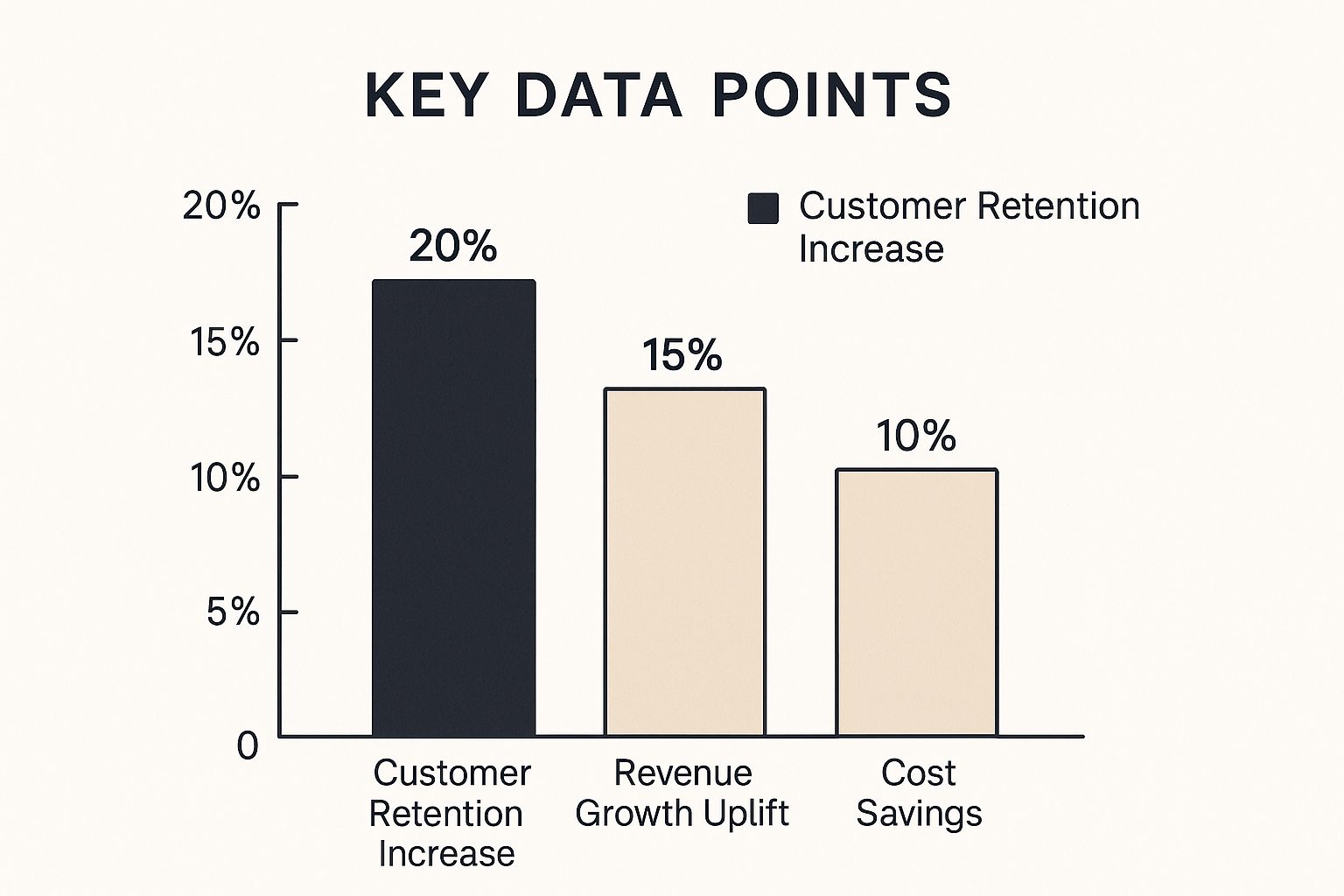
As illustrated, improvements in customer experience can lead to a 20% increase in customer retention, a 15% uplift in revenue growth, and 10% in cost savings. These gains represent a valuable opportunity for businesses to bolster their bottom line through strategic CX investments. Read also: How to master call center quality assurance.
To further understand the potential impact of CX investment across different company sizes, let's look at the following table:
CX Investment Returns by Company Size Revenue growth potential based on initial company size and CX investment level
| Company Size | Annual Revenue | 3-Year CX ROI Potential | Revenue Multiplier |
|---|---|---|---|
| Small | $10 Million | $35 Million | 3.5x |
| Medium | $50 Million | $175 Million | 3.5x |
| Large | $1 Billion | $700 Million | 0.7x |
This table shows the potential revenue growth a company can achieve over three years by investing in CX, assuming the 3.5x multiplier holds true for smaller companies, and using the provided data for a large company. This demonstrates that even with a substantial initial investment, the return potential is significant.
Timelines and Metrics for Success
While the potential ROI of CX investment is impressive, understanding the timelines and metrics involved is crucial. Returns aren't always immediate. Building strong customer relationships and a reputation for excellent service requires time. However, as shown, substantial gains can be achieved within a few years.
Measuring the success of CX initiatives means focusing on the right metrics. Metrics like Net Promoter Score (NPS) and Customer Satisfaction (CSAT) provide valuable insights, but they don't tell the whole story. Tracking metrics directly linked to financial outcomes, such as customer lifetime value (CLV), churn rate, and revenue growth, is essential.
Making the Business Case
Securing executive buy-in requires a compelling business case for CX investment. This involves clearly presenting the potential financial returns and aligning CX initiatives with broader business objectives. By showcasing the data and demonstrating how CX can drive revenue growth, reduce costs, and foster customer loyalty, businesses can effectively advocate for investing in customer experience.
How Superior Experience Unlocks Premium Pricing Power

Exceptional customer experience (CX) doesn't just make customers happy. It actually gives businesses the power to charge more. More and more, customers are happy to pay a premium for a seamless, personalized, and valuable experience. Let's explore how companies use a superior CX to justify higher prices while building strong customer loyalty.
The Psychology of Premium Pricing
Why do customers willingly open their wallets wider for a better experience? It all comes down to perceived value. A superior CX reduces friction and effort, sometimes even adding elements of delight. This creates a sense of value that goes beyond the price tag.
For example, a customer might happily pay more for a hotel with personalized recommendations, smooth check-in, and proactive problem-solving, even if a cheaper option is available. Why? Because the premium experience minimizes stress and maximizes enjoyment, creating a positive feeling about the brand.
A premium experience also often caters to specific customer needs. Imagine a clothing store offering personalized styling advice, free alterations, and early access to new collections. These perks elevate the entire shopping experience, making customers feel valued and understood. This emotional connection strengthens their brand loyalty and justifies the higher price.
Justifying the Premium: Key Experience Elements
Some CX elements can directly support premium pricing. These include:
- Personalized Service: Tailoring interactions to individual customer preferences creates a sense of exclusivity and value.
- Proactive Support: Addressing issues before they even appear minimizes customer effort and shows genuine care.
- Seamless Omnichannel Experience: Providing a consistent and integrated experience across every touchpoint – online and in-store – builds convenience and trust.
- Exclusive Perks and Benefits: Giving premium members access to special offers, events, or services reinforces their importance and encourages loyalty.
- Building Community: Creating a sense of belonging among customers through exclusive events, forums, or loyalty programs deepens their connection with the brand.
Positioning Your Premium Offering
While showcasing the value of your premium CX is crucial, it’s important to avoid alienating budget-conscious customers. This requires strategic segmentation and clear communication. One approach is to offer different service levels for different budgets and needs. This allows you to attract a wider customer base while still offering premium options for those willing to invest more.
A key aspect of CX ROI is the willingness of customers to pay more for superior experiences. A striking 86% of buyers will pay more for a great customer experience, with a premium of 13%-18% for luxury and indulgence services. This shows that companies can retain customers and increase their spending by delivering exceptional CX. Over 50% of customers will switch to a competitor after just one bad experience. This highlights how important it is to maintain high-quality CX to retain customer loyalty and prevent lost revenue. Explore this topic further: Find more detailed statistics here.
Expensive vs. Valuable: The Critical Distinction
Simply raising prices won’t work. The key is to create real value that customers recognize and are willing to pay for. This means focusing on experiences that truly improve their lives, not just adding superficial extras.
A truly valuable CX resonates emotionally with customers, fostering loyalty and advocacy that goes beyond individual purchases. This leads to long-term customer relationships, positive word-of-mouth, and ultimately, sustainable growth. This customer-centric approach, focused on delivering exceptional experiences, drives customer experience ROI and unlocks premium pricing power.
AI-Powered CX: Technology That Actually Delivers Returns
Following our discussion on premium pricing strategies, it's clear that exceptional customer experiences are essential. But how can businesses consistently deliver this level of service while managing costs effectively? This is where the strategic implementation of Artificial Intelligence (AI) becomes invaluable. AI is shifting the perception of customer experience from a cost center to a profit-generating engine, driving real improvements in CX ROI.
Specific AI Applications and Their Benefits
AI offers concrete solutions that directly impact CX. Take intelligent chatbots, for example. These automated assistants handle routine inquiries, resolve simple issues immediately, and free up human agents to focus on more complex cases. This not only improves response times but also enables 24/7 support, boosting customer satisfaction and accessibility. For more on automating customer support, check out this article: How to master automated customer support.
Predictive analytics, another powerful AI application, analyzes customer data to anticipate needs and behaviors. This allows businesses to personalize offers, proactively address potential issues, and create more targeted marketing campaigns. Imagine a retailer using AI to suggest products based on past purchases and browsing history. This tailored approach improves the shopping experience, drives sales, and builds loyalty.
Forward-thinking businesses are also leveraging AI to streamline operations and enhance efficiency. AI can automate tasks like data entry, scheduling, and reporting, reducing manual work and allowing employees to focus on customer interactions. This increased productivity and reduced operational costs ultimately contribute to a better overall customer experience.
Navigating the AI Investment Landscape
While AI presents significant opportunities, implementing it effectively requires understanding the investment landscape. Implementation timelines can vary based on project complexity, but grasping the anticipated costs and potential challenges is critical.
To illustrate the potential ROI of various AI CX solutions, let's look at the following comparison:
AI CX Technology ROI Comparison: Investment costs and returns for different AI-powered customer experience solutions.
| AI Solution | Implementation Cost | Time to ROI | Average ROI % | Key Benefits |
|---|---|---|---|---|
| Intelligent Chatbots | Moderate | 6-12 Months | 20-40% | 24/7 availability, reduced customer service costs, improved response times |
| Predictive Analytics | High | 12-18 Months | 30-50% | Personalized offers, proactive problem solving, increased customer lifetime value |
| AI-Powered CRM | Moderate | 9-15 Months | 25-45% | Automated data entry, streamlined workflows, improved customer relationship management |
As you can see, each solution offers different levels of ROI and benefits. Choosing the right solution depends on your specific business needs and goals.
The integration of AI into customer experience is enhancing ROI. By 2025, AI is projected to be a central component of CX, with 73% of consumers believing AI improves their experience. AI-driven solutions like chatbots and predictive analytics provide faster, more personalized services, leading to increased customer satisfaction and loyalty. The global Customer Experience Management market is predicted to expand at an annual rate of 12.2% through 2028, reaching a value of $20.4 billion. This signifies a substantial investment in technologies that elevate CX. For more detailed statistics, see: Learn more about AI in Customer Experience.
A common mistake is investing in AI solutions without a defined understanding of business requirements. Identifying specific areas for improvement that AI can address and aligning AI initiatives with overall CX objectives is essential. Another oversight is neglecting data quality. AI algorithms depend on accurate, reliable data to perform effectively, so investing in data cleansing and management is crucial.
Positioning For Future AI Innovations
The field of AI is constantly advancing, making it crucial to prepare your business for the next wave of innovations. This involves staying updated on emerging trends, experimenting with new technologies, and cultivating a culture of continuous improvement. By adopting this approach, companies can use AI to deliver increasingly personalized, efficient, and valuable customer experiences. This directly translates to higher customer satisfaction, stronger loyalty, and a healthier bottom line, making AI a vital part of any successful CX ROI strategy.
Measuring Customer Experience ROI That Actually Matters
Many businesses track vanity metrics that look impressive on reports but don't actually tell you much about what to do next. For example, a high Net Promoter Score (NPS) is certainly positive, but it doesn't always translate directly into more revenue. This section offers a practical guide to measuring customer experience ROI, emphasizing the link between CX efforts and actual profit. For a deeper dive into measuring customer satisfaction, check out this helpful resource: measuring customer satisfaction.
Beyond Vanity Metrics: KPIs That Drive Revenue
Traditional metrics like NPS offer a glimpse into customer sentiment but often lack the detail needed to make real changes. To genuinely grasp customer experience ROI, we need to focus on metrics that have a direct impact on revenue. These Key Performance Indicators (KPIs) are essential:
-
Customer Lifetime Value (CLV): This metric represents the total revenue expected from a single customer throughout their relationship with a business. A growing CLV signifies the lasting positive impact of good CX.
-
Churn Rate: A high churn rate signifies unhappy customers and lost revenue. By lowering churn through better CX, businesses can retain valuable customers and create consistent recurring revenue.
-
Customer Acquisition Cost (CAC): Positive CX can be a powerful marketing tool. Building a reputation for great service can lessen the need for costly marketing, resulting in a lower CAC.
-
Average Order Value (AOV): Personalized experiences and targeted offers, fueled by CX data insights, can encourage larger purchases and increase AOV.
Building Actionable Dashboards
Executives need dashboards that clearly demonstrate the impact of CX initiatives on business objectives. An effective CX dashboard should incorporate the following:
-
Clear Visualizations: Charts and graphs make complex data easier to understand.
-
Actionable Insights: Dashboards should not just present data but also suggest concrete actions.
-
Real-time Data: Up-to-the-minute data allows for quick responses to evolving customer needs.
-
Key Metric Focus: Avoid overwhelming dashboards with unnecessary data; concentrate on the metrics most crucial to the business.
Benchmarking and Continuous Improvement
Setting benchmarks is critical for measuring progress and identifying areas for improvement. Regularly comparing CX performance against industry averages and leading companies can offer invaluable insights. This data-driven approach enables businesses to pinpoint strengths, address weaknesses, and continuously refine the customer experience.
Customer experience metrics are directly linked to business performance. Companies with high customer satisfaction scores tend to see better financial results in areas like customer retention, acquisition, and overall growth. Learn more about this connection between customer experience and business performance. For instance, a retailer offering consistent personalized recommendations and proactive customer support might see a significant rise in repeat business and customer loyalty. This, in turn, boosts CLV and reduces churn, having a direct positive impact on the bottom line. Ultimately, this isn't just about making customers happy; it's a strategic investment in sustainable business growth.
You might also find this resource helpful: How to master measuring customer satisfaction.
Building Your Customer Experience ROI Strategy From Scratch
Ready to build a customer experience (CX) strategy that delivers measurable returns? This section provides a practical roadmap, guiding you step-by-step from initial assessment to scaling successful initiatives. We'll explore securing executive buy-in, allocating resources effectively, and creating a truly customer-centric organizational structure.
Securing Executive Buy-In: The Business Case for CX
Gaining executive support for CX initiatives requires a compelling business case, much like pitching a new product. You need to showcase its value and how it contributes to the company's bottom line. This means presenting data-driven projections of potential revenue growth, cost reductions, and the potential for enhanced customer loyalty. Highlighting the potential to increase customer lifetime value (CLV) through improved retention is often particularly persuasive.
Resource Allocation Across Touchpoints: Maximizing Impact
Effective resource allocation is crucial for maximizing the impact of your CX strategy. Think of it like tending a garden: you wouldn't just water one plant. Similarly, you need to distribute resources across all customer touchpoints. This means investing in areas like customer service training, website improvements, and personalized marketing campaigns. Prioritize touchpoints that have the biggest influence on customer satisfaction. For instance, if online checkout is a major pain point, focus resources there.
Organizational Structure: Fostering Customer-Centricity
Building a customer-centric organization goes beyond lip service—it requires structural changes. Empower employees to make customer-focused decisions and create feedback loops for continuous improvement. Imagine a company where every employee, from the CEO down, prioritizes customer needs. This culture requires a supportive structure, perhaps through dedicated CX teams or empowering employees to resolve customer issues on the spot. For more on streamlining processes, check out this resource: How to master improving operational efficiency.
Learning From Success Stories: Practical Solutions and Challenges
Learning from companies that have successfully transformed their CX approach offers valuable insights. Understand common implementation challenges and practical solutions for overcoming resistance to change. Consider a company that successfully implemented a new CRM system to improve customer service. Studying their process can help your business anticipate potential hurdles and adopt best practices. Organizations with well-defined customer experience strategies report 2.3x higher employee engagement and 1.9x higher revenue growth compared to those without formal CX frameworks. More detailed statistics can be found here. This data clearly demonstrates the impact of a well-planned CX strategy.
Maintaining Operational Efficiency During Transformation
Transforming your CX approach doesn't have to disrupt existing operations. Focus on quick wins and build momentum gradually to maintain efficiency while making significant improvements. Simple changes, like improving website navigation or streamlining returns, can noticeably impact customer satisfaction without major overhauls. These early successes can justify larger CX investments down the line.
Prioritizing Initiatives and Aligning With Business Objectives
Limited resources require prioritizing CX initiatives strategically. Use frameworks aligned with broader business objectives, focusing on delivering maximum value to both customers and the company. If a business aims to increase market share, CX initiatives focused on customer acquisition and brand awareness would take priority. This ensures every CX investment directly contributes to the company's overall success. Building a strong CX ROI strategy requires careful planning, execution, and continuous evaluation. By following these steps, you can create a CX program that not only delights customers but also drives measurable business growth.
Future-Proofing Your Customer Experience Investment
Customer expectations are constantly evolving. This makes creating a CX strategy that delivers both present returns and future adaptability crucial. Future-proofing your customer experience investment requires foresight, flexibility, and a commitment to continuous improvement.
Omnichannel Integration: Creating Seamless Experiences
Customers interact with businesses across a multitude of channels, from websites and mobile apps to social media platforms and brick-and-mortar stores. Omnichannel integration isn't simply about maintaining a presence on these channels. It's about crafting a seamless and unified experience.
Imagine a customer beginning a purchase on their smartphone and completing it on their laptop without a single interruption. This level of integration not only promotes convenience but also strengthens the customer relationship.
Achieving this requires robust technology and a data-driven approach to effectively track and manage customer interactions across these varied platforms. The ultimate goal is a smooth and intuitive customer journey, regardless of the touchpoint.
Predictive Personalization: Anticipating Customer Needs
Personalization goes beyond simply addressing customers by name. It involves understanding their individual needs and preferences. Predictive personalization elevates this further, utilizing data and AI to anticipate customer desires before they're even expressed.
Think of a streaming service suggesting movies based on your viewing history. When executed effectively, this enhances value and builds a stronger connection with the brand. This requires analyzing customer data, identifying behavioral patterns, and tailoring recommendations proactively.
A customer might be more receptive to an offer if it aligns with their current needs or interests, as revealed by their past interactions. Balancing the benefits of personalization with privacy concerns is paramount. Ensuring data security and giving customers control over their data builds trust and fosters long-term loyalty.
Emerging Technologies: Balancing ROI and Innovation
The CX space is constantly evolving with new technologies, from virtual and augmented reality to other emerging innovations. Staying informed and exploring the potential of these advancements is crucial.
Businesses need to assess which innovations are most likely to deliver a tangible return on investment. This requires balancing current ROI needs with strategic positioning for the future.
Flexible CX Infrastructure: Adapting to Change
A flexible CX infrastructure is essential for future success. This means developing systems and processes that can readily adapt to new technologies and evolving customer expectations.
For example, modular software components enable businesses to scale their CX solutions quickly in response to fluctuating customer demand. This also facilitates the easier integration of new technologies without disrupting core operations. The ability to swiftly adapt to evolving market trends or customer feedback is vital for staying ahead. An adaptable system allows for quicker integration of new features, smoother implementation of changes, and ultimately, faster responses to customer needs.
Balancing Current ROI and Long-Term Positioning: A Strategic Approach
Balancing current ROI requirements with long-term strategic goals is paramount. While focusing on immediate returns is important, businesses must also invest in building a sustainable CX strategy. This involves focusing on the core elements that drive customer loyalty.
For example, providing excellent customer service and personalized experiences cultivates lasting relationships, ultimately contributing to greater customer experience ROI in the long run.
Practical Approaches for New Channel Integration: Minimizing Disruption
Integrating new channels without disrupting existing operations requires careful planning. Starting with a pilot program is a good approach to test the waters and identify any potential challenges early on.
This allows for valuable feedback gathering before a full-scale launch. Step-by-step integration minimizes disruption and allows for continuous adjustments. Learning from early successes or setbacks informs strategic decision-making for future channel integration. A phased approach also minimizes the risk of overwhelming internal resources, ensuring a smooth transition and maximizing the value of each new channel.
By implementing these strategies, businesses can cultivate a CX approach that not only drives current returns but also provides sustained value in the future. This customer-centric strategy establishes a foundation for lasting success, enabling your business to thrive in the ever-changing customer experience landscape.
Ready to transform your customer communications into revenue-generating engines? Voicetta, the innovative AI communication platform, ensures you never miss a customer interaction. Learn more about how Voicetta can elevate your CX and drive business growth: Explore Voicetta
Was this useful?
If this article helped, add Voicetta as a preferred source in Google Search. Your results can then highlight our writing.
Add as preferred source