
The Real Impact of Customer Interaction Analytics
Customer interaction analytics isn't just a buzzword; it's a whole new way of understanding what customers need. Traditional feedback methods, like surveys, often provide limited and potentially skewed insights. Customer interaction analytics, on the other hand, uses the power of AI and machine learning (Machine Learning) to analyze every customer conversation – phone calls, emails, chats, and social media – to give a complete picture of the customer journey. Now businesses can genuinely hear what their customers are saying, uncovering hidden gems within daily interactions.
Uncovering Hidden Insights
Imagine customer interactions as puzzle pieces. On their own, they might seem random and insignificant. But when combined with the power of customer interaction analytics, a clear picture begins to form. This allows companies to identify patterns and trends impossible to find through manual analysis.
Analyzing conversations can reveal recurring frustrations, unmet needs, and even upcoming shifts in customer preferences. This knowledge is crucial for product development, marketing, and overall business strategy. These tools also help companies predict customer churn, enabling proactive intervention and improving customer retention.
This ability to get ahead of customer needs is a true advantage. Businesses can fix issues before they become major problems, increasing customer satisfaction and loyalty. By understanding the emotional tone of customer conversations through sentiment analysis, businesses can tailor their responses to be more empathetic and effective. This fosters stronger customer relationships and fuels growth.
This market growth is further driven by the increasing need for personalized customer experiences and optimized operations. For more information, take a look at the industry reports on the contact center analytics market. This market, a key part of customer interaction analytics, is projected to grow from US$2.44 billion in 2025 to US$7.03 billion by 2032, at a CAGR of 16.3%.
Driving Strategic Decisions
The information gained from customer interaction analytics empowers organizations to make data-driven decisions across all departments. These insights go beyond just what customers are saying to understanding why. This deeper understanding helps businesses:
- Optimize Agent Performance: Discover best practices and deliver targeted training for better agent effectiveness.
- Streamline Operations: Identify bottlenecks and inefficiencies in customer service workflows.
- Personalize the Customer Journey: Tailor communications and offers to match individual customer preferences.
- Develop New Products and Services: Find unmet needs and recognize emerging trends in customer demand.
By converting raw customer interaction data into actionable intelligence, organizations can gain a competitive edge and achieve lasting growth. Customer interaction analytics provides the necessary tools and insights to become a truly customer-centric organization.
Measurable Results: The Business Case That Convinces CFOs
Customer interaction analytics isn't just a new tech tool; it's an investment with real financial benefits. By carefully examining every interaction a customer has with a business, companies gain a much clearer picture of what truly drives customer satisfaction, loyalty, and ultimately, revenue. This data-focused approach resonates with CFOs because it directly impacts the bottom line. For example, quickly identifying and resolving service issues can dramatically reduce operational costs, leading to greater efficiency and profitability.
Quantifying the Impact of Customer Interaction Analytics
The impact of customer interaction analytics can be measured through key metrics like reduced handle times and improved first-contact resolution. These improvements not only translate to cost savings but also boost customer satisfaction. These tools can even predict customer churn, enabling businesses to proactively address potential problems and keep valuable customers. For more information about customer retention, check out this resource: How to Master Customer Retention Strategies.
To delve even deeper into customer interactions, consider using voice analytics. This allows you to extract valuable insights from customer conversations, uncovering hidden information about customer needs and preferences. This data can then be used to refine product development and marketing strategies.
The ROI of Customer Conversations
The customer analytics market is experiencing significant growth, projected to rise from USD 10.5 billion in 2020 to USD 24.2 billion by 2025. This represents a remarkable 18.2% CAGR. The demand for personalized customer experiences and AI-driven automation is fueling this rapid expansion. You can find more detailed information about this market growth here. Leading companies are tapping into the wealth of competitive intelligence hidden within customer conversations. They're using this information to uncover opportunities for product enhancements and refine overall business strategies. This enables businesses to not only meet customer expectations but to exceed them, cultivating long-term loyalty and driving revenue growth.
The following data chart visually represents the potential return on investment from using customer interaction analytics.
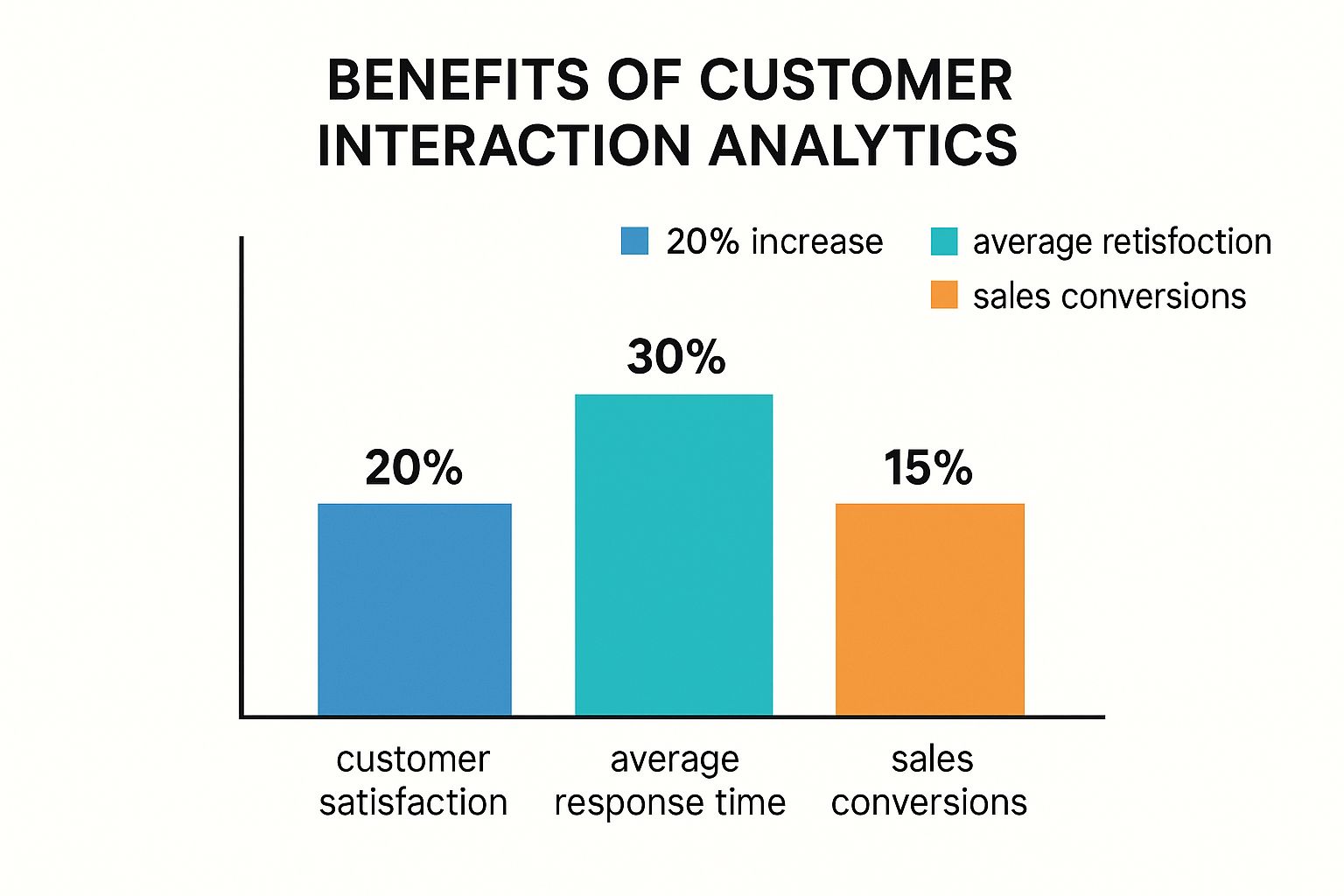
As the chart indicates, businesses can anticipate significant improvements across key metrics. These might include a 20% decrease in customer churn, a 15% increase in sales conversion rates, and a 10% improvement in customer satisfaction scores. The chart effectively highlights the relative impact of these different metrics, allowing businesses to pinpoint areas for improvement and allocate resources strategically.
To further illustrate the potential ROI, let's take a look at the improvements businesses typically see after implementing these solutions.
Introducing the "Customer Interaction Analytics ROI Metrics" table, showing common ROI metrics and the improvements businesses usually experience.
| Metric | Average Improvement | Implementation Timeframe | Industry Variation |
|---|---|---|---|
| Customer Churn Rate | -20% | 6-12 months | +/- 5% |
| Sales Conversion Rate | +15% | 3-6 months | +/- 8% |
| Customer Satisfaction Score | +10% | 12-18 months | +/- 3% |
| First Contact Resolution Rate | +25% | 6-9 months | +/- 10% |
| Average Handle Time | -15% | 3-6 months | +/- 5% |
This table summarizes the substantial positive impact of customer interaction analytics across various aspects of a business, from reducing churn to increasing sales and boosting customer satisfaction. It also acknowledges the time investment required for implementation and the inherent variations across different industries. This data-driven approach ensures that investments in customer interaction analytics are strategic and produce tangible, measurable results.
Building Your Customer Interaction Analytics Ecosystem

Effective customer interaction analytics is more than just collecting data. It's about creating an ecosystem that transforms raw interactions into valuable business insights. This involves integrating several key technologies to gain a complete understanding of the customer journey. These technologies work in concert to create a powerful system for understanding customer needs and behaviors.
Core Components of an Effective System
A robust customer interaction analytics system relies on a combination of speech analytics, text analytics, and sentiment analysis. Speech analytics converts spoken words into searchable text, allowing analysis of calls and other audio interactions. For example, it can identify keywords and phrases that indicate customer intent, like requests for refunds or complaints about specific products.
Text analytics examines written communication, such as emails and chats. This allows businesses to identify emerging themes and trends across various communication channels. Organizations can identify recurring issues impacting customer satisfaction, leading to proactive service improvements.
Finally, sentiment analysis gauges the emotional tone of customer communications. This helps identify positive, negative, or neutral sentiment expressed during interactions. By understanding customer feelings, businesses can tailor their responses to be more empathetic and effective, improving the overall customer experience.
Integrating with Your Existing Tech Stack
Building a successful customer interaction analytics ecosystem requires seamless integration with your current technology. This includes connecting with your CRM system (Salesforce) to enrich interaction data with customer profiles and purchase history. You might be interested in: How to master pricing strategies. Integrating with marketing automation tools (HubSpot) enables personalized campaigns based on interaction insights. Connecting with other platforms like customer support ticketing systems (Zendesk) and live chat platforms (Intercom) provides a holistic view of every customer touchpoint.
Data Security and Compliance
Building a unified data foundation requires careful consideration of data security and compliance. This includes implementing robust security measures to protect sensitive customer data. It's also essential to ensure compliance with relevant regulations, such as GDPR and HIPAA, depending on your industry.
This means adhering to data privacy and security standards to build trust and maintain a positive reputation. By prioritizing data security and compliance, businesses can confidently leverage customer interaction analytics to improve their operations and enhance the customer experience without compromising sensitive information. Implementing these steps creates a cohesive and insightful system that drives better business decisions and stronger customer relationships.
From Pilot to Enterprise: Implementing Without Overwhelm
Implementing customer interaction analytics effectively takes a strategic approach, no matter the size of your organization. It's not about launching every single feature all at once. Instead, think of it as a journey. Start small, learn, and then scale strategically. This careful approach ensures your implementation aligns with your business goals and delivers real, tangible results.
Starting With Focused Use Cases
The most successful implementations often begin with a pilot program zeroed in on a specific business challenge. This could be anything from boosting first-call resolution in your call center to reducing customer churn for a particular product line. By focusing on a well-defined area, you can quickly show the value of customer interaction analytics and get buy-in from key stakeholders. For example, imagine a pilot program analyzing customer service interactions to find the root causes of complaints. This targeted approach lets you address issues quickly and improve customer satisfaction.
Building Cross-Functional Teams
Collaboration is key for customer interaction analytics initiatives. Building a cross-functional team—with people from customer service, marketing, product development, and IT—ensures the system meets everyone's needs. This collaborative strategy bridges the gap between technical capabilities and what your business needs to achieve, making sure insights are translated into action. Plus, it creates shared ownership and encourages wider use of the analytics platform.
Scaling Across the Organization
Once your pilot program shows positive results, you can expand the use of customer interaction analytics to other parts of your organization. As you build your Customer Interaction Analytics Ecosystem, consider adding a live chat platform. Social Intents offers a platform for Live Chat integration. You might analyze customer feedback from various channels, like social media and email, to get a complete picture of the customer experience. This gradual rollout lets you adapt and refine processes along the way, ensuring a smooth transition and maximizing your investment.
Addressing Common Challenges
Challenges are part of any implementation. Data quality issues, stakeholder resistance, and technical limitations can all slow down progress. Addressing these challenges head-on is essential. Use clear communication, provide thorough training, and offer ongoing support. For example, you can set up clear data governance procedures to keep your data quality high. Address any skepticism about the system's value by clearly demonstrating its benefits. Doing this sets you up for long-term success with your customer interaction analytics initiative.
Establishing KPIs and Governance
Defining meaningful Key Performance Indicators (KPIs) that align with your business objectives is critical. These KPIs should be measurable and trackable, clearly demonstrating the system’s impact. Examples might include customer satisfaction scores, average handle time, and first-call resolution rates. Also, establish a governance structure to maintain momentum and accountability. This structure defines roles, responsibilities, and decision-making processes, ensuring the system stays aligned with business goals and delivers continuous value.
To illustrate the implementation process, we’ve outlined a sample roadmap below:
The following table, "Customer Interaction Analytics Implementation Roadmap," compares implementation approaches for different organization sizes and complexity levels.
| Implementation Phase | Small Business Approach | Mid-Market Approach | Enterprise Approach |
|---|---|---|---|
| Pilot Program | Focus on one key area, e.g., customer service calls | Implement across one department or product line | Targeted pilot within a specific business unit |
| Team Building | Small cross-functional team | Dedicated project team with representatives from each department | Larger project team with dedicated resources and expertise |
| Scaling | Gradual expansion based on initial results | Phased rollout across departments, integrating with existing systems | Enterprise-wide deployment with customized integrations and advanced analytics |
| Governance | Simple governance structure with regular reviews | Formal governance process with clear roles and responsibilities | Robust governance framework with executive sponsorship and ongoing oversight |
This roadmap highlights the different approaches needed depending on your organization's size and resources. Smaller businesses can start with a focused pilot and gradually expand, while enterprise-level organizations require a more structured and comprehensive approach.
Industry Transformations Through Customer Interaction Analytics
Customer interaction analytics is giving businesses a much deeper understanding of their customers. By analyzing how customers behave and what they prefer, businesses can tailor their services and products to better meet those needs. This leads to happier customers and stronger brand loyalty. Let's explore how different industries are using this powerful tool.
Retail: Personalizing The Shopping Journey
Customer interaction analytics is changing the retail game. By studying customer interactions across various channels, retailers are getting valuable insights into what drives individual buying decisions. Imagine analyzing online chat logs to see which product features really resonate with customers. This information is gold for product development and marketing strategies. Retailers can also use this data in real-time to offer personalized product recommendations and promotions, creating a more tailored shopping experience.
Healthcare: Enhancing Patient Outcomes
Healthcare providers are also turning to customer interaction analytics to improve patient care and streamline their operations. Analyzing patient feedback helps identify pain points and areas where administrative processes can be simplified, making things easier for both patients and staff. Analytics can even reveal patient sentiment, allowing providers to tailor communication and improve the overall patient experience. For more insights into healthcare technology, take a look at Voicetta's about us page.
Financial Services: Balancing Compliance and Customer Experience
Financial institutions face a unique challenge: balancing strict regulations with the need to provide exceptional customer service. Customer interaction analytics offers a way to navigate this complex landscape. By analyzing customer interactions, these institutions can ensure compliance while also finding opportunities to improve the customer experience. For example, it can help identify common questions or concerns about specific financial products, allowing for more effective communication and service delivery.
Telecommunications: Preventing Customer Churn
In the fiercely competitive telecom world, keeping customers is crucial. Customer interaction analytics allows telecom companies to spot churn signals early on. By analyzing calls, chats, and social media interactions, companies can identify patterns indicating customer dissatisfaction. This allows them to proactively reach out, offer tailored solutions, and retain valuable customers. This proactive approach not only reduces churn, it also strengthens customer relationships and builds brand loyalty. This data-driven approach is becoming increasingly important in today's competitive market. In the U.S. alone, customer analytics revenue is projected to reach USD 11.93 billion by 2030, a significant jump from USD 4.61 billion in 2024. Learn more about this growth here.
These are just a few examples of how customer interaction analytics is reshaping industries. As technology advances, its applications will only expand, offering even more innovative ways for businesses to connect with their customers and achieve sustainable growth.
The Future of Customer Interaction Intelligence
Customer interaction analytics isn't a fixed point; it's a constantly moving target. This evolution is fueled by advancements in artificial intelligence and machine learning, opening up exciting new ways to understand and respond to customer needs. Let's explore some key trends shaping the future of this dynamic field. You might be interested in: How to master customer interaction analytics.
Beyond Sentiment: Advanced Emotion Detection
The future of customer interaction analytics goes beyond simply labeling sentiment as positive or negative. Advanced emotion detection algorithms are emerging, capable of pinpointing specific emotional states like frustration, excitement, or uncertainty.
This granular understanding allows businesses to tailor responses with greater precision and empathy. For example, if a customer expresses frustration, the system could automatically route the call to an agent specializing in de-escalation techniques.
Predictive Interaction Analytics: Anticipating Customer Needs
Imagine a system that predicts a customer's needs before they even voice them. This is the potential of predictive interaction analytics.
By analyzing historical interaction data, these systems identify patterns and anticipate potential issues. Businesses can then proactively intervene and offer assistance before problems escalate. For instance, if a customer frequently calls about a specific product issue, the system could proactively send them helpful resources or offer a personalized discount.
Democratizing Analytics Access With Augmented Intelligence
Augmented intelligence is making interaction analytics accessible to everyone in the organization. User-friendly interfaces and intuitive dashboards empower non-technical users to access and interpret data, creating a more data-driven culture.
This means marketing teams can use insights to refine campaigns, product managers can understand feature requests directly from customers, and sales teams can personalize their approaches based on individual customer preferences.
Ethical Considerations: Responsible AI Deployment
As customer interaction analytics becomes more sophisticated, ethical considerations are paramount. Maintaining customer trust requires a commitment to responsible AI deployment.
This includes ensuring data privacy, transparency in data usage, and avoiding algorithmic bias. This focus on ethical practices allows organizations to benefit from customer interaction analytics while respecting individual rights and building stronger customer relationships.
Convergence of Systems: Creating Truly Customer-Centric Organizations
The future of customer interaction analytics lies in its integration with other business systems. By connecting interaction data with CRM systems (Salesforce), marketing automation platforms (HubSpot), and other tools, organizations can create a unified view of the customer.
This convergence of systems unlocks the true potential of customer-centricity, allowing businesses to personalize every interaction and build lasting customer loyalty.
Ready to transform your customer interactions? Voicetta's AI-powered platform offers 24/7 support, intelligent dialogue systems, and seamless integration with your existing systems. Learn more and request a demo at Voicetta.