
Blog
Your Digital Transformation Roadmap Guide
Right, let's talk about what a digital transformation roadmap actually is. Forget the jargon for a moment. Think of it as your organisation's detailed travel itinerary...
Right, let's talk about what a digital transformation roadmap actually is. Forget the jargon for a moment. Think of it as your organisation's detailed travel itinerary for moving from where you are now to where you need to be in the future. It’s a strategic plan that lays out, step-by-step, how you'll weave new digital technologies into the very fabric of your business.
This isn't just about bolting on new software. It’s about making sure every single tech initiative is directly tied to your core business goals, ensuring every change pushes you forward in a meaningful way.
Starting Your Digital Transformation Journey
Kicking off a digital transformation can feel a bit daunting, like setting sail without a map. There's often a mix of real excitement about what's possible and a healthy dose of fear about getting it wrong. That's where a clear roadmap becomes your North Star, giving you direction and a sense of purpose through what can be a complex and sometimes turbulent journey.
Let me give you an analogy. Imagine you've got a beautiful, classic car that you adore, but its old petrol engine is clunky and unreliable. You decide to swap it out for a modern electric one. This isn't a simple engine switch. It’s a complete overhaul that will change the car's performance, how you maintain it, and its long-term value. You wouldn't just start yanking out wires and hoping for the best, would you?
Of course not. You'd plan everything meticulously. You’d assess the car's chassis, research the perfect electric motor, map out the new wiring, and schedule each stage of the refit. A digital transformation roadmap does exactly that for your business. It's a carefully considered guide to ensure your technology upgrades aren't just for show, but fundamentally improve how your entire organisation works.
The Strategic Blueprint for Change
A well-thought-out roadmap is so much more than a to-do list of tech projects. It's a structured framework that connects every single action back to a specific, tangible business outcome. This is what stops you from chasing after "shiny new objects" and makes sure your efforts are firmly planted in your company's strategy.
A business roadmap helps decision-makers and contributors at every level understand the intent and goal for each phase. In other words, a digital transformation roadmap helps those involved see the vision behind the strategy.
Getting this strategic alignment right is absolutely crucial. Without it, you could easily end up with new systems that your employees find confusing, or that clash with your existing workflows. A good roadmap forces you to step back and look at the bigger picture, ensuring every move you make is deliberate and contributes to the end goal.
More Than Just Technology
It's a common mistake to think of a digital transformation roadmap as something that just belongs to the IT department. The reality is, it’s a business-wide plan that touches every single part of your organisation. It has to consider how new tech will shape your company culture, your day-to-day operations, and, most importantly, your relationship with your customers.
To make this clearer, a roadmap is designed to perform several key functions all at once. It's a multi-faceted tool that guides strategy from several angles.
Core Functions of a Digital Transformation Roadmap
| Function | Description |
|---|---|
| Improving Operational Efficiency | It maps out how to use automation and modern systems to get rid of manual slog, freeing up your team for more valuable, strategic work. |
| Enhancing Customer Engagement | The plan details how to create smoother, more personalised customer journeys by improving every digital touchpoint. |
| Enabling New Business Models | It builds the technical backbone needed for your company to innovate, whether that's launching new services or finding new ways to generate revenue. |
| Modernising Core Systems | The roadmap ensures your foundational technology is kept up-to-date, allowing you to compete effectively and deliver a great experience for everyone. |
Ultimately, the roadmap is about orchestrating change in a way that feels coordinated and purposeful, rather than chaotic and reactive. It’s the difference between building a solid, well-designed house and just piling bricks on top of each other.
The Pillars of a Powerful Roadmap
I’ve seen it happen countless times: a company gets excited about a new piece of tech, dives in headfirst, and a year later, wonders why nothing has really changed. That’s because a real digital transformation isn’t about just one thing. It’s a bit like building a skyscraper. You don't start with the penthouse suite; you start with the deep, foundational pillars that will hold the whole structure up.
If any one of those pillars is weak, the entire project is at risk. That's why your digital transformation roadmap needs to be built on several key components, all working together. Let's dig into what those pillars actually are.
Vision and Strategy
This is your North Star. It's not a fuzzy statement like "we want to be more digital." It has to be a crystal-clear picture of what your business will look and feel like after the transformation is complete. This vision answers the most important question: why are we even doing this?
Your strategy is the practical plan that brings that vision to life. It’s the map that ensures every new piece of software, every team reorganisation, and every operational tweak pushes you toward your main business goals, whether that’s breaking into a new market or creating an unforgettable customer experience. Without it, you're just wandering in the dark.
People and Culture
You can have the most advanced technology on the planet, but it's completely useless if your team doesn't know how—or want—to use it. People are the heart of any change, and I’ve seen employee resistance derail more projects than any technical glitch.
This pillar is all about the human side of things. It involves:
- Building an innovative mindset: Making it safe for people to experiment, ask questions, and get comfortable with new ways of working.
- Leading with open communication: Being honest about why the change is happening, what it means for employees, and what to expect along the way.
- Investing in your team: Providing the right training and support so people feel confident and capable, not left behind.
Don't mistake this for a 'soft' skill. Focusing on your people is a hard requirement for success. Forgetting the human element is the fastest way I know to guarantee your roadmap fails.
Processes and Operations
This is where your big ideas meet Monday morning. Your roadmap has to get its hands dirty and re-engineer the core processes that run your business day-to-day. Think of it as upgrading the plumbing and wiring of your organisation before you start hanging new pictures on the walls.
It means taking a hard look at your current workflows. Where are the manual tasks that are screaming for automation? Can we connect siloed systems, like your ERP and CRM, to create one reliable source of information? Fine-tuning these internal mechanics is absolutely essential to get the efficiency you're promised from new digital tools.
Technology Selection
Notice this pillar comes after vision, people, and process. That’s deliberate. Technology should be the solution to a problem you've already defined, not a solution looking for a problem. It should serve your strategy, not the other way around.
This means picking tools like AI, cloud platforms, or advanced analytics because they directly help you achieve a specific goal. For a logistics company, that might be using AI to predict when a truck needs maintenance. For an estate agency, it could be a CRM that automates follow-ups with potential buyers. The trick is to choose based on need, not just hype.
Data and Analytics
Data is the fuel for any modern business, and analytics is the engine that puts it to work. The final pillar ensures your transformation is guided by cold, hard facts, not just gut feelings. Your roadmap must have a clear plan for how you'll collect, manage, and actually use your data.
These insights let you measure your progress, see exactly how customers are behaving, and find opportunities to improve. It creates a feedback loop that turns your roadmap into a living document—one that you can adjust based on what's actually happening on the ground. This is what separates a good plan from a great one.
Why Poland is the Perfect Launchpad for Your Digital Growth
When it comes to business strategy, timing and location are often the secret ingredients for success. If you're planning a major digital leap, you need to know that right now, Poland offers a uniquely powerful opportunity. This isn't just about a strong economy; it's the story of a nation moving at incredible speed, creating the perfect conditions for digital innovation to flourish.
Think of it like this: you can either swim against the current or ride a powerful wave. By understanding what's happening in Poland, you can design your digital transformation roadmap to catch that wave. It's about aligning your company's ambition with a country's momentum, which can give you a serious competitive edge. The Polish market isn't just expanding; it's being actively shaped by forces that reward tech-savvy businesses.
And the numbers back this up. The digital transformation market in Poland is already buzzing, valued at around €74.58 million. Better yet, it's set to grow at a Compound Annual Growth Rate (CAGR) of 11.71% through 2033. That's a strong, sustained upward trend. You can dig deeper into these market dynamics in this detailed report.
The Forces Fuelling the Fire
This incredible growth isn't a happy accident. It’s the result of a specific mix of factors coming together, making the country especially ready for digital change. For any business with a solid digital transformation roadmap, this environment is ripe with opportunity.
Here are the key drivers creating this perfect storm:
- Active Government Backing: The Polish government isn't just sitting on the sidelines. It’s actively pushing for digitalisation with dedicated programmes and funding, encouraging businesses from the top down to upgrade their systems and processes.
- A Hunger for New Tech: You can feel a real appetite for new technology on the ground. Polish companies are enthusiastically adopting cloud computing and artificial intelligence (AI) not just as concepts, but as practical tools to solve real business challenges.
- Growing Demand for Security: As more businesses go digital, the need for solid cybersecurity has shot up. This has created a huge market for advanced security solutions, making it an essential part of any transformation plan.
When you combine supportive government policy with a genuine business hunger for innovation and a clear need for security, you get an environment where a well-thought-out digital transformation isn't just a nice-to-have. It’s essential for survival and growth.
Riding the Tech Wave
The quick uptake of technologies like AI and the cloud is especially striking. And this isn’t just a game for the big corporations; small and medium-sized businesses are also realising these tools are crucial for staying efficient and competitive. This broad adoption means the entire ecosystem—from potential employees to partners and customers—is becoming more digitally savvy.
This maturity makes everything easier. When you go to implement an AI-powered tool, for instance, you'll find a workforce that's more open to it and partners who already get it. This is especially true in customer service, where solutions for automated quality assurance can be slotted into existing operations with less friction, delivering value almost immediately. By building your roadmap around these trends, you're setting yourself up for a smoother, faster journey.
Tapping into this national momentum means your transformation isn't an uphill battle. Instead, it’s supported by the very environment you're operating in. Your roadmap becomes more than just a plan for internal change; it's a guide to placing your business at the heart of a country's digital revolution. This is a rare chance to build a real, lasting advantage.
Building Your Roadmap Step by Step
This is where the rubber meets the road. Turning a grand vision into a series of deliberate, actionable steps is the real work of creating a digital transformation roadmap. It's the moment you stop dreaming about "what if" and start figuring out "how to." This isn't a one-and-done task; it's a structured process, broken down into distinct phases that build on one another.
Think of it like building a house. You wouldn't just show up and start laying bricks. First, you'd get an architect to assess the land (your current state), finalise the blueprints (your vision), schedule the construction teams in a logical sequence (prioritisation), and then manage the build, checking progress against the plan (implementation and measurement). Let’s walk through that process.
Phase 1: Assessment and Vision Definition
You can't chart a course if you don't know where you're starting from. The first phase demands a brutally honest look at where your organisation stands right now. This means getting real about your current digital capabilities, processes, and technologies.
You'll need to ask some tough questions:
- Where are our biggest operational bottlenecks? Find those manual, repetitive tasks that are slowing your teams down and frustrating customers.
- What does our current tech stack really look like? Map out everything from your CRM to your ERP. Be honest about which systems are assets and which are legacy liabilities holding you back.
- Where are our people struggling? Pinpoint any skills gaps or cultural resistance that could throw a spanner in the works.
Once you have that clear-eyed assessment, you can define your future state. This isn’t about some vague, fluffy goal. It needs to be a vivid picture of what success looks like in 1, 3, and 5 years. For instance, your vision might be to slash customer support calls by 40% by launching an AI-powered self-service portal.
Phase 2: Strategy and Prioritisation
With your starting point and destination locked in, the next phase is all about plotting the most effective route. You'll likely have a laundry list of potential initiatives, and you simply can't do everything at once. Prioritisation is everything. The goal here is to find the projects that will deliver the biggest bang for your buck with the most manageable effort.
A common sense approach is to score potential ideas based on two things: business value and implementation complexity. Those high-value, low-complexity projects—the "quick wins"—are often the perfect place to start. They build momentum and prove the transformation’s worth to the rest of the company.
At this stage, your digital transformation roadmap becomes a sequencing plan. It’s not just a list of projects; it’s a logical flow that shows how one initiative builds upon the next, creating a cascade of positive change.
This is also where you wrestle with how different systems will talk to each other. You might decide to modernise your ERP system first, since it's the central nervous system for your business data. Integrating it with other platforms is a complex but vital step, and understanding the common ERP integration challenges is essential for a smooth rollout.
This is where you see how technology components like servers, cloud services, and software must interconnect to form a cohesive whole.
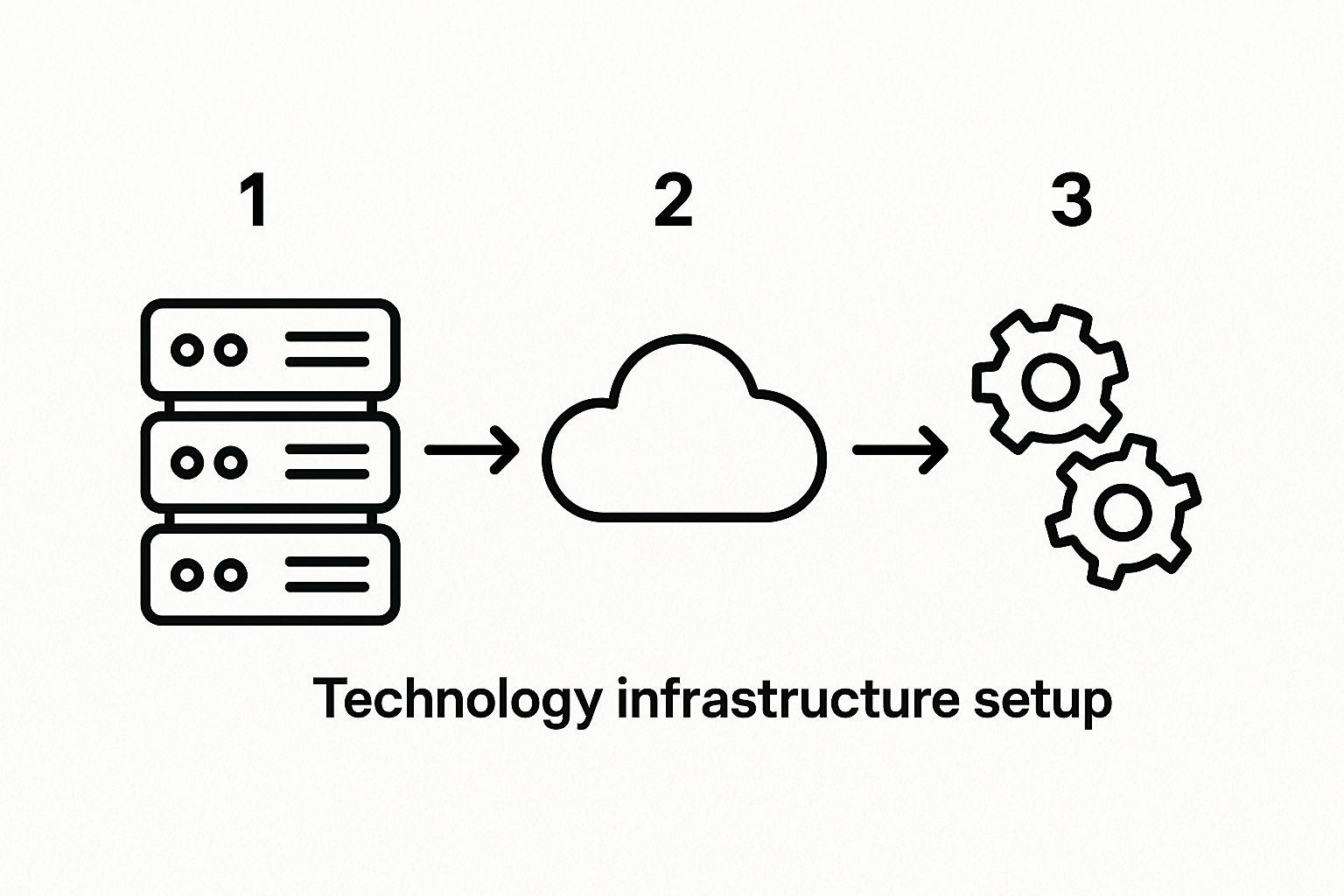
This kind of visualisation hammers home the point: a successful roadmap treats technology not as isolated tools but as an interconnected ecosystem where every part has to work in harmony.
Phase 3: Implementation and Execution
Now it’s time to bring the plan to life. Execution demands strong project management and crystal-clear communication to keep the train on the tracks. Each initiative from your prioritised list gets treated like a formal project with its own timeline, budget, and dedicated team.
Effective execution hinges on a few key things:
- Agile Methodologies: Forget massive, multi-year projects. Break initiatives into smaller, manageable sprints. This lets you deliver value faster and adjust based on real feedback as you go.
- Clear Ownership: Every project needs a champion—someone who is responsible for its success, period.
- Constant Communication: Keep everyone in the loop, from the C-suite to the front-line staff. Share the progress, the wins, and even the setbacks. Transparency builds trust.
Maintaining momentum is absolutely critical during this phase. Celebrating the small victories keeps your team motivated and reinforces the value of the transformation across the entire business.
Phase 4: Measurement and Iteration
Your roadmap is not a sacred document to be framed and forgotten. It's a living guide that must be constantly tweaked based on real-world results. This final phase is a continuous loop: measure performance, gather feedback, and iterate on the plan.
You have to define the right Key Performance Indicators (KPIs) for each initiative. If you implemented a new sales automation tool, you'd track metrics like "lead conversion rate" or "time to close." If you launched a new customer portal, you'd be watching "user adoption rates" and "customer satisfaction scores."
This data gives you the insight to make smart decisions. Maybe a certain technology isn't delivering the ROI you hoped for, or perhaps a new market opportunity has popped up that requires a shift in priorities. You should schedule regular review meetings—quarterly is a good rhythm—to assess progress against the roadmap and make necessary adjustments. This iterative approach is what ensures your transformation stays relevant, effective, and perfectly aligned with your ever-changing business goals.
Navigating Common Transformation Challenges

Let's be honest: any journey as big as a digital transformation will hit a few bumps. Thinking about this from the start isn’t being negative—it's just being realistic. A truly solid digital transformation roadmap doesn’t just map out the sunny, straightforward path; it also prepares you for the storms, helping you turn those potential setbacks into real opportunities for growth.
The biggest mistake I see companies make is getting mesmerised by the shiny new tech and completely forgetting about the people who have to use it. A resilient strategy anticipates these hurdles and builds the solutions right into the plan from day one. Let’s walk through the most common challenges and how you can get ahead of them.
The Human Element of Change
By far, the most significant obstacle is almost always human resistance. Change makes people uncomfortable. Your employees might worry their jobs are on the line or that they won’t be able to learn the new systems. A great roadmap tackles this head-on with transparent communication and tailored training, making sure everyone feels supported, not abandoned.
Right alongside resistance is the skills gap. You can’t become a data-first company if your teams don’t understand how to read and act on data. This isn't just a company-level problem; it's a national one. Take Poland, for example. Their government's digital transformation plan, backed by a hefty €12.4 billion budget, singles out low digital skills as a major hurdle to hitting its 2030 goals, even with fantastic internet infrastructure.
Building resilience means treating your team's adaptation as a core project objective, not an afterthought. Your investment in people will generate a far greater return than any single piece of software.
Technical and Financial Roadblocks
From a technical standpoint, the classic headache is trying to make shiny new systems play nicely with clunky legacy infrastructure. Those old systems are often where your most critical data lives, but they just can't "talk" to modern cloud apps. Your roadmap needs to earmark specific time and resources just for this integration work. It’s a project in its own right.
Then there's the money. Securing a budget and showing a clear Return on Investment (ROI) can feel like a constant battle. Stakeholders need to see that the spend is justified. To get them on board, your roadmap should front-load some "quick wins"—smaller, high-impact projects that deliver a clear payoff right away. These early successes build momentum and make it much easier to get the green light for the bigger, more complex initiatives later on.
Finally, cybersecurity can't be an afterthought. Every new digital tool you introduce creates a potential new back door for trouble.
You absolutely have to plan for common threats from the very beginning, including:
- Data Breaches: Keeping customer and company information safe is non-negotiable.
- Ransomware Attacks: These can bring your operations to a grinding halt and cost a fortune.
- Phishing Scams: These are a favourite way for attackers to get in, often by targeting your employees.
Ignoring these risks can create some of the worst customer service challenges imaginable; a security breach can shatter trust in an instant. A truly robust digital transformation roadmap weaves security planning into every single phase, ensuring your organisation grows stronger, not just more exposed.
Your Roadmap as a Living Document
It’s tempting to think of your digital transformation roadmap as a finished product once it's approved. But the most successful ones are never truly “done”.
Think of it less like a stone tablet of commandments and more like a sailor's chart for a long voyage. You have a destination, of course, but you have to constantly adjust your course for changing winds, unexpected currents, and new islands of opportunity that appear on the horizon. This is the final, crucial piece of the puzzle: your roadmap is a living, breathing guide.
Fostering a Culture of Continuous Improvement
To bring this idea to life, you need to build a culture where adaptation is second nature. This isn't just about management making changes; it's about empowering your team to give feedback and challenge the plan when they see a better way forward. When your employees feel a sense of ownership, they become your best source of on-the-ground intelligence.
This agile mindset is what separates companies that thrive from those that just get by. It requires creating an environment where people feel safe to flag issues or propose new ideas without fear of being shot down. Suddenly, the roadmap isn't a top-down directive anymore. It becomes a collaborative guide that everyone is genuinely invested in.
Your roadmap's greatest strength isn't its initial perfection, but its ability to be refined. The goal is to build a flexible framework that drives sustained growth, not a rigid set of instructions that quickly becomes outdated.
For this feedback loop to be effective, your leadership needs to bake in regular reviews—at least quarterly. These sessions are for assessing progress, celebrating wins, and making smart adjustments based on real data and what the team is seeing.
Remaining Agile in a Shifting Market
In this game, agility is your most valuable asset. New technologies pop up, customer expectations evolve, and your competitors are always making moves. Your roadmap has to be flexible enough to pivot and seize these opportunities as they emerge.
Take the hospitality sector, where guest experiences are constantly being reshaped by tech. The ability to quickly integrate new tools, something we explore in our article on AI in the hospitality industry, is what separates a leader from a laggard.
This adaptability is especially critical in hyper-connected markets. In Poland, for example, there are 34.5 million internet users, and a staggering 97.1% of mobile connections are broadband. As detailed in the full report on Poland's digital landscape, this means businesses must be ready to meet customers on mobile with flawless digital experiences, or risk being left behind.
Your roadmap should be the engine of this continuous innovation, not its anchor. When you treat it as a living document, you ensure your organisation not only weathers change but actually uses it as a powerful fuel for growth.
Frequently Asked Questions
When you start talking about digital transformation, a lot of practical questions naturally come to the surface. A roadmap gives you the big picture, but it’s the nitty-gritty details—things like timing, who’s on the team, and what traps to avoid—that really determine whether your plan will sit on a shelf or actually spark real change.
Let's dive into some of the most common questions we get asked. The answers here are meant to give you some quick, clear guidance so you can move forward with a bit more confidence.
How Long Should Our Roadmap Be?
This is always a bit of a balancing act. You need to dream big but plan for what's right in front of you. A good digital transformation roadmap should sketch out a clear vision for the next 3-5 years. This is your high-level ambition, the North Star that keeps everyone pulling in the same direction.
But when it comes to the actual work—the specific projects and initiatives—you need to bring your focus in much tighter. Plan the detailed action items for the next 12-18 months. This two-tiered approach is essential. It lets you chase a bold vision while staying nimble enough to react to new tech, market surprises, or shifting customer demands. You're not locked into a rigid plan that's obsolete in a year.
Your roadmap has to be ambitious enough to inspire real change but agile enough to handle reality. Think of the 3-5 year vision as your destination and the 12-18 month plan as the immediate turn-by-turn directions.
Who Should Be Involved in Creating the Roadmap?
Putting together a solid roadmap is absolutely a team sport, not a solo mission. While the C-suite needs to sponsor the effort and define the overall direction, the real work of building the plan has to involve people from all corners of the business. You're essentially assembling an expedition crew, and you need specialists from every department.
At a minimum, your core roadmap team should have a seat at the table for:
- IT: They're your reality check for what's technically possible and what the current infrastructure can handle.
- Operations: These are the folks on the ground who know the real-world workflows and pain points inside and out.
- Finance: To make sure the plan is commercially sound and to help measure the return on your investment.
- HR: They spearhead the all-important people and culture side of things, from managing the change to upskilling your teams.
- Marketing & Sales: They are the voice of your customer and will ensure the roadmap is tied directly to improving their experience.
Getting this diverse group involved from day one is the secret to creating a roadmap that is not only realistic and well-rounded but also has the buy-in you'll need to actually make it happen.
What Is the Biggest Mistake Companies Make?
By far, the most common pitfall is viewing the digital transformation roadmap as just a technology project. It's not. It's a business strategy project that happens to be powered by technology. Getting this distinction wrong is the root cause of most failures.
More specifically, this thinking leads companies to completely sideline the 'People and Culture' piece of the puzzle. They get so caught up in the shiny new software or systems that they forget to manage the human side of the equation. If you don't explain the "why" behind the change, fail to train your employees, or ignore resistance, you're setting yourself up for failure, no matter how brilliant the plan looks on paper.
Don't let missed calls and chats become missed opportunities. Voicetta provides an AI-powered communication platform that works 24/7 alongside your team, ensuring every customer interaction is handled intelligently. Learn how we can help you capture more leads and boost customer satisfaction.
Was this useful?
If this article helped, add Voicetta as a preferred source in Google Search. Your results can then highlight our writing.
Add as preferred source