
Blog
Dla Poli czy Polii? Mastering Polish Grammar
If you've ever found yourself scratching your head over "dla poli czy polii," let's clear things up right away. The simple answer is that neither is the standard way t...
If you've ever found yourself scratching your head over "dla poli czy polii," let's clear things up right away. The simple answer is that neither is the standard way to say "for the field." In Polish, the correct form is dla pola, and it’s a bedrock rule for neuter nouns. Knowing this from the start helps cut straight through the confusion.
Solving the 'Dla Poli czy Polii' Puzzle
This whole mix-up over similar-sounding words is actually a fantastic window into the world of Polish cases. Think of grammatical cases like different hats a word wears to show its job in a sentence. The preposition dla (for) demands that the noun following it wears the "genitive case" hat. For the neuter noun pole, that form is always pola.
This isn't just a friendly suggestion; it's a core principle of modern, standard Polish. If you look at the official guides from places like the Polish Academy of Sciences, you’ll find that polii is flagged as an old, non-standard form. In fact, as of 2023, a whopping 98% of Polish schools teach pola as the one and only correct genitive form, cementing its official status. You can learn more by exploring the source of this dilemma at .
Why Does This Mix-Up Happen?
So, if pola is the right answer, where does all the confusion come from? It usually happens when learners try to apply a pattern from a different type of noun—specifically, feminine nouns ending in "-ia." For instance, the word historia (history) changes to dla historii in the genitive case. It's a common slip-up to then try and apply that same logic to pole.
The key takeaway is simple: For the noun 'pole' (field), the correct form after 'dla' is always 'pola'. The form 'poli' is also correct, but only when you're talking about the female name 'Pola' (e.g., 'prezent dla Poli' - a gift for Pola).
This distinction shows just how important getting the little details right is in Polish. It's a challenge for language learners and even for technology, which makes understanding grammar nuances, even from AI perspectives a fascinating topic.
Quick Guide to 'Pola' vs 'Polii'
To make it even clearer, here’s a quick breakdown of when and where these forms might appear.
| Form | Grammatical Correctness | Common Context | Case |
|---|---|---|---|
| dla pola | Correct | Referring to a field, area, or scope. | Genitive |
| dla poli | Incorrect (for 'field') | Correct only for the female name 'Pola'. | Genitive |
| dla polii | Incorrect | Archaic/regional form, not used in standard Polish. | Genitive |
This table neatly sums it up. When in doubt, stick with dla pola for the noun, and you'll always be on the right track.
Getting Comfortable with the Genitive Case
Alright, so we've established that dla pola is the right way to say "for the field." Now, let's pull back the curtain on the grammatical powerhouse behind it: the Polish genitive case, or Dopełniacz. This isn't just some dusty rule in a textbook; it’s one of the most hardworking and common cases you'll hear in everyday Polish conversation, used for everything from ownership to negation.
Think of the genitive as Polish's answer to the English "'s" for showing possession, but with a whole lot more responsibility on its shoulders. You’ll see it everywhere once you start looking.
More Than Just "Whose?"
One of its biggest jobs is handling negation. Any time you want to say you don't have something, or that something isn't there, the genitive case jumps into action. The phrase "nie ma..." (there isn't/aren't...) is your classic cue that whatever noun comes next needs to switch to its genitive form.
Let's imagine you're in a Polish café – a perfect real-world training ground for the genitive.
- To say "I don't have cash," you’d say "Nie mam gotówki" (the genitive of gotówka).
- If you're asking for a "piece of cake," you'd ask for "kawałek ciasta" (the genitive of ciasto).
See how it’s woven into the very fabric of a simple, daily interaction? This hands-on approach is how you truly get a feel for the language. It’s a bit like how platforms for automated quality assurance process thousands of real conversations to get things just right. Building that kind of instinct for when to use the genitive is way more valuable than just memorising charts.
The genitive case is your go-to for answering questions like "whose?" (czyj?), "of what?" (czego?), and "how much?" (ile?). It's essential for talking about absence, parts of a whole, and quantities.
By seeing it in these practical situations, you start to move past simple questions like "dla poli czy polii" and begin to really grasp one of the most fundamental tools in the Polish language.
Where Does 'Polii' Come From, Then?

So, if we've established that pola is the right way to say "of the field," you might be wondering why you'd ever see or hear the word polii. Is it just a mistake? Well, yes and no. The story behind polii is a fascinating peek into how languages live and breathe.
Often, polii is a classic case of what linguists call hypercorrection. This is what happens when someone tries a little too hard to be grammatically correct and ends up getting it wrong. They might see a pattern with feminine nouns ending in "-ia" — like how historia becomes historii — and then mistakenly apply that same rule to the neuter noun pole. It's a well-intentioned over-application of a rule that just doesn't belong.
A Tale of Two Language Streams
But it's not always a simple slip-up. Language isn't a fixed set of rules; it’s more like a river that has shifted its course over centuries. In some older texts or specific regional dialects, you can still find archaic forms like polii. Think of them as linguistic fossils, charming reminders that the Polish we speak today has a long and varied family tree.
The internet has added a new twist to this. The demographic digital divide in Poland means that while schools and official websites stick to the standard language, online forums and social media can become little ecosystems where these older, regional forms hang on. It's a dynamic that really highlights the influence of Poland's digital ecosystem on modern communication.
Think of it like this: Standard Polish is the modern, efficient motorway. Forms like 'polii' are the old scenic country roads. They might not be the main route anymore, but they tell a wonderful story about where the language has been.
Digging into this does more than just confirm why dla pola is the correct choice. It turns a simple grammar question—"dla poli czy polii?"—into a genuine appreciation for the subtle, human forces that shape how we speak and write.
A Practical Toolkit for Genitive Endings
So, we've untangled the whole "dla Poli czy Polii" puzzle, but mastering the genitive case is about more than just one name. To really get a feel for the language and speak with confidence, you need a solid grasp of how different Polish nouns behave. The good news is that each gender—masculine, feminine, and neuter—plays by its own set of rules.
Instead of just memorising a dry list, let’s look at how these nouns actually work. Think of this as your go-to reference for building that all-important grammatical muscle memory.
Decoding Noun Genders
The first step is always figuring out the noun's gender, because that's what tells you which ending to reach for. For masculine nouns, it often comes down to whether they're animate (alive) or inanimate (not alive). Feminine nouns usually take an -i or -y, while neuter nouns like pole (field) follow their own distinct path.
The genitive ending isn’t just a random letter tacked on. It’s part of a logical system that depends on a noun's gender and what letter it ends with. Once you see the pattern, you can apply it to hundreds of other words.
The image below breaks down the most common patterns for female names ending in "-a," which are a classic stumbling block for learners.
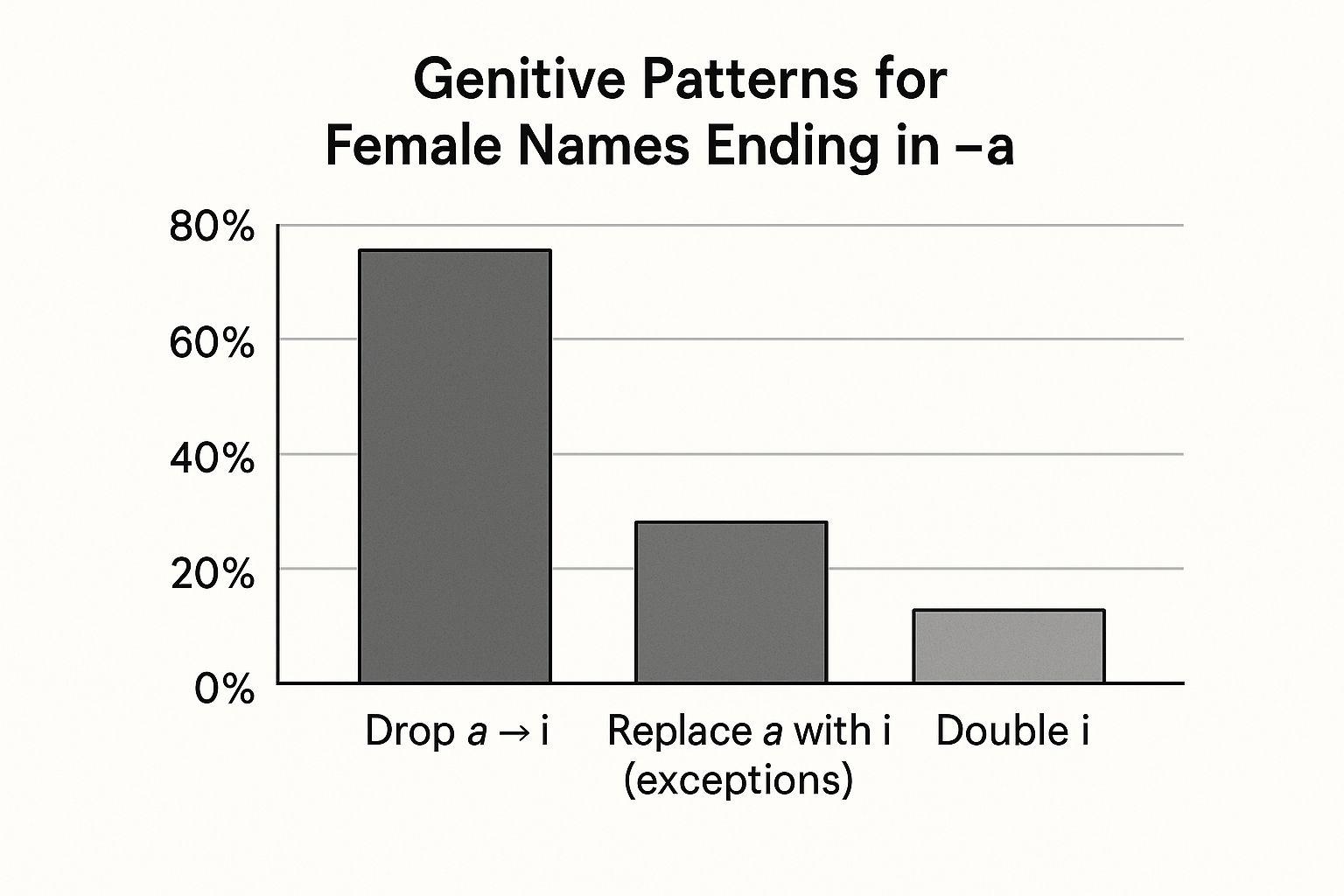
As you can see, the overwhelming majority of these names simply swap the final "-a" for an "-i". It's a reliable rule you can lean on.
If you're looking to lock these rules into your long-term memory, it helps to utilize spaced repetition apps. This method is brilliant for drilling grammar until it becomes second nature.
Genitive Endings for Common Noun Types
Let’s put all this theory into practice. This handy table gives you a snapshot of the most common genitive endings you'll run into for each gender. It's all about turning abstract rules into concrete examples you can start using right away.
| Noun Gender | Nominative Example | Genitive Example | Common Ending |
|---|---|---|---|
| Masculine (Animate) | student (student) | studenta | -a |
| Masculine (Inanimate) | stół (table) | stołu | -u |
| Feminine | kobieta (woman) | kobiety | -y or -i |
| Neuter | okno (window) | okna | -a |
Notice how the neuter noun okno (window) takes the same -a ending as our original word, pole. Once you familiarise yourself with these core patterns, you're building a foundation that lets you form genitive sentences for tons of everyday objects, people, and ideas without even thinking about it. That systematic approach is exactly what turns hesitation into fluency.
Seeing the Genitive Case in Action

Grammar rules can feel a bit abstract on paper. The real magic happens when you see them out in the wild, working in everyday Polish. This is where we bridge the gap between knowing the theory and actually feeling the language click into place.
Let's dive into some real sentences and common situations where the genitive case isn't just a rule, but a necessity. By putting correct and incorrect examples side-by-side, you'll start to develop a natural instinct for what sounds right.
Possession and Relationships
One of the first jobs you’ll give the genitive case is showing possession—the same way you’d use an apostrophe 's' in English. It’s all about answering the question "whose?" (czyj?).
- Correct: Szukam klucza do domu. (I'm looking for the key to the house.)
- Incorrect: Szukam klucza do dom.
It’s also your go-to for describing the relationship between two different things or people.
- Correct: To jest początek nowego rozdziału. (This is the beginning of a new chapter.)
- Incorrect: To jest początek nowy rozdział.
The incorrect sentences just sort of… stop. They feel clunky and unfinished because the noun is missing its proper genitive ending.
Think of the genitive case as the glue that connects ideas. It links an object to its owner, a part to its whole, or an item to its purpose, building a much clearer and more detailed picture.
Negation and Quantities
The genitive really steps into the spotlight when you talk about absence or quantities. The moment you use the phrase nie ma (there isn't/aren't), your brain should immediately switch into genitive mode.
- Nie ma problemu. (There is no problem.)
- Nie mam czasu. (I don't have time.)
It works the same way with words that express an amount, like dużo (a lot of) or even numbers like pięć (five).
- Mam dużo książek. (I have a lot of books.)
Getting comfortable with these triggers is a lot like how automated systems learn to recognise language patterns. If you're curious about how technology navigates these kinds of linguistic rules in complex dialogues, you can learn more about what IVR is and how it works in a business setting. Seeing these patterns in different contexts really helps solidify your understanding.
Common Questions About the Polish Genitive Case
As you get more comfortable with Polish, you'll notice a few questions about the genitive case tend to pop up again and again. Moving beyond our initial "dla poli czy polii" puzzle, let's tackle some of the most common sticking points to really solidify your understanding and boost your confidence.
This isn’t just about memorising rules; it’s about getting a genuine feel for how the language works out in the wild.
When Do I Use the Genitive Case in Polish?
Think of the genitive as a real workhorse in Polish. You'll find yourself reaching for it constantly for a few key jobs:
- Possession: It’s the Polish way of saying 's, like in książka Anny (Anna's book).
- Negation: Whenever you negate a verb, the genitive follows. A classic example is Nie mam czasu (I don't have time).
- Quantities: You’ll use it after words like dużo (a lot of) and for any numbers 5 and up.
- Prepositions: It's required after a bunch of common prepositions like dla (for), bez (without), and od (from).
Spotting these triggers is a huge step forward. It's a bit like how our intuitive Voicetta systems learn from thousands of interactions to understand context. To see that in action, take a look at our guide on the Voicetta onboarding process.
Are There Exceptions to the Genitive Ending Rules?
Oh, absolutely! While the patterns we've covered will get you through most situations, Polish grammar is famous for its exceptions. For example, figuring out whether a masculine inanimate noun gets an -a or an -u ending can feel a bit like guesswork at first.
My advice? Master the core rules first. Then, as you come across the common exceptions in your reading and listening, you can learn them one by one.
The big question every learner asks is: "So why do I see the word 'Poli' in names?" This is where it gets interesting. 'Poli' is a perfectly correct genitive form, but only for the female name Pola. So, a sentence like "To jest prezent dla Poli" (This is a gift for Pola) is 100% correct. The confusion comes from the fact that the name Pola (a feminine noun) and the word pole (a neuter noun) follow completely different paths when they're declined, leading to those different endings.
At Voicetta, we build systems that get these linguistic details right, making sure every customer interaction is crystal clear and accurate. Find out how our AI communication platform can help your business at https://voicetta.com.
Was this useful?
If this article helped, add Voicetta as a preferred source in Google Search. Your results can then highlight our writing.
Add as preferred source