
Blog
A Guide to Enterprise Process Automation
Let's be honest, "enterprise process automation" can sound like just another piece of corporate jargon. But in reality, it’s the strategic playbook large organisations...
Let's be honest, "enterprise process automation" can sound like just another piece of corporate jargon. But in reality, it’s the strategic playbook large organisations are using to fix the operational bottlenecks that secretly hold them back. It’s all about using technology to intelligently connect and automate those complex, multi-step workflows, transforming a patchwork of separate tasks into a single, cohesive engine for growth.
The Hidden Costs of Disconnected Operations

Think of your business as a high-performance orchestra. When every musician is in sync, the sound is magnificent. But what if the string section is playing from a different sheet of music than the brass, and the percussionist is completely off-beat? You don't get a symphony; you get chaos.
That's the everyday reality in many large companies. Their operations are a jumble of siloed manual processes, with each department doing its own thing. This creates a kind of organisational drag—a quiet, persistent force that burns through resources, demotivates your best people, and stalls progress.
The Problem of Organisational Friction
This friction is like trying to drive your car with the handbrake partially on. You’ll still move, but you're wasting fuel, putting unnecessary strain on the engine, and going much slower than you could be. In the business world, that "fuel" is your budget, your employees' valuable time, and your competitive advantage.
This operational drag shows up in expensive ways all across the business:
- Finance teams burn hours and hours manually matching invoices, chasing down approvals, and fixing data entry mistakes between different software.
- HR departments wrestle with clunky onboarding procedures, where paperwork gets stuck on one desk after another, slowing down a new employee's journey to becoming a productive team member.
- Customer service agents have to toggle between half a dozen different apps just to answer one simple customer question, leading to longer queues and unhappy clients.
Every single one of these is a friction point where your company is bleeding value. In fact, some reports show that businesses can lose anywhere from 20% to 30% of their annual revenue simply due to inefficient processes. This isn't just a one-off expense; it's a constant drain on your bottom line.
The true cost of inefficiency isn't just the wasted money or time. It's the squandered opportunity—the innovations you didn't have time for, the customers you couldn't delight, and the market share you lost because your teams were stuck in a loop of manual tasks.
This is exactly why enterprise process automation has become so crucial. It’s not just about making tasks go a little faster. It's about fundamentally redesigning how work flows through your organisation. By connecting those separate systems and automating the hand-offs between them, you eliminate the friction.
Suddenly, the orchestra is playing in perfect harmony. The handbrake is released. Your business can finally accelerate towards its true potential. This is the foundational shift that makes automation an absolute necessity for any company that wants to not just survive, but thrive.
What Is Enterprise Process Automation, Really?

When we talk about enterprise process automation (EPA), it’s easy to get bogged down in technical jargon. So let's cut through the noise. Think of your business as a grand orchestra. You have different sections—strings, brass, percussion—all representing your various departments and systems.
EPA isn’t just about making one violinist play faster. It's the conductor, standing at the front, ensuring every single part works in perfect harmony to produce a beautiful piece of music. It’s about orchestrating entire, complex workflows that span multiple departments and software tools, creating a single, seamless operational masterpiece.
It’s More Than Just Automating a Few Tasks
Most of us have heard of Robotic Process Automation (RPA). RPA is fantastic for tackling simple, repetitive, rule-based jobs. Imagine a digital helper that diligently copies data from a spreadsheet into your CRM, fills out forms, or moves files. It’s a workhorse, but it needs clear, unchanging instructions to do its job.
Enterprise process automation is the next logical leap forward. It takes the power of RPA and supercharges it with smarter technologies like artificial intelligence (AI) and machine learning (ML).
This isn't just about doing tasks faster; it's about making the system smarter. It’s the difference between a music box that can only play one pre-programmed tune and a world-class pianist who can read music, improvise, and lead an entire ensemble.
This is a crucial distinction. An RPA bot will grind to a halt if it encounters something unexpected, like a new invoice layout it doesn't recognise. An AI-powered EPA system, on the other hand, can analyse that new format, understand it, and adapt the process on the fly—often without a human ever needing to step in.
This ability to handle exceptions and make intelligent judgments is what allows EPA to tackle the messy, multistage processes that are the lifeblood of any growing company. If you'd like to dig deeper into the basics, have a look at our guide on business process automation.
The Real Magic Is in the Integration
The true power of enterprise process automation is its knack for tying all your separate systems together into one cohesive workflow. Think about a common process like onboarding a new client. In many companies, the information for that one client is scattered across the CRM, the accounting software, a project management tool, and a few dozen emails or spreadsheets.
Stitching all that together manually is a recipe for mistakes, delays, and frustration. EPA acts as the digital connective tissue for your organisation, linking all these disparate applications.
So, when a new client is signed and added to your CRM, an EPA workflow can kick off a chain reaction:
- It automatically generates the initial invoice in your accounting system.
- It spins up a new project in your project management tool.
- It assigns the right tasks to the right people on your team.
- It sends out notifications to everyone, letting them know the project is live.
This shift toward intelligent, integrated systems is gathering huge momentum. For instance, a recent study of Poland's business services sector revealed that smart automation is no longer a "nice-to-have." It's a strategic necessity.
Let's look at the key motivations driving this shift. The following table breaks down what companies are hoping to achieve with this technology.
Key Goals Driving Intelligent Process Automation Adoption
| Primary Goal | Percentage of Companies |
|---|---|
| Improving service quality | 57.1% |
| Increasing operational efficiency | 55.4% |
| Automating repetitive, manual processes | 51.8% |
| Reducing operational costs | 44.6% |
| Increasing process scalability | 28.6% |
These numbers tell a clear story. While cost savings are important, the primary drivers are about delivering better service and making the entire operation run more smoothly. This is a move towards building more resilient and effective businesses.
Ultimately, enterprise process automation is about building an intelligent, responsive, and seamless foundation for your entire organisation. It helps you graduate from a world of disconnected tasks and firefighting to one of proactive, orchestrated, and continuous improvement.
The Building Blocks of an Automation Strategy
Putting together a solid enterprise process automation strategy feels a lot like building a modern smart home. You don't just go out and buy a single fancy gadget; you need a connected ecosystem where different bits of tech talk to each other seamlessly. To build a genuinely intelligent operation, you first need a solid blueprint and the right components working in harmony.
At its core, this comes down to three key pillars: Robotic Process Automation (RPA), Intelligent Process Automation (IPA), and Business Process Management (BPM). Each one has a specific job, but they truly shine when they work together to change how your organisation gets things done.
Robotic Process Automation: The Diligent Doer
Think of Robotic Process Automation (RPA) as the network of smart plugs and switches in your smart home. Its job is simple: handle the straightforward, repetitive tasks. These software "bots" are brilliant at following a strict set of rules, like turning on the porch light at sunset or locking the front door at 10 PM sharp.
In a business context, an RPA bot is your digital workhorse. It's the dedicated employee who never gets tired of copying and pasting data from a spreadsheet into your CRM, processing payroll based on fixed inputs, or moving thousands of files from one folder to another. It's a powerhouse for high-volume, predictable work, but it can't think for itself. If it comes across something unexpected, like a redesigned invoice format, it simply stops and needs a human to step in.
Intelligent Process Automation: The Smart Brain
If RPA is the simple switch, then Intelligent Process Automation (IPA) is the AI-powered hub that actually learns your habits. It’s the system that understands what you mean when you say, "Hey, it's movie night," and proceeds to dim the lights, play some ambient music, and lower the thermostat—all because it has learned your preferences over time.
IPA gives RPA a brain by infusing it with artificial intelligence (AI) and machine learning (ML). This upgrade allows it to handle variability and make decisions. It can perform more cognitive tasks, like understanding the actual text in an email, interpreting the sentiment of a customer complaint, or pulling key details from an unstructured document. This is where automation moves beyond simple tasks and starts tackling complex, real-world work.
IPA is the crucial layer that transforms automation from a simple "doing" machine into a "thinking" and "learning" system. It allows the enterprise to move beyond rigid rules and start managing dynamic, real-world business challenges.
The growth in this field is undeniable. Poland's industrial automation market, for example, hit a value of about USD 477.5 million in 2024 and is set for major growth. The fastest-growing segment is fully-automated systems, which are powered by intelligent technologies just like IPA. You can explore the full research on Poland's industrial automation market to see the data for yourself.
Business Process Management: The Master Blueprint
Finally, Business Process Management (BPM) is the architectural blueprint for your entire smart home. It's the plan that maps out how every room connects, where the wiring needs to go, and how all the systems should interact to create a cohesive, functional living space. BPM isn’t a single piece of tech; it’s a whole discipline focused on designing, analysing, and fine-tuning your business workflows from start to finish.
BPM provides the strategic oversight for your entire automation initiative. It helps you:
- Model and Visualise: Get a clear picture of your current processes to spot bottlenecks and wasted effort.
- Analyse Performance: Use data to measure how well your workflows are actually performing against key business goals.
- Orchestrate and Optimise: Redesign processes to be more efficient before you automate them, ensuring you aren't just making a bad process run faster.
Without BPM, you risk creating "islands of automation" that, while efficient on their own, don't really improve the overall health of the business. BPM makes sure your RPA bots and IPA systems are working on the right things, in the right way, to hit your most important strategic targets.
This diagram helps visualise how to approach the deployment lifecycle, from the initial choice of what to automate all the way to ongoing optimisation.
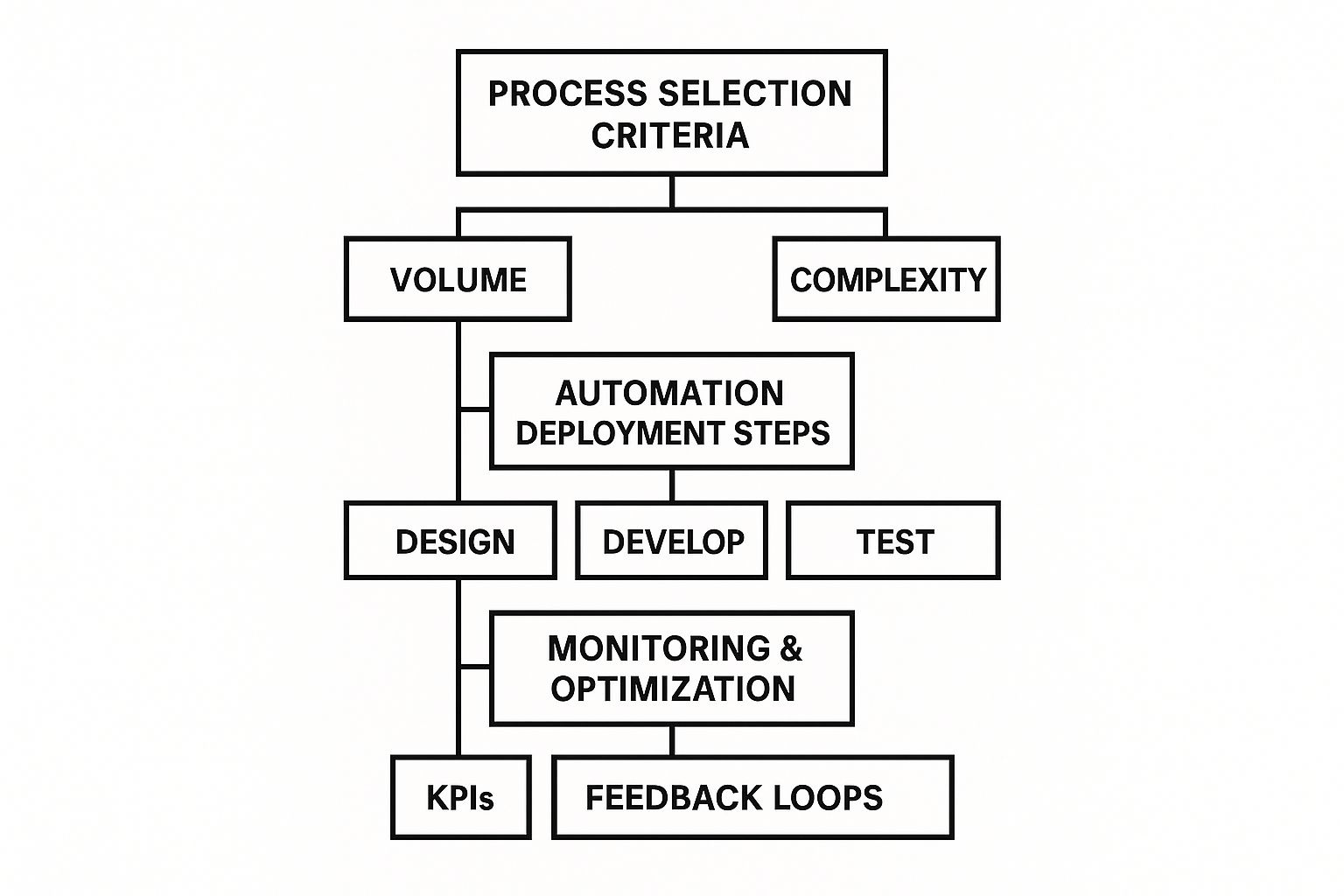
As you can see, it’s a continuous improvement loop, moving from high-level strategy down to the details of monitoring and back again.
When you combine these three building blocks—RPA for the tasks, IPA for the intelligence, and BPM for the strategy—you create an incredibly powerful framework. You can see how this synergy comes to life in these practical business process automation examples, which show real, tangible benefits. This integrated approach is what truly defines modern, effective enterprise automation.
How Automation Is Reshaping Key Industries

The true value of enterprise process automation isn't something you'll find in a technical diagram. You see it in the real world, in the tangible impact it has on day-to-day operations. Its power comes alive when it solves genuine, nagging business problems. Let's look at a few stories that show how this technology stops being a buzzword and becomes a vital part of how a business performs.
Think about a bustling financial services firm, absolutely swamped by its mortgage approval process. Every single application meant a mountain of paperwork, hours of manual data entry, and a constant chain of emails flying between departments. The whole thing was slow, riddled with opportunities for costly human error, and deeply frustrating for both staff and hopeful homeowners.
By bringing in an intelligent automation solution, they didn't just tweak the process—they completely reimagined it. Now, when an application lands, a system instantly pulls out the applicant's details, checks them against internal and external data, and runs an initial risk assessment based on pre-set rules.
The difference was night and day. The firm cut its average loan processing time from weeks down to a matter of days. Accuracy soared, and those frustrating data entry mistakes all but vanished. This didn't make their loan officers redundant; it freed them up. Instead of drowning in admin, they could now focus on the complex cases and build real relationships with their clients.
A New Chapter for Patient Care in Healthcare
Now, let's turn our attention to a large healthcare network. Before automation, just managing patient intake and scheduling was a chaotic, manual juggling act. Staff would spend hours on the phone, trying to align appointments, send reminders, and update patient files across several disconnected systems. This administrative grind was stealing valuable time away from what actually matters: patient care.
They brought in an enterprise process automation platform to conduct this entire symphony. The new system let patients book their own appointments online through a smart chatbot. That booking would then automatically update the main scheduling system and the patient's electronic health record, all without a single phone call.
The most powerful result wasn't just about efficiency; it was the improvement in care. By taking over routine admin work, the platform gave clinical staff over 25% more time to spend in direct patient interactions. This led to better diagnoses, happier patients, and a noticeable drop in staff burnout.
The system also managed all the appointment reminders and follow-up instructions, which dramatically reduced the number of no-shows and helped ensure patients stuck to their treatment plans. It was a perfect example of how automation can directly lead to better health outcomes.
Getting the Manufacturing Supply Chain in Sync
Finally, picture a global manufacturing company wrestling with a sprawling, messy supply chain. Keeping track of inventory, managing supplier orders, and coordinating logistics was a manual nightmare playing out across endless spreadsheets and frantic phone calls. Delays were common, causing production to halt and delivery deadlines to be missed.
To fix this, the company rolled out an enterprise process automation solution that connected their entire supply chain ecosystem. The platform gave them a single, real-time picture of their operations, from one end to the other.
Here’s a glimpse of how it worked:
- Automatic Inventory Watch: The system kept a constant eye on inventory levels. When stock for a part dropped below a certain point, it automatically sent a purchase order to the right supplier.
- Seamless Supplier Links: Orders were sent straight into the supplier’s system, cutting out manual handling and the risk of mistakes. The platform also tracked shipping notices, giving them live updates on incoming materials.
- Smart Alerts: If a shipment got delayed, the system would immediately notify the production and logistics teams. This allowed them to adjust schedules proactively, rather than scrambling to deal with a crisis.
This change gave the manufacturer a level of control and agility they'd never had before. They managed to reduce their inventory holding costs by 15%, slash production delays in half, and dramatically improve their on-time delivery rate.
These stories—from finance, healthcare, and manufacturing—all point to the same truth. Enterprise process automation isn't just about doing old things faster. It’s about building smarter, more resilient, and more human-focused ways of working.
Your Roadmap for a Successful Transformation
Getting started with enterprise process automation isn’t like buying a new piece of software off the shelf. It’s more like planning a major expedition. You need a reliable map, a clear destination in mind, and a skilled crew to navigate the inevitable challenges. A successful rollout is built on a foundation of careful planning, not just flashy technology.
The first step? Choosing your starting point wisely. You want to target the areas where automation will deliver the most visible and immediate impact.
Look for high-volume, rule-based processes that are currently a major drain on your team's time and energy. We’re talking about tasks like invoice processing, manual data entry, or generating the same standard reports week after week. These are the perfect "low-hanging fruit" that can deliver a quick win, building momentum and proving the value of automation to the rest of the company.
Assembling Your A-Team
You can't go on this journey alone. A solid automation programme needs a dedicated team with a mix of skills and, just as importantly, unwavering support from the top. This group often becomes a Centre of Excellence (CoE), the central hub that guides the strategy and makes sure it lines up with the bigger business goals.
Your core team should look something like this:
- An Executive Sponsor: You need a leader who can truly champion the initiative, fight for resources, and broadcast the vision from the top down.
- A Project Manager: This is your on-the-ground coordinator, the person responsible for keeping everything on track, managing timelines, and connecting all the moving parts.
- Process Experts: These are the people who live and breathe the workflows you want to automate. Their insights are gold when it comes to designing solutions that actually work in the real world.
- IT and Technical Leads: Your technical specialists. They’ll handle the implementation, integration with other systems, and security of the automation platform.
Getting this blend of business savvy and technical know-how is absolutely critical for a smooth rollout.
Launching Your Pilot Project
Once you have your team and you’ve identified a promising process to tackle, it’s time to launch a pilot project. A pilot is simply a small-scale, controlled test of your automation strategy. Think of it as a dress rehearsal. Its whole purpose is to help you learn, adapt, and show a clear win before you commit to a full-scale deployment.
For example, you might start by automating just one specific part of your accounts payable process, like matching purchase orders to invoices. The goal here isn't to change the whole world overnight. It's to prove that the technology works in your specific environment and delivers a real, measurable benefit. This approach helps you iron out any kinks and builds a rock-solid business case for more investment down the line.
The success of your pilot project isn't just measured in cost savings. It’s measured in the confidence it builds. A successful pilot creates internal champions and turns sceptics into supporters, paving the way for broader adoption.
Measuring What Truly Matters
To prove success, you need the right metrics, or Key Performance Indicators (KPIs). While reducing costs is often the most obvious one, it's far from the only one that matters. Taking a holistic view of performance tells a much richer and more accurate story of the transformation’s impact. If you want to dive deeper, you can learn more about how to reduce operational costs with intelligent strategies.
For your pilot, consider tracking these KPIs:
- Process Cycle Time: How much faster is the task now?
- Error Rate Reduction: By how much has accuracy improved?
- Employee Satisfaction: Are your people feeling less bogged down by tedious work?
- Compliance Adherence: Is automation making it easier to meet regulatory rules?
This focus on a deeper operational shift is fast becoming the norm. In fact, by 2025, an estimated 74.4% of organisations in Poland's modern business services sector had plans to pursue changes focused on automation, process standardisation, and AI. This points to a clear trend: companies are moving beyond surface-level fixes toward fundamental operational improvements. You can discover more insights about these automation-centric transformation plans.
By following this roadmap—starting small, building a great team, proving the value, and measuring a wide range of benefits—you create a framework that can scale. This allows your enterprise process automation capabilities to grow and evolve right alongside your business, setting you up for long-term success.
The Future of Work in the Automated Enterprise
Whenever the topic of process automation comes up, there’s always an elephant in the room: What does this mean for our people? It’s a fair question, and the common fear of "robots taking jobs" is completely understandable. But that narrative misses the real point. Automation isn't here to replace human talent; it’s here to unleash it. The goal is to shift our focus from mind-numbing repetition to genuinely meaningful work.
Think about one of your top analysts. She’s brilliant, but she spends half her day just pulling data from ten different systems and pasting it into a spreadsheet. Her strategic insights are what you really pay her for, but they’re buried under a mountain of administrative grunt work. Automation is the tool that clears her desk, handling the mundane tasks so she can finally do the job she was hired for.
This ushers in the era of the augmented workforce. It’s a simple but powerful idea: a partnership where humans and digital workers operate side-by-side. Each one sticks to what it does best, creating a combined force that’s far more effective than either could ever be alone.
Unlocking Our True Potential
Let’s be honest, digital workers—or bots—are phenomenal at certain things. They have speed, accuracy, and stamina we can only dream of. A bot can process thousands of invoices without a single typo, work around the clock without needing a coffee break, and follow rule-based instructions to the letter, every single time. What they can't do, however, are the uniquely human things that actually move a business forward.
With the repetitive tasks off their plates, your people are finally free to apply their energy to the work that truly requires a human touch:
- Creativity and Innovation: Dreaming up new products, brainstorming breakthrough marketing campaigns, or finding better ways to delight your customers.
- Strategic Thinking: Piecing together complex market trends, making tough business decisions, and charting the course for long-term growth.
- Emotional Intelligence: Building real relationships with clients, leading and inspiring a team, and handling the nuance of a sensitive negotiation.
- Complex Problem-Solving: Tackling unexpected challenges that a rigid, pre-programmed workflow could never handle.
These are the skills no algorithm can ever replicate. They are the very essence of our value, and automation simply gives us more time and space to put them to good use.
The point of enterprise process automation isn’t to build a company with fewer people. It’s to build a company with more powerful people, equipped with better tools and freed to concentrate on the work that matters most.
From Task Executor to Process Innovator
In this new, augmented environment, the role of an employee naturally evolves. Instead of just performing the steps in a process, they become the designers, managers, and innovators of that process. An employee who used to spend their days manually keying in customer orders might now be responsible for optimising the automated workflow that handles them.
This shift creates an entirely new career path, one focused on continuous improvement and strategic oversight. The job is no longer about doing the work, but about improving how the work gets done. Managing this transition is a huge part of building a modern, resilient business, which is why having a clear digital transformation roadmap is so critical for any leader.
Ultimately, enterprise process automation is a catalyst for human empowerment. It clears the way for us to do our best, most creative work, which leads not only to greater innovation but to more fulfilling and engaging careers for everyone.
Was this useful?
If this article helped, add Voicetta as a preferred source in Google Search. Your results can then highlight our writing.
Add as preferred source