
Blog
How Do Chatbots Work? Your Journey Into AI Conversations
Imagine messaging a company's support line at 2 AM. You're bracing for a long wait or a useless autoreply, but instead, you get a quick, helpful answer that solves you...
Your First Look Behind The Digital Curtain
Imagine messaging a company's support line at 2 AM. You're bracing for a long wait or a useless auto-reply, but instead, you get a quick, helpful answer that solves your issue. You might not even realize you're talking to an AI that never sleeps. This experience is now common, as digital assistants have become incredibly skilled at holding human-like conversations. So, how exactly do they pull it off?
From Simple Scripts to Intelligent Conversations
The path of chatbots wasn't always so smooth. Early versions were little more than digital flowchart operators. They depended entirely on pre-written scripts and specific keywords. If you asked, "Where is my package?" but the bot was only programmed to respond to "track my order," you'd hit a wall. This rigid, rule-based system was the source of those frustrating loops where a bot would repeat, "I'm sorry, I don't understand."
Today's chatbots operate on a whole new level. Instead of just matching keywords, they're built to understand intent. This means they figure out what you mean, not just what you type—typos, slang, and all. These systems can remember what you said earlier, learn from each conversation, and even adjust their tone. This evolution from rigid command-followers to flexible conversational partners is what makes them so effective now.
The Human Touch in a Digital World
This ability to grasp context is why modern chatbots are popping up everywhere. They're no longer confined to answering basic website FAQs. Now, they help schedule medical appointments, walk users through complex banking services, and even provide personalized shopping recommendations in e-commerce. The aim is to create an efficient and natural interaction, removing the clunky feel of older automated systems.
For a great example of this principle in action, just look at the interface for a tool like ChatGPT:
Its clean, simple chat window hides an enormous amount of power. It invites you to ask anything, showing it’s ready for complex questions, not just a handful of pre-set commands. It’s designed to understand nuance in a way that feels much closer to a real conversation.
The Driving Force Behind the Growth
This widespread adoption isn't just anecdotal; it's backed by serious investment. The AI market in Poland, for instance, is projected to reach a size of $1.59 billion by 2025. This figure shows how deeply AI and chatbot technology are being integrated into major sectors like finance and healthcare. You can discover more about Poland's AI market growth here. This level of investment is a clear signal that businesses see these tools as fundamental to how they connect with customers.
So, what’s the secret sauce that separates modern AI from the bots of the past? It isn't a single piece of tech. It’s an orchestra of different processes—language analysis, decision-making, and system integrations—all working together. To truly understand how chatbots work, we need to look at each of these components and see how they create a single, fluid experience.
Inside The Chatbot Mind: Architecture That Actually Works
To really understand how chatbots work, it helps to think of their internal structure not as one giant piece of software, but as a small, specialized team working together. Imagine a business where three different experts collaborate perfectly. Each one has a distinct job, and the final experience for the customer relies on them working in harmony.
The Three Pillars Of Modern Chatbot Architecture
At its heart, every effective chatbot relies on three key components: a translator, a conversation manager, and a response writer. These parts work in a sequence to turn your words into a meaningful action and a helpful reply.
-
Natural Language Understanding (NLU): This is the team's expert translator. When it receives a message like "I'm having trouble with my account," its job is to figure out the user's true goal, not just the literal words. It deciphers meaning from messy, everyday human language.
-
Dialog Management: This is the conversation manager or conductor. It keeps track of the conversation's context, remembers what was said earlier, and guides the interaction logically toward a solution. It's the bot's short-term memory.
-
Natural Language Generation (NLG): This is the team's skilled writer. After the system decides on the right action, the NLG component crafts that decision into a natural, human-sounding sentence.
This entire process converts human language into instructions a machine can follow. The infographic below shows how a simple message is broken down for the system to process.
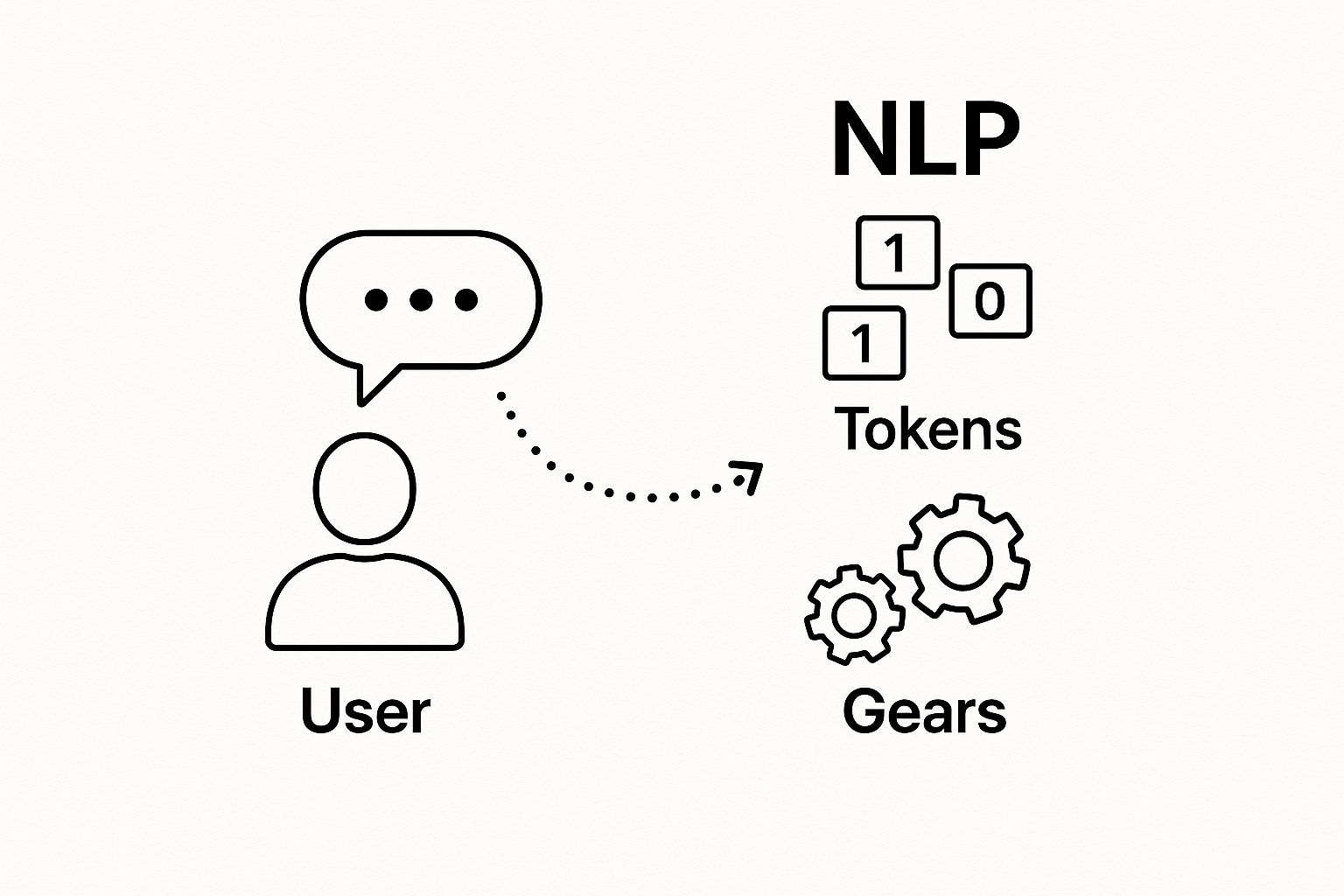
The image visually represents the journey from a user query to digital tokens and gears, symbolizing the complex NLU and processing that happens in just a few moments.
When a user asks, "What's my balance?", the system performs a rapid, coordinated sequence of actions. The NLU component breaks down the sentence, identifies the intent (the user wants to check a balance), and pulls out key entities (the specific account). The Dialog Manager then takes this information, confirms if it has everything it needs, and queries the appropriate backend system for the balance information.
To better understand how these roles function, the following table compares each component’s job in detail. It highlights how each layer contributes a specific, essential function, turning a user's request into a completed task.
Chatbot Architecture Components Comparison
| Component | Primary Function | Technical Process | User Impact |
|---|---|---|---|
| Natural Language Understanding (NLU) | Deciphers the user's intent and meaning. | Uses tokenization, intent classification, and entity recognition to convert human language into structured data. | The bot understands what you mean, even with typos or slang, preventing frustrating "I don't understand" responses. |
| Dialog Management | Manages the conversation's flow and context. | Maintains the state of the conversation, makes decisions on the next step, and interacts with backend APIs. | The conversation feels coherent and progressive; the bot remembers previous information and guides you toward a solution. |
| Natural Language Generation (NLG) | Crafts a human-like response. | Converts structured data from the system back into natural, readable text or spoken words. | The bot's replies sound natural and helpful rather than robotic and scripted, building user trust. |
This seamless coordination between understanding, managing, and responding happens almost instantly. The fluid interplay between these three parts is what makes the difference between a genuinely helpful AI chatbot and a rigid, frustrating script.
This architecture ensures every interaction has the potential to be a productive conversation, not just a simple transaction. The power of this structure is clear in platforms built for complex customer support. To see how these systems come together in a real-world application, you can explore the Voicetta AI chatbot and observe it in action. This whole process, from a user's first keystroke to the final reply, shows how far these systems have come, moving beyond basic programming to achieve real conversational ability.
Decoding Human Language: The AI Translation Challenge
The secret to a good chatbot is its ability to translate our messy, everyday language into clear instructions a computer can follow. When you say, “I’m feeling blue,” how does it know you mean sad, not the color? The answer is a field of AI called **Natural Language Processing (NLP)**. You can picture NLP as a language detective, quickly analyzing every word to understand your true meaning.The First Step: Breaking Down Your Message
It all starts the instant you hit ‘send.’ The chatbot’s first task is to break your sentence into smaller chunks called tokens. This process, tokenization, is much like a chef chopping vegetables before starting a recipe. Each piece becomes easier to work with.
For instance, the sentence "I need to change my flight to Warsaw" is broken down into a list of tokens: ["I", "need", "to", "change", "my", "flight", "to", "Warsaw"]. This step neatly organizes your request and prepares it for the next stage of analysis.
Finding the 'Why': Intent and Entity Recognition
Once your message is broken into tokens, the chatbot needs to figure out what you want to achieve. This is called intent classification. Are you trying to "book a flight" or "check flight status"? By analyzing the tokens, the bot determines your main goal.
Next, it hunts for the important details, a process known as entity recognition. In a request like "change my flight to Warsaw for tomorrow," the bot extracts key entities:
- Action: change
- Item: flight
- Destination: Warsaw
- Date: tomorrow
Tools like the spaCy library are designed to do this automatically. The image below shows how spaCy can map out a sentence, tagging each word and identifying "Warsaw" as a location. This is exactly how a chatbot sifts through your words to pull out the critical data it needs to get the job done.
This separation of the main goal from the supporting details is what allows a chatbot to handle requests accurately and efficiently.
The Power of Learning and Context
But human language is rarely simple. What about sarcasm, local slang, or when you suddenly change the topic? This is where machine learning makes a huge difference. Instead of just following a strict set of rules, modern chatbots learn from immense amounts of real human conversations.
Think of it as learning a language by living in a country, not just by reading a textbook. This immersion gives the chatbot a much deeper grasp of context. It learns that a reply like, "Oh, brilliant," after a long wait time probably means frustration, not happiness.
This ability to understand nuance is why today's AI models are so effective. In Poland, the market reflects this. As of May 2025, ChatGPT leads with an 89.63% market share, with Perplexity at 4.26% and Microsoft Copilot at 3.9%. The popularity of these assistants comes from their powerful grasp of language. See the latest market share data for Poland.
This detailed dance of tokenization, recognition, and context analysis happens in a fraction of a second. It’s a fast translation that turns your casual question into precise instructions, resulting in a helpful and natural-feeling response. To learn more about how these systems work, check out our conversational AI tutorial.
Keeping Conversations On Track: The Art Of Dialog Flow
Once a chatbot understands your message, its next job is to manage the conversation. This is the role of Dialog Management, which works like a conversational GPS. It’s the system that remembers the context of your chat and steers the interaction toward a successful outcome. Without it, every message would be a fresh start, forcing you to repeat information over and over.
Think of it as the chatbot's brain, keeping the dialogue coherent and purposeful from one message to the next.
Guiding the Conversation with State and Context
The secret to effective dialog management is maintaining state, a technical term for the chatbot’s ability to remember what’s going on. Imagine asking a friend, “What’s the weather like?” They would instinctively ask, “Where?” When you answer, “In Warsaw,” they don’t need you to ask your original question again. They remember the context.
A well-built chatbot does the same. It stores important details—like the city "Warsaw" and your intent to "get weather"—in its short-term memory for that conversation. This memory is what separates a modern assistant from a basic keyword-matching bot. It allows the chatbot to handle multi-turn conversations, ask clarifying questions, and even adjust if you change the topic.
Choosing the Next Best Action
So, how does a chatbot decide what to say or do next? Simpler, rule-based bots operate like a decision tree. If you want to track an order, the script tells the bot to ask for an order number. This method is straightforward and works well for predictable, linear tasks.
More advanced chatbots use AI and machine learning to predict the most helpful response. Instead of following a rigid script, they analyze patterns from thousands of past conversations to determine the next logical step. This enables them to manage unexpected questions, adapt when a user changes their mind, or know when it’s time to hand the conversation over to a human. Platforms like Rasa offer visual tools for developers to map out these complex conversational flows.

The image above shows an interface where developers can visually build and connect conversation paths. This structured approach is essential for creating chatbots that can navigate intricate dialogues without getting confused.
Comparing Dialog Management Strategies
Different tasks require different conversational approaches. A simple FAQ bot doesn't need the same sophisticated dialog skills as a complex personal assistant. Businesses select a strategy based on the complexity of the jobs the chatbot needs to perform.
To help clarify these differences, the table below outlines common strategies and their ideal applications.
Dialog Management Strategies
Different approaches to managing conversation flow and their effectiveness in various scenarios
| Strategy Type | Best Use Cases | Complexity Level | User Experience |
|---|---|---|---|
| State Machine / Rule-Based | Answering FAQs, filling out simple forms, and guiding users through linear tasks. | Low | Predictable and efficient for specific goals, but can feel rigid and easily break if the user deviates. |
| Frame-Based (Slot-Filling) | Booking appointments, ordering flights, and gathering structured information from users. | Medium | Goal-oriented and effective at collecting all necessary pieces of information to complete a task. |
| Reinforcement Learning (AI) | Dynamic customer support, personal assistants, and handling open-ended inquiries. | High | Flexible and adaptive. It can manage topic changes and create a more natural, human-like conversation. |
Ultimately, the goal of these strategies is to make interactions with chatbots feel natural and efficient. By managing the dialog flow effectively, a chatbot moves from a simple tool to a capable assistant, ready to solve real business challenges and improve customer experiences.
Chatbots In Action: Success Stories That Changed Everything
Knowing the technical blueprint of a chatbot is one thing, but seeing it deliver real business results is where its true value becomes clear. The combination of language understanding, conversation management, and intelligent responses isn't just a technical exercise; it's a tool that is actively changing how companies connect with their customers. From busy online stores to essential healthcare services, well-built chatbots are delivering clear improvements and better experiences.
The E-commerce Revolution
In the crowded world of online shopping, chatbots have become invaluable personal shoppers. Imagine a bot that doesn't just answer "Is this in stock?" but instead guides a customer through a complicated purchase by asking smart questions about size, style, and features. This proactive help gives shoppers confidence in their choices, leading directly to more completed sales and fewer abandoned carts.
This trend has been especially strong in Poland's online market. The Polish e-commerce industry underwent a major shift, and by the end of 2022, a majority of online shops were using chatbots. They moved beyond simple Q&A scripts to AI-powered assistants that genuinely improve the shopping experience. Discover more insights into the evolution of chatbots in Polish e-commerce.
A New Front Door for Healthcare and Finance
The influence of chatbots goes far beyond retail. In healthcare, they act as a new digital front door, helping to manage the flow of patients and reduce the administrative workload. An intelligent chatbot can perform initial symptom screenings, schedule appointments based on a doctor’s schedule, and answer common questions about procedures—all while protecting patient privacy. This automation cuts down on phone wait times and lets clinic staff concentrate on more critical patient needs, improving access to care.
Similarly, financial institutions use chatbots to offer secure, 24/7 help. Customers can check their balances, report a lost card, or receive instant alerts about unusual activity without having to wait for a person. These bots are trained to handle sensitive information securely and can even provide personalized financial tips based on spending patterns, making banking more convenient for everyone.
Measuring What Matters: The Voicetta Example
A successful chatbot deployment is one that is constantly measured for performance. Companies don’t just launch these tools and walk away; they track specific metrics to understand their real-world impact. Platforms like Voicetta are built on this principle of delivering and proving tangible results.
The Voicetta interface, for instance, is designed to communicate reliability and constant availability, which is essential for businesses that cannot afford to miss a single customer inquiry.
This clean design assures users that help is available anytime, which encourages them to engage with the bot and trust the system. This trust is the first step toward reaching key business goals. Success is then measured through concrete data points, including:
- Reduced Response Times: Tracking the drop from several minutes for a human agent to just seconds for an AI response.
- Customer Satisfaction (CSAT) Scores: Using post-chat surveys to confirm that users found the chatbot helpful and their issue was resolved.
- Cost Savings: Calculating the financial impact of automating thousands of routine inquiries, which frees up human agents for more complex tasks.
- Lead Qualification Rate: Measuring how many conversations lead to a qualified prospect or a scheduled appointment.
Achieving these outcomes requires thoughtful planning and execution. The right implementation strategy is what turns a simple Q&A tool into a core part of the business. For those ready to take that step, you can check out our guide on how to implement a chatbot to ensure your project is set up for success. These stories show that chatbots work not just in theory, but as powerful engines for efficiency and growth.
Connecting The Dots: How Chatbots Access Real Information
A chatbot that understands your question is impressive, but one that can instantly find your order status or check product stock is truly useful. This is where the technical magic behind how chatbots work extends beyond language. The chatbot must act as a secure bridge, connecting its conversational abilities to a company’s live systems to provide real-time, accurate information.
The Digital Bridge: Understanding APIs
This connection is built using an Application Programming Interface (API). Think of an API as a highly efficient waiter in a busy restaurant. You tell the chatbot what you want, like "check my package status." The chatbot, using the API, takes this specific request to the "kitchen"—the company's fulfillment database.
The API ensures the request is properly formatted, retrieves only the necessary data, and brings it back as a clear response. This system is both efficient and secure. The chatbot itself doesn't need a key to the entire kitchen; it just knows how to place an order with the waiter. This controlled interaction is fundamental, allowing the bot to get precisely what it needs without being exposed to sensitive internal databases.
Putting Integrations to Work: Practical Examples
In practice, these API integrations empower chatbots to perform a range of tasks that directly help customers. They transform the bot from a passive information source into an active assistant that gets things done.
- Real-time inventory checks: When you ask if a product is available, the bot uses an API to query the live stock database for an immediate answer.
- Updating customer records: If you change your address, the chatbot securely sends this new information via an API to update your profile in the company’s Customer Relationship Management (CRM) system.
- Coordinating with human agents: When an issue is too complex, the chatbot can use an API to create a support ticket and hand over the conversation history to a human agent.
Connecting these different tools is made easier with dedicated platforms. Tools like Zapier visually demonstrate how different applications can be linked to automate workflows.
This screenshot illustrates a simple automated task where a trigger in one app causes an action in another—the exact principle chatbots use to integrate with business systems.
Security and Scalability: The Foundation of Trust
This seamless flow of data must be built on a solid foundation of security. When a chatbot handles personal information, APIs use methods like authentication tokens and data encryption to shield that data as it travels between systems. This ensures all interactions remain confidential and secure from unauthorized access.
Furthermore, the infrastructure must be prepared for high demand. Businesses design their systems to be scalable, meaning they can handle a sudden surge in conversations—like during a major sale—without crashing. Using cloud computing and load balancing, a chatbot can serve thousands of customers simultaneously, giving every single user a fast and consistent experience. This reliability prevents lost sales and protects a company's reputation, making the chatbot an essential, dependable business tool.
What's Next: The Evolution Of AI Conversations
The technical systems that explain how do chatbots work today are just the starting point. The nature of AI conversation is changing, moving beyond simple commands into a richer, more perceptive style of interaction. The AI assistants of tomorrow won't just process what you type; they will understand the world around them in a more natural, human-like way.
The Leap Beyond Text and Voice
The next major step is multimodal AI, where a chatbot can see what you see. Imagine showing your phone a picture of a broken bike part and asking, "How do I fix this?" The AI could then provide visual repair instructions. This approach blends text, voice, and image recognition into a single experience, removing the headache of trying to describe complex problems with words alone.
At the same time, emotional AI is becoming a tangible technology. These systems can analyze your voice or text to understand emotions like frustration or happiness. If a customer sounds upset, the bot can adjust its tone to be more empathetic or even hand the conversation over to a human agent, creating a much more supportive interaction.
Emerging Frontiers in AI Interaction
These advanced capabilities are opening up new uses in many fields, blurring the line between a simple Q&A tool and a proactive partner. Some of the most exciting trends include:
- Voice-Powered Shopping: Conversational assistants that act as personal shoppers, guiding you through online stores to find and buy products.
- AI Companions for Health: Bots created to provide accessible mental health support or serve as on-demand health and wellness coaches.
- Augmented Reality (AR) Integration: Assistants that project real-time, visual instructions through an AR overlay to help with complex assembly or repair tasks.
The research behind these developments is extensive, with many active projects at leading AI labs. A look at the research from organizations like OpenAI shows a focus that goes beyond language to include reasoning, safety, and perception—all vital for building trustworthy AI. These aren't just distant ideas; they are being actively developed. To see how businesses are already using these concepts, you can explore these conversational AI examples.
Challenges and the Human-AI Future
As chatbots grow more capable, new challenges related to privacy, ethics, and responsible behavior come to the forefront. Building user trust is the single most important factor for successful adoption. The goal is not to replace human connection but to support it. By handling routine tasks, AI allows people to focus on what they do best: creative problem-solving and building relationships.
The future of business communication will depend on how well this technology is integrated. Through intelligent automation, companies can ensure they are always available, responsive, and ready to help every single customer.
Prepare your business for this future. Discover how Voicetta’s 24/7 AI communication platform can ensure you never miss an opportunity and always stay ahead of the curve.
Was this useful?
If this article helped, add Voicetta as a preferred source in Google Search. Your results can then highlight our writing.
Add as preferred source