
Learning how to trim business expenses isn’t just about making panicked cuts when things get tight. It’s about building a smarter, more resilient company—one where efficiency is part of the daily culture. This shift in mindset is what really separates businesses that just survive from those that truly thrive.
Building a Resilient, Cost-Conscious Business

Real financial stewardship goes way beyond the obvious advice. It’s about being proactive and constantly looking for ways to improve. It’s about turning your operations from a cost centre into a genuine growth engine.
I once worked with a small manufacturing firm that was getting hammered by rising material costs. Their first instinct was to consider temporary layoffs, a move that would have tanked morale and slowed production. Instead, we dug into their processes and found that investing in automation would solve the root problem. It wasn't just a short-term labour saving; it boosted their output, cut down on errors, and gave them long-term stability.
That's the kind of strategic thinking that makes all the difference. The goal is always to make informed choices that strengthen the business for whatever comes next.
Adopting a Mindset of Financial Discipline
The bedrock of any successful cost-cutting effort is a cultural one. When every single person on your team is encouraged to think about efficiency, you'll be amazed at where you find savings. This isn't about pinching pennies or micromanaging every little expense. It's about empowering your team to spot and eliminate waste in their own day-to-day work.
Think about a well-run commercial kitchen. The manager isn't just guessing; they're using data to track everything from fridge temperatures to food waste. By keeping an eye on these key performance indicators (KPIs), they can spot problems early, reduce spoilage costs, and even lower their carbon footprint. It’s a perfect example of using operational data to make smart financial decisions.
Proactive financial management means you're constantly looking for ways to optimise, not just reacting to financial pressure. It's an ongoing discipline that turns small, consistent savings into significant long-term gains.
This guide will walk you through the practical steps to make this happen in your own business. We’ll cover everything from instilling financial discipline to optimising your internal processes and using technology to your advantage. For a broader look at different approaches, you can explore these proven top strategies to effectively cut business costs.
Identifying Immediate Opportunities for Savings
So, where do you start? While every business is unique, I’ve found that certain areas almost always offer the biggest bang for your buck. Focusing your initial efforts here can deliver some quick wins and build momentum for the bigger changes to come.
To kick things off, let's look at the primary domains where businesses often find significant cost-saving opportunities.
Immediate Cost Reduction Opportunities
| Area of Focus | Potential Impact | Example Action |
|---|---|---|
| Operational Overheads | High | Conduct a full audit of all software subscriptions. Cancel unused or redundant tools. |
| Supplier & Vendor Contracts | High | Renegotiate terms with your top five vendors based on loyalty and volume. |
| Process Inefficiencies | Medium to High | Map a core business process (like invoicing) and identify bottlenecks to automate. |
| Energy Consumption | Medium | Install smart thermostats and switch to LED lighting to reduce utility bills. |
| Marketing Spend | Medium | Reallocate budget from low-performing channels to those with a clear, high ROI. |
These areas are ripe for review and often hide savings that are easier to unlock than you might think. By starting with a thorough analysis here, you can create a clear roadmap for cutting costs effectively.
Here are a few of the primary domains where you can often find the most impactful savings:
-
Operational Overheads: These are the constant, recurring costs of just keeping the lights on—rent, utilities, and all those software subscriptions. Did you know small businesses spend over $60 billion on energy each year? Simple changes can often cut those utility bills by 10% to 30%.
-
Supplier and Vendor Contracts: Too many businesses sign a contract and forget about it. There is almost always room to negotiate. Make it a habit to regularly review these agreements. You might be surprised by the better pricing or more favourable terms you can secure.
-
Process Inefficiencies: This is the hidden waste that silently drains your resources. Think redundant tasks, manual data entry, or clunky communication between teams. Automating these clogs in the system frees up your people to do work that actually drives the business forward.
Finding Hidden Inefficiencies in Your Operations
Every business I've ever worked with, no matter how slick it looks on the outside, has what I call a "hidden factory" of waste. These are the small, often unnoticed habits and processes that quietly eat up time, drain resources, and add absolutely zero value to what you sell. Spotting these hidden costs is one of the smartest ways to cut expenses because you're trimming fat, not muscle. This isn't about cutting corners; it's about working smarter.
Think of it like a leaky pipe. One little drip seems like nothing, right? But over a few months, that drip turns into a massive water bill and maybe even some water damage. Your operational inefficiencies are those slow drips. They might be redundant data entry, clunky approval chains, or just the time people waste hunting for information. Your first job is to become a detective inside your own company.
Mapping Your Core Workflows to Find Waste
The best way to find these leaks is to map out your core workflows. This just means drawing a visual chart of a process from start to finish. You don't need fancy software—a whiteboard and a stack of sticky notes work perfectly. The whole point is to see every single touchpoint and handover in the chain.
Let me give you a real-world example. A service firm I know was convinced their client onboarding was too slow, but they couldn't figure out why. We sat down and mapped it out. The culprit? Client information was being typed into three separate systems by two different people. That one redundancy was costing them hundreds of hours a year and, worse, making a terrible first impression on new clients. Fixing that workflow didn't just save money; it boosted their customer satisfaction right from day one.
So, pick one critical process to start with. It could be anything from how you source materials to fulfilling an online order or processing an invoice. As you map it, ask these tough questions at every step:
- Is this step truly necessary? Does it add value for the customer or the business? Be honest.
- Where are the bottlenecks? Pinpoint where work piles up and just sits there.
- Could a machine do this better? Are you paying a person to do a task that software could handle instantly?
- Is this the simplest way? Are there too many handovers or approvals slowing things down?
The goal of process mapping is to make the invisible visible. When you can see the entire journey a task takes, the points of friction and waste become glaringly obvious.
This chart shows a simple but effective workflow for procurement. Having a structured process like this is an immediate way to start controlling costs.
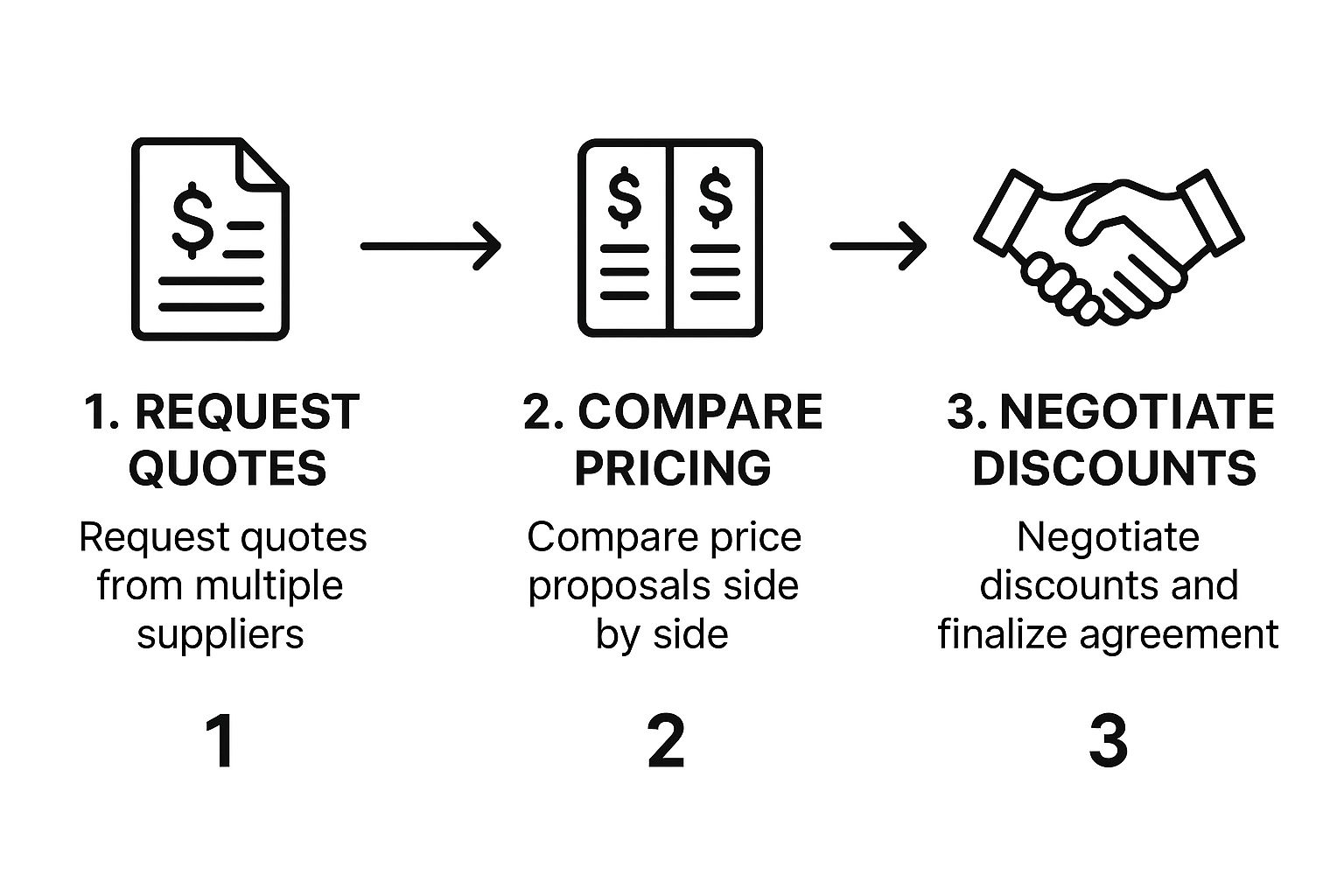
By visualising the entire flow from quoting to negotiation, you can standardise your approach and make sure you're always getting the best possible terms.
Get Out and See the Work Being Done
Mapping a process on a whiteboard is a fantastic start, but it's only half the story. To really get what’s going on, you have to go to the 'Gemba'—a Japanese term that means "the real place." If you're in manufacturing, that's the factory floor. In an office, it means sitting down with your team while they actually do their work.
This practice, called a Gemba walk, is all about observing, asking good questions, and showing respect for the people who do these tasks day in and day out. They are the real experts. Ask them what drives them crazy, what takes forever, and what ideas they have to make things better. I guarantee you'll uncover insights you'd never find staring at a spreadsheet.
For instance, a manager might think their inventory system is working just fine. But a Gemba walk could reveal that the warehouse crew is using a paper-based workaround because the official system is clunky and crashes all the time. That’s a classic hidden inefficiency—a problem that costs time and creates risk, all while being completely invisible to management. You simply can't solve problems you don't know exist. If you want to dig deeper into fixing these kinds of issues, you can learn more about how to improve operational efficiency with focused strategies.
When you combine process mapping with genuine, on-the-ground observation, you get the full picture. This is how you move past guesswork and start making data-driven decisions that lead to real, lasting cost reductions.
Using Technology to Slash Overhead Costs

Technology is hands down your most powerful ally in the mission to cut business costs, but let’s be clear: not all tech investments are created equal. The trick is to think strategically. Don't just add more apps to your stack; find solutions that solve specific, expensive problems. The goal is to automate the tedious stuff, minimise human error, and free up your team for the kind of valuable, strategic work that actually moves the needle.
I've seen it time and again. A small e-commerce shop, for example, was practically drowning in manual inventory counts. By bringing in a simple inventory management system, they did more than just get a fancy new tool. They slashed holding costs by preventing overstock, eliminated the stockouts that were killing sales, and clawed back hours of manual labour each week. That’s the direct, measurable impact you should be aiming for.
This strategic approach is a proven path to efficiency. Historically, one of the biggest ways Polish businesses have managed to reduce expenses is by getting smarter with productivity and innovation. For instance, thanks to better regulation and widespread digital upskilling, Polish manufacturing firms have managed to cut their operational costs by as much as 15% in recent years. In an economic environment where you're trying to offset rising wages, that kind of efficiency is a lifesaver. You can find more insights on this in Poland's economic environment on poland-accounting.eu.
Automate Repetitive Administrative Tasks
Every office has them—those soul-crushing, repetitive tasks that no one wants to do but are somehow essential. I'm talking about manual data entry, processing invoices, or generating the same standard reports week after week. These are prime candidates for automation.
Automating these administrative burdens isn’t about replacing people; it’s about liberating them. When your team isn't bogged down by copy-pasting data from one spreadsheet to another, they have more time for what matters: engaging customers, creative problem-solving, and strategic planning.
Here are a few common automation opportunities I see all the time:
- Customer Communication: An AI-powered system like Voicetta can handle routine customer queries and schedule appointments 24/7. This means you never miss a lead, while your team can focus on the complex issues that truly need a personal touch.
- Financial Processes: Modern accounting software can automatically send invoice reminders, categorise expenses right from your bank feed, and generate financial reports. This alone can drastically reduce manual bookkeeping hours.
- Data Management: Simple tools that sync information between your CRM and email marketing platform eliminate the tedious task of manual list uploads and prevent costly data-entry errors.
When you identify and automate these workflows, you don't just reduce labour costs—you also improve accuracy and speed. If you’re looking for a jumping-off point, we’ve put together some great business process automation examples to get you started.
Optimise Resource Management with Smart Tech
Beyond just administrative tasks, technology can fundamentally change how you manage your physical resources, from office utilities to complex supply chains. This is a massive area for potential savings that often gets overlooked.
Take energy consumption. It’s a huge expense. The Small Business Association estimates that small businesses spend over $60 billion a year on energy alone. A few smart devices can make a serious dent in that bill.
A smart thermostat that adjusts heating and cooling based on whether people are actually in the office can cut utility expenses by 10% to 30%. The best part? No one even notices the change in comfort, but your bottom line certainly will.
This same principle applies to much larger operations. A professional kitchen, for instance, can use Internet of Things (IoT) sensors to manage food safety and slash waste. These sensors monitor fridge and freezer temperatures in real-time, sending alerts before a problem leads to spoilage. This tech doesn't just help with compliance; it gives managers the data they need to forecast food usage, optimise ingredient orders, and pinpoint the exact bottlenecks that lead to waste.
Choosing the Right Technology for a Clear Return
With so many options out there, the real challenge is picking technology that delivers a clear return on your investment (ROI). Don't get distracted by the latest shiny object. Start with a problem.
Here’s a simple framework I always recommend for making the right choice:
- Identify the Pain Point: First, figure out where you’re losing the most time or money. Is it in missed sales calls, inefficient inventory, or sky-high utility bills?
- Quantify the Cost: Put a real number on it. How many staff-hours does this task consume each month? What is the actual financial cost of this inefficiency?
- Research Targeted Solutions: Now, look for tech built specifically to solve that problem. Read case studies and look for proof of ROI from businesses that look like yours.
- Calculate the Payback Period: Finally, compare the cost of the solution to the savings it will generate. A good tech investment should pay for itself within a reasonable timeframe.
By focusing on solving real, costly problems, you ensure that every piece of technology you adopt becomes a tool for growth, not just another line item on your expense report.
Mastering Your Finances and Supplier Negotiations
Once you've tightened up your internal processes and tech, it's time to turn your attention to your finances and supplier relationships. This isn't just about playing defence with your budget; it’s a powerful offensive move that builds a healthier, more profitable business. We're talking about active financial discipline—a continuous practice that can unlock some serious savings.
True financial control starts with a hard look at your existing agreements. A lot of business owners see contracts as iron-clad, but I've found they're often more flexible than you might think, especially when you have a long-standing relationship. Remember, your vendors, suppliers, and even your landlord want to keep you as a client. That shared interest is your greatest leverage.
The Art of Renegotiation
The idea of renegotiating contracts can be daunting, but with a bit of prep work, it becomes a straightforward process. It all starts with data. Before you even think about picking up the phone, you need to understand exactly what you bring to the table.
- Know Your History: How long have you been a loyal customer? What’s your total spend with them over the past few years? Consistency and loyalty are huge negotiating assets.
- Check the Market: What are your competitors paying for the same thing? A little research can reveal if you’re getting a fair deal. This isn't about making threats; it's about making an informed, reasonable request.
- Find a Win-Win: Can you offer something valuable in exchange for a better price? Maybe you can commit to a longer contract, provide a glowing testimonial, or agree to faster payment terms.
I once walked a small retail owner through this very process. Her shop lease was up for renewal, and the proposed rent hike was a gut punch. Instead of just accepting it, we did our homework. We pulled records of her flawless payment history, emphasised the foot traffic her popular store brought to the entire building, and researched comparable rents nearby. Armed with this information, she approached her landlord and proposed a smaller, more gradual increase in exchange for signing a longer-term lease. The landlord saw the value and agreed, saving her thousands over the next few years. It was a classic win-win.
Mastering Your Financial Habits
Beyond those big contracts, your day-to-day financial habits are a goldmine for savings. This is where active management really shines, turning small, consistent adjustments into significant gains down the line. One of the biggest culprits I see? The dreaded 'subscription creep'.
We've all been there—signing up for software tools and services that we slowly forget about. A crucial area for savings is rigorous software license optimization. Block out an hour every quarter to comb through your bank and credit card statements. Question every single recurring charge. If a tool isn’t delivering obvious value or you have another one that does the same thing, it’s time to cancel it.
Active financial management isn’t a one-time project; it’s an ongoing discipline. Continuously auditing your expenses, managing cash flow, and understanding market trends are what separate financially resilient businesses from fragile ones.
This discipline is even more vital when you factor in broader economic shifts. For example, recent trends in Poland showed how inflation and wage growth can directly impact business strategy. During a temporary inflation spike in early 2025, smart firms in manufacturing and logistics got ahead of the curve by renegotiating their supply agreements. By aligning their planning with macroeconomic forecasts, like an expected dip in wage growth, they successfully trimmed costs by up to 10%.
This proactive approach—connecting what’s happening in the market to your own spending—is the hallmark of smart cost management. For a deeper dive into trimming expenses across your entire organisation, check out our detailed article on how to reduce operational costs. By adopting these financial disciplines, you can transform your balance sheet from a source of stress into a powerful tool for strategic growth.
Optimising Your Team and Cultivating a Savings Culture

It’s easy to look at your team as just another expense on a spreadsheet. But that’s a rookie mistake. When cash gets tight, the first instinct is often to cut heads, but that’s a short-term fix that creates long-term pain. You lose experience, destroy morale, and gut your institutional knowledge.
The smarter play? Focus on intelligent workforce optimisation. This is about making your team leaner, more agile, and more engaged—not just smaller. The real goal is to build a culture where every single person is on the lookout for ways to save money, turning your workforce into a powerhouse of efficiency.
Create an Agile Team with Cross-Training
One of the most powerful moves you can make is to start cross-training your people. It’s exactly what it sounds like: teaching employees skills outside their day-to-day roles. Imagine a marketing specialist who can handle basic customer support queries or a developer who genuinely understands the sales pipeline. Their value to the company skyrockets.
Suddenly, you have a far more flexible and resilient team. When a key person goes on holiday or unexpectedly leaves, you’re not left scrambling. Someone can step in to handle the critical tasks, keeping the business running smoothly without the immediate cost of a temp or a panicked recruitment process.
Even better, cross-training shatters those invisible walls between departments. When people understand the pressures and processes of other teams, collaboration clicks into place. They see the bigger picture, which leads to smarter problem-solving and process tweaks that save money across the entire business.
Embrace Flexible Work and Smart Staffing
The old nine-to-five, everyone-in-the-office model comes with some hefty price tags. We’re talking rent, utilities, office supplies—it all adds up, fast. Adopting more flexible work arrangements can be a game-changer for your bottom line.
Remote or hybrid models are the obvious starting point, immediately slashing those fixed overheads. But flexibility is about more than just location. To truly optimise, you should explore the cost-effectiveness of hiring remote talent. This move can give you access to a global talent pool, often at a much more competitive price, without ever compromising on quality.
Here are a few flexible staffing models I’ve seen work wonders:
- Hiring Freelancers or Contractors: Got a specific project or a seasonal rush? Bringing in a specialist on a contract basis is far more economical than hiring a full-time employee you don't need year-round.
- Implementing Flexitime: Letting people adjust their start and finish times costs you nothing, but it can massively improve morale and productivity. A better work-life balance often means lower staff turnover, which is a huge cost saving in itself.
- Job Sharing: This is a fantastic way to retain experienced professionals who can’t commit to a full-time role. Two part-time employees share the duties of one position, giving you double the brainpower and commitment.
Turn Every Employee into a Cost-Saver
The real magic happens when you stop dictating cost-cutting from the top down. You need to build a savings culture from the ground up. Your people on the front lines—the ones doing the work every day—are perfectly placed to spot waste and suggest practical fixes.
A company I know launched an "innovation challenge," a simple programme that rewarded staff for the best cost-saving ideas. The results were incredible. One suggestion from a warehouse employee led to a small change in their packing process that saved the company thousands annually in shipping costs. The initiative didn't just slash expenses; it boosted morale and made everyone feel like a valued partner in the business's success.
This kind of engagement is vital. It’s also important to consider external factors that influence your operational overhead. For example, Poland’s ongoing public finance reforms have a direct effect on business expenses. Local enterprises have noted that administrative and regulatory burdens can make up 5-7% of their annual operating costs. Government efforts to streamline tax compliance and reduce red tape are creating an environment that helps companies lower these financial liabilities. You can discover more insights about Poland's economic forecast on economy-finance.ec.europa.eu.
By empowering your team and staying aware of the economic landscape, you create a powerful combination for sustainable cost control. Another way to empower your team is by automating routine tasks, such as initial customer interactions. If you're looking for ways to free up your team for more strategic work, it's worth exploring how to automate customer support with modern tools. This allows your valuable employees to focus on complex problem-solving rather than repetitive queries, directly impacting your bottom line through improved efficiency.
Common Questions About Trimming Business Costs
When you decide it’s time to get serious about cutting business costs, a lot of questions pop up. It’s natural to feel a bit overwhelmed by the possibilities and the potential pitfalls. Let's walk through some of the most common queries I hear from business owners, breaking them down with clear, practical answers to help guide your strategy.
Where Should I Even Begin With Cutting Costs?
The best starting point is always a deep dive into your three biggest expense categories. For most businesses, this will be your payroll, rent or office costs, and the cost of goods sold (like inventory or raw materials).
I always advise clients to track every single expense for one full month. This isn’t just about the big invoices; it’s about getting a brutally honest, data-backed picture of where your money is actually going. You’ll be surprised how quickly this exercise shines a light on areas ripe for savings. Don't gloss over those small, recurring charges like software subscriptions; they have a habit of adding up fast.
To get some early wins and build momentum, tackle the 'low-hanging fruit' first. These are the changes that won't disrupt your core operations but will still make a tangible difference. A great place to start is by trying to renegotiate a supplier contract or switching over to more energy-efficient equipment.
How Can I Reduce Costs Without Sacrificing Quality?
This is the million-dollar question, isn't it? The key is to focus on making your internal processes more efficient, not on cutting corners that your customers will see or feel. You want to eliminate waste, not value.
Think about automating the kind of back-office tasks that are invisible to the customer but eat up a surprising amount of your team's time. You can also work with your suppliers to get better rates on the exact same materials you're already buying. For service-based companies, better project management tools can help you deliver the same high-quality work in less time, which directly lowers your labour cost per project without ever changing the final output.
Investing in targeted employee training is another powerful, often overlooked, tool. Well-trained staff make fewer mistakes and deliver better service—a form of cost-saving that actually enhances the customer experience and builds loyalty.
What's the Single Biggest Mistake to Avoid When Cutting Costs?
The most dangerous mistake I see is making short-sighted, reactive cuts that hamstring your long-term growth. Slashing your marketing budget, for example, saves money this month but chokes off your ability to find new customers tomorrow. It's a classic case of winning a battle but losing the war.
Another frequent error is cutting employee training or benefits. This almost always spirals into low morale, decreased productivity, and high staff turnover—all of which are incredibly expensive in the long run. A disengaged team is an inefficient team, simple as that.
Strategic cost management is about taking a surgical approach. It means intelligently removing waste and inefficiency, not hacking away at the core functions that drive your business forward and keep your people motivated. Real, sustainable savings come from optimisation, not amputation.
Ready to turn your customer service from a cost centre into a growth engine? Voicetta operates 24/7, ensuring you never miss a lead while freeing up your team to focus on high-value work. Discover how our AI communication platform can help you cut operational costs and boost conversions at https://voicetta.com.