
Handling a customer complaint effectively all starts with that very first response. It's your make-or-break moment. A fast, genuine reply that shows you understand their frustration can completely change the dynamic, turning a negative situation into a chance to strengthen a customer relationship.
The goal here is simple: de-escalate immediately. You need to acknowledge their feelings and prove you're on their side before you even think about jumping into a solution. This initial touchpoint is your single best opportunity to transform a bad experience into a story of great service.
The First Response Your Customer Needs to Hear
That first interaction with an unhappy customer is a moment of truth. You're either going to build a bridge or put up a wall. It's easy to say "be empathetic," but what does that actually sound like? The specific words you choose can defuse a tense situation from the very first sentence.
A well-crafted opening isn't just about calming someone down. It’s a strategic move. It helps you gather the right information efficiently and sets the stage for a resolution that makes the customer feel valued and victorious. It shows them you're not just some faceless corporation, but a team of real people ready to listen and make things right.
Language That Builds Immediate Trust
The real magic in a powerful opening is balancing validation with a clear promise of action. Customers need to feel heard before they'll ever believe you can help. Drop any defensive language or phrases that sound like they came straight from a corporate training manual.
Instead, try opening with lines that immediately absorb their frustration:
- "Thank you for bringing this to my attention. I can completely see why this is so frustrating, and I'm going to get to the bottom of it for you."
- "I'm so sorry you've had this experience. That's definitely not the standard we aim for, and I want to make it right."
- "It sounds like we really missed the mark here, and I appreciate you taking the time to let us know. Let's work together to figure this out."
These phrases are powerful because they accomplish three critical things instantly: they acknowledge the problem, validate the customer's emotions, and pivot toward a collaborative solution. This isn't just good service; it's smart business.
To really nail this, it helps to see what works and what doesn't.
Crafting the Perfect Opening Response
| Component | What Not to Say | What to Say Instead |
|---|---|---|
| Acknowledgement | "We have received your message." | "Thank you for reaching out and telling us what happened." |
| Empathy | "I understand." | "That sounds incredibly frustrating. I'd be upset too." |
| Ownership | "That's not our department's fault." | "I'm taking personal responsibility for looking into this for you." |
| Action | "Someone will get back to you." | "Here's what I'm going to do right now..." |
By shifting your language from passive and generic to active and personal, you immediately signal to the customer that they're in good hands.
A study by Harvard Business Review found that customers who have a complaint handled in less than 5 minutes are willing to spend more on future purchases. This highlights the immense value of a quick, effective initial response.
This isn't just theory. Optimising your first response and the entire complaint process can have a massive impact on your bottom line.
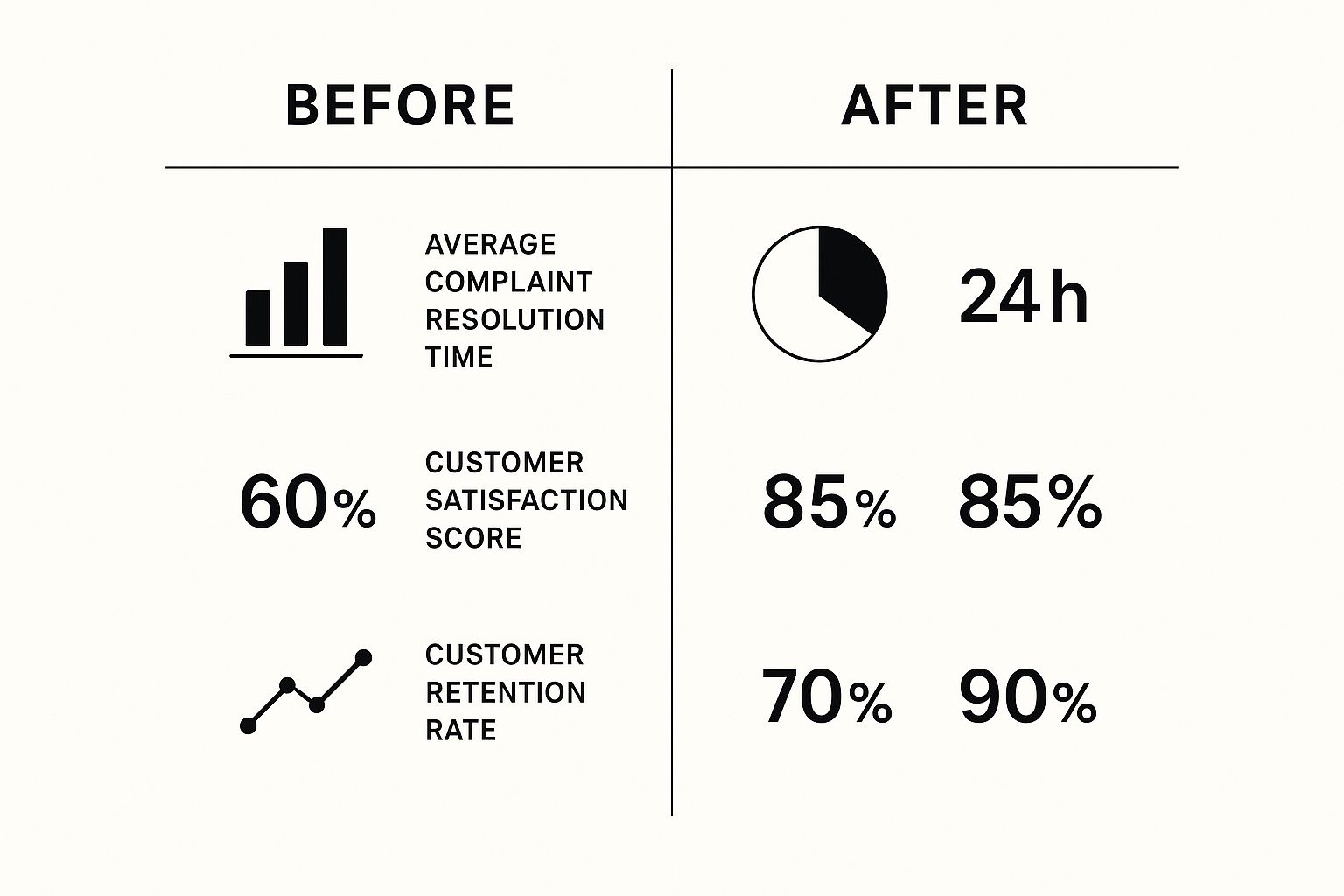
As you can see, a better approach to handling complaints can slash resolution times in half and boost customer retention by a massive 20 percentage points.
Learning from Regional Best Practices
We can also pick up valuable lessons by looking at global markets. For example, insights from Polish contact centres show just how crucial a swift, personal touch is. Their best practices emphasise an immediate acknowledgement, followed by transparent communication and a firm commitment to resolving the issue, often within 48 hours. This straightforward approach has helped reduce repeat complaint rates by up to 30% in major sectors like retail and telecoms. You can find more detail in this analysis of how to handle customer complaints from Polish businesses.
Ultimately, your first response sets the tone for everything that follows. When you use specific, validating language, you’re not just managing a complaint—you’re salvaging a customer relationship. That first step is the foundation on which a successful resolution, and lasting loyalty, is built.
Turning Empathy Into Action

Saying "I understand your frustration" is a crucial start, but it doesn't solve the problem. Let's be honest, empathy on its own won't fix a faulty product or undo a service mistake. The real test of your complaint-handling skill is making the pivot from listening to doing.
This transition is a delicate dance. Rush it, and the customer feels dismissed. Wait too long, and their frustration, which you just worked so hard to defuse, comes roaring back.
The goal is to bring them along with you. You want them to feel like a partner in finding a solution, not just another ticket in the queue. You’re not just collecting data; you're working together to make things right. That means asking the right questions—questions that turn what could feel like an interrogation into a collaborative investigation.
Getting to the Root Cause by Asking Better Questions
Once you've shown you're on their side, it’s time to gently guide the conversation towards discovery. Ditch the generic, closed-off questions like, "What's the problem?" Instead, use open-ended prompts that invite detail and prove you’re genuinely trying to understand their specific situation.
I've found these types of questions work wonders:
- To retrace their steps: "Could you walk me through exactly what you were doing just before this happened? Knowing the sequence helps me see what you're seeing."
- To grasp the real-world impact: "To make sure I fully get it, can you tell me how this has affected your day or your work?"
- To align on the goal: "Just so we're on the same page, what does a perfect outcome look like for you?"
These aren't just about extracting information. They show you care about the full story, which makes the customer feel heard and respected.
This shift from simply fixing one-off issues to understanding the bigger picture is where the magic happens. You stop putting out individual fires and start seeing the patterns that could prevent hundreds of future complaints. This is where analysing customer feedback becomes less of a chore and more of a powerful business strategy.
Managing Expectations With Crystal-Clear Timelines
Nothing dials up a customer’s anxiety faster than being left in the dark. Once you have the details, you absolutely must set clear, and more importantly, realistic expectations. Vague promises like "We'll look into it" are infuriating and do more harm than good.
Get specific. If you need to loop in another team, tell them. Give them a concrete time for your next update.
A weak, frustrating response: "Okay, I have your information. We'll get back to you soon."
A strong, trust-building response: "Thank you for walking me through that. I need to bring in our technical team to find out exactly what's going on. I will personally call you back by 3 p.m. today with an update, even if we don’t have the final answer yet. How does that sound?"
See the difference? The second one offers a concrete plan, a specific time, and a personal promise. That transparency builds trust and gives the customer back a sense of control. It turns a moment of high friction into an experience of genuine, professional care. With PwC reporting that 32% of customers would walk away from a beloved brand after just one bad experience, this kind of communication isn't a nice-to-have; it's essential.
How Modern Tools Help You Skip the Frustration
We’ve all been there—forced to repeat our story over and over to different people. It's one of the most exhausting parts of being a customer with a problem. This is where the right technology gives you a massive advantage in how you handle customer complaints.
Modern platforms like Voicetta can give your team a customer's entire history at a glance—past conversations, previous issues, everything. When an agent picks up the phone or joins a chat, they already have the context. They can skip the frustrating, repetitive questions and dive right into the current problem. This doesn't just get to a resolution faster; it sends a powerful message to the customer: we know who you are, and we value your time.
Delivering the Right Solution Effectively

You’ve done the hard work. You’ve listened, you’ve empathised, and you’ve dug deep with the customer to get to the real heart of the issue. Now comes the moment of truth: presenting the fix. This isn’t just about rattling off what you plan to do; it's an art. It’s about framing the solution in a way that feels fair, respectful, and genuinely satisfying.
Think about it. The best solution in the world, if presented poorly, can still leave a customer feeling brushed off or short-changed. Even if you can’t give them the moon and stars they asked for, your delivery can completely change their perception of the outcome. This is where you cement their trust and show them their frustration wasn't just noise.
This is your chance to turn a simple fix into a memorable act of good faith.
Choosing the Right Resolution Pathway
Not all problems are created equal, so why would the solutions be? Your response needs to be carefully calibrated to the nature and severity of the complaint. Offering a 10% discount for a catastrophic product failure is just as tone-deaf as offering a full replacement for a tiny cosmetic scratch.
Here are a few resolution paths I've seen work time and again, depending on the situation:
- A Full Refund or Replacement: This is your ace in the hole for major issues. Think significant product failures, completely wrong orders, or a service that was never delivered. It sends a clear, powerful message that you stand behind your quality promise.
- Partial Credit or a Discount: This is perfect for minor hiccups—a slight delivery delay or a situation where the core product is fine but one small part of the experience missed the mark. It acknowledges the inconvenience without going over the top.
- A Service Upgrade or Complimentary Gift: When the problem was less about a faulty product and more about a frustrating experience, this is a fantastic way to win back goodwill. It essentially says, “We’re sorry for the hassle, and we want to make sure your next experience with us is brilliant.”
The real skill is matching the scale of the solution to the scale of the problem. A thoughtful, well-proportioned resolution shows you’re being fair and that you truly understand what the customer lost or went through.
How to Confidently Deliver the Solution
The way you present the resolution is everything. Your language needs to be confident and clear, focusing on what you can do, not hiding behind what you can’t.
Let’s walk through a scenario. A customer’s delivery was delayed, causing them to miss an important deadline.
Here's the weak, policy-first approach: "According to our policy, we can't offer a refund for shipping delays, but I can give you a 15% discount code for your next order."
It’s flat, robotic, and unhelpful.
Now, here’s a strong, customer-first delivery: "I completely understand how frustrating that delay must have been, especially with your deadline. While I can’t turn back the clock on the delivery itself, I absolutely want to make this right. I’ve gone ahead and refunded your shipping costs in full, and I’ve also applied a £25 credit to your account for you to use on your next purchase. I'm truly sorry for the stress this caused."
See the difference? The second approach leads with empathy, takes ownership, and presents the solution as a proactive gesture of goodwill—not some reluctant concession dictated by policy.
A study from The Nottingham School of Economics revealed a powerful truth: 45% of customers withdrew a negative review after receiving an apology. In contrast, only 23% did so for compensation alone. An apology isn't just a polite formality; it's a critical tool for earning forgiveness and keeping your customers.
Empowering Your Team to Act Decisively
One of the biggest roadblocks I see in resolving complaints is a disempowered team. When an agent has to constantly say, "Let me ask my manager," it just adds more delay and friction. It makes the customer feel like their problem is being passed around and isn't a priority.
To really get this right, you have to give your team clear guidelines and the autonomy to act within them. Define what they can offer on the spot—whether that’s a refund up to a certain value, a specific service credit, or a straightforward product replacement.
This is where a tool like Voicetta can be a game-changer. You can build automated resolution pathways for common, low-level issues. For simple requests, the system can offer an instant, pre-approved solution. This frees up your human agents to focus their energy on the more complex and emotionally charged complaints where their expertise is truly indispensable. The result is a faster, more consistent experience for your customers and a smarter workflow for your team.
The Follow-Up That Builds Lasting Loyalty
https://www.youtube.com/embed/JhQwRUOoI9E
The moment a support ticket is marked "resolved," most companies breathe a sigh of relief and move on. They’ve just missed the single biggest opportunity to turn a disgruntled customer into a lifelong advocate.
Closing a ticket isn't the end of the story. A thoughtful, well-timed follow-up is what separates an adequate fix from a truly memorable experience. It's the final, crucial step that proves you see them as a person, not just a problem in your queue.
This isn't just about being nice, either. Every complaint is a goldmine of insights—a free consultation telling you exactly where the cracks are in your business.
The Simple Check-In That Changes Everything
Wait a few days after you’ve solved the problem, then reach out. This isn’t the time for a long, automated survey. All it takes is a short, personal message to see how things are going.
That small gesture has a massive impact. It shows you genuinely care about their outcome. Think about it: almost 70% of customers walk away from a business simply because they feel it’s indifferent to them. A quick follow-up shatters that perception.
Here’s what this might look like in the real world:
- After a technical glitch: "Hi Anna, just wanted to check in and see if the fix we rolled out is still working smoothly for you. Hope you haven't run into any more trouble!"
- Following a service hiccup: "Hi David, I was thinking about our chat last week and wanted to make sure everything has been running perfectly since. We really appreciate your patience."
It’s a simple act that completely reframes their entire experience.
Turning Complaints into Your Best Business Intelligence
One complaint might just be a one-off. But five people flagging the same issue? That’s not a coincidence; it's a pattern pointing to a deeper problem. This is where you pivot from being reactive to proactive, using customer feedback as your secret weapon.
A customer complaint highlights a problem, whether that's a problem with your product, employees, or internal processes. By hearing these problems directly from your customers, you can investigate and improve to prevent further complaints in the future.
You stop just putting out fires and start fireproofing your entire operation.
How to Systematically Learn from What Went Wrong
To make the most of this feedback, you need a system. Don't let valuable data get buried in closed tickets. You have to actively dig into it, spot the recurring themes, and fix the root cause.
Here’s a practical way to approach it:
- Tag and Categorise Everything: Was it a shipping delay? A confusing feature? A billing error? Use simple tags so you can easily spot trends later.
- Hold Regular Feedback Reviews: Once a month, get your team together to discuss the most common or severe complaints. Ask the tough questions—why does this keep happening?
- Create an Action Plan: Talk is cheap. If late deliveries are a recurring problem, it's time to have a serious chat with your logistics partner. If users are constantly getting tripped up by a new feature, it’s a sign that your onboarding or help docs need a rewrite.
This structured approach is particularly critical in markets where consumers are more cautious. In Poland, for instance, research shows that around 75% of consumers are highly sensitive to how businesses handle complaints. For e-commerce companies, clear communication and prompt resolution aren't just good service; they're essential for building trust in a market that demands it. You can find more details in these European consumer trends on commission.europa.eu.
For businesses committed to providing truly excellent service, Voicetta can handle those initial interactions with the care they deserve, setting the stage for a positive resolution and follow-up. This frees up your team to focus on the deeper, strategic work of long-term improvement—a cornerstone of providing great 24/7 customer support. At the end of the day, the companies that thrive are the ones that learn from their mistakes and build a business customers genuinely love.
Giving Your Team the Power to Handle Complaints with Confidence

When your customer service team feels confident, customers can sense it in every word. A team that's truly empowered doesn't just put out fires; they build genuine relationships. This goes way beyond standard training. It’s about cultivating a supportive internal culture where complaints are viewed as opportunities to shine, not as personal attacks.
A team that feels trusted and well-equipped can take a genuinely negative experience and turn it into a story of incredible service. The secret is shifting their mindset from reactive problem-solving to proactive relationship-building. An empowered team is your best asset for turning unhappy critics into your most loyal fans.
Go Beyond the Manual with Practical Training
Let’s be honest, standard training manuals often miss the mark. They don't prepare agents for the real, raw emotion of a difficult conversation. To build real confidence, you have to move past theory and get your team into hands-on exercises that feel like the real deal.
Role-playing is fantastic for this. But don't just throw them softballs. Create scenarios that are genuinely tough. Have your agents practise navigating a call with a furious customer, untangling a complex technical glitch, or handling a situation where there simply is no perfect solution. This kind of practice builds the muscle memory they need to stay cool and professional under pressure.
This training should zero in on a few key areas:
- De-escalation Drills: Actually practising the phrases that can soothe a heated situation instead of making it worse.
- Empathy Workshops: Going beyond the robotic "I understand" to forge a real connection with the customer's frustration.
- Problem-Solving Scenarios: Having them work through messy, multi-step issues to sharpen their critical-thinking skills on the fly.
This is the kind of immersive, practical training that gives your team the experience they need to walk into any complaint with genuine assurance.
Arm Your Team with the Right Tools and Autonomy
Skills are one thing, but confidence also comes from having the right support system. Giving your team tools that automate the boring, repetitive tasks and serve up real-time assistance is a total game-changer. When an agent isn't scrambling to find information or bogged down with manual data entry, they can give their full, undivided attention to the human on the other end of the line.
"A customer complaint highlights a problem, whether that's a problem with your product, employees, or internal processes, and by hearing these problems directly from your customers, you can investigate and improve."
This is where autonomy becomes absolutely essential. I think we can all agree that one of the most maddening things for a customer is hearing, "I'll have to get my manager's approval for that." It slams the brakes on the conversation and makes the customer feel like their problem isn't important.
Real empowerment means giving your team clear authority to make decisions. You need to define exactly what they can offer without having to escalate.
Examples of On-the-Spot Authority
| Scenario | Empowered Action |
|---|---|
| Minor Shipping Delay | Agent can immediately refund shipping costs. |
| Small Product Defect | Agent can issue a partial credit or discount code. |
| Service Outage | Agent can apply a pre-approved credit to the account. |
When your team knows they have the power to actually solve a problem right then and there, it’s a massive boost for resolution speed and their own morale. This kind of decisive action is a cornerstone of any successful call centre transformation, turning your support team from a cost centre into a loyalty-building powerhouse.
Nurture a Culture Where Complaints Are Opportunities
At the end of the day, true empowerment starts at the top. Leadership has to champion the idea that every single complaint is a gift—it's free advice telling you exactly how to improve your business. When agents feel safe to share feedback and difficult call experiences without the fear of blame, they become your most valuable source of business intelligence.
Create a culture where tough calls are discussed openly, not as failures, but as learning moments for the whole team. Celebrate the agents who masterfully turn a negative situation around. When your people see that the company truly values complaints as insights, they’ll handle them with the confidence and care they deserve.
Frequently Asked Questions
Even with a solid plan, the world of customer service is full of curveballs. You’re bound to run into tricky situations and specific questions that don't have textbook answers. I’ve put together some guidance on the most common challenges I've seen teams face when handling customer complaints.
Think of this as your go-to resource for those "what on earth do I do now?" moments. These are practical insights, drawn from experience, to help you build a more confident and resilient customer service strategy.
What's the Very First Thing I Should Do When a Customer Complains?
Before you even think about investigating the issue or finding a solution, your first move is simple: listen. Listen without jumping in, and then immediately show them you understand their frustration. You have to get on their side of the table before you can do anything else.
A simple phrase can work wonders here. Saying something like, "I can completely see why that would be so frustrating, and I'm genuinely sorry for the trouble this has caused," is incredibly powerful. This one act of validation instantly de-escalates the tension and makes the customer far more open to working with you on a real fix.
How Should I Handle a Complaint That Seems Unreasonable?
My first piece of advice is to resist labelling it as "unreasonable" right away. From the customer's perspective, their frustration is very real. So, start by treating it like any other complaint: actively listen and validate their feelings. You'd be surprised how often what sounds like a wild demand is just a major misunderstanding or the result of several small issues piling up.
After you've heard them out, calmly and clearly explain what’s possible from your side. The trick is to focus on the solution you can offer, not on everything you can't.
Here are a few practical tips:
- Keep your tone firm but empathetic. Don’t let your own emotions get the best of you.
- Frame your solution positively. Always reiterate what you can do for them.
- Explain the 'why' if you need to. Briefly explain the policy or limitation behind your decision, but make it sound human, not like you're reading from a script.
If their demands truly are impossible to meet, you just have to state the final resolution you can offer—clearly and politely—and then stand your ground. The goal is fairness and consistency, not giving in to every single demand.
Is It Possible to Turn a Complaint into a Positive Experience?
Absolutely. You can often turn a bad situation into a great one by going above and beyond during the recovery process. The secret is to make the resolution so impressive that it completely overshadows the initial problem.
This isn't just one action, but a few things working together: a speedy and genuinely empathetic response, a fast and fair solution, and a thoughtful follow-up. For instance, after you’ve fixed their problem, imagine sending a quick email a week later just to check in. That small gesture shows you care and that they weren’t just another ticket number.
A study by Harvard Business Review found something fascinating: customers who have a complaint handled in less than 5 minutes are willing to spend more on future purchases. This really drives home the value of a quick, effective response right out of the gate.
Sometimes, a small, unexpected token, like a discount on their next purchase, can seal the deal. You want the customer to walk away feeling so well looked after that they remember the fantastic service more than the original hiccup. This is fundamental if you want to raise customer satisfaction and build real loyalty.
Should I Apologise Even If the Company Isn't at Fault?
Yes, and this is a distinction that trips a lot of people up. You should always apologise for the customer's experience. An apology is not always an admission of fault.
You're apologising for their frustration, their inconvenience, and the fact that they're having a bad day. You are not necessarily saying, "Yes, our company messed this up."
A simple, sincere apology could sound like:
- "I'm truly sorry for all the frustration and hassle this situation has caused you."
- "I want to apologise for the negative experience you've had. That's never what we want for our customers."
This expression of empathy is essential for maintaining goodwill. It proves to the customer that you respect their feelings, which is the key to moving the conversation towards a productive solution.
At Voicetta, we get it—every single customer interaction is a chance to build your brand. Our AI communication platform ensures you never miss an opportunity to connect, handling inquiries with smart, natural dialogue 24/7. Let us help you turn every customer conversation into a chance for growth. Discover how Voicetta can transform your customer service.