---
title: "How to Keep a Conversation Going: A Guide to High-Stakes Business Calls"
description: "Learn how to keep a conversation going on high-stakes calls. Master our frameworks to eliminate dead air, build rapport, and turn every lead into a conversion."
publishedAt: "2026-04-30T10:00:00.000000Z"
modifiedAt: "2026-04-30T11:13:45.000000Z"
autoseoId: "1143045"
languageCode: "en"
heroImage: "/blog-images/autoseo/1143045/hero.jpg"
infographicImage: "/blog-images/autoseo/1143045/infographic.jpg"
tags: how to keep a conversation going
metaKeywords: "how to keep a conversation going, conversation skills, sales call tips, lead conversion, building rapport, communication techniques, business communication"
faqSchema: "[{\"answer\":\"Social conversations prioritize rapport, while business calls prioritize decisions and data collection. If you \\\"wing it\\\" without a structure, you miss an average of 15% of critical qualification data. Social chat relies on shared experiences, but business success depends on identifying a specific pain point or budget threshold. Every question must aim for a specific metric to ensure the call stays productive and moves toward a conversion.\",\"question\":\"What is the difference between social chat and lead qualification?\"},{\"answer\":\"Rigid scripts make you sound like a machine and destroy trust instantly. When a speaker follows a script too closely, they lose the ability to pivot based on the lead's specific needs. Timing is just as critical. On a phone call, a three-second delay feels like a technical failure or lack of interest. Efficient systems, like a specialized AI receptionist, solve this by providing immediate, context-aware responses that maintain the natural rhythm of speech without the hesitation of a human operator. The Hook Method is a tactical approach to how to keep a conversation going by identifying specific keywords in a caller’s statement to branch into the next question. It eliminates the need for a rigid script; instead, you use the caller's own words as the bridge. You're looking for two types of anchors: Noun Hooks and Emotion Hooks. Noun Hooks involve specific people, places, or technical problems. If a caller mentions \\\"the London warehouse,\\\" that's your hook. Emotion Hooks are subtler. They're tone shifts, like a frustrated pause or an urgent pace, that signal a deep pain point. Catching these allows you to dig into what actually matters to the client without guessing.\",\"question\":\"How do over-scripting and latency kill momentum?\"},{\"answer\":\"Stop asking questions that can be answered with a simple \\\"yes\\\" or \\\"no.\\\" These are conversation killers. Replace \\\"Do you have a budget?\\\" with \\\"Could you describe the process for budget approval this quarter?\\\" This forces the caller to provide detail. Use the \\\"Tell me more about [Hook]\\\" technique to deepen lead qualification. It's a low-pressure way to gather 20% more data per call without sounding like an interrogator.\",\"question\":\"How to use open-ended questions to bridge gaps\"},{\"answer\":\"A Relatable Pivot validates the caller’s problem before moving to your next qualifying question. It shows you're an expert who understands their industry. For example: \\\"I hear that a lot from 40% of other property managers; how has that affected your vacancy rate?\\\" This demonstrates conversational leadership by maintaining control of the call's direction while building trust. To refine your discovery process, explore our list of strategic qualifying questions to use during your next high-stakes call and master how to keep a conversation going effectively. Handle awkward pauses by treating them as a strategic \\\"reset button\\\" to summarize key points and validate the information you've gathered. Silence usually indicates that a caller is processing data or waiting for professional guidance. Instead of rushing to fill the gap with filler words, use a summary bridge to confirm you've captured their needs accurately. This technique is essential for anyone learning how to keep a conversation going during high-stakes negotiations where every second of silence feels amplified.\",\"question\":\"The art of the \\\"Relatable Pivot\\\"\"},{\"answer\":\"Summarizing acts as a conversational anchor. It transforms a potential dead end into a moment of trust-building. Use this specific script: \\\"So, if I understand correctly, you're looking for X because of Y; is that right?\\\" This direct approach forces a \\\"yes\\\" or a correction, both of which provide immediate momentum. Mastering these transitions helps you never miss customer calls by ensuring the dialogue remains focused on the client's specific pain points.\",\"question\":\"The Power of the Summary Bridge\"},{\"answer\":\"Moving from information gathering to a closing step requires a logical bridge rather than an abrupt pivot. If a caller seems hesitant, address the silence directly with a question: \\\"I've noticed a pause there; are there specific parts of the implementation we should revisit?\\\" Once the hesitation is cleared, link the solution directly to the next step. For example: \\\"Since we've established that speed is your priority, let's look at the calendar for a technical demo.\\\" Automating these transitions reduces the cognitive load on your team. Industry data suggests that 60% of inbound leads fail to convert simply because the \\\"next step\\\" wasn't clearly defined during a pause. Understanding how to keep a conversation going is less about talking more and more about guiding the caller through these natural breaks. Using an AI Receptionist can eliminate this friction by handling the booking logic the moment a summary is agreed upon. This ensures the conversation doesn't just stay active; it stays productive. Stop losing leads to awkward silences. See how the AI Receptionist handles every call professionally AI agents use Large Language Models (LLMs) to identify and follow up on conversational \\\"hooks\\\" with 100% consistency. While human staff might miss a lead's subtle mention of a budget deadline after a long shift, an AI processes every token of speech in real-time. This ensures the system knows exactly how to keep a conversation going by pivoting to the most relevant data point without hesitation. Even in 20-minute calls, real-time data logging keeps the context alive, preventing the agent from repeating questions or losing the thread. Voicetta’s systems use optimized call logic to prevent the \\\"blank mind\\\" syndrome common in junior sales reps. Instead of searching for words, the agent follows a pre-defined conversational arc designed for high-stakes outcomes. You can see this evolution in action by mastering A/B testing for call scripts, which allows the AI to refine its responses based on thousands of previous interactions to ensure the highest possible engagement rate.\",\"question\":\"Transitioning to the \\\"Ask\\\" or Appointment\"},{\"answer\":\"AI feels natural when response times stay below 500 milliseconds. By using high-speed APIs like Retell or Vapi, Voicetta eliminates the processing lag that typically breaks rapport. These agents also use strategic filler words, like \\\"um\\\" or \\\"let me see,\\\" to mimic human thinking time. This maintains the flow while the LLM generates a precise answer, making the interaction feel like a fluid dialogue. It's a critical component in how to keep a conversation going when the caller asks a complex, multi-part question.\",\"question\":\"How does low latency prevent awkward silences?\"},{\"answer\":\"A done-for-you call handling system removes the variability of human emotion and fatigue. Unlike traditional services where quality peaks and troughs, Voicetta ensures every inbound call follows a perfect conversational arc. The system doesn't get distracted, doesn't need coffee breaks, and handles 3:00 AM inquiries with the same energy as midday leads. This reliability is why many firms are switching to AI to ensure they never miss customer calls, regardless of volume or time of day. Mastering how to keep a conversation going requires more than just talking; it demands strategic listening and the right technical support. The \\\"Hook Method\\\" turns passive hearing into active lead qualification by identifying specific client needs mid-sentence. High-stakes calls fail when silence creates friction, but leveraging intelligent automation eliminates these gaps. Relying on human stamina alone to manage every inquiry is a bottleneck. Scalable growth requires a system that captures every detail without hesitation. Voicetta's AI agents provide 24/7 availability with zero latency. Every hook captured during a call syncs directly to your CRM, ensuring your data remains accurate and actionable. This isn't just about answering phones; it's about maintaining a perfect conversational flow even when your team is offline. By automating the initial touchpoint, you ensure that no lead ever encounters an awkward pause or a missed opportunity. Stop losing leads to awkward silences; get a done-for-you AI Receptionist today. Take control of your communication and watch your conversion rates climb with a partner that never misses a beat.\",\"question\":\"Why is an automated system more reliable than a human answering service?\"},{\"answer\":\"Pivot to the \\\"Last Three Words\\\" technique or summarize the 3 key points discussed so far. If you're unsure how to keep a conversation going, repeating the final few words of their last sentence triggers an automatic clarifying response. This forces a natural continuation without you needing to invent new topics. A 10 second recap of the current progress also invites the lead to fill in missing details or confirm alignment.\",\"question\":\"How do I keep a conversation going when I have nothing left to say?\"},{\"answer\":\"Use \\\"How\\\" or \\\"What\\\" questions that focus on their internal process or future goals. Ask \\\"How would this change your team's weekly output?\\\" or \\\"What happens if this problem isn't solved by Q4?\\\" These prompts require more than a yes or no answer. Data from 500,000 sales calls analyzed by Gong shows that top performers maintain a 43:57 talk-to-listen ratio; these open-ended questions are the primary tool to achieve that balance.\",\"question\":\"What are the best questions to ask to keep a lead talking?\"},{\"answer\":\"Apply \\\"labels\\\" to mirror the speaker's emotions or observations before asking your next question. Instead of firing questions, say \\\"It sounds like efficiency is your main priority right now.\\\" This gives the lead space to expand on their thoughts voluntarily. Mix your questions with insights; for every 2 questions asked, provide 1 piece of valuable industry context. This creates a collaborative exchange rather than a one-sided information grab.\",\"question\":\"How do I stop a conversation from feeling like an interrogation?\"},{\"answer\":\"Modern neural networks now process speech with 95% accuracy, enabling AI to maintain contextually relevant logic throughout a call. Voicetta uses specialized algorithms for the Hungarian language to ensure no nuance is lost during transcription or interaction. The technology isn't a rigid script; it adapts to the speaker's tone and intent in real-time. By 2025, Gartner predicts 80% of B2B sales interactions will occur through digital channels supported by these natural-sounding AI tools.\",\"question\":\"Can AI really handle a complex business conversation without sounding fake?\"},{\"answer\":\"Wait for at least 4 seconds before speaking to allow the lead time to process your last point. Silence often means the lead is thinking, not that the call is failing. If the pause exceeds 5 seconds, use a soft reset like \\\"I'll let you sit with that for a moment.\\\" This shows you're comfortable with the pace. Mastering how to keep a conversation going involves knowing when to stop talking to let the other person lead the next step.\",\"question\":\"What should I do if there is an awkward silence on a sales call?\"}]"
canonical: "https://voicetta.com/blog-md/how-to-keep-a-conversation-going-a-guide-to-high-stakes-business-calls"
---
# How to Keep a Conversation Going: A Guide to High-Stakes Business Calls
Published: 2026-04-30
What if the most expensive mistake on your next lead call isn't a pricing error, but the four seconds of dead air you can't fill? Most professionals recognize that sinking feeling when a promising inquiry turns into a series of one-word answers. It's exhausting to lose a potential partner simply because the momentum stalled. You know that sounding like a scripted machine is the fastest way to lose trust. We'll give you the exact linguistic hooks and frameworks needed to master **how to keep a conversation going** while converting inbound leads with precision. You'll learn how to replace robotic scripts with a repeatable system that builds genuine rapport and authority. This article previews three specific communication bridges, including the "Hook-Validate-Pivot" method, to ensure you never forget what to ask next. By the end, you'll have the tools to handle unexpected turns and turn every silence into a conversion opportunity.
## Key Takeaways
- Eliminate dead-end "yes/no" answers by mastering the "Hook Method" to maintain lead momentum during high-stakes calls.
- Learn **how to keep a conversation going** by transforming awkward silences into professional summaries that build immediate trust.
- Identify "Noun Hooks"—specific names, places, or problems—to branch naturally into targeted follow-up questions that uncover lead needs.
- Implement specific "bridging phrases" to transition between call stages without losing authority or the caller's interest.
- Leverage AI agents to catch conversational hooks 24/7, ensuring consistent lead conversion by following optimized call logic without human fatigue.
## Why do most business conversations go cold?
Conversational flow is the exchange of actionable information. Most business calls stall because the speaker fails to offer "hooks" or the listener misses them entirely. Mastering how to keep a conversation going requires you to treat every statement as a bridge to the next data point. Utilizing [active listening](https://en.wikipedia.org/wiki/Active_listening) allows you to catch these hooks, preventing the lead from disengaging during critical moments. Industry data shows that calls without at least three open-ended inquiries lose momentum within the first 90 seconds.
To better understand this concept, watch this helpful video:
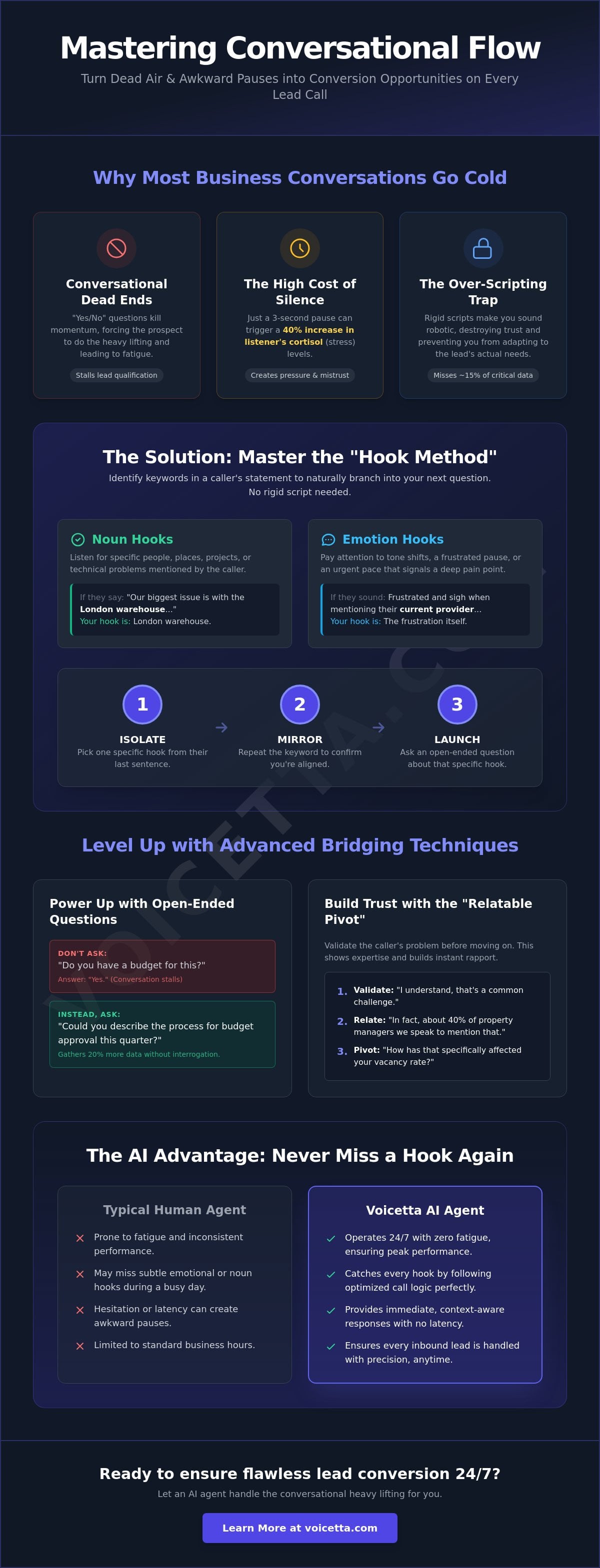
"Yes" or "no" responses are conversational dead ends that kill lead momentum. They halt the natural rhythm and force the prospect to do the heavy lifting, which leads to mental fatigue. In high-stakes environments, silence is expensive. A three-second pause on a phone call can trigger a 40% increase in the listener's cortisol levels, making them feel pressured and eager to end the call rather than supported in their decision-making process.
### What is the difference between social chat and lead qualification?
Social conversations prioritize rapport, while business calls prioritize decisions and data collection. If you "wing it" without a structure, you miss an average of 15% of critical qualification data. Social chat relies on shared experiences, but business success depends on identifying a specific pain point or budget threshold. Every question must aim for a specific metric to ensure the call stays productive and moves toward a conversion.
### How do over-scripting and latency kill momentum?
Rigid scripts make you sound like a machine and destroy trust instantly. When a speaker follows a script too closely, they lose the ability to pivot based on the lead's specific needs. Timing is just as critical. On a phone call, a three-second delay feels like a technical failure or lack of interest. Efficient systems, like a specialized AI receptionist, solve this by providing immediate, context-aware responses that maintain the natural rhythm of speech without the hesitation of a human operator.
## What is the "Hook Method" for active listening?
The Hook Method is a tactical approach to **how to keep a conversation going** by identifying specific keywords in a caller’s statement to branch into the next question. It eliminates the need for a rigid script; instead, you use the caller's own words as the bridge. You're looking for two types of anchors: Noun Hooks and Emotion Hooks.
Noun Hooks involve specific people, places, or technical problems. If a caller mentions "the London warehouse," that's your hook. Emotion Hooks are subtler. They're tone shifts, like a frustrated pause or an urgent pace, that signal a deep pain point. Catching these allows you to dig into what actually matters to the client without guessing.
**3-Step Checklist for Hooking a Caller:**- **Isolate:** Pick one specific noun or emotional cue from their last sentence.
- **Mirror:** Briefly repeat that keyword to confirm you're listening and aligned.
- **Launch:** Ask an open-ended question that starts with "How" or "What" regarding that specific hook.
### How to use open-ended questions to bridge gaps
Stop asking questions that can be answered with a simple "yes" or "no." These are conversation killers. Replace "Do you have a budget?" with "Could you describe the process for budget approval this quarter?" This forces the caller to provide detail. Use the "Tell me more about \[Hook\]" technique to deepen lead qualification. It's a low-pressure way to gather 20% more data per call without sounding like an interrogator.
### The art of the "Relatable Pivot"
A Relatable Pivot validates the caller’s problem before moving to your next qualifying question. It shows you're an expert who understands their industry. For example: "I hear that a lot from 40% of other property managers; how has that affected your vacancy rate?" This demonstrates [conversational leadership](https://hbswk.hbs.edu/item/the-power-of-conversational-leadership) by maintaining control of the call's direction while building trust. To refine your discovery process, explore our list of strategic qualifying questions to use during your next high-stakes call and master **how to keep a conversation going** effectively.
## How do you handle awkward pauses in professional calls?
Handle awkward pauses by treating them as a strategic "reset button" to summarize key points and validate the information you've gathered. Silence usually indicates that a caller is processing data or waiting for professional guidance. Instead of rushing to fill the gap with filler words, use a summary bridge to confirm you've captured their needs accurately. This technique is essential for anyone learning **how to keep a conversation going** during high-stakes negotiations where every second of silence feels amplified.
### The Power of the Summary Bridge
Summarizing acts as a conversational anchor. It transforms a potential dead end into a moment of trust-building. Use this specific script: "So, if I understand correctly, you're looking for X because of Y; is that right?" This direct approach forces a "yes" or a correction, both of which provide immediate momentum. Mastering these transitions helps you never miss customer calls by ensuring the dialogue remains focused on the client's specific pain points.
### Transitioning to the "Ask" or Appointment
Moving from information gathering to a closing step requires a logical bridge rather than an abrupt pivot. If a caller seems hesitant, address the silence directly with a question: "I've noticed a pause there; are there specific parts of the implementation we should revisit?" Once the hesitation is cleared, link the solution directly to the next step. For example: "Since we've established that speed is your priority, let's look at the calendar for a technical demo."
Automating these transitions reduces the cognitive load on your team. Industry data suggests that 60% of inbound leads fail to convert simply because the "next step" wasn't clearly defined during a pause. Understanding **how to keep a conversation going** is less about talking more and more about guiding the caller through these natural breaks. Using an AI Receptionist can eliminate this friction by handling the booking logic the moment a summary is agreed upon. This ensures the conversation doesn't just stay active; it stays productive.
Stop losing leads to awkward silences. See how the AI Receptionist handles every call professionally
## How can AI agents maintain conversational flow 24/7?
AI agents use Large Language Models (LLMs) to identify and follow up on conversational "hooks" with 100% consistency. While human staff might miss a lead's subtle mention of a budget deadline after a long shift, an AI processes every token of speech in real-time. This ensures the system knows exactly **how to keep a conversation going** by pivoting to the most relevant data point without hesitation. Even in 20-minute calls, real-time data logging keeps the context alive, preventing the agent from repeating questions or losing the thread.
Voicetta’s systems use optimized call logic to prevent the "blank mind" syndrome common in junior sales reps. Instead of searching for words, the agent follows a pre-defined conversational arc designed for high-stakes outcomes. You can see this evolution in action by mastering A/B testing for call scripts, which allows the AI to refine its responses based on thousands of previous interactions to ensure the highest possible engagement rate.
### How does low latency prevent awkward silences?
AI feels natural when response times stay below 500 milliseconds. By using high-speed APIs like Retell or Vapi, Voicetta eliminates the processing lag that typically breaks rapport. These agents also use strategic filler words, like "um" or "let me see," to mimic human thinking time. This maintains the flow while the LLM generates a precise answer, making the interaction feel like a fluid dialogue. It's a critical component in **how to keep a conversation going** when the caller asks a complex, multi-part question.
### Why is an automated system more reliable than a human answering service?
A done-for-you call handling system removes the variability of human emotion and fatigue. Unlike traditional services where quality peaks and troughs, Voicetta ensures every inbound call follows a perfect conversational arc. The system doesn't get distracted, doesn't need coffee breaks, and handles 3:00 AM inquiries with the same energy as midday leads. This reliability is why many firms are switching to AI to ensure they never miss customer calls, regardless of volume or time of day.
- **Consistency:** Every caller receives the same high level of professional service.
- **Scalability:** Handle 100 simultaneous calls without hiring a single extra person.
- **Accuracy:** Transcription and data logging happen instantly, leaving no room for human error in CRM entries.
## Transform Your Professional Communication Strategy
Mastering **how to keep a conversation going** requires more than just talking; it demands strategic listening and the right technical support. The "Hook Method" turns passive hearing into active lead qualification by identifying specific client needs mid-sentence. High-stakes calls fail when silence creates friction, but leveraging intelligent automation eliminates these gaps. Relying on human stamina alone to manage every inquiry is a bottleneck. Scalable growth requires a system that captures every detail without hesitation.
Voicetta's AI agents provide 24/7 availability with zero latency. Every hook captured during a call syncs directly to your CRM, ensuring your data remains accurate and actionable. This isn't just about answering phones; it's about maintaining a perfect conversational flow even when your team is offline. By automating the initial touchpoint, you ensure that no lead ever encounters an awkward pause or a missed opportunity.
[Stop losing leads to awkward silences; get a done-for-you AI Receptionist today.](https://voicetta.com)
Take control of your communication and watch your conversion rates climb with a partner that never misses a beat.
## Frequently Asked Questions
### How do I keep a conversation going when I have nothing left to say?
Pivot to the "Last Three Words" technique or summarize the 3 key points discussed so far. If you're unsure **how to keep a conversation going**, repeating the final few words of their last sentence triggers an automatic clarifying response. This forces a natural continuation without you needing to invent new topics. A 10 second recap of the current progress also invites the lead to fill in missing details or confirm alignment.
### What are the best questions to ask to keep a lead talking?
Use "How" or "What" questions that focus on their internal process or future goals. Ask "How would this change your team's weekly output?" or "What happens if this problem isn't solved by Q4?" These prompts require more than a yes or no answer. Data from 500,000 sales calls analyzed by Gong shows that top performers maintain a 43:57 talk-to-listen ratio; these open-ended questions are the primary tool to achieve that balance.
### How do I stop a conversation from feeling like an interrogation?
Apply "labels" to mirror the speaker's emotions or observations before asking your next question. Instead of firing questions, say "It sounds like efficiency is your main priority right now." This gives the lead space to expand on their thoughts voluntarily. Mix your questions with insights; for every 2 questions asked, provide 1 piece of valuable industry context. This creates a collaborative exchange rather than a one-sided information grab.
### Can AI really handle a complex business conversation without sounding fake?
Modern neural networks now process speech with 95% accuracy, enabling AI to maintain contextually relevant logic throughout a call. Voicetta uses specialized algorithms for the Hungarian language to ensure no nuance is lost during transcription or interaction. The technology isn't a rigid script; it adapts to the speaker's tone and intent in real-time. By 2025, Gartner predicts 80% of B2B sales interactions will occur through digital channels supported by these natural-sounding AI tools.
### What should I do if there is an awkward silence on a sales call?
Wait for at least 4 seconds before speaking to allow the lead time to process your last point. Silence often means the lead is thinking, not that the call is failing. If the pause exceeds 5 seconds, use a soft reset like "I'll let you sit with that for a moment." This shows you're comfortable with the pace. Mastering **how to keep a conversation going** involves knowing when to stop talking to let the other person lead the next step.
## Infographic