
Blog
How to Qualify Leads and Boost Conversions
Let's talk about lead qualification. At its core, it’s simply the process of figuring out which prospects are a genuinely good fit for what you sell—and which ones are...
Let's talk about lead qualification. At its core, it’s simply the process of figuring out which prospects are a genuinely good fit for what you sell—and which ones aren't. It's about sorting through the noise to find the people who have the right problems, the right budget, and the right authority to actually become a customer. Without this filtering process, your sales team is essentially flying blind, and that's a recipe for an inefficient, leaky sales funnel.
Why Your Sales Funnel Is Leaking Revenue
Does this sound familiar? You've got a pipeline that looks absolutely stuffed with potential, yet you consistently miss your revenue targets. It’s a frustratingly common story, and it’s not just a run of bad luck. It's a classic symptom of a broken, or maybe even non-existent, lead qualification process.
When you fail to properly vet who gets into your sales cycle, you're building a system that’s designed to be inefficient from the very start. The fallout from this isn’t just a few lost deals; it ripples through your entire organisation, creating significant hidden costs that are easy to overlook.
The Real Cost of Chasing Bad Leads
The most immediate impact, of course, is on your sales team. I've seen it time and again: reps spending their days chasing leads that were dead on arrival. The data backs this up, with research showing that a massive 67% of lost sales happen because reps didn't properly qualify the prospect in the first place.
Think about that. Your team is pouring valuable time and energy into conversations that are doomed from the start. This isn’t just inefficient—it’s demoralising. It leads to burnout and a feeling of constantly spinning your wheels.
And then there's the hard cash. What about the marketing budget spent to get those leads? Every pound spent attracting a prospect who could never realistically buy from you is money straight down the drain. Your Customer Acquisition Cost (CAC) goes through the roof while your conversion rates tank.
A pipeline filled with unqualified leads gives a false sense of security. It masks deep-rooted issues and makes accurate forecasting a complete guessing game, which ultimately leads to missed revenue goals and poor strategic decisions.
Getting good at lead qualification isn't about being a ruthless gatekeeper. It’s about being a strategist. It's the critical shift that turns your sales process from a high-effort, low-reward gamble into a predictable engine for growth.
By figuring out how to qualify leads properly, you give your team the ultimate advantage: focus. They can dedicate all their skills to prospects who have a real shot at becoming happy, long-term customers. That shift in focus is the single most important step you can take to finally plug the leaks in your revenue funnel.
Getting to Know Your Ideal Customer
Before you can even think about qualifying a lead, you have to know exactly who you're looking for. It's a common trap: chasing every inquiry that comes through the door. This isn’t just inefficient; it’s a fast track to a burnt-out sales team and a pipeline full of holes.
The answer is to go deeper than vague buyer personas and build a data-driven Ideal Customer Profile (ICP).
Think of your ICP as the ultimate filter for your sales process. It’s a razor-sharp description of the perfect business for your solution, built on facts, not guesswork. Instead of wondering if a new lead is a good fit, you can hold them up against your ICP. If there’s no match, you can disqualify them confidently and move on, saving countless hours for everyone involved.
Look at Who You’ve Already Won Over
Your best source of truth for building an ICP is right under your nose: your current customer base. But let's be honest, not all customers are created equal. The trick is to focus on your best clients. I’m talking about the ones who are happiest, see the most value, and are the most profitable for your business.
Pull together a list of your top 10-20 customers. Now, put on your detective hat and look for the common threads that connect them. You’re hunting for concrete, firmographic data.
- Industry or Vertical: Do you notice a pattern? Maybe most of them are in SaaS, manufacturing, or professional services.
- Company Size: Is there a sweet spot for employee count or annual revenue?
- Geography: Are your best clients clustered in specific regions, cities, or even countries?
- Technology Stack: What other tools and software are they consistently using? This can reveal a lot about their operational maturity.
This isn’t about making assumptions; it’s about letting the data tell the story of who you serve best. For a practical look at how this plays out in a specific industry, our guide on real estate lead generation shows just how powerful a niche ICP can be.
By defining what a perfect customer looks like, you empower your team to stop chasing ghosts. They can immediately focus their energy on prospects who have a genuine, demonstrable potential to convert.
Weave in Market Realities
An ICP can't be created in a bubble. It has to reflect the world outside your office walls, including the economic currents that affect your customers' ability to buy. For instance, the socio-economic environment in Poland has a direct say in how we should approach lead qualification there.
Recent data shows a 19.2% increase in newly created jobs versus a 5.5% decrease in liquidated ones. What does this tell us? It points to a healthy, stable employment market, which means a growing pool of potential clients who have the confidence and authority to make purchasing decisions. This is particularly true in strong voivodships like Łódzkie, Śląskie, and Małopolskie. Keeping an eye on these Polish economic growth trends can give you a serious edge in your targeting.
Once you’ve collected all this information—from your own customers and the wider market—it's time to put it all together. Create a clear, shareable document that becomes your company’s single source of truth for who you're selling to. Finally, you can get marketing and sales rowing in the same direction.
Putting Qualification Frameworks Into Practice

Alright, so we’ve defined our ideal customer. Now comes the real work: turning that theory into actual revenue. This is where we give our sales team a structured way to have conversations that matter. Qualification frameworks are the key here. They transform discovery calls from rambling chats into strategic fact-finding missions.
Think of these frameworks less as rigid scripts and more as conversational roadmaps. They’re designed to make sure your reps consistently uncover the crucial details needed to tell a genuine opportunity from a time-waster. The goal is learning to qualify leads in a way that feels completely natural, never like an interrogation.
The best sales reps I've ever worked with aren't just selling; they're diagnosing. A solid qualification framework is their diagnostic tool. It helps them get to the bottom of a prospect's real pain points, decision-making process, and urgency before they even think about pitching.
When you get your team behind a proven framework, you standardise your approach. This doesn't just make coaching easier; it makes your sales forecasts a whole lot more accurate. Let’s look at how to put one of the most foundational frameworks, BANT, into action.
Making BANT Feel Human
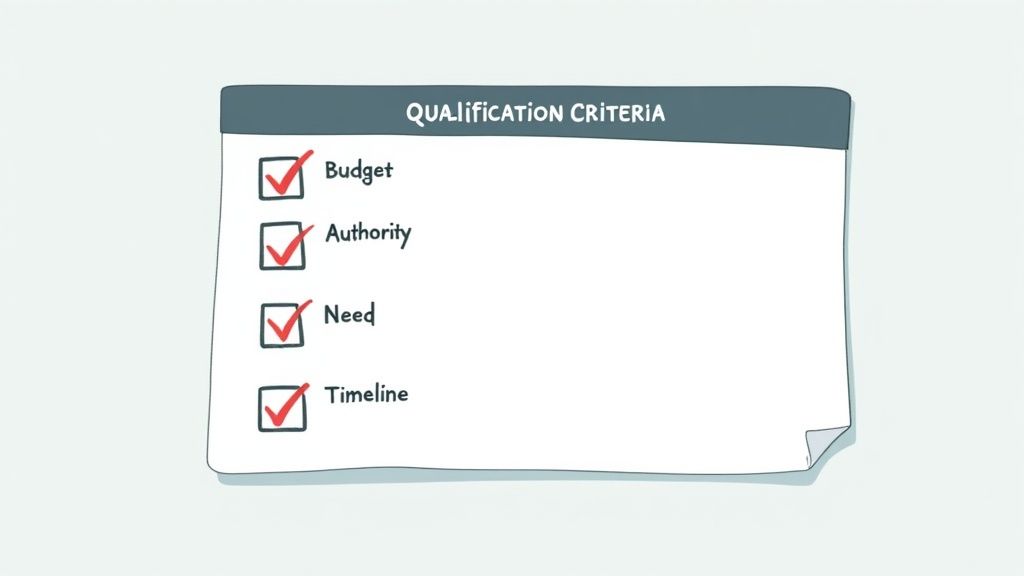
BANT, originally developed at IBM, is a classic for a good reason. It’s wonderfully simple and gets you to focus on four essential pillars: Budget, Authority, Need, and Timeline. But if your rep opens with, "So, what's your budget?", the conversation is dead on arrival. The real skill is weaving these elements into a natural dialogue.
Here's how to reframe those robotic questions into something that actually builds rapport.
-
Budget: Forget asking, "What's your budget?". Instead, try something like, "To give me some context, what are you currently spending to manage this problem?" or even, "Have you looked at solutions for this kind of challenge in the past?". This shifts the focus to value and existing costs, not just a price tag.
-
Authority: The direct "Are you the decision-maker?" is a no-go. A much smoother approach is, "Besides yourself, who else on the team usually gets involved in evaluating a new tool like this?". This simple question helps you map out the entire decision-making unit without putting anyone on the defensive.
-
Need: Go deeper than just, "What's your problem?". Ask questions that uncover the real, underlying pain. "What’s the single biggest challenge your team is wrestling with right now when it comes to [their process]?" followed by, "What would solving that mean for the business?".
-
Timeline: A blunt "When do you want to buy?" is off-putting. Try to understand the urgency by asking, "What’s driving the need to find a solution right now?". Another great one is, "If you had the perfect fix today, when would you ideally want to see it up and running?".
This conversational technique allows you to gather the same critical information without making the prospect feel like they’re being grilled. Mastering this is a cornerstone of a strong lead qualification process that actually builds trust.
While BANT is a fantastic starting point, remember it’s not the only tool in the box. More complex sales cycles often benefit from other frameworks like MEDDIC or CHAMP. The trick is to pick one that genuinely fits your business and, most importantly, train your team to use it as a guide, not a script.
Getting Practical: How to Implement a Lead Scoring System
Alright, you've used frameworks to understand a lead's potential. So what's next? You need to figure out where your sales team should spend their precious time. Let's be honest, not every qualified lead is itching to pull out their credit card right this second. Treating them all the same is a surefire way to burn out your team and waste resources.
This is where a solid lead scoring system comes into play. Think of it as your secret weapon for prioritising focus and understanding a lead's genuine readiness to talk.
It’s really just a point system you design to rank leads. You're looking at a mix of who they are (the firmographics) and what they're doing on your site (their behaviours). By assigning points for different attributes and actions, you can stop the guesswork and systematically identify who’s hot and who needs a little more warming up.
Defining What Matters: Your Scoring Criteria
Your scoring model has to be a mirror image of your Ideal Customer Profile (ICP) and the typical journey a buyer takes with you. The first step is to sit down and list the things that really indicate a good-fit lead for your business.
We can break these down into two buckets:
- Explicit Data (The "Who"): This is the information people give you willingly. You’ll want to award points for things like their job title (maybe +15 for a C-suite exec), company size (+10 for businesses in your target range), and their industry (+10 if it's a key vertical for you).
- Implicit Data (The "What"): This is all about their actions, the digital breadcrumbs they leave behind that signal their interest. Assign points for telling behaviours like visiting your pricing page (+10), downloading an in-depth case study (+5), or attending a live webinar (+20).
The goal here isn't to create a complex beast of a system, but one that truly reflects buying intent for your specific business. It’s about moving from gut feelings to data-driven focus.
This kind of organised approach makes a huge difference. For example, B2B lead generation specialists in Poland found that after structuring their qualification process with scoring and verification, they saw a staggering 45% increase in qualified leads. Even better, they noted that about 20% of those highly qualified leads moved on to the proposal stage, proving just how much more efficient the process became. You can read more about these Polish lead generation findings on Clutch.co.
Setting the Handoff Point
Once you have your point system dialled in, you need to decide on the magic number—the score that officially turns a prospect into a Marketing Qualified Lead (MQL) ready for the sales team. For instance, you might decide that any lead hitting a score of 75 or higher is hot enough for a sales conversation.
This simple threshold creates a crystal-clear, data-backed handoff point between your marketing and sales teams, which is a game-changer for alignment.
This is how that flow can look once a lead hits the score and is passed over for outreach.
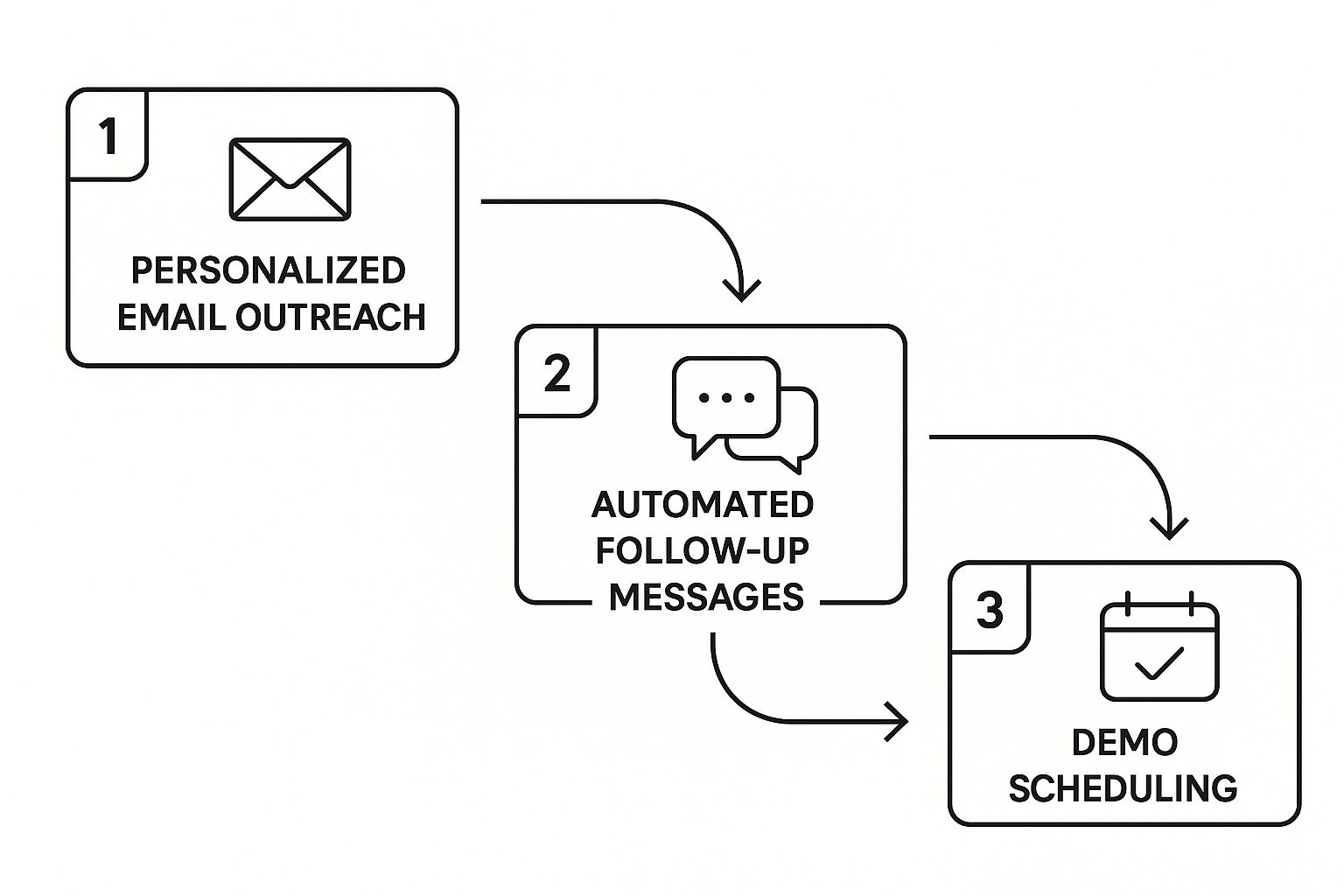
As you can see, this creates a seamless path from that initial personalised outreach to automated follow-ups and, for the best-fit leads, scheduling a demo. A well-oiled system like this is one of the most reliable ways to boost your conversion rate.
One last thing: your lead scoring model should never be a "set it and forget it" tool. I always recommend reviewing and tweaking it at least quarterly. Look at the leads that actually converted and compare them to the ones that didn't. That feedback loop is what will continuously sharpen your model, making it an even smarter asset for your business over time.
Using Automation to Qualify Leads at Scale
Trying to qualify every lead by hand is like trying to fill an Olympic-sized swimming pool with a teacup. Sure, you’ll get some water in there, but you'll burn out long before you make a splash. Manually qualifying leads is slow, riddled with human error, and just can't keep up when speed is your biggest advantage.
The best sales teams I've worked with get this. They've moved past the days of salespeople copying and pasting data from spreadsheets or manually sifting through every form submission. They've embraced technology to do the heavy lifting, freeing up their people to do what they do best: build relationships and close deals.
Automating the Flow of New Leads
One of the most common places I see sales processes break down is the gap between capturing a lead and getting it into the CRM. A hot lead from a Meta Ad campaign that gets stuck in a spreadsheet for two days is already going cold by the time a salesperson sees it. This is where workflow automation tools are an absolute game-changer.
Think about it. A potential customer fills out a lead form on one of your ads. Instead of that data sitting in limbo, an automation platform instantly grabs it and creates a new contact in your CRM. Just like that, the lead is in the system, ready for action. No opportunities are lost to delay, and you keep the momentum going.
This isn't just theory; it's transforming how businesses operate. Take the B2B sales scene in Poland, for instance. The adoption of integration tools has made a massive difference. We've seen that automating the transfer of lead data from ad platforms straight into a CRM has completely changed the game for many companies. It wipes out manual data entry errors and gives sales teams instant access to prospect details, boosting qualification accuracy. You can dive deeper into these Polish sales lead generation strategies at WowMedia&Metrics.
Enriching and Routing Leads in Real Time
But automation is so much more than just moving data from point A to point B. The real magic happens once the lead is in your system. That's when automated workflows can kick off the qualification process for you.
Here’s a quick look at how that might unfold:
-
Data Enrichment: The system can instantly get to work, pulling in extra details about the lead. By checking their email domain against third-party data services, it can find their company size, industry, or even the tech stack they use.
-
Lead Scoring: With this richer profile, the automation applies your lead scoring rules. A lead from a perfect-fit company who just browsed your pricing page? That's an instant high score.
-
Intelligent Routing: The workflow then looks at the score and other details, like location or industry, and automatically assigns the lead to the right salesperson. The rep gets a notification, and the clock starts on their follow-up.
This entire sequence can happen in a matter of seconds. It flips your lead management from a sluggish, reactive chore into a smart, proactive system that serves up the best opportunities to your team on a silver platter.
Don’t forget about AI-powered chatbots, either. Putting a smart chatbot on your website means you're qualifying visitors 24/7. It can handle those initial discovery questions, filter out anyone who isn't a good fit, and even book meetings for qualified prospects straight into a salesperson’s calendar. You’re engaging people at their peak moment of interest, even if it's 2 a.m. By automating these first touches, you're letting your team walk in and focus purely on selling.
Common Questions About Qualifying Leads
As you start to get serious about qualifying your leads, a few questions always seem to surface. It's completely normal. Building a solid process means wrapping your head around some new ideas and terms, and getting straight answers is the best way to avoid common pitfalls and create a system that actually works.
Let’s dig into some of the most frequent questions I hear from teams who are dialling in their lead qualification for the first time.
What Is the Difference Between an MQL and an SQL?
This is, without a doubt, one of the most critical distinctions to nail down. The handover from marketing to sales is where so many potential deals get fumbled.
-
An MQL (Marketing Qualified Lead) is someone your marketing team has identified as a good fit. They’ve shown interest by engaging with your content—maybe they downloaded an ebook or kept coming back to your pricing page. They look promising, but a salesperson hasn't actually talked to them yet.
-
An SQL (Sales Qualified Lead) is a lead that the sales team has personally vetted. They've had a conversation and confirmed this person has a genuine need, the authority to make a decision, and a potential budget. They’ve gone from just browsing to seriously considering a purchase.
You absolutely need a crystal-clear, shared definition for both. When marketing and sales aren't on the same page about what makes a lead "good," you're just creating friction and letting opportunities slip through the cracks.
The journey from MQL to SQL is the most critical handover in the entire sales funnel. A weak pass leads to dropped leads and frustrated teams, while a strong, well-defined pass builds unstoppable momentum.
How Often Should I Update My Qualification Criteria?
Your qualification criteria should never be static. Think of it as a living document. Markets shift, your product line grows, and your own insights into your ideal customer will get sharper with experience.
As a general guideline, you should formally review your criteria at least twice a year.
You should also trigger a review whenever something big happens—like a new product launch, entering a new market, or if you suddenly see your conversion rates take a nosedive. The best insights for refining your criteria come from analysing your recent wins and losses. What did your best new customers all have in common? Where did those promising deals go wrong? This real-world feedback is your most powerful tool.
Can a Small Business Qualify Leads Without a CRM?
Yes, absolutely. While a CRM system brings a ton of automation and slick tracking, the core principles of lead qualification work just fine on a simple spreadsheet.
It’s easy enough to set up columns for your chosen framework (like BANT) and add another for a basic lead score. The tool isn't the magic ingredient here; the discipline is. What really matters is having a consistent, centralised process that everyone on the team actually follows. In fact, getting these habits right from the start makes moving to a CRM later a much smoother experience. This consistency is also vital for measuring customer satisfaction down the line, as well-qualified leads are far more likely to become happy, successful customers.
Ready to stop missing opportunities and start having meaningful conversations 24/7? Voicetta’s AI communication platform qualifies leads, schedules appointments, and integrates with your existing systems, ensuring every interaction counts. Discover how Voicetta can transform your lead qualification process today.
Was this useful?
If this article helped, add Voicetta as a preferred source in Google Search. Your results can then highlight our writing.
Add as preferred source