
That knot in your stomach when you look at a rising expense report? It’s a feeling business owners across Poland know all too well. The real secret to reducing operational costs isn’t just about making cuts; it’s about starting with a deep, honest look at where every single złoty is actually going. This isn't about surface-level savings. It's about digging in to find those hidden cost drains and building a tougher, more efficient business from the ground up.
Your Starting Point for Reducing Operational Costs

Before you can slice away at expenses, you need a perfectly clear picture of your company’s financial health. It’s so tempting to go for the low-hanging fruit—slashing the travel budget or freezing marketing spend—but the most meaningful savings are usually buried in the details. That’s why a proper, systematic audit is your first, non-negotiable step. Think of it less like accounting and more like a diagnostic. You're trying to understand the why behind every line item.
I like to think of this audit as a doctor running tests before handing out a prescription. You’re searching for the symptoms of inefficiency—the waste, the redundancies, the underused assets—that are quietly bleeding your budget dry.
Digging Deeper than the Balance Sheet
A truly effective cost audit means getting out from behind the spreadsheet. It's about having real conversations with your department heads, your team on the floor, and even your most trusted suppliers. The people doing the work day-in and day-out often have the sharpest insights into where time and money are being wasted.
A great first move is to map out your core business processes. Whether you're looking at your production line, your customer support workflow, or how you close a sale, visualising each step helps you see the bottlenecks and needless complications. These are almost always goldmines for cost reduction.
For instance, I once worked with a manufacturing firm that realised it was constantly paying for expedited shipping. The root cause? Poor inventory planning that was completely fixable. Another time, an office-based client discovered they were paying for three different software subscriptions that all did basically the same thing. These are the kinds of hidden costs a simple expense report will never show you.
Identifying Key Cost Drivers
While every business is different, there are a few usual suspects that are almost always worth a closer look. To keep your audit organised and make sure you don't miss anything, it helps to focus on these common areas.
Before diving deep, it's useful to have a quick reference. I've put together a table that outlines the most common areas where businesses find significant savings.
Initial Cost Reduction Focus Areas
| Focus Area | Potential Impact | First Action Step |
|---|---|---|
| Administrative & Overhead | High | Review all software subscriptions and licenses for redundancy. |
| Supply Chain & Procurement | High | Analyse top 5 supplier contracts for renegotiation opportunities. |
| Operational Processes | Very High | Identify one highly repetitive, manual task for automation. |
| Energy Consumption | Medium to High | Conduct a basic energy audit of your facilities (e.g., lighting, HVAC). |
This table serves as a great starting point, giving you immediate, actionable targets to investigate.
Here’s a bit more on where to look:
- Administrative and Overhead Costs: Scrutinise every software subscription, your office supply orders, and the utility bills. Are you paying for software licences for employees who left months ago? Could a switch to more energy-efficient equipment pay for itself?
- Supply Chain and Procurement: Pull out those supplier contracts. When were they last negotiated? Are the terms still competitive? You might find you can get a better deal by consolidating vendors or simply adjusting how often you place orders to get volume discounts.
- Operational Processes: This is a big one. Hunt for those manual, repetitive tasks that eat up your team's valuable time. These are perfect candidates for automation. We have a whole guide on this, and you can explore our guide on how to streamline operations for some practical ideas.
- Energy Consumption: For many industries in Poland, this is a massive operational cost. Simple fixes like upgrading to LED lighting or optimising your heating and cooling schedules can lead to huge savings over time.
This isn't just a challenge for private companies, either. The Polish public sector is also wrestling with reducing operational costs under tight budgets. They’re exploring strategies like shifting funds to local governments and investing in grid upgrades to manage volatile energy prices—a factor that hits industrial competitiveness hard.
A common mistake is treating cost reduction like a one-off project. To see real, lasting savings, you have to build a culture where everyone feels empowered to spot waste and suggest better ways of doing things. It has to be continuous.
When all is said and done, this initial audit is the bedrock of your entire cost-reduction plan. It transforms abstract numbers into a concrete list of actions, empowering you to make smart, data-backed decisions that will make your business stronger for years to come.
Using Technology to Run a Smarter Business
Alright, you've done the hard work of auditing your costs. You now have a clear map showing exactly where every złoty is going. The next step is where the real fun begins—moving from just looking at the numbers to actively changing them with smart technology.
This isn't about jumping on every new tech trend. Far from it. It's about being deliberate. You're looking for specific tools that solve the real-world inefficiencies you just uncovered.
Think of the right tech as a superpower for your team. It’s the key to automating all those mind-numbing, repetitive tasks that eat up your day. This frees up your people to focus on what they do best: thinking strategically, building customer relationships, and driving the business forward. That's the foundation of a truly resilient operation.
Weaving Automation into Your Workflow
When people think about technology and cost-cutting, automation is usually the first thing that springs to mind. And for good reason—when done right, the return can be incredible. The secret is to start small and aim for your biggest headaches first.
I always tell my clients to pinpoint one or two tasks in their business that are incredibly repetitive and time-consuming. It could be anything. Maybe it’s manually keying in invoice details or fielding the same three customer questions a dozen times a day.
Look at these common pain points where automation can make a difference almost overnight:
- Customer Service: How many calls is your team answering that are just simple requests? Think: "What are your hours?" or "Can I book an appointment?" Automating these lets your team tackle the genuinely tricky customer problems.
- Data Entry: Manually copying info from an email to your CRM is slow and a recipe for mistakes. Automation can do it perfectly in a fraction of a second.
- Qualifying Leads: Not every person who gets in touch is a serious buyer. An automated system can ask those first few questions to filter the hot leads, so your sales team's time is spent on opportunities that are actually going somewhere.
The idea is simple: let the robots do the robotic work. This frees up your human experts to apply their skills where it really counts. It’s a small shift in mindset that can fundamentally improve operational efficiency.
A Real-World Look at AI Communication
Let's make this tangible. Picture a busy real estate agency or a hotel front desk here in Warsaw. The phone is ringing constantly. Many callers are asking the same things: "Do you have any two-bedroom flats available?", "What's your best rate for next weekend?". This is the perfect job for a tool like Voicetta.
Instead of your team being chained to the phone, an AI communication platform can handle these initial chats 24/7. It can answer common questions, qualify potential clients, and even book appointments straight into your calendar.
This isn't about replacing your people; it's about making them better. The AI handles the high-volume, simple conversations, which frees up your staff to give fantastic, personalised service to your most important clients or sort out complex bookings. It's a direct route to better efficiency and happier employees.
For many Polish businesses, this approach has been a revelation. They suddenly have fewer missed calls—which means fewer missed opportunities—and a huge drop in administrative busywork. It lets them point their most valuable asset, their team, at activities that actually grow the business.
Tackling Industry-Specific Challenges
The power of technology to cut costs runs deep, especially in Poland’s core industries. Take the energy sector, for instance. It has a significant productivity gap compared to other EU countries, with high energy prices being a major drain on manufacturing budgets.
A recent McKinsey report on Poland's growth potential points out that standardising processes and investing in technology are essential to closing this gap. It even highlights how Poland's expertise in mining tech could be leveraged to create a global hub for intelligent mining—turning local know-how into a powerful, efficiency-driving export.
This same logic applies everywhere. Whether you're using sensors on a factory floor to predict when a machine needs maintenance or using advanced software to map out the most efficient delivery routes, technology paves the way for a leaner, more competitive business. The investment pays for itself not just in savings, but in building an organisation that's ready for whatever comes next.
Fine-Tuning Your Supply Chain and Vendor Partnerships

It’s easy to get tunnel vision and focus only on the costs you control inside your own four walls. But look outwards, and you’ll find a massive, often overlooked, opportunity for savings: your supply chain. For many businesses, procurement is just a transactional cycle of placing orders. That’s a mistake.
The real key to reducing operational costs here isn’t about squeezing every last złoty out of your suppliers. It’s about building genuine partnerships that help both sides win. When your vendors see you as a true partner, the dynamic changes completely. You start getting better pricing, priority service when things get tough, and even proactive ideas for more cost-effective materials.
Shifting your mindset from purely transactional to relational is the first, most crucial step.
Forge Stronger Vendor Relationships
The bedrock of a lean, cost-effective supply chain? Communication and trust. A great place to start is by dusting off your most important supplier contracts. If a contract hasn't been properly reviewed in two or three years, I can almost guarantee it’s out of step with today’s market.
This isn’t about marching in with a list of demands. It's about opening up a conversation. Ask about their business, the hurdles they're facing, and be transparent about your own goals. This kind of collaborative chat can uncover mutual benefits you never would have found otherwise.
Here are a few conversation starters I’ve seen work wonders:
- Volume and Frequency: Ask them directly, "If we consolidated our orders or adjusted our buying frequency, could that open up better per-unit pricing for us?"
- Payment Terms: Explore flexibility. Could slightly different payment schedules improve your cash flow or give them more predictability? Sometimes a small tweak here is a big win for both of you.
- Material Specs: Your suppliers are the experts. Ask them if alternative materials or slightly different specifications could deliver the same performance for less. They often have incredible insights.
This isn't about cutting corners. It's about smart collaboration that protects everyone’s bottom line.
Consolidate and Get Smart About Inventory
Juggling too many suppliers is a recipe for chaos. It creates needless administrative work—more invoices to process, more relationships to manage, and more potential points of failure. Your buying power gets diluted across the board.
Take a hard look at your spending data. You’ll probably discover that the lion's share of your procurement spend goes to a small group of key suppliers. These are the relationships to nurture. By consolidating your purchasing with fewer, trusted vendors, you instantly become a more valuable customer, giving you a much stronger negotiating position.
A classic trap I see all the time is ‘maverick spending’—where different departments buy the same items from different suppliers, often outside of agreed-upon contracts. Centralising your procurement process, or at least the data analysis, shines a light on these expensive habits and helps you stamp them out.
This naturally leads to smarter inventory management. Excess stock is dead money sitting on a shelf. It ties up capital, racks up storage costs, and risks becoming obsolete. With a more organised procurement process and stronger vendor partnerships, you can forecast demand far more accurately. A great partner can support you with flexible deliveries, meaning you don't have to overstock "just in case."
Suddenly, your supply chain transforms from a simple cost centre into a powerful strategic asset.
Empowering Your Team to Drive Savings

It’s easy to get lost in spreadsheets and supply chain logistics when you’re hunting for cost savings. But some of the most powerful insights won’t come from the boardroom. They come from the people on the front lines—your own team. They see the day-to-day friction, the wasted resources, and the inefficient processes that never make it onto a financial report.
Tapping into this knowledge isn't about demanding cuts or enforcing rigid rules. It's about a fundamental shift in culture. You need to create an environment where every single employee feels like an owner, motivated to spot an inefficiency and confident enough to suggest a better way.
When you stop dictating from the top and start cultivating a movement from the ground up, the results are incredible. Your entire workforce becomes a proactive force for operational excellence, and the savings you uncover are often far more creative and sustainable than anything you could devise alone.
Creating Channels for Cost-Saving Ideas
Here’s the thing: your employees probably already have a list of ideas. The real problem is they often have no obvious or simple way to share them. A vague "open door policy" just doesn't cut it. You need to build clear, accessible channels specifically for this feedback.
Forget the dusty suggestion box in the corner. We have much better tools now. It could be as simple as a dedicated Slack channel, an easy-to-use online form, or even regular "innovation huddles" where teams can brainstorm improvements for their own departments.
I once worked with a manufacturing company that started a simple "waste walk" programme. Once a month, a small, cross-departmental team would walk the factory floor with one mission: find waste. They looked for squandered materials and clunky process steps. The ideas they brought back cut their material scrap rate by 15% in just six months.
The secret is to make the process easy and visible. When people see their ideas are actually being heard—and more importantly, acted on—it creates a powerful cycle of positive engagement.
Building a Culture of Ownership and Rewards
For your team to genuinely care about saving the company money, they need to feel like they have some skin in the game. This is where a smart incentive and recognition programme comes in. And remember, it doesn’t always have to be about a big cash bonus. Public recognition can be an incredibly powerful motivator.
Think about a tiered approach to rewards:
- Small Recognitions: A quick shout-out in a company-wide email or a small gift card can go a long way for a helpful idea.
- Impactful Contributions: When an idea leads to real, measurable savings, a more significant reward—like a percentage of the first year's savings—can be a huge driver.
- Team-Based Goals: Set cost-saving targets for entire departments and reward the whole team when they hit their numbers. This encourages collaboration instead of just individual competition.
The fastest way to kill morale and guarantee you never get another good idea is to ask for suggestions and then let them gather dust. Acknowledge every single idea—even the ones you don't implement—and briefly explain the "why" behind your decision.
This approach completely changes the dynamic. Instead of seeing cost-cutting as a threat, employees start to see it as a way to build a more successful company and earn personal recognition. You can bolster this effort by giving them tools that make their work smoother; for example, learning more about how https://www.voicetta.com/automated-quality-management can free up staff to focus on these bigger-picture improvements.
This model of empowering staff is even mirrored in national economic strategies. Recent OECD analysis for Poland, for instance, highlights that boosting public sector efficiency involves better staff incentives and investing in skill development. This focus on human capital is a key driver for productivity growth, which is a direct line to reducing operational costs. By investing in your people, you're not just finding savings—you're building a smarter, more resilient organisation from the inside out.
Keeping the Wins Coming: Measuring Success and Building Momentum
Getting new processes in place is a massive achievement, but the real test is making sure those improvements stick around. Once you've ironed out the kinks and given your team the right tools, your focus needs to shift to measurement and refinement. This is how you turn a one-off project into a core part of your company's DNA—a true culture of efficiency. It's about creating a living, breathing cycle of improvement that keeps you sharp and competitive for the long run.
After all, you can't manage what you don't measure. The first thing to do is set up some clear Key Performance Indicators (KPIs) that show the real-world impact of your efforts. These aren't just numbers to make you feel good; they're the vital signs of your operational health.
What Gets Measured, Gets Managed
Your KPIs need to be laser-focused on the specific changes you’ve implemented. If you brought in automation for a customer service process, your metrics should reflect that directly. Don't get distracted by broad numbers like overall revenue, which can be swayed by a dozen other things. You have to be specific and, frankly, a bit ruthless in what you choose to track.
Let's say your goal was to cut down on waste on a production line. In that case, you'd want to keep a close eye on:
- Material Waste Percentage: This is the most direct measure of your success. You should be looking for a consistent, month-on-month drop.
- Cost Per Unit: As you reduce waste, the cost to produce each item should naturally fall. This is a powerful number to bring to the finance team.
- Employee-Suggested Improvements: Are your people bringing new ideas to the table? Tracking this shows you how engaged they are and how healthy your cost-saving culture really is.
On the other hand, if you were tackling administrative efficiency, your dashboard might look completely different:
- Invoice Processing Time: How many days does it take to get an invoice from received to paid? Good automation should crush this number.
- Software Licence Utilisation: What percentage of your paid software seats are actually being used? This is a quick way to find and cut dead weight in your subscriptions.
- Initial Query Response Time: If you put a tool like Voicetta in place, how fast are customer questions getting their first response? This has a direct line to customer happiness.
This chart really drives home the connection between investing in your team's skills, boosting efficiency, and bringing down costs. It shows how training isn't just an expense—it's an investment with a clear payback.
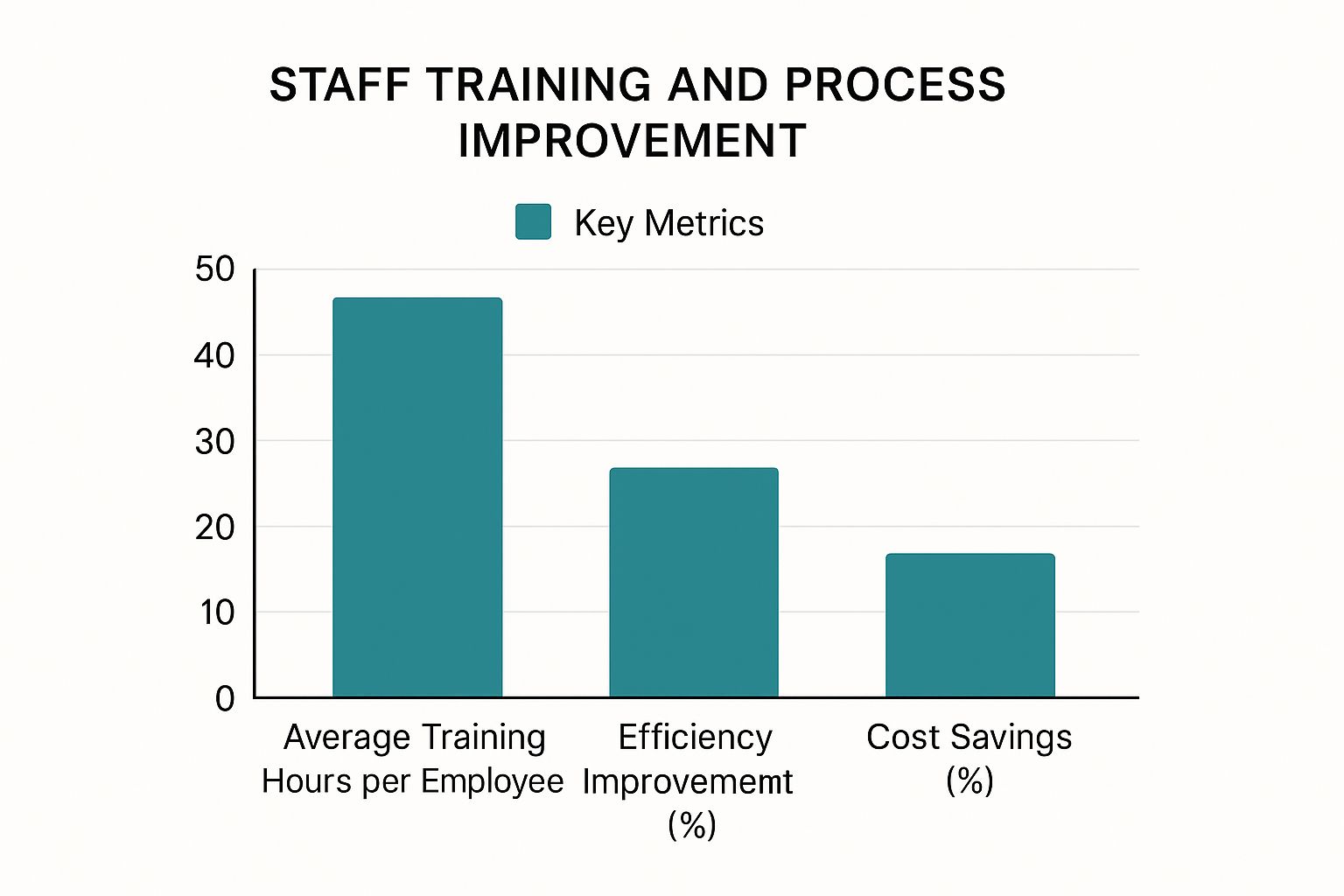
The data makes it pretty clear: even a small investment in training can yield some seriously impressive gains in both how smoothly things run and the direct savings you see on the balance sheet.
Calculating Your Return on Investment
For any new tech you bring in or any big change you make, you've got to be able to prove it was worth it. Figuring out the Return on Investment (ROI) isn't just about getting the budget signed off. It's about proving your decisions were sound and building up the political capital for your next big idea. A clear, positive ROI is your best friend when it comes to getting the whole company on board.
Don’t get lost in the weeds with your calculations. Often, the simplest ROI formula is the most compelling. Stick to the hard, tangible savings you can easily point to.
Start with the most obvious win: labour costs. If you automated a task that used to take an employee 10 hours a week, you’ve just saved 520 hours a year. Multiply that by their hourly rate, and you've got a solid annual saving. Then, just subtract the yearly cost of the software or tech.
To make this crystal clear, here’s a hypothetical look at how different tools might stack up.
Automation Tool ROI Comparison
| Automation Tool | Initial Investment | Annual Labour Cost Saved | Net First-Year ROI |
|---|---|---|---|
| CRM Data Entry Bot | 10,000 zł | 40,000 zł | 300% |
| AI Phone Assistant | 25,000 zł | 90,000 zł | 260% |
| Inventory Management System | 50,000 zł | 75,000 zł | 50% |
When you lay it out like this, the value is impossible to argue with. It completely changes the conversation from "how much does this cost?" to "how much will this make us?". For an even deeper look, you can use powerful tools for customer interaction analytics to put a number on improvements in areas like customer satisfaction and agent productivity, which are huge parts of your total ROI.
Making Improvement a Habit, Not a Project
The quest to lower your operational costs isn't a one-and-done deal. It's a continuous journey. Your business will evolve, new technologies will pop up, and the market will do what it does. Your cost-saving strategies need to be nimble enough to keep up.
Set up a regular rhythm for reviews—maybe monthly for your fast-moving metrics and quarterly for the bigger strategic picture. In these meetings, don't just stare at the numbers. Ask why. Why did one KPI shoot up? Why did another one stall out? The answers to those questions are where you'll find your next big opportunity.
And finally, share the news! Let the entire team know about the wins and be specific about how their work made it happen. Being transparent builds trust and hammers home the message that everyone is a partner in the company's success. This creates a powerful feedback loop: measurement sparks insights, insights drive new actions, and new actions lead to savings that last.
Got Questions About Cutting Operational Costs? You're Not Alone.
When you first get serious about trimming the fat in your business, a million questions probably start swirling around. It’s a bit of a minefield, right? Knowing where to start or what to focus on can feel like a huge task. To give you some clarity, I've pulled together some of the most common things business owners ask me, along with some straight-talking, practical answers.
Think of this as your go-to guide for building a leaner, more resilient business.
Where on Earth Do I Start Cutting Costs?
This is the big one. For a small business, every złoty matters. The last thing you want to do is make cuts that hurt your product or tick off your customers. The trick is to go after the non-core expenses first—the stuff that isn’t directly tied to what you actually sell. People call them "quick wins" for a good reason; they give you immediate savings without messing with your main operations.
Start by putting these areas under the microscope:
- Those Pesky Software Subscriptions: Honestly, go through every single software and service you pay for. I guarantee you'll find licences for ex-employees, tools you used for one project and then forgot about, or different platforms that do the exact same thing. Killing these is just pure savings.
- Office Bits and Bobs: Take a proper look at your utility bills. Simple moves, like swapping to energy-efficient LED lights or getting smart thermostats, can make a real dent over time. Same with office supplies—get one person to handle all the ordering so you can buy in bulk and stop those little, expensive top-up shops.
- Bank Fees and Insurance: When did you last actually review your business bank account or insurance policies? A quick chat with your provider to see if you can get a better deal, or even just shopping around, can often shave a surprising amount off your monthly bills.
These first steps work because you’re trimming the fat, not the muscle. It helps you build a bit of momentum and frees up cash before you dive into the bigger, more complicated stuff.
How Do I Get My Team to Actually Care About Saving Money?
Look, you can't just send out a memo telling everyone to spend less. That’s a one-way ticket to a grumpy team and a culture of fear. The only way to get your people genuinely on board with cutting costs is to make them partners in the mission.
The goal is to shift their thinking from "that's a management problem" to "how can we work smarter?" When your team feels like they own a piece of the solution, they'll become your best source of brilliant, cost-saving ideas.
Put together a clear incentive programme, and don't assume it has to be all about big cash bonuses. A bit of recognition goes a long, long way. When someone’s idea gets used, shout about it in a team meeting or a company-wide email. For the ideas that lead to big, measurable savings, offering a small slice of the first year's savings creates a really powerful link between their effort and a real reward.
Crucially, make it dead simple for them to share their ideas—no dusty old suggestion boxes. And please, acknowledge every single idea, even the ones you don't use. A quick, honest note explaining why it wasn't a fit shows you respect their time and encourages them to keep thinking.
Is Forking Out for Automation Actually Worth It?
This question stops a lot of businesses in their tracks, but it’s probably the most important one to tackle. I get it—the thought of a big upfront spend is scary. But the right automation isn't an expense; it’s an investment that pays for itself over and over again. The key is to run the numbers first and build a solid case.
Don't just guess. Start by figuring out the real cost of a manual, repetitive task. Track how many hours your team spends on it each week. For instance, if two of your staff spend a combined 15 hours a week manually plugging data into a spreadsheet, chasing up leads, or answering the same five customer questions, that's 780 hours a year.
Now, multiply those hours by what you actually pay them (including taxes, benefits, etc.). All of a sudden, that "simple task" could be costing you tens of thousands of złoty every year, and that’s before you even factor in the cost of human error or missed opportunities.
Compare that figure to the annual price of an automation tool built for that exact job. You’ll often find the ROI is shockingly fast, with the tech paying for itself in just a few months. My advice is always to start small. Pick one major headache, bring in a tool to fix it, and measure everything. The success of that one small project will give you all the proof you need to go bigger.
Ready to see how automation can slash your operational costs while making customers happier? Voicetta handles routine calls and chats 24/7, freeing your team for work that truly matters. Find out how Voicetta works and see the difference for yourself.