
Blog
Interactive Voice Recognition IVR That Actually Works
Chances are, you've navigated a phone menu at some point. But a truly effective interactive voice recognition IVR system goes far beyond simple "press one for sales" p...
Understanding What Makes Interactive Voice Recognition IVR Systems Truly Effective
Chances are, you've navigated a phone menu at some point. But a truly effective interactive voice recognition IVR system goes far beyond simple "press one for sales" prompts. Today's IVR has changed quite a bit, moving from stiff, fixed menus to become a more responsive and smart way for businesses to talk with customers. Understanding this shift helps us see what these systems can do now and what makes one genuinely helpful versus just another source of frustration.
So, what does this change mean? Well, the best interactive voice recognition IVR solutions aren't just about sending your call to the right department anymore. They are now tools built to really get what customers need and react accurately, acting more like a capable assistant than a robotic operator. The aim is to make these interactions feel less like a tedious task and more like a natural conversation, which in turn makes customers happier.
The Bedrock: Speech Recognition and Understanding
Think about what makes a good IVR system tick. At its core, any worthwhile interactive voice recognition IVR needs to accurately understand what you're saying. High speech recognition accuracy is absolutely crucial; if the system keeps getting your requests wrong, you're bound to get annoyed. This works closely with Natural Language Understanding (NLU), which helps the IVR figure out the intent behind your words, not just the words themselves.
Let's say you tell the system, "I need to know when my package will get here," instead of a more formal "Track my order." An IVR with strong NLU can handle this everyday language and send your query to the right place. This is what changes the IVR from a basic command-follower to a more intuitive communication partner, making the whole process smoother and quicker for everyone.
Beyond Voice: Integration Capabilities
But just understanding your words isn't the whole story for an effective interactive voice recognition IVR. Real effectiveness also depends on seamless integration capabilities. This means an interactive voice recognition IVR system needs to connect smoothly with other important tools a business uses, like Customer Relationship Management (CRM) systems, helpdesk software, and their own databases.
When these systems are connected, the IVR can pull up your customer history or account details. This allows for things like personalized greetings or smarter call routing. For example, an IVR might recognize a priority customer from their phone number and put them at the front of the queue, or quickly find recent order information to help with a question – these are all signs of a system that’s really working well. It's no surprise that businesses are keen on these smarter systems. The Interactive Voice Response (IVR) market has seen significant growth, mostly because companies are automating customer service and because of developments in AI and natural language processing. In 2024, the global IVR market was valued at around USD 5.96 billion and is expected to climb to USD 6.44 billion by 2025. These numbers show just how much businesses are counting on modern IVR features. You can find more details about this growth in a report from The Business Research Company.
Designing for the User: The Key to Adoption
At the end of the day, what truly shows if an interactive voice recognition IVR system works well is how customers feel after using it. You can have all the fancy tech in the world, but if it’s confusing or makes people want to hang up, it’s not doing its job. That's why putting the customer first in the design is so important for it to be accepted and liked.
So, what goes into a design that people actually like using? Several things need to be considered to make sure the IVR is genuinely helpful:
- Intuitive Call Flows: The path through the menu should make sense and be simple, getting you to an answer or the right person with minimal fuss.
- Clear Prompts: The system should speak plainly, using instructions and options that are easy to grasp, without any confusing technical terms.
- Escape Hatches: It’s vital to offer a straightforward and clearly announced option to talk to a human agent, especially for tricky or personal matters.
- Personalization: Making the call feel personal by using information the system already has, like greeting you by name or mentioning past queries, can really boost how happy you are with the service.
Getting these main parts right—sharp voice recognition, smart language understanding, solid connections to other systems, and a design that thinks about the user—is key for any business thinking about setting up or improving their interactive voice recognition IVR. When all these pieces fit together well, the IVR isn't a roadblock; it's a genuine help that improves customer satisfaction instead of taking away from it. If you're curious to learn more about this, we have an article that goes into more detail: What is IVR and how it can benefit your business.
Why Smart Businesses Are Investing Heavily In IVR Technology Now

The noticeable move many companies are making towards interactive voice recognition ivr systems isn't just a random occurrence. It's a result of real business pressures and advancements in technology coming together, pushing businesses to seriously consider updating how they handle voice communications. Companies that look ahead understand that holding back isn't really an option anymore if they want to stay in the game and keep their customers happy.
This increasing dedication to interactive voice recognition ivr shows a better grasp of how it can tackle significant business hurdles. Whether it's about handling customer chats more smoothly or offering support at all hours, the motivations for this investment are both forward-looking and down-to-earth, affecting many parts of how a business runs.
Meeting Skyrocketing Customer Demands
People today want service that's fast, easy to reach, and effective. Their tolerance for long waits or support that’s only available at certain times is pretty low. This is a major reason why businesses are adopting interactive voice recognition ivr. These systems can give instant answers to frequent questions, provide self-help options 24/7, and make sure callers get to the right place quickly, which really improves the customer's experience.
For instance, an interactive voice recognition ivr can immediately tell you business hours, help track an order, or let a customer make a payment without needing to talk to a person. This not only meets the customer’s desire for quick service but also frees up human staff to deal with more complicated or delicate matters. This kind of quick response isn't just a perk anymore; it's something customers expect.
The Practicalities of Scaling Operations
As companies expand, the number of customer interactions, especially phone calls, also goes up. Traditionally, growing customer service meant hiring more people, which comes with significant expenses and organizational challenges. Modern interactive voice recognition ivr presents a more manageable way to handle this increase. By automating common tasks and routing calls effectively, IVR systems allow businesses to manage more interactions without needing to proportionally increase their staff.
This effectiveness has a direct positive effect on the company's finances. Market reports show the IVR market was valued at around USD 6 billion in 2024, and it's projected to go beyond USD 8.99 billion by 2032, which is a compound annual growth rate (CAGR) of about 6.2%. This steady expansion is closely linked to the trend of automating business operations and using AI-driven voice recognition. Explore this topic further. This indicates that businesses are achieving real benefits from their interactive voice recognition ivr investments through better agent performance and smarter use of resources.
Strategic Adoption Across Key Industries
The shift to advanced interactive voice recognition ivr isn't just happening in one area; it's a widespread movement affecting many industries, each with its own reasons.
- In healthcare, IVR systems help with scheduling appointments, sending reminders for medication refills, and giving out general health information, which makes services more accessible to patients and cuts down on administrative work.
- The finance sector uses IVR for secure tasks like checking account balances, transferring funds, and issuing fraud alerts, giving customers quick and easy access to their financial details.
- Retail companies employ interactive voice recognition ivr for tracking orders, answering product questions, and managing returns, which makes the shopping journey better and simplifies support after a purchase.
These instances show how businesses are thoughtfully using interactive voice recognition ivr to meet particular operational requirements and achieve customer service objectives. The investment is guided by a clear understanding of how this technology can offer a competitive advantage and enhance overall business results. Consequently, choosing to install or upgrade an interactive voice recognition ivr is increasingly seen as an essential move for preparing customer service operations for the future.
Real Business Impact Beyond Cost Savings

While saving on operational costs is often a talked-about perk of interactive voice recognition ivr systems, the setups that truly make a difference offer benefits well past just the financial. Companies looking ahead are finding that a well-crafted interactive voice recognition ivr can be a key part of how they connect with customers, building loyalty and sparking growth in ways that simply cutting costs can't achieve. This wider effect is where these systems really show what they can do.
Elevating the Customer Journey
A major way interactive voice recognition ivr adds value is by noticeably enhancing the customer journey. Instead of leaving callers feeling stuck, modern IVR systems provide quick, around-the-clock help for usual questions and tasks. This means customers can find answers or sort out problems on their own schedule, without needing to wait for an agent.
For instance, businesses are observing real improvements in customer happiness. When an interactive voice recognition ivr can swiftly guide calls to the right team or let customers handle things like checking an order or making a payment themselves, it plays a big part in achieving better First Contact Resolution (FCR) rates. Missouri Star Quilt Company, a fabric and quilting retailer, saw their call answer rate climb to 95 percent and reached a customer satisfaction score of 97 percent after putting effective IVR methods in place. This really highlights how a good system can result in more content customers.
Empowering Agents and Boosting Productivity
Beyond the advantages for customers, interactive voice recognition ivr technology also gives a real boost to call center agents. By taking care of common questions and sorting calls, these systems free up agents to focus on more intricate or delicate issues that truly need a human touch. This not only makes the whole contact center run smoother but also helps agents feel more satisfied with their jobs by letting them concentrate on more interesting work.
This smart way of managing calls means agents are more ready for conversations, often with customer details at their fingertips when the call comes through. As a result, agent productivity isn't just about taking more calls; it's about managing them more skillfully and with greater positive results. This smoother process helps businesses handle more interactions without needing to grow their staff numbers proportionally, making the best use of their resources.
Unlocking New Avenues for Growth and Insight
The good results from a better customer experience and more efficient agents understandably lead to wider business expansion. Happy customers are more likely to stick around and suggest your services to others, directly affecting income. But the advantages of an interactive voice recognition ivr also reach into areas like data gathering and security.
Every time a customer interacts with an interactive voice recognition ivr, useful information is created, giving clues about:
- Common customer queries: This helps spot where services can be better or where new self-help options could be added.
- Call patterns and peak times: This allows for smarter planning of resources.
- Effectiveness of IVR pathways: Showing where call paths can be improved for a smoother experience.
Furthermore, up-to-date IVR systems can include features such as voice biometrics for confirming identity, which adds a security measure that is both strong and easy for people to use. This attention to data and security, along with improved customer dealings, makes the interactive voice recognition ivr a valuable tool for steady business growth.
Getting IVR Implementation Right From Day One
When it comes to launching an interactive voice recognition (IVR) system, success isn't just about picking the newest technology. It's really about getting to know your customers and building a system that truly serves what they need. Taking a careful, step-by-step approach to setting things up is crucial for a smooth start, ensuring users embrace it and feel good about the experience right from day one.
The path to an effective interactive voice recognition IVR system is a journey marked by several important stages. To help visualize this, take a look at the infographic below, which breaks down the key steps:
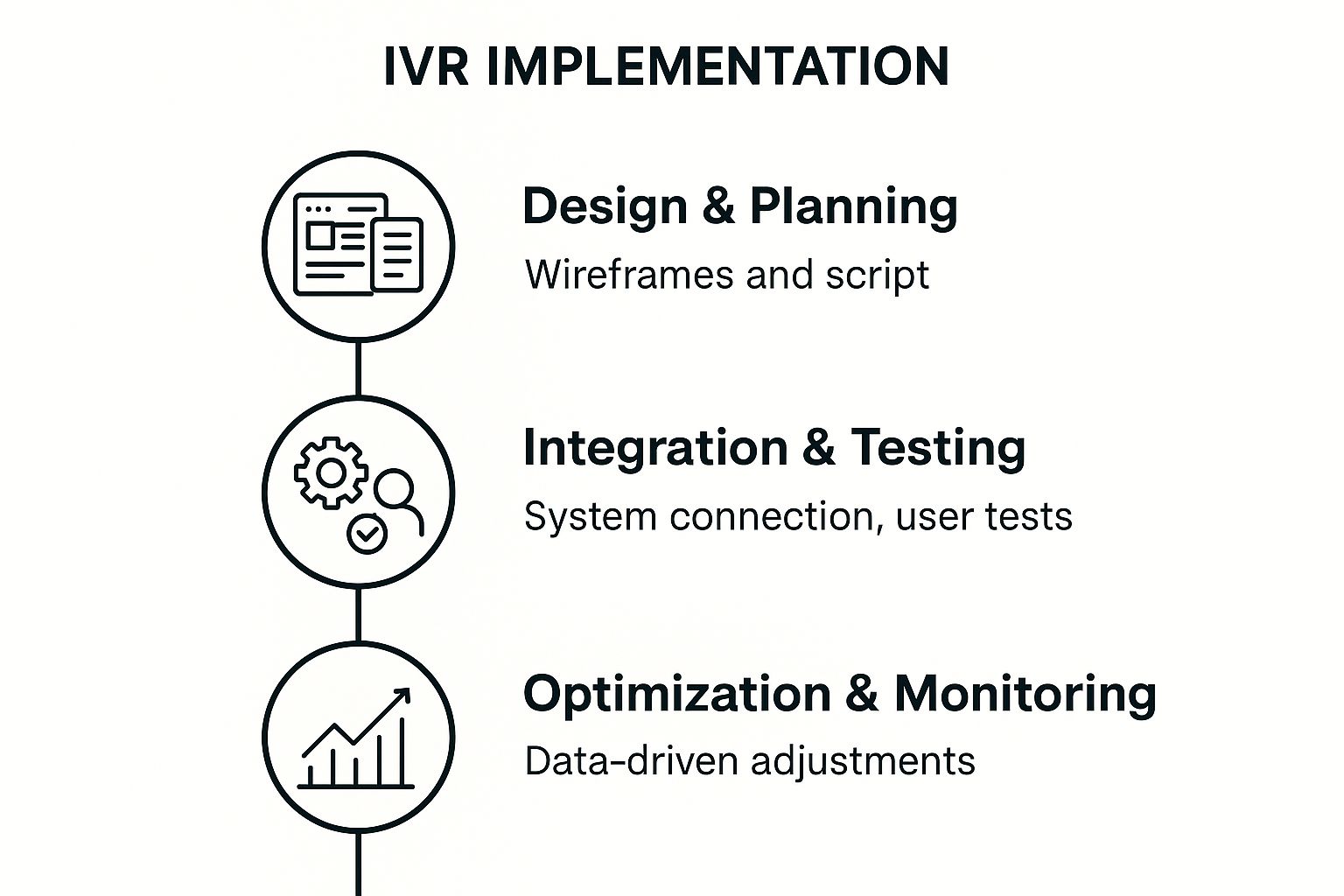
This visual guide highlights that creating a top-notch interactive voice recognition IVR isn't a one-and-done deal. It’s a continuous cycle, beginning with detailed planning and carrying on through ongoing improvements after the system is up and running. Every phase is essential for making sure the IVR system not only meets what customers expect but also helps achieve your business goals.
Phase 1: Strategic Design and Meticulous Planning
The groundwork for a successful interactive voice recognition IVR is put down during the Design and Planning phase. This first step is all about figuring out the "why" and the "how." It starts with clearly stating the issues the IVR is meant to address and setting out goals you can actually measure. What will success look like for your business? To answer this, you'll want to map out typical customer journeys, pinpointing any tricky spots and chances for the IVR to really make a difference.
Good planning also means creating call flows that feel natural and IVR scripts that are straightforward and to the point. The main aim here is to make every interaction feel easy for the person calling. Steer clear of technical talk and confusing menu options; research has shown that overly complex menus are a major reason callers get annoyed. Customer-centric design needs to be your compass, making sure every prompt and choice is logical and simple to understand.
Phase 2: Seamless Integration and Thorough Testing
With a solid design in hand, it's time to move on to Integration and Testing. This part of the process is all about linking your new interactive voice recognition IVR with the business tools you already use, like your Customer Relationship Management (CRM) system, helpdesk programs, or other specialized software. Getting this connection right is key for offering interactions that feel personal and relevant, such as when the IVR needs to pull up a customer's history or account information. A common mistake here is underestimating how tricky integration can be, which can really throw a wrench in the works.
Before your interactive voice recognition IVR sees the light of day, it absolutely must go through comprehensive testing. This involves several checks:
- Functional testing: Making sure every call path operates exactly as you planned.
- Speech recognition testing: Checking how well it understands different accents and ways of speaking.
- User Acceptance Testing (UAT): Bringing in actual users to try it out and give their thoughts on how easy it is to use and how well it flows. It's also really important to train your staff during this phase, so they know how the IVR functions and how it helps them in their jobs.
Phase 3: Ongoing Optimization and Vigilant Monitoring
When your interactive voice recognition IVR goes live, that’s not the finish line; it’s actually the start of the Optimization and Monitoring phase. Keeping the system performing well and customers happy means always looking for ways to make it better. This involves keeping an eye on important numbers like call containment rates (which tells you how many calls the IVR handles on its own), average handling time, and error rates that pop up in IVR conversations.
Collecting customer feedback is just as crucial. Are people finding the system useful? Are there particular spots where they're getting stuck or frustrated? This kind of information is gold, helping you make smart changes to call flows, scripts, and how the system understands speech. An interactive voice recognition IVR needs to grow and change with your business and what your customers need, so regular check-ups and updates are a big part of making it a long-term success.
To help you visualize how these phases come together, here's a detailed breakdown of the implementation journey:
IVR Implementation Timeline and Milestones
A detailed breakdown of implementation phases, timelines, and key deliverables for successful IVR deployment
| Phase | Duration | Key Activities | Success Metrics |
|---|---|---|---|
| 1. Design & Planning | 2-4 weeks | Define objectives, map customer journeys, craft call flows & scripts, select IVR technology. | Clear project scope, approved design documents, finalized IVR scripts. |
| 2. Integration & Testing | 4-8 weeks | System integration (CRM, helpdesk), functional testing, speech recognition testing, User Acceptance Testing (UAT), staff training. | Successful system integrations, >95% test pass rate for core functions, positive UAT feedback, trained staff. |
| 3. Optimization & Monitoring | Ongoing | Analyze key metrics (call containment, AHT, error rates), gather customer feedback, make data-driven adjustments, regular system reviews. | Improved call containment rate (target +10%), reduced IVR error rates (target <5%), higher CSAT scores. |
This timeline provides a clear path, but remember that flexibility is also important as you move through each stage of bringing your IVR to life. The ultimate goal is a system that serves both your business and your customers effectively from day one and beyond.
Proactive Strategies for Smooth IVR Deployment
Successfully rolling out an interactive voice recognition IVR means tackling potential hurdles before they become big problems. Things like tricky system integrations, making sure staff are well-trained, and managing the change management aspect carefully are all vital. If these aren't handled well, what started as an exciting IVR project can quickly become a headache. For example, if your team doesn't see how the IVR helps them, they might not be keen to use it.
To set up timelines that actually keep your project on track, think about these down-to-earth steps:
- Define clear milestones: Break down the big project into smaller, more manageable parts, each with its own specific goals.
- Involve stakeholders early: Get people from all the important departments on board from the beginning, listening to their ideas and concerns.
- Plan for contingencies: It's always smart to build a little extra time into your schedule for those unexpected bumps in the road.
- Measure success consistently: Set up ways to track how well things are going, like looking at Customer Satisfaction (CSAT) scores from IVR users and Task Completion Rates within the system. This helps you see what's working and where you can make things better.
If you're looking for more detailed ideas on getting the most out of your system, you might find some useful tips in these IVR best practices. By paying attention to these areas, companies can sidestep common issues and create an interactive voice recognition IVR that genuinely makes the customer experience better.
Choosing IVR Features That Actually Matter
When you're looking into interactive voice recognition (IVR) systems, it's easy to get lost in all the advertised features. It feels like a maze, doesn't it? But here's the thing: not every shiny capability is going to make a real difference for your business or your customers. The trick is to figure out which features genuinely add value, helping you make smart choices about where to put your tech budget. You want features that actually improve how customers interact with you and help your business run smoother, not just a complicated system that ends up frustrating everyone.
This means we need to dig deeper than just basic call routing. We're looking for those special features that separate a truly helpful interactive voice recognition IVR from what's essentially just an advanced phone menu. Taking the time to really assess what's on offer helps you pinpoint the features that fit your specific business goals and what you want to achieve with customer service. This way, you can be confident your investment will pay off.
Core Pillars: Scalability, Security, and Customization
When you're sizing up an interactive voice recognition IVR, there are a few core elements that are absolutely essential if you want something that will last and grow with you. Different types of IVR systems handle these in different ways.
First up is scalability. If your business is expecting to grow, or if you see big swings in call numbers, this is a big one. Old-school, on-premise IVRs can give you a lot of control, but they're often a headache and expensive to expand or shrink. On the other hand, modern cloud-based IVR solutions are usually much more flexible. They let you change your capacity up or down as you need to, without having to buy a bunch of new hardware. This kind of adaptability means your interactive voice recognition IVR can keep up during your busiest times without breaking a sweat.
Then there's security requirements. This is non-negotiable, particularly if you're in a field like finance or healthcare where you're dealing with sensitive customer information. You'll want to look for systems that offer secure data handling, meet industry compliance standards, and maybe even include advanced options like voice biometrics to confirm who's calling. Making sure your interactive voice recognition IVR follows strong security practices is key to protecting both your customers and your business.
Lastly, let's talk about customization needs, because every business is different. A good interactive voice recognition IVR will let you adjust call flows, what the system says to callers, and how it connects with your other tools to match your specific ways of working and your brand's personality. For instance, being able to easily change scripts or link up with your Customer Relationship Management (CRM) system can make a huge difference in how well things run and how happy your customers are.
Emerging Capabilities That Offer a Competitive Edge
Beyond those essential building blocks, some newer features are turning interactive voice recognition IVR systems into truly effective tools for connecting with customers. These aren't just fancy bells and whistles; they can give you a real leg up on the competition.
Here are a few to consider:
- Sentiment Analysis: Imagine your IVR being able to tell if a caller is getting upset. That's what sentiment analysis does; it listens to the caller's tone and word choices to understand their mood. So, if the interactive voice recognition IVR picks up on growing frustration, it could quickly send the call to an agent who's great at handling tricky situations, or offer another way to solve the problem. This can be a game-changer for keeping customers happy.
- Predictive Routing: This is a smarter way to get callers to the right person. Instead of just basic skills-based routing, predictive routing uses artificial intelligence and past call information to connect a caller with the agent who's most likely to solve their specific problem quickly and effectively. This can really boost your First Call Resolution (FCR) rates and make customers feel much more satisfied.
- Omnichannel Integration: People today expect to switch between ways of communicating without any hassle. An interactive voice recognition IVR that works smoothly with your chat, email, SMS, and social media gives everyone a complete picture of customer interactions. So, if someone starts a chat online and then calls in, both the IVR and the agent will know what's already been discussed, making the whole experience much more pleasant for the customer.
These kinds of advanced features, which you'll often find in AI-driven solutions, can really take your customer service to the next level. If you're curious about how AI can play a role, you might find it interesting to see how systems like an AI Voicebot can transform customer communications.
To help you see how these different types of IVR systems stack up, let's look at a direct comparison. This table breaks down some key features across traditional, cloud-based, and AI-powered IVRs, and considers the impact each can have on your business.
IVR Feature Comparison Matrix
Comprehensive comparison of key IVR features and capabilities across different solution types
| Feature | Traditional IVR | Cloud-Based IVR | AI-Powered IVR | Business Impact |
|---|---|---|---|---|
| Speech Recognition | Basic, often DTMF (keypad) focused | Improved, supports natural language | Advanced NLU, conversational | Better user experience, higher self-service rates |
| Call Routing | Basic, menu-driven | Skills-based, more dynamic | Predictive, sentiment-based, highly personalized | Faster resolution, improved FCR, higher CSAT |
| Scalability | Limited, hardware-dependent | High, flexible | High, cloud-native | Cost-effective growth, handles peak loads easily |
| Omnichannel Support | Typically none or very limited | Often supports some integrations | Seamless, unified platform | Consistent customer experience, increased agent efficiency |
| Customization | Limited, often vendor-dependent | More flexible, API access | Highly adaptable, self-service configurations | Tailored workflows, better alignment with business processes |
| Analytics & Reporting | Basic call logs | More detailed reporting | Deep insights, predictive analytics | Data-driven decisions, proactive service improvements |
| Sentiment Analysis | Not available | Rarely available | Core feature | Proactive issue resolution, identification of at-risk customers |
As you can see from the matrix, there are significant differences in what each type of IVR can offer. While traditional systems cover the basics, cloud-based and especially AI-powered IVRs bring a lot more to the table in terms of customer experience and operational smarts.
So, when it comes down to it, picking the right features for your interactive voice recognition IVR really depends on a close look at what your business specifically needs. Think about your call volumes, what your customers expect, and your overall business aims. When you concentrate on the capabilities that truly make things better for your users and help your operations run more smoothly, you can turn your IVR system into a real asset. This is how you boost customer happiness and see a strong return on investment.
Designing Customer Experiences People Actually Appreciate
Achieving real customer happiness and a solid return on investment from your interactive voice recognition IVR hinges on more than just selecting advanced features; it demands a thoughtful approach to design. Creating systems that callers genuinely find helpful, rather than frustrating, means delving into the psychology of voice interactions and designing with a strong sense of empathy. The goal is to craft intuitive call flows that reduce customer effort significantly while upholding service quality, turning a potential point of friction into a positive interaction. In the end, a seamless IVR conversation can reinforce your brand’s reputation and encourage customer loyalty.
By exploring how people think and feel when they navigate an automated menu, designers can spot friction points early. Recognizing speech patterns and pauses reveals where callers hesitate or repeat themselves. This insight guides the refinement of prompts and pathways so every step feels natural and purposeful.
Understanding The User's Perspective In Voice Interactions
Imagine dialing support with a billing question late at night—you expect to be heard and helped, not get stuck in endless menus. A confusing menu or repeated prompts can make you feel lost in a “phone maze.” That frustration lingers, shaping how you view the entire brand.
Designers must consider callers’ emotional states. Are they calling about a service outage or a simple balance check? An interactive voice recognition IVR should respond with context-aware options, offering fast routes for urgent needs and straightforward paths for routine queries. When a system adapts to real customer intent, it feels more like genuine human assistance.
Crafting Intuitive Call Flows And User-Friendly Interfaces
Top companies often start with customer journey mapping to chart each stage of a caller’s interaction. This mapping shapes the IVR menu, ensuring options align with real goals rather than internal structures. Mapping also uncovers overlooked use cases, like callers who switch languages mid-call.
Key elements of a friendly Voice User Interface (VUI) include:
- Logical Menu Structures: Keep options shallow and ordered by frequency to avoid confusion.
- Concise Prompts: Use everyday language so callers don’t waste time decoding terminology.
- Natural Language Support: Let callers speak their requests instead of forcing rigid keypad navigation.
These principles help craft a menu that feels like a conversation rather than a chore. The result? Reduced support costs and more positive interactions at every touchpoint.
Personalization And Graceful Handling Of Complexity
Adding personal details can make an automated system feel more human. Greeting a returning caller by name or referencing a recent interaction offers immediate reassurance. A friendly greeting alone can lower caller stress, especially in moments of frustration.
Still, not every question belongs in an IVR. It’s vital to:
- Design for graceful handling of complex queries
- Provide a smooth, easily accessible escalation path to a human agent
If a caller struggles with an option or asks to speak with someone, the handoff should be swift and seamless. Advanced systems might use sentiment analysis to flag frustration, ensuring help arrives just when it’s needed.
The Role Of Continuous Improvement And Feedback
A high-performing interactive voice recognition IVR evolves through continuous testing and user feedback. Logs, transcripts, and call analytics reveal where callers pause, change their minds, or drop off. Tracking metrics like call duration, menu drop-off points, and selection frequency unveils hidden pain points.
Directly measuring customer satisfaction (CSAT) with the IVR is crucial. For instance, Missouri Star Quilt Company realized a 95 percent call answer rate and a 97 percent customer satisfaction score by refining their system based on real data. Pairing these metrics with open-ended survey responses uncovers both strengths and opportunities for improvement. You can Automate Customer Support with Intelligent Solutions to ensure every interaction counts. By keeping a listening ear on caller feedback and usage patterns, you’ll keep the IVR aligned with evolving customer needs. Regular reviews ensure the IVR stays current as products, policies, and caller expectations evolve.
Key Takeaways
Getting an interactive voice recognition (IVR) system up and running effectively is about more than just plugging in some new tech. It’s really a journey that needs careful thought, keeping what your customers need and what your business wants to achieve right at the forefront. This summary brings together the essential practices, common stumbles to sidestep, and the critical numbers you should watch. This will help guide your IVR journey, making sure it brings real benefits and makes customer chats better. Think of this as your guide to making your interactive voice recognition IVR a genuinely helpful part of your business.
Essential Elements for IVR Success: An Actionable Checklist
To craft an interactive voice recognition IVR that customers find helpful and that truly serves your business, a few core pieces need to be in place. These are your fundamental building blocks:
- Focus on User-Centric Design: Always imagine the call flow from your customer's viewpoint. This means creating navigation that feels natural, using prompts that are clear and brief, and avoiding those confusing, multi-layered menu trees. The aim is to make interaction smooth and simple.
- Strive for High Speech Recognition Accuracy: It's absolutely vital that the system understands what callers are actually saying. Investing in solid Natural Language Understanding (NLU) capabilities is key for an interactive voice recognition IVR to correctly figure out the caller's intent, not just catch the words.
- Ensure Smooth System Integration: Your IVR shouldn't be an isolated island. Easy integration with your CRM, helpdesk software, and other business systems is what allows for personalized experiences and quick information access, making interactions much more effective.
- Offer Clear Ways to Reach a Human: Let's be real, not every problem can or should be solved by an IVR. Providing an obvious and easy-to-find option to connect with a person is vital for keeping customers happy, especially when they're dealing with complex or sensitive issues.
Common Warning Signs to Watch For
Even if you plan carefully, problems can still pop up. Keeping an eye out for these warning signs means you can act quickly, stopping small issues from turning into big headaches for your customers using the interactive voice recognition IVR.
- High IVR Call Abandonment Rates: If you see a lot of callers hanging up while in the IVR, it’s a strong signal that something's wrong. This could be due to overly complex menus or unclear instructions.
- Frequent "Zero-Outs" to Agents: When customers keep trying to bypass the IVR to speak directly to an agent, it suggests the self-service options aren't meeting their needs or are just too hard to use.
- Negative Feedback on the IVR Experience: Direct complaints or low satisfaction scores that specifically mention the interactive voice recognition IVR are clear indicators that need looking into.
- Long Interaction Times in IVR: If callers are spending too much time in the IVR without getting their issues resolved, it often points to inefficient call pathways or confusing prompts.
Measuring IVR Success: Metrics That Matter
To really get a handle on how well your interactive voice recognition IVR is doing, you need to track the right numbers. These key performance indicators (KPIs) offer a window into its efficiency and how satisfied your customers are.
- Call Containment Rate: This shows the percentage of calls that are completely handled within the IVR, without needing an agent to step in. A good target to aim for after making improvements could be a 10-20% increase.
- First Contact Resolution (FCR): While this isn't just an IVR metric, an effective interactive voice recognition IVR that routes calls well contributes a lot. You want a high FCR, as it means issues are getting solved on the very first attempt.
- Customer Satisfaction (CSAT): Make sure to directly ask customers about their IVR experience through surveys. Aim for high scores; some companies with well-designed IVR strategies have achieved 97% CSAT.
- IVR Error Rate: Keep track of how often the interactive voice recognition IVR misunderstands what callers say or leads them to the wrong solution. Ideally, this rate should be kept below 5%.
- Average Handle Time (AHT) Reduction: For calls that do end up going to an agent, a well-functioning IVR can pre-qualify the call and provide context, which can help reduce agent AHT.
Realistic Timelines and Benchmarks for Implementation
Putting an interactive voice recognition IVR in place is a project with several stages, not something that happens instantly. The timeline can differ quite a bit based on how complex the system needs to be and the size of your organization.
| Business Size | Typical Implementation Timeline | Key Focus |
|---|---|---|
| Small Business | 4-8 weeks | Core functions, simple call flows, basic system connections. |
| Enterprise | 3-6+ months | Complex system connections, significant customization, multi-language needs. |
No matter the size of your business, the process usually unfolds in a few key stages:
- It all starts with Design & Planning, which involves setting your objectives, mapping out customer journeys, and writing the scripts.
- Next is Integration & Testing, where you connect the IVR to your other systems and conduct thorough user acceptance testing to make sure everything works as expected.
- Finally, there's Optimization & Monitoring. This is an ongoing phase after launch that involves analyzing performance and continuously looking for ways to improve. This stage is absolutely vital for long-term success.
Maintaining Momentum and Ensuring Long-Term Value
The day your interactive voice recognition IVR goes live is really just the beginning of the story. To make sure it continues to be a valuable tool, you need to be committed to managing it on an ongoing basis. This means regularly looking at performance data, actively seeking customer feedback, and being ready to adjust call flows and features as your business changes and customer expectations shift. This approach of continuous improvement turns your interactive voice recognition IVR from a fixed system into a responsive solution that consistently provides value.
By focusing on these key takeaways—from the basic design ideas to careful monitoring—you can build and look after an interactive voice recognition IVR that truly makes your customer service better and helps your business reach its goals.
Ready to ensure no customer interaction is ever missed and transform your communications? Discover how Voicetta can help your business handle calls and chats 24/7 with intelligent, natural dialogue systems that work seamlessly with your team. Learn more about Voicetta and start improving your customer experience today!
Was this useful?
If this article helped, add Voicetta as a preferred source in Google Search. Your results can then highlight our writing.
Add as preferred source