
Understanding IVR In Call Center Magic: Beyond Those Menu Mazes

Imagine the old-school switchboard operator: connecting calls based on a limited set of options. That's how traditional IVR in call centers often works. It’s the "press 1 for..., press 2 for..." maze we all know and, let's face it, often dread. These systems are rigid and can be quite frustrating because they lack the flexibility to really understand what a customer needs.
Think about calling your bank to report a lost card. A traditional IVR might make you jump through hoops, navigating irrelevant menus before you finally reach the right person. This wastes everyone's time – yours and the agent's.
Moving Beyond the Maze: Intelligent IVR
Modern IVR systems are different. They're more like intelligent personal assistants. Using natural language processing and machine learning, they understand not just what you say but why you’re calling. They interpret your intent and the context of your call.
Instead of forcing you down a pre-set path, a modern IVR can have a real conversation. It can ask clarifying questions, anticipate your needs, and guide you to the right solution – like a helpful concierge.
The Impact of Intelligent IVR
This shift toward intelligent IVR is changing the game for call centers. Businesses can now automate a significant portion of their customer interactions. This frees up human agents to handle the more complex issues that require a personal touch.
A modern IVR can easily handle routine tasks like checking account balances, scheduling appointments, or processing simple transactions. This boosts operational efficiency and improves the customer experience by providing faster, more personalized service. In fact, IVR systems now handle over 60% of routine customer inquiries entirely through automated channels. This is a huge leap from just a few years ago! For a deeper dive into the future of IVR, check out this article: The Future of Interactive Voice Response (IVR) Software in 2025.
Personalization and Integration
Integrating IVR with other systems, like CRM databases, takes personalization to the next level. By accessing your history and preferences, the IVR can tailor the conversation and offer proactive solutions.
Imagine calling your telecom provider about a billing issue. The IVR, armed with your account information, proactively offers you a payment plan before you even have to ask. This kind of personalized service not only resolves issues faster but also strengthens customer relationships and builds loyalty. Want to learn more about the basics of IVR? Take a look at this: What is IVR?
Why Customers Abandon Your IVR (And What It's Really Costing You)

Think about the last time you were stuck navigating a frustrating phone menu. Pressing button after button, listening to the same options repeat endlessly, or worse, being put on hold indefinitely. We've all been there. It's like being trapped in a voice-activated maze. This isn't just annoying for customers; it's a real problem for businesses.
Your call center IVR is the first impression many customers have of your company. It's the digital front door to your business. If that door is confusing or difficult to use, customers might just walk away.
This leads to abandoned calls, which directly impacts revenue and customer relationships. Imagine a potential customer ready to buy, only to give up in frustration after battling a complicated IVR. That's a sale lost, and potentially a customer lost for good.
The Hidden Costs of IVR Frustration
The cost of a poorly designed IVR system goes far beyond the immediate loss of sales. Think about the effect on customer lifetime value. One negative experience can cause lasting damage. Frustrated customers are more likely to switch to a competitor and less likely to recommend your business to others. Over time, these seemingly small issues can have a major impact on your profits.
Inefficient IVR routing also leads to longer call handling times, which adds to operational costs. This might mean needing more agents, longer call durations, and higher expenses for your call center infrastructure.
Historically, consumer satisfaction with traditional IVR systems has been low. Studies reveal that 82% of consumers express frustration with outdated IVR implementations, with over 60% trying to skip the IVR entirely to connect with a human agent. This clearly demonstrates the need for modernizing the IVR experience. For a deeper dive into this topic, check out this article on emerging trends in IVR systems: Emerging Trends in IVR Systems.
From Frustration to Satisfaction: Modernizing Your IVR
The good news is that there's a way out of the IVR maze. Modern IVR solutions use AI and machine learning to create more personalized and streamlined interactions.
- Intelligent Call Routing: This ensures customers are quickly connected to the right agent or department.
- Natural Language Processing: This allows customers to interact with the IVR using their natural voice, rather than pressing buttons.
- Self-Service Options: This empowers customers to quickly find information or resolve simple issues without needing to speak to an agent.
By understanding why customers abandon calls and embracing modern IVR technology, you can transform your IVR from a source of frustration into a valuable asset. It can boost customer satisfaction, improve efficiency, and ultimately, drive business growth.
Modern IVR Superpowers: When Technology Feels Human
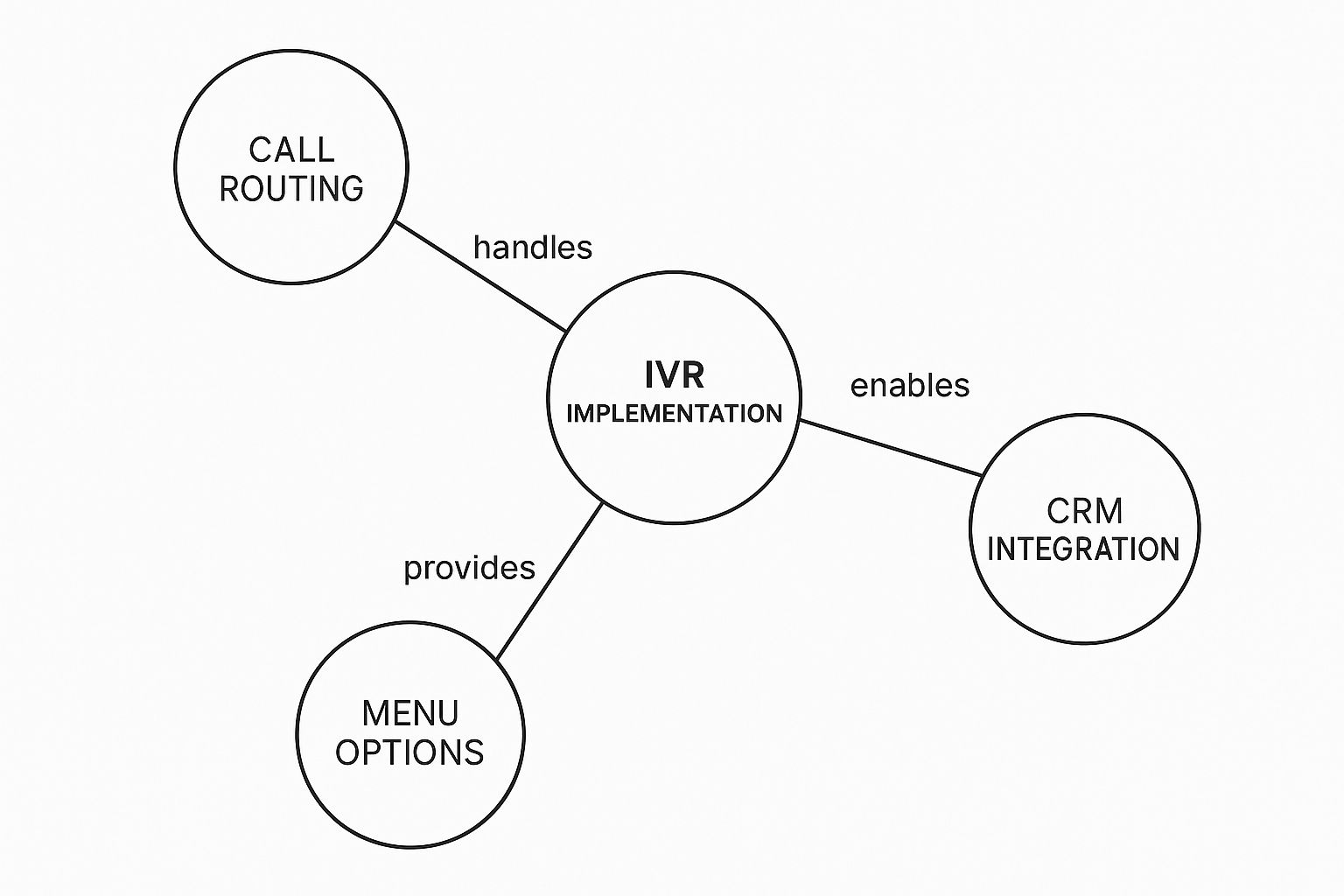
The infographic above shows how different parts of a modern call center IVR work together. Think of it as a well-oiled machine: call routing, menu options, and CRM integration all play a vital role. Effective call routing gets callers to the right place quickly, like a friendly receptionist. Intuitive menus empower customers to help themselves, and CRM integration gives agents instant access to customer information, making interactions more personal.
Imagine a customer calling in. Instead of navigating a confusing phone tree, they’re guided smoothly to the right department. The agent already knows their name and account history, ready to provide efficient and personalized service. That's the power of a well-designed IVR.
Beyond Recognizing Words: Understanding Intent
Today's IVR systems are getting smarter. They're not just listening to words; they're trying to understand what the caller actually means. Think of it like having a conversation with a colleague who anticipates your needs. This is possible thanks to artificial intelligence (AI), which turns robotic voice prompts into dynamic dialogues.
Instead of rigid, pre-recorded messages, AI allows for a natural flow of conversation. The system can handle nuances like accents and colloquialisms, and even detect the caller’s emotional state. This creates a much more human and less frustrating experience.
The Rise of Multimodal IVR
In recent years, we've seen a big shift in how IVR is used, especially with the emergence of multimodal IVR systems around 2025. These systems seamlessly blend voice, text, and visual channels. Customers can choose how they want to interact – by speaking, typing, or even receiving visual confirmations on their screens. Discover more insights on call center statistics.
For example, imagine updating your address with a voice command and instantly receiving a visual confirmation on your phone. This kind of flexibility not only accommodates different preferences but also makes the whole experience more convenient and reassuring.
Real-World Examples of Advanced IVR
Companies like Southwest Airlines and American Express are using advanced IVR features to improve customer service. One such feature is real-time sentiment analysis. This technology detects frustration in a caller's voice and automatically routes them to a human agent, preventing small issues from becoming big problems.
Another valuable tool is predictive routing. The system analyzes the caller's history and current needs to connect them with the best-suited specialist. This personalized approach minimizes wait times and ensures callers get the help they need, especially in complex fields like healthcare or finance.
Personalized greetings also make a big difference. Imagine calling your bank and being greeted by name, with a quick summary of your recent transactions. This personal touch makes customers feel valued and strengthens their relationship with the company.
Cutting-Edge Capabilities: From Voice Biometrics to Visual IVR
Modern IVR systems offer even more advanced features. Voice biometrics provides secure authentication without the hassle of passwords or PINs. It's like a fingerprint for your voice, making logins easier and more secure.
Visual IVR allows call centers to send screenshots, confirmations, and other helpful information directly to the customer’s mobile device, enhancing communication and transparency.
Furthermore, AI-powered problem resolution continuously learns from every interaction. The system gets smarter with each call, providing more accurate and helpful responses over time. These advanced features are not just cool gadgets; they're strategic tools that can improve customer retention and make operations more efficient.
| Feature | Traditional IVR | Modern AI-Powered IVR | Business Impact |
|---|---|---|---|
| Call Routing | Basic menu-driven | AI-powered, predictive routing based on customer data | Reduced wait times, improved first call resolution |
| Self-Service | Limited options | Expanded options, personalized guidance | Increased customer satisfaction, reduced agent workload |
| Personalization | Generic greetings | Personalized greetings, tailored information | Enhanced customer experience, stronger brand loyalty |
| Sentiment Analysis | Not available | Real-time sentiment detection and routing | Proactive issue resolution, improved customer retention |
| Channel Integration | Voice only | Multimodal (voice, text, visual) | Greater flexibility, improved accessibility |
| Security | Basic PIN/password | Voice biometrics | Enhanced security, streamlined authentication |
| Problem Resolution | Pre-defined solutions | AI-powered, learns and improves over time | Increased accuracy and efficiency in resolving customer issues |
| CRM Integration | Limited or no integration | Seamless integration, provides agents with customer data | Personalized service, improved agent efficiency |
The table above, "Traditional vs Modern IVR Capabilities Comparison," highlights the significant advancements in IVR technology. The shift from simple menus to AI-powered conversational platforms represents a major step forward in customer service. As you can see, modern IVR has the potential to dramatically enhance the customer experience while also boosting operational efficiency for businesses.
Strategic Implementation: Your Roadmap To IVR Success
Implementing an effective IVR in a call center isn't just about buying the newest tech. It's about creating a strategy that works for both your customers and your business goals. It's a bit like planning a road trip. You need to know your destination (business objectives) and the best route (customer journey), while keeping in mind potential detours (implementation challenges).
Planning Your IVR Implementation
The first step is setting clear objectives. What are you hoping to achieve? Reduce call handling times? Improve first call resolution rates? Boost customer satisfaction? Defining these goals will shape your implementation strategy.
Next, map out your customer journeys. Why do customers typically call your center? Understanding these common inquiries helps you design IVR flows that address their needs directly. For instance, if someone's calling to check their order status, the IVR should provide that information quickly and efficiently, minimizing the need to speak with an agent.
Designing Intuitive Conversation Flows
A well-designed IVR seamlessly guides callers, offering self-service whenever possible. Think of it like a helpful concierge. Just as a concierge anticipates guests' needs, your IVR should offer relevant options and provide quick access to information or service.
This screenshot, taken from Teneo's website, shows a modern IVR interface for contact centers. It highlights features like visual conversation flows and integration options.  This clear visual representation simplifies the design process and helps you visualize the customer's journey through the system, which is crucial for a positive caller experience.
The language you use in your IVR prompts is also important. Avoid technical jargon and complex sentences. Keep the language clear, concise, and easy to understand. The goal is a smooth and efficient experience. For more tips, check out these IVR Best Practices.
Integrating IVR With Existing Systems
Integrating your IVR with your existing systems, like your CRM and helpdesk platform, is essential. Think of these systems as the backstage crew of a theater production. They might not be visible to the audience (your customers), but they're crucial for the overall performance.
Integrating your IVR with your CRM allows agents to access a caller's history and preferences. This allows for personalized and efficient service. For example, if a customer has contacted you before about a similar issue, the agent can quickly access that information and provide a tailored solution. This not only improves the customer experience but also empowers agents to handle calls more efficiently.
By taking a strategic approach, your IVR can become a valuable tool. It can improve customer satisfaction, make your agents more productive, and ultimately, help your business grow.
Measuring What Matters: IVR Metrics That Drive Real Results
Bringing a modern IVR system into your call center is a big step towards happier customers and smoother operations. But how can you tell if it’s really working? Just like a car needs regular tune-ups, your IVR needs regular performance checks. And that means looking at more than just simple numbers like call volume and average handle time.
Beyond the Basics: Key IVR Metrics
Imagine your IVR system as a friendly guide, helping callers find their way to the right information or department. You wouldn’t just count how many people the guide talked to, right? You'd also want to know how helpful they were. That’s where key performance indicators (KPIs) come into play.
For instance, first-call resolution (FCR) is essential. This tells you how often customers get their issues solved on that first interaction with the IVR, without having to talk to a human agent. A higher FCR means happier customers and lower costs for your business.
Another vital metric is the customer effort score (CES). This measures how easy it is for customers to use your IVR. A lower CES suggests a smoother, more user-friendly system, and that builds customer loyalty.
If you're focused on the financial side, cost-per-interaction is a key metric. It shows the real return on investment (ROI) of your IVR by measuring the money saved through automated interactions.
Containment Rate: More Than Just Call Handling
The containment rate tells you what percentage of calls are handled completely by the IVR, without needing an agent. But a high containment rate isn't the whole story. You also need to know if customers are happy with those automated interactions. A high containment rate paired with low customer satisfaction might mean your system is actually making things harder for callers. You might be interested in: Call Center Quality Assurance.
Real-World Monitoring: Tools and Techniques
Leading call centers use powerful tools to keep an eye on IVR performance. Customer satisfaction surveys, built right into the IVR, give you direct feedback on the caller experience. Sentiment analysis software can even detect emotional cues in callers’ voices, letting agents know if someone is getting frustrated so they can step in. Behavioral analytics tools track how customers interact with the IVR, highlighting any points of confusion or frustration that need fixing.
Linking IVR Performance to Overall Call Center KPIs
Your IVR’s performance has a ripple effect on your entire call center. A well-tuned IVR means agents spend less time on routine questions, boosting their productivity. This then leads to higher customer satisfaction scores and lower operating costs.
To see how these metrics connect to business goals, take a look at the table below:
"Essential IVR Performance Metrics Dashboard"
| Metric | Target Range (Example) | Business Impact | Measurement Frequency |
|---|---|---|---|
| First-Call Resolution | 70-80% | Increased customer satisfaction, reduced call volume | Monthly |
| Customer Effort Score | 1-2 (on a 1-5 scale) | Improved customer loyalty, reduced churn | Quarterly |
| Containment Rate | 60-70% | Reduced agent workload, lower operational costs | Weekly |
| Cost-Per-Interaction | $1-2 | Demonstrates ROI, justifies IVR investment | Annually |
This table shows how tracking these KPIs gives you a complete view of your IVR's performance, helping you make informed decisions to optimize its effectiveness and maximize its value.
Industry Success Stories: IVR Strategies That Actually Work
Imagine calling your doctor's office and effortlessly scheduling an appointment or refilling a prescription without waiting on hold, all while knowing your privacy is protected. Or picture yourself accessing your bank account securely using just your voice. These aren't scenes from a science fiction movie; they're real-world examples of how Interactive Voice Response (IVR) technology is changing customer service in call centers across various industries.
Healthcare: Mayo Clinic Streamlines Patient Services
The Mayo Clinic uses IVR to handle a huge number of everyday requests, such as scheduling appointments and refilling prescriptions. Think of it as a digital receptionist, efficiently directing patient traffic. This frees up staff to deal with more complex patient needs, offering more personalized care. By connecting their IVR with their electronic health records, they personalize the patient experience while staying compliant with HIPAA regulations. This improves both efficiency and patient satisfaction.
Finance: Chase Bank Enhances Security and Access
Chase Bank uses IVR to create a secure environment for account management. Using advanced security measures like voice biometrics, customers can quickly and safely access sensitive information. This adds an extra layer of security, reducing the risk of fraud and streamlining the authentication process for a smoother customer experience.
E-commerce: Amazon Masters High-Volume Automation
Amazon handles millions of customer inquiries every day through its IVR system. From tracking orders and managing returns to providing product information and support, their automated system handles a vast quantity of routine interactions. This allows human agents to dedicate their time to more complex issues and deliver better personalized support. For a deeper understanding of IVR, check out this resource: Interactive Voice Recognition (IVR).
Retail: Target Manages Seasonal Peaks
Retail giants like Target experience massive increases in call volume during busy periods like the holidays. Their IVR systems manage this influx by handling common questions about store hours, product availability, and order tracking. This smart use of IVR reduces wait times and ensures customers receive timely information, even during the busiest times.
Telecommunications: Verizon Handles Complex Service Requests
Telecommunications providers like Verizon deal with complex service requests and billing inquiries on a daily basis. Their IVR systems guide customers through troubleshooting steps, provide account information, and direct calls to specialized agents when necessary. This layered approach improves first-call resolution rates and reduces the workload on human agents, allowing them to focus on the most challenging cases.
Insurance: Streamlining Claims Processing
Insurance companies utilize IVR to simplify the often-complex claims process. Customers can file claims, check on their status, and receive policy information through automated interactions. This speeds up the claims process, providing much-needed efficiency and improving customer satisfaction during potentially stressful situations.
These real-world examples highlight how various industries tailor IVR to fit their specific needs. While some strategies, like efficient call routing and self-service options, work well across different sectors, others require adjustments based on regulations, customer demographics, and business goals. By learning from these successes and applying best practices, companies can create IVR systems that improve the customer experience and deliver real business value.
Future-Proofing Your IVR Investment Strategy
Investing in an IVR system for your call center is a big decision. You want to make sure what you choose today isn't outdated tomorrow. Think of it like buying a car. You wouldn't buy one that doesn't have the features you’ll need in the coming years, like enough seats for a growing family or good gas mileage as prices climb.
Emerging Trends in IVR Technology
Customer service is always changing. New technologies pop up all the time, altering how businesses connect with their customers. Keeping up with these trends is key to making sure your call center’s IVR system doesn't become a relic.
-
Advanced Voice Biometrics: Imagine customers verifying their identity just by speaking. Voice biometrics makes this possible, boosting security and making authentication much smoother.
-
Emotional Intelligence: AI is becoming increasingly adept at understanding human emotions. IVR systems can now pick up on frustration or anger in a caller's voice and react accordingly, perhaps by offering tailored support or transferring the call to a human agent.
-
Predictive Analytics: Think of anticipating customer needs before they even dial. That’s the promise of predictive analytics. By examining past interactions and other data, IVR systems can proactively offer solutions, speeding up resolutions and increasing customer satisfaction.
Integration with Next-Generation Technologies
Modern IVR systems don’t exist in a vacuum. They work with other technologies to provide a smooth customer experience. These integrations are crucial for staying competitive.
-
Conversational AI Chatbots: Chatbots can handle simple questions, leaving human agents free to tackle more complex issues. Connecting chatbots with your IVR lets customers move easily between channels, giving them the freedom to communicate in the way they prefer. You can learn more about chatbots at resources like the Chatbots Magazine.
-
Virtual Assistants: Think of virtual assistants as super-powered chatbots. They can handle more complicated tasks, like scheduling appointments or processing payments. Linking them with your IVR provides another level of automation and personalized service.
-
Omnichannel Platforms: Customers communicate with businesses across various channels – phone, email, chat, social media. An omnichannel platform ties all these channels together, creating a unified experience. Integrating your IVR with an omnichannel platform ensures smooth transitions between channels and a consistent customer journey.
Building Flexibility and Scalability
As your business expands, your IVR needs to expand with it. Building in flexibility and scalability from the start is vital for long-term success. Think of a city – its infrastructure needs to adapt as the population grows. Your IVR needs that same adaptability to handle changes in call volume, evolving customer needs, and new technologies.
One important factor is vendor lock-in. You don’t want to get stuck with a system that can't adapt to your changing requirements. Choosing a vendor with open APIs and several integration options gives you the freedom to connect with other systems and adapt to future technologies.
Practical Approaches for Future-Proofing
Here’s how you can make sure your IVR investment remains a valuable tool for the long haul:
-
Evaluate New Capabilities: Keep up with emerging trends and new IVR features. Think about how these developments could help your business and your customers.
-
Negotiate Flexible Contracts: When selecting an IVR provider, negotiate contracts that allow for upgrades and adjustments as your needs change. This protects your investment and prevents you from being stuck with outdated tech.
-
Develop a Technology Roadmap: Make a long-term plan for your IVR, taking into account future business objectives and technological advancements. This roadmap will guide your decisions and make sure your IVR aligns with your overall strategy.
By following these strategies, you can ensure your IVR system stays an asset, not a liability, for years to come. Ready to explore a future-proof IVR solution? Check out Voicetta, an AI communication platform created to improve customer experience and streamline operations. Learn more about Voicetta and how it can transform your call center.