
Blog
Top 8 KPI for Call Centre Success in 2025 | Improve Performance
In the fastpaced world of customer service, what you don't measure, you can't improve. Call centres are the frontline of customer interaction, where experiences are ma...
In the fast-paced world of customer service, what you don't measure, you can't improve. Call centres are the frontline of customer interaction, where experiences are made or broken in a matter of minutes. But how do you truly know if your team is succeeding? The answer lies in data. Specifically, it lies in tracking the right Key Performance Indicators (KPIs).
Choosing the correct KPI for call centre operations is not just about counting calls or timing agents; it's about understanding efficiency, customer happiness, and financial impact in one unified view. Without these insights, you're navigating without a compass, risking customer churn, operational waste, and missed opportunities. Many managers fall into the trap of monitoring too many metrics, creating noise instead of clarity. The key is to focus on the indicators that provide a direct link to both your customer's experience and your business's bottom line.
This guide will walk you through the 8 most critical KPIs that every call centre manager must master. We'll break down what they are, how to calculate them, and most importantly, how to use them to drive tangible improvements. Forget abstract theories; we'll provide actionable steps to transform your service from a cost centre into a powerful value-creation engine. Let's get started.
1. First Call Resolution (FCR)
Imagine a customer calls your support centre with a frustrating technical issue. After a single, efficient conversation with a knowledgeable agent, their problem is completely solved. They hang up feeling satisfied and relieved, with their faith in your brand reinforced. This ideal scenario is the essence of First Call Resolution (FCR), a cornerstone KPI for call centre performance.
FCR measures the percentage of customer enquiries resolved entirely during the initial contact, eliminating the need for follow-up calls or escalations. It's a powerful indicator of both customer satisfaction and operational efficiency. A high FCR means happier customers and a more productive, cost-effective support team. When customers don't have to call back, it frees up agents to handle new incoming enquiries, reducing overall call volume and wait times.
Why FCR is a Critical Metric
Tracking FCR is essential because it directly correlates with customer loyalty and operational costs. For instance, global retail giant Amazon achieves an impressive FCR of over 85% by investing heavily in agent training and sophisticated knowledge management systems. Similarly, Southwest Airlines boosted its FCR from 72% to 87% by optimising its call routing to connect customers with specialised agents from the outset. These companies recognise that solving problems on the first try is not just good service; it's a strategic business advantage.
The following summary box provides a quick reference for the core components of FCR.
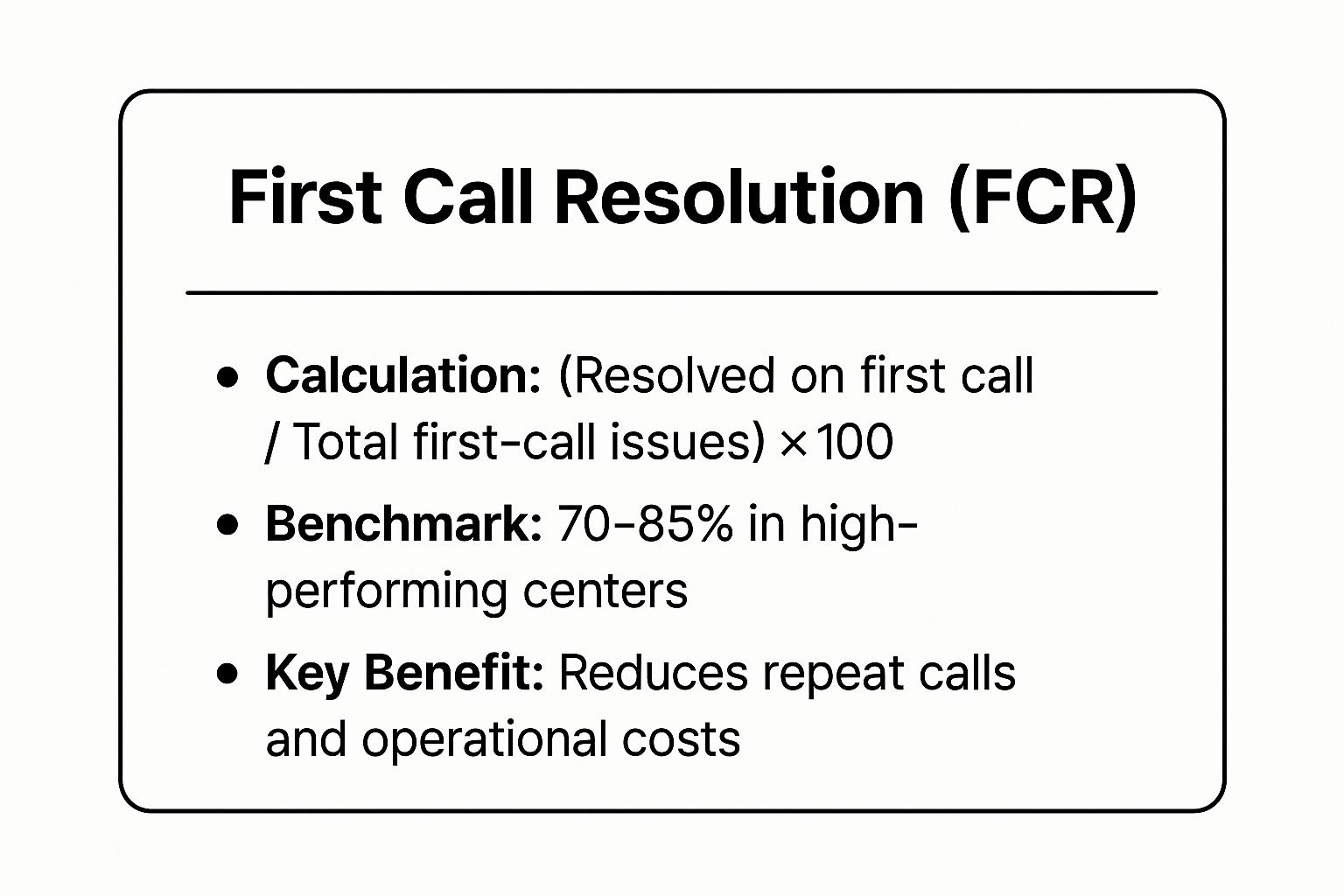
This data highlights that while a perfect 100% FCR is often unrealistic, top-performing centres aim for a high benchmark, understanding that each resolved first call significantly cuts down on repeat call traffic and associated expenses.
Actionable Tips for Improving FCR
Boosting your FCR requires a multi-faceted approach focused on empowering your agents and streamlining processes.
- Empower with Knowledge: Implement a comprehensive, easily searchable knowledge base. When agents can find accurate answers quickly, resolution times plummet.
- Invest in Training: Equip agents with deep product and process knowledge before they ever speak to a customer. Confidence and competence are key.
- Route Intelligently: Use skill-based routing to match a customer's specific need with the agent best qualified to handle it.
- Analyse Failures: Regularly review calls that were not resolved on the first attempt. Identify patterns, knowledge gaps, or process flaws to prevent future failures. For further guidance on structuring these improvements, you can explore these customer service guidelines on voicetta.com.
- Balance with Quality: Avoid pressuring agents to resolve calls too quickly. Use Quality Assurance (QA) scores alongside FCR to ensure resolutions are both fast and effective.
For a deeper dive into the strategic importance of FCR, the video below offers valuable insights.
2. Average Handle Time (AHT)
Consider the entire lifecycle of a customer interaction, from the moment an agent answers the call to the final click after logging notes. This complete duration is captured by Average Handle Time (AHT), a fundamental kpi for call centre management. It measures the average total time an agent spends on a customer interaction, including talk time, hold time, and any after-call work (ACW) needed to wrap up the case.

AHT is a direct reflection of your call centre's efficiency and has a significant impact on workforce planning and operational costs. While a lower AHT can suggest higher productivity, it's crucial to balance this metric with quality. Focusing solely on reducing AHT can lead to rushed agents, unresolved issues, and poor customer experiences, undermining the very purpose of a support centre.
Why AHT is a Critical Metric
Tracking AHT is vital for managing staffing levels, controlling expenses, and optimising agent performance. For example, financial services leader American Express successfully maintains a competitive AHT of around 4.5 minutes by empowering agents with the authority and tools to resolve issues without escalations. Similarly, T-Mobile reduced its AHT by 15% through strategic investments in process automation and enhanced training programmes, proving that efficiency gains don't have to come at the expense of quality. These companies understand that a well-managed AHT is a sign of a streamlined and effective operation.
Actionable Tips for Improving AHT
Optimising AHT isn't about rushing agents; it's about removing obstacles and empowering them to work more effectively.
- Segment AHT Data: Analyse AHT by call type, team, or complexity. This provides meaningful insights, as a complex technical query will naturally have a longer handle time than a simple billing question.
- Invest in Efficient Training: Equip agents with robust product knowledge and efficient system navigation skills. The faster they can find information and execute tasks, the lower their AHT will be.
- Automate Routine Tasks: Implement tools to automate repetitive after-call work, such as logging call dispositions or sending follow-up emails. This frees up agent time for the next customer.
- Review Outlier Calls: Regularly analyse calls with exceptionally long or short handle times. These outliers can highlight agents who need coaching or reveal underlying process inefficiencies that need fixing.
- Balance with Quality Metrics: Never track AHT in isolation. Pair it with metrics like Customer Satisfaction (CSAT) and First Call Resolution (FCR) to ensure efficiency improvements are not damaging the customer experience.
3. Customer Satisfaction Score (CSAT)
Imagine a customer has just finished a call with one of your agents. A few moments later, they receive a simple, one-question survey: "How satisfied were you with the support you received today?" Their answer, typically on a scale of 1 to 5, provides a direct and immediate measure of their experience. This is the essence of the Customer Satisfaction Score (CSAT), a vital kpi for call centre management.
CSAT gauges customer happiness at a specific touchpoint. It measures the percentage of customers who rate their satisfaction as "satisfied" or "very satisfied" (e.g., a score of 4 or 5 on a 5-point scale). It's a powerful tool for getting direct feedback on service quality, agent performance, and overall process effectiveness. A high CSAT score indicates that your team is not just resolving issues but also creating positive emotional outcomes for your customers.

Why CSAT is a Critical Metric
Tracking CSAT is crucial because it provides a direct line to the customer's perspective, ensuring that operational goals don't overshadow the quality of the customer experience. For example, the luxury retailer Nordstrom maintains incredibly high CSAT scores by empowering agents to offer personalised service and flexible solutions. Similarly, USAA, a financial services company, achieves industry-leading satisfaction by investing in specialised training that focuses on building member trust and empathy. These organisations understand that a satisfied customer is more likely to be a loyal one.
By focusing on CSAT, you gain insights into what makes customers happy and what causes friction. This data is invaluable for coaching agents, refining scripts, and improving the underlying processes that shape every customer interaction.
Actionable Tips for Improving CSAT
Improving your CSAT score involves listening to feedback and acting on it decisively to enhance the customer journey.
- Keep Surveys Simple: Make it easy for customers to respond. A single, focused question delivered immediately after the interaction yields the highest response rates and most accurate feedback.
- Analyse Low Scores: Don't just track the number; understand the "why" behind it. Follow up with dissatisfied customers to perform root cause analysis and demonstrate that you value their feedback.
- Share Positive Feedback: Use high scores and positive comments as a tool for recognition and motivation. Sharing wins with your team reinforces good behaviour and boosts morale.
- Identify Training Gaps: Use CSAT data to pinpoint areas where agents or processes are falling short. This allows for targeted training interventions that address specific weaknesses.
- Implement Real-Time Feedback: Use technology to trigger surveys instantly post-interaction. This gives you immediate insight and allows for rapid course correction if a negative trend emerges. For a more detailed guide, you can learn more about measuring customer satisfaction on voicetta.com.
4. Service Level
Picture a customer reaching out to your company for help, only to be met with endless ringing or a prolonged hold time. Their initial patience quickly turns to frustration, damaging their perception of your brand before an agent even says hello. This common scenario is what the Service Level metric is designed to prevent, making it a fundamental kpi for call centre management.
Service Level measures the percentage of incoming calls answered within a specific, predetermined time threshold. The industry standard is often cited as "80/20," which translates to answering 80% of calls within 20 seconds. It serves as a real-time pulse check on your centre's accessibility and responsiveness, directly influencing customer satisfaction and the likelihood of call abandonment.
Why Service Level is a Critical Metric
Tracking Service Level is crucial for effective workforce management and maintaining a positive customer experience. For instance, Disney's renowned customer service is partly built on maintaining an impressive 95% service level, even during peak holiday seasons, which they achieve through sophisticated forecasting and dynamic staffing. Similarly, British Airways consistently hits an 85% service level by employing flexible staffing models that adapt to fluctuating call volumes throughout the day. These organisations understand that answering calls promptly is the first step in delivering exceptional service.
Meeting Service Level targets shows that you value your customer's time and have organised your resources effectively. It’s a direct reflection of your operational readiness and commitment to being available when your customers need you most.
Actionable Tips for Improving Service Level
Improving your Service Level requires a strategic balance between staffing, technology, and operational efficiency.
- Forecast Accurately: Use historical data and predictive analytics to create accurate forecasting models. Knowing when your peaks and troughs will occur is the first step to staffing appropriately.
- Monitor in Real-Time: Implement dashboards that display live Service Level data. This allows supervisors to make immediate adjustments, such as pulling agents from other tasks to answer calls during an unexpected surge.
- Offer Callback Options: During exceptionally high-volume periods, provide customers with the option to receive a callback without losing their place in the queue. This respects their time and manages queue pressure.
- Balance with Costs: While a high Service Level is desirable, aiming for 100% can be prohibitively expensive. Set realistic targets that align with your budget and customer expectations.
- Optimise Call Handling: Train agents on efficient call handling techniques to reduce Average Handle Time (AHT) without sacrificing the quality of the resolution. Shorter calls mean agents become available for the next customer sooner.
5. Call Abandonment Rate
Consider a customer needing urgent help. They dial your support number, navigate the IVR, and are finally placed in a queue. As the hold music drones on and the minutes tick by, their patience wears thin until they finally give up and hang up the phone. This frustrating experience is captured by the Call Abandonment Rate, a vital kpi for call centre health.
Call Abandonment Rate measures the percentage of callers who disconnect before speaking with an agent. It’s a direct reflection of your service accessibility and the customer's willingness to wait. A high rate often signals understaffing, inefficient call routing, or technical issues within your phone system. Minimising this figure is crucial, as each abandoned call represents a potentially lost customer, an unresolved issue, and a negative brand interaction.
Why Call Abandonment Rate is a Critical Metric
Tracking your abandonment rate is essential for gauging customer frustration and optimising workforce management. For example, Southwest Airlines significantly reduced its abandonment rate from 12% to just 4% by implementing better forecasting models and offering a queue callback feature. Similarly, financial institutions like Chase Bank use virtual queuing during peak times, allowing customers to receive a call back instead of waiting on hold, which drastically lowers abandonment. These strategies show a deep understanding that customer time is valuable and directly impacts their loyalty.
The following summary box provides a quick reference for the core components of Call Abandonment Rate.
This data underscores that while some abandonment is unavoidable (e.g., misdials), a high rate points to systemic problems. Top-tier call centres strive to keep this metric low, understanding that it's a key indicator of service level performance and customer experience quality.
Actionable Tips for Reducing Call Abandonment Rate
Lowering your abandonment rate involves managing customer expectations and optimising your resource allocation.
- Offer a Callback Option: Implement a system that allows callers to request a call back when an agent becomes free. This respects their time and drastically reduces queue frustration.
- Provide Wait Time Estimates: Give callers a realistic estimate of their wait time. Knowing what to expect empowers customers and makes the wait more tolerable.
- Analyse Abandonment Data: Use data from abandoned calls to refine your workforce planning. Identify peak times and days where abandonment spikes and adjust staffing accordingly.
- Optimise Self-Service: Ensure your IVR and other self-service channels are efficient and can resolve common issues, deflecting calls that don't require an agent.
- Monitor System Performance: Regularly check for technical glitches or system-wide issues that could be causing delays and leading to hang-ups.
6. Net Promoter Score (NPS)
Consider the ultimate question of customer loyalty: would your customer recommend your service to a friend or colleague? This simple yet profound query is the foundation of the Net Promoter Score (NPS), a metric that gauges customer allegiance. It moves beyond measuring a single interaction to capture a broader sentiment about your brand, making it a crucial kpi for call centre strategy.
NPS is measured by asking customers to rate their likelihood of recommending your company on a scale of 0 to 10. Based on their response, customers are categorised as Promoters (score 9-10), Passives (7-8), or Detractors (0-6). The final score is calculated by subtracting the percentage of Detractors from the percentage of Promoters. This gives you a clear, powerful number that predicts business growth potential and highlights the overall impact of your customer service experience.
Why NPS is a Critical Metric
Tracking NPS is vital because it provides a strategic view of customer loyalty that operational metrics alone cannot offer. Tech giant Apple consistently achieves high NPS scores above 70 by ensuring its support interactions reinforce its premium brand image. Similarly, Amazon’s relentless focus on customer-centric policies, handled efficiently by its call centres, helps maintain a strong NPS. These industry leaders understand that a positive NPS score is a direct indicator of sustainable growth, driven by loyal customers who act as brand advocates.
Actionable Tips for Improving NPS
Boosting your NPS involves not just asking the question, but acting decisively on the answers you receive.
- Follow Up for Context: Don't just collect a number. Follow up the NPS survey with an open-ended question like, "What is the primary reason for your score?" to gain invaluable qualitative insights.
- Segment Your Data: Analyse NPS scores across different service channels, agent teams, and interaction types. This helps pinpoint specific areas of excellence and opportunities for improvement.
- Close the Loop with Detractors: Make it a priority to contact detractors. Understanding their concerns and taking steps to resolve their issues can turn a negative experience into a positive one and prevent future problems.
- Celebrate Success: Share positive feedback and high NPS scores with your agents. Recognising their role in creating promoters reinforces the desired behaviours and boosts team morale.
- Focus on Trends: Look at NPS trends over time rather than isolated scores. A consistently improving score demonstrates that your strategic initiatives are having a real impact on customer perception.
7. Quality Assurance Score
Imagine a customer service interaction so seamless and helpful that it leaves the customer feeling truly valued. This isn't accidental; it's the result of meticulous coaching and high standards. The metric that measures and drives this level of excellence is the Quality Assurance (QA) Score, a vital KPI for call centre management.
A QA Score is a comprehensive evaluation of an agent's performance during a customer interaction. It goes beyond simple metrics like call duration, assessing the quality of the conversation. Evaluators, typically supervisors or dedicated QA analysts, use a structured scorecard to rate everything from the agent's tone and empathy to their adherence to company procedures and problem-solving effectiveness. It provides a holistic view of agent performance, ensuring service is not just fast, but also effective, professional, and on-brand.
Why the QA Score is a Critical Metric
Tracking QA Scores is fundamental for cultivating a culture of continuous improvement and maintaining consistently high service standards. For example, American Express is renowned for its premium service, a reputation built on rigorous QA programmes that include 360-degree feedback. Similarly, the online retailer Zappos famously integrates cultural fit and customer happiness directly into its QA scoring, ensuring agents embody the brand's core values in every call. These companies prove that a focus on quality isn't just a cost centre; it's a direct investment in customer loyalty and brand equity.
A high QA score signifies that agents are not only following the script but are also effectively connecting with and resolving issues for customers. This leads to increased customer satisfaction, better agent development, and a stronger, more consistent brand experience for everyone who contacts your support centre.
Actionable Tips for Improving QA Scores
Improving your QA scores involves creating a clear, consistent, and collaborative evaluation process.
- Develop Objective Criteria: Create a detailed QA scorecard with clear, unambiguous evaluation criteria. Define what "excellent" looks like for each category, from greeting to closing.
- Ensure Evaluator Consistency: Hold regular calibration sessions where all your QA evaluators score the same calls and discuss their reasoning. This minimises subjectivity and ensures every agent is assessed fairly.
- Coach, Don't Punish: Use QA results as a foundation for constructive coaching sessions, not as a punitive tool. Focus on identifying specific areas for improvement and providing agents with the support they need to succeed.
- Involve Your Agents: Include agents in the development and refinement of the QA process. When they have a say in how they are evaluated, they are more likely to buy into the programme and strive for improvement. You can find more strategies by exploring call centre quality assurance on voicetta.com.
- Combine with Customer Feedback: Pair QA scores with direct customer feedback, like CSAT or NPS scores, for a complete performance picture. This helps validate your internal quality standards against actual customer perceptions.
8. Cost Per Call
Imagine your call centre as the engine of your customer experience. To keep it running smoothly, you need to know exactly how much fuel it consumes. This is where Cost Per Call (CPC) comes in. It’s a fundamental financial KPI for call centre management that calculates the total expense associated with handling a single customer interaction.
CPC isn't just about agent salaries; it encompasses all direct and indirect expenses, including technology licensing, facility overheads, management, and training costs. Understanding this metric allows you to create accurate budgets, evaluate operational efficiency, and make strategic decisions about technology investments. A well-managed CPC ensures you are delivering excellent service without overspending, striking a crucial balance between quality and financial sustainability.
Why Cost Per Call is a Critical Metric
Tracking CPC is essential for gauging the financial health and efficiency of your support operations. It helps answer a vital question: are your resources being used effectively? For instance, IBM successfully reduced its cost per call by 30% by implementing AI-powered self-service options, deflecting simpler queries from live agents. Similarly, Capital One optimised its CPC by using intelligent routing to connect customers with specialised agents, increasing efficiency and reducing handling times. These examples show that managing CPC isn’t just about cutting costs; it's about optimising resource allocation for better, more sustainable service delivery.
Actionable Tips for Improving CPC
Optimising your Cost Per Call requires a strategic approach that balances cost-saving measures with the quality of customer interactions.
- Calculate Accurately: Ensure you include all relevant costs, from agent wages and benefits to software licences and a portion of facility overheads, for a true CPC figure.
- Segment Your Costs: Analyse CPC by interaction type (e.g., sales vs. support), channel (phone, chat, email), and complexity. This reveals where your resources are most heavily invested.
- Invest in Efficiency: Embrace technology like IVR, chatbots, and CRM integrations to automate routine tasks and improve agent productivity, which lowers the cost per interaction over the long term. For more ideas on operational savings, you can find strategies on how to cut business costs on voicetta.com.
- Balance with Quality: Avoid pressuring agents to rush through calls to lower CPC. Monitor it alongside metrics like Customer Satisfaction (CSAT) and First Call Resolution (FCR) to ensure efficiency doesn't come at the expense of service quality.
- Focus on Agent Training: Well-trained agents resolve issues faster and more effectively, directly reducing call handle times and, consequently, the cost per call.
Call Centre KPI Comparison Matrix
| KPI | Implementation Complexity 🔄 | Resource Requirements ⚡ | Expected Outcomes 📊 | Ideal Use Cases 💡 | Key Advantages ⭐ |
|---|---|---|---|---|---|
| First Call Resolution (FCR) | High - requires sophisticated tracking systems and definitions | Moderate to high - needs agent training and knowledge systems | Improved customer satisfaction, reduced repeat calls, operational cost savings | Call centers aiming to enhance resolution on first contact | Direct link to customer satisfaction and cost reduction |
| Average Handle Time (AHT) | Moderate - requires time tracking across multiple call phases | Moderate - involves agent training and automation technology | Better workforce planning, reduced costs, improved efficiency | Centers balancing efficiency with quality service | Enables accurate staffing and process improvements |
| Customer Satisfaction Score (CSAT) | Low to moderate - survey implementation and data collection systems | Low to moderate - surveys can be automated | Direct measurement of customer service quality, identifies improvement areas | Monitoring customer experience and service quality | Provides actionable customer feedback |
| Service Level | Moderate - requires real-time monitoring and forecasting tools | Moderate - scheduling and capacity planning resources | Reduced customer wait times, improved experience | Operations needing to meet response time targets | Clear operational performance target with real-time impact |
| Call Abandonment Rate | Low to moderate - requires call system tracking | Moderate - analytics for queue and callback management | Early indicator of service issues; reduces customer churn | Identifying staffing and process bottlenecks | Helps optimize queue management and customer retention |
| Net Promoter Score (NPS) | Low - simple survey with scoring system | Low - typically one-question survey | Measures customer loyalty and advocacy to predict growth | Tracking long-term customer loyalty and brand reputation | Strong predictor of retention and referrals |
| Quality Assurance Score | High - requires detailed evaluation and calibration | High - dedicated QA resources and evaluators | Enhanced agent performance and consistent service quality | Ensuring high standards and targeted coaching | In-depth agent skill insights with training focus |
| Cost Per Call | Moderate to high - detailed cost attribution needed | High - involves comprehensive financial data collection | Clear financial insight; supports budgeting and ROI | Cost management and operational efficiency analysis | Identifies cost-saving opportunities with balanced quality |
From Data to Decisions: Building a World-Class Call Centre
Navigating the landscape of call centre management can often feel like trying to conduct an orchestra where every instrument plays from a different sheet of music. The key performance indicators we’ve explored - from First Call Resolution (FCR) and Average Handle Time (AHT) to Customer Satisfaction (CSAT) and Net Promoter Score (NPS) - are the individual notes. On their own, they provide valuable but isolated insights. A high AHT might suggest inefficiency, while a low FCR could point to knowledge gaps. But the true mastery lies not in just measuring these notes, but in arranging them into a powerful, harmonious symphony of operational excellence.
The journey from tracking metrics to driving meaningful change is where the real work begins. Each KPI for call centre performance is a thread in a larger tapestry. When you weave them together, a clear picture of your customer journey, agent performance, and process integrity emerges. You start to see the connections: how improving your Quality Assurance Scores directly impacts FCR and CSAT, or how a better Service Level naturally reduces your Call Abandonment Rate. This holistic view transforms your strategy from reactive fire-fighting to proactive, predictive optimisation.
Turning Insights into Actionable Strategy
The ultimate goal is to foster a data-driven culture where these KPIs are not seen as punitive measures, but as diagnostic tools for continuous improvement. This involves:
- Holistic Analysis: Instead of fixating on a single metric like Cost Per Call, analyse it in context. A slightly higher Cost Per Call might be acceptable if it corresponds with a significant increase in FCR and CSAT, indicating that agents are taking the necessary time to resolve complex issues thoroughly.
- Empowering Agents: Share KPI data transparently with your team. When agents understand why metrics like AHT or FCR are important and how their individual performance contributes to the bigger picture, they become active participants in the improvement process, rather than just subjects of it.
- Strategic Technology Integration: Modern challenges require modern solutions. Simply pushing agents to work harder is an outdated and unsustainable model. The most significant leaps in performance come from intelligently integrating technology to augment human capabilities.
This is where the synergy between human talent and advanced AI becomes a game-changer. Tools designed to automate routine tasks and provide instant support don’t just handle overflow; they fundamentally reshape your operational capacity. By automating simple, repetitive inquiries, you directly improve metrics like Service Level and slash Abandonment Rates. This strategic automation frees up your skilled human agents, allowing them to dedicate their expertise to the complex, high-value interactions that genuinely boost FCR, CSAT, and NPS. The result is a perfectly balanced system where technology enhances efficiency and humans drive satisfaction, ensuring every customer interaction is optimised for success.
Ready to see how AI can transform your call centre metrics and revolutionise your customer service? Discover how Voicetta automates routine calls, provides 24/7 support, and empowers your agents to focus on what matters most. Visit Voicetta to learn how you can turn your KPI goals into reality.
Was this useful?
If this article helped, add Voicetta as a preferred source in Google Search. Your results can then highlight our writing.
Add as preferred source