
Blog
Boost Sales with Lead Qualification Process
Effective lead qualification forms the foundation of successful sales. It's the process of carefully evaluating potential customers to figure out how likely they are ...
The Science Behind Effective Lead Qualification

Effective lead qualification forms the foundation of successful sales. It's the process of carefully evaluating potential customers to figure out how likely they are to make a purchase. This involves more than just gathering leads; it requires a strategic, almost scientific approach to pinpoint those who truly need your product or service. This ensures your sales team invests their time and energy wisely, focusing on the most promising prospects. You might be interested in Learning more about Voicetta.
Lead Generation vs. Lead Qualification: Understanding the Difference
Many companies mix up lead generation and lead qualification, which can make their sales efforts less effective. Lead generation is all about attracting potential customers, while lead qualification is about figuring out which of those potential customers are most likely to buy. Think of a fisherman casting a wide net. Lead generation is casting the net; lead qualification is sorting through what's caught and keeping only the fish you want.
This difference is crucial. Getting these two processes confused can lead to wasted resources and missed opportunities. A strong lead qualification process makes sure your sales team isn't chasing leads that won't go anywhere, helping them work more efficiently. It allows them to concentrate on building relationships with prospects who have real interest and the potential to become loyal customers.
The Importance of a Systematic Approach
Lead qualification is a key part of modern sales and marketing. It's designed to filter out unpromising leads so resources can be focused where they'll make the biggest impact. The average business generates roughly 1,877 leads per month. With the average cost per lead hovering around $198.44 across industries, qualifying these leads effectively is essential for making the most of your budget and sales efforts. However, around 55% of leads are neglected because of inconsistencies in how lead qualification criteria are applied. Only 39% of companies consistently use these standards. More detailed statistics can be found here. This highlights a significant loss of potential revenue due to a lack of systematic lead qualification.
Building a Solid Qualification Framework
Successful sales teams use clear evaluation frameworks to avoid wasting resources on prospects that aren't a good fit. These frameworks act as a guide, pointing sales teams toward the best leads. They often involve assessing potential customers based on criteria such as budget, authority, need, and timeline (BANT). A strong qualification framework might also consider factors like company size, industry, and specific pain points.
By implementing a structured qualification process, businesses can significantly improve their conversion rates and sales efficiency. This directly translates to higher revenue and a healthier bottom line. A well-defined lead qualification process isn't just a good idea—it's essential for sustainable growth in today's competitive environment.
Crafting Your Ideal Customer Profile: The Qualification Compass
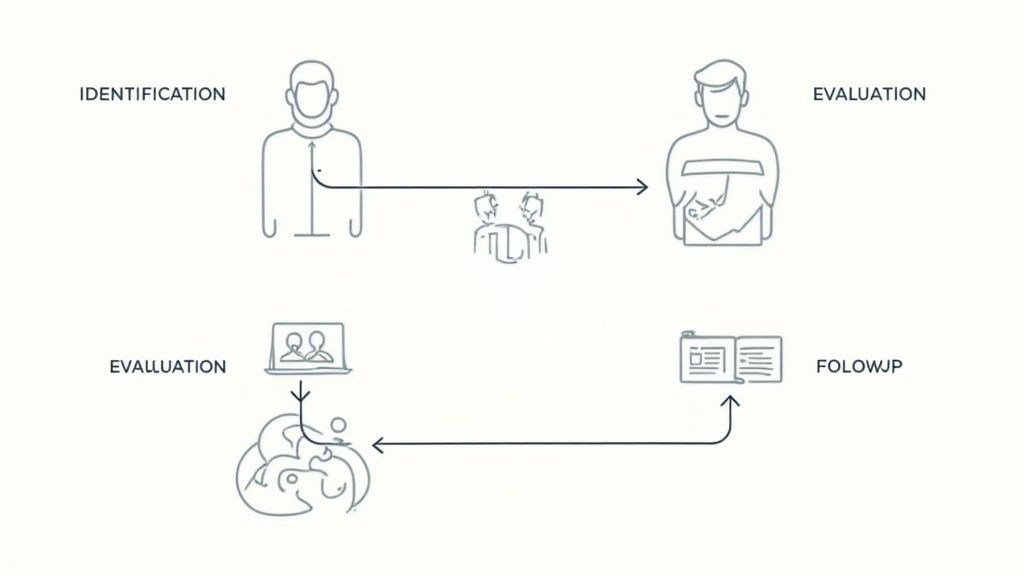
A well-defined Ideal Customer Profile (ICP) acts as a compass, guiding you toward the prospects most likely to become loyal customers. It delves deeper than simple demographics, creating a comprehensive portrait of your perfect customer. High-performing sales teams treat ICPs not as static documents but as dynamic tools, constantly evolving to predict success. This means understanding not only who your ideal customer is but also how they behave and why your product or service resonates with them. For a more in-depth look at developing effective ICPs, check out this helpful guide: best practices for developing Ideal Customer Profiles.
Identifying Key Qualification Indicators
Building a successful ICP requires identifying specific patterns that indicate a lead’s potential. These indicators often include behavioral patterns, pain point intensity, and how decisions are made within their organization.
For instance, imagine a prospect frequently visiting your pricing page and downloading numerous case studies. This demonstrates a higher level of engagement compared to someone who merely subscribes to your newsletter. Furthermore, understanding the intensity of a prospect’s pain points—how significantly a problem impacts their business—can greatly influence their likelihood of purchasing your solution. This nuanced understanding helps prioritize leads who are not only a good fit but also actively seeking a solution like yours.
From Theory to Action: Implementing Your ICP
Turning a theoretical ICP into practical, everyday qualification activities is essential for consistent results. This involves gathering valuable market intelligence and structuring it into clear decision frameworks. These frameworks then translate into specific questions and actions for your sales team to follow.
For example, a company offering a high-value B2B software solution might utilize the BANT (Budget, Authority, Need, Timeline) framework for efficient lead qualification. Surprisingly, there’s often a significant disconnect between marketing efforts and sales realities. Studies reveal that 61% of B2B marketers send all leads directly to sales, yet only 27% of these leads are actually qualified. This discrepancy leads to wasted time and resources. More detailed statistics highlighting this challenge can be found here. This reinforces the importance of a well-defined ICP, enabling sales teams to concentrate on the most promising opportunities.
To further illustrate the essential components of an effective ICP, let's examine the following table:
Essential Components of an Ideal Customer Profile
This table outlines the critical elements to include in your ICP to support effective lead qualification.
| Component | B2B Considerations | B2C Considerations | Data Collection Methods |
|---|---|---|---|
| Industry | Company size, revenue, market share | Demographics (age, location, income) | Market research reports, website analytics |
| Company Size | Number of employees, organizational structure | Household size, life stage | LinkedIn, company directories |
| Budget | Available budget for solutions | Disposable income, spending habits | Surveys, customer interviews |
| Needs | Business challenges, goals, pain points | Personal needs, desires, motivations | Customer feedback forms, social media listening |
| Decision-Making Process | Key stakeholders, buying cycle length | Individual preferences, influencer impact | Sales team feedback, CRM data |
This table provides a starting point for building your ICP. Remember to tailor these components to your specific business and target market.
Building a Dynamic Qualification Process
Your ICP isn't a one-time creation; it should be a living document that adapts to market changes and evolving buyer behavior. This requires ongoing refinement based on feedback from your sales team and analysis of closed deals.
For example, if a particular industry segment converts at a higher rate, adjust your ICP to prioritize similar prospects. This dynamic approach keeps your lead qualification process sharp and aligned with your business goals. For more insights on optimizing your content strategy, take a look at this article: How to master your content calendar.
Qualification Frameworks That Actually Drive Decisions

Moving beyond simply having a lead qualification process to one that truly informs sales decisions requires a solid framework. It's about giving your sales team a practical tool, not just a theory, to make informed choices. Think of it as giving them the right map and compass to navigate the often challenging world of lead qualification.
Choosing The Right Framework For Your Business
There is no single perfect solution for lead qualification. What works wonders for one company might be completely unsuitable for another. For instance, a company selling enterprise software will have a very different lead qualification process than one selling consumer goods. Several established methodologies exist, each with its own advantages and disadvantages, adaptable to different selling situations. These include BANT, MEDDIC, CHAMP, and GPCTBA/C&I. Each focuses on distinct elements of the qualification process.
BANT, centered around Budget, Authority, Need, and Timeline, works well for high-value sales with a clearly defined buying process. However, it can fall short in emerging markets where customer needs are still evolving. On the other hand, MEDDIC (Metrics, Economic buyer, Decision criteria, Decision process, Identify pain, Champion) is well-suited for complex enterprise sales but can be too demanding in terms of resources for smaller businesses.
Comparing Key Qualification Frameworks
To help you choose the best approach for your organization, the following table offers a detailed comparison of popular qualification methodologies:
Lead Qualification Framework Comparison
A detailed comparison of popular qualification methodologies to help you select the best approach for your business
| Framework | Key Elements | Best For | Limitations | Implementation Complexity |
|---|---|---|---|---|
| BANT | Budget, Authority, Need, Timeline | High-value sales, defined buying process | Less effective in new markets | Low |
| MEDDIC | Metrics, Economic buyer, Decision criteria, Decision process, Identify pain, Champion | Complex enterprise sales | Resource-intensive for small businesses | High |
| CHAMP | Challenges, Authority, Money, Prioritization | Consultative sales, focusing on problem-solving | May require deeper initial discovery | Medium |
| GPCTBA/C&I | Goals, Plans, Challenges, Timeline, Budget, Authority, Negative Consequences, Positive Implications | Modern buyer, focusing on goals and plans | Can be time-consuming, requires detailed information | High |
Adapting Frameworks For Optimal Performance
The most successful sales organizations don't just use frameworks; they adapt them. They recognize that buyer behavior, market segments, and product complexity all play a role in lead qualification. This means adjusting your approach based on a variety of factors, ensuring your strategy keeps pace with the market. For example, a B2B software company might tweak its BANT framework for different buyer personas. A small business owner might prioritize budget and need, while a large enterprise might focus on authority and timeline.
This adaptability leads to qualification processes that truly resonate with buyer behavior and drive improved results. It ensures your lead qualification efforts are not static but dynamic, evolving with your target market. As customer behavior changes, your qualification approach should too. Learn more about creating a dynamic qualification process on Voicetta's blog.
The Nurturing-Qualification Loop: Building Conversion Momentum

Many businesses see lead qualification and nurturing as two distinct activities. But leading organizations understand the power of combining them into a continuous loop. This creates conversion momentum, constantly improving how they understand each prospect and guiding them through the sales pipeline. This synergy is key to identifying and converting high-value leads.
Designing Nurture Sequences that Reveal Qualification Signals
Effective nurturing campaigns offer valuable insights into a prospect’s buying readiness. These campaigns are designed to progressively reveal key qualification signals, creating a continuous feedback loop.
For example, a nurture sequence might begin with top-of-funnel content such as blog posts and educational resources. As prospects engage, they move on to more product-focused materials like case studies and webinars. This engagement provides important data, revealing their level of interest and how well they might fit with your product.
This strategic content delivery educates prospects and helps you evaluate their engagement. By tracking which content resonates most, you get a clearer picture of their needs and pain points. This, in turn, refines your lead qualification process. For more insights, visit Voicetta's blog to learn content strategy best practices.
Content Creation for Eliciting Qualification Information
Nurturing content should be strategically designed to gather information that enhances lead qualification. This means going beyond simply providing value and actively seeking data that helps determine a prospect's fit.
This can be achieved with interactive content like quizzes, assessments, and surveys. These tools engage prospects while collecting valuable information about their needs, challenges, and budget. Gated content like white papers and ebooks can also capture lead information in exchange for valuable resources. This blends nurturing with qualification effectively.
Lead nurturing plays a vital role in the overall customer journey. Interestingly, 74% of companies prioritize converting leads into customers, recognizing that qualification is not a standalone event. Yet, despite this, 65% of marketers haven't implemented lead nurturing strategies, a significant missed opportunity. This disconnect further underscores the importance of an integrated approach. Find more statistics here.
Optimizing Communication Cadence and Measuring Nurturing Effectiveness
The frequency and timing of communication in a nurture sequence greatly influence its effectiveness. Too many messages can overwhelm prospects, while too few can lead to disengagement. Finding the right balance is essential.
Key considerations for communication cadence optimization:
- Buyer persona: Different buyer personas have different communication preferences.
- Sales cycle length: Longer sales cycles usually require more sustained nurturing.
- Content type: The frequency of different content types (e.g., emails, social media posts) should be strategically balanced.
Measuring the impact of every touchpoint is critical for optimizing lead qualification. This involves tracking metrics such as open rates, click-through rates, and conversion rates for each piece of content. Analyzing this data helps determine which touches are most effective at moving prospects through the qualification process, allowing you to adjust your strategy. This data-driven approach ensures your nurturing efforts directly build conversion momentum. For AI communication solutions that optimize customer interaction and lead qualification, explore Voicetta's platform.
Qualification Automation: Beyond Basic Lead Scoring
Traditional lead scoring methods often feel inadequate. They resemble using a general roadmap for a complicated journey – helpful for a start, but lacking the specific details required for efficient navigation. Today's leading sales organizations are transitioning beyond basic lead scoring. They're implementing advanced systems that automate and refine the entire lead qualification process. This involves integrating the power of CRM systems like Salesforce, automation platforms like Zapier, and even AI to create qualification engines for consistently identifying high-value opportunities. You might find Voicetta's pricing plans useful for AI-driven communication solutions.
Predictive Lead Scoring: Evaluating Explicit and Behavioral Signals
Modern lead qualification delves deeper than simple demographics and firmographics. It incorporates predictive lead scoring, evaluating both explicit and behavioral signals. Imagine a detective meticulously gathering clues: explicit signals are the direct statements from a witness (job title, industry), while behavioral signals are the subtle footprints at the scene (website visits, content downloads).
By combining these signals, a more comprehensive understanding of a lead’s potential emerges. For example, consider two prospects. One has a relevant job title (explicit) and frequently visits your pricing page (behavioral). The other simply subscribed to your newsletter. The first prospect presents a much stronger lead.
Building Adaptive Qualification Workflows
Static qualification processes struggle to adapt to the ever-shifting landscape of buyer behaviors. Successful organizations are building adaptive workflows that respond to prospect interactions. Think of a GPS system rerouting based on traffic conditions – dynamically adjusting the qualification path according to real-time data.
For example, a prospect downloading a case study could trigger a workflow that automatically sends them more product-focused content. This nurtures the lead and provides further qualification data based on their subsequent engagement.
Automating Qualification Rules That Reflect Your Sales Reality
Generic automation rules are like using a pre-written script for every sales conversation; they lack the personalization and nuance needed to truly connect. Effective qualification automation creates rules reflecting your specific sales environment.
This involves customizing automation based on factors like your target market, sales cycle length, and product complexity. A company selling enterprise software will have different automation rules than one selling consumer goods. This tailored approach ensures alignment between your qualification engine and your unique business objectives.
Balancing Algorithmic Qualification with Human Expertise
While automation streamlines the lead qualification process, human expertise remains invaluable. It's like having a seasoned navigator interpret data from a sophisticated mapping system, understanding the context and making informed decisions based on the insights provided.
The most effective qualification systems find a balance between algorithmic analysis and human judgment. This allows sales teams to focus on building relationships and closing deals, while the automation engine handles repetitive, data-driven tasks. This collaborative approach ensures that your lead qualification process is both efficient and insightful.
Measuring What Matters: Qualification Performance Analytics
Beyond simple conversion metrics lies a rich landscape of qualification performance analytics. These insights empower sales teams by revealing what works and what needs tweaking in their lead qualification process. This data-driven approach replaces guesswork with a more scientific, analytical method, going beyond merely counting leads to understanding the factors driving true qualification success.
Key Performance Indicators (KPIs) for Qualification Success
Identifying the right KPIs is crucial for understanding qualification effectiveness. These metrics reveal not only the quantity but also the quality of leads and the overall process efficiency. For example, velocity metrics, such as lead response time and sales cycle length, show how quickly leads progress through the pipeline. Conversion ratios at various qualification stages (MQL to SQL, SQL to Opportunity) highlight potential bottlenecks or drop-off points. Check out our guide on How to master your content calendar for further insights into content strategy optimization.
Additionally, cost analytics related to lead acquisition and qualification help evaluate the return on investment. Analyzing lead source quality indicators pinpoints which channels consistently deliver high-potential prospects.
| KPI Category | Metric Example | Description |
|---|---|---|
| Velocity | Lead Response Time | How quickly your team responds to inbound leads. |
| Velocity | Sales Cycle Length | Time taken for a qualified lead to become a customer. |
| Conversion | MQL to SQL Ratio | Percentage of marketing qualified leads that become sales qualified. |
| Conversion | SQL to Opportunity Ratio | Percentage of sales qualified leads that convert into sales opportunities. |
| Cost | Cost per Qualified Lead | Total cost of acquiring and qualifying a lead. |
| Source Quality | Lead Conversion Rate by Source | Percentage of leads from a specific source that convert into customers. |
Implementing Qualification Experiments and Win/Loss Analysis
Qualification experiments, such as A/B testing different qualification questions or criteria, provide valuable data for continuous improvement. This involves implementing small, controlled changes and measuring their impact on qualification outcomes, allowing refinement based on real data, not assumptions.
Furthermore, win/loss analysis, examining both successful and unsuccessful deals, offers invaluable insights. Understanding why some qualified leads convert while others don't reveals the accuracy and effectiveness of your qualification criteria. This means learning from both successes and failures.
Establishing Feedback Loops for Continuous Refinement
A feedback loop between closed deals and initial qualification decisions is vital for ongoing improvement. Regularly reviewing closed-won and closed-lost opportunities helps identify patterns and adjust qualification criteria accordingly. This continuous feedback ensures the lead qualification process adapts to changing buyer behavior and market dynamics, fostering a culture of continuous qualification refinement based on data, not assumptions.
By embracing these analytical approaches and applying the resulting insights, businesses can transform their lead qualification process into a powerful driver of sales growth. For an AI-powered solution that enhances communication and automates key aspects of lead qualification, explore Voicetta's platform.
Was this useful?
If this article helped, add Voicetta as a preferred source in Google Search. Your results can then highlight our writing.
Add as preferred source