
Ever feel like you're drowning in a sea of operational tasks, while the real, growth-driving work gets pushed to the side? What if you could hand off those essential but time-consuming functions to a dedicated team of specialists? That's the promise of business process outsourcing. It’s no longer just a cost-cutting trick; it's a genuine strategic tool for smart, modern companies.
Why Smart Companies Outsource Business Process Operations

Think of your business like a high-end restaurant. You've got brilliant chefs in the kitchen—your core team—who craft the incredible dishes that make you famous. But a successful restaurant also needs people to manage reservations, process payments, and keep the accounts in order. It would be a disaster to pull your star chef off the line to do the bookkeeping. The quality of the food would suffer.
When you outsource a business process, you're essentially bringing in a professional front-of-house and back-office crew. You're delegating specific, repeatable tasks like customer support, data entry, payroll, or IT management to an external partner who lives and breathes that stuff. This simple move frees up your star players to focus on what they do best: creating value for your customers.
The Strategic Shift: From Cost-Cutting to Value Creation
The way we talk about outsourcing has completely evolved. It used to be a straightforward conversation about saving money on labour. Now, it’s a much more sophisticated discussion about gaining access to specialised skills and achieving operational excellence. It's less about finding cheap hands and more about gaining a competitive edge through deep expertise.
For example, instead of trying to build an entire IT department from the ground up, a growing business can partner with a provider that already has a team of cybersecurity pros and seasoned developers on standby. This gives you instant access to top-tier talent without the months of recruiting, hiring, and training. It's this kind of strategic advantage that leads so many businesses to explore what is business process outsourcing in more detail.
By delegating non-core functions, companies can reallocate their most valuable resource—their internal team’s time and brainpower—towards innovation, customer relationships, and strategic growth initiatives that define their market position.
This shift empowers businesses to be more nimble and efficient. The decision is often driven by a few key strategic motivations, which we've summarised below.
Key Strategic Drivers for Outsourcing Business Processes
This table outlines the primary motivations that lead companies to embrace outsourcing as a core part of their strategy.
| Strategic Driver | Business Impact |
|---|---|
| Access to Specialised Talent | Instantly tap into experts in fields like finance, IT, or HR without the overhead of full-time hires. |
| Enhanced Focus on Core Competencies | Free up your internal teams to concentrate on revenue-generating activities and core business innovation. |
| Improved Scalability and Flexibility | Quickly scale operations up or down to meet market demand or seasonal peaks without long-term staff commitments. |
| Cost Efficiency and Control | Convert fixed overhead costs into predictable variable costs, improving budget management and cash flow. |
Ultimately, these drivers show that outsourcing is about much more than just offloading work.
When you outsource a business process, you’re not just getting tasks off your plate. You're making a calculated investment in efficiency, expertise, and focus—turning operational necessities into a powerful engine for real, sustainable growth.
Exploring Poland as a Top Outsourcing Hub
When companies decide to outsource a business process, their search for the perfect partner often leads them to an unexpected European powerhouse: Poland. This isn't just a happy accident. It's a calculated move by global leaders looking for something more than cost savings—they're seeking a higher calibre of service and a genuine partnership.
Think about what you'd want in an ideal team. You'd want people who are not only well-educated but who also have that innate drive to solve problems. That’s exactly what you find in Poland's talent pool. The country has a stellar reputation for its focus on STEM (Science, Technology, Engineering, and Mathematics) education, churning out graduates who are as technically skilled as they are analytically sharp. This makes it a fantastic hub for outsourcing complex IT, finance, and engineering work.
The Power of a Skilled, Multilingual Workforce
One of Poland's greatest assets is its people. The workforce is young, driven, and impressively multilingual, with a high level of fluency in English, German, and other major European languages. For any customer-facing role, this ability to communicate seamlessly with clients across the globe is absolutely critical.
This means you’re not just hiring someone to complete a task; you're tapping into a deep well of innovation and expertise. For instance, when outsourcing customer service, Polish teams handle complex, nuanced conversations with an ease that often results in much higher customer satisfaction. To maintain these high standards, these teams can be bolstered by tools that offer https://www.voicetta.com/automated-quality-assurance, ensuring every interaction is top-notch.
Poland's appeal as an outsourcing destination really boils down to three things: a young, highly educated workforce with strong STEM skills, competitive costs, and a prime location right in the heart of Europe. This combination makes it a powerful choice for companies that refuse to compromise on quality to get good value.
This mix of factors provides a stable foundation for long-term growth. As an EU member, Poland offers a solid economic and regulatory framework, which gives businesses the confidence they need to invest in lasting partnerships. On top of that, the country's infrastructure is modern, and its business culture fits right in with Western norms, making collaboration and integration feel natural from day one.
Nearshoring: The Geographic Advantage
Poland’s location offers a massive benefit known as nearshoring. Being in the Central European Time zone means it's only one or two hours ahead of most of Western Europe. This simple fact gets rid of the major time zone headaches that can make working with more distant offshore locations a real challenge.
What does this look like in practice? It means your team in London or Berlin can jump on a real-time call with your outsourced team in Warsaw or Kraków. Problems get solved quicker, projects move forward without delay, and it's far easier to build a sense of one cohesive team. This geographic and cultural alignment is a huge reason why so many European firms choose Poland to outsource business process functions.
Of course, Poland isn't the only option on the map; many businesses also find great success by outsourcing to South Africa, which offers its own unique set of benefits. But for European companies, the nearshoring advantage Poland provides is often the deal-clincher, especially for any operation that depends on frequent, seamless communication. This strategic positioning has truly cemented its status as a premier destination for high-value work.
How IT Outsourcing Accelerates Your Growth

In today’s market, your technology isn’t just a supporting detail—it's the very engine driving your business forward. The quality of your software and IT infrastructure can make or break your ability to compete. The problem is, building and keeping a top-tier development team in-house is a slow, expensive, and often frustrating grind.
This is where a smart decision to outsource a business process like IT can completely change your company's trajectory.
Think of it this way: you could try to forge every single part of a high-performance engine from scratch, or you could install one that's already built, tested, and ready to go. You get all the power and reliability without the massive upfront cost and months of assembly time. By outsourcing your IT and software development, you’re essentially plugging into a ready-made ecosystem of talent, skipping the headaches of local hiring shortages and bidding wars for skilled engineers. It's less about delegating tasks and more about strategic acceleration.
Tapping Into a Global Talent Pool
One of the biggest wins with IT outsourcing is gaining immediate access to specialised skills that might be incredibly rare or just too expensive to hire in your home market. This is especially true when you partner with a tech hub like Poland, which has deliberately built a world-class technology sector.
Suddenly, you're no longer limited by your postcode. You can handpick a dream team of developers, QA testers, and project managers who have the exact experience you need, whether that's in mobile app development, cloud architecture, or machine learning. This infusion of outside expertise gives you the firepower to innovate faster, untangle complex technical knots, and launch your products while your competitors are still sifting through CVs.
The real power of IT outsourcing is its ability to transform your development capacity from a fixed, slow-to-build internal resource into a flexible, on-demand strategic asset.
This flexibility is a complete game-changer. Need to ramp up your team for a major product launch? A good outsourcing partner can bring qualified engineers on board in weeks, not months. Project winding down? You can scale back just as easily, keeping your costs lean without the pain of internal restructuring. If you want to dig deeper into the nuts and bolts, this comprehensive guide to software development outsourcing is a great resource.
Poland: A Centre for IT Excellence
The decision to outsource a business process like software development becomes even more powerful when you choose a location known for its quality. Poland's IT sector is a real powerhouse within the country's broader outsourcing industry.
The numbers don't lie. The IT services market there is projected to hit $10.44 billion in 2025 and climb to $13.14 billion by 2029. The software outsourcing slice of that pie alone is set to reach $5.38 billion by 2029. This incredible growth is built on a solid foundation: Poland is a top-three country for developers, who are known for putting in 1,929 hours annually—noticeably more than the European average.
This environment is a fertile ground for any business looking for a serious technical partner. Here’s what that actually means for your growth:
- Faster Innovation Cycles: When you have elite developers on tap, you can build, test, and release new features and products at a much quicker pace.
- Reduced Time-to-Market: A dedicated, efficient team gets your product into customers' hands sooner, letting you grab market share while others are still on the drawing board.
- Cost-Effective Scalability: You get the freedom to resize your engineering team based on what your projects demand, so you're only ever paying for the resources you truly need.
At the end of the day, outsourcing your IT and development to a premier spot like Poland isn't just about cutting costs. It’s a strategic investment in speed, skill, and scalability—giving you the technical horsepower you need to pull ahead and outmanoeuvre the competition.
Deciding What You Should Actually Outsource
The real magic behind a smart outsourcing decision doesn't live on a vendor's price list. It starts with a good, hard look in the mirror. The most successful companies I've seen don't just randomly offload tasks; they're incredibly deliberate about what they delegate and what they keep tucked safely at the heart of their operations.
Let’s go back to that idea of your company as a master chef's kitchen. The chef's secret, one-of-a-kind recipes are what bring customers back time and time again. Those are your core competencies—the things that create direct value and make you stand out. But then you have all the other stuff: washing the dishes, ordering produce, managing schedules. These are essential, for sure, but they are context processes. They support the main event, but they aren't the star of the show.
Getting outsourcing right is all about drawing a clear line between the two. Your core is your secret sauce; context is everything else that keeps the lights on. The goal is to let your best people focus on perfecting the recipes while specialists handle the dishwashing with an efficiency you could only dream of.
The Core vs. Context Framework
So, how do you figure this out? It comes down to a simple but incredibly powerful framework. Start by making a list of everything your business does, and for each activity, ask two straight-to-the-point questions:
- Does this directly create value for our customers? If we stopped doing this, would they notice right away and be less happy?
- Is this a unique strength of our company? Are we genuinely better at this than our competitors in a way that gives us an edge?
If you get a loud "yes" for both, you've found a core competency. Protect it. Keep it in-house. But if the answer is "no," particularly to that second question, you've just found a perfect candidate for outsourcing. These are the tasks that have to get done but aren't unique to your business.
A software company's core, for instance, is writing brilliant code and crafting intuitive user interfaces. Their context? Things like running payroll, handling basic IT helpdesk tickets, or processing invoices. A specialist firm can manage these standard functions far more effectively, freeing the software team up to innovate.
Identifying High-Impact Outsourcing Opportunities
Once you’ve separated the core from the context, it’s time to prioritise. Not all non-core tasks are built the same. Outsourcing some will give you a much bigger bang for your buck. You're looking for processes that are either highly repetitive, demand specialised skills you don't have, or are a pain to scale up and down internally.
Some of the most common high-impact areas where businesses choose to outsource a business process include:
- Financial and Accounting Tasks: Payroll, accounts payable, and bookkeeping are heavily standardised and regulated. This makes them a perfect fit for specialised firms that live and breathe this stuff.
- IT and Technical Support: From managing cloud infrastructure to providing 24/7 helpdesk support, IT outsourcing gives you access to enterprise-level expertise without the hefty price tag.
- Customer Service and Support: Routine customer enquiries and support tickets can be handled expertly by dedicated teams, often leading to faster response times and happier customers.
- Administrative and HR Functions: Think data entry, scheduling, and benefits administration. They're essential but incredibly time-consuming—ideal tasks to delegate.
The goal is to pinpoint the functions that, if handed to an expert, would create the biggest positive ripple effect across your organisation—saving time, cutting costs, and sharpening everyone's focus.
This decision-making process can be mapped out to make your options clearer. This decision tree, for example, shows how the complexity and cost of a process can point you toward the right kind of outsourcing partner.
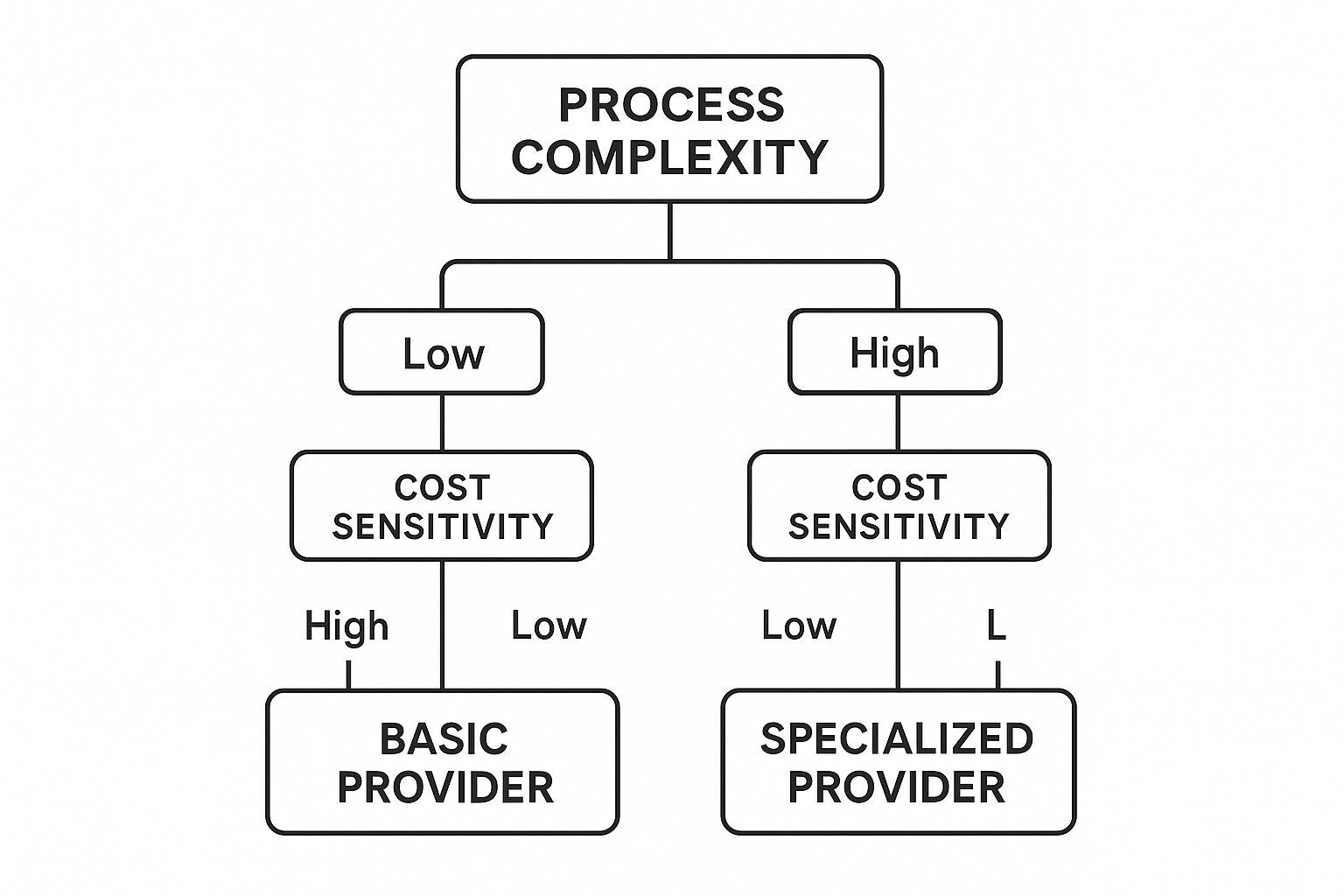
As the graphic shows, simple, low-cost tasks can be handled by a basic provider. But when you get into complex, high-stakes processes, you absolutely need a specialised partner. A crucial part of this strategic puzzle also involves comparing offshore vs nearshore outsourcing to find the best geographical and cultural match for your team.
This kind of careful thinking turns outsourcing from a simple cost-cutting tactic into a powerful engine for growth.
Finding Your Perfect Outsourcing Partner
Choosing a partner to handle one of your business processes is a massive decision. It’s not like picking out new software or ordering office supplies. Think of it more like bringing a new executive onto your team. The right partner becomes a genuine extension of your company, fully invested in seeing you succeed. The wrong one? Well, that can lead to a world of frustration.
Your first move should be to look past the price tag. I know, cost is always a factor, but honestly, it's often the least important part of the puzzle when you're building a long-term relationship. The real evaluation starts when you dig into the things that actually build a solid partnership: a shared culture, clear communication, and real technical know-how.
Look Beyond the Lowest Bid
A rock-bottom price might look great on paper, but it often signals trouble ahead. A provider might be cutting corners on training their people, skimping on data security, or they may just lack the solid infrastructure needed to grow with your business. What you're really after is a collaborator who delivers genuine value, not just a cheap service.
This means you’ve got to do your homework during the vetting process. The most successful outsourcing relationships I've seen are built on a foundation of shared goals and values. You need someone who actually gets your company's mission and is excited to help you get there.
A huge part of this is looking at where these potential partners are based and why that matters. For example, there's a reason so many businesses are turning to specific regions. Poland, for instance, is ranked 13th globally and second in Europe as a go-to spot for business service centres, including BPO. This isn't by accident. It's thanks to a highly skilled, multilingual workforce and a top-notch business environment, making it a hotspot for quality IT, finance, and customer service outsourcing. You can get a better sense of why Polish outsourcing companies are so highly regarded on axendi.com.
Choosing a location like this shows a strategic shift—it’s a move toward quality and reliability over just cost-cutting.
Key Questions to Ask Potential Partners
To really get a feel for a potential partner, you need to ask the tough questions that get to their operational DNA. Forget the slick sales pitch. You want to understand how they really work, how they treat their team, and what they do when things go wrong.
Here are a few questions I always recommend starting with:
- Talent and Culture: How do you find, train, and keep your best people? What’s your company culture like, and how do you make sure it clicks with your clients' own values?
- Communication and Reporting: What's your standard way of keeping in touch? How do you track and report on performance metrics, and how often will we sit down to review everything?
- Technology and Security: What tools and platforms do you rely on? Walk me through your data security and compliance measures, especially for regulations like GDPR.
- Scalability and Flexibility: If we need to scale our team up or down, what does that process look like? How fast can you pivot if our business needs suddenly change?
The answers you get will tell you so much more than a price quote ever could. You’re listening for detailed, confident, and transparent responses. That’s how you know they have solid processes in place.
The Importance of a Good Fit—Culturally and Technologically
At the end of the day, the best partner is one that feels like they’re already part of your team.
Cultural alignment is crucial. It ensures the people working on your account are motivated, engaged, and genuinely care about your company's mission. They won't just be ticking off tasks on a list; they'll be actively contributing to your goals, almost as if they were in the office next door.
Just as important is technological synergy. A partner using modern, compatible systems can plug right into your existing workflows without causing a headache. For example, if you're exploring enterprise process automation, you need a partner who not only gets the concept but has hands-on experience with advanced platforms. This creates a seamless flow of information and avoids the friction that comes from clashing tech.
It's this synergy that turns a simple outsourcing deal into a powerful asset for growth.
Here's the rewritten section, designed to sound natural, human, and expert-driven.
It’s Not a Contract, It’s a Partnership
Getting the contract signed is just the beginning. The ink isn’t even dry, and the real work starts. This is where you separate the good outsourcing experiences from the bad ones. It’s not about managing a vendor; it's about building a genuine, thriving partnership.
You're essentially bringing a new department into the fold, even if they're halfway around the world. Think of it like bringing a new player onto your team. You wouldn’t just throw them a jersey and expect magic on the field. You'd practice together, learn each other's moves, and build a shared understanding of the game plan. That same mindset turns a simple service agreement into a real competitive advantage.
Communication and Ground Rules: The Foundation of Trust
Let's be honest: most partnerships fail because of fuzzy communication. Don't let that happen. From day one, you need to set a clear and predictable rhythm for how you’re going to talk to each other. This isn’t about breathing down their necks; it's about creating a system that stops small misunderstandings from snowballing into massive headaches.
Here’s what that looks like in practice:
- Daily Huddles & Weekly Syncs: Set up quick daily check-ins to keep things moving and schedule deeper, more strategic meetings for once a week or every fortnight.
- A Single Point Person: Avoid confusion by having one go-to person on your side and one on theirs. It streamlines everything and makes sure someone is always accountable.
- One Set of Tools: Get everyone on the same platform, whether it’s Slack or Microsoft Teams, for daily chatter and project tracking. No more lost messages or scattered information.
You also need a shared rulebook—what we call a governance model. This is just a practical way of defining who does what, who's responsible for what, and what happens when things go sideways. When everyone knows the plan, you build a culture of clarity and respect from the get-go.
The goal is to get to a point where your outsourced team feels less like a vendor and more like colleagues just down the hall. That feeling of being ‘one team’ is the secret sauce to a great outsourcing relationship.
This doesn't happen by accident. You have to actively foster it. Share the wins, invite them to virtual company happy hours, and make sure they understand the bigger picture of what your company is trying to achieve. When they feel like they’re part of your success story, their commitment and quality of work will skyrocket.
How to Know If It’s Working: Measuring What Matters
If you can't measure it, you can't improve it. To keep the partnership healthy and productive, you need to agree on what success actually looks like in black and white. This is where Key Performance Indicators, or KPIs, come in. But please, avoid tracking metrics just for the sake of it. Focus on the numbers that genuinely move the needle for your business.
Start with a few crucial KPIs that tie directly back to why you outsourced in the first place.
- Work Quality: For a customer support team, this might be your Customer Satisfaction (CSAT) scores. For a data processing team, it could be their accuracy rate.
- Efficiency: Look at things like the average time it takes to handle a call or how many invoices get processed in a day. It’s all about smooth, productive workflows.
- Business Impact: This is the big one. Connect their work to your bottom line. Are they improving lead conversion rates? Are they helping you cut operational costs?
These KPIs aren't just for a report that sits in a drawer. They should be the cornerstone of your performance reviews. Regular check-ins that focus on these numbers—and the stories behind them—open the door for real, constructive feedback and continuous improvement. It’s a two-way conversation that helps you fine-tune your processes and gives your outsourced team the support they need to knock it out of the park.
Common Questions About Business Process Outsourcing
Dipping your toes into the world of business process outsourcing always brings up a few questions. That’s perfectly normal. After all, it's a big decision for any business, so let's walk through some of the most common concerns I hear from leaders. We'll clear things up so you can feel confident about your next steps.
A lot of managers get hung up on the idea that when they outsource a business process, they’re also giving up control. It's an understandable fear, but a modern outsourcing relationship isn't about blind faith—it's built on a foundation of complete transparency.
How Do I Keep Quality from Slipping?
This is usually the first and biggest question on everyone's mind. The trick is to stop thinking about direct, over-the-shoulder supervision and start focusing on managing performance outcomes. You don't need to micromanage to get great results.
Instead, a solid partnership is built on a few key pillars:
- Crystal-Clear Service Level Agreements (SLAs): Think of these less as legal jargon and more as your shared rulebook. They spell out exactly what you expect in terms of performance, quality standards, and timing.
- Regular Performance Check-ins: Setting up weekly or bi-weekly meetings to go over Key Performance Indicators (KPIs) is non-negotiable. This is your dedicated time to see what’s hitting the mark and what might need a little tweaking.
- Shared Technology: When everyone works from the same dashboards and communication platforms, you get a real-time window into what's happening. There are no surprises because you're always looped in.
A truly great outsourcing partner does more than just tick tasks off a list. They give you the hard data and clear insights to prove they’re delivering top-notch quality. It stops being "us versus them" and becomes a genuine collaboration aimed at hitting real, measurable goals.
What Happens to Our Data Security?
I get it. Handing over sensitive company or customer information can feel like a huge leap of faith. And frankly, it should be treated with extreme seriousness. Security isn't just a "nice-to-have" feature; it's the absolute bedrock of any BPO provider worth their salt.
Before you even think about signing a contract, you need to put their security claims under a microscope. Ask them to walk you through their compliance with standards like GDPR, show you their data encryption practices, and explain their employee access controls. A provider you can trust will be an open book, proud to demonstrate just how seriously they take protecting your data.
Will I Get Hit with Hidden Costs?
The nightmare of a budget blown by unexpected fees is a very real fear. A dirt-cheap initial quote might look attractive, but honest, transparent pricing is infinitely more valuable in the long run. A good partner will lay out all the costs upfront, with no sneaky charges waiting in the wings.
This is a fundamental part of any effort to reduce operational costs effectively. Make sure you talk through potential variables—like what happens if you need overtime or have a sudden spike in volume—and get it all written down in the contract from day one.
Ready to see how intelligent automation can handle customer interactions without missing a beat? With Voicetta, you gain a 24/7 partner that qualifies leads, books appointments, and integrates with your existing systems, freeing your team to focus on what matters most. Discover the future of customer communication at https://voicetta.com.