
Blog
Poli Czy Polii A Guide to Polish Grammar
Let’s get this sorted once and for all. If you're talking about Poland in a wide range of common sentences, the word you need is Polii, not Poli. That simple differenc...
Let’s get this sorted once and for all. If you're talking about Poland in a wide range of common sentences, the word you need is Polii, not Poli. That simple difference—one 'i' versus two—is a classic tripwire for anyone learning the language. But figuring out why it happens is the key to finally getting it right.
Getting to Grips with ‘Poli’ vs. ‘Polii’
Ever feel like Polish words are constantly changing their endings? It can be baffling at first. A good way to think about it is like a wardrobe. The basic word, Polska, is the standard outfit. But depending on what that word needs to do in a sentence—its specific role—it has to change into a different outfit to suit the occasion.
This "costume change" is a core concept in Polish grammar known as declension. It’s what makes the language so expressive.
The word ‘Polska’ is a feminine noun, and it follows a particular set of rules. When you want to say something belongs to Poland (like "the history of Poland") or that something is happening within its borders ("I live in Poland"), the word has to adapt. This is precisely where the whole ‘poli czy polii’ question comes from.
Why Does the Ending Change?
So, why Polii? Why not something else entirely? It comes down to the specific rules for feminine nouns that end in ‘-ska’. The double ‘-ii’ isn't just a quirky spelling preference; it’s a direct result of how Polish grammar and pronunciation work together.
- It creates clarity: The ending immediately tells a listener what role the word is playing. No guesswork needed.
- It sounds right: For a native speaker, this ending ensures the sentence flows naturally and sounds correct.
- It’s a consistent pattern: Once you learn this rule, you can apply it to other similar words, which actually makes the language more predictable.
Think of it this way: grammatical cases are just different jobs a noun can have. Once you learn to spot the job, you can pick the right word-ending for it. Suddenly, a confusing rule clicks into place and becomes a system you can use.
Now, let's look at exactly which of these "jobs" call for the ‘Polii’ form.
Why Do Polish Nouns Change Their Endings, Anyway?
So, you know ‘Polii’ is the right call. But why all the fuss over a couple of letters? Well, in Polish, a word's ending isn't just decoration; it's its job description. Think of it as a little tag that tells you exactly what that word is doing in the sentence.
When you see the word ‘Polska’, it needs to clock in for one of three specific jobs—or cases, as grammarians call them. Each case gives the noun a different role to play, turning it from a static name on a map into a living, breathing part of the story.
The Three Main Jobs for 'Polii'
Getting a feel for these roles is the secret to knowing when ‘Polii’ is the right move. Forget dry rules; let's think of them as different situations.
- Genitive (Dopełniacz): This is the case of "belonging to" or "coming from." It answers questions like "whose?" or "of what?". So, if you're talking about "the history of Poland," you’ve put the country in the genitive case.
- Dative (Celownik): This one’s all about giving or directing something to a person or place. It answers "to whom?" or "to what?". If you were to "give an award to Poland," that’s the dative case in action.
- Locative (Miejscownik): This case is your go-to for talking about a location or a topic. It answers "where?" or "about what?". So, if you're telling a story "about Poland," this is the case you'll need.
Here’s the thing: for feminine nouns that end in ‘-ska’ or ‘-ka’ (like our friend Polska), all three of these jobs require the same uniform—that -ii ending. It’s not just a random quirk. This change helps the word flow smoothly off the tongue, keeping the consonant sound before the vowel soft and natural. Understanding these kinds of subtle nuances is a big deal in communication, which we explore further in our guide to overcoming common customer service challenges.
This little decision tree can help visualise the process.
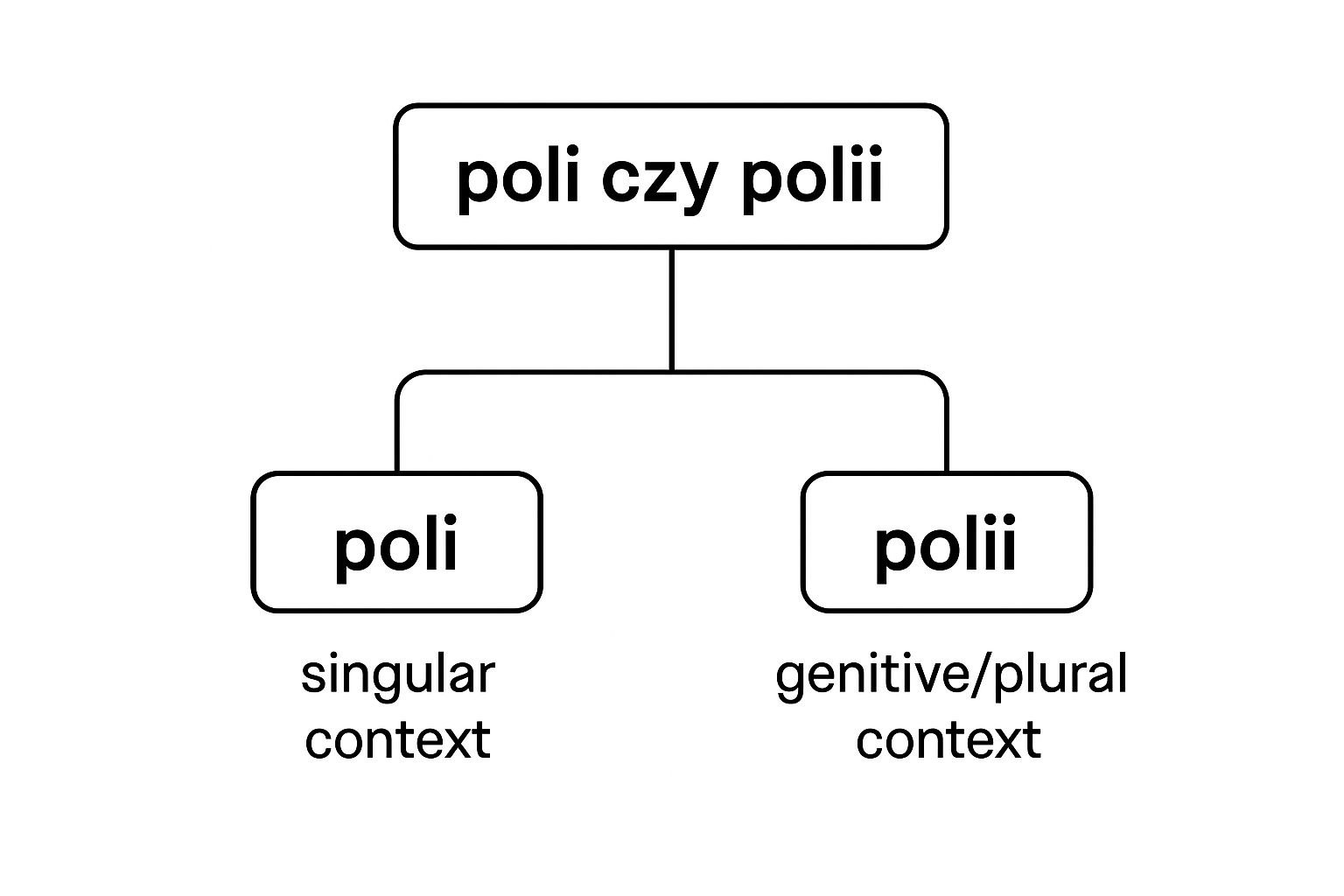
As you can see, it all comes down to the word’s role in the sentence. The context is everything.
Connecting Grammar to the Story of Poland
Let's be honest, grammar rules can feel a bit dry and abstract. But what if I told you they become much easier to remember when you connect them to a powerful story? The whole ‘poli czy polii’ question isn't just about sticking an extra 'i' on the end of a word; it’s woven into the very identity of the Polish nation.
Suddenly, understanding the story of Poland transforms the name ‘Polska’ from a simple noun into a symbol of incredible resilience. The way Polish nouns change their endings isn't just a linguistic quirk; it’s a reflection of the language's journey through a rich and often turbulent cultural landscape. This intimate bond between language and identity is also a core principle behind understanding what is language localization and how it works.
A Nation Reshaped by History
The 20th century, especially the period during and after World War II, fundamentally reshaped Poland. These weren't just historical footnotes; they were monumental events that left a permanent mark on the country's soul, its people, and its language.
The name ‘Polska’ carries the full weight of this history. Think about the staggering demographic shifts. In 1939, the country was home to over 35 million people. By 1946, that number had plummeted to less than 24 million due to war, genocide, and forced migrations.
By linking the grammar of ‘Polii’ to the narrative of Poland’s survival and identity, you’re not just memorising a rule. You’re building a stronger, more personal bond with the language and the people who speak it.
This context adds a profound layer of meaning to what might seem like a small detail. When you use ‘Polii’ correctly, you’re doing more than just getting the grammar right. You’re subtly honouring this history and showing a deeper appreciation for the culture behind the language. It’s about more than words; it's about the people and the nation they represent.
Seeing ‘Polii’ Used in Real Sentences
Grammar rules are great, but let's be honest—they don't really click until you see them in action. Theory is one thing, but watching a word work in the wild is how the lesson truly sticks. So, let’s move from the why to the how and look at some practical examples of Polii in everyday Polish sentences.
This is how you go from just knowing the rule to having a real feel for it. Soon, choosing between ‘poli’ or ‘polii’ will feel completely natural. Each example below shows ‘Polii’ doing one of its three main jobs: genitive, dative, or locative. Notice how the surrounding words give you clues about which form to use.
Unpacking the Genitive Case
Think of the genitive case as showing possession or origin. It usually answers the question "of what?" or "whose?".
- Example: Nie znam historii Polii.
- Translation: I don't know the history of Poland.
- Function: The history belongs to Poland. It’s the history of Poland, which signals the genitive case, so we use ‘Polii’.
Exploring the Dative Case
Next up is the dative case. This one is all about giving or directing something to or towards a person, place, or thing.
- Example: Dziękuję Polii za gościnność.
- Translation: I thank Poland for its hospitality.
- Function: Who are you thanking? You're giving thanks to Poland. That directional action is a classic trigger for the dative ‘Polii’.
It’s all about picking up on these contextual clues. The sentence's meaning essentially tells you which 'outfit' the word 'Polska' needs to wear. Once you see the pattern, you'll start spotting it everywhere.
Locating the Locative Case
Finally, we have the locative case. As the name suggests, it often describes a location ("where?") but it's also used to talk "about" something.
- Example: Opowiem ci o Polii.
- Translation: I will tell you about Poland.
- Function: The conversation topic is about Poland, putting it squarely in the locative case.
Getting a handle on these nuances is crucial, and not just for acing a grammar test. It’s about communicating clearly and effectively. For instance, framing a message correctly is a huge part of providing excellent service, a topic we dive into in our guide on how to improve guest satisfaction.
When you see these examples side-by-side, the whole poli czy polii debate starts to make a lot more sense. It’s not some random, confusing rule; it’s a system that gives Polish its incredible precision. The trick is to listen for the role the word is playing in the story.
How Urbanization Shaped Modern Poland
To really get a feel for a language, sometimes you have to look beyond the grammar books and into the streets where people live. The story of modern Poland is a story of dramatic transformation, and nowhere is that more visible than in its cities. Following World War II, the country launched into a massive rebuilding and industrialization project, sparking a seismic shift from rural life to city dwelling.
This era of intense change gives us a perfect, real-world backdrop for our grammar lesson. Think about it: the stories of people moving to cities, of factories rising from the rubble, and of a new national identity being forged are packed with moments to talk about Poland. Every family that left the countryside for a new start in Warsaw or Wrocław was part of a story of Poland. This historical context turns the ‘poli czy polii’ question from a dry rule into a genuine tool for telling these stories.
The Great Migration to Cities
The sheer scale of this move was incredible. Before the war, Poland was a largely rural nation. The 1931 census, for instance, showed that only 32% of the population lived in towns and cities. But the post-war industrial drive changed everything, pulling millions of people into growing urban centres for work. If you're curious, you can dig into more data on these historical population shifts to see just how profound this change was.
By linking ‘Polii’ to the tangible history of city-building, the language comes alive. It's the language people used to talk about rebuilding their nation—one brick, one factory, and one family at a time.
This migration wasn’t just about economics; it completely reshaped Polish society and culture. The language naturally evolved to describe these new realities. Just as the nation had to manage its resources to modernise and grow, businesses today face similar challenges. In fact, our article on how to reduce operational costs shares some valuable insights into streamlining processes for growth.
Sidestepping Common Mistakes with Polish Declension
Learning Polish grammar can sometimes feel like you're trying to crack a secret code. You finally get the hang of ‘poli’ vs. ‘polii’, and then you discover a whole new set of potential tripwires. But don't worry—spotting these common slip-ups ahead of time is the best way to avoid them and build your confidence.
One of the most frequent stumbles is applying the right rule to the wrong word. A learner might perfectly decline a masculine noun, then turn around and try to force that same ending onto a feminine one like ‘Polska’. It's like having two keys that look almost identical; they won't work if you mix them up.
Misapplying the Rules
Another classic beginner mistake is simply forgetting to decline the noun at all, especially when you're speaking quickly. Saying “historia Polska” instead of the correct “historia Polii” is a dead giveaway. People will still understand you, but that small detail is often the difference between sounding like a learner and sounding natural.
Here are a few key errors to keep an eye out for:
- The Single ‘-i’ Trap: This is the big one. Using Poli when it should be Polii. That double ‘ii’ is absolutely crucial for feminine nouns that end in ‘-ska’.
- Ignoring Declension Entirely: Just leaving ‘Polska’ as is, no matter where it sits in the sentence.
- Mixing Up the Genders: Borrowing declension patterns from masculine or neuter nouns and trying to apply them to feminine ones.
Every error is just a stepping stone. The moment you recognise a mistake is the moment you learn how to fix it. It turns a flash of frustration into a genuine breakthrough, a mindset that's useful far beyond just learning a language.
Getting these fine points right is a bit like handling a delicate conversation—the small details really matter. It’s all about understanding the other side, a skill we dive into in our guide on how to handle customer complaints. By consciously working to avoid these common grammatical errors, you’ll find your Polish becoming sharper and much more precise.
Your Polish Declension Questions, Answered
After wrapping your head around the ‘poli’ vs. ‘polii’ puzzle, it’s only natural for a few more questions to surface. Think of this as a quick Q&A to sort out those lingering thoughts, so you can move forward with a bit more confidence in your Polish.
Let's dive into some of the most common follow-up questions people have once they’ve grasped the basics of this rule.
Does This ‘-ii’ Rule Work for Other Countries?
Yes, it absolutely does! This is where learning the pattern really starts to feel rewarding. The rule isn't just a one-off quirk for ‘Polska’; it’s a consistent pattern for other feminine country names that end in ‘-ja’ or ‘-ia’.
For example, you'll see the same logic apply here:
- Francja (France) becomes Francji
- Hiszpania (Spain) becomes Hiszpanii
- Rosja (Russia) becomes Rosji
The trick is always to spot the noun's gender and its ending. Once you've got that down, you can apply the declension with confidence.
So, Why Is ‘Poli’ Actually Wrong?
It’s true that in a very casual chat, a native speaker would probably figure out what you mean. But grammatically speaking, ‘Poli’ is a mistake. The double ‘-ii’ in ‘Polii’ is there for a reason, baked into Polish spelling and pronunciation rules for this group of nouns. It’s what keeps the consonant sound soft before the vowel.
Getting ‘Polii’ right is about more than just following the rules. It signals a deeper respect for the language and its structure. It shows you’re not just memorising words, but truly understanding how they fit together.
Which Cases Should I Learn First?
If you’re just starting out, don't try to swallow the whole system at once. Your best bet is to get really comfortable with the Nominative (the subject, answering 'who/what?') and the Accusative (the direct object). They’re the most common and often the simplest.
You'll see them constantly:
- “To jest Polska.” (This is Poland - Nominative)
- “Lubię Polskę.” (I like Poland - Accusative)
Once those feel natural, the Genitive case (where you'll use Polii) is the next logical step. It’s incredibly common too. Taking it piece by piece makes the whole system feel much less intimidating.
At Voicetta, we know that clear communication builds real connection. Our AI-powered platform makes sure your business never misses a beat, handling every customer interaction with precision and care, 24/7. Find out how we can support your team at https://voicetta.com.
Was this useful?
If this article helped, add Voicetta as a preferred source in Google Search. Your results can then highlight our writing.
Add as preferred source