
Blog
10 Game-Changing Applications of NLP
This article explores 10 key applications of NLP, demonstrating how this technology streamlines tasks and improves efficiency across various industries. Discover how t...
Unlocking the Power of Language with NLP
This article explores 10 key applications of NLP, demonstrating how this technology streamlines tasks and improves efficiency across various industries. Discover how these applications of NLP—from machine translation and sentiment analysis to chatbots and text summarization—can provide valuable insights, automate processes, and enhance customer experiences. Whether you're in customer support, healthcare, real estate, or IT, understanding these core NLP applications is crucial for staying competitive and leveraging the power of language data. This list will cover the key concepts and their impact on your business.
1. Machine Translation
Machine translation, a prominent application of Natural Language Processing (NLP), revolutionizes how we interact with different languages. It automates the process of converting text or speech from one language (the source language) into another (the target language). This technology breaks down linguistic barriers, fostering seamless communication across cultures and industries. While earlier methods relied on statistical models with limited contextual understanding, modern machine translation systems leverage the power of neural machine translation (NMT). NMT uses deep learning models, particularly sequence-to-sequence models, to learn complex patterns and relationships within languages, enabling more accurate and nuanced translations.
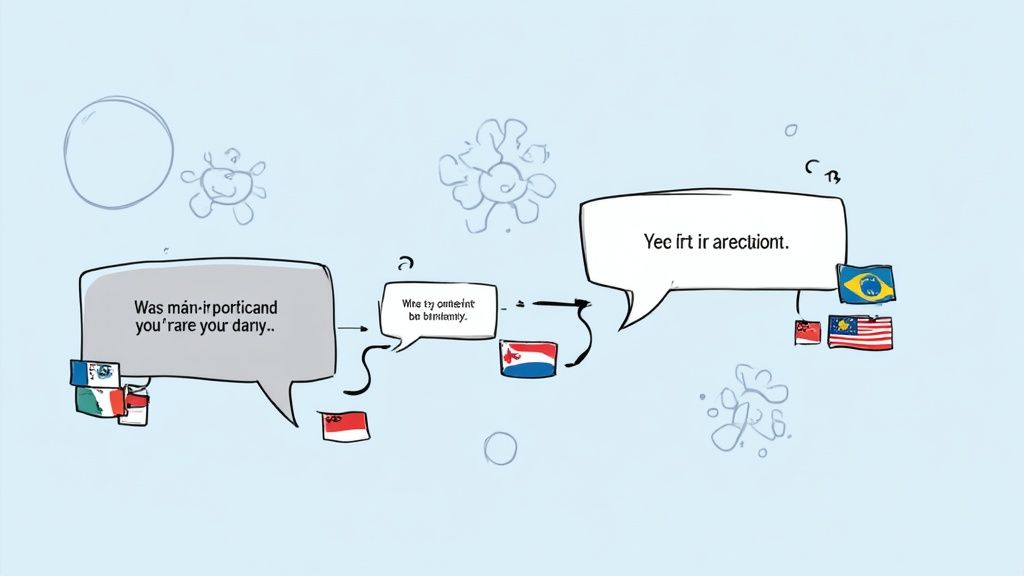
NMT architectures, often incorporating attention mechanisms, process entire sentences, capturing long-range dependencies and contextual information crucial for producing high-quality translations. This contrasts with older statistical approaches that translated phrases in isolation, frequently leading to disjointed and inaccurate outputs. The "attention" mechanism allows the model to focus on relevant parts of the source sentence when generating each word in the target language, significantly improving accuracy and fluency. Modern machine translation systems can handle multiple language pairs, offering real-time translation capabilities and options for domain-specific customization. This versatility makes them invaluable for diverse applications.
The benefits of machine translation are undeniable. It provides significantly faster and more cost-effective translation solutions compared to human translators, especially for large volumes of content. This efficiency is crucial for businesses operating globally, enabling them to reach broader audiences and expand their market reach. Furthermore, machine translation systems continuously improve as they are exposed to more training data, leading to enhanced translation quality over time.
Examples of successful machine translation implementations are abundant. Google Translate, a pioneer in the field, handles over 100 languages and billions of translations daily. DeepL, known for its professional-grade translations, provides a nuanced understanding of context, producing highly accurate and natural-sounding output. Microsoft Translator integrates seamlessly with their productivity tools, facilitating multilingual communication in various business settings. Facebook also utilizes machine translation extensively to automatically translate posts and comments, connecting users worldwide.
However, despite significant advancements, challenges remain. Machine translation still struggles with highly idiomatic expressions, slang, and culturally specific nuances. The quality of translation can vary across language pairs, particularly for low-resource languages with limited training data. Context misinterpretation can also lead to errors, and specialized terminology may not be accurately translated.
When and why to use this approach:
Machine translation is particularly useful for:
- Customer support: Providing multilingual support to a global customer base.
- Hospitality: Facilitating communication between staff and international guests.
- Real Estate: Translating property listings and communication with foreign investors.
- Healthcare: Enabling communication between medical professionals and patients speaking different languages.
- Enterprise IT: Localizing software and documentation for international markets.
- Content creation and dissemination: Translating marketing materials, news articles, and other content for a global audience.
Tips for effective machine translation:
- Post-editing: Employ human translators for reviewing and refining critical content, ensuring accuracy and conveying nuances lost in automated translation.
- Custom models: Train custom models on industry-specific terminology to improve translation accuracy within your specific domain.
- Clear source text: Provide clear, grammatically correct source text for optimal translation results. Ambiguity and errors in the source text can be amplified in the translated output.
- Context window: Be mindful of context window limitations when translating longer texts. Breaking down large texts into smaller segments can improve coherence and accuracy.
Machine translation's ability to bridge communication gaps and facilitate global interaction makes it a cornerstone application of NLP, deserving its place at the forefront of this technology's advancements. Its continued development promises further improvements in accuracy and fluency, unlocking even greater potential for cross-cultural understanding and collaboration.
2. Sentiment Analysis
Sentiment analysis, a powerful application of NLP, unlocks the ability to understand the emotional tone behind text. It goes beyond simply identifying words; it interprets the context and nuances within written language to categorize text as positive, negative, or neutral. More sophisticated sentiment analysis tools can even identify a wider range of emotions, like excitement, frustration, or anger, and quantify their intensity. This empowers organizations to gain invaluable insights into public perception regarding their brand, products, or services across a myriad of platforms. This makes it a crucial tool for anyone interacting with customers or the public, from customer support managers and hospitality professionals to CEOs and CTOs.

How it Works and Key Features:
Sentiment analysis utilizes NLP algorithms to process text data. These algorithms are trained on vast datasets of text labeled with corresponding sentiments. Features enabling powerful analysis include:
- Multi-level Sentiment Classification: Moving beyond basic positive/negative/neutral classifications, advanced tools offer nuanced scales and identify specific emotions.
- Aspect-Based Sentiment Analysis: Pinpoints the sentiment associated with specific aspects or features of a product or service. For example, a customer might be happy with the delivery speed but unhappy with the product quality.
- Real-Time Monitoring Capabilities: Allows businesses to track sentiment as it changes, enabling immediate responses to emerging trends or crises.
- Cross-Platform Data Aggregation: Gathers data from various sources, such as social media, review sites, and customer surveys, for a comprehensive view of sentiment.
- Visualization Tools for Trend Analysis: Presents data in easily understandable formats, facilitating the identification of patterns and trends over time.
Why Use Sentiment Analysis?
Sentiment analysis deserves its place on this list due to its wide-ranging applicability and the actionable insights it provides. Understanding public opinion is critical for any organization. For example, a healthcare provider might use it to understand patient satisfaction, while a real estate agent could gauge market sentiment towards a particular property.
Pros and Cons:
Pros:
- Brand Perception Monitoring at Scale: Analyze massive amounts of data to understand how your brand is perceived by the public.
- Actionable Insights for Product Improvement: Identify areas where products or services need improvement based on customer feedback.
- Early Identification of PR Crises: Detect negative sentiment spikes early on, allowing for proactive crisis management.
- Marketing Campaign Effectiveness Tracking: Measure the impact of marketing campaigns on public sentiment.
- Competitive Analysis: Analyze competitor sentiment to identify opportunities and threats.
Cons:
- Difficulty with Subtleties: Sarcasm, irony, and other nuanced emotional cues can be difficult for algorithms to detect accurately.
- Cultural and Contextual Nuances: Language varies across cultures and contexts, leading to potential misinterpretations.
- Domain-Specific Language: Specialized industries often use specific terminology, requiring custom-trained models for accurate analysis.
- Short Text Challenges: Accuracy can suffer when analyzing short texts like tweets due to limited context.
Examples of Successful Implementation:
- Brandwatch: Analyzes social media sentiment for major brands, providing insights into consumer trends and brand perception.
- Amazon: Leverages sentiment analysis on product reviews to understand customer satisfaction and identify areas for product improvement.
- Airlines: Monitor customer sentiment on Twitter for rapid response to complaints and issues.
- Uber: Analyzes driver and rider feedback to improve the user experience and address concerns.
- Political Campaigns: Gauge public reaction to speeches and policies to refine messaging and strategies.
Actionable Tips for Implementation:
- Human Oversight: Combine sentiment analysis with human review, especially in sensitive situations.
- Custom Models: Train custom models for your industry's terminology and specific needs.
- Focus on Trends: Prioritize analyzing sentiment trends rather than individual data points.
- Cultural Context: Consider cultural differences when analyzing global data.
- Aspect-Based Analysis: Use aspect-based analysis to identify specific areas for product or service improvement.
Popularized By:
The field of sentiment analysis has been significantly shaped by researchers like Bing Liu (University of Illinois) and Bo Pang and Lillian Lee, along with companies like Brandwatch, Hootsuite, and Sprinklr. Twitter's acquisition of sentiment analysis companies further solidified its importance in the social media landscape.
3. Chatbots and Virtual Assistants
Chatbots and virtual assistants represent one of the most widespread and impactful applications of NLP. These intelligent systems leverage NLP to understand, interpret, and respond to human language, enabling natural and engaging conversational experiences. They range from simple rule-based systems providing predefined responses to sophisticated AI-powered assistants capable of understanding complex queries, performing tasks, and maintaining context throughout extended conversations. This makes them invaluable for a variety of businesses, from customer support to hospitality, real estate, healthcare, and beyond.
One of the key reasons chatbots and virtual assistants deserve a prominent place in this list of NLP applications is their ability to bridge the gap between human communication and computer systems. By understanding the nuances of human language, these tools can provide seamless and intuitive interactions, enhancing user experiences and streamlining various processes.
Here's how they achieve this:
- Intent Recognition: This core NLP technique allows chatbots to decipher the underlying purpose of a user's message, understanding what the user is trying to accomplish.
- Entity Extraction: This process identifies and classifies key pieces of information within the text, such as dates, locations, names, and product specifications. This granular understanding is crucial for providing accurate and relevant responses.
- Dialogue Management: This component manages the flow of conversation, maintaining context across multiple turns and ensuring a coherent interaction. It enables chatbots to remember past interactions and respond appropriately to follow-up questions.
- Context Maintenance: Maintaining context is vital for meaningful conversations. These systems track the ongoing dialogue, enabling personalized and relevant responses.
- Integration with Backend Systems: Chatbots and virtual assistants often integrate with backend systems, databases, and APIs to execute tasks like booking appointments, processing orders, or retrieving information.
- Personality and Tone Consistency: Developing a consistent personality and tone for the chatbot enhances the user experience and builds brand identity.
The benefits of deploying chatbots and virtual assistants are numerous:
-
Pros:
- 24/7 Availability: Offer round-the-clock customer support, enhancing accessibility and customer satisfaction.
- Scalability: Handle thousands of interactions simultaneously, reducing wait times and improving efficiency.
- Consistency: Provide consistent responses to common queries, ensuring standardized service delivery.
- Cost Reduction: Lower operational costs compared to human agents, optimizing resource allocation.
- Data Collection: Gather valuable data on customer interactions for business insights and process improvement.
-
Cons:
- Limited Understanding: May struggle with complex or ambiguous requests, leading to inaccurate responses.
- User Frustration: Potential for user frustration when misunderstandings occur, particularly with complex issues.
- Handling Unexpected Queries: Challenges handling queries or conversation flows outside the pre-defined scope.
- Maintenance: Require regular maintenance and updates to stay relevant and effective.
- Language Barriers: May struggle with heavy accents or non-standard language, limiting accessibility.
When implementing a chatbot or virtual assistant, consider these helpful tips:
- Defined Use Cases: Start with clearly defined use cases and gradually expand functionality.
- Fallback Mechanisms: Implement robust fallback mechanisms for graceful error handling and seamless human handoff.
- Continuous Training: Continuously train the system with real conversation data to improve accuracy and responsiveness. For effective automated communication, resources like automated replies from TriageFlow offer valuable insights and practical examples for crafting engaging and effective automated responses.
- User-Centric Design: Design conversation flows with user experience in mind, ensuring clarity and ease of use.
- Human Handoff: Provide a seamless handoff to human agents for complex or sensitive issues.
- Extensive Testing: Test the system extensively with diverse user groups to identify and address potential issues.
Examples of successful chatbot and virtual assistant implementations abound:
- Amazon Alexa: Manages smart home devices, answers questions, and provides various other services.
- Google Assistant: Offers contextual help across devices, answers queries, and performs tasks.
- Intercom's Resolution Bot: Resolves customer inquiries automatically, reducing the need for human intervention.
- Bank of America's Erica: Assists with banking tasks, provides financial guidance, and answers account-related queries.
- Sephora's beauty assistant: Helps customers find products, provides beauty advice, and offers personalized recommendations.
These examples demonstrate the transformative potential of chatbots and virtual assistants across various industries. They exemplify how NLP applications can enhance customer service, streamline operations, and improve overall user experience. To delve deeper into this fascinating topic, Learn more about Chatbots and Virtual Assistants.
These systems have been popularized by tech giants like Amazon (Alexa), Google (Google Assistant), Apple (Siri), Microsoft (Cortana), OpenAI (ChatGPT), and Anthropic (Claude), showcasing the growing importance and adoption of this technology.
4. Text Summarization
Text summarization is a powerful application of NLP that transforms lengthy documents into concise, digestible summaries. This process retains the core meaning and key information of the original text, enabling efficient information consumption in various professional settings. Whether dealing with articles, reports, research papers, or other text-heavy content, text summarization streamlines information processing and facilitates quicker decision-making. This makes it a valuable tool for busy professionals in diverse fields, from healthcare to customer support and beyond.

At its core, text summarization leverages NLP techniques to identify and extract the most important information from a given text. There are two primary approaches: extractive summarization, which selects and combines important sentences from the original document verbatim, and abstractive summarization, which generates entirely new sentences that capture the essence of the original text, much like a human would summarize. Modern summarization tools often incorporate features like length control, topic focusing, and even multi-document and cross-language summarization capabilities.
Why Text Summarization Deserves Its Place on this List:
In today's information-saturated world, the ability to quickly grasp the key takeaways from lengthy documents is essential. Text summarization directly addresses this need, offering tangible benefits across numerous professions. Its inclusion in this list of NLP applications is justified by its broad applicability and potential to significantly improve productivity and decision-making. This is particularly valuable for roles requiring rapid information processing, like customer support managers sifting through customer feedback or CEOs needing to stay abreast of industry trends.
Benefits and Features:
- Reduced Reading Time: Significantly cuts down the time spent consuming long documents. Imagine a healthcare provider quickly summarizing patient history or a real estate agent summarizing property details for clients.
- Information Overload Management: Helps professionals navigate the overwhelming amount of data they encounter daily. This is crucial for enterprise IT managers dealing with system logs or CTOs analyzing market research reports.
- Faster Decision-Making: Provides quick access to essential information, enabling more informed and efficient decisions. Think of a customer support manager resolving issues quickly or a business owner making strategic choices based on summarized market data.
- Content Curation at Scale: Allows for the efficient summarization of vast amounts of content, supporting content curation and knowledge management efforts.
- Enhanced Accessibility: Makes content more accessible to individuals with varying attention spans and learning styles.
Examples of Successful Implementation:
- Primer AI: Summarizes news and intelligence reports, providing actionable insights to decision-makers.
- Salesforce: Uses summarization for customer support cases, allowing agents to quickly understand customer issues and provide efficient solutions.
- Grammarly: Offers document summarization features, assisting users in condensing their writing and highlighting key points.
- TLDR This: Summarizes research papers, making complex academic information more accessible.
Pros and Cons:
- Pros: Reduced reading time, information overload management, faster decision-making, content curation at scale, increased accessibility.
- Cons: Potential loss of nuanced points (especially with extractive methods), occasional factual inaccuracies with abstractive systems, challenges with highly specialized content, potential structure and coherence issues with very long documents.
Actionable Tips:
- Verify Facts: Always cross-check crucial information from summaries against the original source, especially for critical decisions.
- Choose the Right Method: Opt for extractive summarization when dealing with highly technical, legal, or sensitive content to minimize the risk of misinterpretation.
- Consider Domain-Specific Models: For specialized fields, explore using summarization models trained on relevant industry data for better accuracy and relevance.
- User Controls: Implement options for users to control summary length and focus based on their specific needs.
- Combine with Keyword Extraction: Use keyword extraction alongside summarization to enhance topic identification and context understanding.
By understanding the strengths and limitations of text summarization and applying these tips, professionals across various industries can leverage this potent NLP application to improve their efficiency, decision-making, and overall productivity.
5. Named Entity Recognition
Named Entity Recognition (NER), a crucial application of NLP, empowers computers to understand and extract key information from text by identifying and classifying named entities. These entities can range from people, organizations, and locations to dates, times, quantities, and monetary values. This ability to pinpoint specific information makes NER a cornerstone of many information extraction systems and a valuable tool across various industries. As a powerful application of NLP, NER enhances efficiency, improves decision-making, and opens doors to new possibilities in data analysis and automation.
How NER Works:
NER systems typically employ a combination of statistical and rule-based approaches. Machine learning models, often trained on vast amounts of annotated data, learn to recognize patterns and contexts associated with different entity types. These models then predict the likelihood of a word or phrase belonging to a specific category. Rule-based systems, on the other hand, leverage predefined patterns and dictionaries to identify entities. Sophisticated NER systems often combine both methods for optimal performance.
Features and Benefits:
NER boasts several key features contributing to its wide applicability:
- Identification and Classification of Standard Entities: Recognizes common entities like people, organizations, locations, dates, times, and more.
- Domain-Specific Entity Recognition: Customizable to identify entities specific to a particular field, such as gene names in biomedical research or legal terms in legal documents.
- Multilingual Support: Can be adapted and trained for various languages, facilitating global applications.
- Context-Aware Disambiguation: Distinguishes between entities with the same name based on the surrounding context (e.g., "Apple" the company vs. "apple" the fruit).
- Relationship Extraction: Can identify relationships between entities, such as employment relationships ("John Doe works at Google").
Pros and Cons:
| Pros | Cons |
|---|---|
| Automated metadata tagging and indexing | Accuracy challenges with ambiguous entities |
| Powers knowledge graph construction | Performance varies across different entity types |
| Improves search functionality | Requires substantial training data for specialized domains |
| Facilitates content recommendation systems | May struggle with novel entities not seen during training |
| Supports compliance and risk management |
Examples of Successful Implementation:
- Legal and Financial: Thomson Reuters uses NER to process legal and financial documents, automating information extraction and analysis.
- Healthcare: Healthcare systems leverage NER to extract crucial medical information from clinical notes, aiding in diagnosis and treatment.
- Search Enhancement: Google Search uses NER to understand user queries better and provide more relevant search results.
- Financial Compliance: Financial institutions use NER to monitor transactions for names on sanctions lists, ensuring regulatory compliance.
- News and Media: News organizations automatically tag articles with relevant entities, improving searchability and content organization.
Tips for Effective Implementation:
- Start with Pre-trained Models: Leverage pre-trained NER models and fine-tune them with data specific to your domain.
- Maintain Entity Dictionaries: Create and maintain dictionaries of specialized terminology for your industry or area of focus.
- Post-processing Rules: Implement post-processing rules to address domain-specific patterns and improve accuracy.
- Ensemble Approaches: Consider combining statistical and rule-based methods for enhanced performance.
- Error Correction Mechanisms: Design mechanisms to identify and correct common entity recognition errors.
When and Why to Use NER:
Consider employing NER when you need to:
- Automate Information Extraction: Extract key information from large volumes of text data.
- Improve Search Accuracy: Enhance search functionality by understanding the entities involved in user queries.
- Build Knowledge Graphs: Create knowledge bases by extracting and linking entities and their relationships.
- Support Compliance Efforts: Monitor text data for specific entities related to regulations and compliance requirements.
- Personalize User Experiences: Tailor content recommendations based on recognized entities and user interests.
Popularized By:
The development and popularization of NER are attributed to the contributions of organizations like the Stanford NLP Group, spaCy (Explosion AI), IBM Watson, and AllenNLP, as well as researchers like Christopher Manning and Dan Roth.
By accurately identifying and classifying key information within text, NER provides a powerful foundation for various applications of NLP, ultimately leading to more efficient workflows, improved decision-making, and new opportunities for innovation across diverse sectors. This makes NER a deserving and important inclusion in any list of key NLP applications.
6. Question Answering Systems
Question Answering (QA) systems represent a powerful application of NLP, transforming how we access and interact with information. These systems leverage natural language processing to understand questions posed in everyday language, retrieve relevant information from diverse sources, and formulate coherent answers. This capability enables more intuitive human-computer interaction and drastically improves the efficiency of information access, making it a valuable tool for a wide range of professionals, from Customer Support Managers and Healthcare Providers to CEOs and CTOs.
At its core, a QA system deconstructs a user's question, analyzes its meaning and intent, and then searches for the best possible answer. This process can involve several steps, including identifying keywords, understanding the question's context, and searching through vast databases or knowledge graphs. Modern QA systems employ various techniques, including:
- Open-domain question answering: These systems can tackle questions across a broad range of topics, drawing upon general knowledge resources.
- Closed-domain systems: These specialize in answering questions within a specific field, like medicine or law, using a curated knowledge base.
- Extractive QA: This approach locates the answer directly within a provided text, essentially highlighting the relevant passage.
- Generative QA: This more sophisticated approach generates entirely new answers based on the system's understanding of the topic, offering more flexibility and allowing for summarization and synthesis of information.
- Multi-hop reasoning: This allows the system to answer complex questions that require combining information from multiple sources or drawing inferences.
- Evidence citation and source attribution: Increases transparency and trustworthiness by indicating where the answer was derived from.
The benefits of integrating QA systems are numerous. They provide direct answers rather than a list of search results, saving users valuable time and effort. They handle natural language, meaning users can ask questions as they naturally would, without needing to formulate specific keywords or queries. Furthermore, QA systems can integrate with existing knowledge bases and databases, making access to internal information more efficient. For example, a Healthcare Provider could quickly access patient records or research relevant medical literature through a QA system, while a Real Estate Agent could access property information or market trends.
However, QA systems also have limitations. Accuracy can be an issue with complex, ambiguous, or nuanced questions. Pre-trained models have a "knowledge cutoff," meaning they are unaware of information generated after their training period. There's also the potential for "hallucination," where the system generates incorrect or nonsensical information. Finally, comprehensive QA systems can be computationally intensive, requiring significant resources.
Examples of successful QA system implementations abound:
- IBM Watson's victory on Jeopardy! showcased the power of NLP in answering complex questions in real-time.
- Google's featured snippets provide direct answers to user queries directly within search results.
- Wolfram Alpha excels at answering computational and knowledge-based questions.
- Specialized platforms like ROSS Intelligence use QA for legal research, streamlining the process for legal professionals.
- In healthcare, medical diagnostic support systems are emerging that can answer clinical questions, assisting doctors in diagnosis and treatment planning.
Tips for effective QA system implementation:
- Implement confidence scoring to help users identify potentially unreliable answers.
- Provide source citations for verification and transparency.
- Use retrieval-augmented generation to improve factual accuracy.
- Design the system to handle conversational follow-up questions for a more natural interaction.
- For specialized applications, invest in building a robust, domain-specific knowledge base.
Learn more about Question Answering Systems
Question Answering systems deserve their place in the list of essential NLP applications because they directly address the growing need for quick and easy access to information. By streamlining information retrieval and presenting it in a user-friendly format, they empower individuals and organizations to make better decisions, improve productivity, and enhance customer experiences. This technology has been popularized by key players like IBM (Watson), Google (BERT, LaMDA), OpenAI (GPT models), Anthropic (Claude), Meta (DrQA), and researchers like Sebastian Thrun and Percy Liang, driving continuous advancements in the field. Whether you're a business owner seeking to improve customer service, a CTO exploring new technological avenues, or an Enterprise IT Manager seeking to streamline information access, understanding and implementing QA systems can provide significant advantages.
7. Information Extraction
Information Extraction (IE) is a powerful application of NLP that addresses the challenge of transforming unstructured text data into actionable, structured information. This process allows businesses and organizations to unlock the wealth of knowledge trapped within documents, emails, reports, and other textual sources, enabling data-driven decision making and automating key processes. As a core application of NLP, IE deserves its place on this list due to its wide applicability and potential to significantly improve efficiency and insights across diverse industries.
How it Works:
IE utilizes various NLP techniques to identify and categorize relevant information within text. This involves several key steps:
-
Preprocessing: Cleaning and preparing the text by removing noise, handling special characters, and potentially breaking down complex sentences.
-
Entity Recognition and Classification: Identifying key entities like people, organizations, locations, dates, and other domain-specific terms. These entities are then classified into predefined categories.
-
Relationship Extraction: Establishing connections between identified entities. For example, identifying the employment relationship between a person and an organization.
-
Event Detection and Tracking: Identifying specific events and their associated attributes, such as time, location, and participants.
-
Template Filling: Extracting information to populate predefined templates, creating structured records for databases or other systems.
-
Temporal Information Extraction: Identifying and normalizing dates and times mentioned in the text.
-
Coreference Resolution: Linking different mentions of the same entity throughout the text. For example, resolving pronouns like "he" or "she" to their corresponding entities.
Features and Benefits:
IE offers several key features that contribute to its value:
- Entity extraction and classification: Accurately identifies and categorizes key information.
- Relationship extraction between entities: Uncovers connections and dependencies within the data.
- Event detection and tracking: Monitors occurrences and their impact.
- Template filling for standardized information: Streamlines data entry and integration.
- Temporal information extraction: Provides chronological context to events and data.
- Coreference resolution for connected entities: Ensures accurate and comprehensive understanding of relationships.
These features lead to numerous benefits:
- Automates the conversion of unstructured text to structured data: Saves time and resources.
- Enables large-scale processing of documents: Handles massive datasets efficiently.
- Facilitates knowledge discovery from text collections: Unlocks insights hidden within text.
- Supports business intelligence and data-driven decision making: Provides actionable information.
- Reduces manual data entry and associated errors: Improves data quality and accuracy.
Examples of Successful Implementation:
- Finance: Bloomberg extracting financial events from news articles to inform trading decisions.
- Healthcare: Healthcare systems extracting medical findings from clinical notes to improve patient care and research.
- Legal: Legal tech companies automating contract analysis for due diligence and risk assessment.
- Intelligence: Intelligence agencies processing large volumes of reports to identify threats and patterns.
- Academia: Academic platforms extracting research findings from publications to support literature reviews and meta-analyses.
Pros and Cons:
Pros: As mentioned above, IE offers significant advantages in automation, scalability, knowledge discovery, and decision making.
Cons:
- Accuracy challenges with complex or ambiguous text: Requires careful model training and refinement.
- Domain adaptation requirements for specialized content: May need customization for specific industries or applications.
- May miss contextual nuances or implied information: Focuses primarily on explicit information.
- Structured output schema design can be challenging: Requires careful planning and domain expertise.
Actionable Tips for Implementation:
- Define clear extraction schemas based on business needs: Ensure the extracted information aligns with your objectives.
- Start with high-precision extractions for critical information: Prioritize accuracy for the most important data points.
- Implement human-in-the-loop verification for important decisions: Combine automated extraction with human review for crucial decisions.
- Use domain-specific models for specialized terminology: Improve accuracy by leveraging pre-trained models or training your own on relevant data.
- Consider rule-based approaches alongside ML for highly structured information: Combine different techniques for optimal performance.
When and Why to Use Information Extraction:
IE is particularly valuable when:
- You need to extract structured data from large volumes of unstructured text.
- You want to automate data entry and analysis processes.
- You need to gain insights from textual data to support decision-making.
- You are working with domain-specific text data that requires specialized processing.
By leveraging the power of NLP, Information Extraction provides a crucial bridge between raw text data and actionable insights, empowering organizations across various sectors to make better use of their information assets. Companies like Thomson Reuters, IBM Watson Knowledge Studio, Refinitiv, and John Snow Labs, along with the groundbreaking research of individuals like Ralph Grishman and Beth Sundheim, have been instrumental in popularizing and advancing the field of Information Extraction.
8. Text Classification: Organizing the Deluge of Data
Text classification is a powerful application of NLP that automatically categorizes text into predefined groups, bringing order to the chaos of unstructured data. This fundamental technique analyzes the content and structure of text – be it a short message or a lengthy document – to determine its topic, sentiment, intent, or other relevant characteristics. This allows businesses and organizations to automate workflows, extract valuable insights, and make data-driven decisions. This application of NLP is crucial in today's data-driven world, enabling efficient management and analysis of large volumes of textual information.
How it Works:
Text classification algorithms, often powered by machine learning models, learn to categorize text based on patterns and relationships within labeled training data. These models analyze word frequencies, sentence structure, and semantic context to assign documents to specific categories. For example, a spam filter learns to identify junk mail by recognizing common phrases, sender addresses, and other telltale signs.
Features and Benefits:
- Multi-class and Multi-label Classification: Categorize text into single or multiple categories simultaneously (e.g., a news article could be classified as both "Politics" and "International").
- Hierarchical Classification: Organize categories into nested structures for complex classification tasks (e.g., "Customer Support" -> "Billing Issues" -> "Invoice Discrepancy").
- Short Text and Long Document Handling: Analyze text of varying lengths, from tweets to legal documents.
- Classification Confidence Scoring: Assess the certainty of each classification decision, allowing for prioritized review of low-confidence predictions.
- Zero-shot and Few-shot Learning: Enable classification even with limited or no labeled data for specific categories.
- Explainable Classification Decisions: Understand the rationale behind classifications, increasing transparency and trust.
Pros:
- Automates Document Sorting and Routing: Streamline workflows by automatically directing information to the appropriate departments or individuals (e.g., routing customer support tickets).
- Enables Content Moderation at Scale: Identify and filter inappropriate or harmful content across vast platforms.
- Improves Searchability and Organization of Information: Facilitate efficient retrieval of information through categorized archives and databases.
- Supports Compliance Monitoring and Risk Detection: Analyze text data to identify potential legal or regulatory violations.
- Facilitates Data-Driven Decision Making: Gain insights from classified data to inform business strategies and operations.
Cons:
- Requires Labeled Training Data: Supervised learning approaches need significant amounts of labeled data, which can be time-consuming and expensive to acquire.
- Challenges with Emerging Categories: Models may struggle to classify text into categories not present in the training data.
- Impact of Document Length and Clarity: Classification accuracy can be affected by the length and clarity of the text.
- Class Imbalance Issues: Uneven distribution of training examples across categories can lead to biased performance.
Examples of Successful Implementation:
- Gmail's Automatic Email Categorization: Filters emails into Primary, Social, and Promotions tabs.
- Content Moderation Systems: Flags harmful content on social media platforms.
- Customer Support Systems: Routes support tickets based on issue type.
- News Aggregators: Categorizes articles by topic (e.g., Sports, Business, Technology).
- Healthcare Systems: Categorizes patient messages by urgency.
Tips for Effective Text Classification:
- Define Clear Categories: Ensure categories are well-defined and mutually exclusive.
- Balance Training Data: Strive for an even distribution of examples across all categories.
- Hierarchical Approach for Large Category Sets: Use nested categories for better organization and accuracy.
- Active Learning: Strategically label new data points to improve models efficiently.
- Ensemble Methods: Combine multiple classification models for improved accuracy.
- Regular Retraining: Update models periodically as new data becomes available and category distributions change.
Popularized By:
Pioneering work by researchers like Andrew McCallum and Thorsten Joachims has laid the foundation for modern text classification. Companies like Google (email and content classification), Facebook (content moderation), and Zendesk (ticket classification) have successfully implemented text classification for various applications.
Text classification, as an application of NLP, provides invaluable solutions for managing and analyzing text data, making it a crucial tool for a wide range of professionals, from customer support managers and healthcare providers to CEOs and CTOs looking to unlock the potential of their textual data. Its ability to automate tasks, improve decision-making, and extract valuable insights from unstructured text firmly establishes its position as a key application of NLP.
9. Speech Recognition
Speech Recognition, a powerful application of NLP, transforms spoken language into written text. While often considered a separate field, its core functionality deeply relies on Natural Language Processing (NLP) techniques. This makes it a crucial component in the broader landscape of NLP applications, deserving its place on this list. Modern speech recognition systems leverage a combination of acoustic modeling (analyzing the sounds of speech) and language processing (understanding the structure and meaning of language) to accurately transcribe speech across varying accents, environments, and speaking styles. This capability unlocks a wide range of applications, from voice-controlled interfaces to comprehensive transcription services.
How it Works:
Speech recognition systems typically involve several steps:
-
Acoustic Modeling: The system analyzes the audio input, breaking down the sound waves into phonemes (basic units of sound). This involves complex algorithms that consider factors like frequency, intensity, and duration.
-
Language Modeling: NLP comes into play here. The system uses statistical models and linguistic rules to predict the most likely sequence of words based on the recognized phonemes. This involves understanding grammar, syntax, and vocabulary.
-
Decoding: The system combines the acoustic and language models to determine the most probable text transcription of the spoken words.
Features and Benefits:
Speech recognition boasts several key features that drive its utility:
- Real-time Transcription Capabilities: Convert speech to text instantly, enabling dynamic interactions.
- Speaker-Independent Recognition: Accurately transcribe speech from various individuals without prior training.
- Noise-Robust Processing: Minimize the impact of background noise on transcription accuracy.
- Multi-Language Support: Transcribe speech in multiple languages, expanding accessibility and reach.
- Domain-Specific Vocabulary Adaptation: Improve accuracy within specialized fields by incorporating relevant terminology.
- Punctuation and Formatting Prediction: Generate text with proper punctuation and formatting for enhanced readability.
- Speaker Diarization: Identify who said what in multi-speaker conversations, valuable for meeting transcriptions and analysis.
Pros:
- Enables hands-free device control and data entry, increasing efficiency and convenience.
- Makes content accessible to people with disabilities, promoting inclusivity.
- Facilitates automated meeting transcription, saving time and resources.
- Supports voice search and command interfaces, streamlining user interactions.
- Enables voice analytics for call centers, providing valuable insights into customer interactions.
Cons:
- Accuracy challenges with uncommon accents and dialects can still pose a limitation.
- Performance can degrade in noisy environments, affecting reliability.
- Processing technically heavy speech with specialized terminology can be challenging.
- Privacy concerns associated with voice data collection must be addressed.
- Energy consumption on mobile devices can be a factor for continuous usage.
Examples of Successful Implementation:
- Amazon Alexa: Processes voice commands across millions of households, showcasing the scalability and robustness of speech recognition.
- Google's Live Transcribe: Makes conversations accessible for deaf and hard-of-hearing users, demonstrating its potential for social impact.
- Microsoft Teams: Generates meeting transcripts automatically, enhancing productivity and collaboration.
- Apple Siri: Handles voice queries and commands, integrating seamlessly into daily life.
- Call center systems: Transcribe customer conversations for analysis, improving service quality and efficiency.
Tips for Implementation:
- Implement feedback mechanisms to continuously improve recognition accuracy over time.
- Train models with diverse accents and speech patterns to enhance inclusivity and robustness.
- Use domain-specific language models for specialized vocabulary to maximize accuracy within specific industries.
- Consider hybrid cloud/edge processing to balance privacy concerns with latency requirements.
- Design voice user interfaces (UIs) with clear feedback and error recovery mechanisms to improve user experience.
When and Why to Use Speech Recognition:
Speech recognition is invaluable when hands-free interaction, accessibility, or automated transcription is needed. This makes it highly relevant for Customer Support Managers, Hospitality Professionals, Real Estate Agents, Healthcare Providers, Enterprise IT Managers, business owners, CEOs, and CTOs seeking to improve efficiency, accessibility, and data analysis. For example, a Real Estate Agent could use speech recognition to dictate notes during a property showing, or a Healthcare Provider could use it to quickly document patient information. Learn more about Speech Recognition to explore specific use cases and benefits.
Popularized By:
The field of speech recognition has been significantly advanced by companies like Google (Speech-to-Text API), Amazon (Alexa and Transcribe), Microsoft (Azure Speech Service), and Nuance Communications, as well as researchers like Xuedong Huang and Alex Acero. Their contributions have driven innovation and made speech recognition a widely accessible and impactful technology.
10. Grammar and Spelling Correction
One of the most widely recognized applications of NLP is grammar and spelling correction. This technology utilizes the power of natural language processing to identify and rectify linguistic errors, enhancing written communication across various professional sectors. No longer limited to simple dictionary lookups, modern grammar and spelling correction tools leverage complex algorithms to understand context, detect nuanced grammatical issues, offer stylistic improvements, and even analyze readability. This makes it an invaluable tool for anyone creating written content, from Customer Support Managers crafting emails to CEOs drafting important presentations.
How it Works:
Grammar and spelling correction powered by NLP goes far beyond simply flagging misspelled words. These systems utilize statistical language models, trained on vast amounts of text data, to analyze sentence structure, identify grammatical errors like subject-verb disagreement or misplaced modifiers, and suggest appropriate corrections. Context-aware analysis allows the system to differentiate between correctly and incorrectly used homonyms (e.g., "their," "there," "they're") based on the surrounding words. Furthermore, some advanced tools offer style and tone suggestions, ensuring that the writing is appropriate for the intended audience and purpose. For example, a Real Estate Agent crafting a property listing would benefit from a formal and persuasive tone, while a Healthcare Provider might prioritize clarity and empathy in patient communication.
Features and Benefits:
- Real-time error detection and correction: Provides immediate feedback as you write, streamlining the editing process.
- Context-aware grammar checking: Offers more accurate corrections by considering the surrounding text.
- Style and tone suggestions: Helps tailor writing style to specific audiences and purposes, a crucial skill for professionals like Customer Support Managers and Hospitality Professionals.
- Readability analysis: Assesses text complexity and suggests improvements for clearer communication, particularly beneficial for Enterprise IT Managers explaining technical concepts.
- Language variety support: Caters to different language variations (e.g., US/UK English).
- Inclusive language recommendations: Promotes respectful and unbiased communication.
- Plagiarism detection: Helps ensure originality in written work.
Pros:
- Improves writing quality and professionalism, boosting credibility for business owners and CEOs.
- Helps non-native speakers write more confidently, vital in globalized business environments.
- Reduces miscommunication in business contexts, saving time and resources.
- Saves time in editing and proofreading, allowing professionals to focus on other tasks.
- Educational value in learning proper writing, contributing to professional development.
Cons:
- May occasionally suggest incorrect changes, requiring careful review.
- Can struggle with highly technical or creative writing, where unconventional language may be used.
- Style suggestions sometimes flatten unique voice, a potential concern for content creators.
- Privacy concerns with processing sensitive text, especially important for Healthcare Providers handling patient data.
- Potential overreliance affecting writing skill development, though the educational benefits often outweigh this risk.
Examples of Successful Implementation:
- Grammarly: A popular writing assistant used by over 30 million daily users to enhance their writing.
- Microsoft Editor: Integrated across Microsoft Office applications, providing seamless grammar and spelling checks.
- Google Docs' grammar and spelling suggestions: Built-in functionality within Google Docs, facilitating collaborative writing.
- ProWritingAid: Supports long-form content creators with in-depth grammar and style analysis.
- Hemingway Editor: Focuses on improving readability and conciseness.
Actionable Tips:
- Use domain-specific settings for technical writing to avoid inappropriate corrections.
- Review suggested changes carefully rather than blindly accepting all recommendations.
- Combine multiple tools for comprehensive checking, leveraging the strengths of each platform.
- Establish style guides to align with correction systems, ensuring consistent brand voice.
- Periodically check tool settings as writing goals change to optimize the assistance provided.
Why it Deserves its Place in the List:
Grammar and spelling correction exemplifies the practical power of NLP to improve everyday communication. Its widespread adoption across various professions—from Healthcare to IT—demonstrates its value in enhancing clarity, professionalism, and efficiency in written communication. By automating the tedious aspects of proofreading and offering stylistic guidance, these NLP-powered tools empower professionals to focus on their core competencies and communicate more effectively. The continuous development in this area, driven by researchers like Daniel Dahlmeier and Hwee Tou Ng, promises even more sophisticated and helpful tools in the future.
10 NLP Applications: Side-by-Side Comparison
| Application | 🔄 Complexity | ⚡ Resource | 📊 Expected Outcomes | 💡 Ideal Use Cases | ⭐ Key Advantages |
|---|---|---|---|---|---|
| Machine Translation | High (deep models with context capture) | High (large training data & compute) | Accurate, real-time multilingual translations | Global communication and content localization | Scalable, cost-effective, robust language support |
| Sentiment Analysis | Medium (nuance and sarcasm detection challenges) | Moderate (text data processing) | Clear insights on emotion and trend identification | Brand monitoring, PR, and marketing analytics | Scalable insights and timely trend detection |
| Chatbots and Virtual Assistants | High (multi-turn, context-aware conversation design) | High (system integration and backend APIs) | Responsive, natural, and context-aware user interaction | Customer support, digital assistants, and interactive services | 24/7 availability, cost reduction, and high engagement |
| Text Summarization | Medium–High (extractive/abstractive methods) | Moderate–High (computational NLP models) | Concise and accurate summaries of long documents | Information curation, research, and news digesting | Time saving and improved information accessibility |
| Named Entity Recognition | Medium (entity disambiguation challenges) | Moderate (requires labeled data) | Accurate identification and classification of entities | Document indexing, search enhancement, and compliance monitoring | Automated metadata tagging and enhanced search capabilities |
| Question Answering Systems | High (multi-hop reasoning & contextual analysis) | High (advanced models & knowledge bases) | Direct, precise answers with supporting evidence | Support systems, educational tools, and information retrieval | Efficient information retrieval and natural language interaction |
| Information Extraction | High (diverse extraction tasks including relations) | High (intensive data processing) | Structured data extracted from unstructured text | Business intelligence, legal, financial, and research data mining | Automates data conversion and scales analysis |
| Text Classification | Medium–High (labeling and categorization) | Moderate (training data dependent) | Accurate categorization and organization of documents | Email routing, content moderation, and document sorting | Automated organization and improved routing efficiency |
| Speech Recognition | High (acoustic and language model integration) | High (real-time processing and large models) | Accurate, real-time transcription and voice commands | Voice assistants, meeting transcription, and accessibility tools | Hands-free operation, real-time processing, and multi-language support |
| Grammar and Spelling Correction | Medium (context-aware error detection) | Moderate (linguistic model-based systems) | Improved text clarity, correctness, and style | Writing assistance, proofreading, and educational language tools | Enhances professionalism and user-friendly editing experience |
The Future of Communication is Powered by NLP
From revolutionizing customer service with intelligent chatbots to unlocking insights from mountains of text data, the applications of NLP we've explored – machine translation, sentiment analysis, text summarization, named entity recognition, question answering systems, information extraction, text classification, speech recognition, and even grammar and spelling correction – are reshaping how we interact with technology and each other. These powerful tools offer businesses across diverse sectors, from healthcare and hospitality to real estate and enterprise IT, unprecedented opportunities to improve efficiency, enhance customer experiences, and make data-driven decisions. Mastering these applications of NLP isn't just about staying ahead of the curve; it's about harnessing the power of language to achieve meaningful business outcomes. By understanding how these technologies work and where they're headed, professionals like customer support managers, hospitality professionals, real estate agents, healthcare providers, IT managers, business owners, CEOs, and CTOs can identify innovative solutions to complex challenges and unlock new avenues for growth. The future of communication is intelligent, automated, and personalized, and NLP is at the heart of it all.
Want to experience the power of NLP firsthand? Voicetta leverages cutting-edge NLP technology to deliver seamless and intelligent communication solutions that enhance customer interactions and drive business growth. Visit Voicetta to discover how AI can transform your communication strategy.
Was this useful?
If this article helped, add Voicetta as a preferred source in Google Search. Your results can then highlight our writing.
Add as preferred source