
Blog
Real Time Agent Assist: Boost Support with AI Tools
Imagine your newest customer service agent confidently handling complex technical questions like a tenyear veteran. At the same time, your most experienced team member...
Understanding Real-Time Agent Assist: Your Customer Service Game-Changer

Imagine your newest customer service agent confidently handling complex technical questions like a ten-year veteran. At the same time, your most experienced team members navigate challenging conversations without having to scramble through multiple systems. This isn’t a far-off idea—it's the reality when real-time agent assist becomes a part of your support operations.
A Co-Pilot for Every Conversation
Think of this technology not as a strict script but as an expert co-pilot sitting beside every agent. Traditional help desk tools force agents to manually search for information. In contrast, real-time agent assist actively listens to and understands conversations as they unfold. It analyses the customer's words and intent, then automatically delivers relevant information, step-by-step guides, and even response suggestions directly to the agent's screen.
This intelligent guidance means agents no longer need to put customers on hold to find answers. They get precisely what they need, at the moment they need it. This capability transforms standard service calls into smooth and positive customer experiences.
Turning Theory into Practical Results
The effects are not just theoretical; they produce measurable improvements. For example, in Poland, the use of AI-powered tools is raising the bar for customer service quality. One AI co-pilot, KIQ Agent Assist, has been shown to increase customer satisfaction (CSAT) scores by up to 17% and boost agent efficiency by 65%. It achieves this by providing live agents with personalised communication tips and quicker access to knowledge, helping them resolve issues faster.
The following screenshot shows how AI is applied across various parts of customer service, from chatbots to tools that directly support agents.
This visual shows that AI’s role goes beyond simple automation. It directly enhances human abilities in areas like data analysis and operational efficiency. By looking at real-world examples from companies that have adopted this technology, it becomes clear that this is a major shift in how businesses view customer support. It’s no longer just a cost centre but a competitive advantage that builds lasting customer relationships.
The Technology Behind the Magic: How AI Actually Helps Agents
Imagine giving every contact centre agent a personal coach, one who sits beside them during every call, instantly recalling crucial information and suggesting the perfect response. That’s the essence of real-time agent assist. It isn't a single piece of software, but rather a sophisticated suite of AI technologies working in concert to understand conversations and provide immediate, practical support.
This infographic illustrates how these underlying technologies create tangible benefits for your contact centre operations.
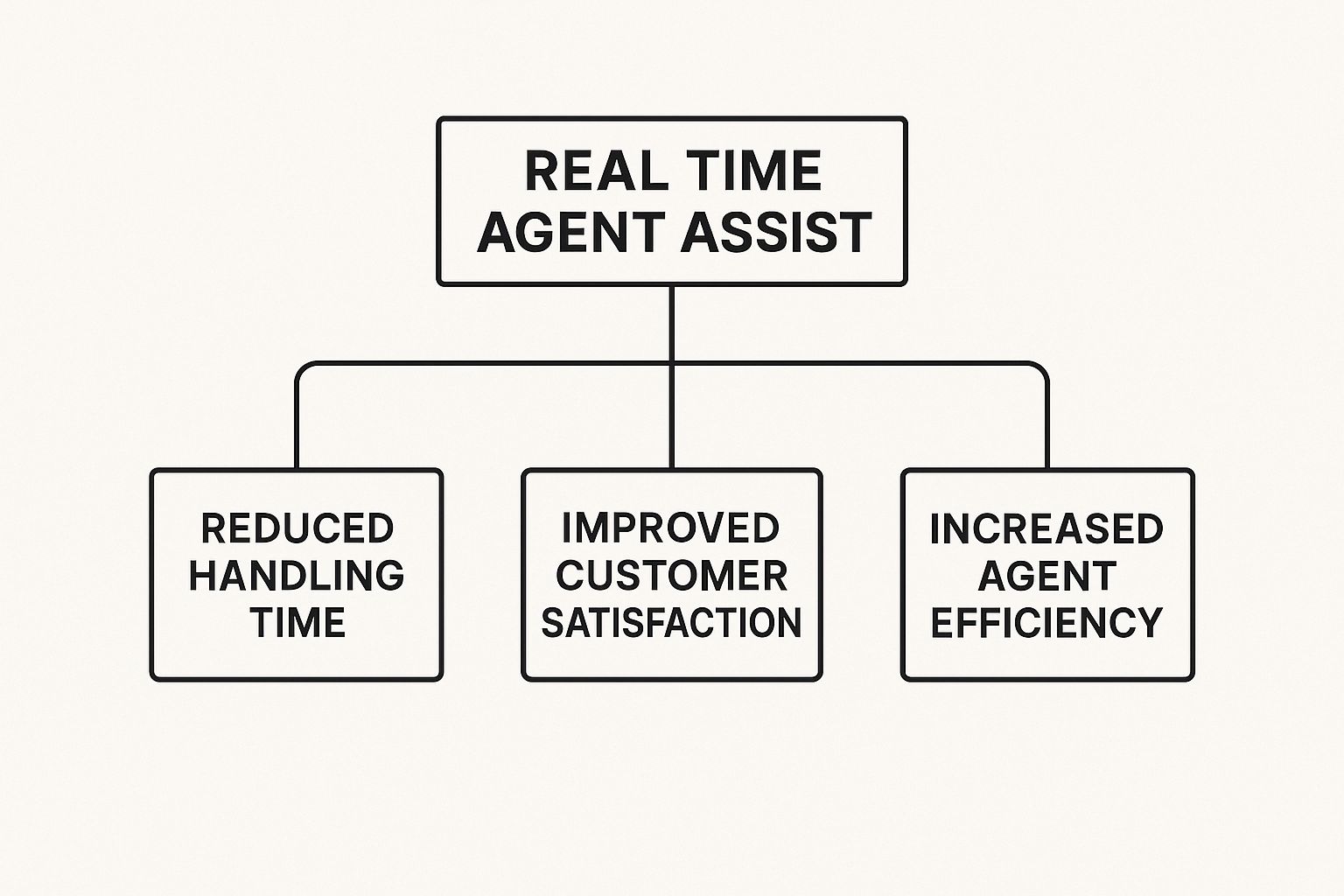
As the diagram shows, the primary goal of real-time agent assist is to directly improve agent performance. This enhancement naturally leads to better customer satisfaction and increased operational efficiency.
Core AI Components
The system's intelligence is powered by several key AI components that analyse customer interactions as they happen. Each component has a distinct job, transforming the natural flow of a conversation into a structured and supportive experience for the agent.
- Natural Language Processing (NLP): This is the system's brain. NLP goes beyond simply recognising words; it grasps the intent, context, and emotion behind them. For instance, it can distinguish between a customer just mentioning a "problem" and one who is clearly frustrated about a specific billing error. If you're curious about other NLP applications, you can discover more about implementing a chatbot in our dedicated guide.
- Speech-to-Text Transcription: Before any analysis can begin, the system must convert spoken words into written text. Modern speech recognition technology achieves this in near real-time, creating a live transcript of the conversation that other AI components can immediately read and process.
- Sentiment Analysis: Think of this as an emotional radar. It detects subtle changes in a customer's tone of voice, word choice, and even the pace of their speech to determine their mood. If it senses growing frustration, the system can promptly alert the agent and recommend specific phrases to de-escalate the situation.
- Machine Learning (ML): This is what enables the system to improve with every interaction. ML algorithms are constantly learning from call outcomes, identifying patterns in what leads to successful resolutions versus unsuccessful ones. This continuous learning cycle refines the system’s recommendations, making its guidance more precise and helpful over time. Ultimately, this reduces the agent's cognitive load, freeing them to focus on building rapport with the customer instead of searching for information.
To better understand how these pieces fit together, the table below breaks down the specific function of each AI component and its direct impact on agent performance.
| AI Component | Primary Function | Real-Time Capability | Impact on Agent Performance |
|---|---|---|---|
| Natural Language Processing (NLP) | Understands context, intent, and entities within a conversation. | Identifies customer needs and questions as they are spoken. | Provides agents with accurate, context-aware information and next-best-action suggestions. |
| Speech-to-Text Transcription | Converts live audio from calls into a written transcript. | Creates an instant, searchable text log of the entire conversation. | Enables real-time analysis and eliminates the need for manual note-taking, improving focus. |
| Sentiment Analysis | Detects emotional cues (frustration, satisfaction) from tone and language. | Gauges customer mood swings throughout the interaction. | Alerts agents to potential escalations and suggests empathetic responses to improve the customer experience. |
| Machine Learning (ML) | Learns from historical interaction data to refine recommendations and models. | Continuously updates guidance based on the outcomes of ongoing calls. | Ensures suggestions become more accurate over time, personalises agent coaching, and automates quality assurance. |
In summary, these AI components do not work in isolation. They form a connected system where live transcription feeds into NLP and sentiment analysis, while machine learning constantly refines the entire process. This synergy is what allows the platform to provide agents with the right information at precisely the right moment.
From Overwhelmed To Empowered: The Agent Transformation Story
Let’s talk about Sarah, a customer service representative who once felt a knot in her stomach every Monday morning. Her week was a constant juggle of complex customer queries, frantic searches across different systems, and the rising frustration on the other end of the line. Now, she logs in eager to connect and solve problems. The difference? Her company introduced real time agent assist, a tool that didn’t replace her skills but amplified them, turning difficult calls into successful resolutions.
This isn’t just Sarah’s story; it’s a narrative unfolding in contact centres everywhere. Think of this technology as a co-pilot for your agents. It removes the fear of the unknown—that obscure technical question or unique customer scenario that could previously throw them off balance. With intelligent support available on their screen, agents feel prepared and confident.
From Anxious New Hire to Confident Expert
The effect on new agents is especially significant. Traditionally, it can take months for a new hire to become truly proficient. Real-time assistance changes this by shortening the learning curve dramatically. Instead of poring over product manuals and memorising scripts, they learn actively on the job with live guidance, enabling them to handle calls like a seasoned professional in a matter of weeks.
This swift onboarding is particularly helpful in markets with high employee turnover. The contact centre industry in Poland, for example, faces a turnover rate nearing 60%, which makes maintaining consistent service quality a major hurdle. AI-powered assistance equips new agents with automated workflows and accurate response suggestions, helping them adapt quickly with less need for direct supervision. This not only lowers operational risk but also helps uphold high service standards. You can explore more about this topic on Ecosmob.com.
Rekindling Passion and Reducing Burnout
For veteran agents, the advantages are just as important, though they look a little different. The tool takes over repetitive, administrative tasks and instantly pulls up relevant information. This reduces cognitive load, freeing up experienced agents to concentrate on what humans do best: building relationships and creatively solving complex problems. This shift allows them to reconnect with the core purpose of their work.
Ultimately, this creates a more supportive and satisfying work environment, which has a direct positive impact on agent burnout and turnover. Teams that might have been wary of new technology come to see it as a valuable partner that makes their work more manageable and fulfilling. When agents feel more effective and supported, it leads to better outcomes for everyone—the agent, the customer, and the business itself. To go deeper, check out our guide on improving agent productivity.
Real Success Stories: Where Theory Meets Measurable Results
While the idea of empowering agents with AI is appealing, the real story is in the results. The true value of real time agent assist shines brightest when we look at its impact on actual business performance. Across different sectors, companies are reporting concrete improvements that move well beyond theory. From telecommunications firms resolving technical issues faster to retailers managing seasonal return surges, the technology is proving its worth with specific, measurable outcomes.
These are not small, incremental changes; they represent major steps forward in operational capability. Instead of just "improving things," businesses are seeing tangible wins. This includes significant drops in customer wait times and a noticeable rise in first-call resolution rates. These are the key metrics that directly shape customer loyalty and strengthen the bottom line.
Industry-Specific Performance Gains
The flexibility of real time agent assist means it can be applied to solve the distinct problems of various industries. For instance, in a field as complex as technical support, the system can provide agents with step-by-step troubleshooting scripts, essentially turning every agent into a product specialist. In the financial sector, it helps maintain strict compliance with regulations on every call, shielding the business from potentially large fines.
The following table provides a snapshot of how real time agent assist is driving performance in different sectors.
| Industry-Specific Benefits of Real Time Agent Assist | ||||
|---|---|---|---|---|
| Performance improvements across different sectors using real time agent assist technology | ||||
| Industry | Primary Use Case | Efficiency Improvement | Customer Satisfaction Gain | ROI Timeline |
| Telecommunications | Technical Troubleshooting | 18% reduction in AHT | +12 points in CSAT | 6–9 months |
| Retail & E-commerce | Order & Return Management | 25% faster processing | Fewer call-backs | 3–6 months |
| Financial Services | Account & Billing Inquiries | 100% compliance adherence | Increased customer trust | 9–12 months |
| Healthcare | Patient Support & Scheduling | 30% lower call escalations | Improved patient experience | 12–18 months |
As the data shows, the technology delivers tailored benefits, from faster ticket resolution in retail to perfect compliance in finance, leading to quicker returns on investment and happier customers.
A Polish Perspective on Productivity
The impact is clear at a regional level as well. In Poland, businesses adopting these AI tools have seen marked improvements in both operational workflows and customer happiness. A recent study found that support agents using real time agent assist can handle 13.8% more customer enquiries per hour. This increase in productivity allows companies to manage higher call volumes without needing to expand their teams.
Moreover, the same study connected this technology to a 31.5% rise in customer satisfaction scores and a 24.8% improvement in customer retention. You can discover more insights about AI agent performance statistics on plivo.com.
These real-world cases demonstrate that successful use is about more than the technology alone. It requires thoughtful changes to team workflows and proper training to make the most of the system. For a deeper dive into the technology itself, you can read also: a complete overview of real-time agent assistance. These examples confirm that, with the right strategy, real time agent assist delivers powerful and quantifiable results.
Your Implementation Roadmap: From Planning To Performance
Successfully adding real-time agent assist to your operations is a bit like landscaping a new garden rather than just plugging in a new appliance. It needs careful planning and a solid understanding of your current environment to truly thrive. You wouldn't plant a sun-loving rose in a dark corner, and similarly, you shouldn't deploy this technology without first checking if your organisation is ready. The goal is to create a change that supports your team, not one that complicates their work.
Assessing Your Current State
Before you start building, you need to take stock of what you have. A good implementation starts with an honest look at your current operations. Think of this as drawing up the blueprint before construction begins. Key areas to look into include:
- Technology Infrastructure: Can your existing CRM, phone system, and knowledge base work well with modern API integrations? Smooth technical connections are the bedrock for any real-time tool.
- Data Quality: An AI is only as smart as the data it learns from. Are your knowledge base articles current and correct? Is your customer data well-organised and easy to access? Clean data is the fuel that powers effective AI guidance.
- Team Skills and Mindset: How does your team manage difficult calls right now? Are they used to following strict scripts, or are they encouraged to think on their feet? Knowing their existing abilities and any worries they might have is vital for planning your training.
Designing for Success: Workflows and Training
Once you have a clear picture of where you're starting from, you can design workflows that improve, not just replace, your team's expertise. The aim is to make your agents' jobs easier. For example, instead of flooding their screens with pop-ups, you can set up the system to offer help only when certain keywords or signs of customer frustration appear.
Getting your team ready is just as important. Tackle their concerns directly by explaining that the tool is a co-pilot, not a pilot replacement. Good training should be all about practical use. Forget long presentations; instead, use role-playing sessions with the real-time agent assist tool running. This hands-on method builds confidence and shows agents exactly how the technology can help them during live calls. A well-planned rollout can also be a central part of a bigger plan. To see how this fits into a larger strategy, you can check out our guide on how to automate customer support.
In the end, a solid implementation roadmap connects the technology with your people and your processes. It sets clear goals, creates realistic timelines, and defines what success looks like from the very beginning. This thoughtful planning ensures your investment becomes more than just another piece of software—it becomes a fundamental part of your team's success.
Overcoming Implementation Challenges: Turning Obstacles Into Wins
Adopting any new technology comes with a set of predictable questions, and bringing real time agent assist into your workflow is no exception. Common concerns often revolve around data privacy, the difficulty of integration, and helping the team adjust. However, leading organisations are finding that tackling these issues directly not only fixes potential problems but also fortifies their entire customer service operation.
Instead of seeing these challenges as barriers, consider them opportunities to sharpen your processes and build a real advantage in your market.
Turning Data Privacy Into a Strength
Protecting customer data is fundamental, especially when a system is listening to live conversations. While a real time agent assist platform needs to process interaction data to function, it must be built with privacy as a core principle. You can take proactive steps to ensure this:
- Anonymise Data: Make sure that personally identifiable information (PII) is automatically removed or hidden from all transcripts and analytics reports.
- Define Access Controls: Restrict who can view sensitive conversation data. This ensures only authorised staff, such as quality managers, can access it for coaching and improvement purposes.
- Communicate Proactively: Be open with your customers about how technology helps you improve their experience. A transparent privacy policy builds trust and shows a genuine commitment to safeguarding their information.
When you successfully manage data privacy, you send a clear message to customers that you value their security, which in turn strengthens brand loyalty.
Simplifying Integration and Encouraging Adoption
Another frequent worry is that a new system will conflict with existing tools or that agents will be reluctant to use it. There's also the concern that agents might become too dependent on prompts, which could dull their problem-solving skills. This is a reasonable point, but it's entirely manageable.
The key is to position the technology as a helpful partner, not a replacement for human expertise. Think of the real time agent assist platform as a co-pilot, there to manage routine tasks and offer support when needed. When agents see that the tool frees up their mental energy to tackle more complex customer issues, adoption naturally follows.
Moreover, rolling out the system gradually gives your team time to adapt without feeling overwhelmed. This approach keeps service quality high during the transition. By framing these potential hurdles as positive steps forward, you set the stage for a smooth and successful implementation.
Key Takeaways: Your Action Plan for Customer Service Excellence
Transforming your customer service is an achievable goal, and this guide to real-time agent assist has given you the foundational knowledge to begin. By now, you probably see that this technology isn't about replacing human talent but making it more effective. The key is to view it as a strategic partner—a tool that empowers agents, refines operations, and builds stronger customer relationships. This action plan will bring together the main points into clear, practical steps for your organisation.
Your Quick-Start Checklist
Getting started requires an honest look at where you are now and where you want to go. Before talking to vendors, use this checklist to see how ready you are:
- Audit Your Technology: Look at your current CRM, communication platforms, and knowledge bases. Are they set up for API-based integration?
- Assess Data Quality: The performance of a real-time agent assist system relies heavily on the quality of your existing knowledge content. Is it current, accurate, and well-organised?
- Prepare Your Team: Start the conversation early. Describe the technology as a helpful co-pilot meant to reduce stress and improve job satisfaction, not as a replacement. Address their worries openly to build trust.
- Define Success Metrics: What does success look like for your team? Is it cutting down Average Handle Time (AHT) by 15%? Improving First-Call Resolution (FCR)? Or increasing CSAT scores? Set clear, measurable goals from the start.
Evaluating Vendors and Making the Right Choice
Choosing the right partner is vital. Not all real-time agent assist solutions are the same. You need a system that fits your specific operational needs. Here are some important questions to ask potential vendors:
- How does your system integrate with our particular technology stack?
- What measures do you have for data privacy and security, especially regarding customer PII?
- What does your training and onboarding process involve for our agents and managers?
- Can you share case studies from our industry that show a tangible return on investment?
The screenshot below from Salesforce shows a typical agent-facing interface. It highlights how real-time recommendations and knowledge articles can appear directly within an agent's workflow.
This image shows how smooth the tool can be, presenting relevant information without forcing the agent to switch screens. This is essential for reducing mental workload and improving efficiency. By moving from theory to a clear, actionable strategy, your organisation can confidently take the next steps toward excellent customer service.
At Voicetta, we provide an AI communication platform that works with your team 24/7, ensuring every customer interaction is a meaningful one. Ready to see how our intelligent systems can support your agents and elevate your service? Explore Voicetta today and discover a smarter way to manage customer conversations.
Was this useful?
If this article helped, add Voicetta as a preferred source in Google Search. Your results can then highlight our writing.
Add as preferred source