
Blog
Restaurant Customer Service Training Tips to Elevate Your Team
Let's be honest, amazing food isn't enough anymore. In a market crowded with fantastic chefs and creative menus, the one thing that truly sets a restaurant apart is th...
Let's be honest, amazing food isn't enough anymore. In a market crowded with fantastic chefs and creative menus, the one thing that truly sets a restaurant apart is the experience. An effective restaurant customer service training program isn't just another line item on your budget; it's a powerful investment in your brand's future, turning every single table into a potential five-star review.
Why Great Service Is Your Restaurant's Best Asset

The flavour of your signature dish might bring a guest through the door once, but the feeling they get from your team is what brings them back again and again.
Think of it this way: your kitchen creates the product, but your front-of-house team creates the memory. A deliberate, well-thought-out training programme is what shapes those memories, making sure they are consistently positive. This isn’t about forcing your staff to recite robotic phrases or follow a rigid script. It's about building a resilient hospitality culture that thrives on genuine human connection. When your team feels confident and empowered, they can transform a simple meal into a celebrated occasion.
The True Impact on Your Bottom Line
Exceptional service has a direct and measurable effect on your restaurant's success. As a seasoned restaurateur, I've seen a clear line connecting well-trained staff to tangible business growth, time and time again.
Here’s what that looks like in the real world:
- Stellar online reviews: Happy customers become your most vocal advocates, sharing their fantastic experiences on the very platforms new diners use to decide where to eat.
- Increased repeat business: A welcoming atmosphere and attentive, personal service forge a kind of loyalty that marketing budgets alone can never buy.
- Higher check averages: A server who can expertly recommend a wine pairing or describe a dessert with genuine passion doesn't just serve—they sell.
The reality is, the experience is everything. A guest might forgive an overcooked steak if the server handles it with grace and empathy, but they will never forget feeling ignored or disrespected.
Adapting to Modern Diner Expectations
The need for top-tier service is more critical now than ever before, especially as customer expectations continue to climb. Here in Poland, for instance, we've seen a sharp rise in consumer standards for service quality. Recent findings show Polish customers expect far more from their dining experiences, compelling restaurants to double down on training in communication and personalised service. You can get a deeper understanding of these evolving standards and what they mean for businesses by exploring more on hospitality customer service training.
This isn't just a local trend; it's a global shift. Today’s diners are more informed and have more choices than ever. A structured programme in hospitality customer service training is your single best tool to meet—and exceed—these modern expectations, building a reputation that stands strong in a fiercely competitive market.
Designing a Training Programme That Actually Works
Let's be honest. Those thick, dusty training binders? They don't work. They become doorstops. A truly effective customer service training programme isn't some corporate mandate you force on your team; it's a living, breathing part of your restaurant's culture. The best ones aren't bought off a shelf. They're built from the ground up, tailored to the unique soul of your establishment.
It all starts with defining your core service philosophy. What's your restaurant's non-negotiable promise to every guest? Are you all about that warm, bustling, family-style welcome, or is your vibe more about sleek, almost invisible professionalism? This philosophy is your North Star. It guides every single decision, from the first "hello" at the door to how you handle a customer's complaint.
Mapping the Guest Journey
Once you’ve nailed down your philosophy, it's time to walk in your customers' shoes. You need to map out their entire journey, visualising every single touchpoint they have with your brand—and I mean every touchpoint, starting long before they even think about stepping inside.
Think about the whole experience from their perspective:
- Discovery & Booking: How do people find you? What's it like to book a table over the phone or through an app? Is it a breeze or a chore?
- Arrival & Welcome: What’s that crucial first impression when they walk in? Is the host's greeting genuine and welcoming?
- The Dining Experience: This is the big one. It covers everything from explaining the menu and taking the order to keeping drinks topped up and checking in at the right moments.
- Problem Resolution: What's the plan when things go sideways? Do your staff feel empowered to fix a problem on the spot, or do they have to run for a manager?
- Payment & Departure: How is the bill handled? What does that final "goodbye" feel and sound like?
Each of these moments is a chance to shine—or a potential pitfall. For example, if your philosophy is all about "effortless elegance," your training for the arrival phase will focus on calm, poised greetings, not high-fives and loud welcomes. To get even more granular on skill-building, our complete guide on Restaurant Employee Training is a fantastic resource.
This simple flow chart really breaks down how communication training can be applied across the guest's entire experience.
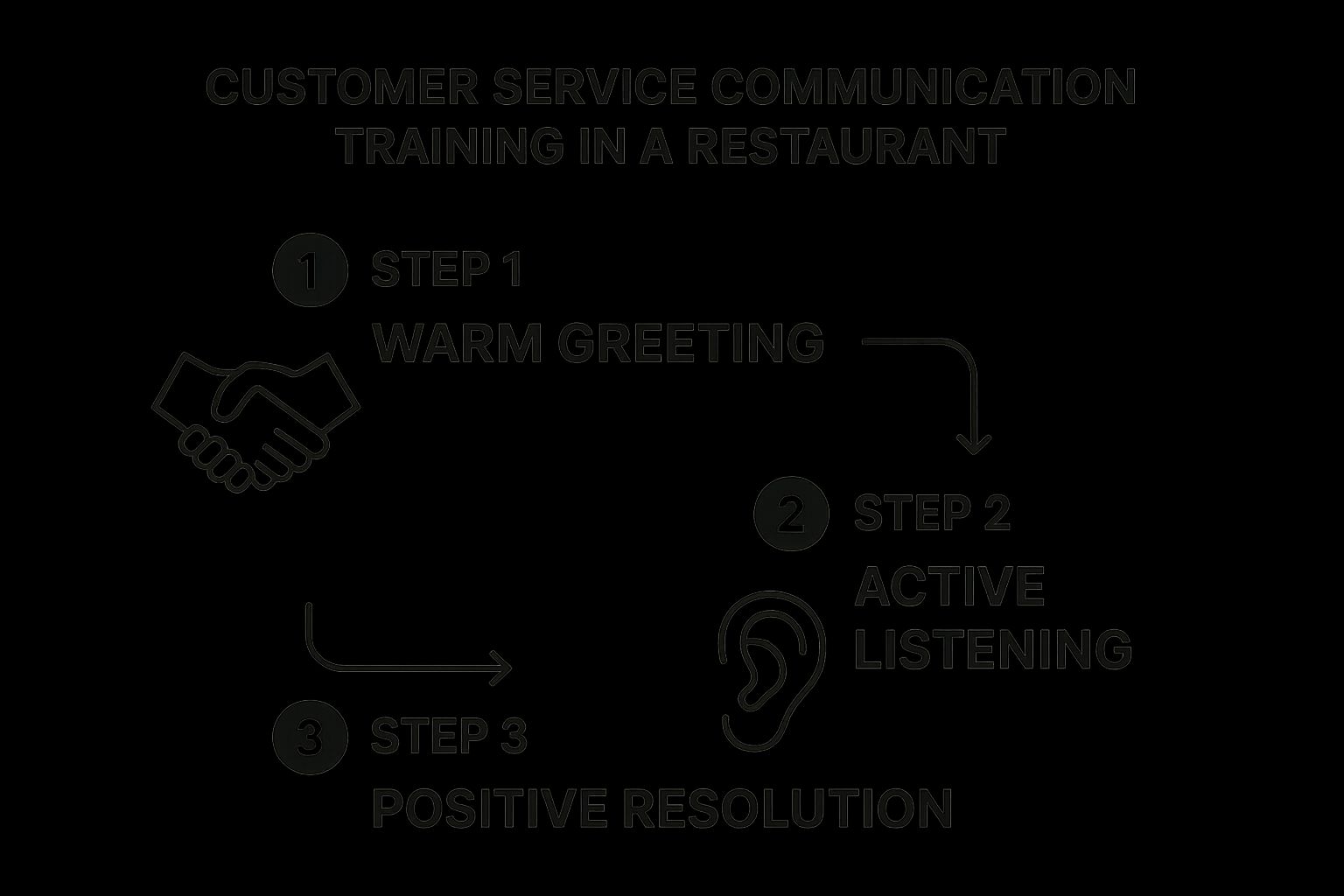
As you can see, great service often just comes down to a handful of core skills executed well: starting on a positive note, truly listening, and then taking clear, helpful action.
Crafting Realistic Training Scenarios
With your journey map in hand, you can build training that actually sticks. Forget generic, textbook examples. The most powerful training comes from role-playing situations that have actually happened on your floor. When your team recognises the scenarios, the lessons resonate and their confidence grows.
Your training programme should prepare staff for the restaurant they actually work in, not some theoretical one. Use real complaints and glowing reviews from your past to build your role-playing exercises.
This isn't just for fine dining, either. Even in the busiest fast-food joints, structured training is the secret sauce. Take Poland, for instance. Major chains like KFC and McDonald's consistently top the charts for customer satisfaction. Why? Because their success is built on hyper-efficient, standardised training that perfectly manages guest expectations. It just goes to show that a well-trained team is your biggest asset, no matter your price point.
By designing a programme rooted in your restaurant's day-to-day reality, you're not just creating a manual. You're building a framework for excellence that your staff will actually understand, embrace, and use to create those truly memorable experiences for every single guest.
Bringing Your Training to Life on the Restaurant Floor
Classroom theory is great, but the real test for any restaurant customer service training is the organised chaos of a busy Saturday night. This is where abstract concepts have to become split-second actions. Let's be honest, the most potent learning doesn’t happen in a sterile back office; it happens on the floor, surrounded by real guests with real-time problems.
The secret is to turn your restaurant floor into a living, breathing training ground. It’s about building a culture where coaching is a constant, supportive part of the daily rhythm, not just a one-off event.
One of the best ways I’ve seen this done is through smart shadowing. Pair a newcomer with one of your seasoned pros. Let them see, up close, how a veteran server handles a tricky custom order or juggles a five-table section when the kitchen gets slammed. Experiencing this is worlds away from just reading about it in a handbook.
Giving Feedback That Actually Motivates
On-the-floor coaching is a delicate dance. You need to correct and guide without crushing someone’s confidence, especially not in front of a guest. Your feedback has to be quick, quiet, and genuinely constructive.
Think about it. Instead of calling out a mistake in the middle of service, a sharp manager will pull a server aside for a brief, discreet chat. Something like, "Hey, on that next table, try describing the special this way—it really brings the local ingredients to life," works wonders. It's about coaching for the next win, not pointing out a past loss.
The real art of on-the-floor coaching is making corrections feel like a collaboration. Your feedback should empower your staff to nail it on their next try, not make them dread their next table.
This simple shift turns every minor slip-up into a private, powerful learning opportunity. It proves you’re invested in their growth, and that kind of trust is the foundation of brilliant service.
Transforming Your Pre-Shift Huddles
Your daily pre-shift meeting is a goldmine for micro-training. Don't let it devolve into a boring recitation of specials and 86'd items. Reimagine it as a focused, five-minute energy boost that sets the tone for service.
Here’s how you can supercharge your huddles:
- Focus on a Single Skill: Dedicate each huddle to one specific thing. Today, maybe it's active listening. Tomorrow, it could be a quick primer on upselling the new dessert menu without sounding pushy.
- Run Mini Role-Plays: Act out a quick, common scenario. For example: "A guest just asked for a 'secret menu' item they saw on TikTok. How do we handle that to make them feel special, even if we can't make the dish?" This gets the team thinking on their feet.
- Share a "Win of the Day": Call out a team member for a recent moment of exceptional service. Celebrating what went right is the fastest way to get everyone else to emulate that same great behaviour.
When you start weaving these lessons into every shift, you move past just teaching rules. You start nurturing a team that instinctively knows how to create incredible experiences for your guests—from defusing a complaint with real empathy to turning a Tuesday night dinner into a cherished memory. That’s the true sign of a restaurant customer service training programme that works.
Developing Unforgettable Service Skills
Anyone can teach staff to be polite. But turning good service into something people remember and talk about? That’s an entirely different skill set. This is where we move past the basics and start nurturing the high-impact abilities that allow your team to transform a standard meal into a standout experience.
It’s all about the subtle arts. I’m talking about teaching true active listening – not just hearing an order, but picking up on the clues a guest gives you. Think of a server who sees a family with young kids and brings over some crayons without being asked. That simple, proactive gesture creates a moment of genuine relief for the parents. It’s also about mastering positive language. Instead of a flat "no, we don't have that," a well-coached team member knows how to pivot, offering a fantastic alternative that turns a potential dead-end into a helpful solution.
From Menu Recitation to Culinary Storytelling
Let’s be honest: your menu is one of your most powerful, and most underused, sales tools. Too often, we train staff to just memorise a list of ingredients. We need to teach them to be culinary storytellers instead.
When a server can paint a picture—describing the local farm where the cheese is from or sharing the chef’s inspiration for a signature sauce—the menu suddenly comes alive. This isn't just for fine dining. It's critical everywhere. In Poland, for example, where around 88% of restaurants are quick-service, this skill is a game-changer. These spots, often focused on Italian, American, or traditional Polish food, rely on staff who can confidently explain new menu items or answer questions about ingredients on the fly. You can review the full analysis of the Polish QSR sector to see just how important this is.
The goal is to transform your servers from order-takers into trusted guides. When a guest feels they've been led on a culinary journey, the meal becomes more than just food—it becomes an event.
This approach doesn't just make for a happier guest; it naturally leads to higher check averages through authentic, well-informed recommendations. It's a win-win.
The Power of Empowered Problem-Solving
Let's face it, things will go wrong. No matter how buttoned-up your operation is, a dish will get delayed, an order will be mixed up, or a guest will have a complaint. How your team handles these moments is what truly defines your restaurant's character.
This is why empowering your staff with real problem-solving authority is probably the single most important part of your training. It means giving them the freedom to make things right on the spot, without having to hunt down a manager for permission every single time.
Just picture it:
- The Empowered Server: A guest’s steak is overcooked. The server immediately apologises, fires a new one, and offers a complimentary drink for the wait. The problem is solved, and the guest feels cared for. The negative has been turned into a positive.
- The Unempowered Server: In the same situation, the server has to apologise, then disappear to find a manager, explain the whole story, and wait for instructions. All the while, the guest is left sitting there, their frustration growing by the second.
When you give your team the tools and trust to resolve issues, you build their confidence and show guests that you’re genuinely committed to their happiness. This sense of ownership is what turns a potential one-star review into a story of incredible service recovery and earns you a loyal customer for life. As tools evolve, so do our options for support; it's worth exploring how artificial intelligence in the hospitality industry is helping to streamline communication and free up staff to focus more on these crucial guest interactions.
Turning Feedback into Fuel for Growth

So, you’ve put in the work and rolled out a fantastic restaurant customer service training programme. Great! But how do you actually know if it's hitting the mark on the restaurant floor? The real proof isn't just a quiet complaint box. It’s a noticeable, positive change in your guests' experience, and that requires a smart system for tracking what truly matters.
This is about more than just a quick glance at your star rating on a review site. It’s about building a continuous feedback loop—a culture where your team is always learning, adapting, and getting better. After all, brilliant service isn’t a destination you arrive at; it's an ever-evolving standard you work to perfect every single day.
Analysing Guest Feedback with Purpose
Your online reviews and comment cards are sitting on a goldmine of insights, but only if you know how to dig properly. A four-star review is nice, but the real treasure is buried in the comments. Look for recurring themes and specific details that highlight where your training is shining or where it needs a bit more polish.
Don't just count the positive reviews; dissect them. Did a guest mention a server by name for their "fantastic wine recommendation"? That's a clear win for your upselling and menu knowledge training. Did another comment on how "incredibly patient" the host was during a busy Saturday night? That's your difficult-situations training paying off right there.
To make sure you’re collecting the best possible information, it's worth learning about effective customer feedback strategies that will give you quality insights without hassling your guests or staff.
The most powerful lessons often hide in negative experiences. When a review outlines a problem, pay close attention to how it was handled. If the team turned the situation around with grace, your problem-solving training is working. If not, you’ve just found a crucial gap to address in your next team huddle.
When you systematically comb through this qualitative data, you start turning vague opinions into a concrete action plan. For a more structured way of doing this, you might want to explore dedicated tools and techniques for analysing customer feedback to spot those trends more efficiently.
Using Internal Metrics for Skill Development
Guest feedback tells you what happened, but internal metrics and check-ins help you understand why. Tracking your team's performance is essential for seeing how your restaurant customer service training is landing on an individual level. This isn't about micromanaging or creating a pressure-cooker environment. It's about supportive, focused coaching.
Here are a few internal signals to keep an eye on:
- Skill-Specific Observations: During a shift, discreetly watch how staff are applying skills you’ve recently covered, like using positive language or practising active listening.
- Performance Check-ins: Hold regular, informal one-on-ones. Keep them light and focused on growth. Ask questions like, "What part of the service makes you feel most confident?" and "Are there any situations where you feel you could use a bit more support?"
- Upselling and Tip Averages: While they aren't the whole story, a steady increase in check averages or tip percentages can often point to a team that's building better rapport and confidence with guests.
This internal loop gives you the context behind the online reviews. A server might be getting praised for their friendly personality but secretly struggling with the new POS system—a detail you’d only catch through direct observation and conversation.
By combining what your guests are saying with what you're seeing in-house, you transform your training from a one-off event into a living, breathing engine for improvement. That's how you fuel your restaurant’s growth, one happy customer at a time.
Answering Your Top Service Training Questions
Even the best-laid plans hit a few bumps in the road. When you're rolling out a new restaurant customer service training programme, questions are bound to pop up. Let's walk through some of the most common ones I hear from managers and unpack some practical, real-world answers to keep you moving forward.
One of the first things people ask is, "How often should we really be doing this?" My answer is always the same: forget the idea of a single, massive annual training day. Great service training isn't an event; it's a constant, gentle rhythm.
Think of it in layers. You start with a solid, comprehensive onboarding for every new person. But the real impact comes from daily reinforcement. Those quick, 5 to 10-minute huddles before a shift are golden. Use them to focus on one tiny thing—a specific skill, a service standard, or a new menu item. Then, back that up with more substantial, formal sessions every quarter to tackle bigger topics or dive into trends you're seeing in guest feedback.
How Do I Get My Staff to Actually Care?
This is the big one, isn't it? Motivating your team to genuinely buy into the training instead of just going through the motions. The secret is to connect the training directly to things that matter to them.
It all starts with you. If you treat training as a priority and show up fully engaged, your team will take the cue. You have to clearly and consistently draw a line from delivering fantastic service to better tips and a smoother, less stressful shift where things just work.
I’ve seen motivation go through the roof when staff feel seen and appreciated. Publicly celebrating a team member for great service or running a friendly competition based on positive guest mentions can completely change the energy. It builds a culture where people genuinely want to do well.
When your crew understands the ‘why’ and sees the results—both in their paycheques and in their day-to-day work experience—training stops feeling like a chore. It becomes a tool for their own success.
What If My Staff and Guests Speak Different Languages?
This is a very real challenge, especially in diverse areas like Poland where you might have a multilingual team serving an international crowd. The key is to lean into the universal language of hospitality, not get bogged down in perfect grammar.
Visual aids are your secret weapon here. Think simple pictograms for common allergens or a flowchart showing the steps for handling a guest complaint. These tools cut right through language barriers. Role-playing is another incredibly powerful technique because it’s all about tone, body language, and action—things everyone understands. To build a strong foundation, it helps to set clear standards; you can get some great ideas by reviewing some core customer service guidelines that apply across any culture.
Ultimately, the goal isn’t to turn your entire staff into fluent polyglots. It’s about giving them the tools to make every single guest feel seen, welcomed, and understood. That simple act of trying speaks volumes, and it’s a language every customer appreciates.
At Voicetta, we believe every customer interaction is an opportunity. Our 24/7 AI communication platform ensures you never miss a call or chat, seamlessly handling inquiries and scheduling so your team can focus on delivering the exceptional in-person experiences you train them for. Discover how we can support your growth at https://voicetta.com.
Was this useful?
If this article helped, add Voicetta as a preferred source in Google Search. Your results can then highlight our writing.
Add as preferred source