
Blog
Sales Lead Qualification Checklist: 8 Key Tips for 2025
In the world of sales, the line between a future key account and a complete timewaster can be incredibly fine. Teams often spend a significant portion of their time on...
In the world of sales, the line between a future key account and a complete time-waster can be incredibly fine. Teams often spend a significant portion of their time on unproductive prospecting, chasing leads that were never going to convert. This isn't just inefficient; it's a direct drain on revenue and morale.
The solution isn't to simply work harder, but to work smarter. This starts with a robust, structured approach to identifying which prospects are genuinely worth pursuing. A sales lead qualification checklist isn't just a set of questions; it's a strategic framework that empowers you to look beyond surface-level interest and diagnose a lead's true potential. By systematically evaluating factors like need, authority, and urgency, you can focus your energy where it matters most, shorten your sales cycle, and dramatically improve your forecasting accuracy.
This guide explores eight powerful lead qualification frameworks that act as your definitive checklist. We will provide the structure needed to separate promising opportunities from dead ends, helping you transform your sales process from a game of chance into a predictable science. We will delve into established methods like BANT and MEDDIC, alongside other effective frameworks, giving you the tools to stop chasing ghosts and start closing deals with real, qualified buyers.
1. BANT (Budget, Authority, Need, Timeline)
BANT is the original, time-tested framework for lead qualification, first popularised by IBM. It’s a foundational element of any effective sales lead qualification checklist, providing a straightforward structure to determine if a prospect is a viable customer. This methodology evaluates leads against four essential pillars: Budget, Authority, Need, and Timeline.
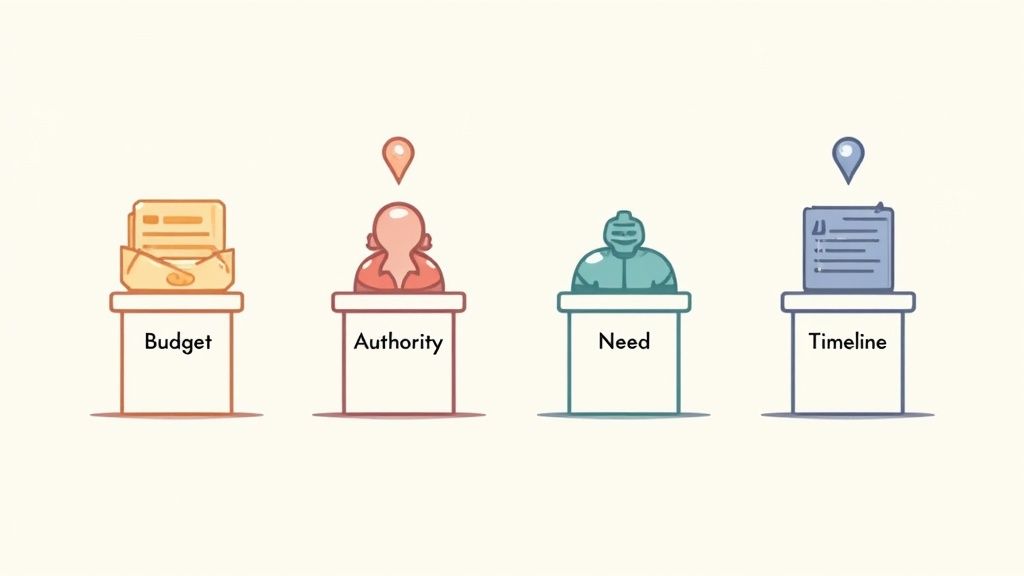
Successfully navigating this framework means you're not just selling; you're solving a recognised problem for someone with the power and resources to act. For instance, HubSpot famously adopted BANT in its early days to systematically qualify leads for its CRM, ensuring its sales team focused only on prospects who were ready and able to buy.
How to Implement the BANT Framework
Applying BANT requires a subtle, conversational approach rather than a rigid interrogation. The goal is to uncover the information naturally during your discovery calls.
- Need: Start here. Before discussing price, understand the prospect's core challenges. Ask questions like, "What specific problems are you trying to solve with a new solution?" or "What does the impact of this issue look like for your team's day-to-day operations?"
- Authority: Identify the decision-maker without being blunt. Instead of "Are you the one who signs the cheque?", try "Could you walk me through your company's typical evaluation process for new software like this?" This reveals who is involved.
- Budget: This can be a sensitive topic. Frame it around value by asking, "Have you allocated a budget for solving this particular challenge?" or "What's the potential return on investment you're hoping to achieve?"
- Timeline: Gauge urgency with questions such as, "When do you need to have a solution fully implemented and operational?" or "What internal or external factors are driving this deadline?"
Pro-Tip: Don't treat BANT as a rigid checklist where failing one criterion means instant disqualification. A prospect might not have a formal budget yet, but a powerful need and a compelling business case can help them create one. This framework is a guide, not a gate. Learn more about optimising your lead qualification process on voicetta.com for deeper insights.
2. MEDDIC (Metrics, Economic Buyer, Decision Criteria, Decision Process, Identify Pain, Champion)
MEDDIC is a highly detailed qualification framework ideal for complex, high-value B2B sales cycles. Developed at PTC by Jack Napoli and Dick Dunkel, it forces sales teams to dig deep into the customer's organisation to gain a comprehensive understanding of the buying process. This rigorous approach makes it a core component of any advanced sales lead qualification checklist, particularly for enterprise-level deals.
MEDDIC moves beyond surface-level qualification to ensure you have a firm grip on every critical aspect of the deal, from quantifiable business impact to internal politics. Enterprise tech giants like Salesforce and Cisco have famously adopted MEDDIC to manage six-figure-plus accounts, ensuring their sales forecasts are accurate and their resources are focused on winnable opportunities. This methodology gives you a clear, evidence-based picture of where a deal truly stands.
The following infographic illustrates the logical flow of the MEDDIC framework, outlining the distinct stages a sales representative must navigate to thoroughly qualify a complex opportunity.
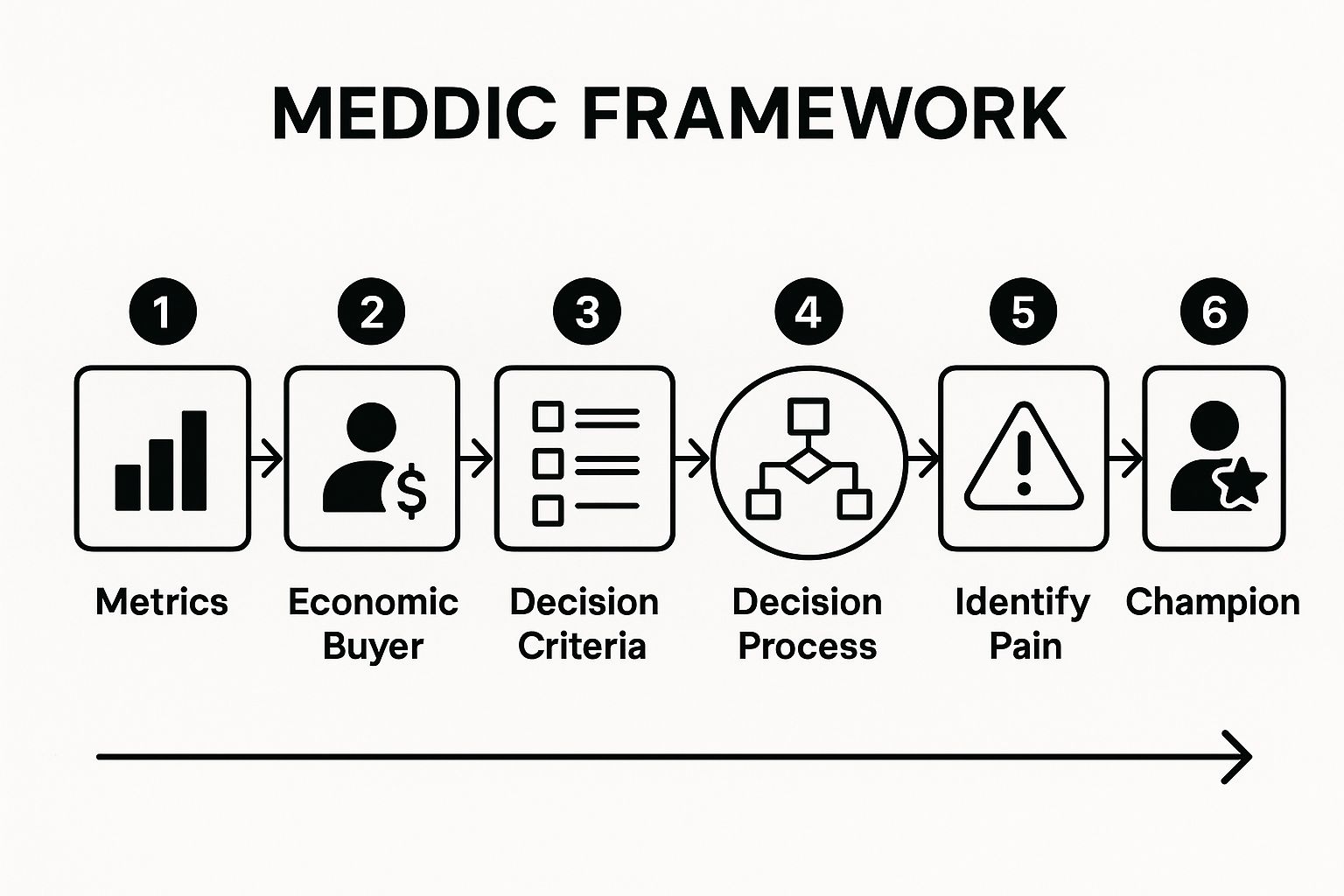
Following this process ensures that each element builds upon the last, from identifying the core pain to securing a champion who can advocate for the solution with the ultimate economic buyer.
How to Implement the MEDDIC Framework
Successfully applying MEDDIC requires a strategic, almost forensic investigation into the prospect's business. It’s about building a robust business case from the inside out.
- Metrics: Quantify the problem and the potential gain. Ask, "What key performance indicators (KPIs) will this solution improve?" or "How will we measure the economic impact of this project?" This creates the foundation for your ROI calculation.
- Economic Buyer: Identify the individual with the ultimate profit and loss responsibility who can authorise the expenditure. This is the person who has final sign-off and can create a budget where one doesn't exist.
- Decision Criteria: Uncover the formal criteria the organisation will use to evaluate vendors. Ask your contacts, "What specific technical, financial, and vendor-related requirements must a solution meet to be considered?"
- Decision Process: Map out the exact, step-by-step process the company follows to make a purchasing decision. This includes understanding the paper process, legal review, and all stakeholder approvals.
- Identify Pain: Go beyond surface-level problems to find the critical business pain driving the need for a solution. What are the consequences of inaction? This pain creates urgency.
- Champion: Find and cultivate an influential insider who believes in your solution and will advocate for you internally. A true champion will provide you with crucial information and sell on your behalf when you're not in the room.
Pro-Tip: Don't confuse a coach or an informant with a true Champion. A Champion has power and influence and is personally invested in your success because it solves their pain. Invest significant time in developing and testing your champion before committing major resources to a deal.
3. GPCTBA/C&I (Goals, Plans, Challenges, Timeline, Budget, Authority, Consequences & Implications)
GPCTBA/C&I is a modern, in-depth qualification framework developed by HubSpot to move beyond simple checklists and foster a more consultative sales process. It’s a powerful addition to any sales lead qualification checklist because it prioritises understanding the prospect's world before ever mentioning a product. This methodology guides sales reps to act as trusted advisors, exploring a prospect's high-level Goals, their current Plans to achieve them, and the Challenges standing in their way.

This comprehensive approach helps uncover deep-seated needs and build a strong business case for change. For example, HubSpot's own sales organisation used this model to achieve 30% faster deal closures by ensuring reps fully understood a prospect's strategic objectives. It transforms the conversation from "Do you have a budget?" to "What happens if you don't solve this problem?"
How to Implement the GPCTBA/C&I Framework
Applying GPCTBA/C&I requires a structured, multi-layered discovery conversation. The goal is to connect your solution directly to the prospect's strategic vision and the real-world impact of their challenges.
- Goals, Plans & Challenges: Start here to set the strategic context. Ask questions like, "What is your company's primary goal for this quarter?" followed by, "What's the current plan to get there?" and "What challenges have you encountered with that plan?"
- Timeline, Budget & Authority: Once the strategic need is clear, you can qualify the practicalities. Ask, "What's the ideal timeline for achieving this goal?" and "Have you considered what resources might be needed to overcome these challenges effectively?"
- Consequences & Implications: This is the critical step that creates urgency. Explore the negative consequences of inaction ("What happens if you miss this goal?") and the positive implications of success ("If we could solve this, what would that mean for you personally and for the business?").
Pro-Tip: The "C&I" (Consequences & Implications) part of this framework is your most powerful tool for creating urgency. By helping a prospect verbalise the pain of their current state and the potential gain of a solution, you tie your offering directly to meaningful business outcomes. This makes the conversation less about cost and more about value. Discover more about implementing advanced qualification models on voicetta.com to refine your approach.
4. SCOTSMAN (Solution, Competition, Originality, Timescales, Size, Money, Authority, Need)
For complex sales cycles where multiple factors are at play, the SCOTSMAN framework offers a highly detailed and comprehensive approach. It expands beyond simpler models to provide a 360-degree view of an opportunity, making it a powerful addition to any sales lead qualification checklist, particularly in competitive enterprise markets. This methodology assesses leads across eight critical dimensions: Solution, Competition, Originality, Timescales, Size, Money, Authority, and Need.
The SCOTSMAN model forces a deeper level of strategic thinking, ensuring your team not only understands the customer's problem but also the broader competitive landscape and your unique position within it. For example, Xerox famously utilised this framework to navigate complex enterprise deals for its document solutions, ensuring its sales force was thoroughly prepared for long and multifaceted sales processes. Similarly, professional services firms use it to qualify major consulting engagements where understanding the competitive environment and differentiating their solution is paramount.
How to Implement the SCOTSMAN Framework
Applying SCOTSMAN involves a detailed discovery process that functions like a strategic checklist rather than a rigid, sequential interrogation. The goal is to gather intelligence across all eight areas to build a complete picture of the sales opportunity.
- Solution & Need: First, confirm you can genuinely solve the prospect's problem. Ask, "What would an ideal solution look like for you, and how does that align with what we offer?" This directly connects their need to your solution.
- Competition & Originality: Actively investigate the competitive landscape. Inquire, "What other options are you currently exploring?" Follow up by highlighting your unique value proposition: "What sets our approach apart is [mention your key differentiator]. How does that sound compared to what you've seen elsewhere?"
- Timescales & Size: Understand both the urgency and the potential value. Use questions like, "What key project milestones are driving your implementation timeline?" and "To understand the full scope, could you give me an idea of the number of users or departments this would impact?"
- Money & Authority: These pillars are similar to BANT but are assessed within a wider context. Ask, "What kind of business impact or ROI would justify an investment of this nature?" and "Who else on your team will be involved in evaluating the technical and financial aspects of this project?"
Pro-Tip: Don't be overwhelmed by the eight points. Use SCOTSMAN as a strategic checklist to guide your qualification calls and internal deal reviews. The "Originality" component is your secret weapon; constantly reinforcing what makes you different is crucial for standing out in a crowded market and justifying your value.
5. FAINT (Funds, Authority, Interest, Need, Timing)
FAINT is a modern, flexible alternative to BANT, developed for today’s dynamic business environment. It acknowledges that many organisations, especially innovative ones, don't have pre-allocated budgets for every potential need. This framework is a core component of a modern sales lead qualification checklist, shifting the focus from a fixed 'Budget' to accessible 'Funds' and adding 'Interest' as a key qualifier.
This approach recognises that a compelling solution can often create its own budget. For example, many SaaS startups successfully use FAINT to engage prospects who haven't formalised a budget for a new software category but have the financial capacity and interest to invest in a tool that solves a significant pain point. It prioritises the prospect's financial health and engagement level over rigid, pre-defined purchasing plans.
How to Implement the FAINT Framework
Implementing FAINT means adopting a consultative mindset to uncover potential and inspire action, rather than simply ticking boxes. The conversation flows from understanding the problem to exploring the financial and organisational capacity to solve it.
- Need: Begin by deeply understanding the prospect's challenges. Ask discovery questions like, "What is the biggest obstacle your team is facing right now?" or "What would the ideal outcome look like if this problem were solved?"
- Interest: Gauge the prospect's genuine engagement. Are they asking insightful questions? Are they responsive to follow-ups? You can probe further with, "On a scale of 1 to 10, how high a priority is solving this issue for you this quarter?"
- Funds: Instead of asking about a budget, explore their financial capacity. Try questions such as, "Organisations like yours often fund high-ROI projects from operational budgets. Is that a possibility here?" or "What kind of financial impact would solving this problem have on your business?"
- Authority: Identify the key stakeholders involved in financial and operational decisions. A good question is, "Who else on your team would be involved in evaluating the financial and practical aspects of a solution like this?"
- Timing: Understand the urgency and external factors driving their decision timeline. Ask, "What key milestones or events are making this a priority for you now?" or "What is the timeline for when you need to start seeing results?"
Pro-Tip: The 'Interest' component is your secret weapon in FAINT. High interest from a key person can overcome a lack of an initial budget or a complex authority structure. If you can build a strong business case that resonates with their primary challenges, they will often find the funds and champion the solution internally.
6. CHAMP (Challenges, Authority, Money, Prioritization)
CHAMP is a modern, customer-centric framework that flips the traditional qualification model on its head. It stands as a critical part of any comprehensive sales lead qualification checklist by prioritising the prospect's business pains over their budget. This methodology evaluates leads based on four key areas: Challenges, Authority, Money, and Prioritisation.
By starting with the prospect's problems, CHAMP fosters a more consultative and trust-based relationship. This approach allows sales professionals to position themselves as problem-solvers rather than just vendors. For example, many professional services firms use the CHAMP framework to qualify complex consulting opportunities, ensuring they fully grasp the client's core business issues before proposing a high-value solution.
How to Implement the CHAMP Framework
Applying CHAMP effectively means leading with empathy and curiosity. The goal is to become a trusted advisor by deeply understanding the prospect's world before discussing your solution.
- Challenges: This is your starting point. Begin with broad, open-ended questions to uncover their primary pain points. Ask, "What are the biggest operational hurdles your team is facing right now?" or "What strategic objectives are proving difficult to achieve?"
- Authority: Once you understand the challenges, you can naturally identify the key players. Frame your questions around the problem: "Who in your organisation is most impacted by this challenge?" or "Who is ultimately responsible for solving this issue?"
- Money: Connect the budget conversation directly to the cost of inaction. Ask questions like, "What is the financial impact of this challenge continuing unresolved for another quarter?" or "What value would you place on eliminating this problem?"
- Prioritisation: Gauge the urgency by understanding where this challenge fits into the company's broader goals. Ask, "How does solving this issue rank against other company initiatives for this year?" or "What happens if a solution isn't found in the next six months?"
Pro-Tip: CHAMP excels because it aligns your solution with an existing, recognised business need. If a prospect's challenge isn't a high priority, they are unlikely to become a customer, regardless of their budget or authority. Use this insight to focus your efforts and tailor your follow-up. Effective follow-up is crucial; explore how to enhance your strategy by mastering lead nurturing automation at voicetta.com to keep high-priority leads engaged.
7. NEAT (Need, Economic Impact, Access to Authority, Timeline)
NEAT is a modern qualification framework that evolved from BANT to better suit complex, value-driven sales cycles. It shifts the focus from the buyer's budget to the financial consequences of their problem, making it a crucial part of any modern sales lead qualification checklist. This methodology prioritises understanding the core need, quantifying its economic impact, gaining access to decision-makers, and aligning the timeline with business urgency.
This approach is especially powerful in B2B sales where demonstrating ROI is paramount. For example, business consulting firms use the NEAT framework to qualify engagements by first deeply understanding a potential client's operational challenges (Need), then modelling the projected cost savings or revenue gains from their services (Economic Impact). This ROI-centric case makes it easier to secure buy-in from key stakeholders.
How to Implement the NEAT Framework
Applying NEAT successfully means becoming a strategic partner who can articulate value in concrete, financial terms. The goal is to build a business case that is impossible for the prospect to ignore.
- Need: Go beyond surface-level pain points. Ask questions that reveal the root cause and the broader implications for the business. "What are the second and third-order consequences your team experiences because of this issue?"
- Economic Impact: This is the core of NEAT. Work with your prospect to quantify the problem. Ask, "If we could solve this, what would that be worth to you in terms of increased revenue or reduced operational costs over the next year?" or "What is the cost of inaction if this problem persists for another quarter?"
- Access to Authority: In many organisations, the decision-maker isn't one person but a committee. Instead of just identifying the final approver, focus on finding a champion who can navigate the internal landscape. Ask, "Who else on the team would be most affected by this change and should be included in our conversation?"
- Timeline: Connect the timeline directly to the economic impact. Create urgency by asking, "You mentioned this problem is costing you approximately £X per month. When would you ideally like to stop that financial leak?"
Pro-Tip: The power of NEAT lies in co-creating the business case with your prospect. Don't just present numbers; guide them to calculate the economic impact themselves. When a prospect quantifies their own pain in pounds and pence, they become much more motivated to find a solution quickly. This collaborative approach transforms your role from a salesperson to a trusted advisor.
8. SPICED (Situation, Pain, Impact, Critical Event, Decision)
SPICED is a modern, story-driven qualification framework developed by Winning by Design. It moves beyond simple criteria to help sales professionals understand the prospect's world in-depth. This makes it an essential part of any contemporary sales lead qualification checklist, especially for complex, high-value sales cycles. It guides you to build a compelling narrative around the customer's challenges and the value of your solution.
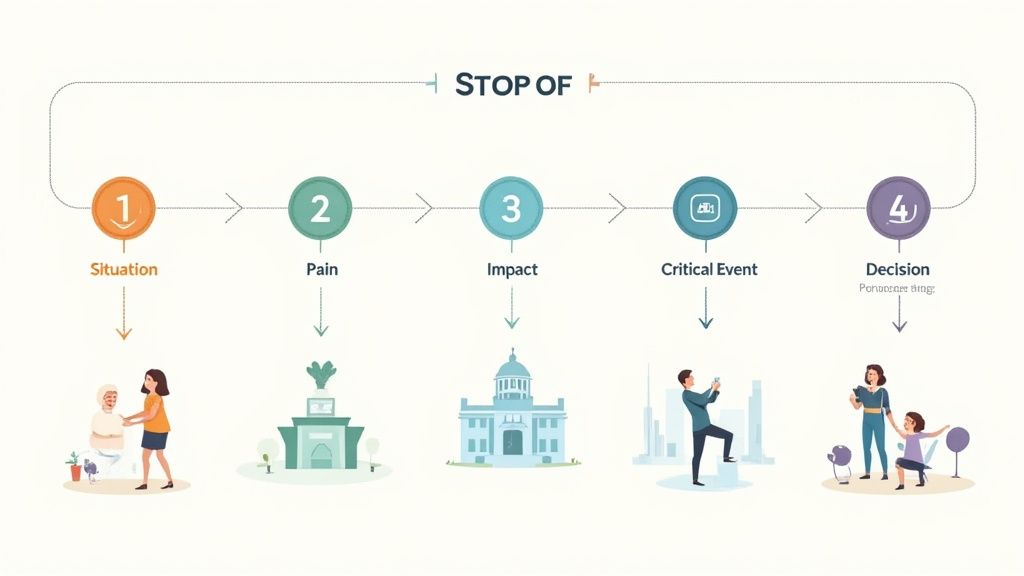
This methodology is particularly effective for SaaS and technology vendors selling transformational solutions. By focusing on the customer’s story, you co-create a business case for change, positioning your product not just as a tool, but as a critical component of their success. It’s about diagnosing the problem before prescribing a solution.
How to Implement the SPICED Framework
Applying SPICED involves weaving its components into a natural discovery conversation to uncover the full context behind a prospect’s needs.
- Situation: First, understand the prospect's current state. Ask broad questions like, "Can you describe your team's current workflow for managing customer data?" or "What tools and processes are you currently using?" to get a lay of the land.
- Pain: Identify the specific frustrations or inefficiencies within that situation. Use probing questions such as, "What are the biggest challenges you're facing with that process?" or "What's preventing you from hitting your key objectives?"
- Impact: Quantify the business consequences of that pain. Frame this in measurable terms by asking, "How does that challenge affect your team's productivity in terms of hours lost?" or "What is the financial cost of this inefficiency on a quarterly basis?"
- Critical Event: Uncover the trigger compelling them to act now. Inquire about deadlines or upcoming initiatives with questions like, "Is there a specific project or deadline that's driving the need to solve this now?"
- Decision: Map out the people and processes involved in making a purchase. Ask, "Who, besides yourself, would need to be involved in evaluating and approving a new solution like this?"
Pro-Tip: The power of SPICED lies in the "Impact" stage. Don't settle for vague statements like "it slows us down." Dig deeper to attach a real number-a cost, a time saving, or a revenue gain-to the pain. This transforms a "nice-to-have" solution into a "must-have" investment. The detailed discovery process in SPICED shares principles with effective client engagement in other industries; you can explore similar strategies for nurturing prospects in our guide to real estate lead generation on voicetta.com.
Sales Lead Qualification Frameworks Comparison
| Framework | Implementation Complexity 🔄 | Resource Requirements ⚡ | Expected Outcomes 📊 | Ideal Use Cases 💡 | Key Advantages ⭐ |
|---|---|---|---|---|---|
| BANT | Low 🔄 | Low ⚡ | Quick lead prioritization based on budget, authority, need, timeline | High-value B2B sales with defined buying cycles | Simple, standardized, prevents time waste |
| MEDDIC | High 🔄🔄 | High ⚡⚡ | Deep customer insight, strong internal champions, measurable impact | Complex enterprise sales, long cycles, multiple stakeholders | Highly effective for complexity, focus on metrics |
| GPCTBA/C&I | Medium 🔄 | Medium ⚡ | Consultative qualification revealing goals, challenges, and consequences | Buyer-centric, consultative selling, complex deals | Consultative, uncovers deeper motivations, adaptable |
| SCOTSMAN | High 🔄🔄 | High ⚡⚡ | Comprehensive opportunity and competitive assessment | Large deals, competitive environments, complex sales | Holistic view including competition and risk |
| FAINT | Low-Medium 🔄 | Low ⚡ | Flexible qualification focusing on funds, interest, timing | SaaS, startups, deals with flexible budgets | Flexible on funding, emphasizes genuine interest |
| CHAMP | Low-Medium 🔄 | Low-Medium ⚡ | Focus on challenges and prioritization for consultative sales | Relationship-based, consultative sales | Builds trust, natural flow, challenge-first approach |
| NEAT | Medium 🔄 | Medium ⚡ | Value-based qualification emphasizing economic impact | ROI-driven sales, value-selling focused | Emphasizes business impact over budget |
| SPICED | Medium-High 🔄🔄 | Medium ⚡ | Narrative-driven qualification with urgency and impact | Complex SaaS, transformational solutions | Creates compelling stories, critical event focus |
From Checklist to Closed Deal: Putting Your Framework into Action
Navigating the landscape of sales qualification can feel like learning a new language, with a vocabulary filled with acronyms like BANT, MEDDIC, and SPICED. We have journeyed through eight powerful frameworks, each offering a unique lens through which to view your potential customers. From the foundational simplicity of BANT to the comprehensive, strategic depth of MEDDIC and the narrative-driven approach of SPICED, the goal remains the same: to focus your team’s energy where it will yield the greatest return.
The true power of a sales lead qualification checklist is not found in rigidly adopting a single, off-the-shelf model. Instead, it is realised when you treat these frameworks as a toolkit. The most effective sales organisations are not just followers of one methodology; they are architects. They meticulously select and combine elements from various models, forging a bespoke qualification process that aligns perfectly with their unique product, ideal customer profile, and sales cycle length.
From Theory to Revenue: Your Next Steps
Adopting a framework is the first crucial step, but consistent execution is what drives predictable growth. To bridge the gap between knowing and doing, consider these actionable steps:
- Select and Customise: Review the frameworks we’ve explored. Which one resonates most with your current sales process? Start there. Don’t be afraid to borrow a criterion from another model if it fills a critical gap. For example, you might use BANT as a base but add the 'Identify Pain' element from MEDDIC to deepen your discovery calls.
- Train and Integrate: A checklist is useless if it lives in a document nobody reads. Organise training sessions to ensure every sales representative understands not just the what but the why behind each qualification question. Subsequently, build your custom checklist directly into your CRM as a series of fields or a workflow, making it an unmissable part of your team's daily process.
- Embrace Smart Automation: The top of your sales funnel is often the most time-consuming. This is where technology can become your most valuable team member. Consider how AI can manage initial lead engagement, asking the foundational qualifying questions from your checklist 24/7. This ensures every inbound lead receives an immediate response and is pre-vetted before a human representative ever gets involved.
By transforming your chosen sales lead qualification checklist from a static document into a dynamic, integrated, and partially-automated process, you accomplish something profound. You free your skilled sales professionals from the repetitive task of sifting through low-potential leads. This allows them to dedicate their most valuable asset, their time, to building meaningful relationships and navigating the complex nuances of closing deals with prospects who have already been identified as a strong fit. This strategic shift turns your sales pipeline from an unpredictable guessing game into a well-oiled, revenue-generating engine.
Ready to automate the top of your sales funnel and ensure your team only speaks with highly-qualified leads? Discover how Voicetta’s AI communication platform can handle initial lead qualification using your custom checklist, 24/7. Visit Voicetta to see how you can transform your lead management process today.
Was this useful?
If this article helped, add Voicetta as a preferred source in Google Search. Your results can then highlight our writing.
Add as preferred source