
Blog
Total Quality Management: Your Guide to Modern Success
Total Quality Management (TQM). The term might bring to mind complicated flowcharts and endless process documentation. But at its core, TQM is really about cultivatin...
Understanding Total Quality Management in the Modern Business World
Total Quality Management (TQM). The term might bring to mind complicated flowcharts and endless process documentation. But at its core, TQM is really about cultivating a company culture of excellence. It's about weaving quality into the fabric of every single process, not just checking for defects at the end of the production line. This represents a significant shift from reactive quality control to a proactive strategy of continuous improvement.
This cultural transformation requires organizations to fundamentally rethink their approach to quality, customer satisfaction, and their own internal operations.
One of the hallmarks of TQM is its focus on employee empowerment. Instead of confining quality control to a designated department, TQM encourages every single team member to take ownership of quality. This shared responsibility fosters a sense of collective purpose and creates a more engaged and motivated workforce.
Imagine a customer service representative empowered to resolve a customer issue on the spot. This directly contributes to customer satisfaction and loyalty. Or think about a production line worker who identifies and reports a potential process flaw. This simple act can prevent costly defects further down the line.
Total Quality Management has a rich history, offering valuable lessons for today's businesses. TQM rose to prominence in the latter half of the 20th century, particularly in the 1980s and 1990s, as businesses searched for ways to improve quality and efficiency. For decades, TQM has been a cornerstone of organizational success, underscoring the importance of customer satisfaction and continuous improvement across all business operations. Want to delve deeper into TQM? Learn more about Total Quality Management. This enduring focus on customer-centricity and continuous improvement remains highly relevant in today’s ever-changing business landscape.
Adapting TQM to the Modern Business Landscape
Today’s business world presents unique challenges, from coordinating remote teams to managing complex global supply chains. Yet, the core principles of TQM remain remarkably adaptable and relevant. Successful organizations are weaving TQM principles into modern working structures by utilizing technology for communication and collaboration. This could involve using project management software to oversee quality initiatives across geographically dispersed teams or implementing online training programs to maintain consistent quality standards.
The rise of data analytics also offers exciting new avenues for measuring and improving quality. Companies can now gather and analyze data on customer feedback, production processes, and employee performance to pinpoint areas for improvement and monitor the effects of TQM initiatives. This data-driven approach helps businesses fine-tune their strategies, optimize resource allocation, and clearly demonstrate a return on investment. TQM empowers organizations not just to overcome current challenges but also to build a strong foundation for sustained future success.
The Foundation Principles That Drive TQM Success
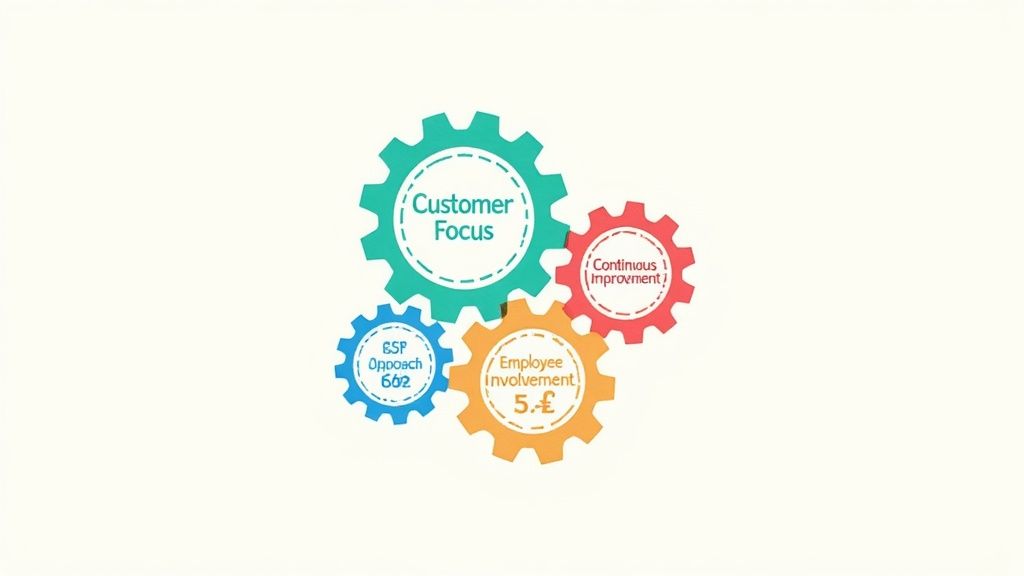
Total Quality Management (TQM) is more than a set of procedures; it's a philosophy. It's a philosophy built upon core principles. When truly understood and put into practice, these principles are what separates successful TQM initiatives from those that stumble. Let's explore the pillars that support TQM.
Customer Focus: The Heart of TQM
At the center of TQM is an unwavering dedication to the customer. This principle focuses on understanding customer needs, not just today's, but also anticipating future needs. It’s about going the extra mile to exceed expectations. This involves actively gathering customer feedback through various channels.
For instance, companies implementing TQM often use surveys, focus groups, and even social media monitoring to collect valuable insights. Analyzing this feedback allows businesses to tailor products and services to better meet customer needs, fostering strong relationships and ultimately, delivering maximum value.
Total Employee Involvement: Empowering Every Team Member
TQM acknowledges that quality is everyone's responsibility, a collective effort. Total employee involvement means creating a culture of empowerment, where every team member feels they have a role to play in quality improvement. This is achieved through open communication.
This also involves providing appropriate training and recognizing employee contributions. When employees feel valued and empowered, they are more likely to take ownership of quality, leading to greater innovation and improved processes.
Process-Centered Thinking: Optimizing for Efficiency and Quality
TQM emphasizes a process-centered approach, viewing the organization as a system of interconnected processes. This means analyzing every process to identify areas for improvement, streamlining workflows, and eliminating waste. Imagine a multi-step manufacturing process.
A company can increase efficiency and enhance the final product’s quality by scrutinizing each step to identify bottlenecks and redundancies that can be removed. This careful examination helps ensure each part of the process contributes to overall quality.
Data-Driven Decision Making: Measuring What Matters
Effective TQM relies on data-driven decision making. Collecting and analyzing data is key to measuring performance, identifying trends, and monitoring progress towards quality objectives. By using data to guide decisions, organizations avoid relying solely on intuition.
Tracking metrics such as customer satisfaction scores, defect rates, and cycle times helps identify areas for improvement. This data-driven approach ensures that TQM initiatives focus on high-impact areas. It also provides a way to objectively measure progress and effectiveness.
To better illustrate how these core principles can be applied, consider the following implementation guide:
To better understand how to apply these principles, let’s look at a practical guide:
TQM Core Principles Implementation Guide: A comprehensive comparison of TQM principles with implementation strategies and expected outcomes.
| Principle | Key Activities | Implementation Timeline | Success Metrics |
|---|---|---|---|
| Customer Focus | Gather customer feedback (surveys, focus groups), analyze data, implement changes based on insights | Ongoing | Customer satisfaction scores, Net Promoter Score |
| Total Employee Involvement | Implement training programs, create open communication channels, recognize contributions | Ongoing | Employee satisfaction, process improvement suggestions |
| Process-Centered Thinking | Map out processes, identify bottlenecks and redundancies, streamline workflows | Continuous review and refinement | Reduced cycle times, improved efficiency |
| Data-Driven Decision Making | Collect and analyze performance data, track key metrics, adjust strategies based on data | Ongoing | Achieved quality targets, positive trend data |
This table highlights the key activities associated with each principle, outlining the ongoing nature of TQM implementation. Success is measured by tracking specific metrics that reflect the impact of each principle. These four interconnected principles, when applied in concert, create a culture of continuous improvement, laying the groundwork for organizational success and sustainable long-term growth.
Your Step-by-Step TQM Implementation Roadmap
Ready to put Total Quality Management (TQM) into practice? This section provides a practical roadmap for implementing TQM within your organization. We'll walk you through the crucial stages, from gaining leadership support to establishing the infrastructure needed for long-term success. This roadmap is based on the real-world experiences of leaders who have successfully implemented TQM.
Phase 1: Laying the Groundwork
The first phase is to determine your organization's readiness for TQM. This involves analyzing your current quality management procedures, pinpointing areas for improvement, and securing buy-in from leadership. Communicating the advantages of TQM to everyone involved is vital. This builds support and generates enthusiasm for the initiative. You’ll also need to define clear goals and objectives for your TQM program. These should be measurable and aligned with your overall business strategy.
Phase 2: Building the Framework
After laying the groundwork, it’s time to create the structure for your TQM program. This involves developing a thorough implementation plan, establishing quality teams, and designing training programs for employees. This stage establishes the foundation for a collaborative and continuous process. For further insights into optimizing procedures, which is key to TQM success, see our guide on streamlining operations.
Phase 3: Implementation and Monitoring
With the framework in place, you can start implementing TQM throughout your organization. This involves putting the changes outlined in your plan into action, tracking progress, and adapting as necessary. Celebrating early achievements is important for maintaining momentum. Studies show that organizations implementing TQM can see an average 15% boost in productivity and a 20% decrease in costs. This method not only focuses on quality but also empowers employees and ensures a customer-centric approach. You can find more detailed statistics here.
The infographic below demonstrates the cyclical flow of core TQM processes:
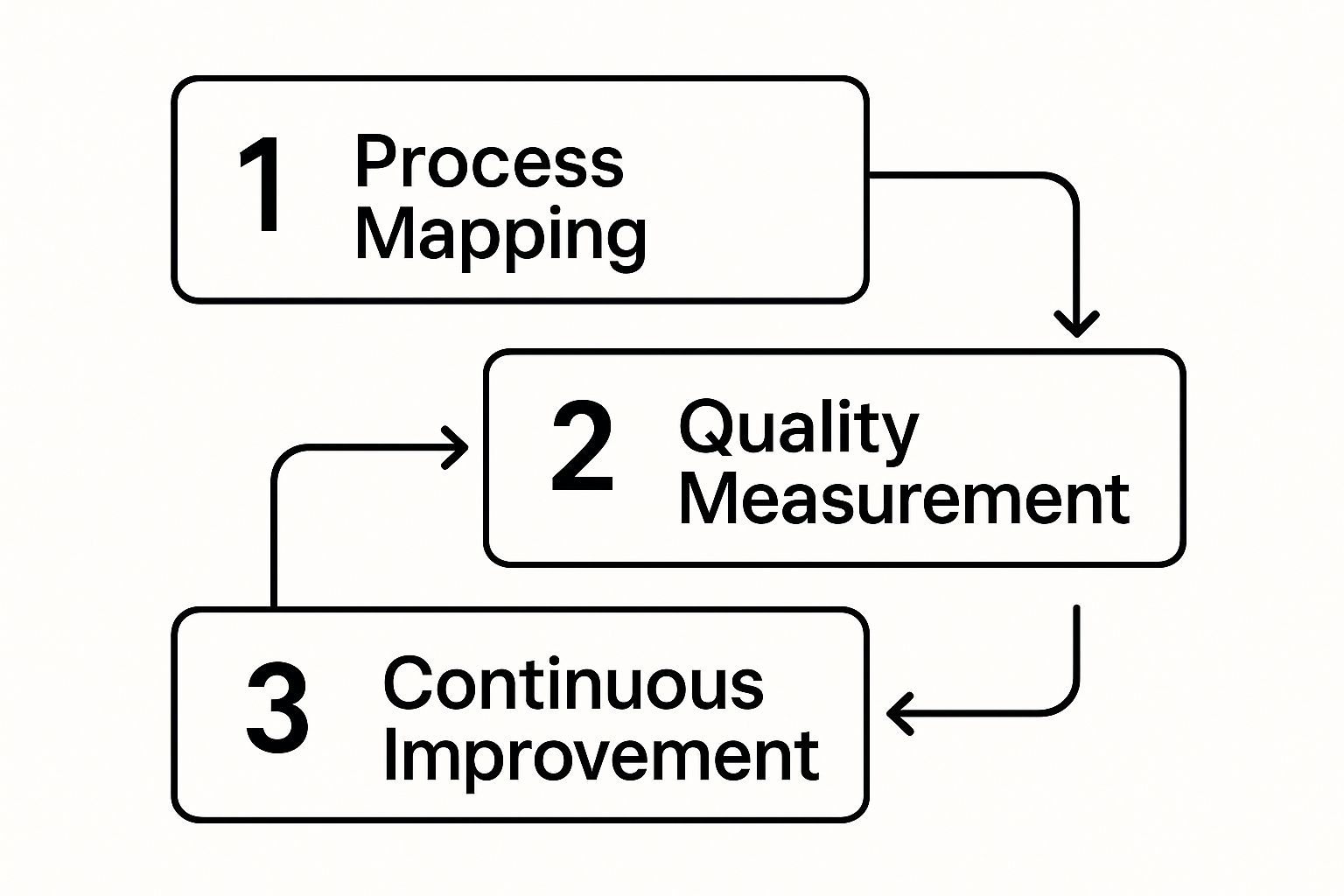
This visual represents the ongoing interplay between Process Mapping, Quality Measurement, and Continuous Improvement. The arrows highlight the continuous nature of these actions, showing how each step informs and refines the others in a cycle of improvement. This interconnectedness guarantees that processes are regularly assessed and enhanced using measurable data, resulting in improved efficiency and quality.
Phase 4: Continuous Improvement
TQM isn't a one-off project; it's a continuous journey. Cultivating a culture of continuous improvement is essential. This involves consistently reviewing your TQM program, identifying areas for refinement, and adjusting accordingly. You might find this resource helpful: How to Master Continuous Improvement. This constant evolution is vital for long-term success in today's ever-changing business world. It keeps your organization adaptable and responsive to evolving customer needs and market conditions. By following this step-by-step roadmap and maintaining a commitment to continuous improvement, you can establish a successful TQM program that benefits both your organization and your customers.
Measuring What Matters: TQM Performance and ROI
Embracing Total Quality Management (TQM) means committing to measuring progress and demonstrating a real return on investment. This goes beyond surface-level metrics. It means focusing on indicators that truly reflect quality improvements and their impact on the bottom line. Let's explore how to build meaningful measurement systems that showcase TQM's value.
Identifying Key Performance Indicators (KPIs)
Choosing the right Key Performance Indicators (KPIs) is fundamental to accurately assessing your TQM program's effectiveness. These KPIs should align with your overall business goals and reflect the core principles of TQM.
For example, tracking customer satisfaction scores directly measures the impact of customer-focused initiatives. Looking at defect reduction rates offers quantifiable proof of process improvements.
Other valuable KPIs include productivity gains, showing increased efficiency, and employee engagement levels, reflecting the impact of empowered employees. For further insights, check out How to master customer support KPIs. This resource provides practical guidance on selecting and using metrics related to customer interactions and service quality.
Building a Balanced Scorecard
A balanced scorecard provides a well-rounded view of TQM performance by blending quantitative and qualitative measures. This approach avoids depending too heavily on any single metric, offering a more holistic perspective. A well-designed scorecard might include:
- Financial Performance: Cost savings, revenue growth, and profitability.
- Customer Satisfaction: Customer retention rates, Net Promoter Score (NPS), and complaint resolution time.
- Internal Processes: Defect rates, cycle times, and process efficiency.
- Learning and Growth: Employee satisfaction, training completion rates, and the number of process improvement suggestions.
This multifaceted approach lets organizations track progress across different areas and spot potential imbalances.
Establishing Baselines and Tracking Progress
Before launching TQM, it's critical to establish baselines for your chosen KPIs. This creates a starting point to measure progress against.
Once baselines are set, regular monitoring and data analysis are essential. Tracking progress reveals trends, highlights areas for improvement, and demonstrates the positive effects of TQM initiatives. This data-driven approach allows for fine-tuning strategies and ensures continuous improvement.
Communicating Success and Building Support
Clearly communicating TQM successes is essential for ongoing support. Sharing success stories, presenting data-driven reports, and highlighting the positive impact on business outcomes demonstrates the program’s value.
This transparent communication builds trust and encourages continued investment in quality improvement. It also reinforces a culture of quality throughout the organization. By measuring what truly matters and effectively communicating the results, organizations can establish TQM as a driver of long-term success.
TQM Strategies That Work for Small and Medium Businesses
Many believe Total Quality Management (TQM) is only for large corporations. However, small and medium-sized businesses (SMEs) are increasingly using TQM principles to sharpen their competitive edge, even with limited budgets. This section explores how SMEs can implement TQM strategies effectively and affordably.
Adapting TQM to the SME Context
TQM for SMEs requires a customized approach. It’s about focusing on key areas and making the most of limited resources. Unlike large corporations, SMEs often have simpler organizational structures and more direct communication. This can be a real advantage for TQM, allowing for faster decisions and quicker implementation of improvements.
Resource limitations can be a challenge. This means carefully choosing which TQM initiatives to pursue and finding cost-effective solutions. For example, instead of expensive software, an SME might choose simpler, budget-friendly tools to monitor quality metrics.
Focusing on Customer Relationships
Strong customer relationships are essential for SMEs. TQM provides a structure for improving customer satisfaction by understanding and exceeding customer expectations. This could involve setting up feedback systems, personalizing interactions, and proactively addressing any concerns.
These steps build loyalty and encourage positive word-of-mouth referrals, vital for SME growth. Focusing on customer feedback also helps SMEs quickly adapt to changing market needs, ensuring they remain competitive.
Creating a Culture of Quality
TQM isn't just about procedures; it’s about building a culture of quality across the entire organization. This means involving every employee in quality improvement, fostering a sense of ownership and responsibility. In SMEs, this can be achieved through regular team meetings, open communication, and recognizing individual contributions.
Empowering employees leads to greater innovation and continuous improvement, embedding quality into the company’s DNA. This results in a more engaged workforce committed to excellent products and services.
Prioritizing Initiatives and Measuring Success
A phased approach to TQM is often best for SMEs. This involves prioritizing projects based on their potential impact and the resources available. Start with areas where improvements can be made quickly and affordably.
Measuring success is also crucial. This means choosing key metrics aligned with business goals and regularly monitoring progress. You might be interested in: How to improve operational efficiency. A study on the financial performance of Australian SMEs found that those using TQM had better financial results. This improvement is linked to TQM's emphasis on reducing waste and optimizing resources, which aligns perfectly with sustainable business practices. More detailed statistics can be found here. This data-driven approach helps SMEs demonstrate the value of TQM and refine their strategies over time.
To further illustrate the differences in implementation between SMEs and large enterprises, let's look at a comparison table:
Introduction: The following table provides a detailed comparison of TQM implementation aspects between Small/Medium Enterprises (SMEs) and Large Enterprises, highlighting key differences and considerations.
| Implementation Aspect | Small/Medium Enterprises | Large Enterprises | Key Considerations |
|---|---|---|---|
| Resource Allocation | Limited, focused on high-impact areas | Extensive, dedicated budgets | Prioritization is key for SMEs, while large enterprises can afford broader implementation |
| Organizational Structure | Flatter structures, direct communication | Hierarchical structures, complex communication | SMEs can leverage their agility for faster implementation |
| Employee Involvement | Direct involvement, fosters ownership | Often delegated to specific teams | SMEs benefit from a more engaged workforce |
| Technology Adoption | Focus on cost-effective solutions | Investment in advanced software and systems | SMEs can achieve significant results with simpler tools |
| Customer Focus | Personalized interactions, direct feedback | Formalized feedback mechanisms, customer relationship management systems | Building strong relationships is crucial for SMEs |
| Implementation Approach | Phased approach, prioritizing quick wins | Comprehensive, long-term strategies | SMEs should focus on achievable milestones |
Conclusion: As the table shows, TQM implementation in SMEs requires a more targeted and adaptable approach compared to large enterprises. Leveraging their unique strengths, such as agility and direct communication, allows SMEs to achieve significant benefits from TQM, even with limited resources.
Examples of TQM in Action for SMEs
-
A local bakery uses a feedback system where customers rate products and provide suggestions. This helps them improve recipes and introduce new items based on customer preferences.
-
A small software company adopts Agile methodologies for better project management and higher quality software development. Regular feedback and iterative development identify and address issues early, leading to improved customer satisfaction.
-
A family-owned restaurant trains all staff on quality standards, empowering them to solve customer problems immediately. This builds a customer-focused culture and improves the overall dining experience.
These examples show how SMEs can adapt TQM to their specific situations, achieving real improvements in quality, customer satisfaction, and overall business performance. By embracing TQM, SMEs can not only survive but thrive in a competitive market.
Overcoming Common TQM Challenges (And Why Some Fail)
Implementing Total Quality Management (TQM) is a journey. Like any journey, it has its bumps in the road. Understanding these challenges is the first step to a smooth ride and a thriving TQM initiative. Let's explore those common hurdles organizations face, and how to navigate them successfully.
Resistance to Change: A Common Hurdle
One of the biggest challenges is resistance to change. Employees used to the old ways can be hesitant about new processes. This resistance might come from fear of the unknown, a lack of understanding, or simply preferring the status quo.
Overcoming this requires clear, consistent communication. Explain the benefits of TQM, not just for the company, but for each employee. Provide training and support to build confidence and help everyone adapt.
Resource Constraints: Doing More With Less
Resource constraints are another common obstacle. Implementing TQM often means investing in training, new technology, and process improvements. For smaller organizations, this can be tough on the budget.
Prioritization is key here. Focus on areas with high impact where you can make quick, affordable improvements. Look for creative solutions and consider phasing in TQM implementation over time. For example, automated quality management is a valuable strategy for optimizing resources.
Communication Barriers: Keeping Everyone Informed
Effective communication is vital for TQM success. But communication barriers can slow down progress. These can come from hierarchical structures, departmental silos, or a simple lack of clear communication channels.
Establishing open communication is crucial. Encourage feedback from everyone, from the top down. Use different communication methods: regular meetings, newsletters, and online platforms.
Lack of Leadership Commitment: Leading by Example
TQM needs strong leadership. Without support from management, initiatives can lose steam and fail. Leaders must actively champion TQM, participate in the process, and show their commitment through action.
This means allocating resources, setting clear expectations, and recognizing employee contributions. Leading by example creates a culture of quality.
Measuring and Demonstrating ROI: Showing the Value
Showing the return on investment (ROI) of TQM is essential for continued support. But measuring TQM's impact can be tricky. Some benefits, like improved customer satisfaction, are hard to put a number on.
Establish clear metrics that align with your business goals and track your progress. Communicate your successes and highlight the positive impact of TQM on your bottom line.
Turning Setbacks into Learning Opportunities: Embracing Failure
Not every TQM initiative will be a home run. Setbacks happen. The important thing is to see them as opportunities to learn. Analyze what went wrong, find areas to improve, and adjust your approach.
This adaptability is essential for long-term success. By embracing a culture of continuous improvement, setbacks become valuable lessons.
Why Some TQM Initiatives Fail: A Reality Check
TQM offers real benefits, but some initiatives don't meet expectations. Here are some common reasons for failure:
- Lack of a Clear Vision and Goals: Without a well-defined plan, TQM initiatives can get lost.
- Inadequate Training and Support: Employees need the right skills and resources.
- Insufficient Data Collection and Analysis: Data-driven decisions are crucial.
- Ignoring Employee Feedback: You might miss valuable insights and potential problems.
- Focusing on Short-Term Gains: TQM is an ongoing journey, not a quick fix.
By understanding these challenges and pitfalls, you can address them proactively, increasing your chances of TQM success and building a lasting culture of continuous improvement.
Key Takeaways
This section boils down the core principles of Total Quality Management (TQM), offering practical advice learned from real-world applications and proven outcomes. Think of it as your handy guide for a successful TQM journey.
Essential Strategies for TQM Success
Several key strategies are crucial for implementing TQM effectively:
-
Secure Leadership Buy-in: Leadership commitment is absolutely essential. Leaders need to champion TQM, dedicate resources, and actively participate in the process.
-
Foster a Culture of Quality: TQM is more than just following procedures; it's a company-wide philosophy. Cultivate an environment where each employee feels ownership of quality. Empower your team with training, open communication, and recognition.
-
Focus on the Customer: Always keep the customer at the heart of your efforts. Actively collect and analyze customer feedback to understand and anticipate their needs.
-
Embrace Data-Driven Decision Making: Track key metrics, analyze the data, and use this information to inform your TQM initiatives. This ensures your focus is on high-impact areas and you can measure progress objectively.
-
Strive for Continuous Improvement: TQM is an ongoing journey, not a one-time project. Continuously evaluate your processes, find areas for improvement, and adapt your approach as needed.
Critical Success Factors
These factors are critical for achieving and maintaining TQM success:
-
Clear Vision and Goals: Define a clear vision for your TQM program and establish measurable goals that align with your overall business strategy.
-
Effective Communication: Open communication channels are essential to ensure everyone understands the goals of TQM and how they contribute.
-
Employee Engagement: Involve employees at all levels in the TQM process. Empower them to identify problems, suggest improvements, and take charge of quality.
-
Data Analysis and Measurement: Tracking relevant metrics allows you to monitor progress, pinpoint areas for improvement, and demonstrate the impact of your TQM program.
-
Adaptability and Flexibility: Be prepared to adapt your TQM strategy as needed, based on the data and feedback you receive.
Warning Signs to Watch For
Keep an eye out for these potential problems during your TQM journey:
-
Lack of Leadership Support: TQM requires a strong commitment from leadership. If leaders aren't actively involved and supportive, the initiative is likely to falter.
-
Resistance to Change: Employees may resist adopting new processes and procedures. Address this through clear communication, training, and ongoing support.
-
Inadequate Resources: Implementing TQM requires investment. Make sure you have the necessary resources, including time, budget, and dedicated personnel.
-
Poor Communication: Breakdowns in communication can hinder progress. Establish clear communication channels and promote open feedback.
-
Focusing on Short-Term Gains: TQM requires a long-term view. Avoid focusing solely on short-term results at the expense of sustainable improvement.
Implementing TQM: A Practical Checklist
This checklist can help you get started with your TQM implementation:
- Conduct a Readiness Assessment: Evaluate your current quality management practices and identify areas for improvement.
- Develop a TQM Plan: Outline your goals, objectives, and your overall implementation strategy.
- Establish Quality Teams: Create cross-functional teams to manage and implement TQM initiatives.
- Provide Training: Give your employees the knowledge and skills they need to participate effectively in TQM.
- Implement TQM Processes: Put your plan into action and start tracking key metrics.
- Monitor and Evaluate: Regularly review your progress, analyze the data, and adjust your approach as needed.
- Celebrate Successes: Recognize and reward employees for their contributions to quality improvement.
Realistic Timelines for TQM Implementation
TQM implementation isn't a quick fix; it's a sustained effort. While the exact timeline will vary depending on the organization and the scope of the initiative, a realistic timeframe is typically 12-18 months to see substantial results. It’s important to remain patient and persistent. Concentrate on building momentum and celebrating small victories throughout the process. This long-term perspective is essential for achieving sustainable quality improvement.
By concentrating on these key takeaways, organizations can implement TQM effectively, create a culture of continuous improvement, and achieve long-term success.
Are you ready to improve your customer communication and optimize operations? Learn how Voicetta, our innovative AI communication platform, can empower your business to provide outstanding customer service and improve your workflow. Visit Voicetta today to find out more.
Was this useful?
If this article helped, add Voicetta as a preferred source in Google Search. Your results can then highlight our writing.
Add as preferred source