
Blog
What Are API Connectors and How Do They Work
Ever found yourself wondering how all your different apps and software seem to work together so seamlessly? The magic behind that smooth experience is often an unsung ...
Ever found yourself wondering how all your different apps and software seem to work together so seamlessly? The magic behind that smooth experience is often an unsung hero of the digital world: the API connector.
So, what exactly are they? Put simply, API connectors are pre-built bridges that let different software applications talk to each other and share information automatically. No need for your team to write a single line of complex, custom code.
The Invisible Engine Driving Your Digital World

Think of an API connector as a universal translator for your software. We actually see them in action all the time in our daily lives, even if we don't realise it. When you book a holiday and the booking site shows you hotel options on a map, that’s an API connector linking the travel service with a mapping tool like Google Maps. It just works.
These connectors are the quiet, essential engines that power our interconnected digital lives. They save businesses from the costly and time-consuming headache of custom software development every time two systems need to chat. Instead of building a new bridge from scratch for every single river, you get to use a reliable, ready-made one that's already been proven to work.
The Power of a Ready-Made Solution
Building a custom integration from the ground up is a huge project. It demands specialised developers, can drag on for months, and requires constant upkeep to squash bugs and stay compatible with software updates. This is where you really see the value of a pre-built API connector shine through.
An API connector is more than just a bit of tech; it's a smart business move. It shifts your thinking from, "How can we build this?" to "How can we connect this efficiently?" This simple change frees up your own team to focus on what they do best—driving your business forward, not just maintaining code.
When you opt for a pre-built connector, you're essentially getting a finished product. It's a solution that has already been designed, thoroughly tested, and is actively supported by the company that made it. This dramatically cuts down your risk and fast-tracks your ability to automate tasks and bring all your data together in one place.
API Connector vs Custom Integration
Deciding between a pre-built connector and a custom-built solution is a critical choice. To put it simply, a connector gives you speed and reliability out of the box, whereas a custom integration offers total control, but at a much higher price in both time and money.
Here's a quick comparison to help you see the difference at a glance:
| Feature | API Connector (Pre-built) | Custom Integration (From Scratch) |
|---|---|---|
| Time to Get Started | Very Fast (Hours or Days) | Slow (Weeks or Months) |
| Initial Cost | Low (Often subscription-based) | High (Developer salaries and project costs) |
| Ongoing Maintenance | Handled by the Provider | Handled by Your Team |
| Technical Skill Needed | Low to None (No-code friendly) | High (Expert developers required) |
| Flexibility | Good (Works for most common needs) | Total (Built exactly to your specs) |
Ultimately, for most businesses, the speed, lower cost, and reduced hassle of an API connector make it the obvious choice for linking their favourite tools together. It lets you get the job done quickly and focus on what truly matters.
How an API Connector Works Step by Step
To really get to grips with what API connectors are, it helps to break down how they actually do their job. Let’s stick with a simple analogy: you’re dining out.
Imagine you're the customer (we’ll call you Application A), and the restaurant kitchen is the system you need to get information from (Application B). The API connector? That’s your waiter. You don't just wander into the kitchen and start grabbing ingredients, right? You give your order to the waiter, who takes care of everything for you.
That’s pretty much what an API connector does. It takes your request, goes to the other application's API (the kitchen's serving hatch), manages all the communication, and brings back exactly what you ordered. The best part is that this all happens automatically, tucked away behind the scenes.
The Initial Handshake and Request
First things first, there’s always a digital handshake, which we call authentication. Before a single piece of data moves, the connector has to prove it’s allowed to ask for it. It does this by presenting credentials, like a secret password or an API key. Think of it as the waiter checking your name off the reservation list. It’s a crucial security step that stops unauthorised apps from snooping around.
Once it's been given the green light, the connector makes a specific request. It’s not just shouting "send me some data!" into the void. It’s a very precise instruction sent to a specific endpoint. An endpoint is like a specialised station in the kitchen—the grill, the salad bar, the dessert counter. The connector knows exactly where to go (e.g., the 'customer_data' endpoint) and what to ask for (e.g., "get all new leads from the last 24 hours").
This simple diagram maps out the core journey of your data.
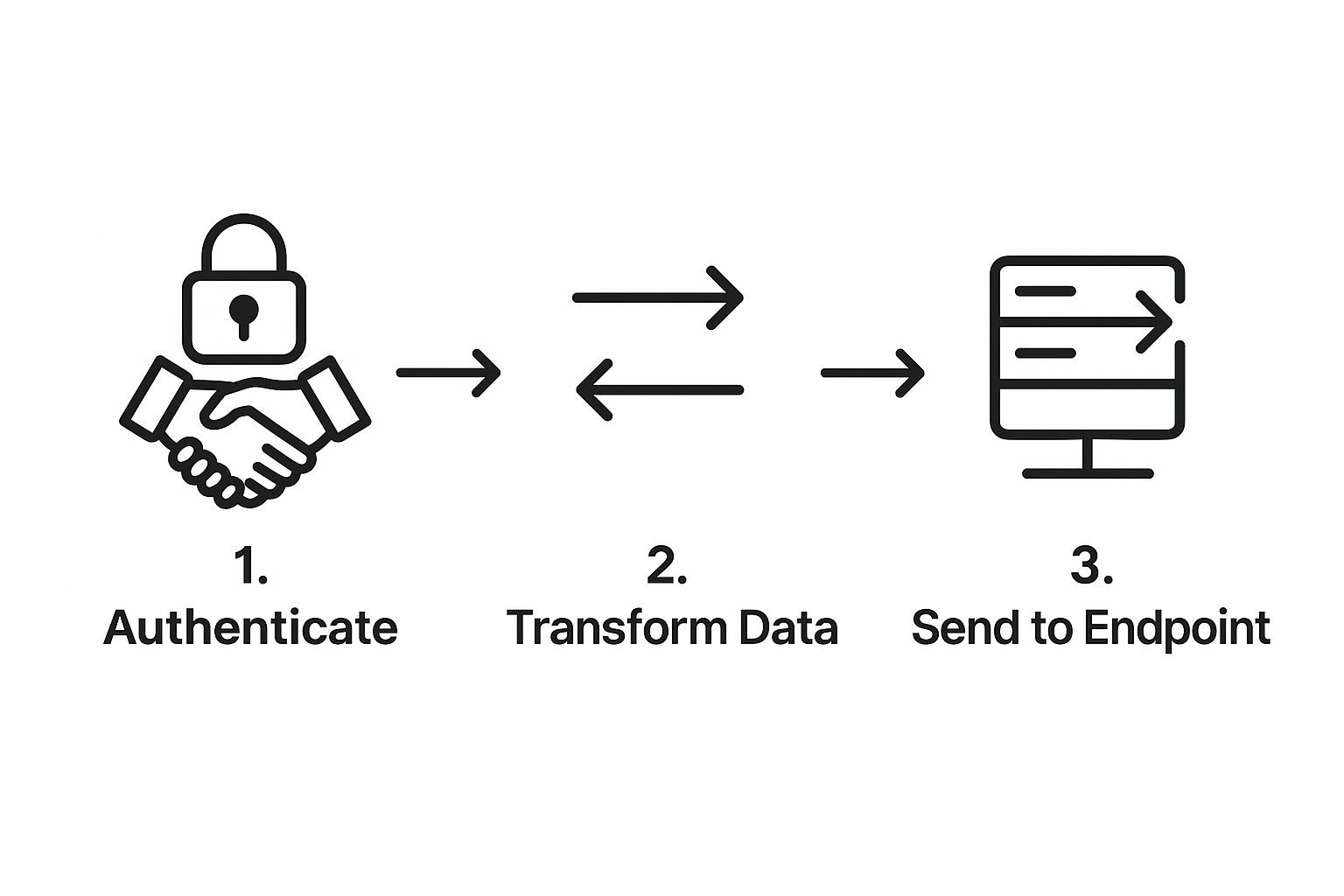
As you can see, the whole thing is a well-defined and secure process from start to finish.
Translating and Delivering the Data
Here's where things get clever. The two applications you're connecting often speak different languages. The kitchen might serve its food on a square plate (let's call that JSON format), but your table is set with round plates (XML format). This is where the connector truly earns its keep.
The connector is also a translator. It grabs the data from the source and automatically transforms it into the exact format the other application needs to understand it. This single step eliminates a huge technical headache that would normally demand hours of custom coding.
Finally, with the data correctly translated and formatted, the connector completes its round trip. It delivers the "meal" back to your application. For instance, it could take a new lead from your website contact form and instantly create a new customer profile right inside your CRM, mapping all the information to the correct fields.
This whole cycle—authentication, request, transformation, and delivery—is over in a flash. It's this reliable, repeatable process that makes API connectors so essential for automating your business and getting all your systems to work as one.
What Are the Real Business Benefits of API Connectors?

It’s one thing to understand the technical side of API connectors, but their true magic really comes to light when you see what they can do for a business. Let's step away from the code for a moment. These pre-built bridges are more than just a convenience; for many organisations, they're the key to becoming faster, smarter, and more data-aware. The benefits aren't just tiny tweaks—they change the way you work.
The first thing most businesses notice is how much faster everything gets. Projects that used to take months of painstaking custom coding and a hefty budget can now be done in a matter of days, sometimes even hours. For a communications platform like Voicetta, this means linking up to a new client's CRM isn't a massive, drawn-out project. It's a quick configuration.
That incredible speed leads directly to serious cost savings. You get to skip the high price tag of hiring specialist developers and dodge the continuous expense of keeping custom code up to date. This frees up your team and your budget to focus on growing the business, not just keeping the lights on.
Building a More Responsive Business
Saving time and money is just the beginning. Using API connectors makes your entire operation more agile. When all your systems are talking to each other effortlessly, your business can react to just about anything in a fraction of the time.
Think about it: your sales, marketing, and support tools all drawing from the same, up-to-the-minute information. A fresh lead from a marketing campaign pops up in your CRM instantly. When that person calls, your support agent already has their complete history on the screen. That’s the kind of power a connected system gives you.
This deep integration leads to a few fantastic outcomes:
- Better Data Accuracy: Automatic syncing gets rid of the manual data entry mistakes that cause bad decisions and annoy customers.
- More Productive Employees: Your team spends less time jumping between different apps and more time doing meaningful work, all with the full picture right in front of them.
- Top-Notch Customer Service: A single view of every customer interaction means you can deliver quicker, more personal support that builds real loyalty.
You can see the impact of this kind of connection everywhere. Here in Poland, the software development industry is a great example of this speed. The sector, valued at €8.3 billion in 2024, is booming largely because companies are using tools like API connectors to automate and integrate their services. In fact, it's on track to become a €14.3 billion market by 2030.
Getting Past Integration Roadblocks
At the end of the day, API connectors are your best bet for clearing the hurdles that stop you from building a modern, effective tech stack. Instead of getting tangled up in complicated code, you can finally concentrate on your business strategy.
They bring sophisticated automation within reach for everyone, breaking down the stubborn data silos that hold so many companies back. By making connections simple, you also neatly sidestep many of the common . This allows you to build a stronger, more unified backbone for your entire company, helping you not just compete, but create a smarter and more responsive business from the ground up.
Right, let's move from theory to reality. It’s one thing to talk about what API connectors are, but it’s seeing them in action that really makes the concept click. When you see how they solve real, everyday business headaches, their value becomes crystal clear.
Picture this: you're running a busy online shop on Shopify. Every single time a customer buys something, someone on your team has to stop what they're doing, open up QuickBooks, and manually key in a new invoice. It's tedious, it's slow, and honestly, it's a recipe for disaster. One typo, one missed sale, and you’ve got accounting problems.
This is a textbook case for an API connector. Instead of all that manual work, the shop simply uses a connector to link Shopify and QuickBooks. Now, the second a customer hits "confirm purchase," the connector springs into action behind the scenes.
The Problem: Manual invoicing was eating up hours and creating costly errors. The Solution: An API connector was set up to automatically push new sales data from Shopify directly into QuickBooks. The Outcome: Invoicing is now completely hands-off. The team gets back hours of their week, data entry mistakes vanish, and the financial records are always accurate and up-to-the-minute.
It's a beautiful, simple example of how connecting two apps creates powerful, practical automation.
Unifying Customer Communications with Voicetta
Now, let's apply that same logic to customer communications, where the stakes are even higher. A platform like Voicetta, which is on the front lines handling customer calls and chats 24/7, would be working with one hand tied behind its back if it was cut off from your other business tools. API connectors are what truly unleash its power.
Think about how Voicetta works with your core systems, like a Zendesk helpdesk or a Salesforce CRM. By using API connectors, we build a seamless, two-way bridge for data to flow freely.
So, when a customer calls, Voicetta can instantly dip into your CRM and pull up their entire history. This isn't just about knowing their name; it's about understanding their past issues and purchases, which allows our AI to have a much more intelligent and personal conversation.
But it doesn't stop there. Once the call ends, the connector sends a full transcript and a neat summary straight back to the CRM and helpdesk. This creates a single, unified timeline of every interaction for your human agents. No more asking customers to repeat themselves. Your team has all the context they need, right where they need it. This also makes other automated tools, like a virtual agent, smarter and more capable.
API Connectivity in the Public Sector
This push for integration isn’t just a private-sector trend. Government bodies are also getting on board, using APIs to open up valuable data to the public. Take the Polish administration, for example. Its Central Statistical Office (GUS) offers a public API for its Sustainable Development Goals data.
Here's a peek at the developer portal for that very API.
What you're seeing is the government making official data easily accessible for developers and researchers.
By providing this as a REST service, they allow anyone to programmatically pull official statistics into their own applications. This fuels better analysis, innovative projects, and data-informed policymaking. It's the same core idea businesses use to drive efficiency, just applied on a national scale. You can dig into Poland's open data strategy to see how these principles are being put into practice.
How to Choose the Right API Connector

So, you're sold on the idea of an API connector. That's the easy part. Now you're facing a sea of options, and it can feel a little overwhelming. How do you actually pick the right tool for the job?
Choosing a connector is about more than just solving one immediate problem. It's really about selecting a long-term partner for your business's growth. Think of it less like a quick fix and more like building a flexible, future-ready technology setup that can scale right alongside your ambitions. Get this decision right now, and you'll save yourself a world of expensive migrations and headaches later on.
Core Evaluation Criteria
When you start comparing different API connectors, it’s tempting to get bogged down in endless feature lists. A better approach is to zoom out and focus on the fundamentals—the core pillars that define a connector's quality and dependability.
Here are the critical questions you should be asking about any potential solution:
- Reliability and Uptime: Can you count on this connector to be up and running 24/7? Look for providers with a public status page or a clear service level agreement (SLA) that guarantees performance. Your operations depend on it.
- Security Standards: This is non-negotiable. How will your data be protected? The provider absolutely must use modern, robust security protocols like OAuth 2.0 and provide end-to-end encryption.
- Quality of Documentation: Is the setup guide actually helpful? Great documentation means your team can get up and running quickly and confidently, without needing to constantly contact support for help.
- Provider Support: What happens when something inevitably goes wrong? You need a provider with responsive, expert support channels to help you troubleshoot when you’re stuck.
Choosing a connector is like hiring a new team member. You need someone dependable, trustworthy, and easy to work with who will be there to help when you need them most.
Thinking About Your Future Needs
Beyond the technical checklist, take a step back and consider how this connector fits into your bigger picture. The right tool doesn’t just patch a hole in your current workflow; it opens up new doors for what you can achieve tomorrow. A huge part of this is seeing how it can boost your business process automation efforts across your entire company.
Scalability is another key piece of the puzzle. Will this connector grow with you? A solid API connector should handle a massive increase in data volume as your company expands, without slowing down or needing a complete re-think.
Finally, look at the connector’s ecosystem. Does it play well with the other essential apps you rely on every day, or the ones you plan on adopting in the future? A wide range of integrations gives you the freedom to build a truly connected system, making sure your investment keeps delivering value for years to come.
The Future of Automated Business Connectivity
If you think API connectors are impressive now, just wait. We're on the cusp of something much bigger than just simple automation. The next wave is all about intelligent, predictive integration that will completely change how we think about business operations. Welcome to the dawn of the true API economy.
This isn't just wishful thinking; it's being fuelled by huge leaps in artificial intelligence and machine learning. Soon, the connectors linking our favourite apps won't just follow the rules we set. They’ll start to think for themselves.
Imagine a connector that doesn't just shuffle data around but actually anticipates what your team needs next, all based on past behaviour and what’s happening in real-time.
The Rise of Intelligent Integration
This evolution means our connectors will take on far more complex tasks, all without needing a human to step in. It might sound like science fiction, but it’s the next logical step.
So, what does this future actually look like in practice?
- Proactive Workflows: Forget triggers based on what just happened. Future connectors will kick off actions based on what they predict will happen. For example, a connector could spot a sales trend and automatically tweak inventory orders with your suppliers before you even realise you're running low.
- Self-Healing Connections: We’ve all been there—an API changes, and everything breaks. An intelligent connector could diagnose the fault on its own, find a new way to connect, or reroute the data automatically. No more late-night panics.
- Adaptive Data Mapping: AI will give connectors the ability to understand the context of your data. This means they could map new data fields between your apps without you having to configure anything manually, making new integrations practically instant.
The ultimate aim here is a state of 'autonomous integration'. This is where your systems don't just talk to each other; they learn from each other, constantly refining your business processes without any prompting. That's when seamless connectivity becomes a genuine strategic weapon.
This isn't just a Silicon Valley trend; it's a global movement. Take Poland, for example, where the IT sector is increasingly focused on exports. The value added from foreign demand shot up from 27% in 2009 to 37% in 2020. A big part of that success comes from API connectors that let Polish companies effortlessly plug their systems into international partners and automate their cross-border workflows. You can dive deeper into Poland's expanding digital economy and its global integration.
Getting to grips with API connectors is no longer just a nice-to-have for efficiency. It’s about making your business ready for whatever comes next. For any company that wants to thrive in our hyper-connected world, these tools are simply essential for growth and resilience.
A Few Final Questions About API Connectors
To wrap things up, let’s tackle a couple of common questions that often pop up. Getting these details straight can make all the difference when you start putting these powerful tools to work.
What’s the Real Difference Between an API and an API Connector?
It's easy to get these two mixed up, but a simple analogy helps clear it up.
Think of an API as a restaurant’s menu. The menu lists all the dishes you can order and the rules for doing so (like no substitutions). It’s the official set of possibilities, but it doesn't actually place the order for you.
The API connector, on the other hand, is your waiter. The waiter takes your specific order from the menu (the API), communicates it to the kitchen, and handles all the back-and-forth to bring your meal to the table. The connector is the active go-between that does the work.
Are API Connectors Actually Secure?
Absolutely, provided you're using one from a reputable source. Trustworthy API connectors are built from the ground up with security as a core feature. They use standard, battle-tested protocols like OAuth and encrypted API keys to ensure that data is only ever shared between authorised systems.
The key is to choose a connector from a provider that lives and breathes security and is constantly updating its defences.
Building your own connector means taking on the entire burden of development and maintenance. It demands deep programming knowledge, extensive time for building and testing, and continuous resources to keep it running.
For the vast majority of businesses, a reliable, pre-built API connector is simply the smarter, more efficient, and more cost-effective choice. It lets you focus on what you do best, not on complex coding. When you choose to automate customer support with a platform like Voicetta, for example, you get to tap into secure, ready-made integrations right away.
Ready to see how seamless integration can transform your customer communications? Let Voicetta connect your systems and ensure you never miss another opportunity. Learn more at https://voicetta.com.
Was this useful?
If this article helped, add Voicetta as a preferred source in Google Search. Your results can then highlight our writing.
Add as preferred source