
Blog
What Is a Digital Worker? Your Quick Guide to AI Employees
The term "digital worker" is increasingly common in business conversations. But what exactly does it mean? It represents a significant change in how we work, going bey...
Understanding Digital Workers In Today's Workplace
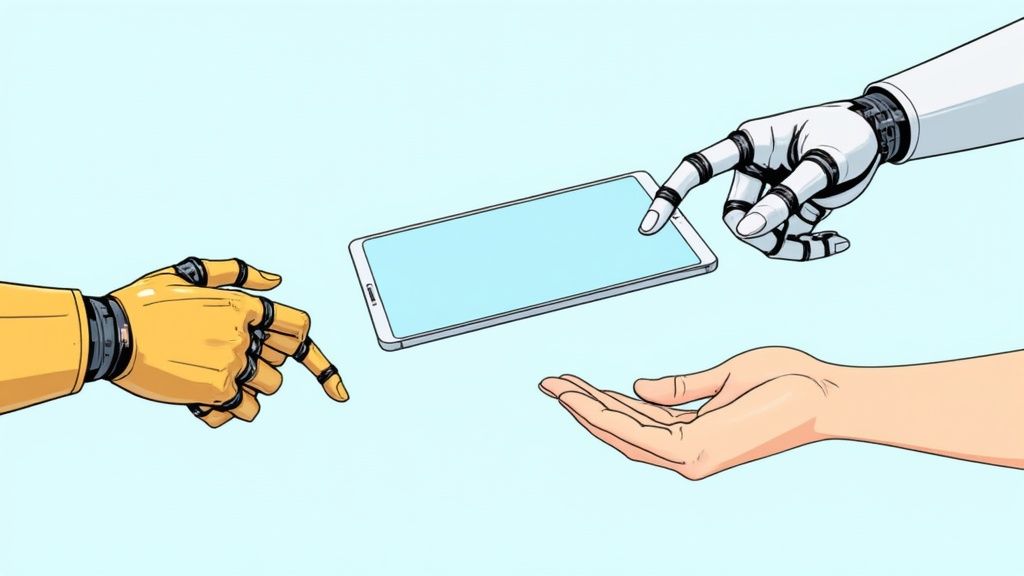
The term "digital worker" is increasingly common in business conversations. But what exactly does it mean? It represents a significant change in how we work, going beyond simple automation. A digital worker isn't just software; it's an AI-powered virtual team member designed to perform entire job functions. Instead of automating individual tasks, these digital workers manage complex workflows, much like their human counterparts.
Imagine a digital worker managing every aspect of customer onboarding: initial contact, data entry, and scheduling follow-ups. This comprehensive approach is a major leap forward from traditional automation.
This workplace evolution is driven by the need for greater efficiency, improved accuracy, and rapid scalability. Digital workers tirelessly handle repetitive tasks, freeing human employees for strategic and creative work. This allows businesses to adapt quickly to changing markets. Digital workers also offer 24/7 availability, ensuring continuous service and responsiveness – a critical advantage in today's global business environment. This constant availability enhances customer satisfaction and fuels business growth.
A digital worker is an AI-driven entity designed to automate entire job roles, not just isolated tasks, performing all the functions of a specific position in a human-like way. By 2025, digital workers have moved beyond simple chatbots, handling complex workflows like graphic design, HR management, and sales. McKinsey reports that one-third of surveyed organizations regularly use generative AI for at least one business function, with 40% planning further AI investment. Find more detailed statistics here. This rapid adoption highlights the growing recognition of AI's potential to reshape businesses.
The Impact of Digital Workers
Integrating digital workers isn't simply about automating tasks; it's about reimagining how work is structured and performed. This involves redefining roles, optimizing workflows, and fostering collaboration between human and digital employees. However, challenges arise, too.
Businesses must address workforce displacement concerns, the ethical implications of AI, and the need for continuous training and development for both human and digital workers. Successful implementation requires careful planning, open communication, and a dedication to continuous improvement. The future of work is constantly evolving, and understanding the role of digital workers is essential for navigating this changing environment.
The Technology That Powers Digital Employees

Digital workers represent a significant leap forward from basic automation. They're powered by a network of interconnected technologies working in concert to create a digital workforce capable of handling complex tasks and even entire job functions. To truly understand the potential of a digital worker, we need to look at the technology behind the curtain.
Artificial Intelligence (AI) as the Core
At the heart of every digital worker is Artificial Intelligence (AI). Think of it as the brain of the operation. AI provides the fundamental intelligence that allows these digital employees to learn, reason, and make decisions. Sophisticated AI algorithms empower digital workers to analyze data, recognize patterns, and respond to changing conditions, mirroring the adaptability of human employees. This allows them to learn from new information and constantly improve their performance.
Machine Learning for Continuous Improvement
Machine learning, a subset of AI, gives digital workers the ability to learn from data without explicit programming. This means each interaction and new piece of data refines their processes, making them more efficient over time. This constant learning is critical for staying agile in dynamic business environments and keeping up with ever-changing customer needs.
Natural Language Processing for Human-Like Interactions
Natural Language Processing (NLP) is what enables digital workers to understand and interact with human language. This technology allows them to interpret text, spoken words, and other communication forms, fostering more natural interactions with both customers and colleagues. Imagine a digital worker in customer service understanding a nuanced question and providing a relevant answer. For real-world applications of this, check out this guide on automating customer support.
Advanced Automation for Complex Workflows
Finally, advanced automation integrates different technologies to automate entire workflows, going beyond simple, individual tasks. This means digital workers can manage complex processes from beginning to end, streamlining operations and boosting overall efficiency. This workflow management capability is what sets digital workers apart from traditional automation tools, making them more versatile and valuable to an organization. This powerful combination of technologies is a game-changer for businesses looking to optimize their operations and elevate their customer experiences.
Digital Workers vs Traditional Automation Showdown
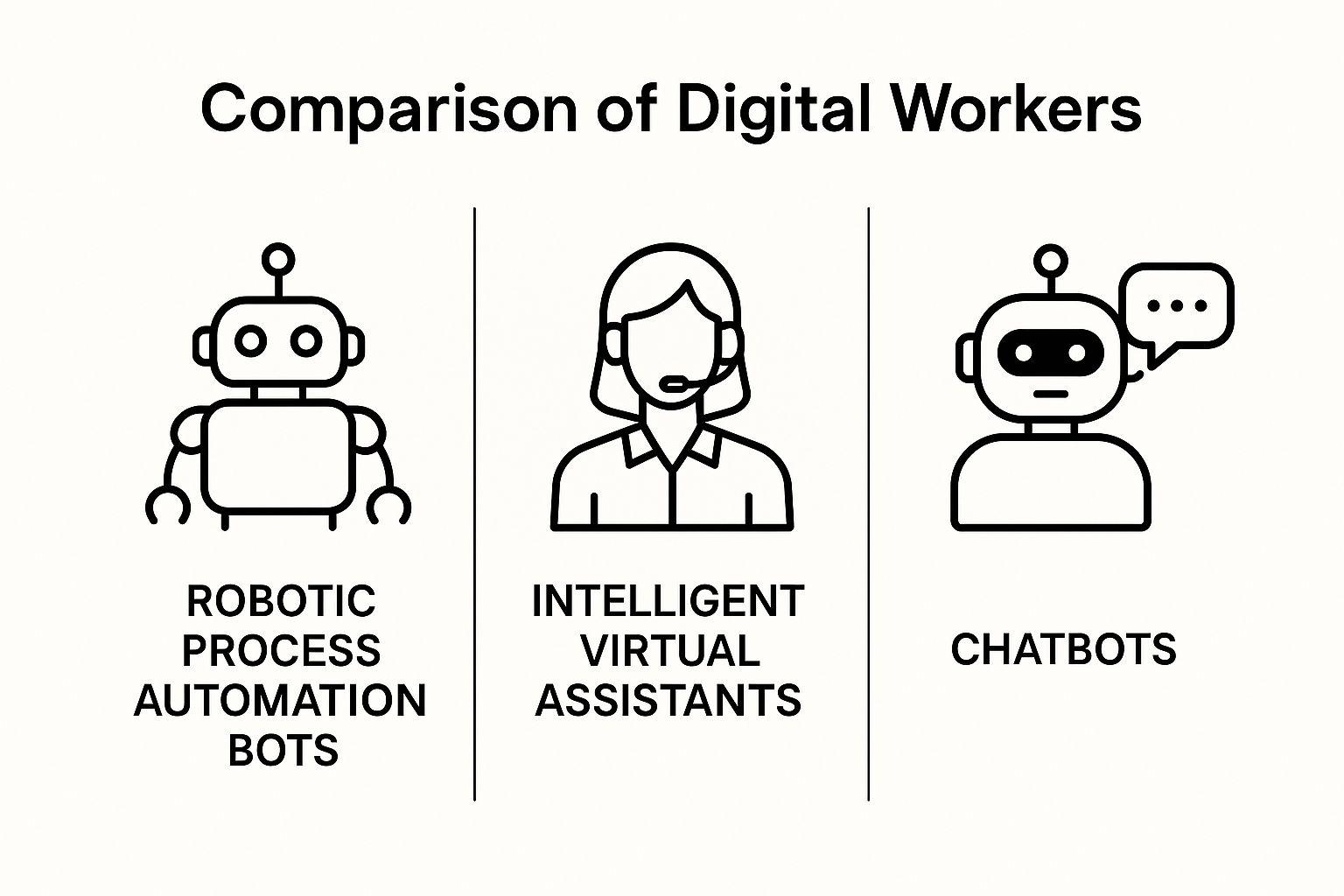
The infographic above shows the range of digital workers, from simple Robotic Process Automation (RPA) bots to sophisticated Intelligent Virtual Assistants and Chatbots. It highlights the growing complexity and abilities of these digital colleagues. This progression marks a move from automating basic tasks to more intelligent, AI-powered solutions.
This goes beyond simply automating repetitive work; it's about changing how work is done. Traditional automation tools like RPA are great for pre-defined, rule-based processes, but they lack the cognitive flexibility of digital workers. This means traditional automation struggles with tasks that need judgment, adaptability, or an understanding of context.
For example, a traditional RPA bot might automate invoice processing, but a digital worker could handle complex customer service interactions, analyze market trends, or even manage project workflows. Let's explore the key differences between these two approaches to automation. To help illustrate these differences, we've put together a comparison table.
To understand the key distinctions, let's examine a table summarizing the core differences between digital workers and traditional automation.
| Feature | Traditional Automation | Digital Workers | Business Impact |
|---|---|---|---|
| Process Type | Rule-based, repetitive tasks | Complex, judgment-based tasks | Increased efficiency for simple tasks vs. enhanced decision-making for complex ones |
| Cognitive Ability | Limited, pre-programmed | Advanced, AI-driven | Inability to handle exceptions vs. adaptability and learning |
| Human Interaction | Minimal, often siloed | Collaborative, integrated | Requires human intervention for exceptions vs. seamless teamwork |
| Adaptability | Low, requires reprogramming | High, learns and adapts | Difficulty with changing environments vs. continuous improvement |
| Cost of Implementation | Lower initial investment | Higher initial investment | Quick ROI on simple tasks vs. long-term value for complex processes |
| Examples | Invoice processing, data entry | Customer service, market analysis | Automating back-office functions vs. supporting strategic decision-making |
This table highlights the fundamental differences between traditional automation and digital workers. While traditional automation excels at streamlining simple, repetitive tasks, digital workers offer the cognitive abilities and adaptability needed for more complex, dynamic processes. This opens up exciting possibilities for businesses looking to optimize their operations and enhance their decision-making capabilities.
Adaptability and Cognitive Reasoning: Key Differentiators
Digital workers represent a significant step forward from traditional automation because of their cognitive reasoning and contextual awareness. These abilities enable them to handle unclear situations and make complex decisions. Also, digital workers can learn and adapt to new information, constantly improving their performance.
You might be interested in learning more about process automation: How to master business process automation with examples. This adaptive learning is what sets them apart from traditional automation tools, which are constrained by pre-programmed rules.
Collaboration and Human-Digital Workforce Integration
Digital workers can also seamlessly collaborate with human colleagues, connecting automated processes with human expertise. This collaboration creates a more efficient and dynamic work environment.
However, traditional automation often operates in isolation, needing human intervention to deal with exceptions or complicated situations. This difference highlights the potential of digital workers to smoothly integrate into existing teams and boost overall productivity. This potential for seamless integration is changing how businesses approach workforce planning and resource allocation, letting them strategically combine the strengths of both human and digital employees.
Digital Workers Transforming Industries Right Now

The increasing presence of digital workers marks a significant change in business operations across various sectors. From healthcare to finance, these AI-powered assistants are proving their worth, handling important tasks and delivering tangible improvements. Let's explore how different industries are using digital workers to address their specific needs.
Healthcare: Enhancing Patient Care and Streamlining Operations
Digital workers are making a real difference in healthcare. By automating administrative tasks such as appointment scheduling and record management, they free up healthcare professionals to concentrate on patient care. Digital workers can also assist with patient monitoring and data analysis, contributing to more accurate diagnoses and personalized treatment plans. Some hospitals are even using digital workers to manage patient intake, answer FAQs, and provide preliminary medical advice.
Finance: Managing Risk and Improving Efficiency
Financial institutions are leveraging digital workers to manage risk and boost efficiency. These digital assistants can automate fraud detection, analyze market trends, and process complex transactions with increased speed and accuracy. They can also assist with regulatory compliance, mitigating the risk of penalties. This allows human employees to focus on strategic financial planning and client relationships.
Manufacturing: Optimizing Production and Reducing Downtime
In manufacturing, digital workers optimize production schedules, manage inventory, and anticipate maintenance needs. This helps reduce downtime and improve overall efficiency. They can also monitor equipment performance and identify potential problems before they cause disruptions, ultimately improving output and reducing costs.
Retail: Personalizing Customer Experiences and Boosting Sales
Digital workers are transforming retail by personalizing customer experiences and driving sales. They can offer 24/7 customer support, provide tailored product recommendations, and even manage online orders. Imagine a digital worker responding to customer inquiries online, suggesting specific promotions, and giving product details in real time. This approach boosts customer satisfaction and sales growth.
Professional Services: Handling Client Deliverables and Increasing Productivity
Professional services firms are utilizing digital workers to handle complex client deliverables, manage projects, and conduct research. This improves productivity and allows professionals to focus on high-value client work. A digital worker might draft legal documents, analyze market data for consulting projects, or even create marketing materials. This boosts efficiency and enables human professionals to concentrate on client relationships and strategic guidance. The implementation of digital workers in these and other industries highlights the potential of AI to tackle key business challenges while adhering to quality and compliance standards. These examples illustrate how organizations are effectively identifying suitable applications, overcoming implementation obstacles, and achieving a positive return on their digital worker investments.
The Business Case That's Driving Digital Worker Adoption
The rise of digital workers isn't simply a passing fad; it's a strategic response to the changing dynamics of the business world. Companies are increasingly seeing the value in these AI-powered employees, recognizing their potential to deliver a substantial return on investment (ROI). This shift is fueled by a combination of factors, from cost savings and efficiency gains to bridging the talent gap and boosting overall competitiveness.
Cost Reduction and Efficiency Gains
One of the most attractive benefits of digital workers is their ability to cut costs. By automating tasks that were once handled by human employees, businesses can significantly reduce labor costs, minimize errors, and boost operational efficiency. These savings can then be channeled into other critical areas like research and development or marketing initiatives, fostering further growth.
Imagine a digital worker processing invoices. It works tirelessly, day and night, significantly faster and more accurately than a human counterpart. This not only reduces errors but also frees up human employees to focus on more strategic, value-added activities. It’s a recipe for a leaner, more agile, and ultimately, more profitable organization.
Addressing the Talent Shortage and Bridging Skill Gaps
The global digital workplace market is booming. Reaching $33 billion in 2022, it's projected to soar to $62 billion by 2025, boasting a 22.3% CAGR. The tech sector alone faces a potential loss of $162 billion in revenue if the digital skills gap isn't addressed, highlighting the critical role digital workers can play. For a deeper dive into these trends, check out: Insights on Digital Transformation Statistics.
This surge in demand for digital solutions underscores the increasing pressure on businesses to adapt. It also exacerbates an already challenging talent shortage. Many organizations struggle to find and retain employees with the in-demand digital skills needed to thrive. Digital workers offer a practical solution, bridging these skill gaps and ensuring business continuity.
Integrating AI-powered solutions like those described in How to enhance your customer communication with an AI Voicebot can help businesses address immediate needs and position themselves strategically for future growth. By adopting digital workers, companies can build a more resilient workforce, prepared for the ever-evolving demands of the modern business world.
To understand the potential impact, let’s look at some key data:
Digital Worker Market Growth and ROI Metrics: Key statistics showing market growth projections, adoption rates, and typical ROI metrics organizations achieve with digital worker implementations.
| Metric | Current Value | Projected Growth | Business Impact |
|---|---|---|---|
| Market Size (2022) | $33 Billion | Significant market opportunity | |
| Market Size (2025) | $62 Billion | Rapid expansion | |
| CAGR (2022-2025) | 22.3% | High growth potential | |
| Potential Revenue Loss (Tech Sector due to Skills Gap) | $162 Billion | Underscores importance of digital workers |
These numbers highlight the significant growth and potential impact of digital workers across industries.
Productivity Gains and Competitive Advantage
Digital workers don't just cut costs; they also fuel productivity. By taking over repetitive, time-consuming tasks, they free up human employees to focus on more strategic, creative, and ultimately, more impactful work. This increased efficiency translates to faster turnaround times, greater output, and improved profitability.
In today’s competitive landscape, even incremental productivity gains can make a significant difference. By harnessing the power of digital workers, businesses can outperform competitors by offering faster, more efficient services and developing more innovative products. This advantage becomes particularly pronounced in industries where speed and efficiency are paramount.
The combined benefits of cost savings, increased productivity, and the ability to address talent shortages make a compelling case for adopting digital workers. Organizations that embrace this technology are not just keeping up; they're positioning themselves for success in the constantly evolving world of business.
Your Roadmap to Digital Worker Success
Implementing digital workers isn't just about installing new software. It's about welcoming a new type of teammate. This requires a strategic approach, blending the technical aspects with the human element of your existing team. This roadmap, drawn from successful deployments, will guide you through the key steps.
Initial Assessment: Defining Your Needs and Opportunities
Before introducing any digital worker, it's essential to identify where they can have the greatest impact. Start by analyzing your current workflows and pinpoint processes ready for automation. Look for tasks that are repetitive, time-consuming, or susceptible to human error. These are often ideal areas for digital worker integration.
Think about processes like data entry, customer service inquiries, or scheduling. These tasks can consume significant time for human employees. Digital workers can handle them efficiently, freeing up your team for more strategic, higher-value work. You might find this resource helpful: How to master customer communication with an AI Messenger Voicebot.
Selecting the Right Digital Worker
Once you’ve identified your needs, the next step is selecting the right digital worker for the job. Digital workers possess diverse capabilities, ranging from simple chatbots to advanced AI-powered assistants. Consider the complexity of the tasks, the necessary level of human interaction, and how well the digital worker integrates with your existing systems. Choosing wisely is essential to maximize the benefits of your digital workforce.
Implementation and Integration
Smooth integration is the cornerstone of success. This involves configuring the digital worker to interact seamlessly with your systems, data sources, and workflows. Ensure data flows efficiently between the digital worker and your other platforms, preventing data silos and boosting efficiency. Thorough testing and refinement are crucial at this stage to optimize performance.
Change Management and Workforce Adaptation
Introducing digital workers often requires adapting existing roles and workflows. This can sometimes spark concerns among employees about job security and their evolving roles within the organization. Addressing these concerns proactively is paramount.
Open communication, setting clear expectations, and providing appropriate training can smooth the transition and empower employees to adapt to the changing environment. Emphasize the collaborative nature of digital workers, showcasing how they enhance, not replace, human capabilities.
Ongoing Monitoring and Optimization
Implementing digital workers isn't a one-and-done project. It’s a continuous process. Regularly monitor the performance of your digital workforce, track key metrics, and identify areas for improvement. Continuously evaluate their effectiveness and make necessary adjustments to maximize their impact. This iterative approach keeps your digital workforce aligned with your evolving business needs and drives long-term success.
Key Takeaways
This section boils down the essentials of digital workers into practical insights. Whether you're just starting to explore AI-powered solutions or you're already modernizing your business processes, these takeaways offer a helpful guide for success.
Understanding the Core Value of Digital Workers
- Digital workers go beyond simple automation: They represent a real change in how work gets done, progressing from automating individual tasks to managing whole job functions. This creates more efficient and flexible workflows.
- AI is the key driver: Technologies like Artificial Intelligence, Machine Learning, and Natural Language Processing enable digital workers to learn, adapt, and communicate in a human-like manner. This makes them more adaptable and valuable than traditional automated tools.
- Strategic implementation is crucial: Successfully integrating digital workers needs careful planning, clear communication, and continuous optimization. This makes sure the transition goes smoothly and maximizes the benefits for your business.
Realizing the Business Benefits
- Reduced costs and improved efficiency: Digital workers can cut labor costs significantly and improve operational efficiency by automating repetitive tasks. This gives human employees more time for strategic work.
- Filling the skills gap: With increasing demand for digital skills and an ongoing talent shortage, digital workers offer a solution to bridge skill gaps and maintain business operations.
- Gaining a competitive advantage: By automating time-consuming tasks and increasing productivity, digital workers can give businesses an advantage in today's competitive markets.
Charting Your Path to Digital Worker Integration
- Begin with a thorough assessment: Before implementation, carefully evaluate your existing workflows to find the areas where digital workers can make the biggest difference.
- Select the appropriate digital worker: Picking a digital worker with the right abilities for your specific requirements is essential for maximizing the returns. This involves understanding the tasks, the required level of human interaction, and how it will integrate with your current systems.
- Consider the human factor: Proactively address employee worries about job security and changing roles through open communication and training. Highlight the collaborative aspect between human and digital workers.
- Strive for continuous improvement: Regularly check the performance of your digital workers and refine their integration to ensure they keep meeting your evolving business needs. This ongoing improvement will maximize your return on investment.
Ready to transform your customer communications and explore the possibilities of AI? Visit Voicetta today to see how their platform can improve your customer support, increase efficiency, and help your business grow.
Was this useful?
If this article helped, add Voicetta as a preferred source in Google Search. Your results can then highlight our writing.
Add as preferred source