
Blog
What is IVR? A Complete Guide to Interactive Voice Response
We’ve all experienced it: calling a business and being greeted not by a human, but by an automated voice guiding us through a menu of options. This is Interactive Voi...
Demystifying IVR: The Technology Behind the Voice

We’ve all experienced it: calling a business and being greeted not by a human, but by an automated voice guiding us through a menu of options. This is Interactive Voice Response (IVR), a technology that's become a cornerstone of modern customer service. It's more than just a simple phone menu; it's a virtual receptionist capable of handling a large volume of calls, ensuring efficient routing and reduced wait times. But how does this technology actually work behind the scenes?
Understanding the Core Components of IVR
Modern IVR systems operate through a coordinated effort of several key components. The process begins when the system receives an incoming call and plays a pre-recorded greeting, presenting the caller with available options.
The caller's input is then captured in one of two ways: through Dual-Tone Multi-Frequency (DTMF) tones, generated by pressing the keys on their phone, or through voice recognition software. This interpretation of the caller's response enables the system to take action.
This action could be anything from transferring the call to the appropriate department or providing self-service information, like an account balance. The system's integration with other business applications, such as Customer Relationship Management (CRM) software, allows for personalized interactions. Imagine calling your bank and the IVR instantly recognizing you and addressing your specific needs—that’s the power of CRM integration.
The Impact and Growth of IVR Technology
The IVR market is experiencing remarkable growth, fueled by businesses seeking efficient customer service solutions and personalized customer experiences. North America holds a prominent position in this market, contributing approximately 40% of its growth. This regional significance underscores the growing global emphasis on tailored IVR interactions.
The incorporation of Artificial Intelligence (AI) and advanced analytics is further transforming IVR systems. These technologies are paving the way for intelligent platforms capable of addressing complex queries with minimal human intervention. Moreover, cloud-based IVR solutions are playing a key role in enhancing workflows and bolstering customer satisfaction. For a more in-depth look at market statistics, check out this resource. You can also learn more about optimizing your IVR strategy through this helpful guide: How to Master IVR.
IVR technology is continuously evolving, moving beyond basic touch-tone menus toward platforms powered by AI and Natural Language Processing (NLP). This shift facilitates a more natural and conversational experience, marking a significant change in how businesses connect with their customers. It's a transformation focused on enhancing both operational efficiency and customer satisfaction.
The Evolution of IVR: From Clunky Menus to Conversational AI
Early IVR systems were heavily reliant on Dual-Tone Multi-Frequency (DTMF). This meant callers had to navigate complex, and often frustrating, touch-tone menus. These systems offered limited self-service options, frequently leading to long wait times and caller frustration. This initial phase made it clear that more intelligent and user-friendly solutions were needed.
The Rise of Natural Language Processing
The advent of Natural Language Processing (NLP) marked a significant shift in IVR technology. NLP allows IVR systems to understand and respond to human speech, enabling more natural and conversational interactions. Callers could simply state their needs, rather than navigating a rigid menu structure.
This change dramatically improved the caller experience. It also opened up new possibilities for more complex self-service functionalities. For example, callers could ask for their account balance, schedule appointments, or get answers to frequently asked questions, all without needing to speak to a live agent.
The Impact of AI and Cloud Computing
Building upon NLP, advancements in artificial intelligence (AI) and cloud computing have taken IVR systems to new heights. AI allows for more personalized interactions, anticipating caller needs and providing tailored responses. Cloud-based systems offer greater scalability and flexibility, letting businesses adapt to changing demands and integrate with other business applications.
This powerful combination has transformed IVR from a simple routing tool into a robust customer experience platform. You might be interested in: Learning more about Voicetta.
IVR Market Growth and Future Trends
The Interactive Voice Response (IVR) market has experienced impressive growth, reflecting the increasing demand for efficient customer service. In 2023, the market was valued at USD 5.23 billion. It is projected to reach USD 8.99 billion by 2032, growing at a CAGR of 6.20%.
This growth is fueled by the need for enhanced customer relationship management and the adoption of cloud-based solutions. Find more detailed statistics here. As the market evolves, advancements like AI-powered conversational interfaces and personalized self-service options will shape the future of IVR technology. These developments promise to further improve customer satisfaction and streamline business operations.
Anatomy of Effective IVR: Components That Drive Success
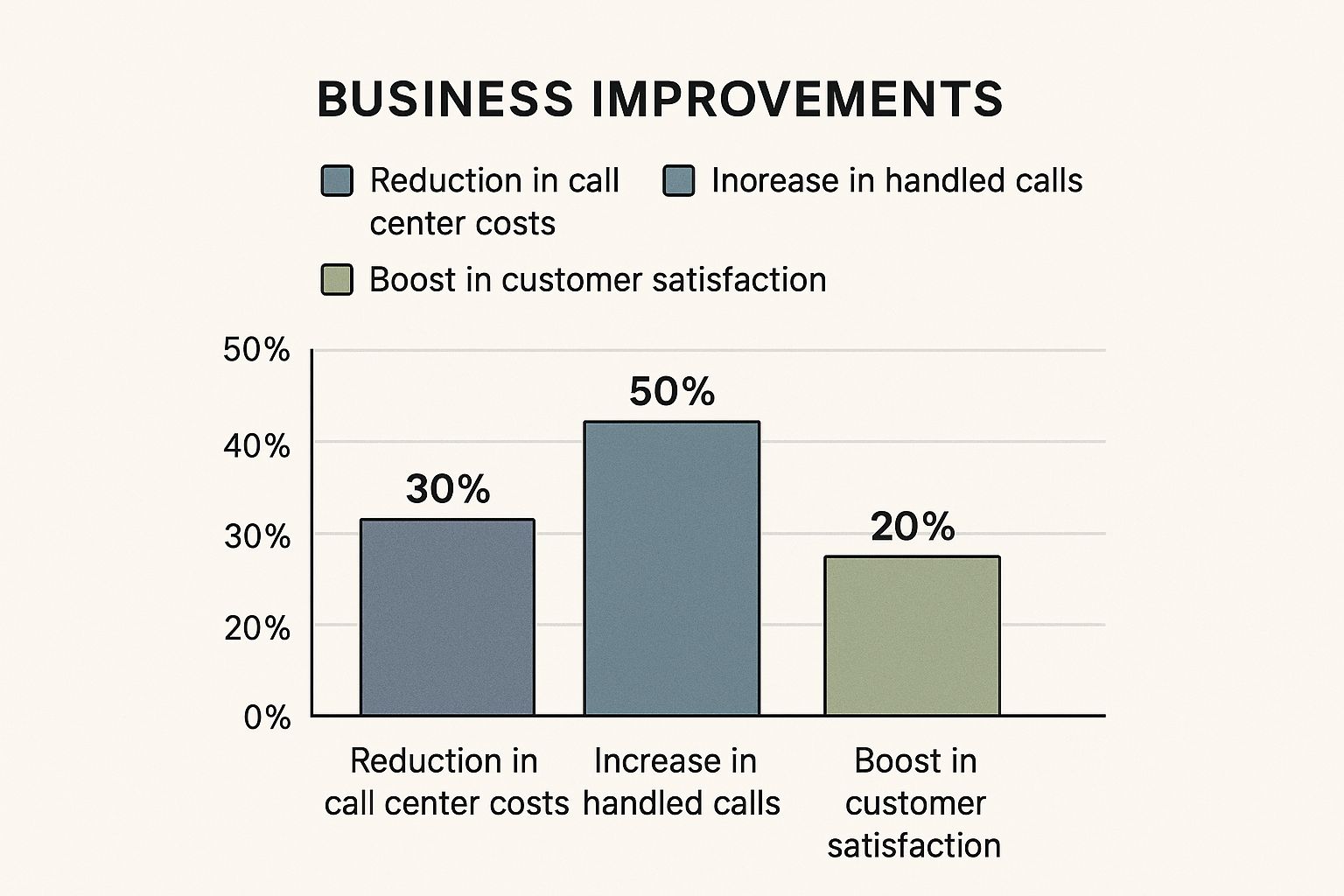
This bar chart tells a compelling story: a potential 30% reduction in call center costs, a 50% increase in handled calls, and a 20% boost in customer satisfaction. These aren't just numbers; they represent the tangible impact of a well-implemented IVR system. For businesses, this translates to significant improvements in key performance indicators, leading to cost savings, increased call capacity, and happier customers.
But how exactly are these impressive results achieved? Let's delve into the inner workings of an effective IVR system. These systems are far more sophisticated than simple pre-recorded messages. They involve a complex interplay of technologies, including the telephony infrastructure managing the calls, the voice recognition engine deciphering caller input, and the crucial backend integrations connecting the IVR to other business systems.
Core Components of an Effective IVR System
At the heart of every IVR is Dual-Tone Multi-Frequency (DTMF) processing, the familiar touch-tone interaction we all know. However, modern IVR systems have evolved significantly. They now leverage Natural Language Understanding (NLU), enabling callers to communicate in a natural, conversational manner. This, coupled with text-to-speech (TTS) technology, creates a more engaging and user-friendly experience.
Deployment Models: On-Premises, Cloud-Based, and Hybrid
The success of an IVR system isn't just about its core components; the deployment model also plays a crucial role. Businesses have several options to choose from: on-premises solutions offer maximum control but demand substantial investment and maintenance. Cloud-based systems provide scalability and flexibility, often at a lower initial cost. Hybrid models combine the strengths of both, offering a tailored approach. The evolution of IVR is intertwined with advancements in AI, with modern call centers increasingly incorporating call center AI solutions.
To illustrate the different approaches: a large corporation might implement an on-premises system tightly integrated with its CRM (Customer Relationship Management) system for enhanced data security and personalized customer interactions. A smaller business, on the other hand, might find a cloud-based solution more suitable due to its cost-effectiveness and ease of deployment. The optimal choice depends on the specific needs and resources of each organization.
To help visualize the key differences between these deployment models, let's take a look at the following comparison:
Comparison of IVR System Types
This table compares the three main types of IVR systems: on-premises, cloud-based, and hybrid solutions, highlighting their strengths and weaknesses across key areas.
| IVR System Type | Initial Cost | Maintenance Requirements | Scalability | Integration Capabilities | Best For |
|---|---|---|---|---|---|
| On-Premises | High | High | Limited | Extensive, Customizable | Large enterprises with complex needs and high security requirements |
| Cloud-Based | Low | Low | High | Pre-built integrations, limited customization | Small to medium businesses seeking cost-effective and scalable solutions |
| Hybrid | Medium | Medium | Moderate | Customizable, leveraging both on-premises and cloud integrations | Businesses needing a balance of control, scalability, and integration flexibility |
As the table highlights, each IVR deployment model offers a unique set of advantages and disadvantages. The ideal choice hinges on a business's specific needs and priorities.
By carefully considering these components and deployment options, businesses can create IVR systems that not only streamline operations but also elevate the customer experience. This strategic approach drives measurable improvements in both caller satisfaction and operational efficiency.
The Business Case: Real ROI from Strategic IVR Implementation
Understanding IVR (Interactive Voice Response) isn't just about the tech itself; it's about seeing how it can seriously boost your profits. This section dives into how a well-planned IVR system can deliver a real return on your investment.
Quantifiable Benefits Across Industries
Businesses in all sorts of fields are using IVR to cut costs, make customers happier, and work more efficiently. Retailers, for instance, have seen staffing costs drop by 35% while also solving more customer issues on the first call. Automated reminders in healthcare have reduced missed appointments. Financial institutions have tightened security and streamlined authentication. These are just a few ways IVR delivers tangible results across different industries. Using tools like Intelligent Process Automation can create a truly effective IVR system.
The IVR market itself is also set for major growth. Expected to hit $5.92 billion in 2025, up from $5.53 billion in 2024 (a 7.0% CAGR), the increasing demand for this technology is clear. The market is further projected to reach $7.7 billion by 2029, with a CAGR of 6.8%. This expansion is fueled by things like better internet access, the need for personalized systems, and the rise of cloud-based solutions. You can learn more about these IVR market trends here.
Calculating and Tracking ROI
So, how can you measure the potential IVR ROI for your business? A few key metrics can help you track progress and show the value of your IVR system.
-
Cost Reduction: Look at the money saved from needing fewer staff, shorter call times, and smoother operations.
-
Customer Satisfaction: Keep an eye on things like CSAT (Customer Satisfaction scores), NPS (Net Promoter Score), and CES (Customer Effort Score).
-
Call Resolution Rates: Check what percentage of calls are solved by the IVR without needing a human agent.
-
Call Containment: See how well the IVR keeps calls within the system, avoiding unnecessary transfers to live agents.
-
Average Handling Time: Measure how much the average call time goes down, showing improved efficiency.
To explore pricing options and how they might fit your needs, you can check out Voicetta's pricing. By focusing on these metrics and setting clear goals, businesses can effectively show IVR's value and make sure they're getting the most out of it.
Let's take a look at the ROI metrics across different industries:
The following table provides a closer look at how IVR implementations can affect ROI across various sectors.
IVR Implementation ROI Metrics by Industry
This table presents key performance metrics and return on investment figures for IVR implementations across different industry sectors, highlighting the varying impact and benefits.
| Industry | Average Cost Reduction | Customer Satisfaction Improvement | Call Resolution Time Change | Typical Payback Period | Notable Benefits |
|---|---|---|---|---|---|
| Retail | 35% | 20% | -15% | 12 Months | Reduced staffing costs, improved first call resolution |
| Healthcare | 20% | 15% | -10% | 18 Months | Fewer missed appointments, streamlined appointment scheduling |
| Financial Services | 25% | 25% | -20% | 9 Months | Enhanced security, efficient authentication |
| Telecommunications | 30% | 10% | -12% | 15 Months | Reduced call volume to agents, faster customer service |
| Travel & Hospitality | 15% | 30% | -5% | 24 Months | Improved booking process, personalized customer experience |
Note: These figures are illustrative examples and may vary depending on the specific implementation and context.
As you can see, implementing an IVR system can have a significant positive impact on a variety of key metrics. From cost savings to improved customer satisfaction and faster call resolution times, the benefits are substantial across diverse industries. Choosing the right IVR system and implementation strategy is crucial for maximizing these returns.
Designing IVR Experiences That Customers Actually Appreciate

Let's face it, nobody looks forward to navigating an Interactive Voice Response (IVR) system. But what if these interactions could be less frustrating and more efficient? The key lies in shifting the focus from simply routing calls to crafting a positive customer journey. A well-designed IVR can transform this often-dreaded experience into something genuinely helpful.
Crafting Intuitive Menu Structures
The foundation of any good IVR is a well-structured menu. Think of it as a roadmap guiding callers to their desired destination. This menu should be simple, logical, and easy to navigate. Clear, concise language is essential in voice prompts, avoiding technical jargon or complex sentences that can quickly lead to confusion.
Limit the number of options presented at each stage to avoid overwhelming callers. Instead of listing every single department, group them by service type. This allows callers to quickly identify the relevant category. A "main menu" option at each step is also invaluable, empowering callers to easily correct wrong choices and reducing frustration.
Writing Clear and Concise Voice Prompts
The words used in your voice prompts have a direct impact on the caller's experience. Keep prompts short, direct, and easy to understand. Long explanations and complicated instructions will only lead to frustration.
For example, "For product support, press 1" is much more effective than "If you are experiencing technical difficulties with your recently purchased product, press 1." Brevity respects the caller's time and ensures clarity. Investing in professional voice talent can also make a difference, adding a touch of warmth and personalization. For more tips, check out this guide on How to master your IVR strategy.
Designing Efficient Call Flows
Efficient call flows are the backbone of a positive customer experience. They ensure callers are routed quickly and effectively to the correct department or resource. This involves carefully planning and anticipating the various paths a caller might take.
Offering self-service options for common inquiries, like checking account balances or tracking order status, can significantly reduce call handling time and boost efficiency. Empowering callers to access information quickly improves their overall experience. However, always provide a clear and accessible option to speak with a live agent, ensuring callers don't feel trapped in the automated system.
Testing and Optimization: Continuous Improvement
Regular testing and optimization are essential for peak IVR performance. Gather caller feedback through surveys and analyze call data to identify areas for improvement. For example, if many callers abandon the system at a particular point, that signals a problem that needs attention.
This might involve revising prompts, restructuring menu options, or streamlining the overall call flow. Continuously refining the IVR based on data and feedback keeps it user-friendly. Adding personalization, like addressing callers by name and tailoring menu options based on their account history, can further enhance the experience.
The Future of IVR: Where Voice Technology Is Heading Next
The world of Interactive Voice Response (IVR) is constantly changing, thanks to the rapid advancements in voice technology. These changes promise to make interactions smoother, more personalized, and much more efficient. But what do these advancements mean for businesses and their customers? Let's delve into the key trends shaping the future of IVR.
AI-Powered Conversations: Beyond Basic Interactions
One of the most significant shifts is the rise of Artificial Intelligence (AI) within IVR systems. This goes far beyond simple voice recognition and into the realm of true conversational AI. Imagine systems that not only understand a caller's words, but also the intention behind them. This allows IVR systems to anticipate needs and offer more tailored responses, leading to a more natural and helpful conversation. For instance, instead of navigating a caller through a complex phone tree, an AI-powered IVR could understand a request like, "I need to reschedule my appointment," and immediately direct them to the right department.
Predictive Analytics and Personalization
Another exciting area of development is the use of predictive analytics. By analyzing past call data and individual customer histories, these systems can anticipate future needs and even offer proactive assistance. Picture an IVR that recognizes a caller's previous issues and proposes solutions before they even ask. This personalized touch makes for a much more efficient and satisfying experience. Moreover, incorporating emotion detection can help IVR systems recognize frustrated callers and prioritize their needs, potentially routing them to a live agent more quickly.
Omnichannel Integration for Seamless Experiences
The future of IVR isn't about standalone systems; it's about integrating voice into a wider omnichannel strategy. This involves weaving together different communication channels like web chat, email, and social media to create a fluid experience. For example, a customer could begin interacting with a business via web chat and then move seamlessly to a phone call with the IVR, all while maintaining context from their initial interaction. This connected approach creates a cohesive customer journey.
Voice Biometrics and Enhanced Security
Security remains paramount, and voice biometrics offers a robust solution for authentication. By analyzing the unique characteristics of a caller's voice, IVR systems can confirm their identity, eliminating the need for passwords or security questions. This streamlines access to sensitive information while also reinforcing security measures.
Proactive Outreach and Automated Engagement
IVR isn't just about reacting to customer calls anymore; it's becoming proactive. Think of an IVR system that reaches out to customers with important reminders or personalized promotions. This proactive communication strengthens customer relationships and contributes to better business outcomes. A healthcare provider, for example, might use IVR to remind patients about upcoming appointments or to provide follow-up care instructions.
The future of IVR is bright, filled with the potential for intelligent, personalized, and proactive conversations. These improvements stand to reshape the way businesses connect with customers, making interactions more effective and enjoyable. By adopting these evolving technologies, companies can unlock fresh opportunities to improve customer service, optimize their operations, and foster growth.
Ready to revolutionize your customer communication? Visit Voicetta to discover how our innovative platform can empower your business.
Was this useful?
If this article helped, add Voicetta as a preferred source in Google Search. Your results can then highlight our writing.
Add as preferred source