
The Evolution of AI Messenger Voicebot Technology

AI messenger voicebots represent a significant leap forward in how we interact with customers. They combine the ease of messaging with the natural feel of voice, changing the way businesses connect with their audience. This shift is happening quickly, driven by key advancements in the underlying technology.
Core Components Powering AI Messenger Voicebots
Three core components form the foundation of these intuitive interactions: Natural Language Processing (NLP), speech recognition, and machine learning. NLP gives voicebots the ability to understand and interpret human language, going beyond the words themselves to grasp the user's intent. For example, NLP can tell the difference between a customer asking for store hours and one lodging a complaint.
Speech recognition transforms spoken words into text, which the voicebot can then process. Meanwhile, machine learning algorithms allow the AI to learn from every interaction, constantly refining its understanding and responses. This continuous improvement ensures that each conversation with an AI messenger voicebot is more effective and personalized than the last. Working together, these technologies create a conversational experience that feels remarkably human.
Debunking Misconceptions and Highlighting Real-World Applications
Despite the rapid progress, some still doubt the capabilities of voice technology. However, today’s AI messenger voicebots can handle complex questions, understand various accents, and even perceive the emotional undertones of a conversation. Moreover, the market is exploding. The global conversational AI market, including AI messenger voicebots, is on a steep upward trajectory. Valued at about $12.24 billion in 2024, it's projected to skyrocket to $61.69 billion by 2032. This impressive compound annual growth rate is fueled by businesses eager to automate interactions, reduce costs, and enhance the customer experience. For a deeper dive into the statistics, check out this resource: Conversational AI.
As we explore the evolution of this technology, it’s essential to consider its use across various platforms, like WhatsApp. This highlights the growing adoption of voicebots across different communication channels. Forward-thinking businesses are already using AI messenger voicebots to reshape customer communication, setting the stage for a future where voice interactions are the standard.
Industry-Specific Applications and the Future of Voicebots
AI messenger voicebots are finding their place in a wide range of industries, from retail and healthcare to hospitality and finance. In retail, they personalize the shopping experience, offering product information and processing orders. In healthcare, voicebots schedule appointments, answer patient queries, and send medication reminders. These examples showcase their versatility and adaptability.
The potential for growth and innovation in this area is vast. As the technology evolves, we can anticipate even more nuanced and human-like interactions, blurring the lines between human and machine communication.
Measurable Business Gains from AI Messenger Voicebots
AI messenger voicebots are changing the way businesses interact with their customers, providing real, measurable advantages that go beyond simple task automation. These smart tools help smooth operations, improve customer happiness, and ultimately contribute to significant business growth. So, what does that growth look like in practice? Let's explore the quantifiable benefits driving the widespread adoption of this technology.
Reduced Operational Costs and Increased Efficiency
One of the biggest draws of AI messenger voicebots is their ability to significantly lower operational costs. By automating routine questions and answers, businesses can manage a much larger volume of customer interactions without needing to grow their customer support teams. This increased efficiency directly affects a company's profits. For instance, an e-commerce business using an AI messenger voicebot could see a considerable drop in customer service emails, freeing up the team to focus on more complex issues.
24/7 Availability and Enhanced Customer Relationships
Unlike traditional customer service channels that operate during set business hours, AI messenger voicebots offer 24/7 availability. This constant access helps build stronger customer relationships because questions are answered quickly, no matter the time of day. This always-on support contributes to higher customer satisfaction and encourages loyalty. It can also result in more positive online reviews and word-of-mouth referrals.
Measuring ROI Through Key Metrics
Leading businesses track the return on investment (ROI) of their AI messenger voicebot implementations using several key performance indicators (KPIs). These include improvements to first-contact resolution rates, demonstrating how effectively the voicebot resolves customer issues on the first try. Shorter wait times and boosts in agent productivity also contribute to a more effective and streamlined customer service operation. Read also: How to Automate Customer Support.
To help visualize these improvements, take a look at the infographic below. It showcases the average gains businesses see after implementing AI messenger voicebots:
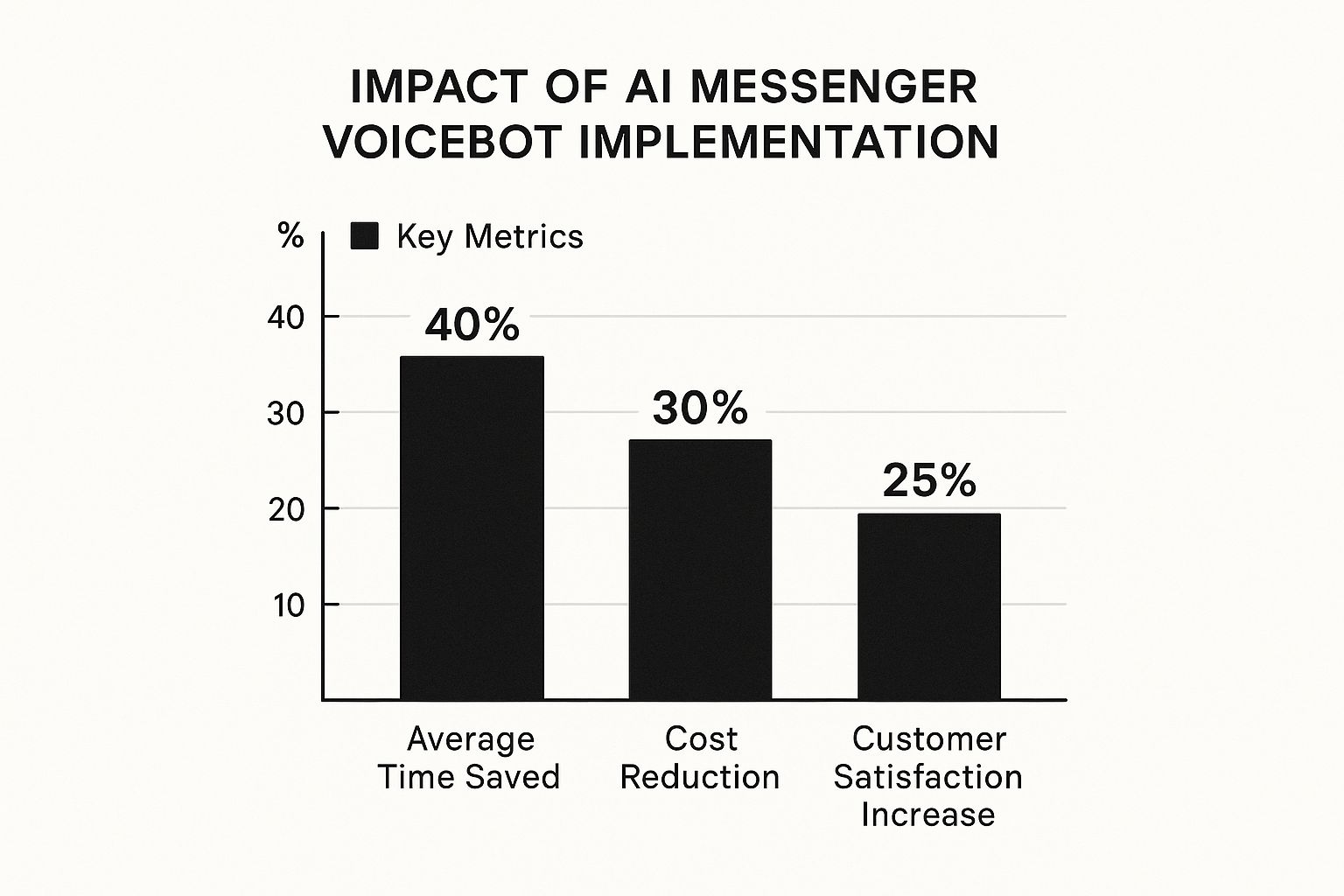
As the infographic highlights, businesses typically experience 40% time savings, 30% cost reductions, and a 25% boost in customer satisfaction. These impressive figures showcase the significant impact voicebot implementation can have on a company's overall performance.
The table below further details the potential ROI of implementing AI messenger voicebots.
To better understand these impressive results, let's examine the potential Return on Investment (ROI) in more detail. The following table demonstrates the possible improvements across key metrics.
| Metric | Average Improvement | Implementation Timeframe |
|---|---|---|
| Time Saved | 40% | Ongoing |
| Cost Reduction | 30% | Ongoing |
| Customer Satisfaction | 25% | Ongoing |
| First Contact Resolution | Data not provided in the provided text | Dependent on implementation and complexity |
| Agent Productivity | Data not provided in the provided text | Dependent on implementation and complexity |
As this data shows, AI messenger voicebots can offer substantial improvements across various metrics, leading to better efficiency and a stronger bottom line.
This burgeoning market is only expected to grow. Projections indicate the global chatbot market will hit $46.64 billion by 2029. Over 987 million people worldwide already utilize AI chatbots, a clear sign of their growing popularity. You can find more detailed statistics here: Chatbot Statistics.
Creating Exceptional Customer Experiences Through Voice
Customers are increasingly using voice interaction on messaging platforms, and it's easy to see why. Voice offers a more natural and engaging way to connect, reflecting how we communicate every day. AI messenger voicebots take advantage of this preference, providing more intuitive and personalized experiences. This move towards voice is reshaping how we think about customer experience.
The Psychology of Voice Preference
So why are people choosing voice? Speaking is often faster and more convenient than typing, especially on mobile devices. This removes friction from the customer journey, meaning quicker problem-solving and happier customers. Voice interactions also address accessibility needs, helping users who may have difficulty with traditional text-based interfaces. This inclusivity expands your reach and shows a genuine commitment to serving all customers. In short, businesses can provide a better experience while improving accessibility.
The Impact on Customer Satisfaction and Effort
Successful voicebot projects have demonstrated a remarkable improvement in customer satisfaction. By streamlining interactions and offering immediate support, voicebots reduce the effort customers have to put in. This leads to increased customer happiness and loyalty. Imagine a customer resolving a billing issue quickly through a voicebot, avoiding complex menus and long wait times. This efficiency creates positive feelings and builds brand loyalty. For a closer look at AI chatbots in retail, check out this article: AI Chatbot for Ecommerce.
Designing Effective Voice Interactions
Creating a truly valuable voice experience takes planning. It's important to design interactions that feel natural and avoid rigid, robotic responses. A crucial aspect is understanding when to smoothly transition to a human agent. For example, if a voicebot encounters a complicated or emotionally sensitive situation, it should intelligently hand off the conversation to a trained representative. Blending automation and human touch ensures the best possible customer experience. You might also find this helpful: How to master conversational AI.
Emotional Intelligence in Advanced Voicebots
Advanced AI messenger voicebots now include emotional intelligence features. This means they can gauge customer sentiment and respond appropriately. A voicebot can detect frustration in a customer's voice and adjust its tone, perhaps offering a sincere apology or escalating the issue to a human agent. This nuanced approach builds trust and strengthens the customer relationship. It's this ability to understand and react to emotions that represents a major step forward in voicebot technology.
Implementing AI Messenger Voicebots: A Practical Roadmap
Thinking about using AI messenger voicebots? Making the leap from initial curiosity to a successful launch needs a solid plan. This section offers a practical roadmap to get these powerful tools working for your organization. We'll break down the key steps, guiding you through the process.
Needs Assessment and Use Case Prioritization
First, take a good look at how you currently communicate with customers. Where can an AI messenger voicebot make a real difference? Rank potential uses based on what your customers need and what your organization can handle. For instance, if you're flooded with questions about basic FAQs, a voicebot could be a game-changer.
Vendor Evaluation and Integration Planning
Once you know what you need, it's time to check out different vendors. Compare their technology, what systems they work with, and the support they offer. Think about what platforms the voicebot supports (like WhatsApp or Facebook Messenger), how well it understands natural language, and if it can connect to your current CRM or other business software. Planning carefully now will make the whole setup much smoother. For a deeper dive into chatbot implementation, check out this helpful resource: How to Implement a Chatbot.
Industry-Specific Implementation Guidance
Every industry has its own quirks and requirements. To help you navigate these nuances, we've put together a comparison table. It outlines typical use cases, potential hurdles, and what success looks like across various sectors.
The following table, "AI Messenger Voicebot Implementation Comparison by Industry," compares implementation considerations across different industries, highlighting unique requirements and challenges.
| Industry | Key Use Cases | Implementation Challenges | Success Metrics |
|---|---|---|---|
| Retail | Order Tracking, Product Information, Personalized Recommendations | Integrating with Inventory Systems, Handling Complex Product Questions | Increased Sales, Reduced Customer Service Costs |
| Healthcare | Appointment Scheduling, Medication Reminders, Basic Health Inquiries | Maintaining HIPAA Compliance, Ensuring Accuracy of Information | Improved Patient Engagement, Reduced Missed Appointments |
| Financial Services | Balance Inquiries, Transaction History, Fraud Alerts | Ensuring Security of Financial Data, Integrating with Legacy Systems | Increased Transaction Volume, Reduced Fraudulent Activities |
| Hospitality | Booking Reservations, Concierge Services, Handling Guest Requests | Integrating with Property Management Systems, Providing 24/7 Support | Improved Guest Satisfaction, Increased Bookings |
As you can see, the potential uses and challenges vary significantly across industries. Understanding these differences is crucial for tailoring your implementation strategy.
Training, Performance Measurement, and Governance
To get the most out of your voicebot, training is key. Feed it the right data and constantly refine its responses based on real customer interactions. Keep an eye on important metrics, like first-contact resolution rate and customer satisfaction, to see how well it's performing. And finally, set up clear guidelines to ensure high-quality interactions and protect your brand. This includes having a plan for handing off tricky questions to human agents and regularly checking the voicebot’s performance. These steps help maximize the voicebot's effectiveness while safeguarding your brand's image.
The Future Landscape of AI Messenger Voicebots

The world of AI messenger voicebots is constantly changing, pushing the boundaries of how we interact with customers. For businesses to stay competitive, keeping up with the latest advancements is essential. So, what's next for this exciting technology?
Emerging Trends and Innovations
Several key trends are shaping the future of AI messenger voicebots. A major development is the growing sophistication of emotional intelligence. This allows voicebots to understand and respond to customer emotions, creating more empathetic and human-like interactions. Imagine a voicebot recognizing frustration in a customer's voice and offering a more understanding response.
Another significant advancement is in multilingual capabilities. As voicebots become more adept at understanding and speaking multiple languages, businesses can connect with customers worldwide in their native tongues. This creates new markets and opportunities for international growth.
The integration of voicebots with other technologies, such as Augmented Reality (AR) and Virtual Reality (VR), is also opening up exciting new possibilities. Picture a voicebot guiding a customer through a virtual store, offering personalized recommendations and assistance. These applications are changing how we interact with businesses and the world around us. Interested in learning more? Check out our guide on AI voicebots.
Expanding Beyond Customer Service
While customer service is a primary use case for AI messenger voicebots, their applications are branching out into other areas. Voicebots are being used in sales and marketing to qualify leads, personalize offers, and provide automated product demonstrations. They're also being used internally to streamline tasks like employee onboarding, training, and IT support. This versatility highlights the potential of voicebots across various business functions.
From Cutting-Edge to Mainstream
As AI messenger voicebot technology matures, certain capabilities are becoming mainstream. Natural Language Understanding (NLU), once complex and computationally intensive, is now becoming increasingly common. This allows voicebots to have more natural conversations, understanding complex queries and nuanced language. This shift toward mainstream adoption is driving wider implementation across industries. Voicebots are expected to become a dominant force, with the market projected to reach $98.2 billion by 2027. This growth is driven by the increasing demand for personalized, automated customer service and the growing use of smart devices. For more statistics, see this Voicebots Market Research.
Positioning for Competitive Advantage
Forward-thinking businesses recognize the importance of AI messenger voicebots for gaining a competitive edge. They are investing in this technology to improve customer experience, streamline operations, and create new revenue streams. By embracing these innovations, businesses enhance the overall customer journey, a key factor for long-term success. This proactive approach is essential for staying ahead of the curve and thriving in an increasingly voice-first world.
Your AI Messenger Voicebot Transformation Strategy
Embarking on the implementation of an AI messenger voicebot represents a significant shift in how you engage with your customers. It's not a simple plug-and-play solution, but a journey that requires careful planning and execution. This guide, drawing on the experiences of industry leaders, provides a practical roadmap to navigate this transformation confidently.
Assessing Organizational Readiness and Identifying High-Value Use Cases
Before diving into implementation, take stock of your organization's current state. Evaluate your existing technology, customer service processes, and available internal resources. Pinpoint the specific areas where an AI messenger voicebot can offer the greatest value. For instance, if your team is inundated with routine inquiries, a voicebot can drastically reduce response times, allowing human agents to handle more complex issues. This initial assessment is paramount to a successful rollout.
Prioritize use cases that align with your unique business needs. A retail company might deploy a voicebot for order tracking and product information, while a healthcare provider might use it for appointment scheduling and medication reminders. OpenDialog, an open-source conversational AI platform, offers customizable implementation based on specific requirements, highlighting the potential for tailored solutions. By concentrating on high-impact areas, you maximize the return on your voicebot investment.
Building Internal Support and Selecting the Right Technology Partner
Securing buy-in from your team is crucial for smooth adoption. Clearly articulate the advantages of an AI messenger voicebot to all stakeholders, addressing any reservations and emphasizing the benefits for both customer and employee experiences. Frameworks like Rasa, an open-source bot-building framework, can assist in developing and refining your voicebot strategy.
Choosing the right technology partner is a pivotal decision. Seek partners offering scalable solutions, seamless integrations, and ongoing support. Botpress, another open-source option, offers integrations with popular messaging services and a visual conversation builder, fostering collaboration between developers and conversation designers. Consider factors such as platform compatibility, natural language understanding capabilities, and integration with your existing CRM or other essential business systems.
Establishing Performance Benchmarks and Scaling Implementation Thoughtfully
Establish clear performance metrics to gauge the effectiveness of your voicebot implementation. Monitor crucial indicators such as first-contact resolution rate, customer satisfaction, and agent productivity. Bottender, a framework for conversational UIs, provides features like automatic batching and intuitive APIs to aid in real-world optimization and scalability. Regularly review and adapt your strategy based on this data to ensure continuous improvement.
Scale your implementation strategically. Begin with a pilot program in a specific area and gradually expand as you gather experience and refine your approach. DeepPavlov, an open-source framework, offers tools for building production-ready conversational skills and complex multi-skill assistants, facilitating a phased implementation approach. This measured approach allows you to tackle unforeseen challenges and fine-tune your strategy before a full-scale deployment.
Addressing Organizational Concerns and Ensuring Customer and Employee Acceptance
Address any internal concerns about AI messenger voicebots proactively. Equip your employees with training and resources to ensure a seamless transition. Underscore how the voicebot can complement their work, rather than replace it. Golem, a Python framework for building chatbots, simplifies development and offers a web GUI for easy testing, empowering employees and promoting a positive view of the technology.
Prioritize creating positive and helpful interactions to ensure both customer and employee satisfaction. Design conversations that feel natural and intuitive, with smooth transitions to human agents when necessary. Claudia Bot Builder, an open-source project focused on reducing boilerplate code, streamlines the development of effective bot interactions. Consistently collect feedback and make adjustments to optimize the user experience. By following these steps, you can transform customer engagement and position your business for a competitive advantage.
Ready to elevate your customer communication and streamline your operations? Discover the possibilities of Voicetta, the innovative AI communication platform.