

Blog
7 Data-Backed Tactics to Boost Conversion Rate Today
Boosting your conversion rate isn't a matter of randomly trying different tactics. It requires a deep understanding of the core principles that drive customer behavio...
The Fundamentals of Strategic Conversion Optimization

Boosting your conversion rate isn't a matter of randomly trying different tactics. It requires a deep understanding of the core principles that drive customer behavior. This means going beyond superficial metrics and exploring the psychology behind decision-making. For example, consider the vital role of trust. Are you more inclined to purchase from an anonymous corporation or a business that transparently presents its team and values?
Understanding Conversion Benchmarks
Before you can effectively increase your conversion rate, you need to understand what constitutes competitive performance in your industry. Benchmarks can vary drastically between business models. A 2% conversion rate might be excellent for an e-commerce platform, while a 10% conversion rate could be the norm for a SaaS company. Comparing your rate to industry averages without considering the specifics of your market can be misleading. Check out our guide on understanding Voicetta.
Why Conversion Strategies Fail
Many conversion strategies fall short because they lack a basic understanding of customer needs and motivations. They often prioritize tactics over a well-defined strategy. Furthermore, neglecting to analyze customer behavior and identify bottlenecks in the conversion funnel can lead to wasted effort. It's like trying to fix a leaking pipe without locating the source of the leak; you might make changes, but the underlying problem remains.
The Psychology of Conversion
Effective conversion optimization relies heavily on understanding the psychological factors that influence customer choices. Aspects like trust, urgency, scarcity, and social proof can significantly impact a visitor's decision to convert. Implementing strong Conversion Rate Optimization (CRO) strategies doesn't just improve conversion rates; it yields substantial financial returns. CRO initiatives generate, on average, a 223% return on investment (ROI).
Using multimedia content strategically, such as videos, can increase conversion rates by up to 30%. Despite these clear advantages, only about 39.6% of businesses have a documented CRO strategy, highlighting a substantial area for potential growth. Learn more about CRO Statistics. The CRO technology market is projected to reach $1.932 billion by 2026, emphasizing the growing significance of these strategies. By adopting more systematic CRO approaches, businesses can leverage these trends and dramatically improve their bottom line.
This fundamental understanding lays the groundwork for the tactical approaches we’ll explore later.
Diagnosing Your Conversion Roadblocks
Boosting your conversion rate begins with understanding where your current process falls short. This means identifying the conversion roadblocks that prevent potential customers from completing desired actions. It’s not enough to simply glance at overall conversion numbers; you need a more detailed analysis to uncover hidden obstacles hindering your success.
Beyond Basic Analytics: Uncovering Hidden Obstacles
Basic analytics platforms often provide a general overview of conversion data, but they sometimes lack the granular insights needed to pinpoint specific problem areas. This is where specialized tools become invaluable. Heatmaps, for example, visually represent where users are clicking, scrolling, and interacting with your website. This reveals areas of interest and potential friction points.
Session recordings offer a firsthand view of how visitors navigate your site and where they encounter difficulties, allowing you to observe actual user behavior. Imagine a user repeatedly abandoning their cart after reaching the checkout page. A session recording might reveal they are struggling with a complex form or are confused by unexpected shipping costs. This direct observation can highlight issues that traditional analytics data might miss. Customer journey mapping, additionally, allows you to visualize the entire customer experience from initial contact to final conversion, identifying key touchpoints and potential drop-off points.
Segmenting Your Audience for Deeper Insights
Analyzing your audience as a single group can obscure important conversion patterns. By segmenting your audience based on demographics, behavior, or source, you can uncover hidden trends that broader metrics might miss. For instance, you might discover that users from social media have a significantly lower conversion rate than those from organic search. This could indicate a mismatch between your social media messaging and the content on your landing page. Segmenting your audience is crucial for understanding specific user needs and tailoring your optimization efforts accordingly.
In e-commerce, optimizing for a higher conversion rate directly impacts revenue. Data reveals that the average conversion rate for US e-commerce shoppers reached 2.6% in 2021. However, this number varies significantly depending on the platform and industry. Shopify stores reported a lower average of 1.4% in September 2022, while certain sectors, like consumer goods, saw conversion rates as high as 4.22% in September 2023. These differences highlight the importance of analyzing your specific market. Learn more at Conversion Rate Optimization Statistics. Using analytics tools, employed by 69% of businesses, can significantly improve your Conversion Rate Optimization (CRO) efforts.
To help you understand how your business compares, let's look at some industry benchmarks:
Average Conversion Rates by Industry and Platform This table compares conversion rate benchmarks across different industries and platforms to help you understand where your business stands in relation to competitors and industry standards.
| Industry/Category | Average Conversion Rate | Platform | Date Reported |
|---|---|---|---|
| US E-commerce | 2.6% | All | 2021 |
| E-commerce | 1.4% | Shopify | September 2022 |
| Consumer Goods | 4.22% | All | September 2023 |
As you can see, conversion rates can fluctuate greatly. Understanding these benchmarks allows you to set realistic goals and identify areas for potential improvement.
Prioritizing for Maximum Impact: Actionable Insights Over Vanity Metrics
Finally, it’s important to distinguish between vanity metrics and actionable insights. Vanity metrics, like page views or social media followers, might appear impressive but don't always correlate with business goals. Actionable insights, however, provide specific information you can use to improve your conversion rate. By focusing on metrics that directly impact your bottom line—such as average order value or customer lifetime value—you can prioritize your optimization efforts and achieve meaningful, sustainable growth. Establishing clear conversion benchmarks tailored to your specific business model is essential for measuring progress and maximizing your ROI.
Website Optimization That Actually Converts
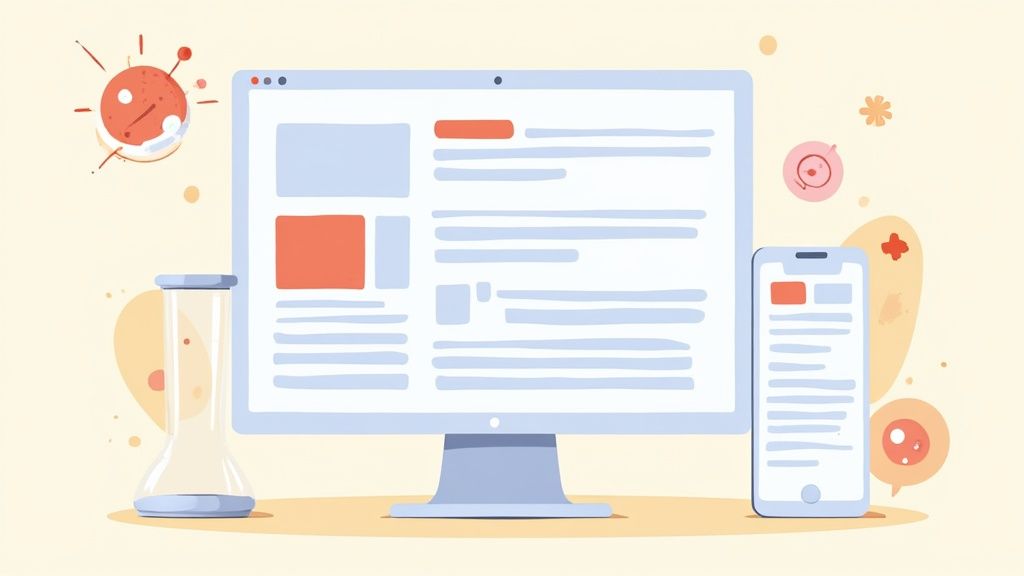
Optimizing your website for conversions involves more than just a visually appealing design. It's about understanding user interaction and guiding them towards specific actions. This means diving deep into the elements that truly encourage conversions, not just the ones that initially grab attention. Let's explore how seemingly minor details can have a major impact.
The Power of Placement: Buttons, Forms, and Content Hierarchy
Strategic placement of key elements like call-to-action (CTA) buttons, forms, and content is critical for boosting your conversion rate. A brightly colored CTA button placed prominently above the fold, for instance, can immediately draw the user's eye and encourage a click.
Simplifying forms by reducing required fields can also significantly decrease friction and increase completion rates.
Content hierarchy, the way you structure and present information, guides the user's eye and emphasizes important messages. Using headings, subheadings, and bullet points effectively breaks up large text blocks, making information easily digestible. Imagine a well-organized store: items at eye level and grouped logically are much more enticing than those hidden away. This organized approach creates a smoother user experience and encourages conversions.
Personalization: Making It Helpful, Not Intrusive
Personalization, when done correctly, can be a powerful tool. Instead of generic messages, tailor your content to individual user needs and interests. But avoid being overly intrusive.
For example, showcasing similar items or offering personalized recommendations based on a user's previous browsing history can be helpful. This demonstrates an understanding of their needs and increases the likelihood of a purchase. However, bombarding them with irrelevant pop-ups or excessive tracking can create a negative experience. The key is finding a balance that enhances, not detracts from, the user experience.
Site Speed: The Unsung Hero of Conversion
Site speed is a critical factor that often gets overlooked. A slow-loading website can lead to frustration and abandonment, regardless of how compelling the content may be. Research shows that even a one-second delay can result in a 7% reduction in conversions.
Optimizing your website for speed is paramount. Techniques like image compression, browser caching, and minimizing HTTP requests can drastically improve loading times, creating a more positive user experience and, consequently, higher engagement and increased conversions.
Improving conversion rates significantly impacts business performance. The average B2B eCommerce conversion rate hovers around 1.8%. Businesses like EcoFoil have seen an 86% increase in purchases using personalized pricing and multi-step checkouts. The use of AI in marketing is also on the rise, up 190% over two years. Find more detailed statistics here. These trends highlight the constantly evolving nature of customer behavior and the need for adaptable optimization strategies.
Content That Converts Visitors Into Customers
Creating website content is only half the battle. The real challenge lies in crafting content that actually converts visitors into paying customers. Not all website content contributes equally to this goal. This section explores the strategies and psychology behind truly effective content that motivates action and drives sales.
Crafting Compelling Content: The Psychology of Persuasion
Have you ever bought a product based on a friend’s recommendation? That's the power of social proof at play. Understanding the psychology behind customer decisions is paramount to creating effective content. It's not just about presenting information; it's about connecting with your audience on an emotional level and tapping into psychological triggers. Scarcity and urgency are two other powerful motivators that can encourage immediate action. By addressing your audience's needs and motivations, you can create content that resonates and drives conversions.
Learn more about connecting with your audience in this article about Voicetta resources.
Content Formats That Drive Results: Beyond the Basics
Different content formats play unique roles in the conversion process. Blog posts are fantastic for educating your audience and building trust, establishing you as a reliable source of information. However, when it comes to influencing purchase decisions, interactive tools can be game-changers. Think about comparison charts that simplify complex choices or calculators that provide personalized results. These interactive elements engage users, make information easily digestible, and empower them to make informed decisions, guiding them closer to a purchase. High-quality visuals like videos and infographics also play a crucial role, conveying complex information concisely and keeping your audience engaged.
Balancing Education and Promotion: Nurturing the Customer Journey
Effective content marketing requires a delicate balance between education and promotion. Educational content builds trust and positions you as an industry expert, laying the groundwork for a strong relationship with potential customers. Promotional content, on the other hand, directly highlights the value of your product or service. Think of it as a two-pronged approach, nurturing potential customers through the different stages of awareness.
For example, you could publish a blog post explaining the benefits of project management software (Asana), followed by a case study showcasing how your specific project management tool helped a client streamline their workflow and achieve tangible results. This balanced strategy educates while subtly promoting your offering, building credibility and increasing the likelihood of conversion.
Personalization: Increasing Relevance and Conversion Probability
Personalization is more than just addressing users by their names; it's about tailoring the entire content experience to individual preferences and past interactions. If a user has previously shown interest in a particular feature, showcasing content that highlights that feature can significantly boost engagement. By using data-driven insights to personalize the customer journey, you demonstrate that you understand their specific needs, increasing the probability of conversion. This targeted approach makes your content more relevant and impactful, ultimately leading to a higher conversion rate.
A/B Testing Frameworks That Deliver Results

Moving beyond random website tweaks and implementing a structured A/B testing framework is essential for consistently boosting your conversion rate. Successful companies understand this. They don't rely on guesswork; their test hypotheses are grounded in solid customer research.
This research-driven approach ensures A/B tests are targeted and address actual user behavior. This leads to more meaningful results. It means understanding not just what users are doing, but why.
Prioritizing Tests: Focus on Impact
Not all elements on your website carry the same weight when it comes to influencing conversions. Some changes, like tweaking a button's color, might have a minimal impact. Others, like restructuring your checkout process, can significantly affect your bottom line.
Prioritizing which elements to test first is crucial. You might be interested in: More content at our blog. Focusing on high-impact areas maximizes your return on investment and achieves significant improvements faster.
Designing Effective Experiments: Statistical Validity
Designing A/B tests that yield statistically valid results is paramount. A poorly designed experiment can lead to misleading conclusions, wasting valuable time and resources.
This involves ensuring a large enough sample size and running the test for an adequate duration. This accounts for natural fluctuations in user behavior. For example, testing a change on a low-traffic page for just a few days might not provide enough data for reliable conclusions.
Interpreting Data and Extracting Actionable Insights
After running your A/B test, interpreting the data and extracting actionable insights is the next critical step. This goes beyond simply identifying the winning variation.
Understanding why a particular version performed better allows you to apply those learnings to future optimization efforts. This deeper understanding helps build a more effective conversion optimization strategy.
Case Studies: Learning From Successes and Failures
Analyzing case studies of both successful and failed A/B tests offers invaluable lessons. Learning from others' mistakes helps you avoid common pitfalls and design more robust experiments.
Studying successful tests provides inspiration and insights into effective optimization strategies. This blend of positive and negative examples strengthens your understanding of what works and what doesn’t.
Building a Culture of Continuous Testing
Establishing a continuous testing culture within your organization is key for long-term success. This means moving beyond one-off experiments and integrating A/B testing into your regular workflow.
By fostering a mindset of ongoing optimization and encouraging experimentation, you can consistently improve your conversion rate over time. Small, incremental improvements can add up to significant results.
Advanced Multivariate Testing: Taking Optimization to the Next Level
For businesses looking to elevate their optimization efforts, multivariate testing provides a more advanced approach. Unlike A/B testing, which compares two variations of a single element, multivariate testing lets you test multiple variations of several elements at once.
This helps identify the optimal combination of factors that drive the highest conversion rate. However, multivariate testing requires significantly more traffic and a deeper understanding of statistical analysis for effective interpretation.
Leveraging Social Proof to Overcome Buying Hesitation
In today’s bustling marketplace, consumers face a constant barrage of options. This makes them understandably wary of marketing claims. To boost conversion rates, businesses must prioritize building trust and credibility. Perhaps the most effective way to accomplish this is through social proof. This goes far beyond simply adding a few testimonials to your website; it's about strategically showcasing customer validation throughout the entire buying journey.
Tailoring Social Proof to the Customer Journey
Different types of social proof resonate more effectively at different stages of the customer journey. In the awareness stage, showcasing industry awards or media mentions can establish your authority and pique initial interest.
As prospects transition to the consideration phase, detailed case studies and customer testimonials become invaluable. These offer tangible evidence of your product’s value proposition.
Finally, in the decision stage, elements like user ratings, reviews, and the number of satisfied customers can provide the final nudge needed to encourage a purchase.
Exploring Different Types of Social Proof
Let's break down a few impactful types of social proof:
-
User-Generated Content (UGC): Authentic customer photos and videos establish a powerful connection with potential buyers. Seeing real people using and enjoying your product fosters trust and relatability.
-
Third-Party Validation: Reviews and ratings from reputable sources, such as industry experts or established publications like TechCrunch, significantly enhance your brand's credibility.
-
Community Signals: Highlighting the size and engagement of your customer community demonstrates social acceptance and creates a sense of belonging.
The Importance of Authenticity in Feedback
The cornerstone of effective social proof is authenticity. Generic, overly polished testimonials often come across as contrived and unconvincing. Encourage customers to share their genuine experiences, both positive and negative.
Addressing negative feedback openly and constructively demonstrates transparency and reinforces your commitment to customer satisfaction.
Display customer feedback prominently throughout your website and marketing materials. Consider using visuals and multimedia to make the feedback even more engaging.
Preemptively Addressing Objections with Trust Signals
Strategically placed trust signals can preemptively address common purchase objections. For instance, prominently displaying security badges near the checkout process can alleviate security concerns and boost conversions. Similarly, offering guarantees or warranties can reduce the perceived risk associated with purchasing your product.
To help you prioritize which trust signals to implement for your business, let's examine their effectiveness across different industries. The following table offers a comparison:
Effectiveness of Different Trust Signals by Industry This comparison table shows how different types of trust signals and social proof impact conversion rates across various industries, helping you prioritize which elements to implement for your business.
| Trust Signal Type | E-commerce Impact | B2B Impact | Service Industry Impact | Implementation Difficulty |
|---|---|---|---|---|
| Customer Testimonials | High | Medium | High | Easy |
| User Ratings & Reviews | High | Medium | High | Medium |
| Case Studies | Medium | High | Medium | Medium |
| Influencer Endorsements | High | Low | Medium | Hard |
| Media Mentions | Medium | High | High | Hard |
As you can see, the effectiveness of each trust signal varies depending on the industry. Consider your target audience and business model when selecting which elements to implement.
By strategically incorporating diverse forms of social proof, you can effectively overcome buying hesitation, boost conversion rates, and establish a strong foundation for sustained business growth.
Optimizing Checkout Flows to Capture More Sales
The checkout process is the final step in turning a potential customer into a paying one. It's a crucial moment for securing the sale and building a lasting relationship. But a poorly designed checkout flow can lead to cart abandonment, lost revenue, and unhappy customers. Optimizing this stage is essential for boosting your conversion rate and maximizing sales.
Identifying and Eliminating Friction Points
A smooth checkout experience is key to increasing sales. Any friction, like a complicated form, unexpected shipping costs, or limited payment options, can discourage customers from completing their purchase. Requiring account creation before checkout can be a major obstacle. Offering a guest checkout option simplifies the process and reduces friction, ultimately leading to more completed purchases.
Displaying all costs upfront, including taxes and shipping, builds trust and prevents surprises that might cause customers to abandon their carts. Transparency is essential throughout the checkout process.
Streamlining Form Design for Enhanced Completion Rates
Form design plays a vital role in the checkout process. Long forms with unnecessary fields can overwhelm users and lead to abandonment. A streamlined form with only essential information dramatically improves the user experience. Ask only for the absolute minimum information needed to complete the transaction.
Clear labels and instructions, auto-fill functionality, and real-time validation feedback can further simplify the process, reduce errors, and make checkout faster and more efficient.
The Importance of Payment Flexibility
Offering a variety of payment options caters to different customer preferences and significantly impacts conversion rates. Support major credit cards, digital wallets like PayPal, and other popular payment methods. Limiting payment choices restricts your customer base and increases the likelihood of cart abandonment.
A secure payment gateway is also crucial for building trust and assuring customers that their financial information is safe. A secure checkout process inspires confidence and encourages conversions.
Implementing Effective Cart Abandonment Recovery
Even with the best checkout flow, some cart abandonment is unavoidable. However, effective recovery strategies can recapture lost sales and re-engage potential customers. Sending personalized email reminders to customers who abandoned their carts, offering incentives like discounts or free shipping, can encourage them to complete their purchase. Learn more in our article about Voicetta's pricing.
Cart abandonment recovery goes beyond simple email reminders. Retargeting campaigns can also effectively re-engage customers who have shown interest but haven't completed the purchase. Strategically re-engaging these potential customers can significantly improve conversion rates and recover lost revenue.
Strategic Upselling and Cross-Selling
Upselling and cross-selling are valuable techniques for increasing the average order value without disrupting the primary conversion. But it’s crucial to implement these tactics strategically to avoid overwhelming customers. Offering relevant product recommendations based on the customer’s cart or browsing history can enhance their overall experience and encourage additional purchases.
For example, if a customer adds a laptop to their cart, recommending a compatible laptop bag is a relevant and potentially helpful cross-sell. This personalized approach adds value for the customer and increases revenue for the business. However, bombarding customers with irrelevant upsells can create a negative experience and drive them away.
Creating Post-Purchase Experiences That Foster Loyalty
The customer journey doesn't end with the purchase. Positive post-purchase experiences are essential for building customer loyalty and encouraging repeat business. This includes sending personalized thank-you messages, providing order tracking information, and offering exceptional customer service. Exceeding customer expectations after the sale transforms one-time buyers into loyal advocates.
Building a strong relationship with your customers after the purchase is crucial for long-term success. This ongoing engagement can lead to increased customer lifetime value and sustainable business growth.
Ready to transform your customer communication and boost conversion rates? Visit Voicetta today to learn more about our AI-powered communication platform and how it can help you capture more sales and elevate your customer experience.
Was this useful?
If this article helped, add Voicetta as a preferred source in Google Search. Your results can then highlight our writing.
Add as preferred source