
Think of an AI chatbot as less of a robot and more of a smart conversational partner. It’s a piece of software built to chat with people just like a human would, either through text or by voice.
We've moved way beyond the clunky, script-based bots of the past. Today’s chat bot AI uses the power of artificial intelligence, machine learning, and natural language processing. This means it doesn't just follow a script; it actually understands what you're saying, learns from every chat, and gets better and more helpful over time.
So, What Is a Chat Bot AI Really?
Let’s break this down. Forget the idea of a simple, robotic script for a moment. The best way to think about it is to compare an old-school calculator with a seasoned financial analyst.
The old chatbots were the calculators. They were programmed with very specific rules and could only give you an answer if you asked the question in exactly the right way. Anything slightly different, and they'd just freeze up with a "Sorry, I don't understand."
Today’s chat bot AI is the analyst. It gets the bigger picture. It understands the context of a conversation, remembers what you’ve talked about before, and uses every interaction to learn. This is what makes the difference between hitting a dead end with an automated menu and having a genuinely helpful conversation with a digital assistant.
The Big Leap: From Scripts to Intelligence
What really separates the old from the new is the technology running under the hood. The first chatbots were basically just flowcharts—a long list of "if the user says this, then you say that." If someone typed "opening hours," the bot would reply, "We are open from 9 AM to 5 PM." It worked, but it was incredibly rigid.
An AI-powered bot is playing a completely different game:
- It figures out what you mean: It knows that "what time do you close?," "are you open now?," and "your business hours" are all asking for the same information. This is called intent recognition.
- It gets smarter over time: Every conversation is a learning opportunity. The AI model takes in this new data to sharpen its understanding and make its future answers even better.
- It can handle real conversations: It can keep track of a back-and-forth chat, ask you questions to clarify what you need, and even pick up on your mood, like whether you’re happy or frustrated.
This evolution is a game-changer. It turns chatbots from simple Q&A machines into proactive assistants that can actually help people get things done. If you want to get into the nuts and bolts, you can learn more about how chatbots work and the tech that makes them tick.
A modern chat bot AI isn't just a tool for answering questions. It's an intelligent system designed to have real conversations, solve problems, and connect with people on a massive scale.
Instead of just firing back pre-canned responses, a truly smart chat bot AI can walk a customer through a tricky troubleshooting issue, suggest products based on their recent activity, or even book a meeting by connecting directly to a calendar. It's this ability to hold a dynamic conversation and take action that makes them so incredibly valuable today.
How AI Chatbots Actually Understand Us
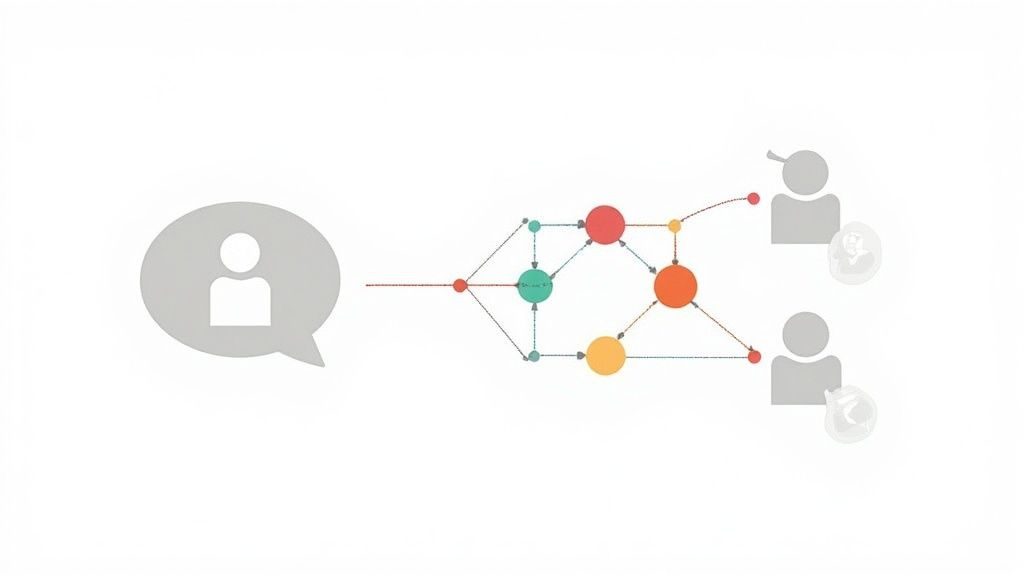
Ever typed a messy, typo-riddled question into a chat window only to get a perfectly helpful answer back in seconds? It feels a bit like magic. But behind the curtain, it’s not magic at all—it's a powerful trio of technologies working in concert to make that seamless conversation happen. A modern chat bot AI isn’t just scanning for keywords; it’s genuinely trying to figure out what you mean.
To get a grip on how this works, let's use an analogy. Imagine you’re training someone to be a world-class conversationalist. You wouldn't just hand them a script and call it a day. You'd need to teach them how to listen, how to learn from their interactions, and give them access to a massive library of knowledge. That's precisely how a chat bot AI is built, using three core components.
Natural Language Processing: The Ears of the AI
First up is Natural Language Processing (NLP). Think of NLP as the AI's ability to listen and understand human language in all its chaotic glory. It’s the engine that translates our slang, typos, and roundabout phrasing into structured data that a machine can actually work with.
When you ask something like, "hey, what time's your shop shut today?", NLP gets to work breaking it down. It figures out your main intent (you want to know the closing time), picks out the key entities ("shop," "today"), and even gets a sense of your sentiment. This is why you don’t have to speak like a robot to get what you need. NLP gives the AI the flexibility to understand what you mean, not just what you type.
Machine Learning: The AI's Life Experience
Once the AI understands your question, it has to decide on the best way to answer. This is where Machine Learning (ML) steps in. If NLP gives the bot its ears, ML gives it the ability to learn from experience. With every single conversation, the system is gathering data, spotting patterns, and tweaking its responses to be better next time.
It’s a lot like a new customer service agent. On their first day, they might stumble over tricky questions. But after a few weeks of real-world interactions, they start to recognise common problems and know the best solutions by heart.
A chat bot AI does the exact same thing, just on a massive scale. It sifts through thousands of conversations to learn things like:
- Which answers actually solve problems and make customers happy?
- What’s the clearest way to explain a complicated topic?
- At what point should it hand the conversation over to a human?
This constant learning loop is what separates a static, rule-based bot from a dynamic AI partner that genuinely adapts. For instance, a travel bot might learn that people asking about "baggage fees" in December are often also interested in the policy for ski equipment, allowing it to offer that information proactively.
"Half of the battle when building an LLM powered app these days is getting the prompt right... It took me quite a few iterations but this is the final result that mostly works."
This insight gets to the heart of it. Just like a human, an AI’s performance is only as good as its training and the guidance it’s given. The real power comes from this ongoing process of learning and refinement.
Large Language Models: The AI's Vast Library
Finally, to piece together an intelligent reply, the AI needs a huge source of information to draw from. This is the job of Large Language Models (LLMs). You can think of an LLM as an enormous digital library combined with a brilliant librarian who has read every single book inside.
These models are trained on gigantic datasets of text and code scraped from across the internet. This process gives them an incredible grasp of language, context, grammar, and facts about the world. So, when your chat bot AI needs to answer a question, it isn’t just grabbing a pre-written script.
Instead, it consults its LLM to generate a fresh, natural-sounding response that’s tailored to the conversation. This is what allows a bot to do more than just rattle off FAQs. It can draft an email for you, summarise a long document, write a snippet of code, or even brainstorm creative ideas. The LLM provides the raw knowledge and linguistic skill, which the NLP and ML components then shape into the perfect conversational reply.
What Modern AI Chatbots Can Actually Do For You
So, what's all the fuss about? What really separates a modern chat bot AI from the clunky, frustrating bots of the past? It comes down to practical, real-world superpowers that can fundamentally change how a business operates. We're not talking about small tweaks; we're talking about capabilities that were simply out of reach for human-only teams.
The most obvious benefit is being available 24/7. An AI chatbot doesn’t need to sleep, take a coffee break, or go on holiday. This means your business is always on, ready to help a customer in a different time zone or someone browsing your site late at night. No more missed opportunities or unanswered questions.
On top of that, these systems are built to handle a staggering number of conversations at once. Your best human agent might be able to juggle one or two chats effectively. An AI can handle thousands simultaneously without breaking a sweat. That’s what true operational scale looks like.
To really grasp the difference, it helps to see a direct comparison. The old, rule-based systems were like a phone tree—rigid and limited. Today's AI is a whole different ball game.
Modern Chat Bot AI vs Traditional Chatbots
| Feature | Traditional Chatbot (Rule-Based) | Modern Chat Bot AI |
|---|---|---|
| Conversation Flow | Follows a strict, pre-programmed script. Deviations cause errors. | Understands context and intent, allowing for natural, flexible dialogue. |
| Language Ability | Recognises specific keywords only. Struggles with slang or typos. | Uses Natural Language Processing (NLP) to grasp nuances, sentiment, and complex queries. |
| Personalisation | Generic, one-size-fits-all responses. | Taps into user data (e.g., CRM) to offer hyper-personalised interactions. |
| Learning | Cannot learn or improve. Must be manually updated. | Uses Machine Learning to learn from every conversation and get smarter over time. |
| Scalability | Can handle volume but offers a poor, repetitive experience at scale. | Scales instantly to handle huge spikes in traffic while maintaining quality. |
As you can see, we've moved from a system that simply follows commands to one that understands, adapts, and learns. It’s the difference between a simple calculator and a personal financial advisor.
Delivering Hyper-Personalised Experiences
Beyond just being available, modern AI chatbots are masters of hyper-personalisation on a scale humans just can't match. By connecting to your other business systems, like a CRM, it can pull up a customer's entire history—past purchases, support tickets, you name it.
Think of it like a personal shopper who remembers every single thing you've ever bought and knows your style inside and out. That's the kind of service a well-integrated AI can deliver. It can suggest products based on past browsing behaviour or guide a returning customer through a technical problem by remembering their specific product model. Every single chat feels unique and relevant.
This turns a generic customer service chat into a one-on-one consultation. An e-commerce bot, for instance, could greet a returning visitor by name, mention their last purchase, and ask if they're looking for something similar.
The real magic of a chat bot AI is its ability to combine infinite scale with deeply personal, context-aware conversations. You get the best of both worlds: the raw efficiency of a machine with the thoughtful touch of a dedicated human assistant.
Scaling Seamlessly with Demand
Another game-changer is effortless scalability. Picture your busiest times—Black Friday, a huge product launch, or an unexpected service outage. These events can swamp your support team, leading to long waits and unhappy customers.
An AI chatbot scales up instantly to meet that demand. You don't need to scramble to hire and train temporary staff. It can handle a sudden flood of thousands of chats just as easily as it handles ten. This elasticity ensures you provide a consistently great experience even when things get chaotic, protecting both your sales and your reputation.
This visual captures the core benefits a chat bot AI brings to the table.
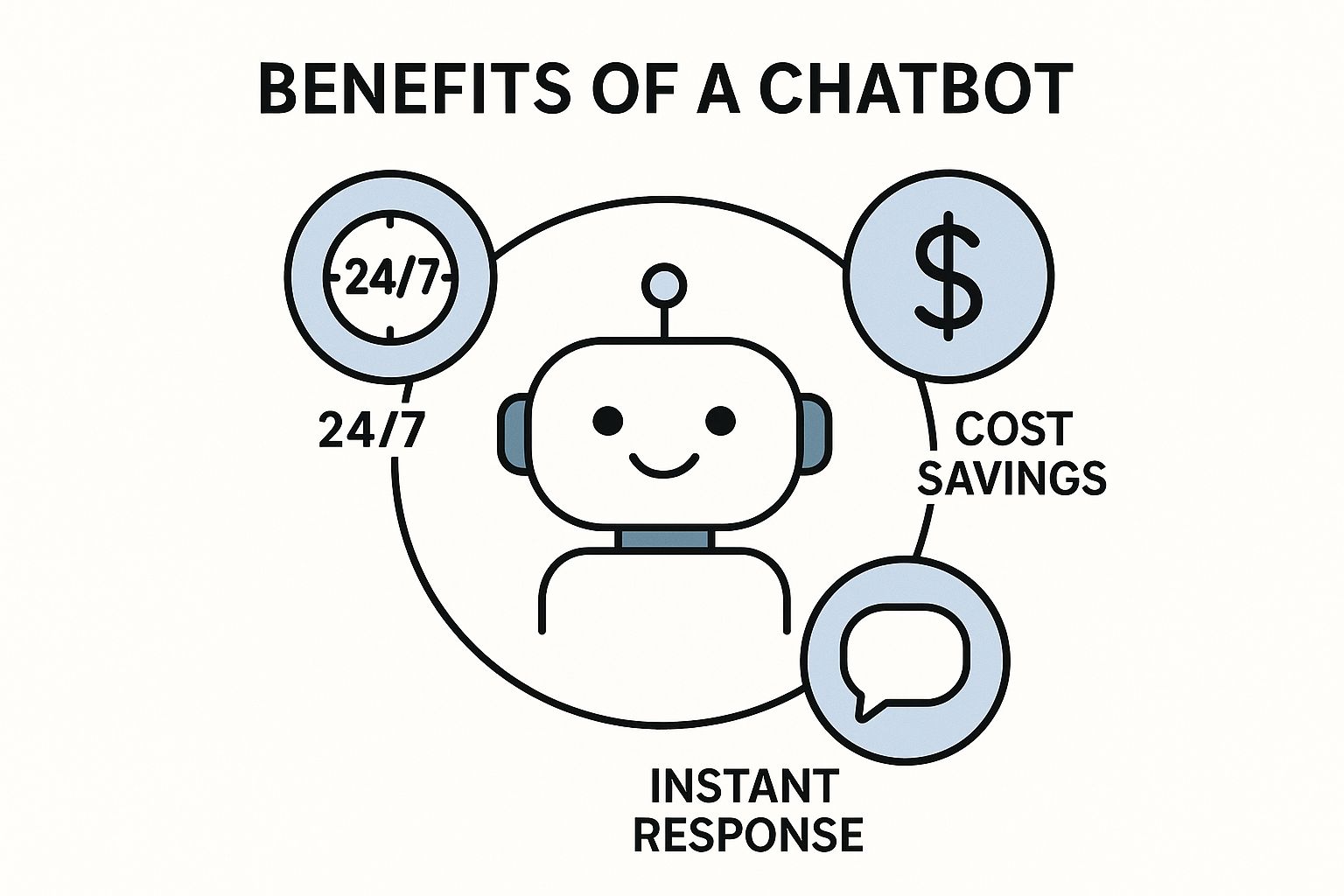
As you can see, we’re talking about tangible advantages—non-stop availability, serious cost savings, and instant support—that have a direct impact on your bottom line.
Fuelling Business Growth and Innovation
The economic side of this is becoming impossible to ignore. In Poland, for example, the generative AI market—which is the engine behind these advanced chatbots—is projected to hit US$343.01 million in 2025. This isn't just tech for tech's sake; it's being pulled forward by customers who now expect instant, personalised digital help.
But here’s the most important part: this technology empowers your most valuable asset—your people. By letting a chat bot AI handle the routine, repetitive queries, you free up your human team to focus on what they do best:
- Solving complex problems that need real creativity and critical thought.
- Building strong relationships with your most important customers.
- Managing sensitive situations that require genuine human empathy.
This partnership between human and AI is where the real value is unlocked. By bringing in smart automation, you’re not replacing your team; you’re making them stronger. You can learn more about how modern conversational AI solutions can support your specific business goals. This synergy creates a more efficient, responsive, and ultimately more successful organisation.
Seeing Chatbot AI Succeed in the Real World
Theory is one thing, but seeing a chatbot AI solve real problems is where its value truly shines. Let's move from concepts to concrete examples and look at stories of these smart assistants making a tangible impact across different industries. These aren't futuristic ideas; they're happening right now, reshaping how businesses connect with people.
Businesses are seeing incredible success with chatbot AI, particularly when they optimize customer experience with AI in SaaS. The results are often dramatic, turning operational headaches into major competitive advantages.
Revolutionising Retail with a Virtual Stylist
Imagine walking into a clothing store where the assistant knows your style, remembers your last purchase, and can instantly pull together the perfect outfit for any occasion. A major retail brand brought this exact experience to its online store using a chatbot AI.
The problem was clear: online shoppers felt overwhelmed by choice and missed the personalised guidance they'd get in person. The solution was a sophisticated AI bot that acted as a virtual stylist. It would ask shoppers about their preferences, the event they were shopping for, and their budget.
By combining this information with the user's browsing history, the chatbot could recommend specific items and even create entire looks. It could answer nuanced questions like, "What shoes would go with this dress for a summer wedding?" The results were staggering. The brand saw a 30% boost in online sales and a significant increase in customer satisfaction, proving that AI could deliver a high-touch experience at scale.
Improving Patient Outcomes in Healthcare
The healthcare sector faces immense pressure to manage appointments, communicate with patients, and ensure people stick to their treatment plans. One healthcare system deployed a chatbot AI to tackle these challenges head-on, focusing on improving the patient journey from start to finish.
Their AI assistant helped patients easily schedule or reschedule appointments 24/7, without needing to call a busy reception desk. More importantly, it sent out personalised medication reminders and pre-appointment instructions, directly addressing a major cause of missed appointments and poor health outcomes.
The bot also served as a reliable source for non-urgent questions, like clinic opening times or how to prepare for a specific procedure. This simple yet effective system dramatically reduced appointment no-shows and freed up administrative staff to focus on more complex patient needs. It turned a logistical burden into a seamless, supportive experience for patients.
By automating routine interactions with precision and care, a chatbot AI can transform the patient experience, ensuring individuals feel supported and informed every step of the way.
Navigating Travel Chaos with an AI Assistant
Travel disruptions are a nightmare for both passengers and airlines. During a major storm, one airline faced thousands of cancellations and delays, threatening to overwhelm its customer service centres. This is where their chatbot AI became the hero of the story.
Instead of leaving passengers on hold for hours, the airline’s AI assistant proactively managed the crisis. It could instantly:
- Identify all affected passengers based on their flight details.
- Present them with alternative flight options directly in the chat window.
- Rebook their tickets and issue new boarding passes in seconds.
- Answer questions about hotel vouchers and compensation policies.
This system turned a potentially disastrous situation into a remarkably smooth process. The chatbot AI handled the majority of rebookings automatically, keeping passengers informed and in control. The airline not only saved immense operational costs but also earned customer loyalty by providing calm, efficient support during a stressful event.
These examples highlight a clear trend of successful real-world AI implementation. This momentum is reflected in market growth, and the global trends resonate strongly in Poland, where the market is growing in line with worldwide developments. Globally valued at $3.3 billion in 2024, the AI chatbot market is forecast to surge to $22.6 billion by 2032 at an annual growth rate of 27.8%. As an emerging hub for AI adoption, Poland is benefiting from this trajectory through investments in AI platforms tailored for sectors like IT, telecommunications, retail, and e-commerce. You can explore the full report and learn more about AI chatbot market findings.
A Practical Guide to Implementing Your First AI Chatbot
Dipping your toes into the world of AI-powered conversation can seem daunting, but launching your first chat bot AI is far more straightforward than you might imagine. The secret is to have a clear, practical plan.
Don't think of it as some massive technical overhaul. Instead, picture it as hiring a new digital team member. Just like any new hire, it needs a specific job description and clear instructions to do its best work. This guide will walk you through the essential steps, from figuring out its purpose to planning for its future growth, so you can deliver real value from day one.
Define a Crystal-Clear Purpose
Before you even glance at a piece of technology, you need to answer one simple question: What problem, exactly, will this chatbot solve?
A bot without a specific mission is like a ship without a rudder. It might look impressive floating in the harbour, but it won't actually go anywhere. Your goal has to be something you can see and measure.
For example, are you trying to:
- Generate more leads? Your bot could act as a friendly greeter, asking a few smart questions to qualify visitors and then booking demos right on the spot.
- Lighten the load on customer support? It could handle all those repetitive questions like "Where's my order?" around the clock, freeing up your team for the tricky stuff.
- Boost sales? An e-commerce bot can become a personal shopper, guiding customers to products they’ll love based on what they're looking for.
Pick one main job to start. A bot that tries to be a jack-of-all-trades usually ends up being a master of none. Nail one thing first, and you'll have a solid foundation to build on later.
Choose the Right Platform for Your Needs
The market is flooded with chatbot platforms, from dead-simple builders to heavy-duty frameworks for developers. The "best" one depends entirely on your goal and your budget. For your first chat bot AI, you absolutely do not need the most powerful or expensive option out there.
Think about where you're starting from:
- No-Code Builders: These are perfect if you're not a coder. They use simple drag-and-drop tools to map out conversations, making them great for basic lead generation or FAQ bots.
- Low-Code Platforms: A step up, these give you more room to customise things with a little bit of code. This is where you can start connecting your bot to other systems, like your CRM.
- Developer Frameworks: This is the deep end. These are toolkits for developers to build a completely custom bot from the ground up for highly specific needs.
Start small. Pick a platform that lets you get going quickly but has room to grow with you. A common mistake is paying for a dozen features you won't touch for years.
Design the Human Handover
Let's be realistic: even the most advanced AI will hit a wall. That's why one of the most important parts of your plan is the human handover—that smooth, seamless moment when your bot knows it's out of its depth and passes the conversation to a person.
A great chatbot doesn't try to solve every problem. It knows exactly when to ask for help from its human colleagues, ensuring the customer always gets the best possible support.
You need to map this out carefully. The bot should gather all the important details—the customer's name, their issue, and what's been discussed so far—and hand it all over to the human agent. That way, the customer never has to repeat themselves, which is a huge win. It creates a brilliant tag-team system where the bot and your team work together.
Give Your Bot a Personality
Your chatbot is a new face for your brand. A generic, robotic tone can feel cold and off-putting. Take a bit of time to think about its voice. Is it fun and casual? Or more formal and to the point? A little bit of personality makes the whole experience feel less like talking to a machine and more like a helpful conversation.
The big players in the market can even influence what your customers expect. For example, by July 2025, the AI chatbot landscape in Poland is projected to be dominated by ChatGPT, which is expected to hold a market share of around 89.9%. With so many people used to a certain conversational style, it’s even more crucial that your bot's personality feels authentic to your brand.
Launch, Learn, and Improve
Getting your chatbot live isn't the end of the project—it's the beginning. Once it's out in the wild, it starts collecting a goldmine of data on what your customers are asking and where it's struggling.
This feedback is how you make it better over time.
- Read through the conversation logs to see what questions it couldn't answer.
- Look for patterns in where human handovers are happening most often.
- Polish its responses to be clearer, more helpful, and more on-brand.
This constant cycle of launching, learning, and tweaking is what separates a decent chatbot from a truly great one. To see how this technology can be shaped for your own business, check out our complete guide to the Voicetta AI chatbot.
What's Next for AI-Powered Conversations?
The story of the chat bot AI is really just getting started. We're on the verge of a fascinating new era where these digital helpers evolve from simply reacting to our questions into genuinely proactive partners in our day-to-day lives.
Think about it. The next generation of conversational AI won't just wait for you to ask a question; it'll anticipate what you need, sometimes before you even realise it yourself.
Imagine you're browsing an online store, looking at running shoes. The chatbot notices you keep switching between two specific models. Instead of sitting idle, it pops up with a message: “Hey, I see you’re comparing trail and road running shoes. Are you training for a specific race or terrain? I can help you pick the right one.” That jump—from waiting for a command to predicting a need—is the next big step.
Fading into the Background of Our Lives
The future isn't just about building smarter chatbots; it's about making them disappear. Conversational AI is breaking out of the little chat window in the corner of a website and becoming a seamless, invisible layer in the tools we use every single day.
It's all about connecting with the technology you're already familiar with:
- Voice Assistants: Your smart speaker won't just be for playing music. It could link up with your pharmacy’s AI to remind you it's time to take your medication and then ask if you'd like to reorder your prescription, all with a simple voice command.
- Smart Devices: Imagine your car’s AI detects a warning light. It could instantly tell you what the problem is in plain English and then offer to book a service appointment at your favourite garage for you.
- Wearable Tech: One day, your smartwatch might have a wellness bot that sees a stressful meeting in your calendar and proactively checks in afterwards, suggesting a quick mindfulness exercise.
These aren't distant dreams; they're the kinds of applications rapidly becoming a reality. If you're curious about what's already out there, you can check out some incredible conversational AI examples that are making waves today.
The real goal here is to make technology feel less like a tool you have to actively manage and more like a helpful assistant that understands your situation and simply makes things easier, often without you even noticing.
Making Digital Feel More Human
As this technology matures, it promises to do more than just make our lives more efficient. We're talking about a future with automated wellness check-ins that offer genuine support or highly personalised shopping experiences that feel like getting advice from an expert you trust.
By taking care of the routine, repetitive tasks, AI creates more space for actual human connection. The future of the chat bot AI isn't just about building smarter systems; it's about removing the friction from our digital world to make our interactions feel more thoughtful, helpful, and, ultimately, more human.
Your AI Chatbot Questions, Answered
Jumping into the world of AI chatbots can feel like a big step, and it’s natural to have questions. As the technology becomes a more common part of our daily lives, business leaders I talk to are always curious about the practical side of things—the cost, how it affects their team, and what the setup actually involves. Let's tackle some of the most common queries I hear.
Getting clear, straightforward answers helps you make a much better decision about whether this is the right move for your business.
How Much Does It Cost to Build a Chat Bot AI?
This is usually the first question on everyone's mind, and the honest answer is: it really depends. The price tag is tied directly to how complex and capable you need your bot to be. You could get started with a simple, template-based bot on a subscription service for under £100 per month. These are perfect for answering basic FAQs or capturing lead information.
At the other end of the scale, a completely bespoke AI chatbot built from the ground up to integrate with all your business systems could run into the tens of thousands. The trick is to avoid paying for bells and whistles you don't actually need. The smart approach is to match the solution to what you want to achieve and what your budget allows.
The most successful AI projects I’ve seen always start with a clear, focused goal. Instead of asking 'how much does a bot cost?', try asking 'what is the value of solving this specific customer problem?' This shifts the conversation from a cost to an investment with real returns.
Will an AI Chatbot Replace My Customer Service Team?
Absolutely not. This is probably the biggest myth out there. The best way to use a chat bot AI is to support your team, not replace them. Think of the chatbot as your tireless first line of defence, handling all the common, repetitive questions that come in around the clock.
This frees up your human agents to focus on what they do best: handling complex issues that need a bit of empathy and creative problem-solving. Your team becomes more effective, and they get to spend their time building real relationships with customers—turning a good experience into a great one.
Is It Difficult to Integrate a Chatbot with My Existing Software?
How tricky this is really comes down to the chatbot platform you choose and the systems you're already using. Most modern chatbot platforms are built to play nicely with others. They often come with ready-made connectors for popular software like CRMs, property management systems, or e-commerce platforms, which can make the whole process surprisingly simple.
If you're working with custom-built or older systems, you'll likely need to use an API (Application Programming Interface) to build a bridge between them. This might require a developer's help, but it's what allows for a smooth flow of information. For instance, your chatbot could pull a customer's order history directly from your database to offer personalised help, all without a human lifting a finger.
Ready to see how an intelligent assistant could work for your team? Voicetta provides a 24/7 chat bot AI that integrates with your systems, qualifies leads, and makes sure you never miss a customer interaction again. Explore Voicetta today and start turning conversations into conversions.