
Picture this: you have a digital team member who never clocks out, never takes a holiday, and is ready to greet every single website visitor with a helpful answer, 24/7. That's the essence of a modern chat bot online. They're not just bits of code; they’re tireless digital assistants that are fundamentally changing how businesses talk to their customers.
What Is a Chat Bot Online and Why Does It Matter Now?
Think of an online chat bot as your frontline customer service specialist. It pops up on your website or social media profile, ready to engage with anyone who lands there. The magic is in the interaction. Unlike a static FAQ page that forces users to search for answers, a chatbot starts a two-way conversation, making people feel seen and supported, no matter the time of day.
This isn’t about replacing the human touch, but rather, sharpening it. A well-built bot can effortlessly handle all the routine, repetitive questions that bog down your team. This frees up your human experts to focus their energy on the complex issues where their skills and empathy truly make a difference. It’s this smart partnership between people and technology that’s becoming essential for any business looking to stay ahead.
The Strategic Value of a Digital Assistant
The real power of a chat bot online is its role as a strategic asset. It's so much more than just a Q&A tool; it's an engine for driving efficiency and creating better customer experiences.
Here’s a quick look at what a modern bot brings to your business:
- Always-On Availability: It delivers the instant, round-the-clock support that today's customers have come to expect as standard.
- Improved Efficiency: By automating the simple stuff, it takes a significant load off your support team, letting them tackle the bigger, more valuable conversations.
- Enhanced Customer Experience: It gives users immediate, personalised guidance, pointing them straight to what they need without the frustration of waiting.
A chat bot is no longer just a piece of tech; it's a core part of a customer-first strategy. It's often the very first impression a person has of your brand, with the power to turn a simple question into a loyal customer.
This shift is happening everywhere, especially in forward-thinking economies. In Poland, for example, the generative AI market—which is the brainpower behind these advanced bots—is expected to hit around US$343 million by 2025. This incredible growth is being driven by rapid digitalisation and a huge appetite for smarter, more interactive AI. You can get a deeper insight by reading more about Poland's AI market growth and how it’s shaking up industries.
The Journey from Clunky Scripts to Conversational AI
It wasn't that long ago that interacting with a chat bot online felt like talking to a very stubborn, very limited machine. You know the type. They were built on rigid scripts, and if you didn't type the exact keyword it was listening for, the conversation ground to a halt. You’d be met with that all-too-familiar, "Sorry, I don't understand." Frustrating, right?
These early bots were essentially glorified flow charts. They worked on simple "if-then" logic. If you typed "opening hours," it spat out the answer. But if you dared to ask, "What time do you close tonight?" it would likely get confused, unable to understand what you actually meant. They were a first step, but they certainly weren't smart.
The Leap to Actually Understanding Us
The real game-changer was the introduction of artificial intelligence (AI), specifically Natural Language Processing (NLP). Think of NLP as the magic that lets a bot truly learn a language, complete with all its quirks and nuances, rather than just memorising a few key phrases.
This was like upgrading from a basic four-function calculator to a powerful graphing one. The old calculator could only do what you told it, step-by-step. The new one understands complex problems and knows which formulas to apply. AI-powered bots do the same; they can figure out a user's intent, even if the message has typos or uses slang.
Nowhere has this shift been more apparent than in fast-moving sectors. Take the chatbot market in Polish e-commerce, for example, which has absolutely exploded. By 2024-2025, most major online retailers in Poland had rebuilt their customer support around sophisticated AI chatbots. They now offer 24/7 service, actively guide shoppers, and even help recover abandoned carts. You can discover the full story of chatbot evolution in Polish e-commerce to see just how far things have come.
So, what does this all mean? The modern chat bot online is no longer a passive FAQ machine. It's an active, intelligent assistant that helps shape the entire customer journey.
This evolution from clunky scripts to conversational AI has completely rewritten the rulebook. We've moved from a tool that just answers basic questions to a partner that can build relationships, personalise experiences, and genuinely drive business forward.
Real Business Wins from an Online Chat Bot
The theory behind a modern online chat bot sounds great, but what does that actually look like in the real world? It’s one thing to talk about benefits, but the real magic happens when those abstract ideas start showing up as concrete wins on your balance sheet.
The most immediate victory is simply being available. Your customers aren’t just shopping or looking for help between 9 and 5, so your support shouldn’t be, either. A chat bot offers instant answers, day or night, which has a massive impact on customer satisfaction. This always-on presence shows you respect their time, a small detail that makes a huge difference in building loyalty.
This 24/7 coverage also means serious cost savings. Think about all the routine questions your team answers every single day—"Where's my order?" or "What are your return policies?". A chat bot handles that volume effortlessly. This frees up your human agents to focus their energy on the complex, nuanced problems where their expertise truly shines. If you want to see how this works in practice, you can get a better sense of how to automate customer support and really empower your team.
From Answering Questions to Generating Leads
But a well-implemented online chat bot does more than just save you money; it becomes a powerful engine for growth. Instead of just sitting there waiting for a question, it can proactively engage visitors. Imagine it popping up to offer help, suggest a product that matches what they're browsing, or gently guide them toward making a purchase.
This kind of proactive engagement is a brilliant way to capture leads. The bot can ask a few qualifying questions to gauge a visitor's interest. For those who are a good fit, it can seamlessly collect their contact details or even schedule a call right then and there.
Every conversation is a goldmine of data. The questions your customers ask are a direct window into their needs, frustrations, and desires. It’s like getting a direct line into the mind of your audience without spending a fortune on market research.
This quick comparison highlights just how much of an impact a chat bot can have compared to older, more traditional methods.
Chat Bot Impact vs Traditional Support
| Feature | Online Chat Bot | Traditional Support (Email/Phone) |
|---|---|---|
| Availability | 24/7/365, instant | Limited to business hours |
| Response Time | Seconds | Hours or even days |
| Cost Per Interaction | Pennies | Several pounds |
| Lead Generation | Proactive, automated | Passive, manual |
| Scalability | Handles 1000s of chats at once | 1 agent to 1 customer |
It’s clear that bots not only improve the customer experience but also create incredible efficiencies for the business.
This chart drives home the key performance metrics you can expect, showcasing the bot's efficiency in a real-world scenario.
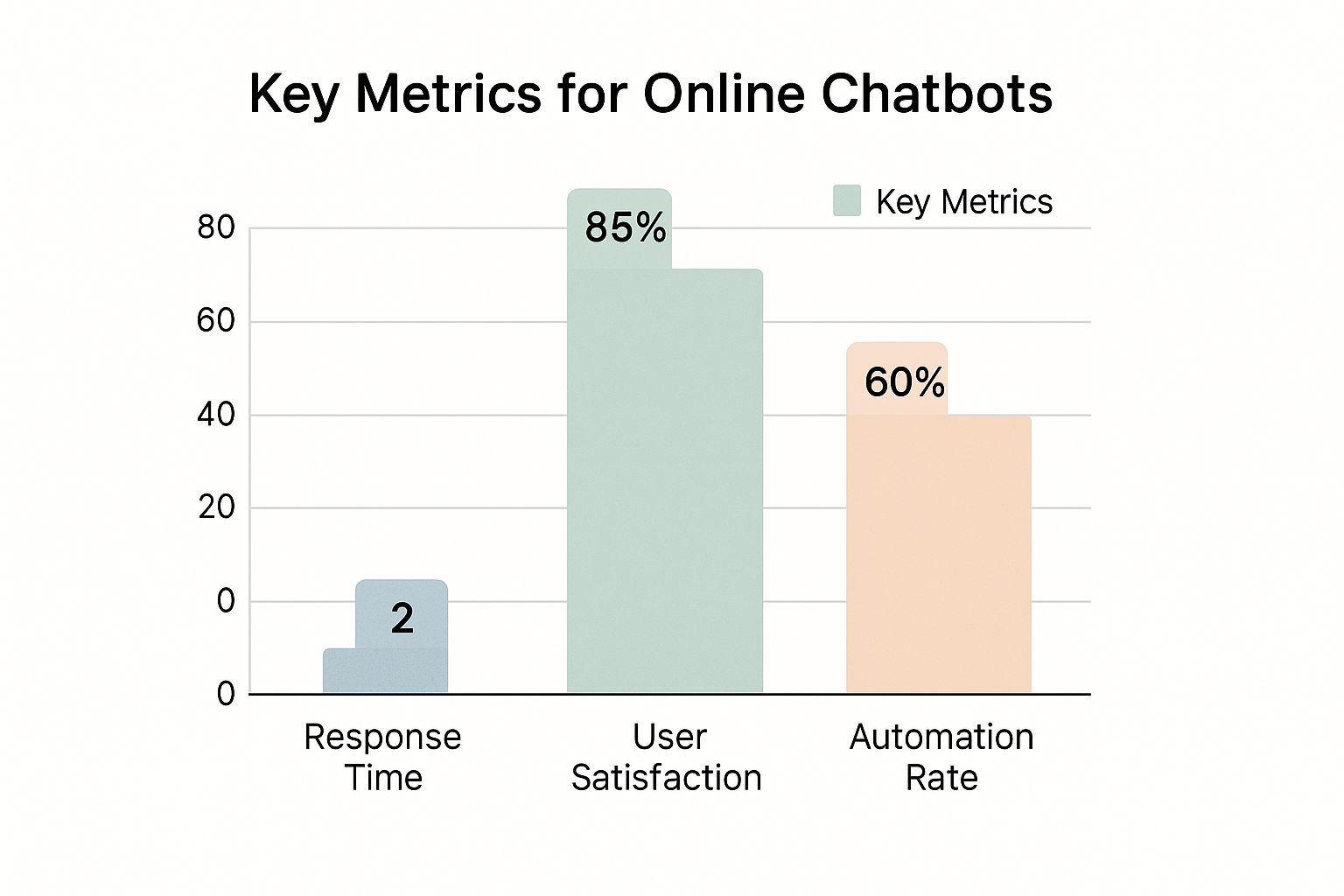
The data speaks for itself. Chat bots deliver almost instant responses and can successfully automate the vast majority of conversations, all while keeping user satisfaction high. It’s a win-win.
Navigating Chat Bot Platforms in Poland
Picking the right platform for your chat bot online can feel like a daunting task, especially with so many options floating around in Poland. But don't worry, it's not as complicated as it seems. Once you understand the two main paths you can take, the choice becomes a whole lot clearer.
Think of it this way: on one hand, you have the no-code builders. These are the digital equivalent of LEGO blocks – intuitive, easy to use, and perfect for small businesses or teams without a developer on standby. You can snap together a perfectly good bot to answer customer questions or generate leads, all without touching a single line of code.
Enterprise Solutions and Market Leaders
On the other hand, you have the heavy-duty, highly customisable enterprise platforms. These are the serious tools built for larger companies with very specific, often complex, needs. They require some technical skill to hook into your existing systems, like a CRM or ERP, but the payoff is immense. You get deep analytics and the ability to tailor every interaction to your precise business logic. If this sounds like your direction, exploring the wider world of conversational AI solutions is a brilliant first step to grasp what’s truly possible.
When you look at the Polish market specifically, a clear leader emerges. By mid-2025, ChatGPT has become the go-to choice, commanding a massive 89.9% market share. Other players like Perplexity and Microsoft Copilot hold much smaller pieces of the pie, at 4.35% and 3.73% respectively. You can discover more insights about the Polish chatbot market to get the full story.
This kind of dominance doesn't happen by accident. It shows a deep-seated trust in the technology's power to understand what people are actually saying and provide responses that are genuinely helpful and human-like. At the end of the day, that’s what every business is aiming for.
Ultimately, the right platform for you boils down to your goals, your budget, and the technical resources you have available. The most important thing is to choose a tool that fits your business like a glove and delivers real, measurable value.
Launching Your First Online Chat Bot Step by Step
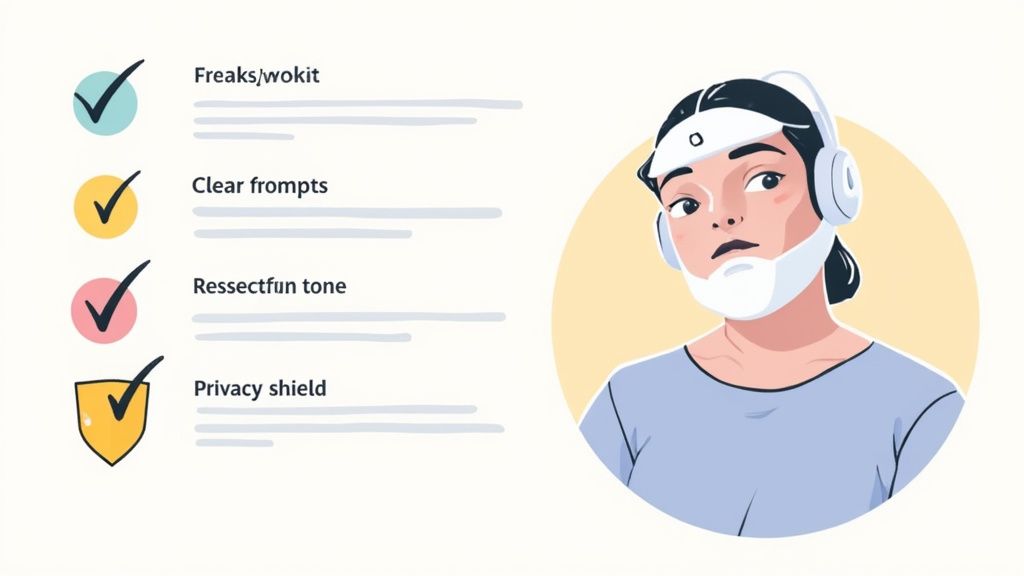
Diving into the world of AI might seem a bit daunting, but launching your first online chat bot is actually quite straightforward when you take it one step at a time. Let's walk through the process, minus the confusing tech-speak.
Before you even think about the technology, you need to start with a clear "why". What is this bot’s main job? Think of it like hiring a new employee. Are you looking for a 24/7 customer support specialist, a lead-capturing machine, or a friendly shopping assistant? Nail this down first, as it will guide every decision you make from here on out.
Once you’ve defined its role, it's time to pick the right platform. Your goals, budget, and how much technical help you have will all point you toward the best fit. With a platform chosen, the real fun begins.
Designing a Natural Conversation
This is where your bot truly takes shape. You’re aiming for a conversation that feels less like talking to a machine and more like chatting with a helpful person. It's almost like writing a script for a play, but your user is the other main character.
-
Map Out Common Paths: What are the top reasons people contact you? Jot down the most frequent questions and tasks, like tracking an order, booking a meeting, or asking for product details. These will form the core of your bot's script.
-
Give it a Personality: How should your bot sound? Professional and efficient? Or warm and chatty? This voice should feel like a natural extension of your brand.
-
Keep the Dialogue Simple: Ditch the jargon and overly complicated sentences. Use clear, direct language that helps users get what they need without any frustration.
Think of your chatbot as a member of your team. Its tone, helpfulness, and personality are a direct reflection of your business. The goal is to create an experience that's not just effective, but genuinely pleasant.
With the main conversations mapped out, the next phase is all about training and testing. You'll feed the bot with all sorts of questions and phrases to help it learn. Be ruthless in your testing—go through every possible conversation to iron out any clunky responses or dead ends before your customers see it.
If you're looking for an even more in-depth look, our guide on how to implement a chatbot breaks down these practical steps even further.
Your Questions About Online Chatbots Answered
It’s completely normal to have questions before bringing any new technology into your business, and that’s especially true for an online chatbot. Let's walk through some of the most common things people ask. Getting these practicalities sorted is the best way to feel confident about taking the next step.
First up, the big one: cost. The truth is, there’s no single price tag. You can find simple, no-code platforms with affordable monthly plans that are a great fit for small businesses. On the other end, you have deeply customised AI bots that require a much larger investment. The best way to think about it isn't the cost, but the return you get from saved time and new business.
Another frequent concern is whether a bot will replace your human team. Not at all. It’s more like adding a new, highly efficient team member. The bot is brilliant at handling all the repetitive, common questions that come in day and night. This frees up your human experts to focus their energy on the more complex, sensitive situations where their skills truly shine. It's a win-win for everyone.
How to Know if Your Bot is Actually Working
So, you’ve got a bot. How can you tell if it's doing a good job? Success isn't just about having it switched on; it’s about measuring what matters. You’ll want to look at a mix of performance data and actual business results.
Keep an eye on key metrics like these:
- Conversation Volume: How many chats is the bot actually handling?
- Resolution Rate: What percentage of problems does it solve on its own?
- Customer Satisfaction (CSAT): Are people walking away happy after talking to it?
But don't stop there. Look at how it’s affecting your bottom line. Is it bringing in more qualified leads? Are conversations started by the bot turning into sales? Are you seeing fewer support tickets? These are the numbers that prove its real value.
The best online chatbots don't just sit on your website. They become a connected part of your entire business, making every other tool you use even more powerful.
Finally, people often worry about integration. Will it be a technical nightmare? Modern chatbot platforms are built for this. They're designed to connect smoothly with the tools you're already using every day. With simple plugins for your website and straightforward links to your CRM and social media, you can get a single, unified view of your customer across the whole organisation.
Ready to see how an AI assistant can transform your customer communications? Voicetta provides intelligent, 24/7 chat and voice solutions that integrate seamlessly with your team, ensuring you never miss an opportunity. Discover the difference at https://voicetta.com.