
The Evolution of Chatbots in Modern Business
Chatbots have evolved significantly. Early chatbots often led to frustrating user experiences, confined to pre-programmed responses that rarely addressed complex customer queries. But the landscape has shifted dramatically. Today's chatbots are becoming powerful AI-driven tools, capable of understanding nuanced language and offering personalized, human-like interactions. This evolution is changing how businesses interact with their customers, creating opportunities for enhanced customer service and operational efficiency.
From Basic Scripts to Intelligent Assistants
This transition from simple text responders to intelligent conversational agents is fueled by advancements in Artificial Intelligence (AI), especially in areas like Natural Language Processing (NLP) and Machine Learning (ML). NLP allows chatbots to understand and interpret human language more effectively, while ML enables them to learn from past interactions and refine their performance over time. For instance, a chatbot can now analyze a customer's purchase history and suggest relevant products, much like a human sales representative. Curious about building your own AI chatbot? Check out this guide on how to build an AI chatbot.
The Rise of 24/7 Availability and Instant Gratification
The growing need for immediate, round-the-clock customer support has accelerated chatbot adoption. Consumers expect businesses to be accessible 24/7, and chatbots provide a cost-effective solution. They can manage a large volume of inquiries at once, instantly answering common questions and allowing human agents to handle more complex issues. Chatbots also integrate seamlessly with other business systems, automating tasks such as lead qualification and appointment scheduling. This streamlines workflows and enhances the overall customer experience.
The Expanding Chatbot Market: A Testament to its Value
The business world recognizes the potential of chatbots. The global chatbot market illustrates this trend. In 2019, the market was valued at USD 396.2 million. By 2021, this figure had jumped to USD 2.47 billion. Projections indicate continued growth, with the market expected to hit USD 15.57 billion by 2025 and a remarkable USD 46.64 billion by 2029, expanding at a CAGR of 24.53%. This growth reflects the increasing dependence on chatbots for optimizing business processes and improving customer engagement. For a deeper dive into these statistics, explore the data here. This rapid expansion underscores the vital role chatbots play in modernizing business and enhancing customer interactions.
Chatbots and the Future of Customer Engagement
As chatbot technology continues to develop, we can anticipate more sophisticated applications. These advancements will likely include even greater personalization, tighter integration with business tools, and wider use of voice and multimedia interfaces. The chatbot's journey is ongoing, promising further changes in how businesses operate and connect with their customers.
Unlocking Measurable Benefits of Chatbot Solutions
While the development of chatbots is interesting, the real value for businesses lies in their tangible benefits. When implemented correctly, chatbot solutions offer substantial advantages across an organization, impacting efficiency, cost savings, and even customer satisfaction. Let's explore these measurable benefits.
Cost Reduction and Improved Response Times
One of the biggest draws of chatbots is their potential for significant cost reductions in customer support. By automating answers to common questions and handling routine tasks, chatbots free up human agents to address more complicated issues. This reduces the need for large support teams, resulting in considerable savings.
Furthermore, chatbots provide instant responses, shrinking response times from hours or days to mere seconds. This speed boosts customer satisfaction and fosters loyalty.
Scaling Customer Interactions and Standardizing Service
Chatbots allow businesses to handle growing customer interactions without a proportional increase in staff. As the customer base expands, chatbots manage the higher volume of inquiries, maintaining consistent service delivery.
Chatbots also guarantee a standardized level of service quality across every customer touchpoint. This consistency helps build trust and reinforces a positive brand image. For instance, a chatbot can provide identical, accurate information about product details regardless of the time or the number of concurrent requests.
To illustrate the potential impact across various sectors, let's consider the following data:
The table below, "ROI of Chatbot Implementation Across Industries," compares cost savings, efficiency gains, and customer satisfaction metrics across different business sectors. It also provides a glimpse into the typical ROI timeline for chatbot initiatives.
| Industry | Average Cost Savings | Response Time Improvement | Customer Satisfaction Impact | ROI Timeline |
|---|---|---|---|---|
| Retail | 20% | 60% | 15% increase | 6-12 months |
| Healthcare | 15% | 50% | 12% increase | 9-18 months |
| Financial Services | 25% | 70% | 20% increase | 12-24 months |
| Technology | 18% | 55% | 10% increase | 6-12 months |
As the table demonstrates, chatbots can yield significant returns across a variety of industries, though the specific benefits and ROI timeline can vary depending on the sector and implementation strategy.
Gathering Customer Insights for Product Improvement
Beyond providing immediate support, chatbots are powerful tools for gathering valuable customer insights. Analyzing chatbot interactions allows businesses to identify recurring customer problems, understand their preferences, and pinpoint areas for product improvement.
This data-driven approach allows businesses to make smart decisions regarding product development and refine their offerings to better meet customer needs. Learn more in our article about How to master customer support automation.
Empowering Human Agents for High-Value Interactions
Strategically deploying chatbots doesn't eliminate human agents; it empowers them. By handling routine inquiries, chatbots liberate human agents to concentrate on complex, high-value interactions that demand empathy, creativity, and critical thinking.
This strategic shift allows businesses to use their human capital more effectively, providing personalized attention where it matters most. This also boosts job satisfaction among support staff while simultaneously delivering a superior customer experience. Ultimately, chatbots become valuable partners, enhancing human capabilities and enabling businesses to deliver outstanding service while optimizing resources.
Choosing Your Perfect Chatbot: Solutions Compared
Navigating the world of chatbots can feel like wandering through a maze. So many options, so many promises! This section sheds light on the various types of chatbot technologies, guiding you toward the ideal solution for your specific business needs.
Rule-Based vs. AI-Powered Chatbots: Understanding the Core Differences
The first major difference to understand is between rule-based chatbots and AI-powered chatbots. Rule-based chatbots follow a predetermined script. If a customer asks "A," the chatbot responds with "B." This straightforward approach makes them easy to set up but limits their ability to handle unexpected questions. AI-powered chatbots, conversely, use machine learning and natural language processing (NLP) to understand the nuances of human conversation. They learn and adapt, growing more versatile with every interaction.
Hybrid Chatbots: Blending the Best of Both Worlds
For businesses looking for a middle ground, hybrid chatbots offer a compelling alternative. These combine rule-based logic with elements of AI, allowing for a degree of automation while retaining the flexibility to handle more complex questions. This makes them a great option for businesses with evolving customer service needs. You might be interested in: How to master chatbot implementation.
Selecting the Right Chatbot: Key Considerations
Choosing the right chatbot involves a few key considerations. Think about your customer journey. Where do customers typically interact with your business? Which channels are most important? Integrating chatbots into those key touchpoints can significantly boost efficiency and customer satisfaction. Also, consider your technical capabilities and business goals. A complex AI-powered chatbot demands more technical resources than a simpler rule-based system.
The infographic below illustrates some core benefits of effective chatbot implementation: 24/7 availability, cost savings, and improved customer satisfaction.
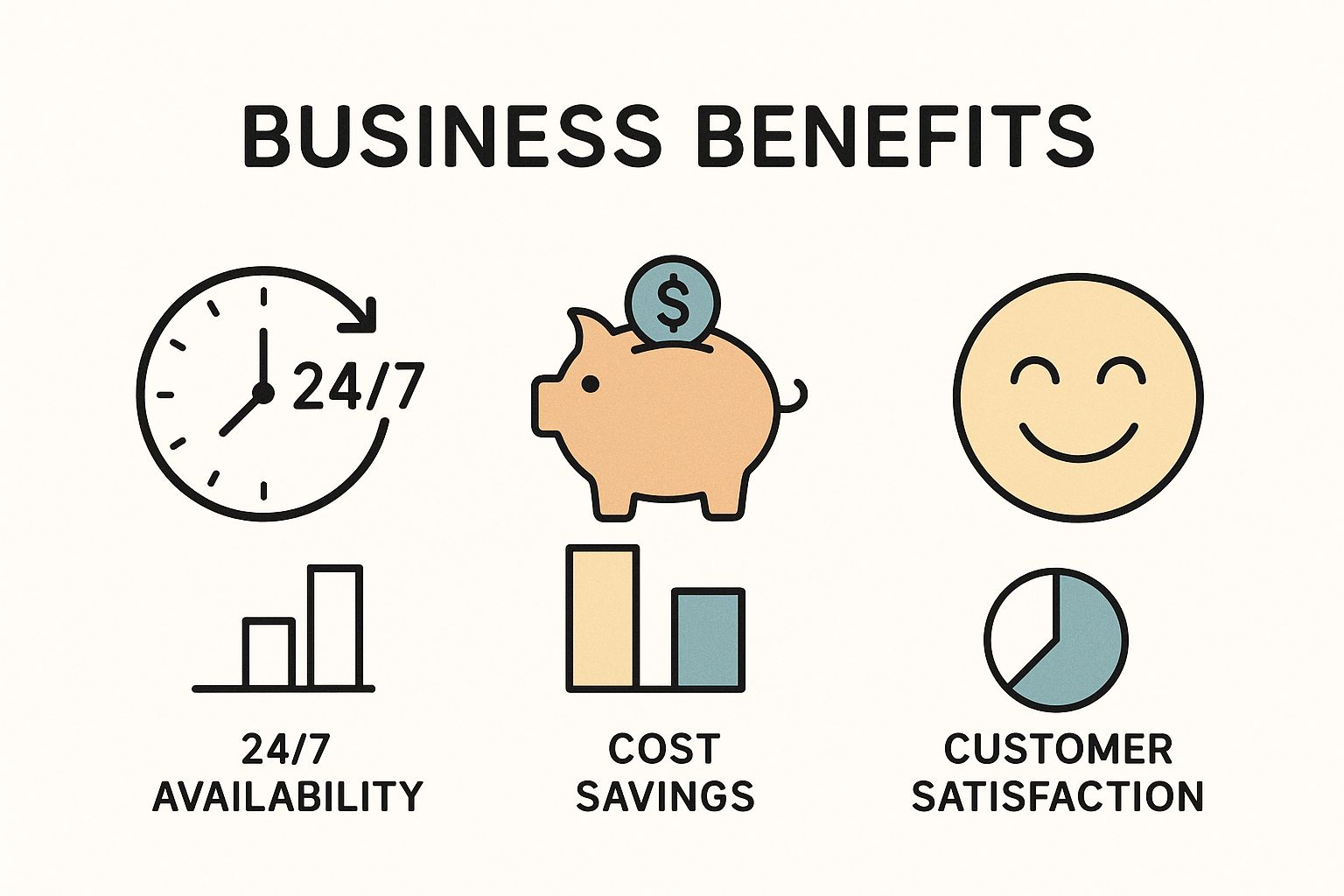
These benefits can significantly contribute to a positive return on investment.
Comparing Chatbot Solutions: A Practical Framework
To make comparing chatbot types easier, the table below summarizes their key characteristics, benefits, and drawbacks. It provides a practical framework for understanding which type best suits your needs.
To help you compare different chatbot technologies, the following table breaks down their core features, implementation requirements, and ideal use cases.
| Chatbot Type | Technology Foundation | Implementation Complexity | Customization Options | Best For | Limitations |
|---|---|---|---|---|---|
| Rule-Based | Pre-defined rules and scripts | Low | Limited | Simple FAQs, basic customer service | Difficulty handling complex or unexpected queries |
| AI-Powered | Machine learning, natural language processing | High | Extensive | Personalized interactions, complex problem-solving | Requires significant technical resources |
| Hybrid | Combination of rule-based and AI | Moderate | Moderate | Businesses with evolving needs, blend of simple and complex tasks | May require more ongoing maintenance than rule-based systems |
By carefully weighing these factors, you can choose a chatbot solution that truly aligns with your business goals and delivers maximum value. Remember to consider the total cost of ownership, including implementation, maintenance, and potential upgrades. Choosing the right chatbot is a strategic investment that can significantly enhance customer experience and optimize your business operations.
Designing Chatbots That People Actually Want to Use

Many chatbots miss the mark because they're designed with the business, not the user, in mind. This section explores how to build chatbot experiences that users will truly appreciate. It's all about understanding user needs and preferences, creating a conversational partner, not just an automated response system.
Crafting Natural Conversation Flows
At the heart of any successful chatbot is effective communication. This starts with building natural conversation flows that resemble real human interactions. Forget rigid, robotic exchanges.
Instead, design conversations that feel fluid and intuitive. Consider how a human agent would handle a customer question and aim to recreate that experience within the chatbot’s structure. Simple things like using greetings and polite phrases can make a big difference.
Developing a Chatbot Persona
Just like your brand has a voice, your chatbot should too. Giving your chatbot a unique personality is essential for engagement. This personality needs to align with your brand identity and resonate with your target audience.
A chatbot for a tech company, for example, might have a more casual, tech-savvy persona, while a chatbot for a financial institution might adopt a more formal and professional tone. This persona should be consistently reflected in the chatbot’s language, emoji use (if any), and the overall conversational tone. This helps build a cohesive brand experience. Check out this helpful guide on How to master conversational AI.
Handling Edge Cases and Frustrations
One of the toughest parts of chatbot design is handling the unexpected. Edge cases, those unusual or unpredictable user requests that deviate from the usual script, can easily lead to frustration.
Proactively plan for these situations with appropriate responses and fallback mechanisms. For instance, train the chatbot to recognize when it doesn't know the answer and seamlessly offer to connect the user with a human agent.
Balancing Automation With Human Warmth
While automation is key for efficiency, it's important not to lose the human touch. Find the sweet spot between automated responses and opportunities for human intervention. A chatbot can manage many routine inquiries, but knowing when to escalate to a human agent is vital.
This handoff might be triggered by specific keywords, complex questions, or if the user expresses frustration.
Anticipating User Needs and Continuous Learning
Design your chatbot to anticipate user needs by providing clear and easy-to-use pathways to information. Buttons, menus, and quick replies can effectively guide users toward their goals.
Also, implement continuous learning mechanisms. By analyzing user interactions, the chatbot can pinpoint areas for improvement and become more effective over time. This data-driven approach helps chatbots adapt to changing trends and improve their ability to serve users. This iterative refinement process is essential for building a chatbot that truly connects with users and provides lasting value.
Measuring Chatbot Success Beyond the Basics
How can you tell if your chatbot is truly effective? Simply counting chats isn't enough. We need a more nuanced approach, one that goes beyond basic metrics and focuses on real business results. This section explores how to truly measure chatbot success.
Key Performance Indicators (KPIs) for Different Chatbot Types
The effectiveness of a chatbot depends heavily on its purpose. A customer service chatbot, for example, won't have the same goals as one designed for lead generation. Therefore, the KPIs we use to measure success should also differ.
-
Customer Service Chatbots: Here, we prioritize metrics like resolution rates, customer satisfaction scores, and average handling time. A high resolution rate shows the chatbot is effectively solving customer problems. Positive satisfaction scores mean users are having a good experience. And a reduced handling time signals improved efficiency.
-
Lead Generation Chatbots: For lead generation, we track conversion rates, lead qualification rates, and cost per lead. A high conversion rate means the chatbot is successfully guiding potential customers toward taking action. Strong qualification rates show it's filtering leads effectively, and a lower cost per lead means it's generating leads efficiently.
-
Automation Chatbots: With automation chatbots, we focus on the task completion rate, error rate, and time saved. A high task completion rate and a low error rate mean the chatbot is automating processes effectively. Significant time saved shows the chatbot's value to operational efficiency.
Quantitative vs. Qualitative Measurement
Measuring chatbot success requires a balanced approach, using both quantitative and qualitative data. Quantitative data gives us hard numbers, like resolution rates and conversion metrics. Qualitative data, such as that gathered through sentiment analysis, offers insights into the user experience, helping us understand user feelings and feedback.
By combining these two types of data, we gain a more holistic understanding of the chatbot’s performance, revealing both strengths and areas for improvement. For example, a high resolution rate combined with negative sentiment analysis might suggest the chatbot is solving problems but lacking a personal touch.
Setting Up Analytics and Benchmarks
To track chatbot performance effectively, we need the right analytics systems. We also need to establish benchmarks by analyzing past data or researching industry best practices. This helps us see how our chatbot compares to competitors and where we can optimize.
This data-driven approach allows for continuous improvement. By regularly reviewing performance data and adjusting chatbot strategies as needed, we create a cycle of learning and improvement. This helps us respond to user feedback, optimize conversational flows, and refine the chatbot’s performance over time, ensuring it continues to provide lasting value to our business.
The Future of Chatbots: Innovations That Will Transform Business
The chatbot landscape is constantly changing. Current chatbots offer businesses significant advantages, but exciting new technologies promise even more dramatic improvements in the coming years. These innovations have the potential to reshape how businesses operate and connect with their customers, creating fresh opportunities for growth and efficiency.
Advancements in Natural Language Processing (NLP)
One crucial area of innovation is Natural Language Processing (NLP). Advancements in NLP are enabling chatbots to understand and respond to human language with remarkable accuracy. This includes understanding context, interpreting complex questions, and generating responses that sound increasingly natural. This improved understanding allows for more personalized and engaging interactions, evolving beyond simple transactions to build stronger relationships with customers.
The Rise of Emotional Intelligence
Another exciting development is the growing integration of emotional intelligence into chatbots. This allows chatbots to recognize and respond to the emotional state of the user, providing more empathetic and helpful assistance. Imagine a chatbot recognizing frustration in a customer’s voice and offering to connect them with a human representative. These personalized, empathetic interactions can change potentially negative experiences into positive ones, creating loyal customers.
Multimodal Interfaces: Beyond Text
Chatbots are also evolving beyond just text interactions. Multimodal interfaces incorporate voice, video, and images into the experience. This creates richer, more immersive interactions, with potential for engaging customer service conversations, interactive product demonstrations, and even personalized video consultations. For more on conversational AI, check out this article about conversational AI solutions.
Voice Integration and Visual Recognition
Voice integration lets users communicate with chatbots using their natural speaking voice, making conversations more convenient and accessible. Combined with visual recognition, chatbots can analyze images and videos, further enhancing their understanding. A chatbot could even help a customer troubleshoot a technical issue by examining a photo of the problem.
Predictive Capabilities and Deeper System Integrations
Looking further into the future, predictive capabilities will equip chatbots to anticipate customer needs and proactively offer support. Tighter integration with internal business systems will facilitate seamless data transfer, automating complex workflows and providing personalized insights. This means integrating with Customer Relationship Management (CRM) systems for personalized recommendations and marketing campaigns, and connecting with inventory management systems for real-time stock information and simplified ordering.
The Growth of the Chatbot Market: A Look Ahead
The chatbot market is rapidly expanding, fueled by growing demand for these versatile tools. This growth shows no signs of slowing down. Projections show the market reaching USD 27.29 billion by 2030, with a CAGR of 23.3% from 2025 to 2030. Looking even further ahead, the market is expected to reach USD 61.97 billion by 2035, driven by ongoing AI advancements and the increasing need for 24/7 customer support. This sustained growth highlights the enormous potential of chatbots to transform customer interactions and improve efficiency across diverse industries. Learn more about the global chatbot market. Want to know how to measure your success with chatbots? Here are some strategies to improve your chatbot ROI.
Ethical Considerations and Privacy Implications
As chatbots become increasingly sophisticated, it’s critical to consider the ethical implications and potential impact on user privacy. Ensuring data security, protecting user privacy, and using AI responsibly are essential to build trust and encourage widespread adoption. Businesses must develop clear guidelines for handling data, provide transparency in chatbot interactions, and address any potential biases within their algorithms.
Preparing for the Future of Chatbots
Businesses can prepare for the future of chatbots by keeping informed about new technologies, exploring innovative solutions, and developing a targeted chatbot strategy aligned with their business goals. This includes investment in staff training and development, building flexible systems, and nurturing a culture of innovation within the company.
Ready to improve your customer communications and unlock the power of conversational AI? Explore the AI communication platform offered by Voicetta and see how they can help elevate your customer experience.