
When you hear "contact centre quality assurance," it's easy to picture someone with a clipboard and a headset, ticking boxes. But that's a dated, and frankly, unhelpful view. In reality, it’s the very soul of your customer service operation.
Think of it this way: your brand's reputation isn't built in a boardroom. It's built in thousands of individual conversations—every single call, email, and chat. Contact centre quality assurance (QA) is the craft of making sure each one of those conversations is a masterpiece. It's less about catching mistakes and more about creating a consistent, positive experience that keeps customers coming back.
What Is Contact Centre Quality Assurance Really?
At its core, QA is a structured approach to listening, analysing, and improving how your team communicates with customers. It's about moving beyond random spot-checks and implementing a system that turns every interaction into a valuable piece of data. This isn't just about policing agents; it's about protecting your brand and understanding what your customers really think and feel.
A robust QA programme helps you uncover the gold hidden in your daily interactions. It’s the engine that drives continuous improvement, not just for individual agents, but for the entire business.
The Core Purpose of a QA Programme
A great QA programme is a balancing act. It has to juggle business efficiency with the one thing that matters most: the customer. The goal is to create a framework that supports your agents, delights your customers, and strengthens your bottom line all at once. For a closer look at what this takes, these expert strategies for call center quality assurance success offer some fantastic, practical insights.
The infographic below really brings the key goals of a modern QA strategy to life.
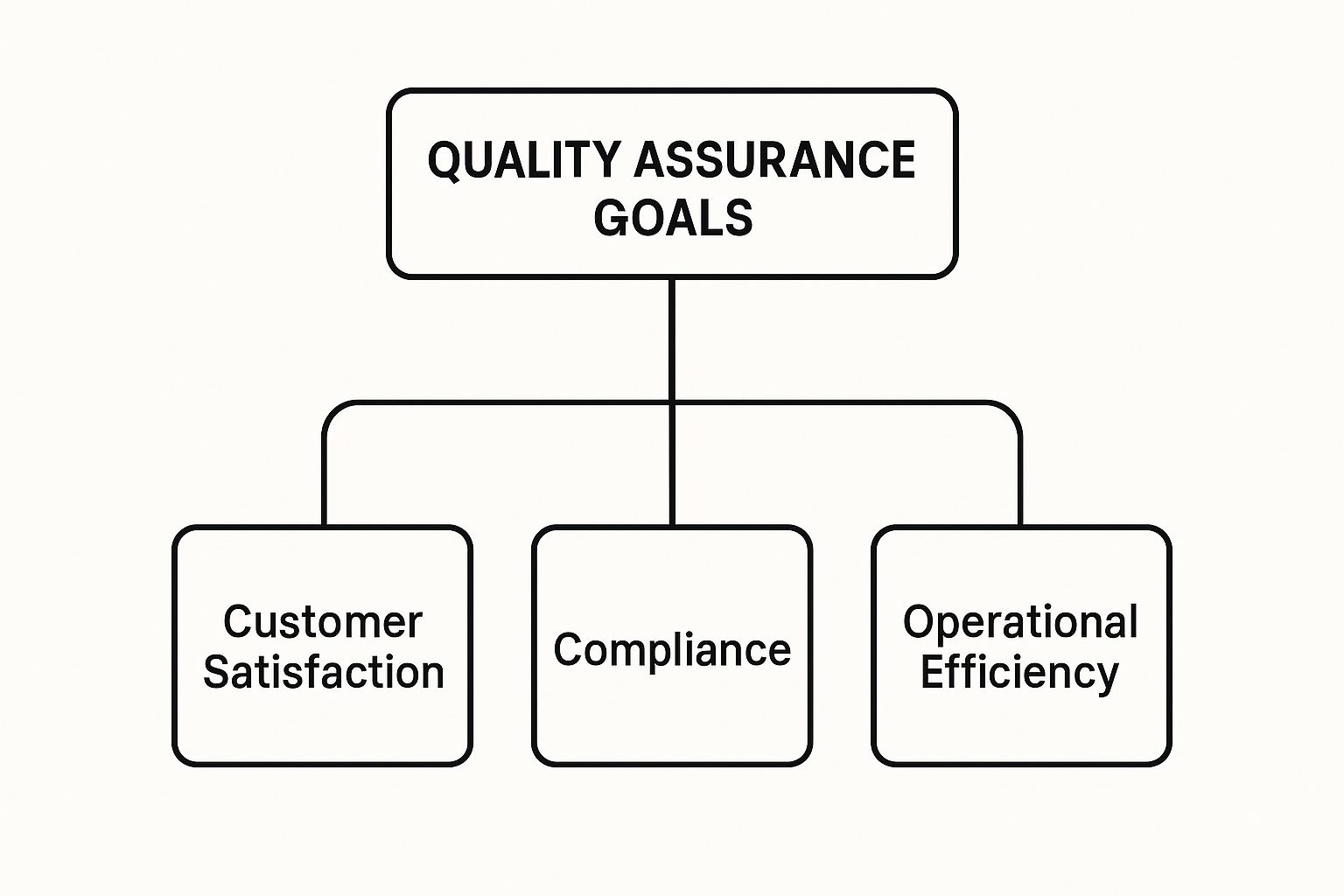
As you can see, QA isn’t an isolated function. It’s the glue that holds together customer satisfaction, operational performance, and even compliance, ensuring the business stays healthy and competitive.
From Checklist to Business Intelligence
For years, QA was stuck in a rut—a simple, often dreaded, checklist exercise. Today, that couldn't be further from the truth. It has blossomed into one of the most powerful sources of business intelligence a company can have. A great example of this evolution is seen in the Polish contact centre market, which has grown into a powerhouse valued at around €668 million across more than 2,000 businesses. That kind of growth doesn’t happen by accident; it's built on a relentless focus on service quality.
A well-designed QA framework shifts the perspective from just scoring agents to unearthing powerful, actionable data.
A modern quality assurance programme transforms your contact centre from a cost centre into a hub of valuable insights. It reveals what customers love, what frustrates them, and where your products or services can improve.
Instead of a simple pass/fail grade, a strong QA framework gives you the intelligence for:
- Targeted Agent Coaching: Identifying the exact skills an agent needs to work on, turning feedback from generic to genuinely helpful.
- Process Improvement: Spotting the cracks in your internal processes that are causing friction for customers and fixing them at the source.
- Product Feedback: Creating a direct line from the customer’s mouth to your product development teams.
To really get this right, you need to understand the building blocks. The table below shows how the focus of QA has shifted from a traditional, narrow view to a more modern, holistic one.
Core Components of a Modern Quality Assurance Framework
| Component | Traditional Focus | Modern Focus |
|---|---|---|
| Interaction Analysis | Manual review of a small, random sample of calls | AI-powered analysis of 100% of interactions (calls, chats, emails) |
| Evaluation Criteria | Rigid, one-size-fits-all scorecards | Dynamic, context-aware scorecards tailored to interaction type |
| Agent Feedback | Infrequent, often negative, and backward-looking | Real-time, continuous, and focused on development |
| Business Impact | Viewed as a cost centre; focused on compliance | Seen as a value driver; provides strategic business intelligence |
By embracing this modern approach, QA becomes a strategic asset, not just an operational task. When you reframe its purpose from "checking work" to "gathering intelligence," you unlock its true potential.
To explore this topic in even greater detail, have a look at our complete guide on https://www.voicetta.com/call-center-quality-assurance.
Why Smart QA Is Your Most Valuable Business Asset
A great quality assurance programme does so much more than just tick boxes and keep customers satisfied. It strengthens your entire business from the inside out. It's a huge mistake to see contact centre quality assurance as just another operational chore. Think of it instead as a strategic powerhouse, one that delivers real, measurable value right across your organisation.
When you get QA right, the benefits ripple out far beyond the contact centre floor. It has a direct line to customer loyalty, operational efficiency, and even your next big product idea. Let's unpack the genuine business value that a thoughtful, intelligent QA strategy brings to the table.
Reduce Customer Churn and Boost Retention
Let's face it: losing a customer is expensive, but keeping one pays dividends for years. A solid QA programme is your first and best defence against customer churn. By systematically digging into conversations, you can pinpoint the real reasons for frustration and disappointment long before they turn into a bigger problem.
Picture this: an agent is repeatedly giving out wrong information about a new product feature. Without QA, that might fly under the radar until dozens of customers have already had a bad experience. With a smart QA system, however, that pattern gets flagged almost immediately. You can step in, retrain the agent, and stop the issue in its tracks.
This proactive approach means more customers get their problems solved correctly the first time, which is a massive driver of loyalty. Consistent, positive experiences build trust and give customers very little reason to see if the grass is greener elsewhere.
Slash Operational Costs with Higher Efficiency
A well-oiled QA machine is also a brilliant cost-saving engine. One of the biggest drains on any contact centre's budget is repeat contacts. When a customer has to call back two or three times about the same issue, it doesn't just sink their satisfaction—it multiplies your cost to serve them.
A core function of modern contact centre quality assurance is to drive First Contact Resolution (FCR). By resolving issues on the first attempt, you not only create happier customers but also dramatically reduce operational overhead.
Beyond that, an effective QA process shines a light on clunky, inefficient workflows. It might uncover that a certain process forces agents to look up information in three different systems, adding precious seconds to every call. By finding and fixing these friction points, you can lower your Average Handle Time (AHT) without ever compromising on service quality. Your team becomes more effective, handling more interactions without burning out.
Uncover Priceless Business and Product Insights
Your contact centre is a goldmine of raw, honest-to-goodness customer feedback. Every single day, your customers are telling you exactly what they think about your products, your services, and your brand. A modern QA programme is the machinery that mines that gold, pulling out priceless insights from thousands of individual interactions.
This is where QA really evolves from a simple operational task into a strategic intelligence unit. For example, if you notice multiple customers mentioning a confusing step in your website's checkout process, that isn't just a coaching opportunity for an agent. It's critical, direct feedback for your web development team.
This kind of intelligence can inform all sorts of things:
- Product Improvements: Spotting recurring complaints or suggestions about specific features.
- Service Innovations: Discovering unmet customer needs that could spark a whole new service offering.
- Marketing Adjustments: Understanding how your marketing messages actually land with customers on the front line.
By turning scattered comments into structured data, QA gives the wider business a clear, customer-led roadmap for improvement. It makes sure the voice of the customer isn't just heard but acted upon, transforming your contact centre from a cost centre into a genuine engine for growth.
The Metrics That Truly Define QA Success

Measuring the impact of your contact centre quality assurance isn't about ticking boxes or hitting arbitrary targets. It’s about digging into the story your numbers are trying to tell you. Think of it this way: effective metrics are more than just pass/fail scores. They’re a direct window into your customer's journey, showing you the moments of frustration, the flashes of brilliance, and every opportunity in between to forge a real connection.
Imagine you're piloting a ship. Relying on just one gauge, like speed, is a recipe for disaster. It tells you nothing on its own. But when you look at your speed alongside your compass, the weather radar, and your fuel levels, you get the full picture. It's the same with QA. A balanced set of KPIs is the only way to steer your customer service team in the right direction.
The Voice of the Customer Metrics
The most revealing metrics are always the ones that come straight from the source: your customers. These are the KPIs that cut through your internal assumptions and give you an unfiltered look at the actual customer experience. They're the ultimate judge of quality.
- Customer Satisfaction (CSAT): This is your classic "How did we do?" check-in. Usually measured on a 1-5 scale right after an interaction, a high CSAT score means you met or exceeded the customer's needs in that specific moment. It’s a brilliant snapshot of transactional success.
- Net Promoter Score (NPS): Moving beyond a single interaction, NPS asks a much bigger question: "How likely are you to recommend us?" This gives you a feel for overall brand loyalty. It sorts your customers into Promoters, Passives, and Detractors, offering a more long-term view of customer health.
- Customer Effort Score (CES): For my money, this might be the most telling metric of them all. CES simply asks how easy it was for the customer to get their problem solved. Research shows time and again that customers hate jumping through hoops. A low-effort experience is a massive driver of loyalty.
Of course, just collecting these numbers isn't enough; you need a solid game plan for interpreting them. For a much deeper dive, you can learn more about the best ways of measuring customer satisfaction in our dedicated guide.
Balancing Efficiency and Effectiveness
While knowing what your customers think is vital, you also need to keep an eye on how your operation is running. The real art is in striking the right balance between efficiency (how quickly you work) and effectiveness (how well you work). If you lean too heavily on one, the other almost always suffers.
A classic mistake is obsessing over Average Handle Time (AHT). Sure, speed matters, but if an agent is rushing, they might not truly resolve the issue. This forces the customer to call back, which completely tanks both your CSAT and your First Contact Resolution rate.
A well-rounded scorecard needs to look at both sides of the coin:
| Metric Type | Key Examples | What It Measures |
|---|---|---|
| Effectiveness | First Contact Resolution (FCR) | Did we solve the problem on the first try? This is a huge driver of customer satisfaction. |
| Effectiveness | Quality Score (QS) | The internal score from your QA evaluation form, measuring adherence and skill. |
| Efficiency | Average Handle Time (AHT) | How long an interaction takes. Useful for staffing, but must be paired with quality metrics. |
| Efficiency | Adherence to Schedule | Are agents available when they are supposed to be? Critical for meeting service levels. |
For any of these metrics to mean anything, the data behind them has to be rock-solid. Before you can gain reliable insights, it's crucial to improve data quality.
A great real-world example of this is the Polish call centre industry. Their focus on rigorous quality frameworks and data integrity leads to incredible results. By blending AI analytics, detailed call scoring, and customer surveys, they consistently achieve satisfaction scores that are, on average, 12% higher than the rest of Europe. It’s a powerful testament to getting your metrics right.
Building Your Quality Assurance Dream Team
A world-class contact centre quality assurance programme is built on one thing: exceptional people. The right technology and processes are crucial, of course, but it’s the team behind the scorecards that truly ignites change. Building this "dream team" isn't about hiring a squad of auditors; it's about nurturing a group of dedicated coaches, sharp analysts, and inspiring leaders who are genuinely invested in seeing every agent thrive.
Think of your QA team less like inspectors on a factory line and more like the skilled mechanics for a high-performance racing team. Their job is to fine-tune every part of the engine—the agents—to make sure the entire operation runs at its absolute peak. This demands a unique mix of skills, a smart structure, and a mission everyone buys into.
The Anatomy of an Ideal QA Analyst
The best QA analysts are much more than just box-tickers. They are empathetic communicators and sharp analytical thinkers all rolled into one. They have that rare knack for delivering constructive feedback that doesn't just point out a mistake, but actually inspires an agent to want to improve.
Here are the key traits to look for:
- Deep Empathy: They need to feel the pressure agents are under and understand the customer's emotional journey.
- Analytical Mindset: A natural talent for spotting patterns and trends in conversation data that others might easily miss.
- Stellar Communication: The ability to explain feedback clearly and constructively, turning what could be a critique into a real coaching moment.
- Unwavering Objectivity: A deep-seated commitment to fair, consistent evaluations, completely free from personal bias.
These are the people who form the very backbone of your quality programme. They are the ones who transform routine evaluations into genuinely valuable opportunities for growth.
The most effective QA teams build a true partnership with agents. They shift the dynamic from "us versus them" to "we're in this together." This collaborative spirit is the secret ingredient for creating a culture where everyone is always looking to get better.
Structuring Your Team for Success
How you organise your team is just as critical as who you hire. A well-designed structure ensures everyone is on the same page, encourages teamwork, and ties your QA efforts directly to what the business is trying to achieve. A non-negotiable part of this structure is holding regular calibration sessions.
During these meetings, your whole QA team listens to the same customer interactions and scores them individually. Then, they come together to hash it out, debating scores and aligning on what "good" actually looks and sounds like. This process is absolutely essential for maintaining consistency and fairness, guaranteeing an agent in one pod gets the same standard of evaluation as an agent in another.
This rigorous alignment is also vital for connecting QA with the operational side of the house. Effective call centre workforce management depends on having accurate performance data to make smart staffing and scheduling choices. You can learn more in our guide on how to optimise your call centre workforce management.
Ultimately, the goal is to create a symbiotic relationship where QA analysts are seen as strategic partners. They should be embedded with the teams they support, jumping in with real-time coaching and celebrating the wins right alongside the agents. This approach transforms analysts from distant auditors into trusted advisors who are personally invested in the team's collective success.
How AI Is Reshaping Contact Centre Quality Assurance

Picture yourself standing in a massive, bustling town square, trying to listen to every single conversation at once. It’s an impossible task. For years, this was the reality for contact centre quality assurance teams. They had to rely on a tiny, random sample of interactions—maybe 2-5%—and just hope they stumbled upon something meaningful.
This old-school approach left a huge blind spot, missing critical insights tucked away in the other 95% of conversations. Now, artificial intelligence has completely changed the game. It acts like a superhuman assistant, capable of analysing 100% of your customer interactions—every call, chat, and email—automatically and in near real-time.
This isn't some far-off concept; it's fast becoming the new standard for high-performing QA programmes. AI doesn’t just do the old job faster; it opens the door to a fundamentally new, proactive way of ensuring quality across the board.
Moving Beyond Tedious Work with Unbiased Precision
The most immediate benefit of AI is its ability to automate the monotonous task of manual reviews. AI-powered platforms use sophisticated speech and text analytics to "listen" and "read" every single interaction, scoring them against your custom quality scorecards. This process is not only lightning-fast but also refreshingly objective.
Let's be honest, human bias is a real thing. Even with the best intentions, one analyst might score an interaction differently from a colleague. AI removes that subjectivity from the equation.
AI evaluates every single interaction using the exact same criteria, every single time. This ensures fairness and gives you a level of consistency that's simply impossible with manual reviews alone, creating a much more reliable benchmark for agent performance.
By offloading the heavy lifting of routine scoring, AI frees up your human QA experts to focus on what they do best: high-value, strategic work. They can spend less time checking for compliance phrases and more time coaching agents, digging into complex trends, and driving real improvements.
From Post-Mortem to Real-Time Guidance
Perhaps the most powerful shift AI brings is moving from reactive feedback to proactive guidance. Traditional QA is a bit like a coach reviewing game footage a week after the match—the advice is useful, but it arrives far too late to change the outcome. AI-powered QA provides coaching during the game.
For example, an AI system can:
- Detect Customer Sentiment: It can pick up on rising frustration in a customer's tone or word choice and alert the agent or a supervisor instantly. This allows for immediate de-escalation before a call goes sour.
- Flag Compliance Risks: AI can monitor for mandatory disclosures or forbidden phrases in real-time, nudging an agent if they forget a required statement. This dramatically reduces compliance errors and the risks that come with them.
- Provide In-the-Moment Support: When a customer asks a tough question, the AI can pull the right answer from a knowledge base directly onto the agent's screen, helping them solve problems faster and more accurately.
This real-time capability transforms QA from an after-the-fact report card into a live support system that helps agents succeed. Of course, bringing this technology on board requires careful thought. Exploring the nuances, especially the importance of building trust in AI, is essential for getting it right.
Unlocking Deeper Strategic Insights
By analysing the entire universe of your customer conversations, AI uncovers patterns and trends that would be completely invisible in a small sample. It connects the dots across thousands of interactions, delivering a level of business intelligence that was previously out of reach.
Imagine being able to pinpoint the exact product feature that’s generating the most confusion this month. Or identifying that a new marketing campaign is causing a spike in calls because the messaging isn’t clear. This is the strategic power of 100% analysis.
It turns your contact centre into a goldmine of data, informing everything from process improvements and product development to marketing strategy. Ultimately, AI helps your contact centre quality assurance programme become a true engine for business growth.
Navigating the Inevitable Bumps in the Road
Let's be realistic: even the best-laid quality assurance plans will run into trouble. It’s not a sign that your programme is broken, but rather a natural part of its growth. Think of this as your field guide for spotting and fixing the common growing pains that every contact centre faces.
Tackling these issues head-on is the only way to forge a truly resilient and effective QA framework. The good news? These challenges are completely manageable with the right mindset and a solid strategy. Let's walk through the most common hurdles and talk about how to get past them.
Finding Time in the Daily Chaos
I hear this from contact centre leaders all the time: "We just don't have enough hours in the day for QA." It’s a classic problem. Manual reviews take a huge amount of time, and when the call queues start lighting up, quality checks are usually the first thing to be sacrificed. This creates a vicious cycle where quality dips precisely when your team is under the most pressure.
This isn't just a hunch; it's a widespread issue. A staggering 85% of contact centres admit they struggle to carve out enough time for proper quality assurance. You can see more data on this in a detailed report covering contact centre quality assurance statistics. This constant time crunch makes it impossible to review a statistically significant number of interactions, which means you’re operating with massive blind spots.
The answer isn't about working harder or longer; it's about working smarter. And that means making technology your best friend.
The single biggest improvement you can make is to stop relying solely on manual reviews. You need to automate the grunt work so your quality experts can spend their time on what truly matters: coaching, strategy, and high-level analysis.
This is why so many organisations are now implementing systems that can analyse 100% of their customer conversations. Our guide on automated quality assurance explains exactly how this technology can transform your process and deliver immediate wins.
Dealing with Outdated or Clunky Tech
Another all-too-common roadblock is being stuck with technology that just isn’t up to the job. For 61% of centres, inadequate tools are a major barrier to effective QA. We’re talking about clunky software, systems that don't talk to each other, and a frustrating lack of real-time insights that makes the whole QA process feel like wading through treacle.
To break free from this, you need a clear plan:
- Audit Your Current Toolkit: Take an honest look at what your technology can and can’t do. Where are the biggest bottlenecks? What frustrates your team the most?
- Map Out Your Ideal State: Forget what you have for a moment and list what you need. This could include features like automated scorecards, instant alerts for compliance issues, or sentiment analysis.
- Build a Compelling Business Case: Don't frame new technology as a cost. Position it for what it is—an investment that will directly reduce customer churn, make your team more efficient, and measurably improve agent performance.
Keeping Everyone on the Same Page with a Remote Team
The move to remote and hybrid work has thrown a new spanner in the works. How do you maintain consistent service quality when your team is spread out across different locations? It's a major concern, with 77% of centres reporting struggles with quality compliance in remote environments and 87% finding it tough to get consistent performance from their distributed agents.
The solution comes down to two things. First, you have to be relentless with your calibration sessions. Get your analysts together—virtually or in person—to ensure everyone is scoring calls against the same objective standards. Second, you need technology that acts as a single source of truth, giving everyone, everywhere, access to the same performance data and expectations.
Your Quality Assurance Questions, Answered
Even with the best-laid plans, questions are bound to pop up as you refine your contact centre's quality assurance. That's perfectly normal. This is where we’ll tackle some of the most common hurdles with straightforward, practical answers. Think of this as your go-to guide for building a quality programme that actually works.
Getting bogged down in the details of a new QA initiative is easy. Let's cut through the noise and focus on what you can do right now.
How Do I Start a Quality Assurance Programme?
First things first: get your team in a room and figure out what a "quality" interaction really looks like for your business. Don't try to boil the ocean. Start with a simple, focused evaluation form that has just 5-7 key criteria. These should link directly back to what matters most—your business goals and what makes customers happy.
You might want to include things like:
- Did the agent solve the problem accurately and completely?
- Did they show real empathy and listen properly?
- Did they follow the essential compliance and procedural steps?
Once you have a draft of your form, grab a small, manageable number of interactions and give it a test run. This is your trial period. The goal here is to learn and tweak the form based on what you find, long before you even consider rolling it out to everyone.
How Many Interactions Should We Review?
There’s no magic number that works for every single company, but a classic starting point for manual reviews is 3-5 interactions per agent, per week. The problem? This traditional method leaves you with huge blind spots. You’re only ever getting a tiny glimpse of what’s actually happening on your front lines.
This is where modern, AI-powered quality assurance completely flips the script. Instead of relying on a small sample, these platforms can analyse 100% of your interactions automatically. Your human QA team no longer has to search for a needle in a haystack.
With this shift, your analysts can stop random sampling and instead pour their energy into the conversations that truly need their attention. They can zoom in on calls with low customer sentiment or potential compliance red flags, making their coaching infinitely more specific and effective.
How Do We Get Agents to Support QA?
Agent buy-in isn't just nice to have; it's everything. You have to earn it. The secret is to position QA as a tool for coaching and professional growth, not as a system for catching people out. It should never, ever feel like a "gotcha" exercise.
To build that trust, get your agents involved in creating the evaluation form from the very beginning. When they help set the standards, they feel a sense of ownership. And when it comes time for feedback, focus on specific, coachable behaviours. Make sure you celebrate the wins and improvements just as much as you point out the areas for growth.
When your agents genuinely believe that the quality programme is there to help them succeed, their attitude and performance will follow.
Ready to see what it looks like when AI analyses 100% of your customer interactions? Discover how Voicetta can uncover the insights you need to elevate every single conversation.