
Understanding the Power of Real Time Agent Assistance
Real-time agent assistance is changing how we think about customer support. Rather than replacing human agents, these AI-powered systems work alongside them, empowering agents to provide truly exceptional service. We've moved beyond simple script suggestions. These new systems use natural language processing and sentiment analysis to create what's known as augmented intelligence. This means agents can now understand customer emotions, anticipate needs, and respond with efficiency and genuine human empathy.
How Real Time Agent Assistance Works
At its core, real-time agent assistance analyzes ongoing customer interactions. Imagine an agent chatting with a customer. In the background, the system analyzes the conversation, providing relevant information, suggesting responses, and even offering guidance on the best course of action. To dive deeper into the technicalities, check out the definition of AI Agent Assist. This empowers agents to handle complex inquiries with confidence, leading to faster resolutions and happier customers.
The infographic below shows the growth of real-time agent assistance from 2018 to 2022, and compares average response times before and after implementation.
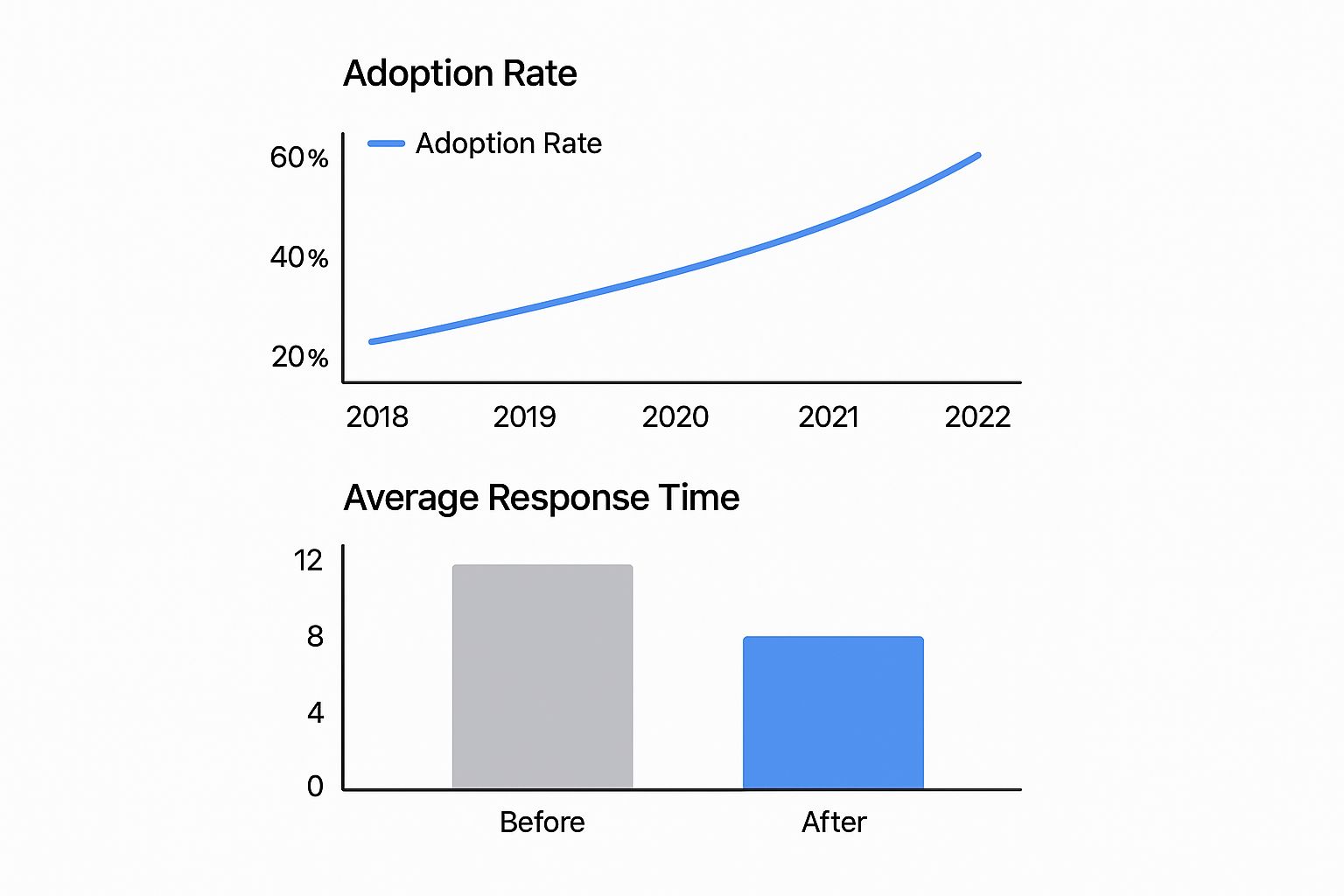
The increasing adoption rate correlates with a significant drop in average response time, a clear demonstration of the technology's benefits. The market for this technology is experiencing rapid growth. The market for real-time AI agent assist, valued at approximately $4.4 billion in 2024, is projected to reach $124.6 billion by 2034. This impressive growth reflects the increasing demand for better customer service and more personalized support. You can find more detailed statistics here.
Key Benefits of Real Time Agent Assistance
Real-time agent assistance offers several significant advantages:
-
Improved Agent Performance: Agents receive real-time guidance and support, boosting their confidence and ability to handle complex situations. This results in higher first-call resolution rates and shorter average handle times.
-
Enhanced Customer Experience: By providing agents with the right information at the right moment, real-time assistance enables faster resolutions, more personalized interactions, and ultimately, greater customer satisfaction.
-
Increased Efficiency and Productivity: The automation of routine tasks frees up agents to focus on more complex and valuable interactions, improving overall team productivity and efficiency. Reduced agent turnover is another benefit, saving on training and onboarding costs.
-
Scalability and Flexibility: Real-time assistance makes it easier for businesses to scale their customer support operations without significantly increasing staff. This allows them to adapt to fluctuations in demand and maintain consistent service quality.
The following table outlines the core components driving these systems:
Key Components of Real Time Agent Assistance Systems This table outlines the essential technological components that make up modern real time agent assistance platforms
| Component | Function | Business Impact |
|---|---|---|
| Natural Language Processing (NLP) | Understands and interprets human language | Enables the system to analyze customer conversations and extract key information. |
| Sentiment Analysis | Detects the emotional tone of customer communications | Helps agents gauge customer satisfaction and tailor their responses accordingly. |
| Machine Learning (ML) | Allows the system to learn from data and improve its performance over time | Leads to more accurate suggestions and better predictions of customer needs. |
| Knowledge Base Integration | Connects the system to a company's knowledge base | Provides agents with instant access to relevant information and resources. |
| Real-Time Analytics | Analyzes interactions as they occur | Enables immediate feedback and support for agents during customer conversations. |
This overview highlights the core technological components enabling real-time assistance. Each component plays a crucial role in delivering the business benefits outlined above.
These advantages create a more streamlined and effective customer support operation, driving business growth and improving the bottom line. Real-time agent assistance is more than just a new technology; it's an investment in the future of customer service.
The Business Case That Wins Executive Approval
Moving beyond the initial excitement surrounding real-time agent assistance, the critical question for executives becomes: what's the return on investment (ROI)? This section explores the compelling ROI metrics that justify implementing this technology, convincing even the most budget-conscious decision-makers. Real-time agent assistance offers a strong business case because of its potential to optimize operations, reduce costs, and boost customer satisfaction. Want to learn more about effective communication? Check out this article on How to master customer communication.
Quantifying the Benefits of Real Time Agent Assistance
Real-time agent assistance systems typically pay for themselves within months through significant improvements across several key performance indicators.
-
Average Handle Time (AHT): By giving agents instant access to information and suggested responses, these systems can drastically reduce the time spent resolving customer issues.
-
First Contact Resolution (FCR): Equipping agents with the right knowledge at the right moment leads to higher FCR rates. This minimizes the need for customers to contact support multiple times for the same issue.
-
Customer Satisfaction (CSAT) Scores: Improved efficiency and personalized responses directly improve CSAT scores, reflecting happier and more loyal customers.
Beyond these core metrics, these systems also contribute to other important improvements.
-
Reduced Agent Turnover: By simplifying complex tasks and providing ongoing support, real-time assistance lessens agent stress and improves job satisfaction, leading to lower turnover. This, in turn, minimizes hiring and training costs.
-
Scalability Without Increased Headcount: Real-time assistance allows businesses to handle growing customer volumes without needing to expand their support teams at the same rate. This flexibility provides a cost-effective way to manage periods of peak demand.
These improvements are not just theoretical. Case studies across various industries showcase the real-world impact of real-time agent assistance on profitability.
To illustrate the potential improvements, let's take a look at some typical ROI metrics. The table below demonstrates how real-time agent assistance can significantly improve key customer service metrics.
To illustrate the potential improvements, let's take a look at some typical ROI metrics. The following table shows a comparison of key performance indicators before and after the implementation of real-time agent assistance.
| Performance Metric | Before Implementation | After Implementation | Percentage Improvement |
|---|---|---|---|
| Average Handle Time (AHT) | 5 minutes | 3 minutes | 40% |
| First Contact Resolution (FCR) | 60% | 75% | 25% |
| Customer Satisfaction (CSAT) | 70% | 85% | 21% |
As you can see, implementing real-time agent assistance can lead to substantial improvements in efficiency and customer satisfaction. These improvements translate directly into cost savings and increased revenue.
Building a Tailored Business Case
Creating a convincing business case for real-time agent assistance requires tailoring the argument to your organization's specific pain points. For example, if your main challenge is scaling customer support without increasing headcount, emphasize the system's ability to improve agent productivity and handle larger call volumes.
If your focus is on reducing agent turnover, highlight how real-time assistance improves agent satisfaction and reduces job-related stress. This also translates to significant savings on recruitment and training. Regardless of your company’s challenges, a well-crafted business case should demonstrate the potential of real-time agent assistance to cut costs, improve customer experiences, and create a lasting competitive advantage. The broader AI agents market, including real-time AI agent assist, is also experiencing rapid growth. In 2024, the market was valued at $5.4 billion and is projected to reach $7.6 billion in 2025, potentially expanding to between $47.1 billion and $50.31 billion by 2030. You can explore this further here.

This sustained growth reflects the increasing demand for AI-powered solutions in various industries, especially customer service. Investing in this technology will empower your team to improve response times and deliver more personalized interactions that boost customer satisfaction and strengthen relationships.
Creating Customer Experiences That Build Loyalty
Real-time agent assistance isn't just about boosting agent performance; it's about transforming the entire customer experience. It empowers agents to provide truly personalized service, leading to happier customers and stronger loyalty. By giving agents immediate access to the right information, real-time assistance helps them address customer needs efficiently and effectively. This creates a smooth and positive experience for everyone involved.
Personalization and Context: The Keys to Customer Delight
Imagine real-time agent assistance as a silent partner working in the background. For example, a customer calls about a recent order. The system instantly displays the customer's purchase history, enabling the agent to greet them by name, mention the specific order, and offer proactive solutions, all without putting the customer on hold. This instant access to information allows for genuinely personalized interactions that go beyond standard scripts. For more on effective communication, check out this resource: How to master real-time communication skills. This personal touch helps build stronger customer relationships.
Real-time agent assistance also helps agents strike the right emotional tone. By analyzing customer sentiment, the system can guide agents on how to respond empathetically and appropriately, ensuring a positive interaction even in difficult situations. Building trust and rapport with customers depends on these positive interactions.
The Human Touch: Balancing Efficiency and Authenticity
While efficiency is important, maintaining a human connection is crucial. Real-time agent assistance should complement, not replace, human interaction. The aim is to create a natural experience where customers don't even realize AI is involved. One of the primary drivers behind the adoption of real-time AI agent assist technology is the desire to improve customer interaction efficiency while offering more empathetic service. Nearly half of customers believe AI agents can be empathetic, highlighting the potential for AI to enhance customer service. Furthermore, 70% of customer experience leaders believe chatbots are becoming increasingly adept, solidifying the role of AI in agent assistance. This trend is expected to grow as businesses increasingly recognize the value of AI in boosting customer engagement and satisfaction. For more insights, explore these AI customer service statistics.
Leading Brands Setting the Standard
Many leading brands are already leveraging real-time agent assistance to revolutionize customer experiences. These companies are seeing real results, including:
- Increased Customer Retention: Exceptional service fosters loyalty.
- Improved Brand Reputation: Positive customer experiences lead to positive word-of-mouth and a stronger brand image.
- Higher Conversion Rates: Personalized interactions can drive sales and create upselling opportunities.
By using real-time agent assistance, these brands are building customer experiences that create lasting loyalty and fuel business growth. The ability to anticipate customer needs and offer proactive solutions is a key differentiator in today's competitive landscape. This proactive approach builds the foundation for strong, long-term customer relationships.
Implementing Real-Time Agent Assistance Without Disruption
Moving from the concept of real-time agent assistance to a successful deployment can feel daunting, but it doesn't have to be. This section offers a practical roadmap for implementing this powerful technology with minimal disruption to your current workflows. We'll guide you through the process, from identifying your organization's unique needs to full-scale implementation and continuous optimization. A key consideration when implementing real-time agent assistance is the need for speed, a crucial component of positive customer experiences, allowing businesses to offer customers real-time support.
Assessing Your Needs and Choosing the Right Partner
The first step is to pinpoint your organization's pain points. Are long average handle times a struggle? Is agent turnover a major concern? Perhaps you're looking to scale operations without a corresponding increase in staffing costs. Clearly defining your challenges will help you select a real-time agent assistance solution that best fits your specific needs.
Next, thoroughly evaluate potential technology partners. Look for solutions that integrate seamlessly with your existing CRM and other enterprise systems. Scalability and the degree of customization offered are also vital factors. Security and data privacy should be paramount, especially when handling sensitive customer information.
You might be interested in exploring Voicetta’s pricing to get a grasp of the cost implications and create a plan that aligns with your budget and specific needs.
Seamless Integration and Data Management
Successful implementation hinges on smooth integration with your current infrastructure. This encompasses not just your CRM but also other pertinent systems, such as your knowledge base and ticketing platforms. Ensuring seamless data flow between these systems is essential for the real-time agent assistance solution to work effectively.
Addressing potential data integration issues early can save valuable time and resources later. This might involve data cleansing, formatting, or migration to ensure compatibility with the new system. A well-defined data management strategy is essential to maximizing the benefits of real-time agent assistance.
Overcoming Agent Adoption Barriers
Introducing new technology can sometimes meet with resistance, particularly from the team using it daily. Successfully implementing real-time agent assistance requires addressing any agent skepticism directly. This involves clear and consistent communication about the system's advantages, both for the agents and the customers they support.
Thorough training and ongoing support are also key. Agents need to feel comfortable using the new system and confident in its ability to enhance their job performance. Transforming initial hesitation into enthusiastic adoption often depends on showcasing the system's practical value in real-world scenarios.
Change Management and Ongoing Optimization
Implementing real-time agent assistance is not a one-off project but a continuous process. A robust change management strategy is vital for smooth transitions and long-term success. This includes setting realistic timelines, establishing clear milestones, and providing ongoing feedback and support to your team.
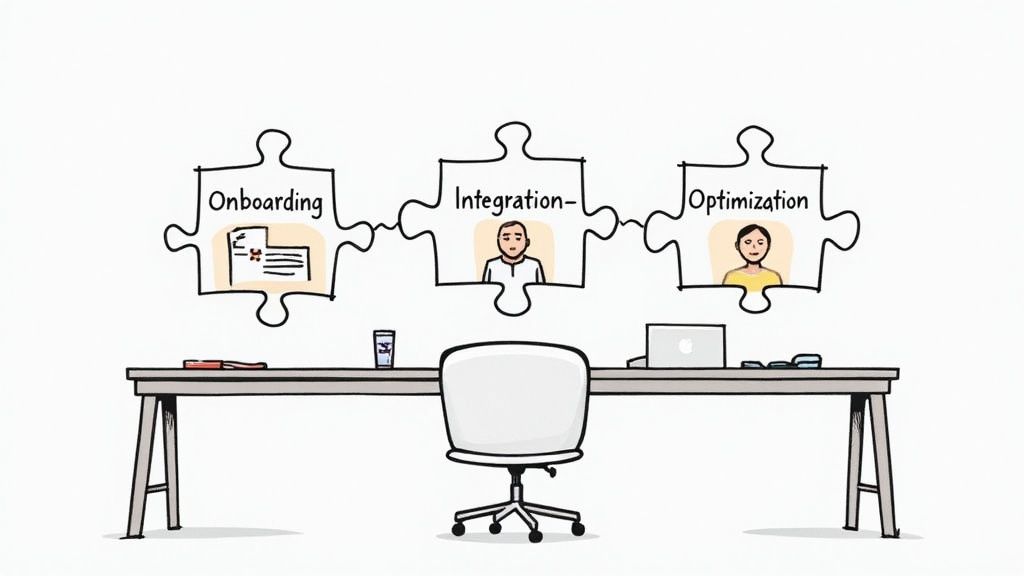
Continuous monitoring and optimization are crucial for maximizing the system's effectiveness. Regularly reviewing performance data and gathering agent feedback can pinpoint areas for improvement and ensure the system continues to meet your evolving business needs. This ongoing optimization enables your real-time agent assistance system to adapt to shifts in customer behavior and market dynamics, ensuring its lasting value.
Tailoring Real-Time Agent Assistance Across Industries
Real-time agent assistance is a powerful tool, but its effectiveness comes from its adaptability. Instead of a one-size-fits-all approach, leading companies are tailoring implementations to meet the unique challenges of different industries. This benefits both agents and customers, leading to smoother interactions and better outcomes.
Financial Services: Compliance and Fraud Detection
In the world of finance, compliance and fraud detection are paramount. Real-time agent assistance can play a crucial role in upholding these standards. Imagine an agent helping a customer with a complex transaction. The system can instantly provide up-to-date regulatory information and flag any potential fraud indicators. This ensures every interaction adheres to strict industry regulations, protecting both the customer and the institution.
Healthcare: Sensitivity and Empathy
Healthcare demands a sensitive and empathetic approach. Real-time agent assistance can empower agents to access patient records quickly and deliver accurate information while maintaining a compassionate tone. This is especially vital when dealing with sensitive health information. The system can even offer suggestions for appropriate language to use in emotionally charged situations.
E-commerce: Product Knowledge and Upselling
Real-time agent assistance can be a game-changer for e-commerce businesses, acting as a powerful sales tool. By instantly providing agents with detailed product information, inventory levels, and customer preferences, the system equips them to handle inquiries efficiently and suggest relevant upsells or cross-sells. This personalized approach can lead to a significant boost in conversion rates and revenue. You might also be interested in: How to master customer communications with Voicetta.
Telecommunications: Technical Troubleshooting
Telecommunications companies frequently handle complex technical issues. Real-time agent assistance can guide agents through troubleshooting steps, providing relevant documentation and even suggesting solutions based on similar past cases. This quick access to information reduces resolution times and leads to greater customer satisfaction, especially when dealing with frustrated customers experiencing service interruptions.
Travel/Hospitality: Personalized Recommendations
Personalization is the key to success in the travel and hospitality industries. Real-time agent assistance can help agents provide tailored travel recommendations, suggest relevant amenities, and offer proactive solutions to potential travel disruptions. This creates a highly personalized customer experience that fosters loyalty and encourages repeat bookings.
Measuring Success Across Sectors
No matter the industry, measuring the effectiveness of real-time agent assistance is essential. Key metrics such as average handle time, first contact resolution rates, and customer satisfaction scores offer valuable insights into the system's impact on business performance. Tracking agent feedback provides valuable qualitative data to further refine and optimize the system. This data-driven approach ensures that real-time agent assistance continues to deliver measurable results and contributes to overall business growth.
The Future of Real-Time Agent Assistance Is Already Here
Real-time agent assistance is constantly evolving. This exploration delves into emerging innovations shaping the future of customer interactions. Forward-thinking companies are already implementing these advancements, gaining a competitive advantage. By understanding these trends, businesses can prepare for the future of customer service and develop strategies that maximize the potential of real-time agent assistance.
Multimodal Analysis: A Deeper Understanding of the Customer
Beyond text, the future of real-time agent assistance lies in multimodal analysis. This involves processing text, voice, and visual cues simultaneously. Imagine a video call where the system analyzes not only the customer's words but also their tone and facial expressions. This allows for a deeper understanding of customer sentiment and intent, leading to more personalized and effective responses.
This richer understanding of customer needs opens new doors for personalized service and proactive support. No longer are agents limited to reacting to what a customer says; they can understand the nuances of communication and respond accordingly.
Augmented Reality and IoT Integration: Expanding the Scope of Assistance
Real-time agent assistance is moving beyond traditional channels. Imagine a field service technician wearing augmented reality glasses. The system provides real-time guidance overlaid on their view, displaying instructions or highlighting potential issues.
The Internet of Things (IoT) also offers exciting possibilities. Real-time agent assistance systems can integrate with IoT device data to offer proactive service alerts. Imagine a smart refrigerator detecting a malfunction and notifying a support agent. The agent, armed with real-time information, can proactively contact the customer and offer help before the problem escalates.
Predictive Analytics: Anticipating Customer Needs
Predictive analytics is another key trend. By analyzing past interactions and identifying patterns, these systems can anticipate future needs. This allows agents to offer proactive solutions and create a truly personalized experience. A customer browsing a website for a specific product could trigger a proactive chat from an agent offering assistance and information.
This proactive approach not only solves problems before they become major issues, but also fosters a sense of personalized care, strengthening the customer relationship.
Extending Agent Assistance Beyond Traditional Support
Real-time agent assistance is expanding beyond customer support. Businesses are integrating this technology into sales and marketing, empowering teams with real-time insights. This includes providing sales representatives with personalized product recommendations or giving marketing teams feedback on customer sentiment during campaigns. Internal functions can also benefit, with real-time agent assistance helping employees quickly find information and resources.
This expansion demonstrates the versatility of real-time agent assistance, showing its potential to improve efficiency and effectiveness across an entire organization.
Building a Flexible and Ethical Agent Assistance Strategy
As this technology evolves, businesses need a flexible strategy. This includes embracing new technologies while addressing ethical considerations, particularly around AI autonomy. The goal should be to enhance human capabilities, not replace them. By creating a partnership between humans and AI, organizations can maximize the benefits while upholding ethical standards and maintaining a human-centric approach.
This balance ensures that technology serves to empower human agents, allowing them to provide even better service and build stronger relationships with customers.
Want to learn more about how Voicetta can help transform your customer communications? Visit us at Voicetta today.