
Let’s start with a simple thought experiment. Imagine your support team never sleeps. Every customer, no matter the time of day, gets an immediate, intelligent answer to their question. That’s the real promise of virtual assistant customer service. It’s not about replacing people; it's about blending smart technology with human expertise to build a support system that’s always on, always helpful, and always learning.
This is how we create a better, faster, and genuinely more efficient way to help people.
The New Face of Customer Support
First things first, let's get rid of the old idea of clunky, frustrating chatbots. That’s not what we’re talking about here. A much better way to think about modern virtual assistant customer service is to picture a digital concierge.
This isn't some pre-programmed script. Think of it as a tireless team member that learns from every single conversation, anticipates what a customer might need next, and is ready to help day or night. It’s a powerful support engine that runs on a sophisticated mix of AI and real human insight.
And it goes far beyond just spitting out answers. Businesses are now using this model to solve surprisingly complex problems, offer help before customers even realise they need it, and, most importantly, build genuine loyalty. We're seeing a fundamental shift from just reacting to problems to proactively building relationships.
What Does a Digital Concierge Actually Do?
So, what kind of work can this digital concierge handle? It’s not just one thing. It’s a whole suite of tasks that takes the pressure off your human team and makes the entire support operation run more smoothly.
You can think of it as playing several key roles at once:
- Frontline Responder: The first point of contact that instantly greets customers, figures out what they need, and gets them to the right person or resource without any delay.
- Information Hub: A living FAQ that provides lightning-fast, accurate answers to common questions about your products, return policies, or account details.
- Problem Solver: An assistant that can walk users through simple troubleshooting steps, process a return, or help them reschedule an appointment on the spot.
Ultimately, the goal is to free up your human experts from the grind of repetitive questions. This allows them to pour their energy into the complex, sensitive issues that truly need a personal touch. That perfect balance is where virtual support really starts to shine.
A Growing Global Industry
It’s no surprise that the demand for these kinds of services has created a booming global market. The virtual assistant industry in Poland is a perfect example of this trend, with a landscape that’s both competitive and rapidly expanding.
You’ll find dozens of Polish companies offering specialised support, from simple administrative help to full-blown customer service automation for international clients. As of mid-2025, many of these firms are highly ranked for their outsourcing skills. They tap into Poland's highly skilled workforce, offering competitive hourly rates that often land between $25 and $49, depending on the complexity of the work. If you're curious, you can find a detailed breakdown of the Polish virtual assistant market on Clutch.co.
By blending automated efficiency with genuine human empathy, businesses can create a support experience that feels both immediate and personal. This is how you build a foundation for lasting customer relationships and set a new standard for what exceptional service truly means.
Why Are So Many Businesses Turning to Virtual Support?
The move towards virtual assistants in customer service isn’t just some passing fad; it’s a smart, practical solution to very real business problems.
Imagine a small, fast-growing online shop. Their sales go through the roof, which is fantastic, but so do the customer questions. Once their tiny team clocks out for the day, the emails pile up: "Where's my order?", "How do I make a return?", "Do you have this in blue?". It creates a massive backlog that frustrates customers and completely burns out the staff.
By bringing in a virtual assistant, they didn’t just patch a leak. They created a 24/7 support system that answered those routine questions instantly, keeping customers happy and freeing up the human team to tackle the trickier problems and actually grow the business. This story gets to the heart of it: people today expect answers now, and businesses need a better way to deliver them.
Doing More with What You’ve Got
One of the biggest wins here is, frankly, the cost. Running a traditional, round-the-clock call centre is incredibly expensive. You’re paying for salaries, benefits, office space, and all the gear needed to cover multiple shifts. A virtual assistant, on the other hand, works tirelessly without any of those overheads.
This isn’t about being cheap; it’s about being smart with your money. The savings can be funnelled back into what really matters, like improving your product or ramping up your marketing. If you’re keen to see how automation can help with resource management, our guide on how to improve operational efficiency is a great place to start.
Scaling Up (or Down) in a Snap
Let's be honest, business demand is never a flat line. You’ve got the holiday rushes you can plan for, but also the unexpected viral TikTok video or a sudden shift in the market that you can't. A human team just can't expand or shrink that quickly, leaving you either overstaffed and wasting money or understaffed and drowning in tickets.
This is where a virtual assistant really shines. It can handle a sudden tenfold spike in questions without breaking a sweat, ensuring every single customer gets an immediate, helpful response. That kind of instant scalability means you're always ready, never missing a sale or letting a customer down when it matters most.
The real advantage is simple: you can offer consistent, high-quality support around the clock, without the sky-high costs and team burnout of the old model. This leads to a healthier, more focused human team and, ultimately, much happier customers.
The Magic of Being Always On
In a world that never sleeps, telling a customer "we're open 9-to-5" is a surefire way to lose them. A virtual assistant offers that crucial 24/7 availability, meeting customers whenever and wherever they are.
This constant presence builds incredible trust and can easily be the thing that turns a one-time buyer into a loyal fan. It means no question goes unanswered, capturing leads and solving problems long after your competitors have switched off for the night.
The Winning Human and AI Hybrid Model

The future of great customer service isn’t a battle of humans versus technology. It's about bringing them together to create a team that's far more powerful than the sum of its parts. The most successful strategies I’ve seen combine the warmth and nuanced problem-solving of a human agent with the sheer speed and data-crunching power of an AI virtual assistant. This is the hybrid model, and it completely changes the game.
Let me paint you a picture. Think of a skilled pilot and their advanced AI co-pilot. The AI handles all the routine system checks, manages standard communications, and can pull up any piece of flight data in an instant. This frees up the human pilot to focus their expertise where it matters most: navigating tricky weather, making critical judgement calls, and ensuring every passenger has a smooth, safe flight.
This is precisely how virtual assistant customer service shines. The AI acts as that brilliant co-pilot, screening initial enquiries, gathering all the necessary customer details upfront, and then handing a neat, organised summary over to a human agent. The result? Resolution times get slashed, and your agents become incredibly effective from the moment they say hello.
How the Hybrid Model Works in Practice
So, what does this tag team actually look like on the ground? It's a smooth, behind-the-scenes handoff designed to make getting help feel effortless for the customer while making your team's life easier. It usually follows a smart, logical flow.
- First Contact & Triage: The AI assistant is the first point of contact. It greets the customer, quickly figures out what they need, and instantly resolves any common, straightforward questions.
- Gathering the Backstory: As it interacts, the AI is busy collecting the important details – account numbers, previous order information, and a clear description of the issue.
- The Smart Handoff: When an issue is too complex, emotional, or sensitive for a bot, the AI knows to escalate. It seamlessly transfers the entire conversation, along with all that context it gathered, to the perfect human agent for the job.
This means your human agents never, ever have to start a conversation with that dreaded phrase, "So, could you tell me everything all over again?" They walk into the conversation armed with the full story, ready to solve the problem, not just diagnose it.
At its heart, the hybrid model is about a simple, powerful idea: let technology do what it does best—the repetitive, data-heavy lifting—so your people can do what they do best—the high-value, relationship-building work that truly matters.
Empowering Agents, Not Replacing Them
And what do the agents themselves think? Far from seeing AI as a threat, they view it as a powerful ally. Research shows that about 79% of contact centre agents feel that having an AI assistant helps them resolve customer issues much more effectively. In Poland’s booming BPO sector, for example, this kind of AI-human collaboration is quickly becoming the gold standard. You can dig into more of the findings on AI in customer service from Zendesk.
Ultimately, a well-implemented AI chatbot becomes a force multiplier for your team. It takes the tedious, repetitive tasks off their plate, reducing burnout and freeing them up to focus on more fulfilling work. It gives them the data and tools they need to perform at their absolute best, creating a happier team and delivering a far better customer experience—the kind that builds real, lasting loyalty.
Implementing Your Virtual Service Strategy
Bringing a virtual assistant into your customer service team can feel like a massive undertaking, but it’s really just a series of well-planned steps. Think of it less as a total rebuild and more like a smart upgrade to your support operations. The secret is to lay a strong foundation before you go live. This ensures your new virtual team member, whether it’s a human or an AI, is ready to deliver from day one. A bit of planning upfront saves a world of headaches down the line.
The entire process begins with one thing: clarity. Before you write a single line of code or hire anyone, you need to be crystal clear about what you want this virtual assistant to accomplish. Are you trying to slash first-response times? Handle those late-night enquiries? Maybe you just need a better way to qualify sales leads.
Whatever the reason, your goals need to be specific and measurable.
Defining Your Goals and Model
A vague goal like "improve customer service" isn't going to get you very far. You need something you can actually track, like "cut email response time by 50%" or "handle 80% of order status questions automatically." Once you have these sharp objectives, you can pick the right model to get the job done.
This choice is absolutely critical.
- Human VA: This is your go-to for tasks that demand empathy, complex problem-solving, and genuine relationship-building.
- AI VA: Perfect for the high-volume, repetitive stuff. Think answering FAQs, tracking orders, or booking appointments around the clock.
- Hybrid Model: Often the most powerful option. You get the speed of AI for the initial questions and the skilled touch of a human for anything that needs escalating.
It's no surprise the market for these services is booming. The global virtual assistant market was valued at around $4.12 billion back in 2020 and has been on a steep upward curve ever since. This trend is very much alive in Poland’s growing tech scene, signalling a major shift in how businesses think about support. You can find more detailed statistics on the VA market's growth to see just how fast things are moving.
Mapping the Customer Journey
Once you’ve settled on a model, it's time to map out your customer journeys. Take a close look at every single touchpoint where a virtual assistant could step in and make a difference. This might be the little chat widget on your website, your Facebook Messenger inbox, or even your main phone line.
Drawing this out helps you see exactly where the VA fits and how the whole system will work together.
This infographic gives you a simple, visual idea of how an AI-powered VA handles a customer enquiry.
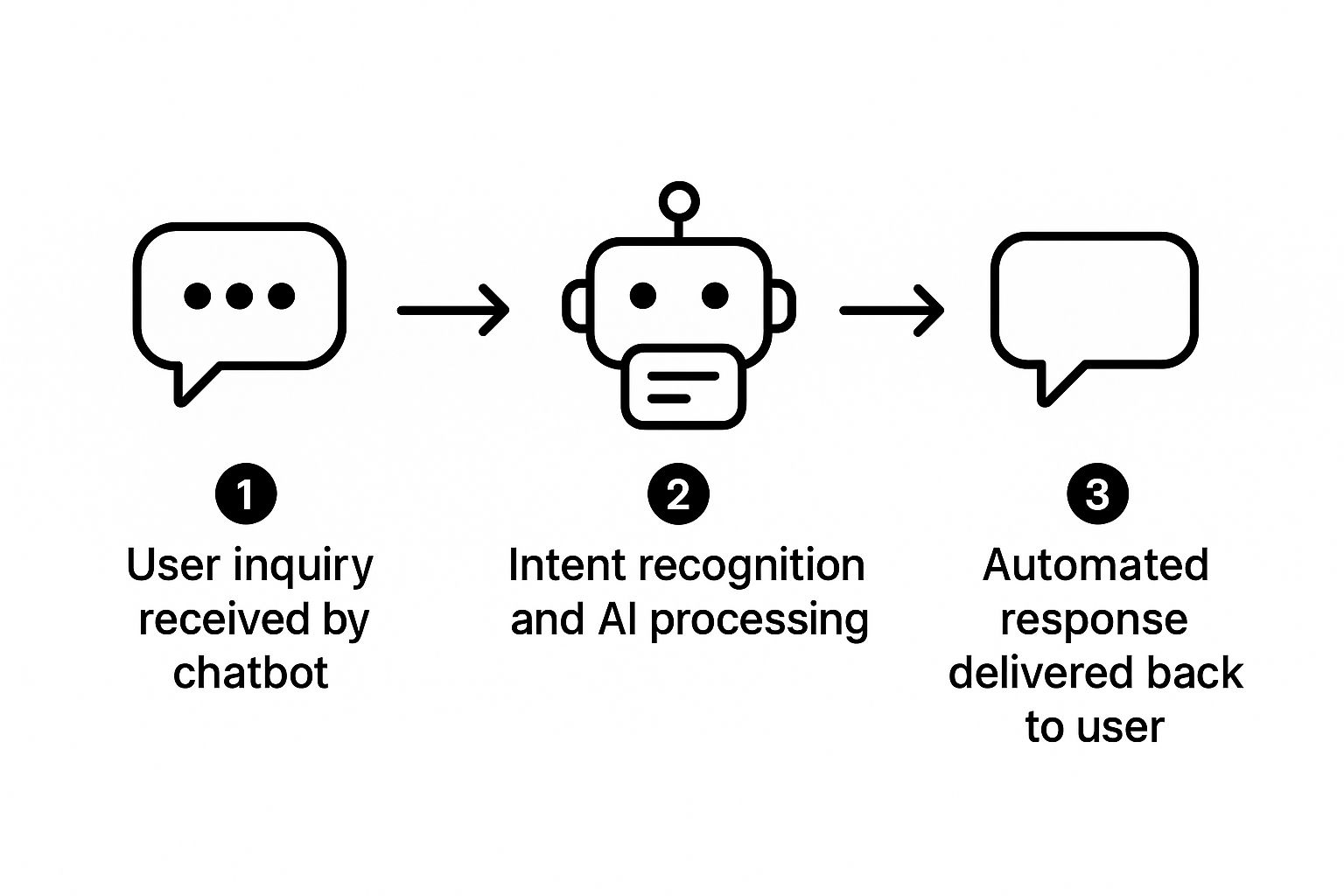
As you can see, the AI receives a question, figures out what the customer wants, and provides an instant, automated answer. It’s a fast and efficient first line of defence.
The final piece of the puzzle is training and integration. Your virtual assistant is only as smart as the information you give it. It needs access to a rich, up-to-date knowledge base to provide accurate answers. Just as important, it needs to be connected to your other systems, like your CRM, to have the context it needs to deliver truly personal and helpful service. This is the step that turns a good VA into an invaluable one.
Keeping Your Virtual Support Team on Top of Their Game
Getting a virtual assistant up and running is a great first step, but it’s certainly not the finish line. The real work—and the real payoff—comes from how you manage and refine it over time. I like to think of it like coaching a sports team. You don't just pick the players and hope for the best. You need a strategy, constant practice, and a way to adapt to every new challenge.
This is especially true for a virtual assistant customer service team. The foundation of it all? Rock-solid communication. You have to create a space where information flows easily and everyone stays in sync. For the day-to-day chatter and quick team huddles, tools like Slack or Microsoft Teams are fantastic. They become your digital headquarters. When it comes to managing the actual work, something more structured like Trello or Asana ensures every task is tracked and nothing gets lost in the shuffle.
You Can't Improve What You Don't Measure
If you don't know where you are, you can't figure out how to get where you want to go. This is where setting clear key performance indicators (KPIs) becomes essential. Think of them as the scoreboard for your team. They tell you if you're winning and show you exactly where you need to focus your efforts. Ambiguous goals only lead to mediocre performance.
Here are a few core metrics that I always recommend starting with:
- First-Response Time (FRT): This is a big one. How long does it take for a customer to get that first, crucial acknowledgement? Speed here sets the tone for the entire interaction.
- Resolution Rate: What percentage of customer problems are solved in that first conversation? A high first-contact resolution rate is a sure sign of an efficient and knowledgeable team.
- Customer Satisfaction (CSAT) Score: The ultimate report card. After all is said and done, are your customers actually happy with the help they received?
Keeping a close eye on these numbers isn't about micromanaging; it's about spotting trends and finding opportunities to get better.
A well-managed virtual assistant is more than just a piece of software; it becomes a living, breathing part of your team. By communicating clearly, measuring what matters, and continuously feeding it knowledge, you’re building a system that doesn't just solve problems—it learns, adapts, and grows more valuable every single day.
Creating a Central Source of Truth
The most powerful tool in your entire virtual support arsenal is a single, comprehensive knowledge base. This is your team's collective brain. It's the central hub that ensures every agent, human or AI, is pulling from the same playbook and giving customers consistent, correct answers. Every time a tricky question gets answered or a new procedure is established, it needs to be documented here.
This living library is a lifeline for your human agents, too. When a customer throws them a curveball, they need a reliable place to find the answer, fast. For businesses wanting to give their agents an even bigger edge, looking into real-time agent assistance can make a massive difference, feeding them the right information and guidance at the exact moment they need it.
Measuring Success and Proving ROI
So, you've launched your virtual assistant. The real question now is: is it actually working? How can you tell if your investment is genuinely paying off? It’s not enough to just feel like things are better; you need to prove it.
To build a solid business case, you need to track both the hard numbers and the human story. It's about combining tangible financial wins with the less obvious, but equally crucial, improvements in customer happiness. Get this right, and you'll have a powerful story to tell.
One side of the coin is the quantitative data—the cold, hard facts that speak directly to your bottom line. This is the evidence that will make your finance department sit up and listen.
The other side is the qualitative story. Are your customers less frustrated? Are they finding what they need without wanting to pull their hair out? This perspective tells you if you're truly improving the experience, not just deflecting tickets. A complete picture needs both.
Tracking the Tangible Returns
Let's start with the money. To really build your case, you need to focus on metrics that directly connect to costs, productivity, and profitability. These are the numbers that show exactly how your virtual assistant is making the business leaner and more efficient.
Here are a few key areas to keep a close eye on:
- Cost-Per-Interaction: This is a big one. Calculate what it costs to handle a query via the virtual assistant versus a human agent. As the VA takes on more of the routine traffic, you should see this number drop significantly.
- Agent Productivity Gains: Your human agents are your most valuable resource. Are they now free to tackle more complex, high-value problems? Measure if they're resolving more difficult tickets per day now that the simple stuff is automated.
- Reduced Customer Churn: This is where great support hits the bottom line. Track your customer retention rates. Faster, 24/7 support often keeps customers from jumping ship to a competitor. Even a small improvement here can have a massive financial impact.
Gauging the Customer Experience
Financial data tells you part of the story, but the rest is written in how your customers feel. A happy customer is a loyal one, and your virtual assistant should be a major contributor to that positive sentiment.
The real proof of a successful virtual assistant programme isn't just in saved costs, but in happier customers. When your Net Promoter Score (NPS) climbs, it's a clear signal that you’re not just answering questions faster—you're building better relationships.
Dive into your customer feedback, run satisfaction surveys, and keep an eye on online reviews. These will give you the ground-truth on how your VA is being perceived. Tracking this narrative is absolutely essential, and to do it properly, you need the right framework. You can learn more about the most important customer support KPIs to build a measurement strategy that truly covers all your bases.
Got Questions? We’ve Got Answers
Thinking about adding a virtual assistant to your customer service team? It’s a big step, and you’ve probably got a few questions floating around. Let's tackle some of the most common ones head-on.
What’s This Going to Cost?
The price tag really comes down to what kind of assistant you hire. If you’re looking for a skilled human virtual assistant, someone based in a competitive market like Poland might charge an hourly rate between $25 and $49. It's a direct investment in a person's time and expertise.
AI-powered chatbots, on the other hand, usually come with a monthly subscription. You could be looking at anything from under a hundred dollars for a simple setup to several thousand a month for a sophisticated system that manages huge volumes and plugs into all your other tools. It’s all about finding the right fit for your budget and your needs.
Can a Virtual Assistant Actually Handle Tricky Customer Problems?
That really depends on the assistant. A basic AI chatbot is a wizard at handling the same questions over and over again, but it’ll get stuck if a problem has too many moving parts. Smarter AI, however, can pull off more complex jobs like tracking a complicated order or booking appointments because it can talk to your other business systems.
But when things get really emotional or tangled, a hybrid approach is your best bet.
Let the virtual assistant be the first point of contact. It can gather all the details and figure out what’s going on. Then, it can pass the entire conversation—context and all—to a human agent who’s ready to jump in and solve the problem without making the customer repeat a single thing.
What Tools Do I Need to Get a Virtual Assistant Set Up?
The tools you'll need hinge on what you’re already using. You’ll definitely need a place for the assistant to talk to customers, whether that's a chat box on your website, a social media messenger, or your phone line.
The real magic happens when you connect it to your Customer Relationship Management (CRM) software. This integration is what allows the assistant to pull up customer history and offer genuinely personal service. You’ll also want a solid knowledge base or help centre for both AI and human VAs to find accurate answers. Thankfully, most modern virtual assistant platforms are built to play nicely with popular tools like Salesforce, HubSpot, and Zendesk.
Ready to make sure a customer is never left waiting again? Voicetta offers a 24/7 AI communication platform that works right alongside your team. It can qualify leads, book appointments, and provide top-notch support, day or night. See how our smart, seamless conversations can completely change your approach to customer service by learning more about Voicetta.