
Blog
Boost Efficiency: Virtual Assistant for Customer Service
The customer service world is changing. Customer expectations are evolving, and AIpowered solutions are on the rise. Smart businesses are adapting to these changes by...
The Revolution of Virtual Assistants in Modern Support

The customer service world is changing. Customer expectations are evolving, and AI-powered solutions are on the rise. Smart businesses are adapting to these changes by using virtual assistants for customer service. These AI-driven systems offer a new approach to support that is efficient, personalized, and budget-friendly. This isn't just a tech upgrade. It's a fundamental shift in how businesses connect with their customers.
Why Businesses Are Adopting Virtual Assistants
Several factors are encouraging businesses to use virtual assistants for customer service. A major driver is the demand for 24/7 availability. Customers want fast responses and solutions any time, day or night. Traditional support models, often relying on human agents, struggle to meet this need affordably. Virtual assistants can operate continuously, providing consistent support and minimizing missed opportunities from unanswered questions.
Virtual assistants are also great at handling large numbers of routine requests. This allows human agents to handle complex issues and provide personalized support where it's most needed. This division of labor creates a more efficient and satisfying experience for both customers and agents.
For example, a virtual assistant can easily manage password resets, order tracking, and basic product questions. Human agents can then focus their attention on complicated technical problems or sensitive customer complaints.
This shift in support strategies is data-driven. The use of virtual assistants has grown considerably, with 85% of customer interactions handled without human agents by 2022. These interactions were primarily managed by AI-powered systems like chatbots and virtual assistants. This trend has reduced staffing expenses, improved response times, and increased service availability. For more in-depth statistics, see: AI in Customer Service Stats
Meeting Evolving Customer Expectations
Customer expectations are constantly changing. Today's consumers desire instant results and tailored experiences. They want answers quickly and conveniently through their favorite communication channels. Virtual assistants are well-suited to meet these needs. They can integrate seamlessly with a variety of platforms like messaging apps, websites, and social media, delivering instant support wherever customers are. Virtual assistants are changing modern support strategies. Explore the growth of AI in Customer Service.
AI-powered virtual assistants are always learning and improving. They can analyze customer information, spot patterns, and personalize interactions based on individual preferences and past activity. This level of personalization is hard for human-only teams to achieve on a large scale. This creates more targeted and helpful interactions, and also offers useful information on customer behaviors and preferences. These insights can then further refine support operations and boost the overall customer experience.
Game-Changing Benefits That Transform Customer Support

Beyond simple cost reductions, virtual assistants are reshaping the customer service landscape. They're not just about saving money; they're a strategic investment that can significantly elevate your business's competitive advantage. This shift is driven by the unique ability of virtual assistants to tackle key customer support challenges.
Eliminating Wait Times and Providing 24/7 Availability
One of the biggest advantages of virtual assistants is eliminating customer wait times. Unlike human agents limited by shifts and breaks, virtual assistants offer 24/7 availability. Customers receive immediate support, regardless of time or day.
This constant accessibility drastically reduces customer frustration associated with long waits, especially during peak times or holidays. This improved responsiveness directly boosts customer satisfaction and loyalty.
Handling Multiple Inquiries Simultaneously
Virtual assistants excel at managing numerous customer inquiries concurrently. A single virtual assistant can efficiently handle a high volume of chats and requests, a feat difficult for even a large human team.
This significantly improves efficiency, reducing the need for extensive support staff and lowering operational costs. This capacity makes virtual assistants invaluable for businesses experiencing rapid growth or seasonal increases in customer inquiries.
Delivering Consistent and Excellent Experiences
Virtual assistants maintain consistent service quality across all interactions. By following predefined scripts and processes, they guarantee every customer receives the same high level of support. This consistency builds trust and reinforces brand reputation, driving long-term customer loyalty.
Many virtual assistants are now powered by AI, enabling them to learn from past interactions and improve over time. Consider exploring how to automate customer support to further optimize your service.
To illustrate the quantifiable impact of virtual assistants, let's examine a comparison of key performance metrics:
Virtual Assistant Impact: Before & After Implementation
This table presents key performance metrics comparing traditional customer service models with virtual assistant implementation, showing the quantifiable improvements businesses can expect.
| Performance Metric | Traditional Customer Service | With Virtual Assistant Implementation | Percentage Improvement |
|---|---|---|---|
| Average Wait Time | 5 minutes | 2 seconds | 90% |
| Inquiries Handled per Hour (per agent) | 10 | 50 | 400% |
| Customer Satisfaction Score | 75% | 90% | 20% |
| Resolution Time | 10 minutes | 5 minutes | 50% |
As the table shows, implementing a virtual assistant significantly improves key customer service metrics, leading to reduced wait times, increased efficiency, and higher customer satisfaction.
The use of AI in customer support is continually growing. Currently, 30% of companies utilize virtual assistants for daily operations. Within this group, 40% of virtual assistants utilize AI tools for tasks like customer support, highlighting their growing importance. For more detailed statistics, visit Talent. For more insights, check out our blog.
Selecting Your Perfect Virtual Assistant Solution
Not all virtual assistants are created equal. Choosing the wrong solution can be an expensive mistake, impacting both your budget and customer satisfaction. This section provides a practical framework for evaluating and selecting the best virtual assistant for your specific customer service needs. We'll explore various options, from basic rule-based chatbots to advanced AI-powered assistants with natural language processing (NLP) capabilities.
Understanding Your Needs and Options
Before exploring specific solutions, it's essential to understand your business needs. What are your primary customer service challenges? Are you looking to reduce wait times, improve resolution rates, or offer better 24/7 availability? Clearly defining your objectives will guide you toward the right virtual assistant solution.
Virtual assistants come in varying levels of complexity:
-
Rule-Based Chatbots: These chatbots follow predefined rules and scripts, making them suitable for simple, repetitive tasks. Think answering FAQs or directing inquiries to the appropriate department. They are easy to implement but less flexible than AI-powered options.
-
AI-Powered Assistants: These assistants use machine learning and NLP to understand and respond to more complex customer queries. They can learn from past interactions and personalize responses, creating more natural and engaging experiences.
-
Hybrid Solutions: Many businesses find a combined approach beneficial. A rule-based chatbot could handle initial inquiries, then escalate complex issues to a human agent or a specialized AI assistant.
Key Features and Integration Considerations
Certain features are essential for an effective customer service virtual assistant. Consider these factors when evaluating providers:
-
Integration Capabilities: Seamless integration with your existing CRM (HubSpot), helpdesk (Zendesk), and other systems is vital for efficient data flow and a unified customer view. Ask potential providers about their integration options and any associated costs.
-
Natural Language Processing (NLP): For AI-powered assistants, the quality of NLP greatly affects how well the assistant understands and responds accurately to customer questions. Look for solutions with robust NLP capabilities and demonstrably accurate intent recognition.
-
Customization Options: The ability to tailor the virtual assistant’s responses, appearance, and branding ensures a consistent customer experience that aligns with your brand identity.
-
Analytics and Reporting: Comprehensive analytics and reporting tools give valuable insights into your virtual assistant’s performance. This data allows you to identify areas for improvement and measure ROI.
Implementation Timelines and Cost Considerations
Implementation timelines vary depending on the complexity of the chosen solution. Simple rule-based chatbots can often be deployed in a matter of weeks. More complex AI-powered assistants may require several months. Costs also vary significantly depending on features, customization requirements, and the vendor's pricing model. You might be interested in: How to master pricing.
To help you compare different virtual assistant options, we've created the following comparison guide:
Virtual Assistant Solution Comparison Guide
This table compares various virtual assistant solutions across key features, complexity, cost, ideal use cases, and limitations to help businesses make informed decisions.
| Solution Type | Key Features | Implementation Complexity | Cost Range | Best For | Limitations |
|---|---|---|---|---|---|
| Rule-Based Chatbots | Predefined scripts, simple responses | Low | Lower | FAQs, basic inquiries | Limited flexibility, struggles with complex requests |
| AI-Powered Assistants | NLP, personalized responses, learning capabilities | Medium to High | Higher | Complex inquiries, personalized support | Requires training data, ongoing maintenance |
| Hybrid Solutions | Combination of rule-based and AI | Medium | Varies | Businesses with diverse needs, balancing cost and functionality | Can be complex to integrate and manage |
This table highlights key differences between common virtual assistant solutions. While rule-based chatbots offer a quick and affordable solution for basic inquiries, AI-powered options provide greater flexibility and personalization, albeit at a higher cost. Hybrid solutions aim to strike a balance, leveraging both approaches to cater to a broader range of customer service needs.
By carefully considering your business needs, exploring available features, and understanding implementation and cost factors, you can choose the virtual assistant solution that best positions your customer service for success.
Implementation Secrets From Customer Service Leaders
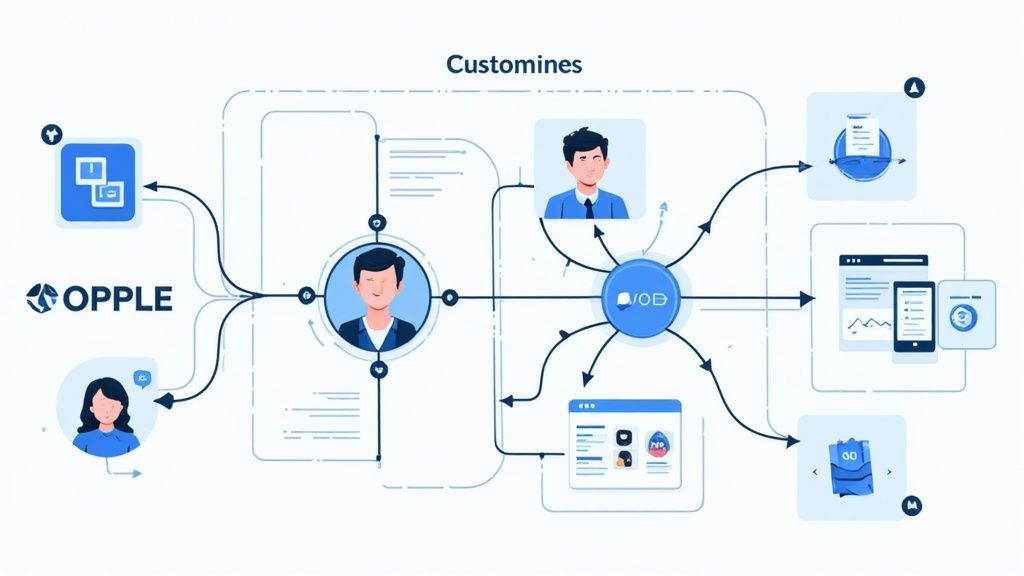
Deploying a virtual assistant for customer service involves many different moving parts. It takes careful planning, execution, and continuous optimization. Just picking the right platform isn't enough. For real success, businesses need a strategic implementation approach.
Preparing Your Knowledge Base and Brand Voice
A crucial first step is preparing your knowledge base. This means organizing information in a way that's easy for an AI to understand. Think of it like building a well-stocked library for your virtual assistant. This ensures accurate and current information for answering customer questions effectively.
Training your virtual assistant on your brand voice is also essential. This maintains consistency and builds customer trust. It involves feeding the AI examples of your brand's communication style. This includes language, tone, and even humor. The aim is to create authentic customer interactions that reflect your brand identity.
Building Team Buy-In and Setting Benchmarks
Successful implementation requires team buy-in. Address any concerns by highlighting the collaborative nature of human-AI support. Show your team how the virtual assistant handles routine tasks. This frees them to focus on more complex and engaging interactions.
Establishing clear performance benchmarks is also vital for measuring success. These benchmarks should align with your business goals and customer service objectives. Key metrics include average wait time, resolution rate, and customer satisfaction. Tracking these helps identify areas for improvement. It also shows the value of your virtual assistant investment.
Developing Feedback Loops and Achieving Quick Wins
Continuous feedback loops are key for ongoing optimization. Regularly review customer interactions. Identify areas where the virtual assistant can improve. This iterative process helps your virtual assistant learn and adapt to your customers' changing needs.
Finally, aim for visible progress early on. Start with a pilot program focused on a specific customer service area. This lets you test and refine your strategy before a full rollout. These quick wins demonstrate the value of your virtual assistant. They also build internal momentum and wider adoption. For a deeper look at building and deploying AI solutions, check out the Voicetta blog.
Creating the Perfect Human-AI Support Ecosystem
The most effective customer service strategies don't involve choosing between human agents and virtual assistants. Instead, the best approach combines the strengths of both. Building a collaborative environment where humans and AI work together creates a powerful synergy, optimizing support operations and enhancing the customer experience. Let's explore how to build such a system.
Designing Intelligent Routing Systems
The foundation of a successful human-AI partnership lies in intelligent routing. This system acts as a gatekeeper, directing incoming inquiries to the most appropriate resource. Several factors determine the routing decision, including the complexity of the request, the customer's value, and even the emotional tone of their message.
A simple question, like inquiring about store hours, can be efficiently handled by a virtual assistant. However, a complex technical issue or an emotionally charged complaint requires the empathy and problem-solving skills of a human agent. This intelligent routing ensures efficient and personalized support, leading to increased customer satisfaction and optimized agent productivity.
Training for Collaboration and Seamless Handoffs
Human teams need training to collaborate effectively with AI assistants. This training should cover the AI's capabilities and limitations, as well as best practices for seamless handoffs. A smooth transition between AI and human agents is vital for maintaining customer trust and avoiding frustration.
For example, if a virtual assistant encounters a problem it can't solve, it can transfer the chat to a human agent, including the entire conversation history. This context allows the agent to quickly grasp the situation and provide a personalized solution without repeating previous steps. Learn more in our article about How to master the art of customer service.
Determining Human vs. AI Interaction
Clearly defining which interactions are best handled by humans and which by AI is crucial. Consider the nature of the request and the desired outcome. Tasks such as answering FAQs, scheduling appointments, and providing basic information are perfectly suited for virtual assistants. AI excels at these repetitive processes, handling them with speed and accuracy.
Conversely, interactions requiring empathy, critical thinking, and complex problem-solving benefit from the human touch. Handling customer complaints or providing technical support often falls into this category. This strategic allocation of tasks maximizes efficiency and ensures customers receive the appropriate level of support.
Real-World Examples of Hybrid Models
Many companies have successfully implemented hybrid support models, integrating human agents and virtual assistants. These models often demonstrate significant improvements in both efficiency and customer satisfaction. One example is a company using a virtual assistant to handle initial inquiries, triaging and then transferring complex issues to specialized human agents.
This tiered approach allows for high-volume request handling while still providing personalized attention where needed. Another example involves using AI to analyze customer data, providing valuable insights to human agents. This empowers agents to personalize interactions and even offer proactive support. These real-world examples illustrate how hybrid models can transform customer service.
The Future of Virtual Assistants in Customer Experience

The landscape of customer service is constantly changing, and virtual assistants are playing an increasingly important role. What does the future hold for these AI-powered solutions? Emerging technologies are poised to reshape how businesses connect with their customers, creating interactions that are both highly personalized and incredibly efficient.
Enhanced Emotional Intelligence and Predictive Capabilities
Thanks to advancements in natural language processing (NLP), virtual assistants are evolving beyond simply understanding words. They are now beginning to recognize the nuances of human emotion in customer communications.
This means virtual assistants can tailor their responses to a customer's emotional state, resulting in more empathetic and helpful interactions. Furthermore, these advancements empower virtual assistants to anticipate customer needs.
By analyzing past interactions and recognizing patterns, virtual assistants can proactively offer solutions and guidance, creating a more streamlined and satisfying customer journey.
Integration With Emerging Technologies
The future of virtual assistants is intertwined with the evolution of other technologies. Augmented reality (AR) and voice recognition are two key areas of development.
Imagine a virtual assistant guiding a customer through assembling a product using AR overlays, or offering real-time support during a phone call with advanced voice recognition. These integrations will create richer, more interactive experiences for customers, further blurring the lines between human and AI-driven support.
From Emerging Tech to Everyday Use: The Next Generation of Support
Many of these advancements are transitioning from the experimental phase to practical application. Forward-thinking businesses are investing in these capabilities, recognizing the potential of virtual assistants to revolutionize their customer service operations.
This growth is reflected in market projections. The global virtual assistant services market is expected to reach USD 44.25 billion by 2027. This represents a CAGR of 20.3% from a value of USD 4.12 billion in 2020. You can find more detailed statistics here.
This widespread adoption highlights the increasing importance of virtual assistants in diverse sectors, such as e-commerce and healthcare, where they handle tasks like order processing and patient follow-ups. Virtual assistants are becoming essential for providing top-notch support and enhancing the overall customer experience.
Future-Proofing Your Customer Service Approach
Businesses must prepare for these changes. This includes evaluating current support systems, exploring new technologies, and cultivating a culture of innovation within customer service teams.
While full integration of advanced features may take time, beginning now with a well-defined strategy will ensure businesses maintain a competitive edge. This means staying current on emerging capabilities, running pilot programs, and incorporating virtual assistants into long-term customer service plans.
Focusing on incremental progress and carefully measuring results will be crucial for successful implementation. By embracing the future of virtual assistants, companies can position themselves to meet the evolving expectations of their customers and create truly exceptional support experiences.
Measuring ROI: Beyond Cost Savings to True Value
Investing in virtual assistants is a significant decision. But how can you accurately measure their true impact, moving beyond simple cost reductions? This exploration delves into comprehensive frameworks that capture the full value virtual assistants bring to customer service. We'll look at both quantitative metrics and the qualitative benefits that signal real success.
Quantifying the Impact: Key Metrics
While cost savings are important, they only paint part of the picture. A truly effective ROI measurement strategy considers a broader range of factors. Key quantitative metrics to track include:
-
Response Times: How quickly are customer inquiries answered? Faster responses generally lead to increased customer satisfaction.
-
Resolution Rates: What percentage of customer issues are resolved without human intervention? A high resolution rate signifies efficiency.
-
Cost Per Interaction: How does the cost of handling an interaction with a virtual assistant compare to a human agent? This metric highlights cost-effectiveness.
-
First Contact Resolution (FCR): How often are issues resolved on the first contact? This reflects both efficiency and effectiveness.
-
Interaction Volume: How many interactions are handled daily, weekly, or monthly? This demonstrates capacity and utilization.
Tracking these metrics uncovers tangible benefits. For instance, reduced response times translate directly to a better customer experience. A high resolution rate demonstrates the virtual assistant's ability to handle a high volume of inquiries effectively.
Qualitative Benefits: The Human Element
Numbers alone don't tell the whole story. Qualitative benefits provide deeper insights into the overall impact. Consider these key aspects:
-
Improved Customer Satisfaction: Are customers more satisfied with the service they receive? Positive feedback and improved satisfaction scores are key indicators.
-
Increased Customer Loyalty: Are customers more likely to return due to positive support interactions? Repeat business and increased retention rates demonstrate long-term value.
-
Enhanced Brand Perception: Does using a virtual assistant project a modern, customer-centric image? Positive brand perception attracts new customers and strengthens market position.
These qualitative aspects, while harder to measure directly, are essential for a complete ROI assessment. Increased customer loyalty, for example, translates to higher lifetime value. A strong brand reputation attracts new customers and builds brand equity.
Building a Measurement Dashboard
A comprehensive dashboard is crucial for tracking and analyzing both quantitative and qualitative data. This dashboard should offer a clear overview of performance across key metrics. Regular review of this data enables you to:
-
Identify Areas for Improvement: Are there specific areas where the virtual assistant is underperforming? Data analysis reveals opportunities for optimization.
-
Demonstrate Value to Stakeholders: A well-structured dashboard clearly communicates the positive impact to decision-makers.
-
Optimize for Continued Success: Monitoring performance and making adjustments ensures consistent value delivery over time.
Sector-Specific Benchmarks and Continuous Optimization
Industry benchmarks provide valuable context. Comparing your results to industry averages helps identify areas of strength and areas for improvement. This comparative analysis allows for:
-
Set Realistic Targets: Benchmarking helps define achievable performance goals based on industry standards.
-
Identify Best Practices: Learning from successful companies within your sector helps optimize your strategy.
Continuous optimization is essential for maximizing ROI. Regularly reviewing data and making adjustments based on those insights ensures ongoing success. This iterative process allows your virtual assistant to remain effective and adaptable to evolving customer needs.
Ready to transform your customer service with a 24/7 AI-powered solution? Visit Voicetta to learn more about how intelligent virtual assistants can elevate customer experience and maximize ROI.
Was this useful?
If this article helped, add Voicetta as a preferred source in Google Search. Your results can then highlight our writing.
Add as preferred source