
Blog
AI in Hospitality Industry: Your Complete Strategy Guide
This screenshot shows a typical online travel agency interface, like Booking.com, which already uses AI behind the scenes for personalized search results and dynamic p...
Making Sense of AI in Your Hospitality Business

This screenshot shows a typical online travel agency interface, like Booking.com, which already uses AI behind the scenes for personalized search results and dynamic pricing. Notice the search filters and recommendations? These are often powered by AI algorithms. These platforms are using AI to improve the customer journey and boost bookings, setting a standard for individual hotels.
Think of AI not as a replacement for your staff, but as a powerful tool that helps them do more. Imagine AI as a tireless digital assistant, handling repetitive tasks and sifting through mountains of data to find useful insights. This frees up your team to focus on what truly matters: creating exceptional, personalized guest experiences.
How AI Is Already at Work
AI-powered chatbots, for example, can handle common guest questions, allowing your front desk staff to focus on more complex issues and build relationships with guests. These chatbots aren't just retrieving canned responses. They're constantly learning, getting better at understanding natural language and giving helpful answers. This means quicker responses and happier guests, even outside of normal business hours.
AI is also changing how hotels manage revenue. By analyzing data like occupancy rates, competitor prices, and even local events, AI can predict demand and adjust pricing in real-time. This can lead to higher revenue and profitability, while staying competitive.
The Rise of AI in Hospitality
This isn't a passing trend. The use of AI in hospitality is growing fast. The global AI in hospitality and tourism market is expected to jump from $15.69 billion in 2024 to $58.56 billion by 2029. That's a compound annual growth rate (CAGR) of 30.1%. Businesses worldwide are realizing the potential of AI to improve both customer service and how they operate. Discover more insights on the growth of AI in hospitality.
Turning Data into Delight: The True Power of AI
The real magic of AI is how it transforms raw data into usable insights. By looking at guest preferences, past stays, and even social media activity, AI can help you truly understand your guests. This allows you to personalize every part of their experience, from pre-arrival messages to in-room amenities and suggestions for local attractions. This creates loyal guests who spread the word about their great experiences, ultimately helping your bottom line. We'll explore specific examples of how AI is changing the guest experience in the next section.
Transforming Every Guest Touchpoint With Smart AI
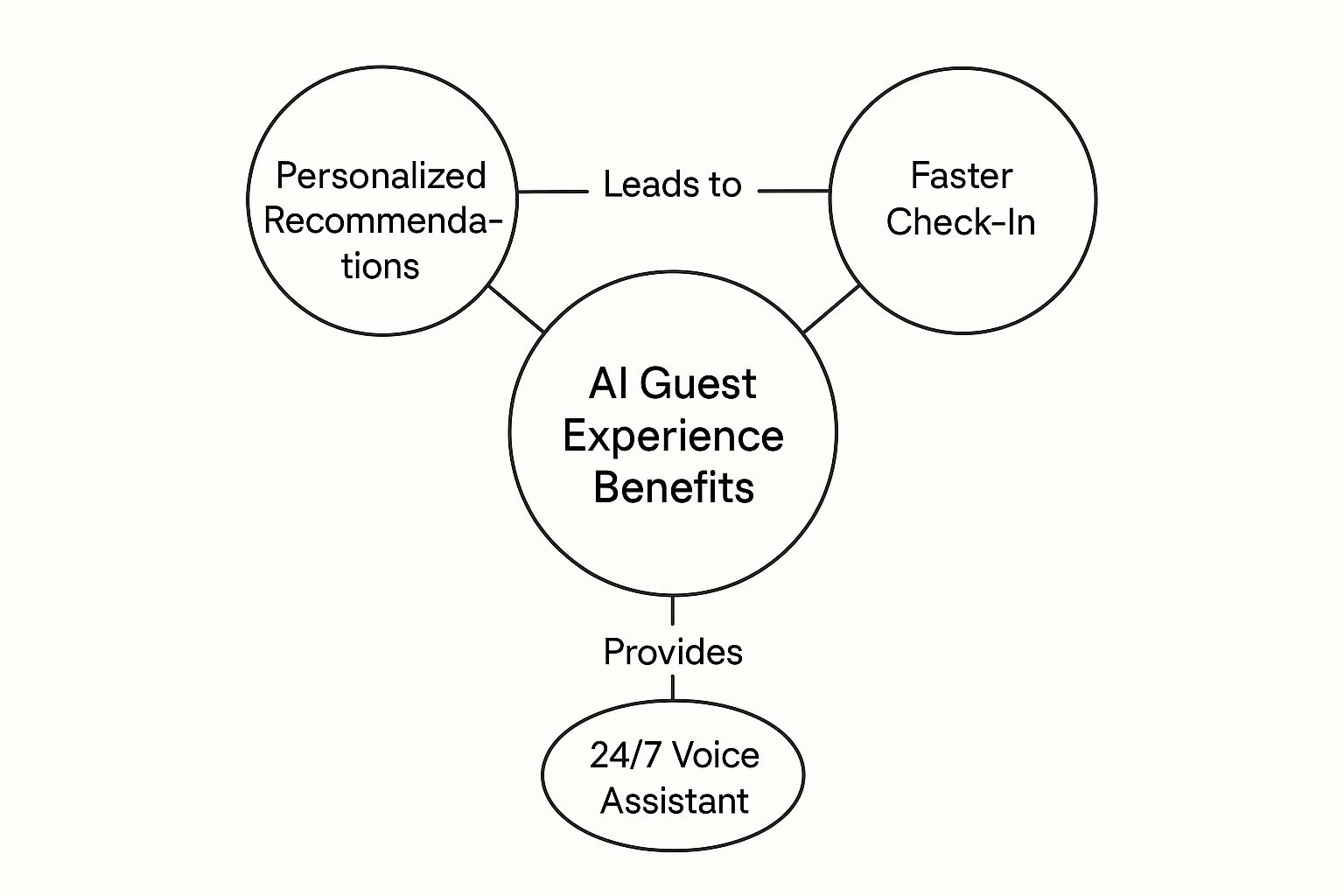
This infographic highlights how AI can improve the guest experience. It focuses on three key areas: personalized recommendations, quicker check-ins, and always-available voice assistance. These changes point towards a smoother, more convenient experience for guests. As the infographic shows, AI helps hotels anticipate and meet individual needs, leading to happier guests.
Think of your hotel like a well-oiled machine, with every part working together seamlessly to create amazing guest experiences. That's what AI can do for the hospitality industry. It empowers your team to act like super-efficient concierges, anticipating guest needs before they even ask.
Personalization: The Key to Guest Loyalty
Think about a time you received a truly personal recommendation. Maybe it was a book you ended up loving or a restaurant that became your new favorite. That's the power of personalization, and AI can make it happen for your guests. By looking at guest data, from past visits to social media activity, AI can predict what they'll like and offer tailored suggestions. This could mean recommending a specific room type, a nearby attraction, or even creating a personalized welcome message.
This screenshot from the Hilton website highlights their easy booking process. While not explicitly about AI, large hotel chains like Hilton are increasingly using AI on their websites and apps for personalized offers and efficient booking management. This shows a growing trend of using AI to better connect with customers.
This level of personalization makes a stay memorable and builds guest loyalty. It changes a stay from a simple transaction to a special experience that feels custom-made. Happy guests are also more likely to tell others about their positive experience, boosting your hotel’s reputation and attracting new business. Imagine a chatbot offering instant support in multiple languages. This solves guest problems quickly and raises overall satisfaction. If this sounds interesting, you might want to learn more about automating your customer support with AI.
Streamlining Operations, Maximizing Efficiency
AI doesn’t just personalize the guest experience; it also makes hotel operations more efficient. Picture a system that predicts maintenance needs before something breaks, preventing costly downtime and ensuring everything runs smoothly. AI can also create optimized staff schedules based on predicted occupancy. This ensures enough staff during busy times while controlling labor costs.
AI also helps with revenue management. AI-powered systems analyze market trends and adjust room prices dynamically. This helps maximize profits during high demand and stay competitive during the off-season. These AI tools work constantly in the background to optimize your operations for the best possible performance.
To get a clearer picture of how AI can impact different guest interactions, take a look at the table below. It breaks down the guest journey and explains the benefits of AI at each step, both for the guest and your business.
AI Applications by Guest Journey Stage: Comparison of AI tools and their impact across different stages of the guest experience.
| Journey Stage | AI Application | Guest Benefit | Business Impact |
|---|---|---|---|
| Booking | Personalized recommendations on website | Easier to find the right room and deals | Increased conversion rates |
| Pre-Arrival | Automated communication and check-in | Less hassle, more control | Reduced front desk workload |
| Check-in/Check-out | Self-service kiosks and mobile check-in | Faster and more convenient process | Improved efficiency, reduced wait times |
| Concierge Services | AI-powered chatbots for information and requests | 24/7 support, personalized suggestions | Lower staffing costs, increased guest satisfaction |
| In-Room | Smart room controls and personalized entertainment | Customized experience, enhanced comfort | Energy efficiency, upselling opportunities |
| Post-Stay | Personalized feedback requests and loyalty programs | Recognition and rewards | Increased guest loyalty, valuable data insights |
This table demonstrates how AI can enhance every stage of the guest journey. By understanding the various applications and their corresponding benefits, hotels can make strategic decisions about how to implement AI to achieve their specific goals. From pre-arrival to post-stay, AI presents numerous opportunities to personalize the guest experience, streamline operations, and ultimately drive business growth.
Running Smoother Operations With AI-Powered Intelligence
This screenshot from the Opera browser shows how they've built in their AI assistant, Aria. It's a good example of how AI tools are becoming a normal part of the apps we use every day, even if it's not specifically related to hospitality. Just like web browsers are using AI to improve things for their users, hotels are using it to make things better for both their guests and their staff. It's all about making AI easy to use and accessible, no matter the industry.
Think about how much data a hotel generates every day. It's a huge amount! AI is great at sifting through all that information and spotting patterns that humans might miss. This is where predictive analytics comes in, and it's changing the game for demand forecasting.
Imagine knowing, with a high degree of accuracy, how many guests are likely to check in next week, or even next month. This kind of foresight helps hotels make smarter decisions about staffing. No more scrambling to find extra hands at the last minute, or having staff stand around with nothing to do. This smarter approach leads to significant cost savings. It also allows hotels to get a handle on their inventory and resources well in advance, planning months ahead.
Maximizing Revenue With AI-Powered Insights
AI is also having a huge impact on revenue management. It's not just about adjusting prices based on simple supply and demand anymore. AI algorithms can look at a much wider picture.
Think about things like local weather forecasts, upcoming events in the area, what people are saying on social media, and even what the competition is charging. By considering all these factors, hotels can fine-tune their pricing strategies. They can maximize revenue without sacrificing guest satisfaction.
Intelligent Maintenance and Streamlined Operations
Beyond forecasting, AI can help prevent problems before they even happen. Intelligent maintenance systems use real-time data from sensors and equipment logs to predict potential maintenance needs. It's like giving your equipment a regular check-up to catch small issues before they become big headaches. This proactive approach prevents costly breakdowns and keeps things running smoothly for guests.
And the growth of AI isn't just a global phenomenon. Take Poland, for example. Their AI market is booming, and that has a big effect on their hospitality sector. Statista projects that Poland's AI market will grow at a CAGR of 26.25% between 2025 and 2031, reaching a market volume of US$6.45 billion by 2031. Find out more about Poland's AI market growth.
AI can even streamline those behind-the-scenes operations. Imagine optimizing housekeeping routes based on which rooms are currently occupied. Or think about reducing food waste by accurately predicting how many meals the restaurant will need to prepare. These might seem like small changes, but they add up to big savings and increased efficiency. You might also be interested in exploring how IVR enhances call center efficiency.
Ultimately, these AI-driven improvements mean better service without added complexity. By automating repetitive tasks and giving staff valuable data-driven insights, AI frees them up to focus on what truly matters: providing an exceptional guest experience.
Creating Unique Experiences With Generative AI Magic
Imagine crafting experiences so unique, they feel designed just for each individual guest. That’s the potential of generative AI in hospitality. It's not simply about automating tasks; it's about creating personalized moments of delight. Think custom greetings that reference a guest's hometown or favorite sports team, itineraries built around their passions, or even AI-generated room ambiance settings that match their mood.
Personalized Communication That Feels Human
Generative AI is also changing how hotels communicate with their guests. Instead of stiff, robotic interactions, picture smooth, natural conversations with AI-powered chatbots. These aren't just there to answer basic questions. They're offering personalized recommendations, handling complex booking changes with ease, and sharing local insights—all in a way that feels truly helpful and personal. Curious about chatbots in hotels? Explore the possibilities with hotel chatbots.
Some hotels are already ahead of the curve, using generative AI for personalized spa treatment recommendations, crafting unique local experience packages, and even generating custom in-room dining suggestions based on dietary needs and favorite cuisines. These small touches can elevate a guest's experience from ordinary to extraordinary.
Reimagining Marketing and Content Creation
Generative AI is a game-changer not only for guest interactions but also for how hotels market themselves. Imagine easily creating engaging marketing materials tailored to specific guest segments. Picture personalized email campaigns that adapt to individual preferences and website content that dynamically changes based on user behavior.
This screenshot from Salesforce demonstrates how AI can personalize the customer journey. While not specific to hospitality, it showcases how AI can tailor communications and craft more engaging experiences across various sectors. Just as Salesforce uses AI to analyze customer data and automate tasks, hotels are leveraging AI to personalize guest experiences.
This targeted approach lets hotels connect with potential guests on a deeper level, fostering stronger relationships and driving bookings. Generative AI can even transform staff training by developing customized learning scenarios and role-playing exercises, empowering your team to deliver exceptional service. And speaking of AI’s influence, the growth of generative AI in hospitality is truly impressive. For example, the global generative AI in hospitality market saw an incredible jump from $24.08 billion in 2024 to $34.22 billion in 2025—a compound annual growth rate (CAGR) of 42.1%. And projections suggest the market will reach a staggering $138.45 billion by 2029. Learn more about the exciting growth of generative AI.
The Future of Unique Guest Experiences
Generative AI holds the key to creating truly unforgettable guest experiences. Imagine every interaction, every message, every recommendation perfectly tailored to each guest. This is the future of hospitality, and it's within reach. This level of personalization is essential for building guest loyalty and increasing revenue. As AI advances, the potential for creating unique, magical moments for guests is practically boundless.
Learning From Businesses That Got AI Right
Let's face it, sometimes the best way to learn is by looking at what others have done. When it comes to AI in the hospitality industry, real-world examples are like gold. They show us the potential, the pitfalls, and everything in between. Let's explore some success stories, where businesses saw measurable improvements in guest satisfaction and, importantly, their bottom line.
One boutique hotel chain, for instance, managed to boost their direct bookings by a whopping 40%. How? They used AI-powered personalization to really understand their guests. Think of it like a concierge who knows exactly what you want before you even ask. This allowed them to offer tailored recommendations and promotions that truly resonated.
Another great example comes from a restaurant group struggling with food waste. Using predictive analytics, they were able to forecast demand with incredible accuracy, right down to specific dishes. The result? A 30% reduction in food waste. This not only saved them money but also made their operations more sustainable. For a deeper dive into the applications of AI, check out this resource: Artificial Intelligence in Hospitality Industry.
Real-World Implementation: Successes and Challenges
Of course, adopting AI isn't always a walk in the park. These success stories are even more valuable because they also reveal the bumps in the road. We'll hear from those on the front lines—general managers, IT directors, and operations teams—about the challenges they faced, the mistakes they made, and the lessons they learned. This unfiltered perspective can offer incredibly valuable insights, potentially saving you time and resources down the line.
Take Marriott, for example. This screenshot from their website highlights how they present their different hotel brands and offers. Large chains like Marriott are leading the way in using AI for things like personalized recommendations and dynamic pricing. By analyzing guest data, they can fine-tune their offerings and create a better experience. They’re setting a benchmark for the whole industry.
We’ll explore different approaches to implementing AI. Some hotels started small, with pilot programs for things like AI-powered chatbots to handle basic guest inquiries. Once they saw the positive impact on response times and guest satisfaction, they expanded AI to other areas.
Learning From the Best to Optimize Your Strategy
By studying these real-world implementations, you can identify the best opportunities for your own property. Think of it as learning from the best in the business. This allows you to focus on initiatives that align with your specific goals and offer the highest potential return on investment.
Before we go further, let's look at some real-world examples in a table format to highlight the impact of AI:
AI Implementation Success Metrics
Key performance indicators and results from successful AI implementations in hospitality
| Business Type | AI Solution | Key Metric | Improvement | Timeline |
|---|---|---|---|---|
| Boutique Hotel Chain | Personalized Recommendations | Direct Bookings | 40% Increase | 1 Year |
| Restaurant Group | Predictive Analytics | Food Waste | 30% Reduction | 6 Months |
| Large Hotel Chain (e.g., Marriott) | Dynamic Pricing | Revenue per Available Room (RevPAR) | 15% Increase | 2 Years |
| Independent Hotel | AI-Powered Chatbot | Guest Satisfaction Scores | 20% Increase | 1 Year |
These examples showcase how focusing on specific metrics can lead to significant improvements. Remember, starting small and scaling up is a valid strategy.
By understanding the journeys of others, you can also learn how to avoid common pitfalls. Whether you’re thinking about a small, targeted project or a complete overhaul of your guest experience, these real-world examples offer valuable guidance for developing your AI strategy. They’re your roadmap to navigating the exciting world of AI in hospitality.
Avoiding Common AI Implementation Mistakes

This screenshot from Revinate showcases their focus on guest data and marketing automation. Platforms like this demonstrate how data-driven insights are increasingly used to create truly personalized guest experiences. This underscores just how vital data is in modern hospitality; it’s a cornerstone of successful AI implementation.
Implementing AI offers exciting possibilities for the hospitality sector, but it's not a magic wand. Like any new technology, there are potential downsides. Let’s explore some common mistakes and learn how to sidestep them.
Overlooking Staff Buy-In
Imagine introducing a new tool to your team. Some might be excited, others hesitant. It's the same with AI. Some employees may worry about job security, seeing AI as a replacement rather than an assistant. Addressing these concerns directly is key.
Explain how AI can enhance their roles, not eliminate them. Think of it like this: AI takes care of routine tasks, freeing staff to build stronger guest relationships. Instead of answering the same questions repeatedly, they can use AI tools to offer personalized recommendations and create memorable experiences.
Underestimating the Costs
Think of an iceberg: the tip is the initial cost of AI software or hardware. But what lies beneath the surface? Ongoing maintenance, staff training, and integration with existing systems. These hidden costs can catch you off guard.
Create a realistic budget that encompasses all aspects of AI implementation. Demonstrating a clear return on investment (ROI) to stakeholders is also important for ongoing support of your AI initiatives.
Neglecting Data Privacy
Guests entrust you with valuable personal information. Protecting this data is paramount. When integrating AI, ensure your chosen solutions comply with relevant data privacy regulations, such as GDPR.
Transparency with guests about how their data is used builds trust. Explain the advantages of data collection, like personalized recommendations and improved service, while emphasizing your commitment to data security.
Setting Unrealistic Expectations
AI isn't a quick fix. It requires time for implementation, training, and optimization. Don’t expect immediate transformations. Set achievable goals and embrace the learning process.
Start small. Pilot projects allow you to test and refine your approach before expanding across your entire operation. This helps identify potential challenges early and allows you to adapt your strategy. By celebrating small wins along the way, you can build momentum and demonstrate the value of AI to your team and stakeholders. Remember, successful AI integration is an ongoing journey, not a one-time event.
Your Roadmap to AI Success in Hospitality
This screenshot from Oracle's hospitality page showcases their integrated technology solutions. It's a good example of how important a strong tech foundation is for successfully using AI. Think of it like building a house: you need a solid foundation before you can add the walls and roof. Modern systems, like the one Oracle offers, provide that foundation for smooth AI integration.
The screenshot highlights how essential it is to manage the sheer volume of information a hotel generates. A solid infrastructure lets hotels gather, understand, and use guest data effectively—a key ingredient to unlocking AI's full potential. Now, let's map out a clear path to bring AI into your hospitality business.
Assessing Your Needs and Setting Clear Goals
Adding AI isn't a one-size-fits-all solution. Before diving in, take stock of your current technology. Where can AI make the biggest impact? Consider your unique challenges. Are staff shortages a problem? Want to create more personalized guest experiences? Zeroing in on your specific needs will guide you to the right AI tools.
Next, set measurable goals that connect with your broader business objectives. Whether it’s increasing direct bookings by 20%, boosting guest satisfaction scores by 10 points, or streamlining operations to save 15% on costs, having clear targets keeps you on track and shows the value of your AI investments.
Prioritizing Your AI Initiatives
Some AI projects offer quick wins with small investments, while others are larger undertakings. Think about potential return on investment, how complex it is to implement, and how important it is to your overall strategy.
For instance, an AI chatbot for common guest questions is a relatively fast and easy way to improve service and free up staff. Integrating AI into your revenue management system, however, might be a bigger project requiring more time and resources.
Building Your AI Implementation Plan
With your priorities set, create a detailed plan. This includes a realistic timeline, a budget covering both initial and ongoing costs, and a strategy for connecting AI to your current systems.
Think about working with existing AI providers versus building custom solutions. Each option has pros and cons. Working with an established provider often means a quicker setup and access to expert support. Custom solutions offer more flexibility and control, but can be more resource-intensive.
Measuring Success and Scaling Up
As you roll out AI, track its performance and measure the impact on key metrics. This helps you fine-tune your approach and make sure you’re getting the results you want.
Regularly check your AI projects against your initial goals. Are you seeing the expected improvements? If not, what needs to change? If your initial projects are successful, create a plan to expand them throughout your business.
Practical Tips for AI Success
Here’s a quick recap:
- Start small and focus on specific uses: Don’t try to do everything at once. Begin with projects that address your most urgent needs.
- Get your staff on board: Explain how AI can help them in their work. Address any concerns about job security upfront.
- Choose the right partners: Select vendors or developers with a strong track record in hospitality.
- Protect guest data: Make data privacy and security a top priority in every AI project.
- Stay flexible and adapt: AI is always changing. Be prepared to adjust your strategy as new technology becomes available.
By following these steps, you can confidently navigate the world of AI and unleash its potential to improve your hospitality business.
Ready to transform your guest communication and operational efficiency? Learn how Voicetta, an AI communication platform, can help you achieve 24/7 customer engagement and streamline your operations.
Was this useful?
If this article helped, add Voicetta as a preferred source in Google Search. Your results can then highlight our writing.
Add as preferred source